DeepRoute's Self-Developed VLA Goes Live, First Batch of Co-Developed Mass-Production Vehicles Coming Soon | Yunqi Capital

Entering the Era of "Defensive Driving"
"AI + driving" continues to evolve.
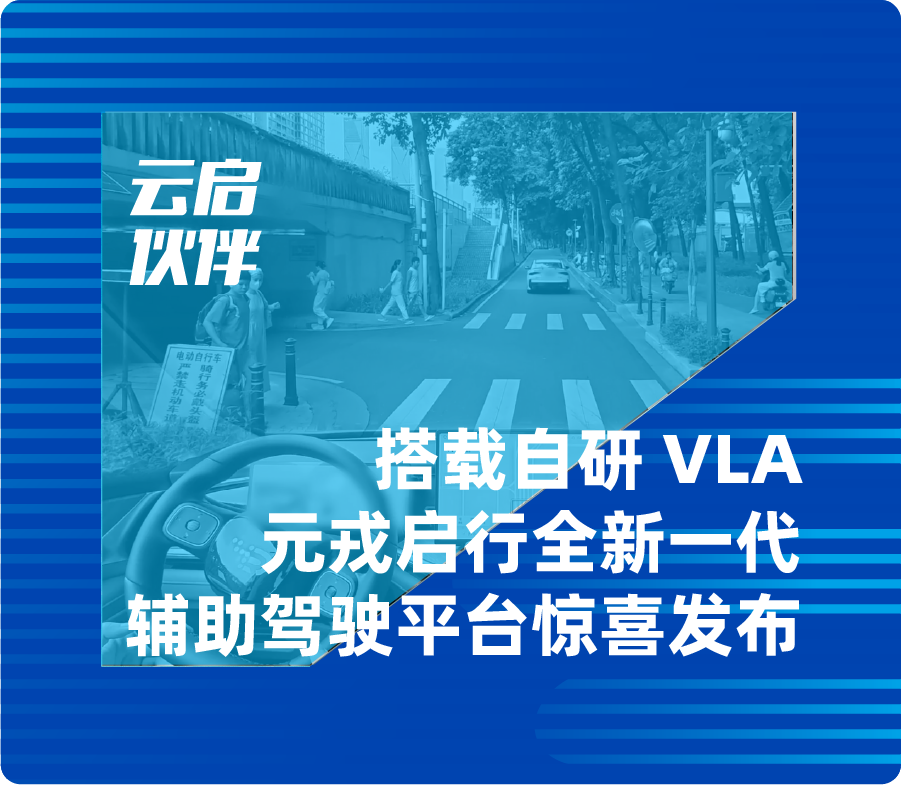
Yesterday (August 26), DeepRoute — an early Yunqi Capital portfolio company — unveiled its next-generation ADAS platform. The platform features a self-developed VLA model, delivering breakthrough improvements in handling complex road conditions, safety, and ride comfort.
In this edition, Yunqi Capital shares the details on DeepRoute's new product, DeepRoute IO 2.0.
On August 26, DeepRoute launched its next-generation ADAS platform — DeepRoute IO 2.0. Built on an in-house VLA (Vision-Language-Action) model, it integrates three core capabilities: visual perception, semantic understanding, and motion decision-making. Compared to traditional end-to-end models, the VLA model excels at navigating complex traffic scenarios and represents a generational leap in safety and comfort.
DeepRoute IO 2.0 is designed around "multi-modal, multi-chip, multi-vehicle" adaptability, supporting both LiDAR and pure-vision configurations, with customizable deployment across multiple mainstream passenger vehicle platforms. To date, DeepRoute has secured five designated production programs based on the DeepRoute IO 2.0 platform, with the first mass-produced vehicles set to hit the market soon.
DeepRoute CEO Guang Zhou explained: "The VLA model incorporates a language model with powerful chain-of-thought capabilities. It overcomes the black-box problem of traditional end-to-end models by connecting and analyzing information to infer causal relationships. It also draws on a massive built-in knowledge base, giving it stronger generalization abilities and better adaptation to complex, ever-changing real-world driving environments."
At the launch event, DeepRoute also demonstrated four key VLA model features: spatial semantic understanding, irregular obstacle recognition, text-based sign comprehension, and memory voice control — capabilities that will be rolled out gradually according to deployment timelines.
Spatial semantic understanding is the headline feature of this release. It enables the system to perceive potential risks in dynamic or static blind spots where visibility is limited — such as areas obscured by buses, complex intersections, or underpasses — and proactively make "preventive predictions" about these blind zones. The system can slow down and navigate cautiously before risks materialize, employing a highly human-like defensive driving strategy that gives users greater peace of mind.
The other three capabilities each bring distinct advantages: irregular obstacle recognition allows the system to identify and flexibly respond to unstructured obstacles like construction cones or overloaded small trucks; text-based sign comprehension lets the system "read road signs," accurately interpreting text information such as tidal lane markings and bus-only lanes; and memory voice control supports natural language command interaction while gradually learning user preferences, delivering a more personalized and human-like driving experience.
While technology advances rapidly, DeepRoute has also built a solid foundation in mass production commercialization, securing designated partnerships for over 10 vehicle models and achieving delivery of nearly 100,000 mass-produced vehicles equipped with urban navigation assist systems, spanning SUVs, MPVs, and off-road vehicles. These production milestones validate the market adaptability of DeepRoute's platform solutions and lay a solid groundwork for the commercial rollout of its VLA model.
"100,000 is just a starting point. As the high-end ADAS market accelerates, we believe companies with core technical capabilities like DeepRoute will see even greater market opportunities," Zhou concluded.
Going forward, DeepRoute will continue expanding the application boundaries of its VLA model, accelerating mass production deployment in the passenger vehicle market while advancing its Robotaxi business based on mass-produced vehicle platforms. Within the broader Road AGI framework, the VLA model will also extend to additional mobile intelligent agents, gradually evolving from point solutions toward general-purpose intelligent systems.