Yunqi Capital WAIC Recap | Four Days That Weren't Enough, and Where AI Is Headed Next

The future belongs to the doers.

Blazing heat, noise, and crowds — WAIC 2026 turned the temperature up another notch.
For the first time, the exhibition sprawled across "three venues, four halls": over 100,000 square meters, 1,100+ companies, 3,000+ exhibits, and 300+ new product launches. Even four days wasn't enough to see it all.
Robots still stole the spotlight, but they weren't just dancing and doing backflips anymore. They were giving tours, serving drinks, entering factories — and competing on the "brains," data, and training methods behind them. Meanwhile, models kept launching, Agents started taking on more concrete tasks, and AI found its way into real-world scenarios through different product entry points.
Over the past four days, more than ten Yunqi Capital portfolio companies brought new products and tech to WAIC; Yunqi also walked the exhibition halls, forums, and networking events, discussing AI's next stop with founders and industry partners.
Below, a collection of snapshots from Yunqi and friends at WAIC 2026 — shared with you.
New Models, AI Taking On More Tasks
Large model capabilities are still evolving rapidly, but this year's WAIC could no longer be summed up with "model releases" alone. More companies showed how models enter products: some let AI handle complex tasks, some made AI a creative partner, others tried embedding it into specific everyday scenarios.
MiniMax
Creating, working, laying out the full multimodal matrix
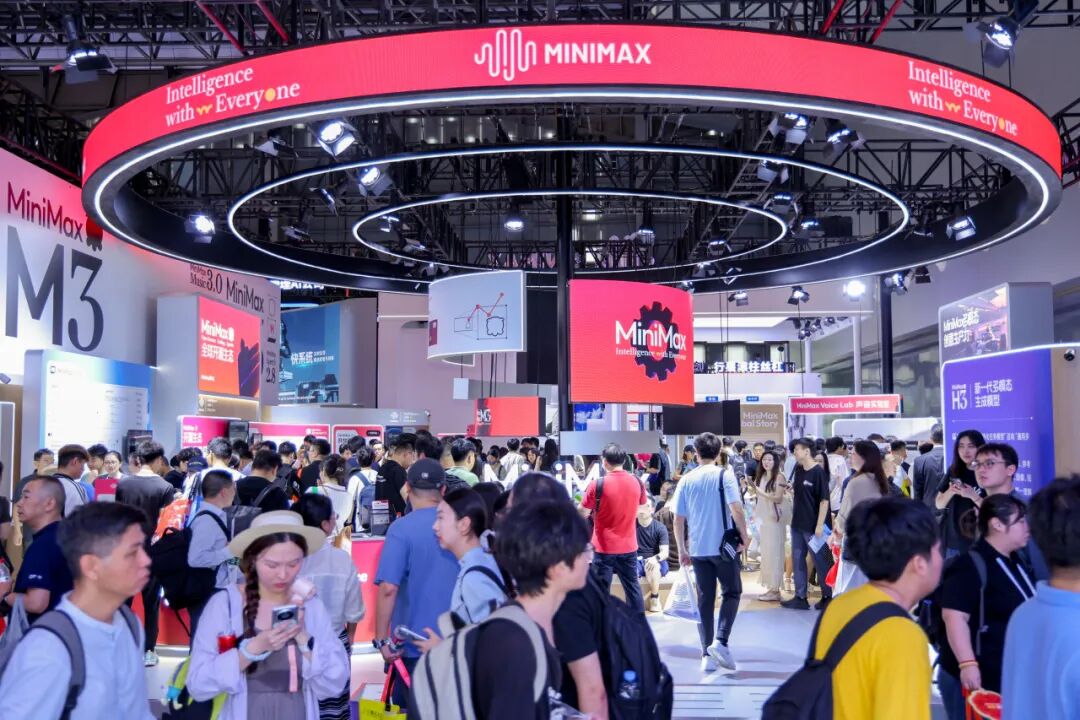
At the H1 Application & Ecosystem Hall, MiniMax showcased its flagship model MiniMax M3, the Code 2.0 desktop client, and the creative workstation MiniMax Hub, with the next-generation multimodal generation model H3 getting a sneak preview.
H3 no longer treats images, video, or audio as separate generation tasks. Instead, it simultaneously understands context composed of text, images, video, and sound, recognizes complete creative intent, and then generates more coherent content and expression. MiniMax Hub puts scripts, storyboards, video, voiceover, and music onto the same canvas, with an Agent scheduling different models and tools to complete the creation.
On the other side of the booth, robotic dogs, AI glasses, smart headphones, AI toys, and NAS devices demonstrated how MiniMax's model capabilities enter more hardware and software endpoints.
Xiaosu Technology
Giving Agents the ability to act
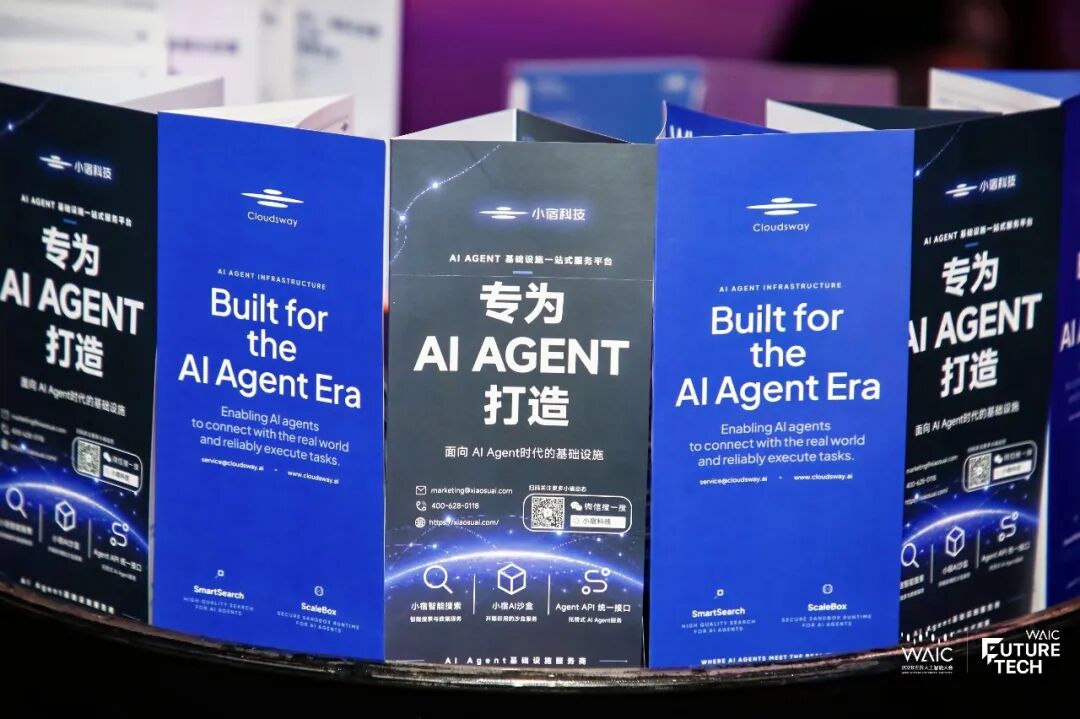
Xiaosu Technology is an infrastructure provider for AI Agents, dedicated to helping developers and enterprises build intelligent systems that can connect to real-world information, execute tasks, and produce actual results.
At this WAIC, Xiaosu Technology demonstrated its infrastructure capabilities including Agent API, SmartSearch, and Sandbox: through real-time high-quality search, secure execution environments, and model invocation services, it provides Agents with a complete chain from information acquisition, tool calling to task execution.
As AI Agents move from "able to converse" to "able to act," Xiaosu Technology hopes to become the infrastructure layer connecting model capabilities to real tasks, letting more intelligent systems truly enter work scenarios.
NoonWake.AI
Putting AI companionship into a desktop calendar
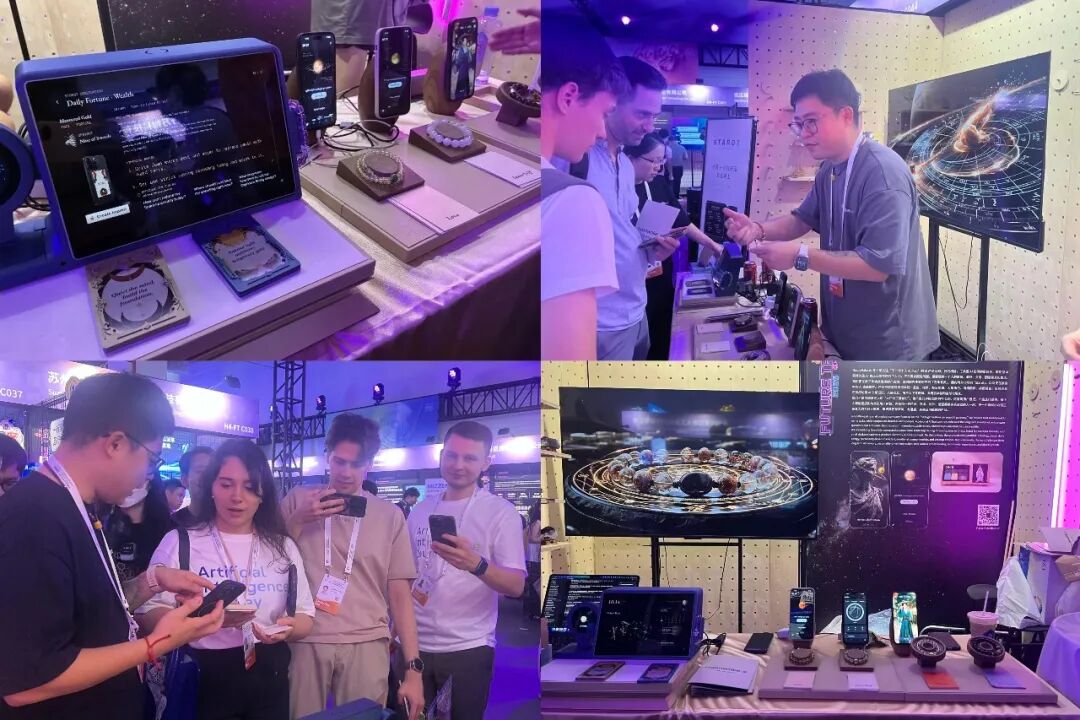
NoonWake.AI brought its hardware-software products for personal companionship scenarios, including the domestic app "Wanxiang Youling," the overseas app Starot, and the desktop device "Xingyun Calendar."
The Xingyun Calendar consists of a calendar machine, a portable token, and灵犀 magnetic chips. Users first record emotions, relationships, and life confusions in the app; after the AI continuously understands this information, it syncs reminders, content, and interactions to the desktop calendar machine. AI companionship that originally happened in phone chat boxes thus gains another physical entry point that can sit beside you.
From daily prompts and emotional records to longer-term personality and life information, NoonWake hopes to make AI not just respond to single questions, but gradually remember a person's daily life.
Robots "On the Job," Real Scenes Become the New Test
Robots remained one of WAIC's most crowded exhibition areas. But compared to dancing, running, and single-point skills, the questions on display had become more concrete: Can robots understand a long task, handle unfamiliar objects, adapt to changes in real environments, and stably complete the job?
AI2Robotics
Robot brains enter factories and new retail
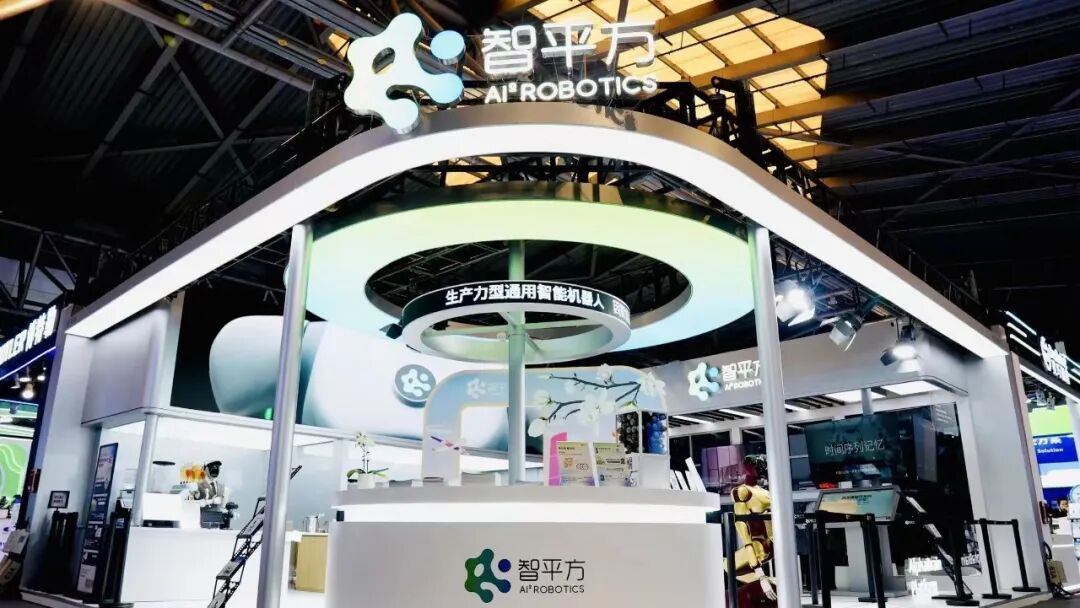
AI2Robotics brought AlphaBot 2 equipped with its latest "robot brain," the brain-like large model NeuroVLA, and the one-stop embodied intelligence open-source platform AlphaBrain Platform.
On one side of the floor: PCB loading and unloading, where robots needed to identify PCBs and trays of different sizes, colors, and materials, continuously completing picking, transport, and dual-arm coordination. On the other, the upgraded "Aibao Smart Cube" made coffee, ice cream, and cocktails on site.
Behind these capabilities is AI2Robotics's newly upgraded NeuroVLA. Drawing on the "cortex-cerebellum-spinal cord" coordination mechanism, it handles semantic understanding and planning, dynamic adjustment, and motion execution respectively. Alongside the model, the AlphaBrain Platform further opens the R&D chain from data, training to models and evaluation.
At the HKUST International AI Industry Innovation Ecosystem Forum, founder and CEO Yandong Guo proposed that "brain-like" approaches will be the key path for next-generation physical-world AI. He argued that if embodied models continue relying on high-compute, high-energy cloud training, they cannot scale sustainably; borrowing the human brain's low-power mechanisms is what lets robots "learn while doing" on the edge, continuously accumulating memory and capabilities in real environments.
Independent Variable Robotics
World models don't just generate, they must guide action
Beyond robot bodies and scenario deployment, world models also became one of the core directions in embodied intelligence discussions at this WAIC.
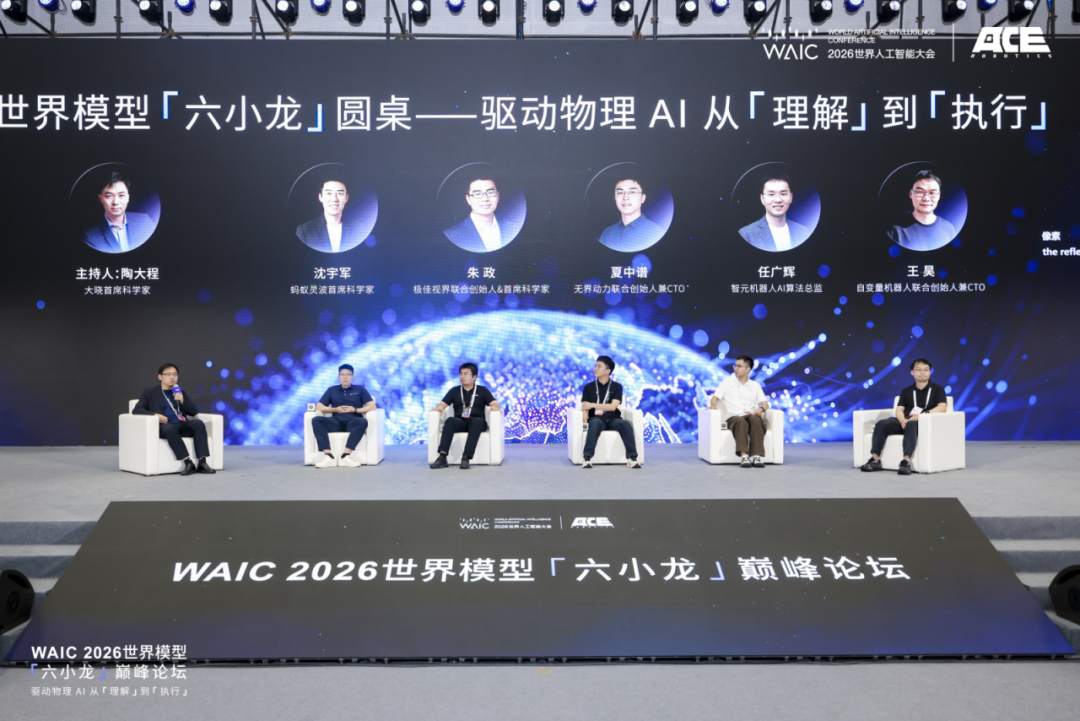
At the "Six Little Dragons of World Models" summit forum, Independent Variable Robotics CTO Hao Wang shared the company's exploration of embodied world models. He noted that world models for robots differ fundamentally from video models mainly serving content generation: what robots truly need is not making the world "look right," but understanding physical laws, predicting environmental changes, and further guiding action.
He used everyday actions as examples: when a robot pushes a door open or picks up a cup, it needs to understand the relationship between force, distance, object state, and action — not just generate a visually plausible image. For physical AI, the core value of world models lies in establishing understanding of causal physical-world laws, letting AI gradually shift from observer of the digital world to participant in the physical world.
Astribot
Appearing across multiple booths, showing how robots enter real scenarios
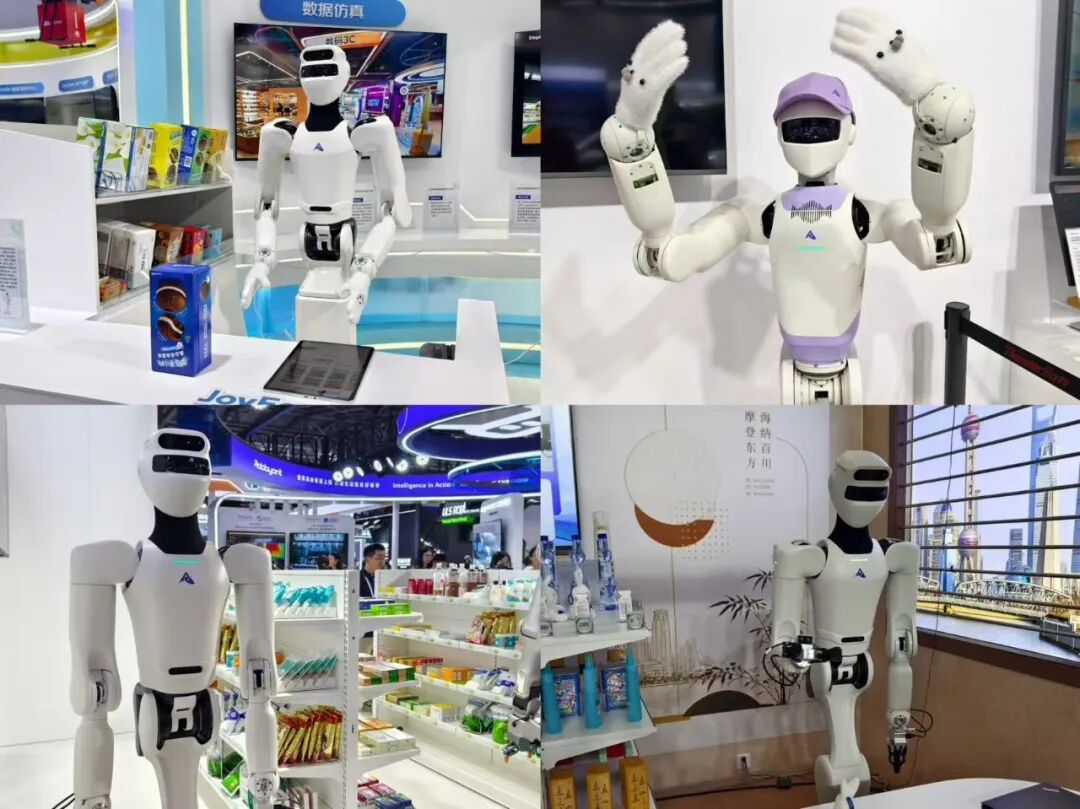
Astribot showcased its "AI model — embodied OS — cable-driven body" trinity solution across multiple booths. Its S1, the world's first mass-produced cable-driven AI robot, and the new T1 starting at 89,900 yuan, became representative robot products in multiple collaborative scenarios, entering applications including Ant Group smart pharmacy, JD.com smart retail, ThunderSoft intelligent interaction, Juphoon smart guided tours, and SEER industrial logistics.
Behind these deployments are Astribot's self-developed cable-driven robot bodies and continuously upgraded embodied intelligence system. During the conference, the company released its second-generation embodied foundation model Lumo-2, improving robot understanding of complex tasks through "first predict world changes, then generate actions"; the simultaneously launched Agent Philia further strengthened long-term memory, multi-robot coordination, and task scheduling capabilities.
Sudu Technology
Ten-plus skills, watching robots accumulate "atomic capabilities"
Making its WAIC debut, Sudu Technology demonstrated over ten skills ranging from precise placement, flexible object manipulation, and dual-hand coordination to mobile grasping and autonomous navigation. In the exhibition area, robots could both cooperate with both hands to wrap items and insert parts into corresponding holes, as well as collaborate on simulated battery module production lines to complete loading, assembly, scanning, and unloading. Compared to its April debut focused on generalized grasping, Sudu's capability range has expanded from single skills to multi-step operations in both life and industrial scenarios.
Sudu calls these foundational skills "atomic capabilities": first let robots master reusable abilities like grasping, placing, applying force, and coordination, then combine them like building blocks into long-horizon tasks.
At the opening main forum, Sudu Technology CTO Hao Su gave a speech titled "Physical Intelligence: From Hallucination to Reality," proposing that the industry's focus will shift from "how impressive is the demo" to "how reliable is the operation" — generality is the destination, but reliability is the starting point; breakthroughs in physical intelligence don't rely solely on model architecture, but on aggregating knowledge scattered across video, equations, force-sensing data, and human experience. Click to read the full speech
Keenon
An "embodied community," handling food, clothing, housing, and transport
Keenon built its booth into an "embodied community." Humanoid robots from the XMAN series entered cafes, dessert shops, retail stores, and hotel laundry rooms, autonomously completing tasks like cup retrieval and coffee extraction, color-based candy grasping, shelf picking and delivery, and laundry and folding; delivery robot T10 and cleaning robot C40 also operated simultaneously, forming a collaborative service loop of "general-purpose humanoid + specialized robots."
All tasks on site ran with zero teleoperation, purely autonomously. Behind this is Keenon's self-developed fused world model VLA architecture, and domain-specific models KEENON ProS trained for specific roles like barista, retail picking, and laundry.
Founder and CEO Tong Li summarized this path as "role-based": first find specific roles with decomposable processes and quantifiable results, let robots work continuously and produce stably, then gradually improve general capabilities. He also proposed that the industry should shift from "parameter competition" to "value validation" — getting humanoid robots to actually work is the essence of commercialization.
Noematrix
Entering pharmacies and laundry rooms, validating complex coordination
At the Noematrix booth, robots entered two real scenarios: retail pharmacy and hotel laundry.
Facing a chain pharmacy with over 3,000 SKUs, robots needed to identify medications in different packaging, completing picking, placing, transport, and order processing; the complete solution occupies about 2.5 square meters and has already entered real store deployment validation. The hotel laundry scenario involves multiple robots collaborating: robotic arms pick and place laundry and operate equipment, mobile bases handle navigation and transport, with unified task planning stringing together washing, drying, and organizing steps.
Behind these tasks is Noematrix's general embodied brain Noematrix Brain, along with a complete toolchain covering data collection, management, training, and deployment. The company is also building a million-hour-level real-world operation data system, letting models learn from continuously occurring actual work.
RealMan
New product launch,
making robots "affordable, usable, and truly working"
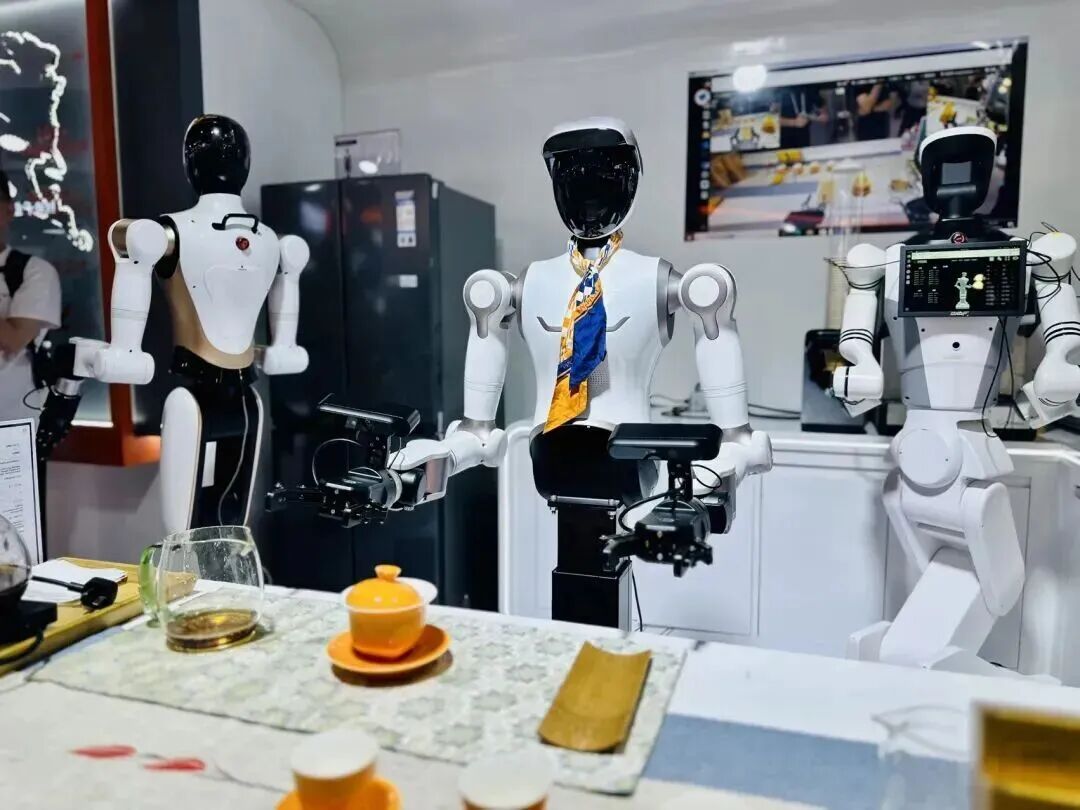
RealMan launched two new wheeled humanoid robots at WAIC: RealBOT-S2 and RealBOT-L2. The former adapts to narrow spaces through folding and small-radius turning, while the latter covers taller, heavier operation needs through a lifting structure. On-site demonstrations also included tasks like opening refrigerators, cross-city teleoperated tea brewing, and industrial quality inspection.
Both new products are designed for long-duration continuous operation, with an MTBF of 50,000 hours for the integrated joint modules behind them. They share RealMan's full-stack self-developed joint modules, GLN remote operation network, and real-scenario data closed loop: at the exhibition, an operator in Beijing remotely controlled a robot in Shanghai to complete warming the cup, adding tea, pouring water, and serving; data generated by robots in real operation also continues to feed back into model iteration.
RealMan partner Sen Li summarized the company's product philosophy as "affordable, usable, and truly working." In his view, robots can only truly understand the world when deployed long-term in real scenarios, facing unpredictable physical variables.
3
AI Moving Toward Reality,
Needs This "New Infrastructure"
For AI to move from the digital world to the real world, it doesn't just need stronger models — it also needs new infrastructure support. From spatial understanding, physical simulation, and data collection, to compute and computing system upgrades, these underlying capabilities are together forming the technical foundation for AI's next phase of development.
Manycore Tech
Letting AI generate an interactive space
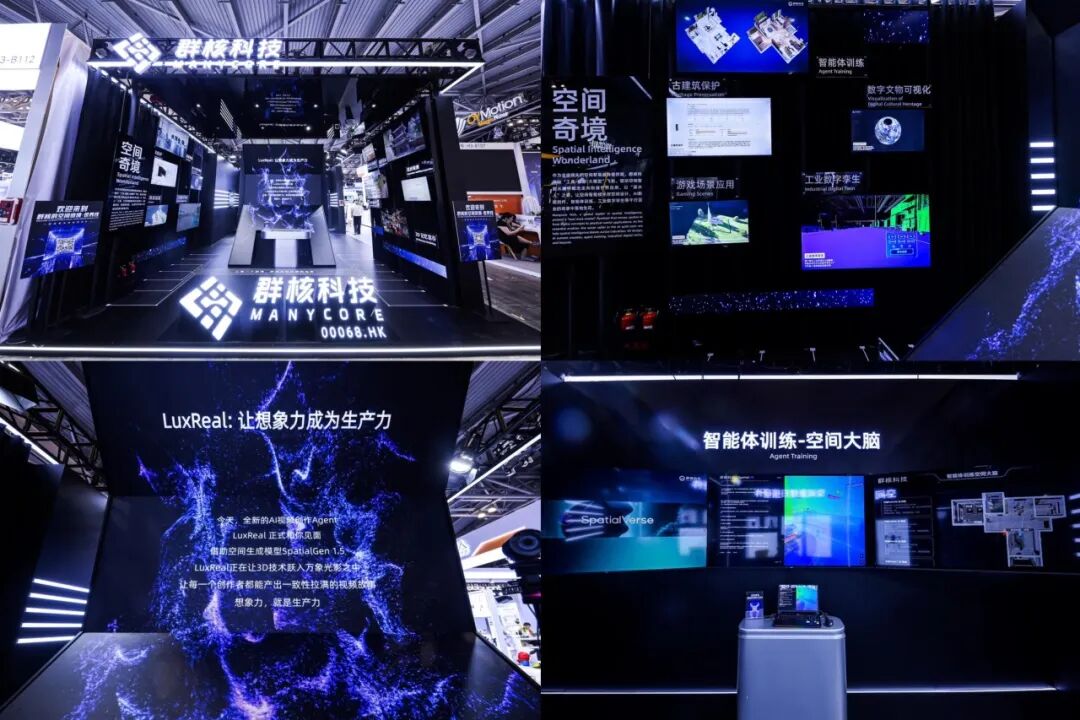
At this WAIC, Manycore Tech announced that its AI video creation Agent LuxReal is officially connected to its self-developed world model SpatialGen. Users upload a flat scene image, and the system transforms it into an interactive 3D virtual set, then adjusts camera positions, characters, and shots within the same space to complete multi-shot video creation.
This capability mainly addresses spatial consistency in AI video: first SpatialGen generates a stable three-dimensional spatial base, then LuxReal organizes shots within the same space, reducing drift in scene structure, character position, and prop relationships during cuts.
From spatial design software to world models and AI video Agents, Manycore is extending years of accumulated 3D spatial capabilities into content generation and the spatial understanding needed for physical AI.
Fysiverse
One image, generating a runnable physical simulation world
If Manycore focuses on "understanding space," then Fysiverse further explores how to let AI learn and act within space.
Fysiverse released and open-sourced the Fysiverse-3D pipeline in its physical world model system during the conference. With just one RGB image and minimal prompts, the system identifies object relationships in the scene and generates an editable, physically simulatable 3D environment. Unlike traditional 3D generation focused on "looking right," Fysiverse-3D further processes object scale, spatial layout, contact relationships, and gravity stability, letting generated scenes be used for robot training, digital twins, and other real applications. Learn more
Behind this capability is Fysiverse's self-developed physics simulation engine Fysics, and a technical system covering "simulation — training — deployment — iteration." Founder Professor Lihua Zhang also shared in a CCTV interview that for robots to truly possess understanding and action capabilities, they need to continuously train their "brains" through physical world models.
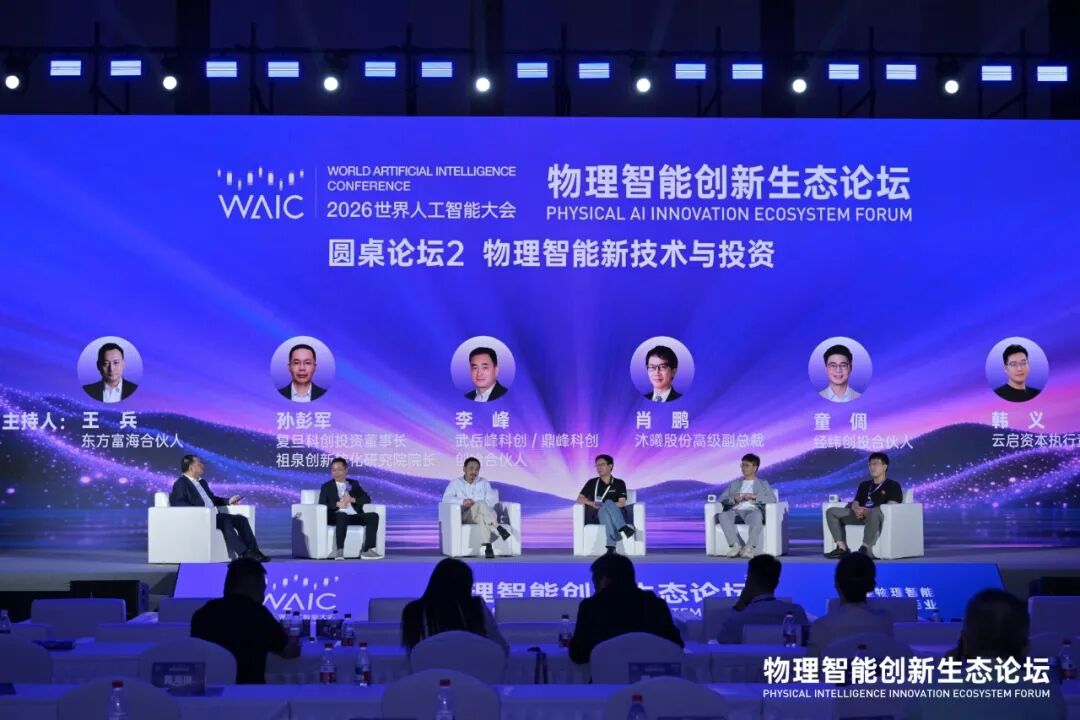
During WAIC, Fysiverse also co-initiated the Physical Intelligence Innovation Ecosystem Forum, with Yunqi Capital executive director Yi Han participating in a roundtable discussion, exploring the technical evolution and industrial opportunities of physical simulation, world models, and embodied intelligence with industry partners. Learn more
Ropedia
Letting robots learn from humans,
filling the Physical AI data entry point
The development of embodied intelligence needs to return to a core question: where does the data for robots to learn about the world come from? Ropedia showcased its human data collection and training system for robot foundation models. Its flagship dataset Xperience-10M focuses on human first-person perspective operation data in real scenarios, converting human operational experience into learnable robot skills through wearable device collection, data processing, and training pipelines.
Unlike traditional AI relying on internet text and image data, embodied intelligence needs to understand the relationships between action, space, and physical feedback. Ropedia hopes that through large-scale real operation data, it can help robots bridge the gap between "seeing the world" and "acting in the world."
From human data collection, to VLA model training, to robot skill transfer, Ropedia is exploring data infrastructure for the Physical AI era.
LightStandard
Optical computing explores a new paradigm for AI compute
As AI model scales continue expanding, compute bottlenecks are extending from "chip capability" further to system efficiency. Optical computing and optical interconnect have also become important exploration directions for next-generation AI infrastructure.
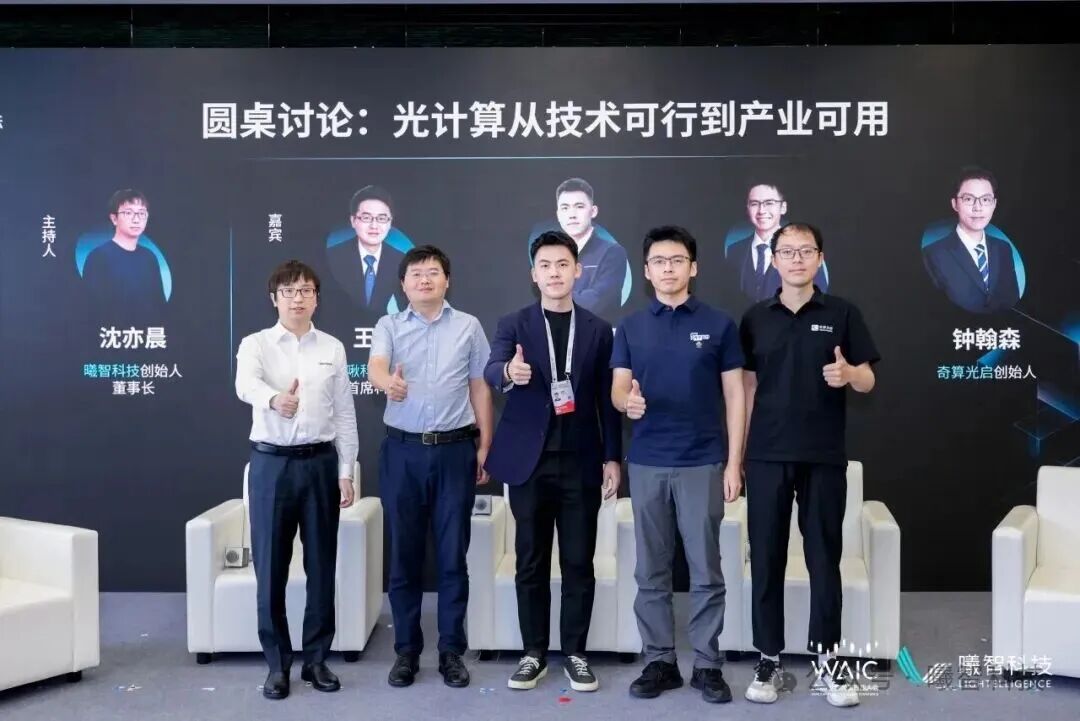
Yunqi Capital portfolio company LightStandard founder and chairman Yinjiang Xiong participated in the Optical Computing Industry Forum roundtable discussion, exploring optical computing industrialization paths with Lightelligence, Guangjiu Technology, PhotonCore, and Qisuan Guangqi. Additionally, Xiong received the "2026 WAIC Yunfan Award," demonstrating industry attention to the optical computing innovation direction.
Magic Leap Quantum
Exploring quantum × AI fusion for
next-generation computing infrastructure
As an emerging company in quantum computing, Magic Leap Quantum also appeared at this WAIC, showcasing its exploration around quantum computing software infrastructure.
The company focuses on quantum error correction, quantum compilation and scheduling, and algorithm applications, dedicated to building software infrastructure connecting quantum hardware to practical applications. As AI's demand for computing power continues growing, the fusion of quantum computing and artificial intelligence has also become an important exploration direction for next-generation computing systems.

4
Beyond the Booth: Continuing the Conversation on AI's Next Stop
The sparks at WAIC weren't limited to the venue. As robots begin moving toward real scenarios, how models understand the world and where Physical AI goes next also became hot topics during the conference.
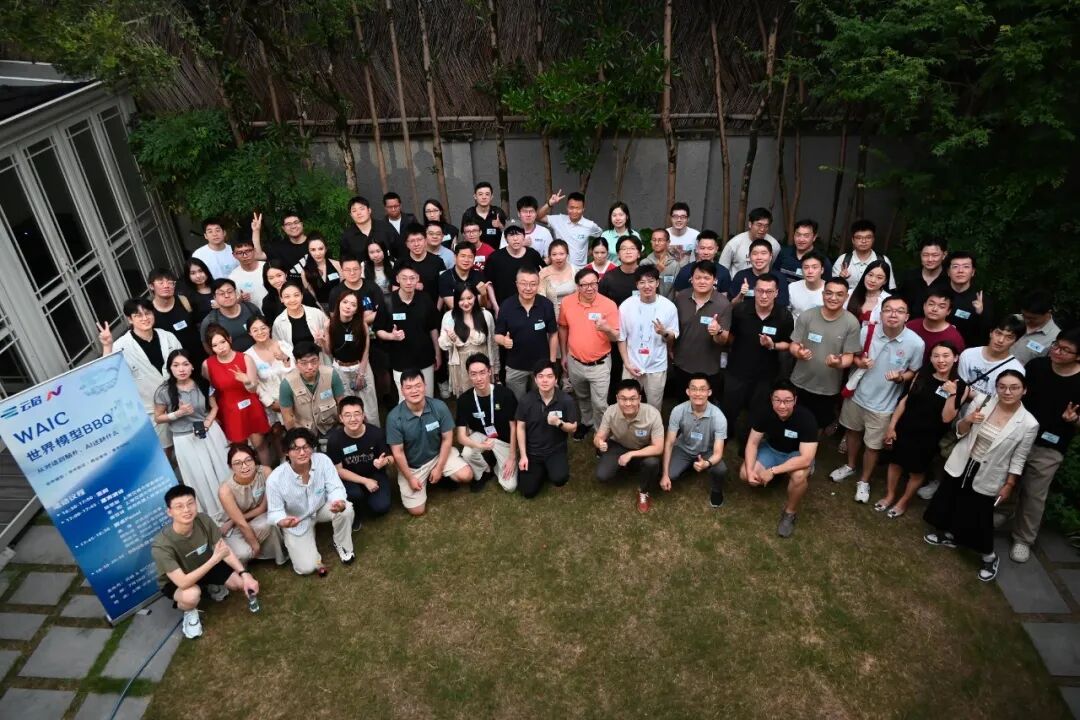
On the evening of July 18, Yunqi Capital co-hosted the "World Model BBQ" networking event with NICE Academic during WAIC, with nearly a hundred university researchers, frontier founders, and investors continuing heated discussions on this cutting-edge direction over summer evening charcoal fires. Highlights will be presented in follow-up posts on the "Yunqi Capital" WeChat account — stay tuned.
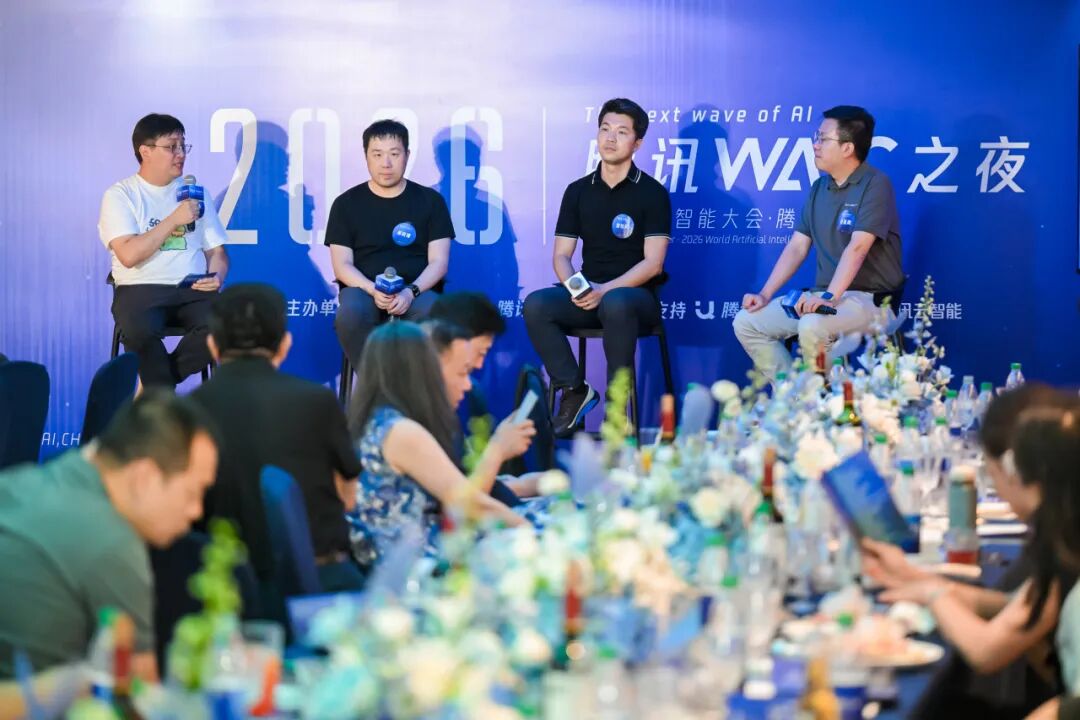
And the day before, at Tencent's WAIC Night, Yunqi Capital managing partner Yu Chen joined representatives from Manycore Tech, Shengshu Technology, Galaxy Universal, and others in discussions around spatial intelligence, world models, and Physical AI. Learn more
On site, Chen noted that over the past year AI has extended further from language models to embodied intelligence, video generation, and spatial intelligence, and that an important question for the next phase is how AI moves from the digital world to the real world. Around development paths for world models, guests exchanged views from directions including 3D simulation, video generation, and data flywheels, exploring what still needs to be crossed between "able to generate" and "able to understand."
The bustling WAIC has come to a close. Over four days, we saw AI moving from screens to reality, from generation to action, from single-point capabilities to complete ecosystems.
The future won't happen overnight, but every technical breakthrough and every real-world deployment is a signal that the next stop is arriving. Yunqi Capital will continue walking alongside innovators, jointly exploring the new frontiers AI is opening. The future belongs to the doers!