Yunqi at WAIC | The "No Time to Wait" AI Landscape of 2026: What Got Rewritten?

The Year of Action

Every summer, the heat along the Huangpu River carries an extra layer — the warmth of AI. This temperature can be traced back to 2018. That year, the inaugural World Artificial Intelligence Conference (WAIC) was held, graced with a grand description: "the Olympic Games of artificial intelligence."
But flip through the blue paper published at that year's conference, and a different reality emerges: among surveyed enterprises, only 4% had actually invested in or deployed AI technology.
Back then, AI was exciting enough, but still far from large-scale implementation. The WAIC stages in subsequent years became a mirror, reflecting the industry's fluctuating fortunes.
It wasn't until generative AI swept more people into this transformation that things shifted — from visitor numbers surpassing 300,000 in 2024 to the current norm of tickets selling out instantly. WAIC's temperature has moved in sync with the AI industry these past few years. And as a tech investment firm that has consistently stayed deep in AI, we've been there the whole time — observing real progress during the downturns, and searching for what is genuinely changing amid the excitement.
Today (July 17), WAIC 2026 officially kicks off. Every year around this time, our feeds get flooded with new products and new perspectives. We also take this moment to sort through what we've seen and done on this fast-moving AI road, alongside our Yunqi partners.
Looking back at AI's trajectory this year, one can sense a more tangible shift: AI is no longer merely being displayed or invoked — it has acquired a clearer sense of "action." So we want to take "The Year of Action" as our theme, and through five numbers, observe several key slices of AI's evolution from "answering questions" to "completing tasks."
And through these slices, see where our Yunqi partners are driving real progress in the critical links of this AI transformation.
380,000+ is the number of GitHub stars OpenClaw had accumulated as of early July. Born less than a year ago, this open-source Agent assistant that started as a personal project has achieved growth far outpacing many classic open-source projects in their early stages. The subsequent "lobster-raising" craze that swept Chinese social media then pushed it from developer communities into broader public discourse.
The hype came fast, and the underlying sentiment was simple: people expect AI to not just answer questions, but to actually get the work done.
This expectation is being met across many scenarios: Coding Agents have been first to validate commercialization, while verticals like finance, healthcare, and education are accelerating their trials; the OPC (One-Person Company) has become a new entrepreneurial vision — one person equipped with an Agent matrix, handling what used to require a small team.
From "being able to talk" to "being able to act," there's another noteworthy shift underneath: Agent is changing not just product form, but entry-point logic. When users start delegating tasks in chat windows, the entry point may belong to whichever Agent first understands the goal, breaks down the task, and organizes execution.
But action is only the beginning. How does one truly capture the Agent entry point? Here's some of our thinking.
An Agent's entry value can't rely on "being able to work" alone
An Agent's ability to "get work done" doesn't automatically equal an entry point. Especially in 2C scenarios, general-purpose models and big-tech products will cover a large swath of lightweight needs; if an Agent merely repackages base model capabilities into a smoother interaction, it can easily lose its position in the next model upgrade or system-level entry integration.
Agents with real potential for long-term value need to penetrate deeper task chains: high-frequency, complex, dependent on specific workflows, and accumulating context, memory, private data, and delivery feedback through use. The key here isn't merely efficiency gains and cost compression, but whether a data flywheel, user relationships, and delivery loops can form — even establishing new incentive mechanisms so that users, experts, or organizations are rewarded for contributing skills, data, and workflows. Reorganizing the collaborative relationship between humans and AI, and between humans and platforms, is what may create more sustainable network effects.
Therefore, judging whether an Agent possesses entry value hinges on whether it occupies a critical position in the AI ecosystem: is it the foundational capability for understanding and invoking the world, the working entry point connecting users to tasks, or the specialized executor embedded in specific scenarios?
Along this chain, today's Agent entrepreneurial opportunities are coalescing around several key directions: intelligent infrastructure providing model and Agent base capabilities, general Agents / Agent Computers redefining human-machine collaboration, and vertical-scenario Agents entering specific business processes.
81.36% is the task success rate achieved by the same model after being fitted with a more complete Harness architecture, in a programming Agent benchmark test (cited from "Recursive Agent Harnesses," arXiv:2606.13643). The model itself didn't change — with a simple execution loop, its previous score was only 71.75%.
The nearly 10 percentage point improvement reflects that when Agents start truly working, what determines outcomes isn't just the model "brain" but also the operating system around it — Agentic Infra.
In 2026, Agentic Infra has become a focal topic, with Harness being one of the most discussed concepts: it equips Agents with constraints and control systems, organizing context, task state, tool invocation, result verification, and other links, so that Agents not only "can run" but "run steadily." And MCP, Sandbox, Memory, Evals, Guardrails, and others are all fundamentally addressing the same problem.
Beyond discussion, industry practice has also extended further into the infrastructure layer. Major model vendors are successively filling out Agent runtime environments and long-task execution capabilities, while capital markets are paying greater attention to Agent execution infrastructure. Market data shows that this year, startups focused on "Agent execution infrastructure" already account for nearly 20% of deal volume in the Agentic AI space, but less than 6% of funding amount.
This somewhat reflects that while the foundation must be built, the industry is still vigorously contesting which links will ultimately form independent value. On this question, we also have some thoughts.
Agentic Infra opportunities lie beyond the model
The explosion of AI applications and Agents has shifted compute infrastructure logic from "compute stacking" toward "system reconstruction and Token conversion." The previous round of large model competition centered more on training scale, with the core being cluster expansion and compute increase; as inference demand grows rapidly, competition is shifting from "how many GPUs you have" to "how to generate Tokens more efficiently."
One key criterion is whether it must serve multi-model, multi-cloud environments. If a capability must remain model-agnostic, it's harder to be fully internalized by a single model vendor. Evals, Observability, Guardrails, security auditing, for instance, all need to maintain independence across different models and systems.
Another criterion is whether it connects to unique data networks, real-world resources, and other assets that model vendors cannot easily replicate. Enterprise permissions, identity authentication, payments, tool connectors — these require long-term ecosystem accumulation and system integration, and won't naturally disappear as model capabilities improve.
Therefore, Agentic Infra entrepreneurial opportunities may not lie in the layer closest to models, but rather at the critical connection points across models, clouds, and enterprise systems. Whether one can form data moats, ecosystem networks, and compliance capabilities may determine long-term value more than pure model adaptation capabilities.
An AI infrastructure race is unfolding. In 2026, global top cloud service providers and data center operators are expected to invest approximately $750 billion in capital expenditure (cited from S&P Global Ratings forecast), betting on next-generation compute infrastructure — a sum approaching Sweden's annual GDP.
The heat around AI applications ultimately comes down to one practical question: who produces, transmits, stores, and delivers these Tokens.
Currently, demand-side changes are particularly pronounced in the China market: OpenRouter data shows that China large model call volume first surpassed US models in February 2026; just over a year ago, this share was under 2%. Cheaper, more accessible models are enabling rapid Token consumption overflow.
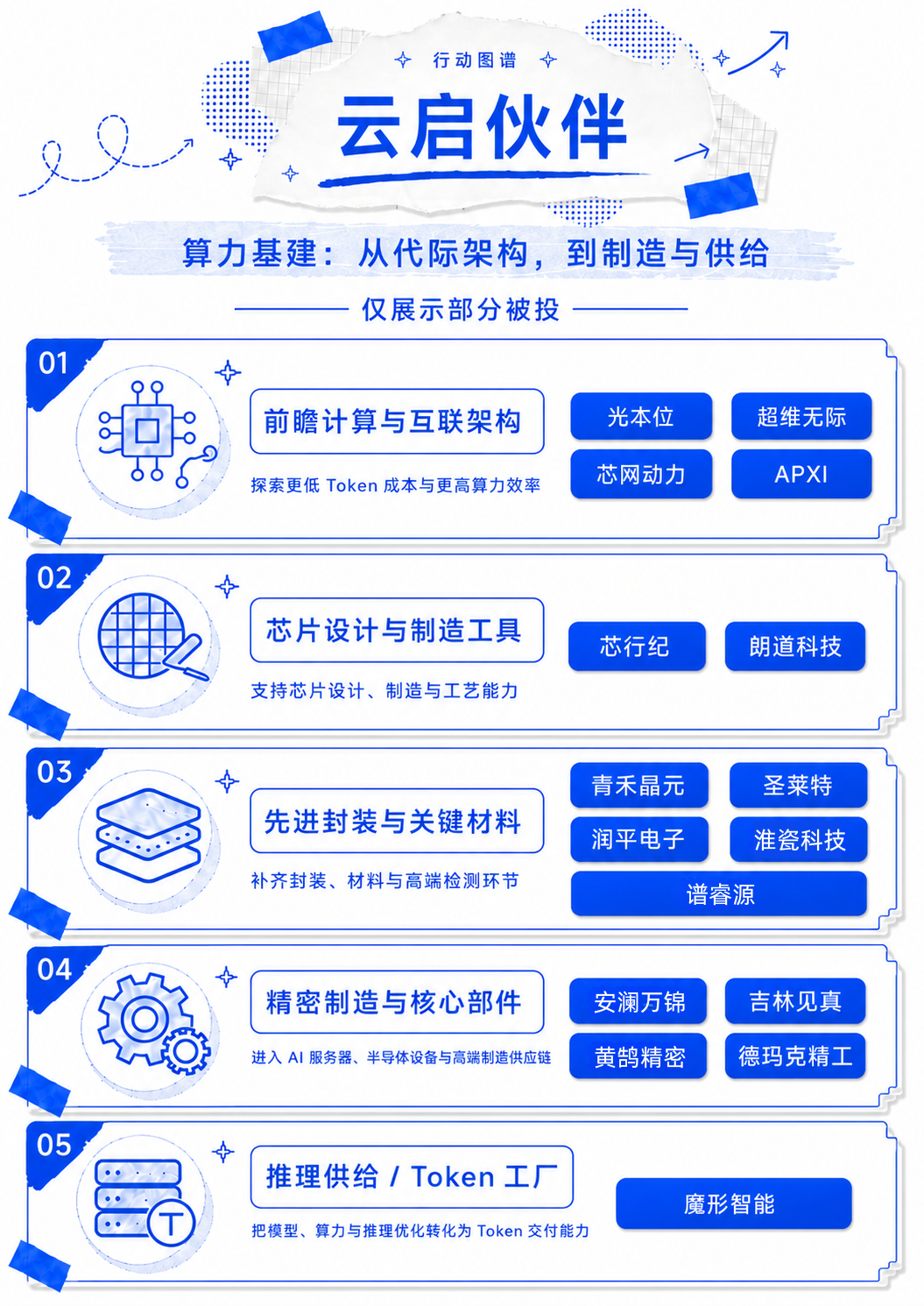
But what determines whether this curve keeps climbing isn't just the models themselves, but the compute infrastructure behind them. Token is becoming a foundational resource of this era, and industry logic is shifting accordingly — it's no longer just about who has more GPUs, but about an entirely new industrial base: chip architecture, optical interconnect, storage, advanced packaging, materials, cooling, power, manufacturing capacity, and more efficient inference supply.
Demand is exploding, supply is restructuring. The competitive logic of compute infrastructure is also changing. On this topic, here are our thoughts.
Yunqi Light Observation

Next-gen compute infrastructure: competition is in system efficiency
The explosion of AI applications and Agents has shifted compute infrastructure logic from "compute stacking" toward "system reconstruction and Token conversion." The previous round of large model competition centered more on training scale, with the core being cluster expansion and compute increase; as inference demand grows rapidly, competition is shifting from "how many GPUs you have" to "how to generate Tokens more efficiently."
Future compute centers may be positioned more like "Token factories": core metrics are no longer just peak compute, but increasingly "effective Token output rate" and "per-Token inference cost." As 10,000-card and 100,000-card clusters face physical constraints in communication, cooling, and power supply, industry competition is also moving from single-point expansion toward system-level optimization.
Therefore, judging compute infrastructure opportunities isn't just about short-term supply-demand, but whether it follows technology architecture evolution. The links truly worth long-term attention may come from hard-to-avoid physical constraints and system bottlenecks — optical interconnect breaking bandwidth limits, advanced packaging improving integration efficiency, or hardware-software collaboration reducing inference costs — any of these could become critical leverage points in the next round of compute competition.

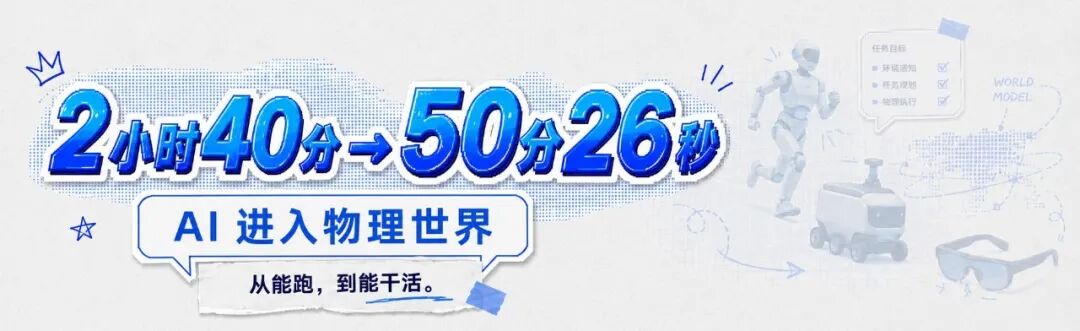
This is the change in humanoid robot half-marathon champion times from last year to this year. In just one year, robot competitors went from barely finishing to a massive leap — nearly 7 minutes faster than the human half-marathon world record.
Of course, this doesn't mean robots have learned to run like humans — there were still falls, battery swaps, and remote interventions on the course. But the speed of AI entering the physical world is clearly accelerating.
The changes aren't limited to robots. On the model side, world models are becoming an important route for Physical AI: what robots need to learn is no longer just image recognition, but mentally rehearsing the physical consequences of actions. DeepMind's Genie 3, NVIDIA's Cosmos, and others are all pushing this route forward.
On the roads, NOA solutions are further proliferating, with 26 cities nationwide already opening commercial fee-based Robotaxi operations without safety drivers; the unmanned delivery industry scale jumped from the thousands to the ten-thousands in the first half of the year, with monthly delivery volume surpassing 3 million orders. In vehicle cabins, cockpit large models are shifting from "understanding" to "action success rate." In more everyday moments, a pair of glasses, a toy — all are being re-equipped with AI capabilities.
Of course, AI's entry into the physical world is just beginning. What should we watch next? Here are our thoughts.
Yunqi Light Observation
AI enters the physical world: what to watch next?
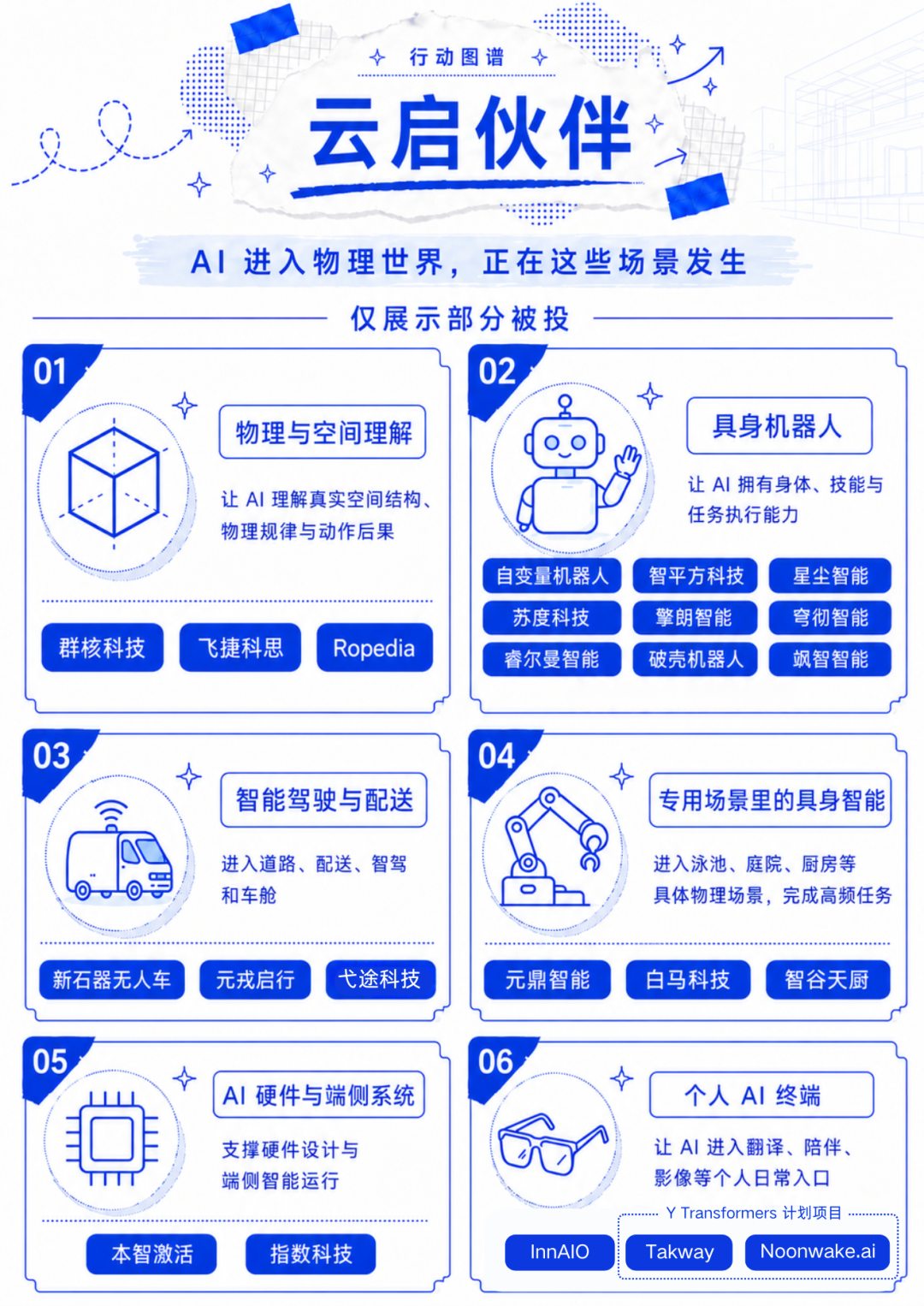
AI's entry into the physical world didn't suddenly start with humanoid robots. Over the past few years, robotics, autonomous driving, AI hardware, and other directions have respectively accumulated capabilities in perception, decision-making, control, and engineering deployment; today, as world models, VLA, reinforcement learning, visual reasoning, and others continue advancing, these paths are converging toward the same goal: enabling AI to complete tasks in real environments.
The robot half-marathon only validated one layer of capability. Locomotion is improving, but truly entering homes, factories, roads, and public spaces still requires solving manipulation, scene generalization, long-tail data, task planning, failure recovery, scaled delivery, and a series of other problems.
Therefore, the next stage matters not just for single-point technology, but for systems engineering capabilities: where does data come from, can simulation compensate for long-tail cases, can models rehearse action consequences, are the body and core components reliable, can supply chains support scaled delivery, are scenarios sufficiently刚需.
Different scenarios will grow different forms — robots, unmanned vehicles, smart cockpits, personal AI terminals... but a common validation standard is: can AI continuously complete valuable tasks in specific scenarios. For AI Native hardware, there's a further question: has AI truly rewritten product definition?

The final number is ♾️, representing the future.
In the first half of 2026, AI's main storyline looks increasingly "realistic": Agents taking jobs, robots entering the field, compute continuing to scale up. But simultaneously, some new interfaces are growing ahead of time.
Quantum computing is the interface to next-generation compute capability — in Q1 this year, disclosed financing in China's quantum space already approached last year's full-year total; brain-computer interfaces are the interface between human states and intelligent systems — Neuralink plans to launch high-volume device production in 2026, while multiple domestic departments have set 2027 timelines for driving medical-grade applications and key-scenario demonstrations; commercial aerospace is the interface extending perception, communication, and computation into space — on July 10, the Long March 10B carrier rocket completed China's first controlled recovery of a launch vehicle first stage, with commercial aerospace continuing from "being able to reach space" toward lower-cost, higher-frequency, more sustainable space infrastructure; AI for Science and AI virtual cells are interfaces opening new pathways within scientific systems themselves — from auxiliary research tools to participating in hypothesis generation, mechanism understanding, and outcome prediction, scientific discovery itself is being reorganized.
They may not yet be in large-scale invocation, but they may determine what AI can invoke, understand, and reach next.
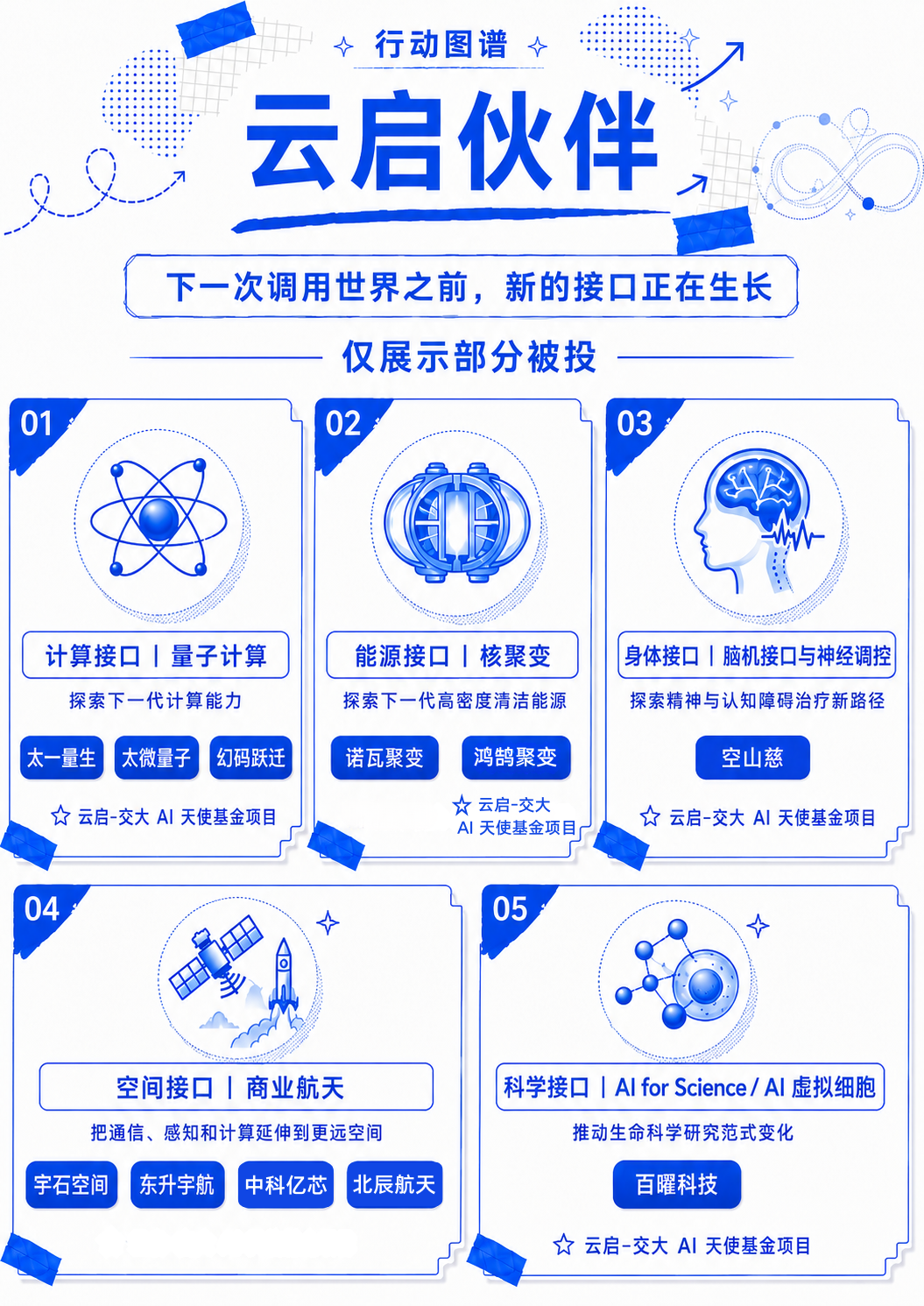
From Agent to Physical AI, from compute infrastructure to scientific interfaces, AI is opening more and more new ways to connect with the real world.
And from July 17-20, several portfolio companies from Yunqi will also be waiting at the WAIC main venue to open new connections with everyone. Click here to view the "Yunqi WAIC 2026 Roaming Guide"
On July 18, the second day of WAIC, we will also co-host a WAIC off-site event with the NICE community: "World Model BBQ," inviting AI entrepreneurs, investors, and industry partners to discuss how world models can help AI better understand and act.
Looking forward to seeing you on-site, continuing to explore the next stop where AI invokes the world!