Why Are the Trisolarans So Terrified of Earth's Particle Accelerators? | Yunqi Capital Science Chat

The applications of accelerators extend far beyond this.


Why are the Trisolarans so terrified of Earth's accelerators? What do accelerators actually look like, and how do they work? Today, we're introducing three common types.
This edition of "Yunqi Science Chat" brings you everything you need to know about accelerators. Enjoy~
Source | Science Courtyard (Kexue Dayuan) Authors | Lishi Wang, Fang Liu
The animated adaptation of The Three-Body Problem opens with this exchange:
"Where's the breakthrough for scientific development?"
"Particle collision experiments?!"
Then we see the collider in space:
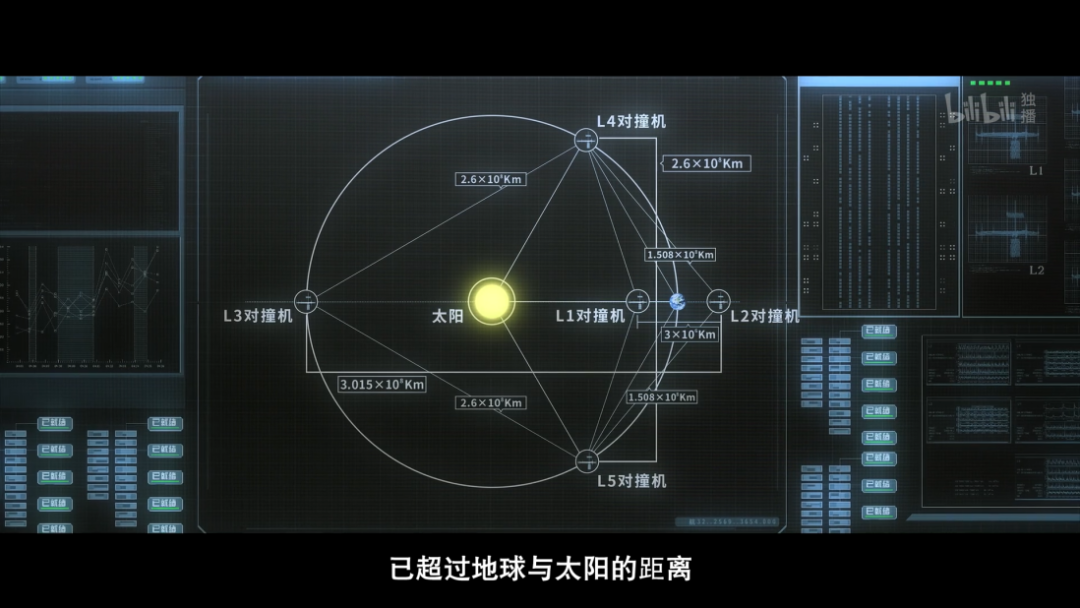

Of course, we also see the sophons interfering with the experiments. Why are the Trisolarans so afraid of Earth's colliders? Colliders are actually a type of particle accelerator. According to the novel's premise, the Trisolarans fear that humans will use accelerators to uncover the fundamental nature of matter, achieve technological leaps, and become formidable rivals.
This premise is remarkably scientific! Particle accelerators have indeed played a pivotal role in the history of human technological development. By artificially accelerating charged particles, scientists can conduct cutting-edge physics experiments to explore the fundamental composition of the material world and advance basic science; they can also inspect materials for flaws, process food, and even produce diapers that babies can't live without!
What do accelerators actually look like, and how do they work? Today, we're introducing three common types.

Linear Accelerators — Maybe That Old TV in Your House
As the name suggests, a linear accelerator (linac) accelerates charged particles in a straight line. As early as 1924, British physicist Gustav Ising proposed the concept of the linear accelerator — using multiple accelerating electric fields to give charged particles higher energy. In 1928, Norwegian Rolf Widerøe developed Ising's principle and built the world's first linear resonance accelerator.
Those bulky "big butt" CRT televisions popular in the 1980s and 90s were essentially linear accelerators, using an electron beam generated by a cathode ray tube to strike phosphor coatings on the inner screen and produce images.
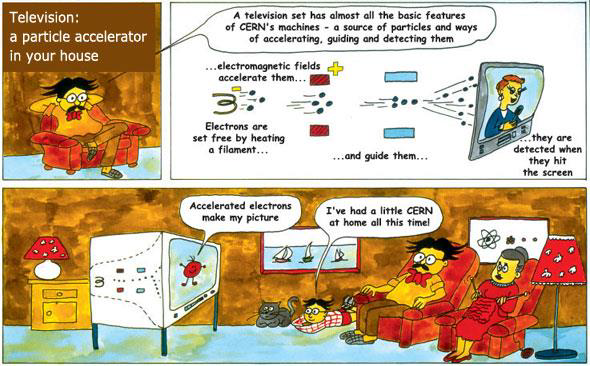
The accelerator inside a television
(Source: CERN)
Linear accelerators are among the most common types today. When you're happily munching on pickled pepper chicken feet from the supermarket, there's a good chance you're enjoying the convenience brought by accelerators. Irradiation processing technology based on linear accelerators (using radiation) is an efficient and safe sterilization technique that can extend the shelf life of pickled pepper chicken feet from 3-5 days to several months without adding preservatives.
The principle of a linear accelerator isn't complicated: as long as you provide particles with an accelerating electric field, they'll move in a straight line. If you use an appropriate alternating electric field, you can achieve continuous acceleration.
But alternating electric fields have both positive and negative phases — how do you ensure the particles only speed up, never slow down? Scientists cleverly devised a structure called drift tubes. When the voltage is negative, particles can hide inside the drift tube, allowing the particle beam (usually just called the "beam") to forge ahead through the straight section!
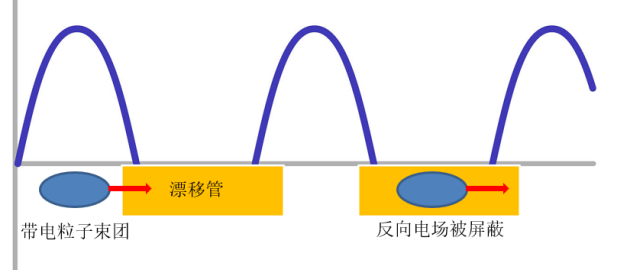
Principle of a drift tube linear accelerator
(Source: veer, modified by Lishi Wang)
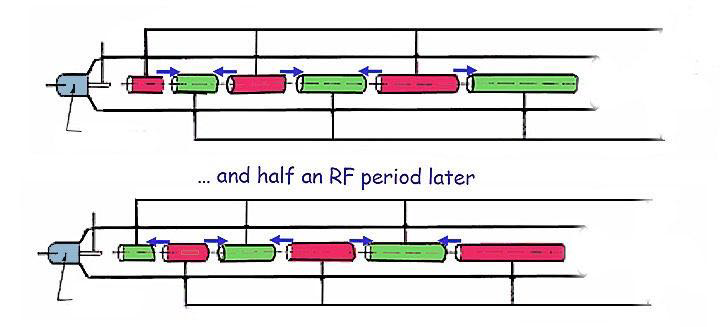
Schematic of a drift tube linear accelerator
(Source: William A. Barletta, USPAS)
Those red and green cylinders in the image above are the drift tubes. Observant readers may notice these cylinders getting progressively longer. That's because as particle energy increases and velocity rises, the distance traveled per unit time grows longer, so the corresponding drift tube lengths gradually increase.
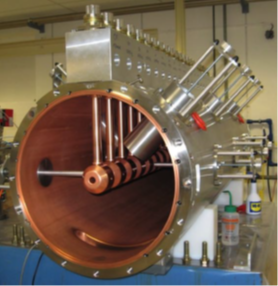
Internal structure of a drift tube linear accelerator (Source: CERN)
Following this principle, the higher the energy of particles you want to achieve, the longer the linear accelerator must be, dramatically increasing costs. To avoid building excessively long accelerators, the cyclotron was born.

Cyclotrons — Maybe Like a Sliced Cake
American physicist Ernest Lawrence had a stroke of genius building on linear accelerators. In 1932, he designed and built the first cyclotron, applying an external magnetic field to transform the straight trajectory of accelerated particles into a spiral form. This groundbreaking achievement solved the problem of low acceleration efficiency caused by excessively long accelerators, and Lawrence was awarded the 1939 Nobel Prize in Physics.
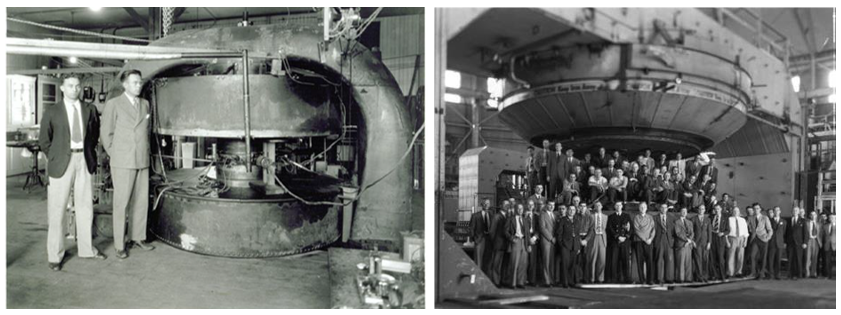
Lawrence with his cyclotron (Source: LBNL)
How does a cyclotron work? Take a look at the figure below for a basic understanding:
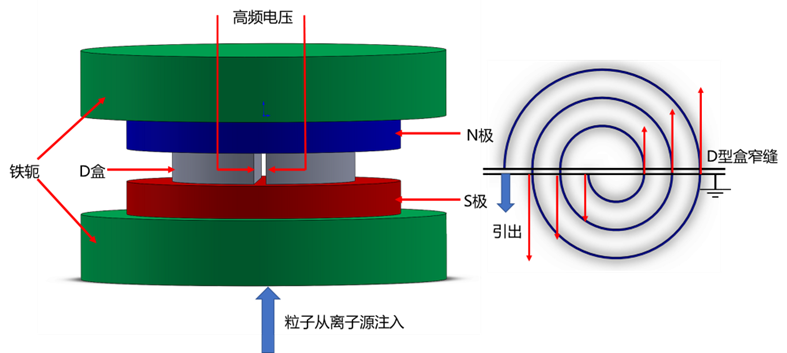
Principle diagram of a classical cyclotron
(Source: Lishi Wang)
As shown, particles are injected from the center of the cyclotron and accelerated through the gap between D-shaped electrodes (dees). Since particles accelerate each time they pass through the dee gap, their orbital radius increases with each revolution under the fixed magnetic field, creating a spiral trajectory.
Subsequently, to meet the experimental demands of nuclear and particle physics, classical cyclotrons underwent a series of upgrades, such as being modified into sector-focused cyclotrons with spiral angles. "Focusing" here can be understood this way: imagine a particle beam as a beam of parallel sunlight — through a kind of lens (in this case, a magnetic field with gradients), it's converged into a smaller, more intense spot of light, thereby improving collision efficiency when particles strike materials.
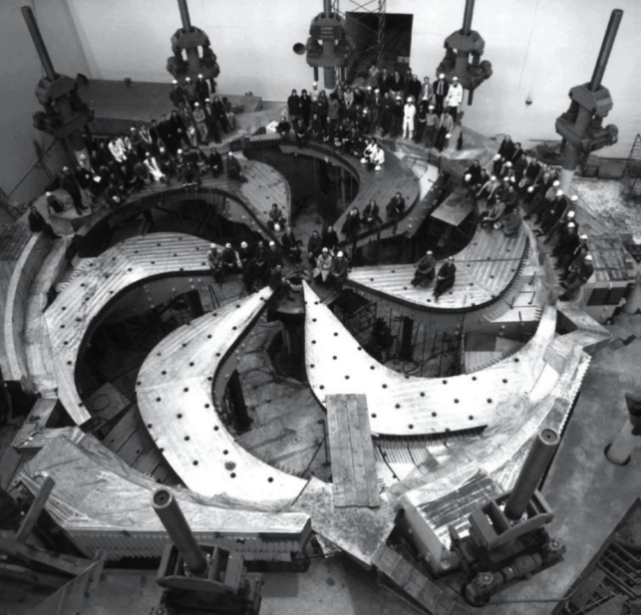
Focusing structure with spiral angles
(Source: Mike Seidel, CAS, Cyclotrons, 2019)
Since the 1970s, as a logical extension of sector-focused cyclotrons, scientists developed separated-sector cyclotrons, further increasing the accelerating voltage and improving operational efficiency. At that time especially, separated-sector cyclotrons were an excellent choice to meet the needs of heavy-ion physics research.
Take a look at the separated-sector cyclotron built by the Institute of Modern Physics, Chinese Academy of Sciences in 1988 — doesn't it look like four slices of cake?
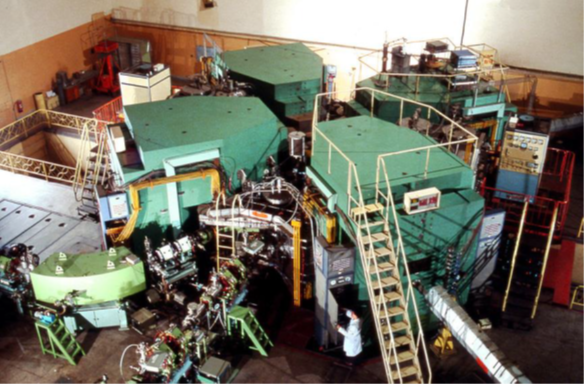
Separated-sector cyclotron built by the Institute of Modern Physics, CAS
(Source: Institute of Modern Physics)

Ring Accelerators — How Do You Direct Particles to Run in Circles?
In The Three-Body Problem, Cixin Liu also envisions a solar-ring accelerator:
With no air in space, a solar-ring accelerator becomes possible. Engineers need not build an integrated pipeline; establishing some relay acceleration coils orbiting the Sun would suffice to assemble an unprecedented solar-ring accelerator. This accelerator could truly accelerate particles to the creative energy of the Big Bang. Yet even so, engineers would need to build 3,200 acceleration coils, precisely deliver them to solar orbit, each coil separated by 1.5 million kilometers.
This grand vision corresponds to the third type of accelerator we're discussing — the ring accelerator. Coincidentally, the great physicist Enrico Fermi once proposed the idea of a "globe-circling accelerator," also based on the ring accelerator concept.
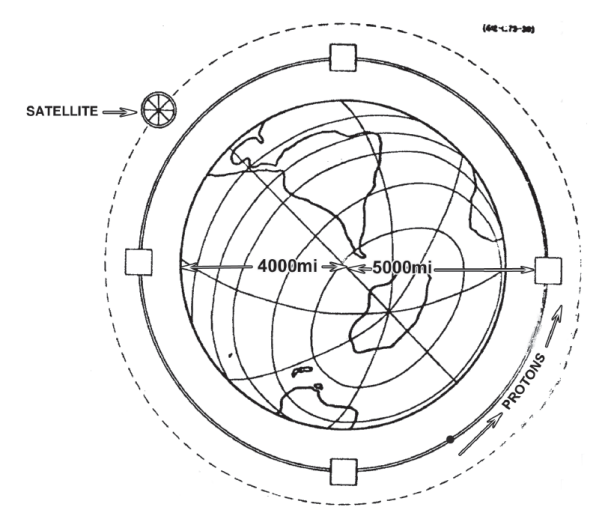
Fermi's envisioned "globe-circling" accelerator
(Source: Enrico Fermi: The Master Scientist)
In 1952, M. Stanley Livingston (another accelerator luminary) at Brookhaven National Laboratory broke from traditional accelerator focusing structures (where the same weak-focusing structure was used throughout the ring, i.e., the weak-focusing synchrotron), instead alternating magnets with focusing and defocusing effects (focusing-defocusing-focusing-defocusing...). The results were surprisingly good — the net effect was focusing! But Livingston harbored doubts about this result and asked colleague Ernest Courant to calculate it. Courant re-examined the result and, together with Snyder and others, proposed the principle of alternating-gradient focusing, also known as strong focusing. The strong focusing principle and the automatic phase-stability principle later became the two cornerstones of modern accelerators.
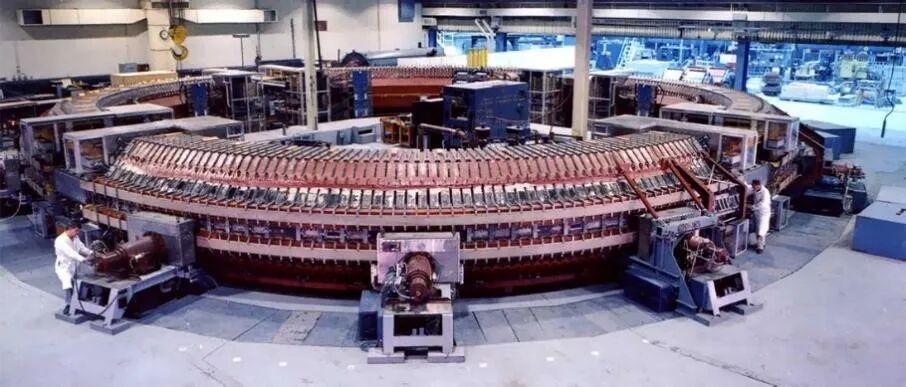
The Cosmotron, a proton accelerator built by Brookhaven National Laboratory in the 1950s — the world's first weak-focusing synchrotron.
(Source: BNL)
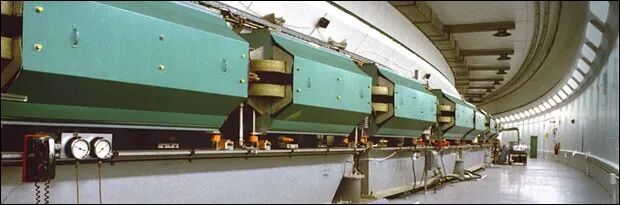
The Alternating Gradient Synchrotron built by Brookhaven National Laboratory in the 1950s — the world's first strong-focusing synchrotron.
(Source: BNL)
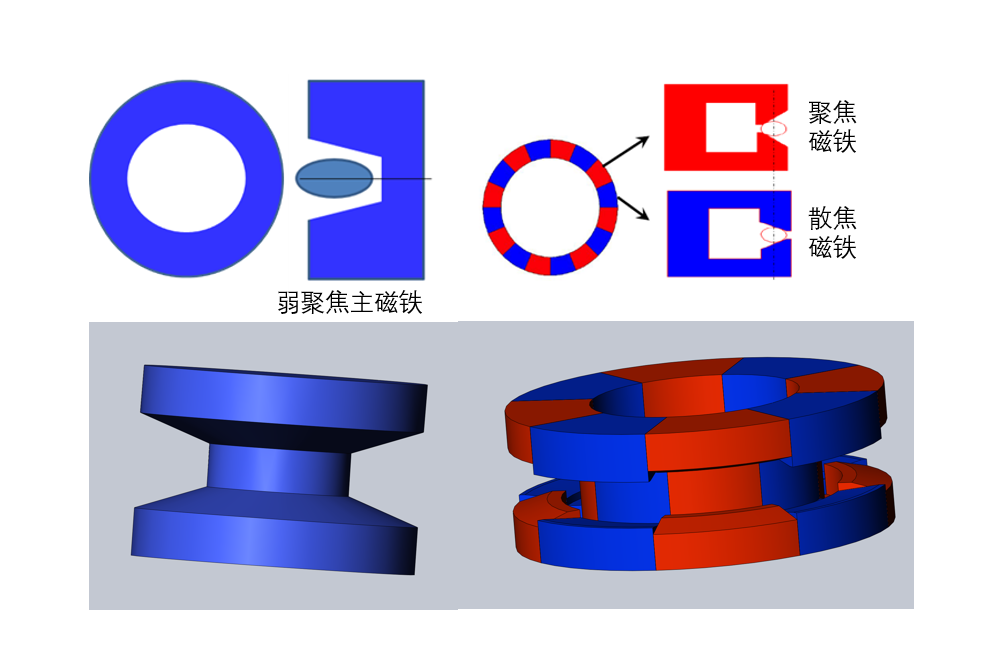
Comparison of weak focusing and strong focusing. Due to the alternating arrangement of focusing and defocusing, the lower right figure appears "jagged."
(Source: Drawn by Xudong Wang)
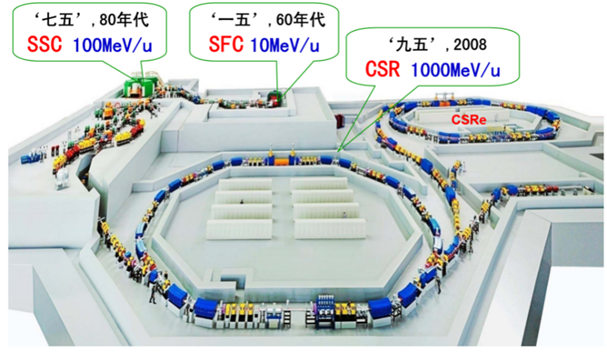
Ring accelerator built by the Institute of Modern Physics — the Cooling Storage Ring
(Source: Institute of Modern Physics)
Particle orbits in ring accelerators are much simpler than in cyclotrons — they're closed circular paths. Particles are deflected into circular orbits by magnetic elements called dipole magnets, and accelerated in cavities similar to those in linear accelerators. Meanwhile, to ensure the beam doesn't "run apart" during motion, ring accelerators also use quadrupole magnets and other elements to adjust the beam's formation, so particles move in orderly fashion under the magnets' direction.
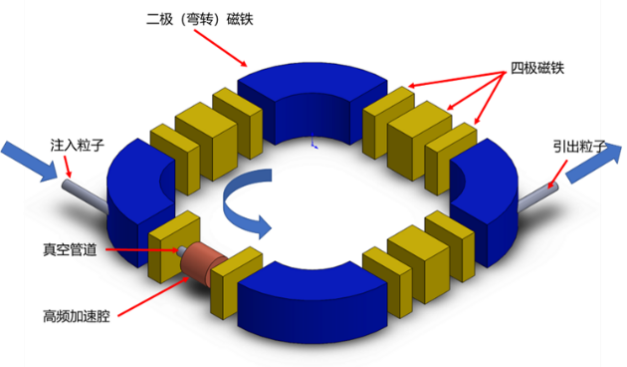
Principle of a ring accelerator
(Source: Lishi Wang)
Ring accelerators can better store accelerated particles and effectively adjust beam quality. Today, most large accelerators use ring accelerators as their main component, with linear accelerators and cyclotrons generally serving as injectors for the ring — each playing to its strengths. For example, the world's largest particle accelerator, the Large Hadron Collider, as well as domestic synchrotron radiation sources and spallation neutron sources, all have ring accelerators as their core.

Structural diagram of the High Intensity heavy-ion Accelerator Facility (HIAF) being built in Huizhou, Guangdong. This accelerator consists of linear accelerators and ring accelerators, among other components.
(Source: Institute of Modern Physics)

Why Do We Need Accelerators?
Why do humans go to such great lengths to build all kinds of accelerators and continuously explore new accelerator technologies?
Exploring the microscopic world has long been scientists' aspiration. The "father of nuclear physics," Ernest Rutherford, once said: "For long years I have been hoping for a copious supply of atoms and electrons with energies far beyond those of the particles from radioactive substances."
From Rutherford's earliest experiments using alpha particles to bombard gold foil, opening the door to atomic physics research, to the 2013 discovery of the Higgs boson at the Large Hadron Collider, accelerators are undoubtedly scientists' most important and cutting-edge tool for studying matter. We can use them not only to discover new fundamental particles but also to synthesize new isotopes, and even experience what it feels like to be a creator — synthesizing new elements!
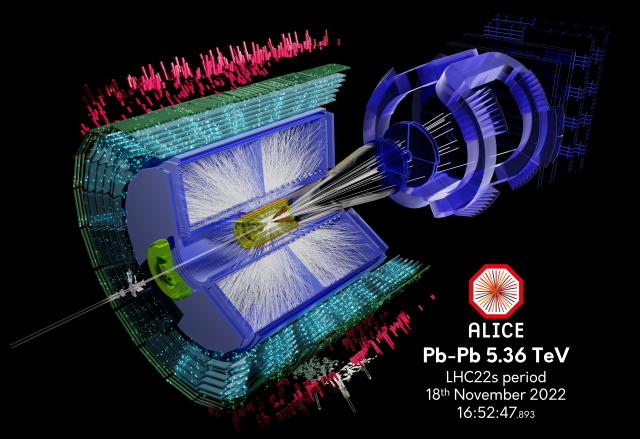
High-energy particle colliders smash out new understandings of our world.
(Source: CERN)
The contributions of accelerators to basic research extend beyond nuclear and particle physics. By exploiting the electromagnetic radiation emitted when charged particles travel along curved trajectories in electromagnetic fields, scientists have built synchrotron radiation sources to conduct experiments in materials science, structural biology, and other fields. These experiments help humans understand microscopic structures more clearly, playing crucial roles in analyzing the structures of influenza, Ebola, Zika, and COVID-19 viruses, and screening antiviral drugs and antibodies.
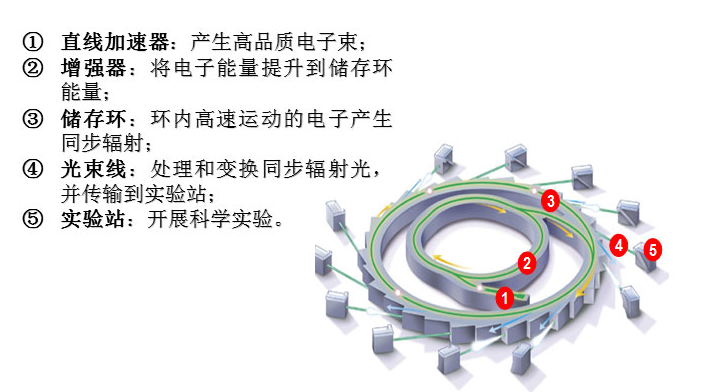
Diagram of the Beijing High Energy Photon Source components.
(Source: Institute of High Energy Physics)
Beyond basic scientific research, by accelerating different charged particle beams or ion beams — such as electrons, heavy ions, and so on — scientists can conduct various applied research. Accelerator applications have permeated many aspects of human life:
We can use accelerators to treat cancer. Heavy-ion radiotherapy is internationally recognized as an advanced radiation treatment modality. Heavy-ion beams are like precision missiles that can directly hit lesions, concentrating energy release to eliminate cancer cells.
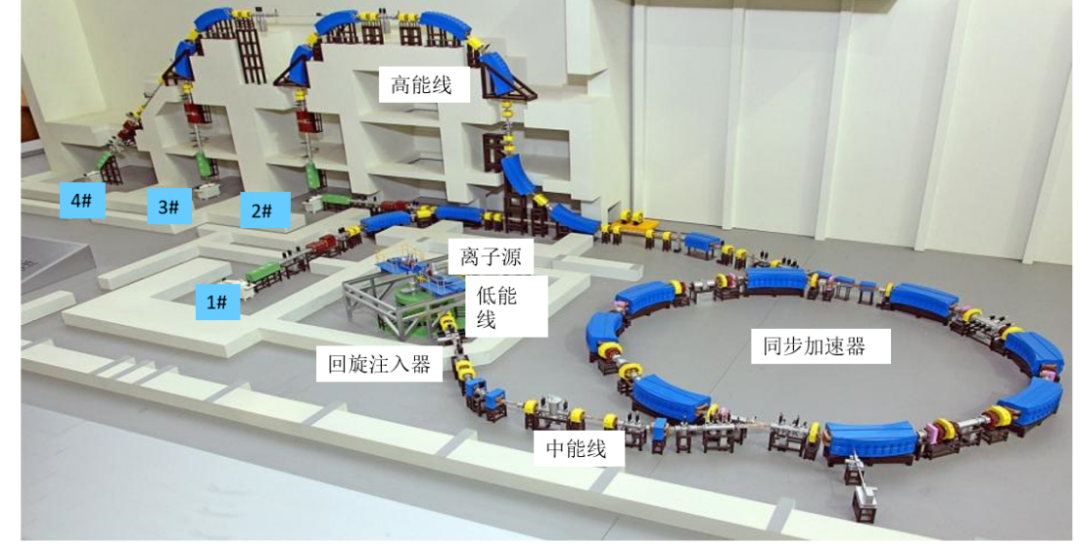
Carbon-ion therapy device developed by the Institute of Modern Physics. This accelerator consists of a cyclotron and a ring accelerator.
(Source: Institute of Modern Physics)
Even the production of delicious chocolate and baby diapers involves accelerators! Synchrotron radiation technology can prevent chocolate from blooming, improving its texture, taste, and appearance. Lawrence Berkeley National Laboratory once used X-rays produced by the Advanced Light Source (ALS) to help Dow chemists deeply understand and improve the superabsorbent polymer materials in diapers, changing how parents care for babies.
Accelerator applications extend far beyond this: security screening systems, non-destructive testing equipment, radiation mutation breeding, sewage treatment, aerospace — all are closely tied to accelerator technology. No wonder the Trisolarans fear Earth's accelerators so much! If you could visit one in person, the awe would surely rival reading The Three-Body Problem!
References:
[1] Cixin Liu. The Three-Body Problem[M]. Chongqing Publishing House, 2010
[2] Weixie Gui. Principles of Charged Particle Accelerators[M]. Tsinghua University Press, 1994.
[3] Wangler T P. Principles RF Linear Accelerators[M]. 2008.
[4] Sloan D H, Lawrence E O. The Production of Heavy High Speed Ions without the Use of High Voltages[J]. Physical Review, 1931, 38(11): 2021-2032.
[5] Jiaer Chen. Fundamentals of Accelerator Physics[M]. Peking University Press, 2012.
[6] Jay Orear. Enrico Fermi: The Master Scientist[M], 2004
[7] Courant E D, Livingston M S, Snyder H S. The Strong-Focusing Synchroton — A New High Energy Accelerator[J]. Phys Rev, 1952, 88(5): 1190-1196.
[8] Alexander Wu Zhao. LECTURES ON ACCELERATOR PHYSICS[M], World Scientific, 2020
[9] Baowen Wei: Pioneering New Frontiers in Heavy Ion Physics Research (https://mp.weixin.qq.com/s/gQwCTsXV0YONanIVXHTkvA)
[10] Chocolate Is So Delicious — Don't Forget to Thank Particle Accelerators (https://mp.weixin.qq.com/s/ccWC3uU-7rPJRnB3NE4Pag)
[11] Modern Diapers Also Owe Thanks to Particle Accelerators (https://mp.weixin.qq.com/s/Y75HKCsxJXF5MqJkNjyrQA)
Science Courtyard (Kexue Dayuan) is the official science popularization micro-platform of the Chinese Academy of Sciences, hosted by the CAS Bureau of Science Communication and operated by the China Science Expo team, dedicated to in-depth interpretation of the latest research achievements and scientific perspectives on social hot topics.