Yunqi Capital Leads Seed Round in "Phantom Leap" Worth Tens of Millions of RMB, Accelerating Quantum x AI Convergence | Yunqi Partners

The Next Generation of Computing Infrastructure Is Taking Shape
Quantum computing system-level software and application solutions provider Quantum Leap Code (幻码跃迁) recently announced the completion of a seed round of tens of millions of RMB, with participation from the Yunqi-Shanghai Jiao Tong University AI Angel Fund.
Join us in this edition of "Yunqi Partners" to learn how Quantum Leap Code is building a cross-hardware full-stack software platform that connects underlying quantum computing power with future industrial applications.

Yunqi Capital's Investment Thesis:
Quantum computing is gradually transitioning from an early stage focused on hardware metrics and experimental breakthroughs to a systems engineering phase characterized by hardware-software synergy and real-world applications. The Quantum Leap Code team combines expertise in quantum algorithm research, mainstream hardware understanding, and software engineering capabilities, while also exploring AI to enhance quantum R&D and application development efficiency — a rare combination for building a cross-hardware full-stack software platform. We believe the team will continue to lower the barriers to developing and using quantum computing, becoming critical infrastructure that connects underlying quantum computing power with industrial applications.

The following content is adapted from Lighthouse Capital
Quantum Leap Code focuses on the convergence of quantum computing and AI, positioning itself as a domestic provider of quantum computing system-level software and application solutions. The company is dedicated to building software infrastructure and intelligent agent platforms that support fault-tolerant operation, large-scale deployment, and industrial applications. Through a strategy of "bottom-layer software stack + upper-layer algorithm applications + AI-driven R&D tools," it aims to transform heterogeneous quantum hardware capabilities into callable, evaluable, and verifiable new computing power for industry, accelerating quantum computing's progression from experimental validation to engineering and industrialization.
A Full-Stack Team Spanning Algorithms, Engineering, and Hardware
The Quantum Leap Code team combines deep algorithmic theory, understanding of mainstream hardware, software engineering capabilities, and industrialization experience. Core members come from leading enterprises and universities including QuEra, Baidu, Harvard University, The Hong Kong University of Science and Technology, University of Maryland, and University of Waterloo, with experience across mainstream hardware approaches including neutral atoms and superconducting systems. They have also been deeply involved in multiple national key research projects in quantum computing. The company has assembled an R&D team of several dozen people covering key directions including quantum algorithms, quantum machine learning, hardware-aware compilation, quantum software stacks, and intelligent agents.
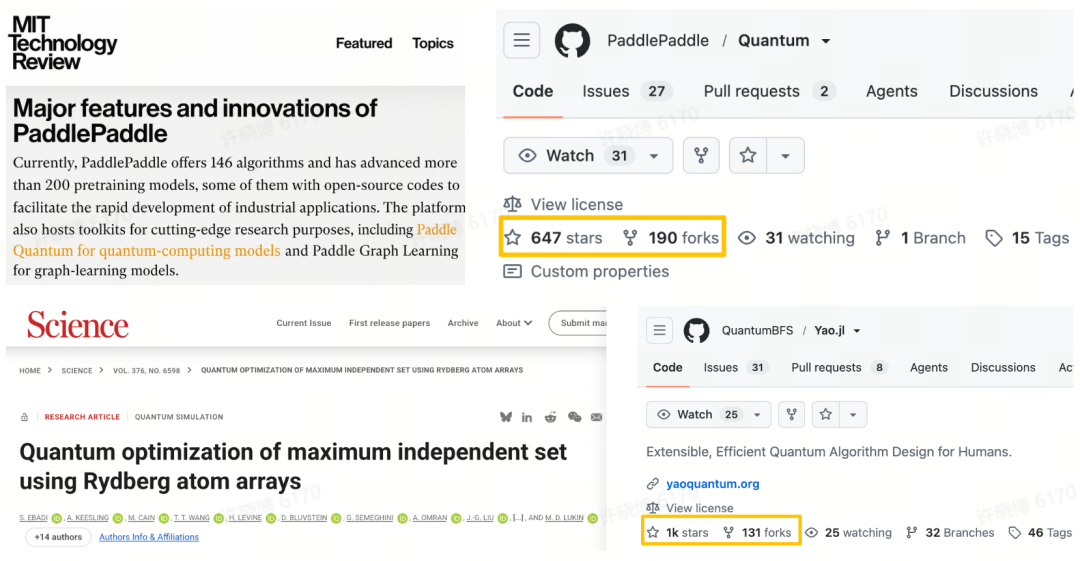
Two Chief Scientists provide critical technical depth. Xin Wang formerly served as Tech Leader at Baidu's Quantum Computing Institute, where he led the development of the industrial-grade quantum software platform "Paddle Quantum" (量桨). He has long focused on quantum algorithms, quantum information, and quantum artificial intelligence, publishing over 100 papers in top journals and conferences including Physical Review Letters, PRX Quantum, Nature Computational Science, IEEE Transactions on Information Theory, NeurIPS, AAAI, ISCA, HPCA, and MICRO. He has led and participated in National Natural Science Foundation major research programs and national key R&D programs in quantum algorithms and quantum-classical integration, and was invited to deliver a keynote at TQC, the top international conference on quantum computing theory. His work has been covered by CCTV News and MIT Technology Review, among other authoritative media.
Jinguo Liu conducted postdoctoral research at Harvard University's Lukin Group — a global leader in neutral-atom quantum computing — and served as a full-time consultant at QuEra, the world-leading neutral-atom quantum computing company spun out from that group. He was deeply involved in QuEra's team building and software stack construction, accumulating comprehensive experience spanning theory, software, and hardware mapping. Liu has long specialized in neutral-atom system simulation, quantum algorithms, and combinatorial optimization. He is one of the core evangelists of China's quantum software open-source community and a major contributor to Yao.jl. The long-term stable collaboration between the two Chief Scientists at The Hong Kong University of Science and Technology (Guangzhou) gives Quantum Leap Code an extremely rare full-stack capability within China.
CEO Hongshun Yao joined Baidu's Quantum Computing Institute in 2021 to work on core modules of PaddleQuantum, and was among the first researchers in China to explore quantum algorithm applications on self-developed superconducting quantum hardware. His extensive technical R&D and team management experience at Baidu Quantum enables him to effectively coordinate the collaborative deployment of algorithms, software, and hardware, ensuring precise alignment between technical decisions and business execution. Lead Architect Chenghong Zhu has long focused on quantum architecture, hardware-aware compilation, and AI-driven quantum software optimization, with published results at top architecture and design automation conferences including ISCA, MICRO, HPCA, and DAC, supporting the company's engineering capabilities in compilation scheduling, architecture optimization, and AI for Quantum.
The Quantum Leap Code team covers mainstream approaches including superconducting, neutral-atom, trapped-ion, and photonic quantum computing. It has developed capabilities in hardware-aware algorithm design, cross-platform compilation, resource estimation, and scheduling optimization, and has accumulated experience through open-source ecosystems, national research projects, hardware vendor partnerships, and industry scenario validation. The company is currently engaged in research collaborations with multiple hardware vendors, including exploring quantum application deployment scenarios based on hardware characteristics and hardware performance enhancement solutions based on software algorithm design. It is advancing scenario validation in high-value domains such as financial optimization and biomedicine, and has established deep partnerships with leading business customers. Going forward, the company will focus on infrastructure software for hardware vendors, developer toolchains, and industry algorithm solutions.
Quantum Computing Is Moving from Hardware Demonstrations to Systems Engineering
The industrial value of quantum computing is shifting from isolated scientific breakthroughs to the sustained accumulation of systems engineering capabilities. In recent years, market expectations have largely been built around physical qubit counts, hardware approaches, and experimental progress; in the next phase, what will truly determine whether quantum computing becomes practically usable are metrics closer to engineering deliverability: logical error rates, error correction efficiency, resource overhead, system reliability, and algorithm application maturity.
The application value of quantum computing also needs to be continuously released through modelable, verifiable industrial workflows. Although quantum hardware approaches have not yet converged, the software stack for the fault-tolerant era is gradually becoming clear. Key layers including application牵引, algorithm design, compilation optimization, error correction support, runtime scheduling, and hardware interfaces are forming a systematic support framework that connects industrial demand with underlying hardware capabilities.
Building a Quantum Computing Full-Stack Software Platform Through Quantum × AI Convergence Innovation
Oriented toward fault-tolerant quantum computing and large-scale deployment, Quantum Leap Code positions itself as a provider of domestic quantum computing software infrastructure and application solutions, forming a full-stack platform of "bottom-layer software stack + upper-layer algorithm applications + AI-driven R&D tools."
Bottom-Layer Software Stack
Connects diverse hardware approaches including superconducting, trapped-ion, neutral-atom, and photonic quantum computing, providing system-level capabilities including hardware abstraction, compilation optimization, error correction interfaces, runtime scheduling, resource evaluation, and benchmarking. This helps hardware vendors improve usability while lowering the barrier to entry for industrial customers.
Upper-Layer Algorithm Applications
Focuses on high-value scenarios including materials simulation, financial optimization, logistics scheduling, and AI model optimization, translating real industrial problems into modelable, verifiable, compilable, and executable quantum computing workflows.
AI-Driven R&D Technology Stack
Runs through the entire chain of applications, algorithms, compilation, error correction, and scheduling. Through intelligent agent orchestration, Quantum Leap Code will improve the efficiency of problem modeling, algorithm generation, circuit compilation, resource estimation, hardware invocation, and result verification, pushing quantum computing from expert-driven experimental systems toward new computing infrastructure that is accessible, manageable, and verifiable within industrial R&D systems.
Quantum Leap Code's core conviction is that the key to quantum computing industrialization lies not only in hardware breakthroughs, but in packaging heterogeneous, noise-sensitive, resource-scarce quantum hardware into new computing power that is callable, evaluable, and deliverable for industry, and landing applications in real research and industrial scenarios. With this funding round as a starting point, the company will continue advancing the construction of its quantum computing full-stack software platform, expand partnerships with quantum hardware vendors, research institutions, and industrial customers, and drive quantum computing capabilities from experimental environments into real-world scenarios, becoming new computing infrastructure for future industrial R&D systems.