"XTransfer" Releases *2022 First Three Quarters SME Export Trade (B2B) Index Report* | Yunqi Capital Industry+

Steady progress through innovation

"Yunqi Industry+" shares updates from Yunqi Capital's portfolio companies, exploring how industries upgrade through technology enablement, with a focus on the digital transformation trend. This issue brings you the latest news from XTransfer.
➤➤➤ Recently, the "2022 Future of Foreign Trade Conference" kicked off virtually under the guidance of the Commercial Sub-council of the China Council for the Promotion of International Trade (CCPIT). The event was hosted by XTransfer, a Yunqi Capital angel-round portfolio company and one-stop cross-border financial and risk management services provider for foreign trade enterprises. Bill Deng, XTransfer's founder and CEO, officially released the 2022 Q1-Q3 SME Export Trade (B2B) Index Report at the conference.
Jointly published by XTransfer and the CCPIT Commercial Sub-council, the report covers the China Foreign Trade Export Leading Index and the China SME Foreign Trade Competitiveness Index for the first three quarters of 2022. It focuses on the development trajectory of China's foreign trade exports during this period and reflects the export performance of Chinese SME foreign trade enterprises in Q1-Q3 2022.
The report notes that the environment for foreign trade development has become increasingly complex and uncertain. Since 2022, global economic growth has slowed, inflationary pressures have intensified in some economies, and COVID-19 has continued to disrupt operations, with multiple major foreign trade hubs in China affected by outbreaks. Additionally, evolving international dynamics and heightened exchange rate volatility have further dampened demand, creating risks and challenges for exports.
Despite these harsh conditions, Chinese SME foreign trade enterprises saw their payment collection volume grow 12.8% year-over-year in the first three quarters — slightly outpacing the 12.5% growth in national exports reported by the General Administration of Customs. China's foreign trade achieved steady growth in a complex environment during Q1-Q3 2022; meanwhile, the rising payment collection volume of SME foreign trade enterprises reflected steadily improving competitiveness.
The report maintains that although China's foreign trade exports will still face significant challenges in Q4, numerous favorable factors will support high-quality development. It projects that Q4 exports will withstand pressure and continue to break new ground, achieving steadier and faster growth with improved quality; Chinese SME foreign trade enterprises are expected to sustain their strong performance and further enhance competitiveness.

China's Foreign Trade Posts Steady Growth in Q1-Q3,
SMEs Emerge as "Resilience Champions"
According to the 2022 Q1-Q3 China Foreign Trade Export Leading Index, the leading index rose compared to the same period in 2021, demonstrating the resilience and agility of Chinese SME foreign trade enterprises when facing external pressure. The report argues that while Q4 still holds much uncertainty, favorable factors such as continued implementation of business relief policies and foreign trade enterprises' enhanced adaptability through digital tools will support high-quality export development. Combined with Q4's seasonal peak in global consumer spending, China's foreign trade exports are projected to withstand pressure and continue breaking new ground.
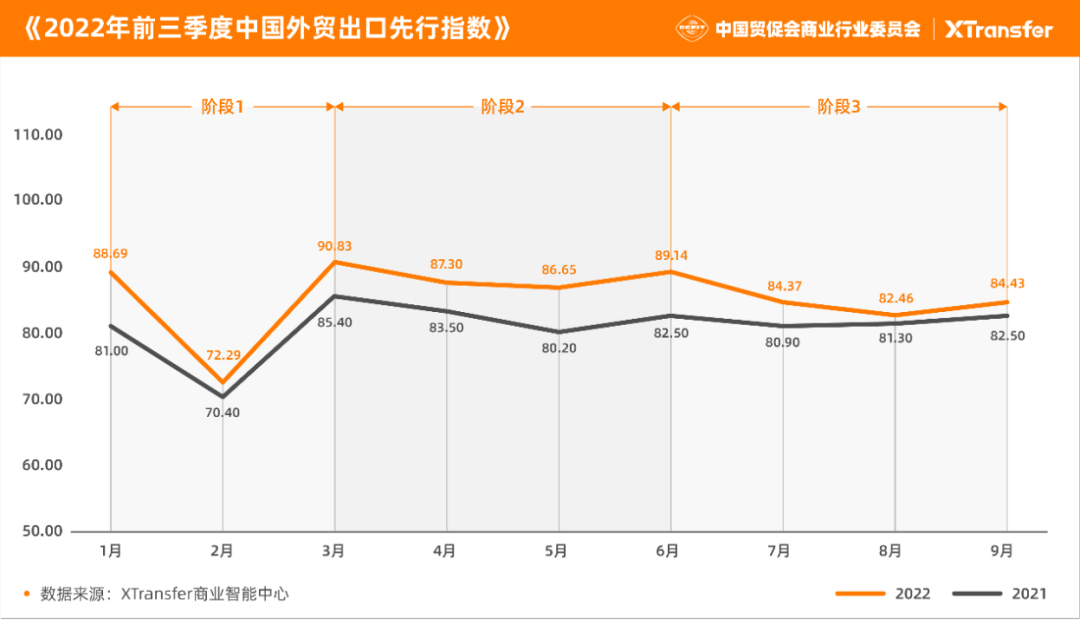
The report's analysis shows that amid harsh conditions, Chinese SME foreign trade enterprises not only achieved a stable start in Q1 but also rapidly reversed the index decline caused by frequent COVID outbreaks in the latter half of Q2. Entering Q3, overseas demand slowed due to factors including intensified inflation and currency depreciation, combined with summer holidays in Europe and the US — China's major export destinations — in July and August, which caused some index fluctuation. However, compared to the same period last year, growth remained positive.
On one hand, China's complete manufacturing system, comprehensive supply chain support, and cost-effective products provided traditional advantages that bolstered the leading index's rise. On the other hand, facing complex circumstances, many SME foreign trade enterprises leveraged their inherent agility — the advantage of being "small ships that turn easily" — to actively adapt. Some enterprises, for instance, began expanding their customer base through independent websites, social platforms, and search engine marketing.
In response to COVID challenges, China has continued advancing coordinated epidemic prevention and control alongside economic and social development, rolling out a series of foreign trade stabilization policies that have created a favorable environment for exports. To help foreign trade enterprises secure orders and expand markets amid the pandemic, local governments in Zhejiang, Guangdong, and other provinces organized business charter flights overseas to facilitate exchanges between enterprises and foreign partners. Additionally, governments in Jiangsu and elsewhere actively hosted "online matchmaking sessions," inviting SME foreign trade enterprises and overseas buyers to virtual exhibitions to accelerate enterprises' "going global" pace.
Notably, by export destination, the top three regions for Chinese SME foreign trade enterprise payment collection volume were: North America, the EU, and ASEAN. Collection volume from ASEAN countries grew 23.6% year-over-year, while North America saw 10% growth. Against the backdrop of euro weakness and slowing European demand, China's sustained strong export performance to ASEAN and North America has been an important driver of steady export improvement.
Furthermore, SME foreign trade enterprises are actively expanding into emerging markets such as Africa and Latin America. By payment collection volume share, Africa grew 15.5% compared to the same period last year, and Latin America grew 11.7%. This reflects Chinese SME foreign trade enterprises' growing roster of trading partners and further optimization of their overseas market footprint.
By export product category, textile raw materials and textile products saw the largest payment collection volume growth among major export countries, rising 46% year-over-year. Machinery and electrical products grew 32.7%, while automotive and other transport equipment parts grew 24.2%.
As China's largest trading partner, ASEAN's deepening industrial and supply chain cooperation with China — characterized by complementary relationships — has driven growth in labor-intensive exports such as textile raw materials and textile products, providing strong support for steady export growth. Additionally, in Q1-Q3, China's complete vehicle exports grew 55.5% year-over-year, making it the world's second-largest auto exporter. This significantly boosted exports of automotive and transport equipment parts, with SME foreign trade enterprises serving as an important complementary force behind this trend.

SME Competitiveness Steadily Improves,
Advantages Become More Diverse and Pronounced
The 2022 Q1-Q3 China SME Foreign Trade Competitiveness Index shows that Chinese SME foreign trade enterprises steadily improved their competitiveness levels against this backdrop. The report argues that as these enterprises enhanced their technical capabilities and service quality while actively expanding into new channels and acquiring new customers, their advantages in international competition became more diverse and pronounced. It projects that in Q4 2022, Chinese SME foreign trade enterprises will sustain their strong performance and further elevate competitiveness.
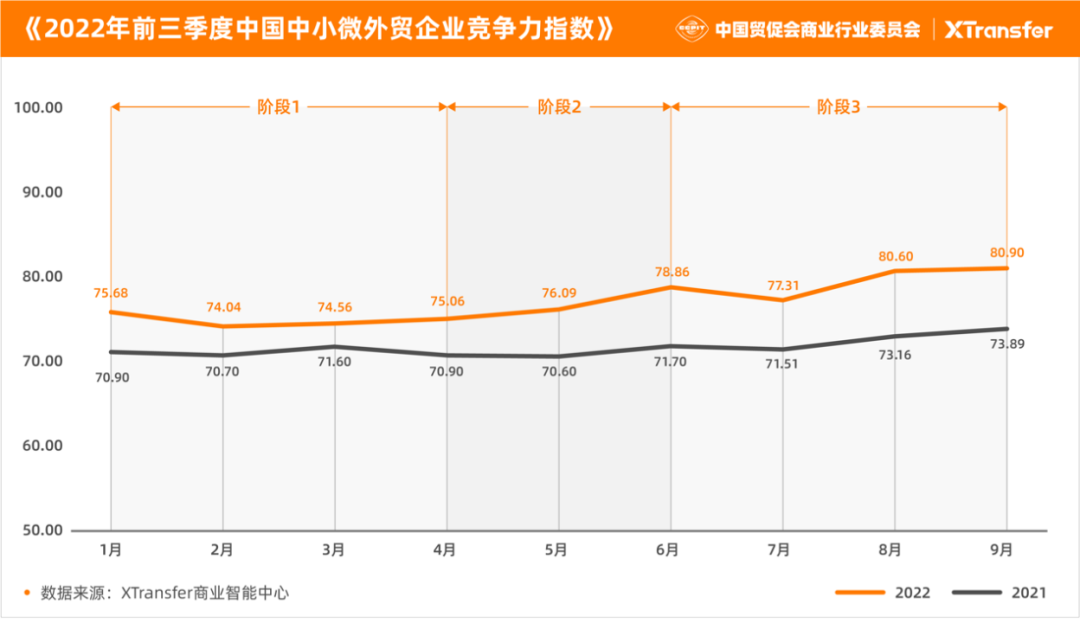
This composite index evaluates three dimensions: buyer trust, product attractiveness, and export operational efficiency. At the start of 2022, the competitiveness index continued its momentum from late 2021, maintaining overall stability. From March to April, despite frequent domestic COVID outbreaks, the index was not significantly affected and rose steadily. From May to June, as outbreaks came under effective control, the competitiveness index climbed rapidly, reaching its first-half peak in June. From July to September, affected by slowing overseas demand and summer holidays in China's major export destinations, the index fluctuated slightly. However, as transportation costs — a persistent challenge for SME foreign trade enterprises since the pandemic — were largely alleviated, operational efficiency continued improving, the competitiveness index recovered, and reached its Q1-Q3 peak in September.
The report notes that frequent domestic COVID outbreaks in Q1-Q3 2022 did not significantly impact the competitiveness index. Survey findings indicate that SME foreign trade enterprises actively elevated their digital capabilities to mitigate negative effects such as restricted overseas exhibitions and offline transactions caused by the pandemic. Meanwhile, some SME foreign trade enterprises maintained supply chains distributed across multiple locations nationwide, effectively enhancing risk resilience.
On another front, amid complex and shifting international dynamics, SME foreign trade enterprises leveraged their inherent flexibility to adjust strategies more rapidly, actively expanding into new markets and acquiring new customers. Survey findings show that in Q1-Q3 this year, as European demand slowed, some SME foreign trade enterprises stepped outside their "comfort zones" to tap growth opportunities in ASEAN, North America, and other emerging markets, ensuring stable payment collection volume growth.
Beyond responding to external challenges, SME foreign trade enterprises also proactively examined their own operations and continuously strengthened core competitiveness, thereby turning "crisis" into "opportunity." Survey findings reveal that SME foreign trade enterprises are gradually moving beyond the "price competition" development stage. By enhancing product technical content, building brand influence, and strengthening service capabilities, their innovation capabilities are continuously growing, gradually forming new international competitive advantages.

Steady Progress Through Innovation
In Q1-Q3 2022, complex and evolving international circumstances weakened growth momentum in the world economy and global trade, placing considerable pressure on China's foreign trade development. Yet China continued expanding high-standard opening up, with a dense rollout of foreign trade stabilization policies and measures that helped the industry withstand pressure and rise to challenges, injecting sustained momentum for stabilizing and improving foreign trade quality.
Concurrently, Chinese SME foreign trade enterprises have continuously pursued innovative development. Some have remained committed to deepening and solidifying their core business, focusing on strengthening their advantages. Others have actively expanded into new markets and sought new growth points amid slowing demand. Still others have maintained composure even while riding industry tailwinds, continuously enhancing core competitiveness. Through this extraordinary period, they have achieved steady progress and turned "crisis" into "opportunity."
Compared to previous periods of tight shipping capacity and "one container, hard to find," a representative from a household packaging materials exporter in the Pearl River Delta region noted: "This situation improved in the first half of this year, with shipping prices declining, allowing us to better control costs. Our customers are mainly in North America, and overall this year's business performance met my expectations. Despite unstable international circumstances and recurring COVID outbreaks, we've begun trying to acquire new customers through overseas social media. We met our targets fairly well in Q1-Q3."
Heightened exchange rate volatility and its further dampening effect on demand was an unavoidable topic for foreign trade exports in Q1-Q3. A representative from a 3C digital/home appliance exporter in the Pearl River Delta region stated: "Our export destinations are primarily Europe and North America. This year, due to international dynamics and exchange rate fluctuations, orders from Europe have declined somewhat, and North American customers' willingness to place orders has also weakened considerably. Beyond the European and American markets, we're actively developing emerging markets such as Southeast Asia. Going forward, we'll also consider further enhancing product competitiveness and optimizing operational efficiency to continuously improve our viability in a complex external environment."
Since September, surging orders for electric heating equipment exports to Europe has been a major hot topic in foreign trade. A representative from a raw materials supplier for electric heating equipment in northwest China received feedback from buyers that as temperatures dropped, electric heating equipment orders have continued growing. The enterprise maintains that "market fluctuations are normal — even when riding a tailwind, one must remain composed and clearly understand one's own capabilities and strengths. I believe Chinese manufacturing and China's position as the 'world's factory' are very solid. Therefore, by deeply cultivating one's own industry, maintaining customer relationships, and continuously enhancing core product competitiveness, one can certainly survive in an ever-changing environment."
Automotive exports were a major bright spot in China's foreign trade exports in Q1-Q3 2022. A representative from an auto parts exporter in the Pearl River Delta region explained that with China's strong auto export performance, particularly in new energy vehicles, the auto parts industry's future development is promising. "With more auto exports, demand for wear-and-tear parts may see significant growth. I'm quite confident about the future."
"Foreign trade is getting increasingly competitive. Only by continuously deepening one's business and enhancing competitiveness can one find certainty amid uncertainty." This sentiment was echoed by numerous SME foreign trade enterprises in Q1-Q3 2022. Faced with external changes, SME foreign trade enterprises have actively explored new methods, developed new channels, and expanded their customer base, continuously creating room for growth and driving steady expansion in China's foreign trade exports.
Click "Read Original" for the full report
Yunqi Capital remains committed to "technology innovation, industry enablement." Enterprise services represent one of Yunqi's sustained focus areas. Beyond XTransfer, Yunqi made early-stage investments in outstanding companies including Techwind, Coohom, Jijia ERP, PingCAP, Sobot, IceKredit, and others.