Yunqi Capital Leads Beichen Aerospace's Angel Round: Building the "Nerves and Blood Vessels" for Spacecraft | Yunqi Portfolio

The Engineering Foundation Behind the Stars and the Sea
Recently, Qingdao Beichen Aerospace Technology Co., Ltd. completed a seed round of financing worth tens of millions of RMB, with Yunqi Capital as the sole investor.
If rockets, satellites, and drones are the "body" of complex aircraft, then electrical system interconnection serves as their "nerves and blood vessels." As commercial aerospace and low-altitude industries enter a phase of rapid iteration, this previously less visible engineering link is becoming a critical foundational capability that affects R&D efficiency, delivery quality, and flight reliability.
In this edition of "Yunqi Partners," we explore how Beichen Aerospace, the market share leader in its niche segment, builds reliable "nerve and blood vessel" systems for spacecraft.

Yunqi Capital's Investment Thesis

We hold the founder of Beichen Shuzhi, Mr. Haifeng Man, and the core team in high regard. The team has spent over a decade deeply rooted in the aerospace electrical interconnection field, possessing extensive model experience, exceptional engineering execution capabilities, and a long-term commitment that is rare among specialized leading teams in this space. The company has a solid, hardcore technical foundation, having independently developed the domestic CSED cable network design and production system, creating a closed-loop data chain across the entire process and building technical moats that are difficult to replicate.
As the only private domestic manufacturer providing a full-chain turnkey solution covering "design-production-assembly-delivery," the company has deeply served leading clients in aerospace technology and commercial aerospace, achieving continuous high growth and leading market share. We are firmly optimistic that the company will leverage its advantages in technology, qualifications, client relationships, and production capacity to fully benefit from the major trends in commercial aerospace and the low-altitude economy, and continue to lead the core segment of aerospace electrical interconnection.
The following content is excerpted from "Hard Kr"
Original title: Hard Kr Exclusive | Aerospace Electrical System Interconnection Component Solution Provider Raises Tens of Millions, Leading Market Share in Niche Segment
Author: Qiao Yujie | Editor: Yuan Silai
Qingdao Beichen Shuzhi Technology Co., Ltd., a wholly-owned subsidiary of Beichen Aerospace, was founded in 2014 and has long focused on the development of aerospace electrical system interconnection components, providing systems engineering solutions from design to assembly.
Electrical system interconnection is one of the five core components of spacecraft, analogous to the "nerves and blood vessels" of the human body, undertaking critical functions such as power distribution, signal transmission, and measurement control, with high complexity and reliability requirements. With the development of commercial aerospace, deep space exploration, and low-altitude aircraft, instrument layout and electrical system interconnection (cable network) routing design and supporting electrical system interconnection component products are experiencing new demand growth.
It is understood that Beichen Aerospace participated in aerospace electrical system interconnection system design early on as an external contractor to state-owned entities, deeply engaging in 3D design work for multiple launch vehicle models, with industry-leading technology maturity.
After more than a decade of accumulation, Beichen Aerospace has developed comprehensive one-stop service capabilities for aerospace enterprises, capable of completing closed-loop execution from equipment configuration layout, electrical system interconnection (cable network) routing design, to production processing and assembly guidance — clients need only provide requirements and IDS interface data. The company is currently also the only private commercial aerospace enterprise in China capable of providing full-chain services covering "design—production—assembly—delivery."
On the technology platform front, Beichen Aerospace independently developed the Chenshu EWIS Cable Network Design and Production Management System (CSED), which enables organic integration of IDS data with 3D design data for entire satellites, entire rockets, and other spacecraft. It adopts coordinated design and a single-source-data model for one-click transformation to production, bridging the data link between design and manufacturing and reducing the risk of information disconnects inherent in traditional models. This system once supported a satellite project to complete the full-process design (including multiple rounds of scheme iteration) within one month, demonstrating better adaptability to the "short cycle, fast iteration" demands of commercial aerospace.
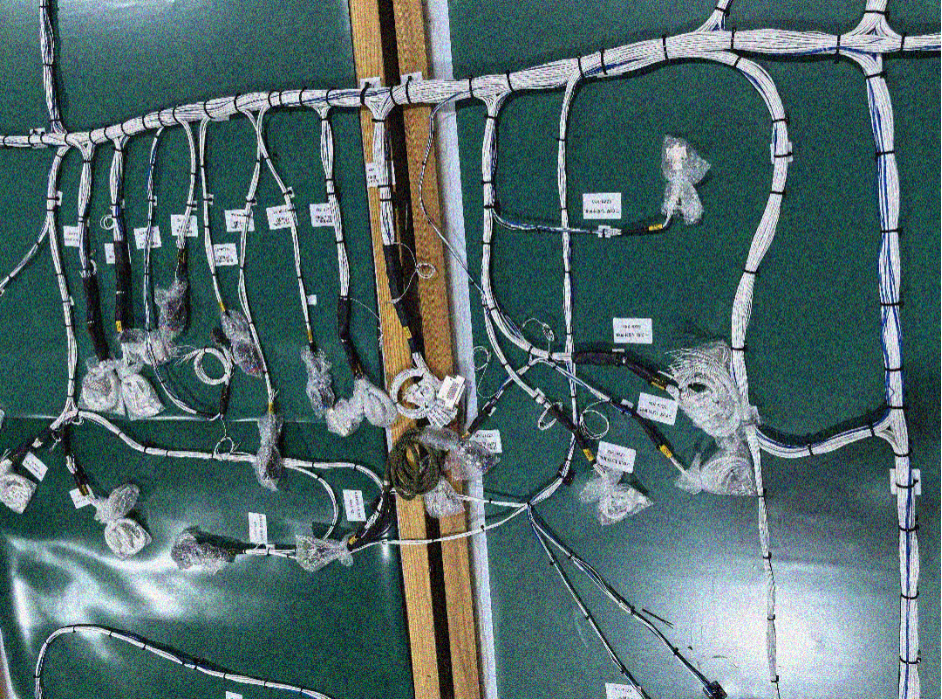
A model product (Image source: Company)
Beyond commercial aerospace, Beichen Aerospace also serves low-altitude and drone clients. In the low-altitude and drone sector, large drones (with payload capacity exceeding 1 ton) must provide complete electrical system interconnection design documentation during airworthiness certification, a requirement that traditional on-site wiring methods struggle to meet in terms of consistency and reliability.
Beichen Aerospace's "turnkey" solution intervenes from the schematic design stage for the entire aircraft's electrical system interconnection layout and drawing output, improving assembly efficiency through cable network prefabrication and modular installation, further ensuring mass production consistency and reducing flight risks, while providing assurance for clients seeking airworthiness certification.
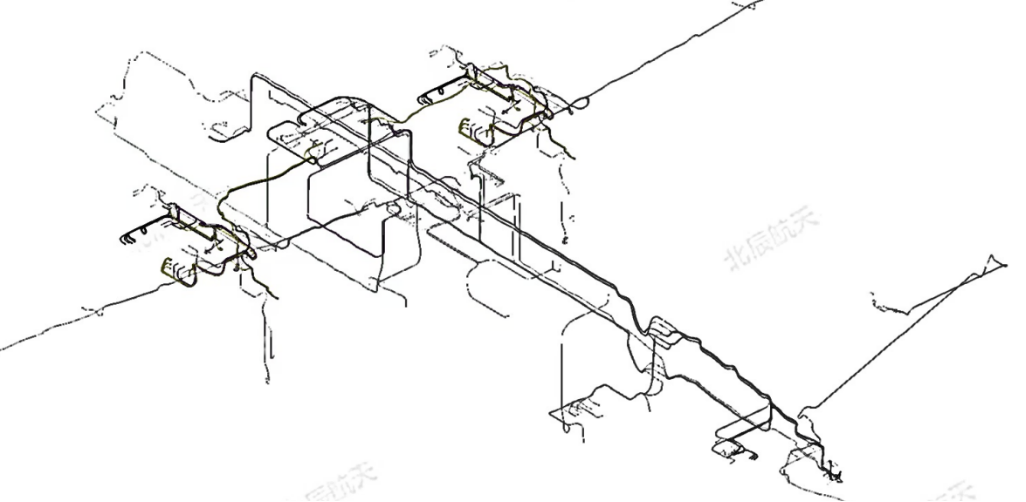
Aircraft nerve and blood vessel network (Image source: Company)
Currently, Beichen Aerospace has established stable product delivery capabilities, with revenue maintaining continuous growth for multiple consecutive years, reaching tens of millions of RMB in 2025.
Following the completion of this financing round, Beichen Aerospace will further expand production capacity, constructing approximately 2,000 square meters of R&D and production facilities, and completing related equipment configuration.


Excerpts from Hard Kr's Interview with Beichen Aerospace Founder Haifeng Man
Hard Kr:
Compared to rocket and satellite prime contractors building their own teams, what pain points can Beichen Aerospace solve that they cannot?
Haifeng Man:
First is experience. We've been focused on electrical system interconnection design since 2012, and the company was founded in 2014 — so we've accumulated over a decade of experience, approaching fifteen years. This kind of long-term engineering experience is difficult for most commercial aerospace companies to build up quickly. We've participated in over a hundred models, especially numerous national key models for system interconnection and configuration layout design. This brings not just quantity of experience, but depth of understanding of complex systems. For example, we've worked on many ton-class high-orbit satellites, while many current commercial aerospace projects are still in the several-hundred-kilogram class — the complexity difference between the two is substantial.
Second is specialized division of labor. We've long focused exclusively on the niche segment of electrical system interconnection and general layout, somewhat like a "specialist physician" — we're very familiar with the strengths, weaknesses, and risk points of this particular link.
Additionally, there's the practical issue of talent. High-level engineering talent is currently scarce in the commercial aerospace field, and such talent requires long-term model accumulation that is difficult to solve through short-term hiring or training.
We've produced large volumes of design drawings in the past, and with support from industry experts, we've also established a production system. We can not only do design, but also bridge through to manufacturing and delivery — this entire integrated capability cannot be built in a short time.
Hard Kr:
How specifically does Beichen Aerospace's solution achieve cost optimization?
Haifeng Man:
It can be understood on three levels. First is process restructuring. We've connected the entire chain from design to production into an integrated system interconnection subsystem that we lead and execute. Clients only need to provide requirements and interface data; we complete equipment layout and system interconnection design, then directly transition to production through our self-developed system. Under this model, an average satellite project design cycle is about 3 months, rockets about 5 months, and in fast cases even several weeks can suffice; compared to traditional models, the overall cycle can be compressed to roughly one-third. Time is cost.
Second is scaled procurement. Single-model material demand is limited, with weak bargaining power; but because we serve multiple clients, we can conduct batch procurement — for example, same-specification cables, specialized connectors — thereby gaining advantages in both pricing and delivery timelines.
Third is test equipment and tooling reuse. Under traditional models, each model requires separate test tooling configuration; but because we serve multiple projects, we can design for commonality, improving tooling reuse rates and thereby reducing test costs.
Additionally, as a market-oriented company, we have greater organizational and structural flexibility — whether in pricing systems or response efficiency — which is also an important reason we can continuously achieve cost reduction and efficiency improvement.
Hard Kr:
In the coming years, through what commercial means will Beichen Aerospace further reduce costs?
Haifeng Man:
What we currently call "turnkey" still mainly covers the client-facing segments of design, production, and assembly. But behind this, there is actually a complete upstream system — including supplier networks, material capabilities, manufacturing capabilities — these are what truly determine costs. As commercial aerospace and the low-altitude industry develop, we will also expand these capabilities, gradually completing the entire chain. The ultimate goal is that in the system interconnection domain, we can both guarantee aerospace-grade quality and make pricing more competitive.