Yunqi Capital | "Zhigu Tiancui" Closes Tens of Millions of RMB in Series A Funding, Letting Smart Cooking Speak Through Orders

Smart Cooking Robots Take Shape
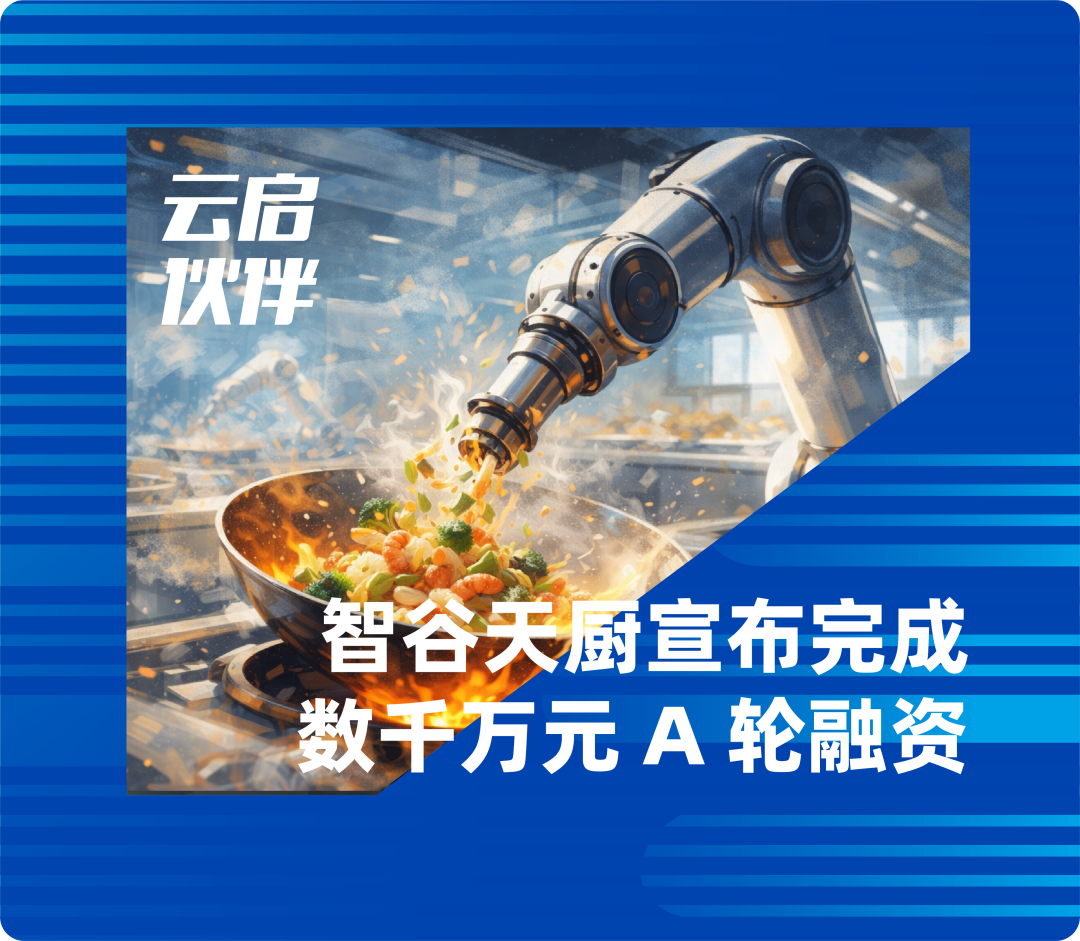
From mass deployment by chains like Country Style Cooking and JD.com's 7Fresh, to deep penetration into group dining and corporate catering, cooking robots are moving from "does it work?" to "is it worth replacing everything?"
Recently, Yunqi Capital portfolio company Zhigu Tiancu announced the completion of a tens of millions of RMB Series A round, with a brand upgrade slated for early 2026 — it will be renamed "Qianyi Intelligence." Yunqi Capital has backed Zhigu Tiancu since its Pre-A round.
At a moment when product stability, scenario adaptability, and integrated solution capabilities have become the industry's dividing line, this company with only an 8-person sales team that landed a record-breaking 150 million RMB order offers a notably representative case study.
Three months ago, we sat down with Zhigu Tiancu founder and CEO Kaiping Geng on our podcast for a deep dive into how cooking robots are transforming the traditional restaurant industry. In our ongoing coverage, product stability, scenario adaptability, and integrated solution delivery efficiency are emerging as the new fault lines in the smart cooking race — precisely where Zhigu Tiancu continues to widen its lead.
The following is adapted from Hard Kr.
Smart cooking robots are shedding their "concept" label and entering the eve of scaled deployment.
As brands like Country Style Cooking and JD.com's 7Fresh fully adopt cooking robots, a clear leader effect has taken shape. Restaurant owners who once hesitated are now knocking on company doors.
Rising market confidence is also showing up in capital flows. Cooking robot company Zhigu Tiancu recently closed a tens of millions of RMB Series A round. Concurrently, the company is undergoing a brand upgrade, officially changing its name to "Qianyi Intelligence" in early 2026. Since its founding, the company has raised multiple rounds from prominent investors including Yunqi Capital, with total funding exceeding 100 million RMB.
Behind the sector's heating up, product stability and scenario adaptability, operational efficiency, and overall solution service capabilities are becoming the new competitive dividing lines. In this trillion-scale yet woefully under-digitized traditional industry, the smart cooking transformation has only just begun.
8-Person Team, 150 Million RMB Record Order
Data from Tonghuashun's investment advisory platform shows that in 2024, China's smart cooking machine market reached 12.61 billion RMB, up 14.80% year-on-year; the commercial segment accounted for 57.23%, with chain restaurants and group dining driving penetration.
In the evolution of smart cooking robots from "usable" to "actually good," the ability to precisely respond to differentiated market demands is the key measure of core competitiveness.
Currently, Zhigu Tiancu divides its business into three segments: domestic social dining, domestic group dining, and overseas markets. It has built an efficient, refined operations system centered on customer scenarios.
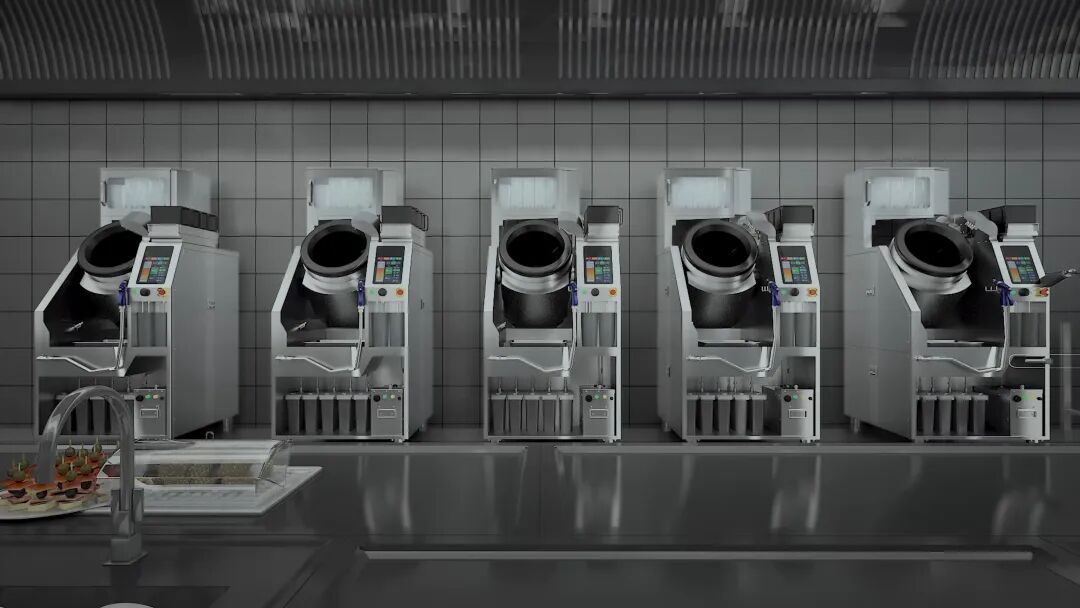
Notably: Zhigu Tiancu has established deep partnerships with major enterprises including Muyuan, Goertek, and Foxconn, and secured a record-breaking single order of 150 million RMB.
From Goertek's perspective, its partnership with Zhigu Tiancu was never merely a cooking robot procurement deal, but a joint exploration of a complete smart kitchen solution.
"When we were sourcing for this project, we put forward extremely challenging functional requirements that multiple suppliers initially deemed impossible or unrealistic," Goertek's head of corporate services told Hard Kr. "But Zhigu Tiancu responded to all of them, and demonstrated satisfying professionalism and execution throughout the partnership."
On organizational structure, unlike traditional人海战术 (human wave tactics), Zhigu Tiancu's sales team comprises just 8 people. The company primarily acquires customers through new media operations, content matrix building for targeted outreach, and diversified channels including referrals from existing clients. The company projects that order value will exceed 300 million RMB in 2026, including continued repeat business from multiple industry-leading customers.
This lightweight, high-efficiency model centered on product and word-of-mouth allows the company to concentrate advantage resources on R&D. Currently, R&D staff account for over 60% of headcount, forming a virtuous cycle of "R&D driving growth, reputation driving repeat business."
Diversified Scenario Layout + R&D-Driven Model, Building Core Moats
As controversies around pre-made dishes exposed the tension between standardization and consumer demand for freshly cooked food, and as chain expansion hit constraints from chef skill variance and rising labor costs, smart cooking robots are emerging as the critical variable to crack the "efficiency-taste-cost" trilemma.
Today, moving from single-unit robot procurement to full kitchen intelligence upgrades, Zhigu Tiancu offers customers one-stop integrated solutions, helping restaurants reduce costs and improve efficiency while boosting employee satisfaction.
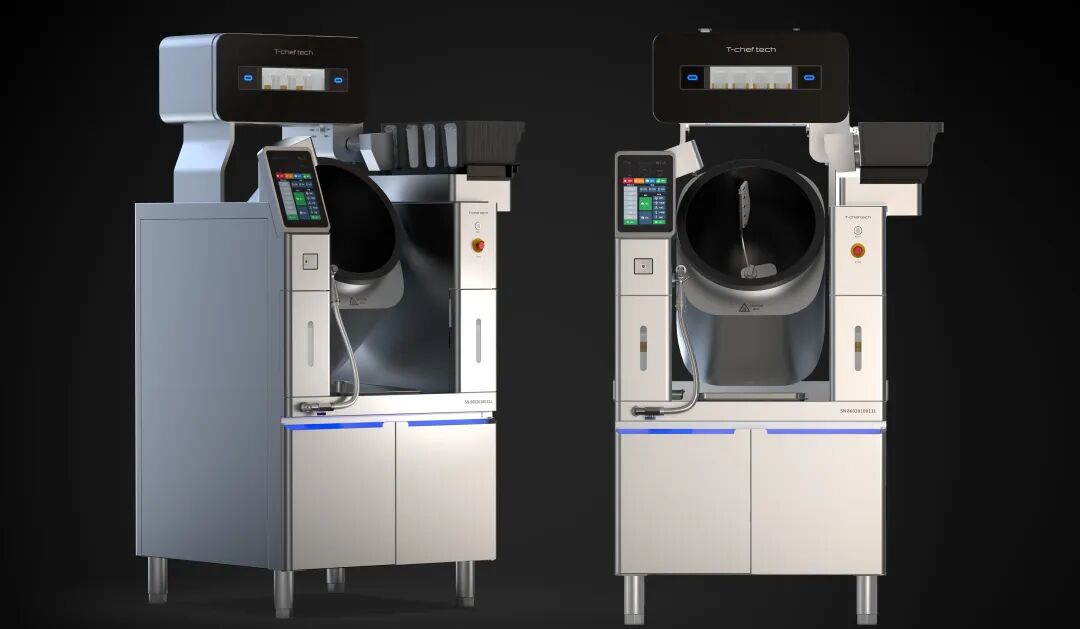
Zhigu's core advantage stems from its team's deep hardware DNA and profound industry insight. Founder Kaiping Geng has spent 20 years in the industry, working closely with seasoned restaurant veterans to form a rare "technology R&D + scenario deployment" dual-wheel drive model that achieves deep integration between products and actual kitchen environments from the ground up.
Based on its three business segments, the company's product architecture spans group dining, chain restaurants, overseas markets, and other scenarios, forming clear functional gradients and market positioning.
More critically, in the restaurant industry where stable operations are paramount, robot reliability often serves as a supplier's "veto power."
"Zhigu Tiancu has done very deep product definition, with extremely strict supply chain and manufacturing quality control," the aforementioned investor noted. "But more crucially, they've built a true closed loop in AI-hardware coordination."
Zhigu's self-developed AI dynamic heat control algorithms, full premixed combustion technology, combined with multi-channel sensors and a smart kitchen cloud platform, form an integrated "hardware + software + data" solution.
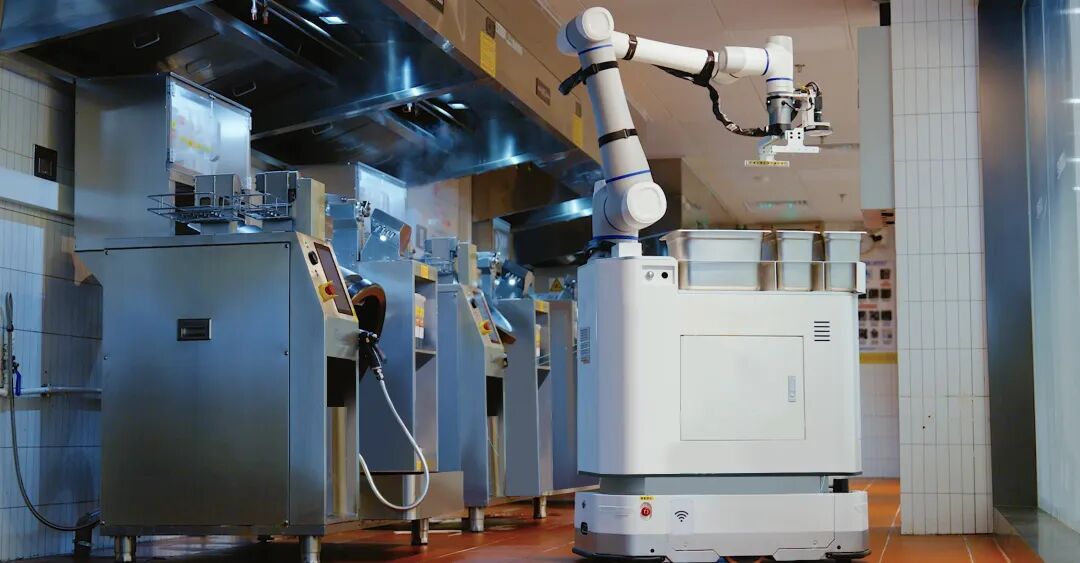
Robotic arm loading, fully automated operation
In this process, cooking robots aren't simply replacing chefs with machines, but experimenting with a new "human-machine collaboration" model.
This is also the evolutionary direction Zhigu Tiancu is actively exploring. Since last year, the company has assembled an embodied intelligence team led by post-90s PhDs, dedicated to developing a "culinary embodied brain." By collecting and analyzing cooking process data from different cuisines, regions, and scenarios, combined with reinforcement learning and other AI techniques, the company aims to achieve intelligent decision-making and autonomous optimization in heat control and dish production workflows.
"What we're building isn't just a commercial cooking robot, but a 'cooking brain' that deeply understands restaurant logic and continuously evolves," said a Zhigu Tiancu business partner.
In his view, fusing technological innovation with real-world restaurant expertise is the critical leap to truly move smart cooking from "feature phones" to "smartphones." As the culinary embodied brain capabilities advance, Zhigu Tiancu is gradually upgrading from a robot equipment supplier to a smart kitchen integrated solution provider.
Accelerating Overseas Expansion, Capturing the Global Hundred-Billion Market
Currently, with persistently high overseas wages and chef shortages, plus elevated post-pandemic hygiene standards for food service, smart cooking robots are showing strong growth potential in international markets.
In its globalization push, Zhigu Tiancu has demonstrated extreme efficiency and precise scenario control. A Zhigu Tiancu business partner told Hard Kr that since October this year, the company's daily overseas client visits have grown three to fourfold, with an overall conversion rate reaching 50%.
Zhigu Tiancu's overseas exploration rides the wave of "Chinese manufacturing + mega-infrastructure going global," creating opportunities for overseas group dining market development.

Zhigu Tiancu overseas layout
Given the pain points of long service radius and difficult localized support overseas, the company has built a comprehensive service system of "modular products + local hardware support + remote software service." In regions where grid-based service is impractical, modular design lowers maintenance barriers, with local repair support provided to customers, combined with remote software operations and maintenance, ensuring stable product performance.
This model has already successfully launched in North America, Europe, Australia, Japan, Vietnam, Thailand, Indonesia, Malaysia, and other countries and regions.
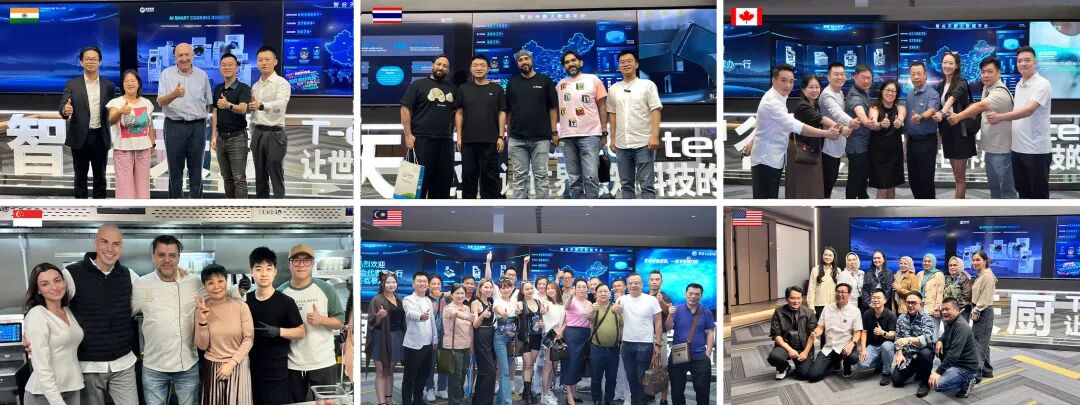
From a technically mature cooking robot company, to a leading smart kitchen integrated solution provider, and now aiming to become a global leader in full-stack smart kitchen solutions, Zhigu Tiancu's development path clearly traces an industrial upgrade trajectory from "hard" to "soft," from "point" to "surface."
Zhigu Tiancu is going from China to the world, redefining the global paradigm for smart kitchens.