"Zhì Píngfāng" Robot Launches New Model — What Can It Do With Its New "Brain"? | Yunqi Capital

Equipped with a full-body, full-domain VLA large model, exploring new possibilities for intelligence.
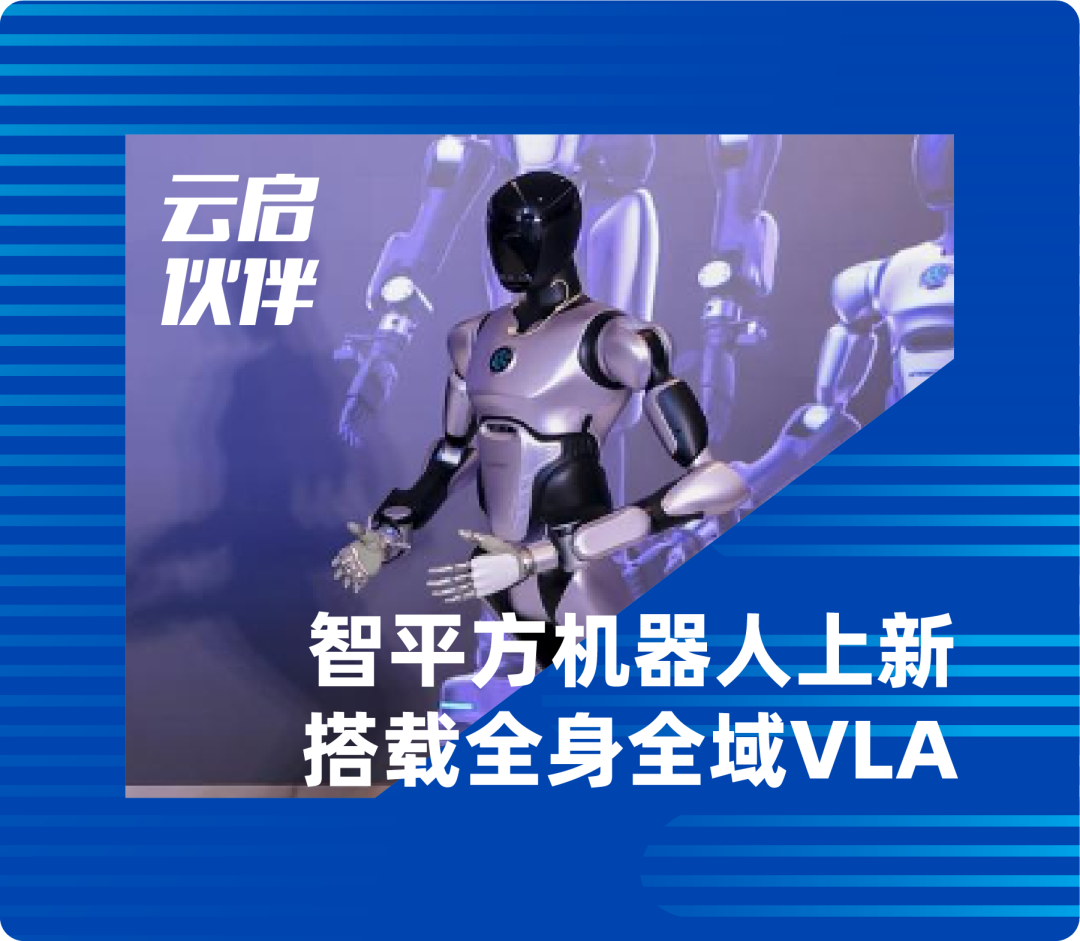
On April 17, embodied intelligence company and Yunqi Capital portfolio company AgiBot (智平方) unveiled its next-generation general-purpose intelligent robot, AlphaBot 2, in Shenzhen. The company also announced a comprehensive upgrade to its "AGI Terminal" strategy, spanning technology upgrades, product iteration, proprietary production line construction, and commercialization targets. This edition of "Yunqi Capital" takes you through the details.
➤ Key Highlights
- Launched the world's first general-purpose intelligent robot powered by the embodied large model Alpha Brain
- Alpha Brain is AgiBot's full-stack, self-developed Global & Omni-body Vision-Language-Action (GOVLA) large model, breaking through traditional single-task limitations to achieve end-to-end vision-language-action coordination
- Entered the biotech manufacturing sector through partnership with Bloomage Biotech
- Embodied products expected to roll out at airports and in communities in Q3 and Q4 this year
- Officially launched proprietary production line construction
The following content is adapted from AgiBot.
AgiBot is dedicated to extending AGI from the digital world into the physical world. At the product launch event, Dr. Yandong Guo, AgiBot's founder and CEO, said: "Every few years, a remarkable intelligent terminal emerges that changes how people live. After PCs, smartphones, and smart vehicles, we are once again at a critical juncture of intelligent terminal transformation."
AgiBot believes the previous three waves of intelligent terminal transformation share one common thread: human-machine interaction becomes increasingly seamless, and intelligent terminals can perform diverse tasks across multiple scenarios. This is the essence of intelligent terminals. As a new type of terminal defined by general intelligence, general-purpose intelligent robots — powered by multimodal perception, rapid learning, autonomous decision-making, and execution capabilities — will become the fourth generation of revolutionary intelligent terminals.
AlphaBot 2 represents the culmination of this vision. As the world's first general-purpose intelligent robot equipped with the embodied large model Alpha Brain, AlphaBot 2 achieves end-to-end coordination of vision, language, and action, breaking through the single-task training limitations of traditional robots and demonstrating powerful generalization capabilities and adaptability in complex industrial and public service scenarios.
01 New Technology
AlphaBot 2 Powered by Full-Stack Self-Developed Global & Omni-Body VLA Large Model
The key distinction between general-purpose intelligent robots and their predecessors lies in being driven by a general-purpose embodied large model. As one of the earliest companies in China to propose and systematically develop the end-to-end VLA (Vision-Language-Action) technical paradigm, AgiBot is a proponent, practitioner, and leader in embodied large models. Since its founding, AgiBot has adhered to three core elements of embodied intelligence: spatial intelligence, end-to-end VLA, and vertical hardware-software integration, developing the domestically autonomous and controllable embodied large model AI2R Brain. AI2R Brain leads globally in generalized task success rates and on-device operational speed, earning AgiBot national-level certifications and prestigious technology awards.
At this launch event, AgiBot announced that its original embodied large model brand AI2R Brain has been officially upgraded to Alpha Brain. According to Dr. Guo, Alpha Brain's most critical feature is AgiBot's full-stack self-developed Global & Omni-body Vision-Language-Action (GOVLA) large model — a vision-language-action model capable of operating from desktop to open environments, from single-arm to full-body coordination, and from simple tasks to long-horizon reasoning. This represents a comprehensive upgrade of VLA technology, designed to enable intelligent terminals such as robots to achieve efficient interaction and autonomous action in full-body coordinated control and all-scenario task coverage.
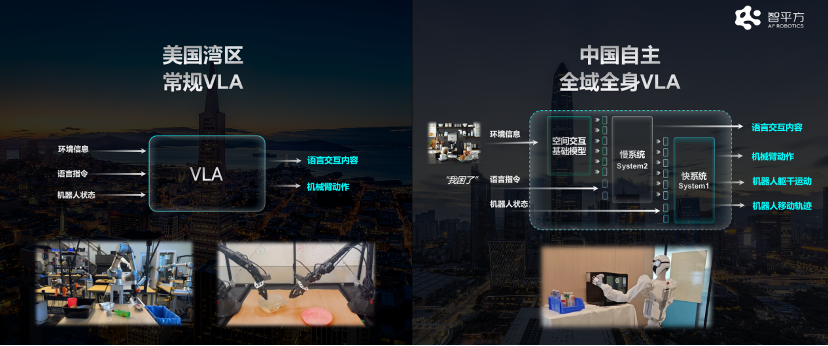
AgiBot's full-stack self-developed GOVLA
The GOVLA large model consists of three components: a spatial interaction foundation model, a slow system, and a fast system. By parsing user instructions (such as voice commands), real-time environmental information, and robot status, the dual systems collaborate: Slow System 2 handles complex logical reasoning and task decomposition, outputting language interaction content; Fast System 1 outputs robot full-body control actions and movement trajectories, balancing real-time responsiveness with complex decision-making capabilities. Notably, while conventional VLA large models only output robotic arm actions, the GOVLA large model is the first to propose outputting full-body control and movement trajectories.
Dr. Guo offered an example of a robot preparing breakfast: a robot equipped with a conventional VLA large model requires a person to place ingredients on a table within the robot's field of view, as it can only see and operate on the table surface, and still needs human assistance afterward; by contrast, a robot powered by the GOVLA large model can perceive its surroundings in 360°, retrieve ingredients from the refrigerator itself, prepare a healthy breakfast with proper proportions, and deliver it to the dining table — completing a butler's full-chain service. This is the fundamental difference between a robot butler and an automated device.
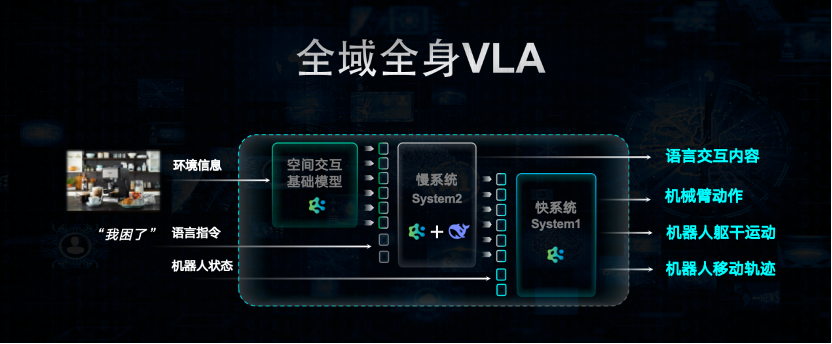
First integration of DeepSeek technology into VLA large model
According to the company, AgiBot is the first to integrate DeepSeek's technology into the construction of VLA large models, enhancing GOVLA's reasoning capabilities and endowing robots with comprehension and analysis of long-horizon complex tasks, building the strongest domestically controllable global & omni-body VLA model.
At the launch event, the "Peking University–AgiBot Joint Laboratory on Embodied Intelligence" was officially inaugurated. Leveraging Peking University's deep academic foundation and outstanding research capabilities in artificial intelligence, robotics, and other frontier fields, combined with AgiBot's technical expertise in end-to-end embodied large models, spatial intelligence, and robotics industrialization, the joint laboratory is committed to breaking through frontier technical challenges in embodied intelligence such as 4D world models and end-to-end intelligent agents.
02 New Product
Smarter AlphaBot 2 — The New Generation of Intelligent Terminals Defined by Alpha Brain
The general-purpose intelligent robot AlphaBot 2 unveiled at this event is a new generation of intelligent terminals defined (Defined) by Alpha Brain. It possesses exceptional spatial intelligence and powerful learning capabilities, able to complete diverse tasks without training, rapidly master new tasks, and stably adapt to various changes.
Beyond its smarter brain, AlphaBot 2's hardware architecture fully accommodates Alpha Brain's new characteristics of full-body control and global reach: 360°×360° full-space detection and perception, 34+ degrees of freedom across the body, a waist-leg lifting structure with vertical working range of 0–240cm, single-arm reach of 700mm (excluding end effector), delivering wide activity space, flexible manipulation capabilities, and superlative endurance (continuous operation 6h+), making it the general-purpose intelligent robot most optimally matched to the GOVLA large model.
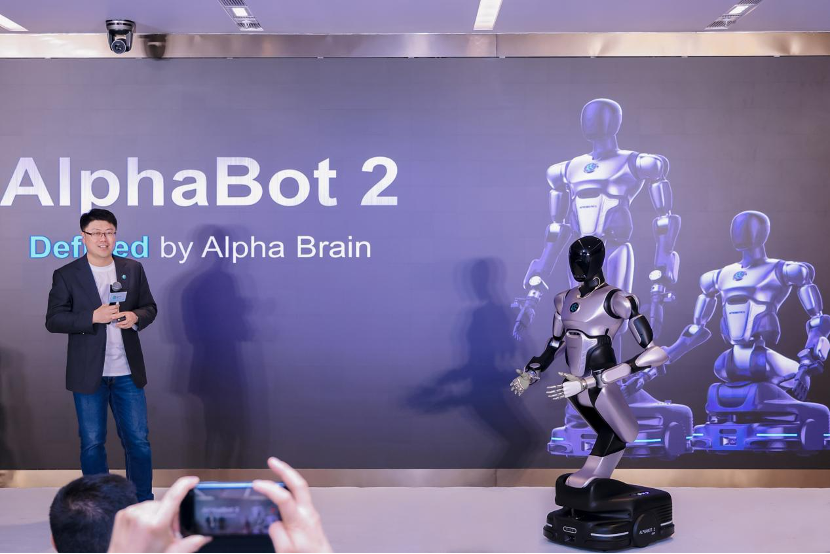
AlphaBot 2 makes its debut
In fact, AgiBot's ability to create a robot like AlphaBot 2 that can adapt to multiple scenarios and accomplish diverse tasks stems from its outstanding vertical hardware-software integration capabilities. The AgiBot team was among the earliest in the industry to emphasize and persist with vertical hardware-software integration, and represents the general-purpose intelligent robot OEM segment.
The AgiBot team brings extensive experience in mature mass-production edge deployment, having supported stable local operation of hundreds of millions of intelligent terminals (spanning vehicle infotainment systems, smartphones, IoT devices, etc.), and maintains deep partnerships with mainstream domestic and international chip vendors, with cross-platform high-performance deployment capabilities adaptable to different compute environments — an important technical foundation for embodied intelligence commercialization.
In terms of complete machine hardware design and optimization, AgiBot employs a series of technologies including more rational structural design, module selection optimization, and motion control底层 optimization, enabling the hardware to fully exploit Alpha Brain's capability ceiling and adapt to diverse tasks in automotive manufacturing, semiconductor manufacturing, public services, biotech, and other sectors.
03 New Applications: Entering Biotech Manufacturing, Expanding to Airports, Communities, and Other Public Services
At this launch event, AgiBot and global biotech leader Bloomage Biotech formally announced a strategic partnership. The two parties will jointly develop general-purpose intelligent robot solutions for the biotech sector, injecting powerful momentum into the intelligent upgrading of the biotech industry.
AgiBot robots will eventually perform operations including coordinated material transfer, intelligent unpacking and disinfection, intelligent visual inspection, and multi-material coordinated intelligent feeding at Bloomage Biotech's factories, covering full-process automated operations. Moreover, in high-risk scenarios such as aseptic product filling and microbial culture monitoring, robots can replace human workers, preventing cross-contamination and reducing microbial contamination risks; their end-to-end learning capabilities also enable rapid adaptation to process change requirements. The two parties will also leverage Bloomage Biotech's mature nationwide supply chain system to advance robot deployment in industrial scenarios, genuinely enhancing productivity.
Previously, AlphaBot had already entered automotive manufacturing scenarios, directly competing with Tesla's Optimus and securing orders from international top-tier automakers. In March this year, AgiBot reached a strategic partnership with Jingneng Microelectronics, a subsidiary of Geely Technology, where AlphaBot efficiently performed loading/unloading and inter-line material transfer tasks through its superlative cross-task generalization capabilities at Jingneng Microelectronics' intelligent semiconductor production base. This year, AgiBot and Jingneng Microelectronics will jointly promote large-scale deployment of the AlphaBot series in semiconductor manufacturing scenarios.
With this, AgiBot has established a three-dimensional commercial layout across "Automotive + Semiconductor + Biotech" core manufacturing scenarios.
AgiBot's AGI terminal strategy uses industrial scenarios as an entry point, gradually expanding into public services, home services, and other domains, building a "technology-scenario-data" closed loop.
AgiBot also unveiled new public service scenarios — airports and communities — at the event. In Q3 this year, AgiBot's robots will go live at airports in China's first-tier cities, providing attentive services to travelers. In Q4, AgiBot's robots will be deployed in demonstration communities domestically, offering intelligent and warm services to residents. This marks a solid step forward for AgiBot's expansion from industrial services to public services.
04 Announcing Proprietary Production Line Construction
Accelerating Commercialization Through the "General-Purpose Intelligent Robot OEM" Model
As intelligent robot manipulation capabilities continue to advance, market demand for intelligent robots is poised to explode. In its analysis report Humanoid Robot: The AI Accelerant, Goldman Sachs projects that the global humanoid robot market will reach $38 billion by 2035, with shipments of 1.4 million units.
To timely meet this expanding market demand, AgiBot announced the official launch of proprietary production line construction at this event, and set forth phased commercialization targets: achieving 10,000-unit scenario deployment by 2028, striving to contribute one percentage point to Nanshan District's output value by 2030, expanding to million-unit scale by 2033, covering diversified scenarios including industry, logistics, and home services, and becoming a new calling card for Shenzhen.
"We are committed to building world-leading intelligent robots, starting from industrial scenarios and gradually expanding to broader application domains through continuous technology iteration and scenario validation, ultimately achieving what we envision as general-purpose intelligent robots entering millions of households and becoming ubiquitous intelligent terminals, just like smartphones and automobiles," said Dr. Guo.