"I want to do 0-to-1 things, to really drive some progress forward" | 5Y Tavern Vol. 13 x Tingting Technology's Chen Rui

Innovation never stops, and neither does the boundless joy of food or the preservation of culinary heritage.
Notes from a 5Y Capital Izakaya
This conversation took place at an izakaya in Shenzhen. In this edition of the 5Y Capital Izakaya series, we listened to Chen Rui, founder of Botinkit, share her story. Before starting Botinkit, Chen Rui worked at an intense pace in consulting while also opening multiple restaurants, exploring different paths, until she decided to build food robots for Botinkit. "I searched for many years, and finally found something that belongs to me."
At many junctures, Chen Rui — a post-90s entrepreneur — made hardcore choices: quitting her job with no safety net, venturing where no one had gone before, deliberately choosing the harder path. She is resolute and confident about this. "I just want to do zero-to-one things, and hope to genuinely drive some progress and change." We saw extraordinary energy in her, much like her company's name — "non-stop" is a spirit, a vitality. Innovation never stops, and the boundless enjoyment and transmission of food never stops either.
She shared much of what she sees in the future and the efforts she is making toward it. We hope it inspires you :)
Guests at this 5Y Capital Izakaya:
Chen Rui, Founder & CEO, Botinkit
Peter, Investor, 5Y Capital
He Kaiyan, Investor, 5Y Capital
01
Non-Stop: Never Stopping on the Path of Innovation
5Y Capital Izakaya: Have you been in Shenzhen since you started your company?
Chen Rui: I believe there's a certain energy between people and cities. You'll feel particularly attuned to some cities. I especially love Shenzhen — I really like that state of wild growth. I've been in Shenzhen and Hong Kong since university. The main theme of Shenzhen is striving, and it's very inclusive. It doesn't put limits on people, and it's still like that now.
Peter: I actually quite agree with the idea of city energy. I also feel very comfortable in Shenzhen.
What was your first restaurant, and where was it?
Chen Rui: In 2015, in OCT. It was a Japanese izakaya. It happened somewhat by chance — I really liked going to this style of restaurant, and after going back and forth I got to know the owner. Later the place was going to transfer, and a few of us friends took it over.
I started trying many things from university. In my third year, I started a food delivery platform that brought groceries to people's doors. At the time in Shenzhen we had many loyal customers. The Japanese restaurant opened after graduation.
He Kaiyan: You later opened a Western restaurant?
Chen Rui: It was a craft beer restaurant. Our consulting chef was Italian, and the food was quite authentic. Foreign customers made up 50% of our clientele, mostly regulars. But this category was very difficult to scale. Later we converted that place into a hot pot restaurant. After that we opened nearly 10 locations. In 2018, we were quite popular on Xiaohongshu and Douyin — the wait was basically three hours minimum.
Running a restaurant is a small sparrow with all five organs — from defining the product, to solving supply chain issues, to marketing, and so on. It's actually quite a grueling thing, not simple at all, but the process was also very joyful.
Peter: When did you first think about building food robots?
Chen Rui: In 2018, our own restaurants were already using dishwashing and food delivery robots. But for food and beverage operators, these aren't the core concerns. What people in the industry care most about are the dishes and taste. Delicious output is the first principle of this industry.
I also experienced some things at the time. Once, the head chef and the store manager had a fight, and the entire back-of-house team was going to quit collectively. But the restaurant still had to open normally the next day. A boss being held hostage by their head chef is a very common thing in the restaurant industry — it's like this in every country around the world. Another time, a junior chef mistakenly used vinegar instead of soy sauce, making the dish sour. The customer complained that we were serving overnight food. It even escalated to food safety inspections. Only after reviewing the surveillance footage did we discover the soy sauce-vinegar mix-up.
Also, our revenue was quite good at the time, but when you actually calculated the profits, they were extremely thin. The entire industry is like this. New dish R&D is especially difficult. Coming up with a new dish requires the head chef to innovate, then test and adjust repeatedly, then train the team — it takes at least two months.
The inability to scale the food preparation process is the most important factor limiting restaurant chains and global expansion. If you have 1,000 locations, you need to manage tens of thousands of chefs. Getting them all to make tomato and egg to a high, consistent standard is nearly impossible, let alone expanding to tens of thousands of locations or going global. Some overseas ten-thousand-location brands use industrialized solutions, but those are compromises made in the absence of good technology and good products.
We started researching from this point, and tried all the products on the market. We found there were no good products. In the process, we discovered that this matter goes far beyond simply reducing costs, increasing efficiency, or replacing humans. The most profound significance of food robots is actually digitizing the process of COOKING and the result of FOOD. For thousands of years, cooking and food have been based on human experience and habit — traditional, difficult to pass down, and difficult to spread across regions. Food robots will fundamentally change the way we COOK and reconstruct humanity's relationship with food.
For example, remote cooking. Today we cannot enjoy food made by a chef in Paris, but in the future we will be able to. Food carries very strong cultural and emotional characteristics, so it should be able to transcend time and space.
Another example: when ordering milk tea, you can choose less sugar, much less sugar, no cheese foam. 75% of HEYTEA users select personalized options. If when ordering food you could also choose less salt and oil, under 500 calories, or no chicken bouillon or MSG, I believe most consumers would select these. But this kind of fine-grained precision control is impossible with human production methods — only robots can achieve it. On top of this massive shift, the entire landscape of food-related scenarios will be reshaped.
This also fits my principles for choosing a direction to start a company. I want to do zero-to-one things. I want products that bring users a 10x better experience, not 2x. I want something that can genuinely drive human progress and create non-zero-sum value for the world. I want to keep doing it. For many years I hadn't found a vision that matched all my principles. Until the end of 2020, when I realized digital food and food robots were "The Thing," and decided to go all in.
02
Opening the New World of Digital Food
5Y Capital Izakaya: Food is closely tied to region and culture, and people's tastes can vary enormously. How do robots face these regional and cultural differences and make food that has "warmth"?
Chen Rui: Food is a complex system because it involves processing different ingredients, adding different seasonings, with different cultures and methods. Globally, there are nearly a thousand ways just to make stir-fried pork with chili peppers alone.
An AI Cooking Robot learns how different people cook. It initially starts with human demonstration. In the future, we believe it will surpass humans because it has access to so much high-quality data input. This engine is a supreme brain — through knowledge distillation and reasoning, it continuously generates. Robots can evolve continuously. On day one it can't cook, but it gets better and better. The world's greatest chefs teach it, and after learning, distilling, and optimizing, it advances further.
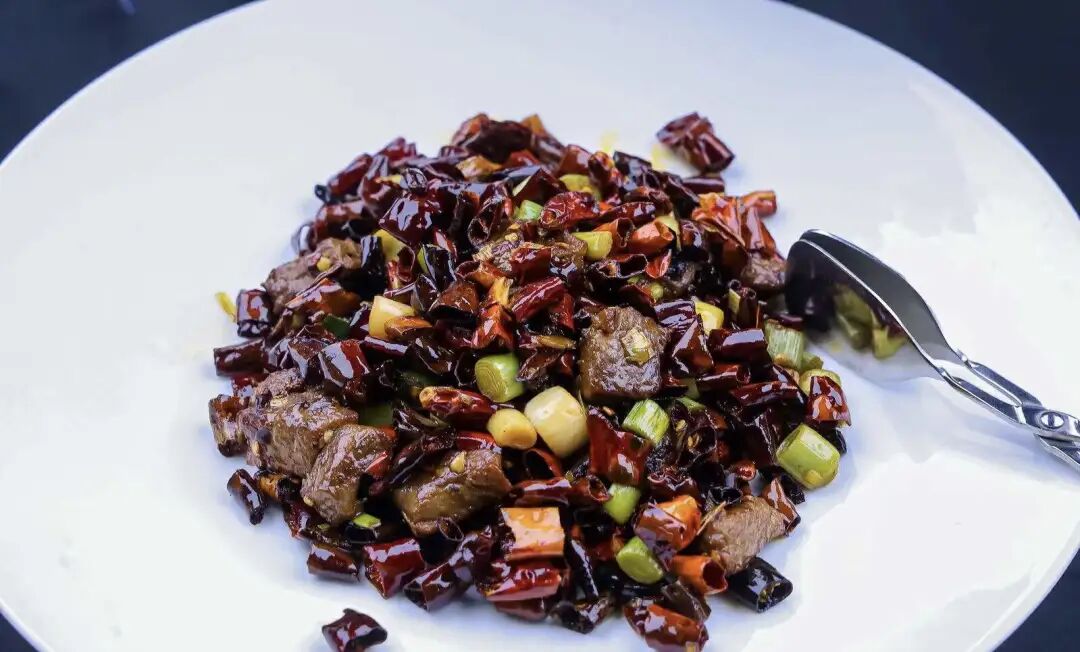
Dishes made by Botinkit's food robot
5Y Capital Izakaya: Many Chinese recipes also use vague expressions like "a little." I've also seen certain descriptions before, like how a particular baker's hand temperature makes bread taste better. How does a robot handle this kind of problem?
Chen Rui: "A little salt" also has a specific numerical value. "First high heat, then low heat" also has temperature values. They are fundamentally science — it's just that they weren't quantified before. People always thought they remained at the level of experience.
Cooking is something that demands extremely high precision control. There is much precise control involved. For example, hand temperature affects bread fermentation — you need to know what that hand temperature value is. It's like music: listening to a piece feels wonderful, but you don't know why. With digital music tools, you can analyze it very clearly — how it's distributed across different frequency ranges. It's just that there weren't research tools before. Through new science and technology, the entire process can be quantified.
Peter: Very interesting. Before the phonograph was invented, musical experience was very difficult to reproduce. Live performance was scarce and expensive — it was hard to imagine it becoming something mass-market, something you could experience repeatedly.
Chen Rui: Food and cooking are the first mile of life and health. Better food makes you a better person, makes you healthy and happy. But today, the world is moving toward industrial food. When food goes through multiple processing steps before reaching you, it becomes an industrial product. We don't think it should be this way. People should return to fresh ingredients, freshly prepared, with flavors that adapt to needs.
We are building the infrastructure of the digital food world. We particularly believe that food can circulate across regions, and that the connections between people will deepen through eating together.
03
A Group That Defies Definition
He Kaiyan: You discovered this need while running restaurants, but actually doing it is completely different from running restaurants. From idea to actually starting the company, how did this process unfold?
Chen Rui: After deciding to do this, I went to find my co-founder. He did his PhD in chemistry at RPI in the US. The reason I looked for him was that cooking is chemical change of multiple substances (ingredients) at different temperatures, so we believed an important part of cooking's essence is chemistry. Together with cooking science, food science, thermodynamics, robotics, and so on, this formed the first-principles underlying R&D path.
Also, because we needed to do hardware, we sought out the world's best teams working on food robots. There were some teams in Japan, Israel, and the US. Another co-founder was working on a salad robot in Silicon Valley at the time. We hit it off immediately.
5Y Capital Izakaya: How did you convince everyone to start a company with you?
Chen Rui: I think it was less me convincing them, and more everyone buying into the vision and wanting to make the future happen. We believe the future of eating won't be like today. We won't eat industrialized food anymore — people can eat fresh ingredients. Food can also transcend the boundaries of time and space. It's very similar to music: worth preserving, with artistic attributes.
Everyone's underlying foundation was the same, so after not much conversation we resonated, hit it off, and got to work.
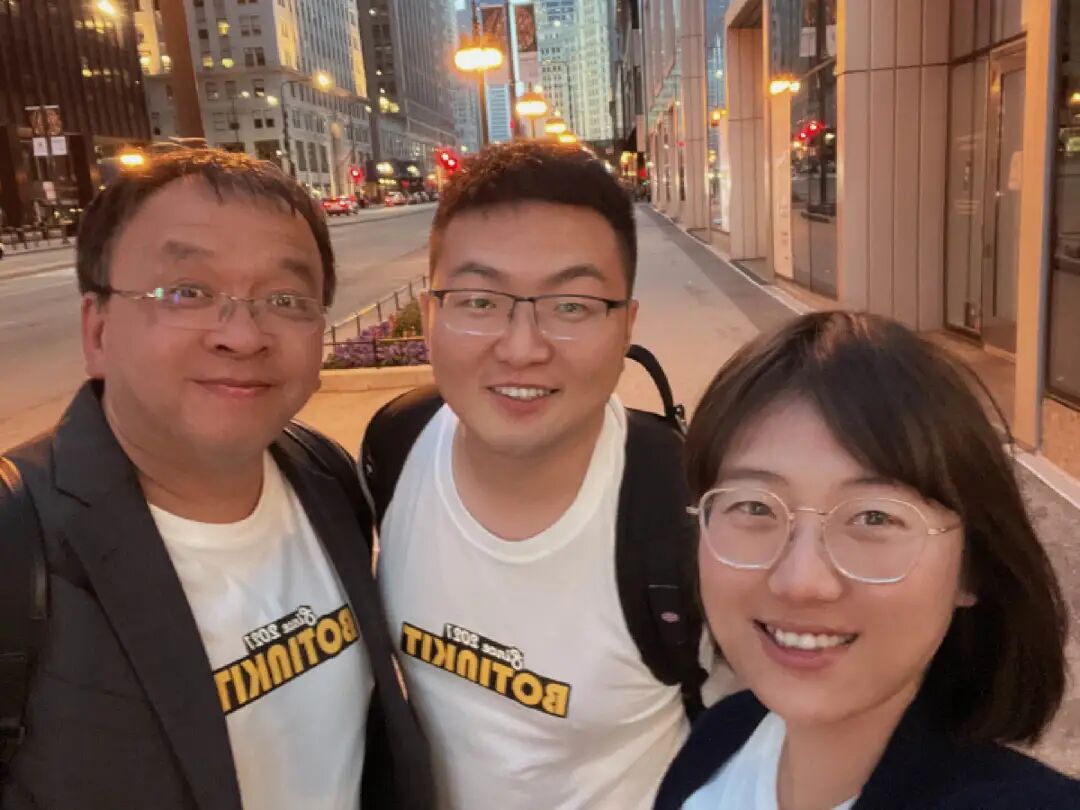
Chen Rui with her two co-founders, photographed in Chicago
after the NRA exhibition
Peter: For entrepreneurs, finding people with similar vision is still very important. How do you increase the probability and possibility of finding such people?
Chen Rui: First, you definitely need to expand the base — meet more people. Then find people whose underlying foundation aligns with yours. You need to know what drives them, whether they hope their products can change people's lives, and whether their way of working is first-principles, whether they pursue excellence — these are probably in their values.
Whether you can see the same future is also very important. Some people can't see it, and are hard to ignite. Only the same kind of people can have a common language and feeling, and can move forward together. So we need people who have imagination about the future and the ability to realize it.
He Kaiyan: Our values also believe in founders crazy enough to want to change the world, so we came together.
Chen Rui: I think some of Botinkit's team members might not survive elsewhere either. We are all undefined. We are a group of such people, constituting this kind of soil. We don't have so many secular rules and frameworks. Our team members are all people with strong inner cores and persistence.
Sometimes when chatting with potential team members, we discover they originally also had fiery hearts inside. But for various reasons, their edges have been worn smooth, like products from an assembly line mold, afraid to try crazy, unprecedented explorations that conform to first principles. But even if it's a young person, we especially want to find what's unique in them — their talents and individuality. They are living people. It's these unique personalities and persistence that constitute this team.
We have a shared understanding: products and brands aren't made — you are what they are. It's this group of people that shapes the product. It's the externalization of each of our souls and attitudes.
Peter: Why did you choose the name Botinkit?
Chen Rui: We started with the English name. We wanted to do bot in kitchen — bot in the kitchen, abbreviated as BOTINKIT. After settling on the English name, we wanted a Chinese name that was interesting, meaningful, and spirited.
BOTINKIT in Chinese happens to be "不停" (non-stop). Non-stop is a spirit, meaning we never stop on the road of innovation and product-making. The boundless enjoyment and transmission of food — this also never stops. I think it's a vitality.
What's especially coincidental is that later when we Googled this name, we discovered that the oldest continuously operating restaurant in the Guinness World Records is called "Botín Restaurant," founded in 1725. I feel this is a kind of fated coincidence — non-stop also has this kind of enduring vitality and perseverance.
04
Achieving What Others Consider Impossible
He Kaiyan: Digital food is something entirely new. Using robots to achieve cooking is still not a widespread consensus even now. What did the first person to believe in you see?
Chen Rui: In my view, if the founder isn't all in, then the thing isn't worth others believing in. So when we first started, I began with my own money. Later I met investors willing to believe in us.
We should be the first in the world to combine AI and Cooking Robots. There was no precedent anywhere in the world, so it was hard for people to imagine the product. People who can see the future are already rare; among them, those willing to believe in us are even fewer. Later, perhaps people saw that we really wanted to make this happen, and investments and partnerships followed.
5Y Capital Izakaya: Kaiyan and Peter, how did you find Chen Rui, and why did you believe in her?
He Kaiyan: Cooking has always been a major scenario we pay attention to. After communicating with Chen Rui's team online, I went to Shenzhen for an on-site visit. I previously thought it might be a stewed texture, without wok hei, and wouldn't taste good. But I was surprised by the dishes Botinkit's robot stir-fried. I watched the robot cook 10 dishes with my own eyes, then tasted them and found them delicious. I could see this team could deliver the product and results. I also saw that spirit of refusing to lose in Chen Rui, very visionary. I remember immediately calling Peter after our conversation to say, this woman has especially strong entrepreneurial spirit and traits, very different — you must come see for yourself.
Peter: We often appreciate somewhat strange founders — undefined, rule-breaking, even seemingly somewhat unreasonable.
He Kaiyan: Beautiful futures and visions are what we collectively aspire to, but putting them into practice is still very difficult, and there's quite a long road to the endgame. In this process, have you felt pressure and uncertainty about the path?
Chen Rui: Uncertainty doesn't seem too bad to me, because internally I become more certain by the day. The longer we do this, the clearer the path becomes. Regardless of what others think, we are very clear on how to make this succeed. For me and our team, uncertainty is continuously decreasing.
I think entrepreneurs often need to toggle back and forth between idealism and realism. You need idealism because the process is so arduous — without belief, you can't move forward. But you also need realism. For example, the product must be mass-produced; you must get orders back in the shortest possible time, no time to dawdle.
Starting a company is quite撕裂 (tearing), but for me it's also a tempering process. I feel like I've been shattered and rebuilt again and again.
He Kaiyan: Whether in product direction or life choices, your choices have always been quite hardcore — like quitting without a safety net, then entering the hardware industry which you previously knew nothing about. You chose very difficult paths with no predecessors to reference, requiring original creation. Do you think this is something in your DNA, or a way of thinking?
Chen Rui: I think it's in my DNA. For example, in high school I didn't do homework because I felt I already knew it, and writing it out was a waste of time. I would check off all the test papers, leaving only the last two problems. At the time I told the teacher, learning is my own matter — I'm willing to spend time on the last two problems, not mechanically writing out what I already know. But my grades were very good.
In high school I was obsessed with physics. I divided my day into two halves — three hours on physics, three hours on the last two problems of other subjects. I spent two and a half years self-studying all physics competition and university physics knowledge, out of passion, and achieved good results. I skipped some classes too. This might be a kind of self-awareness, being responsible for oneself, not caring about other things.
Peter: Perhaps because of your previous physics training, you're accustomed to deconstructing problems with first-principles thinking. Many people think lack of experience is a major bug, or not being an engineering major. But for truly innovative things, having no experience is quite good. In the process of trial and error, using first-principles thinking rather than analogy and experience is a better habit.
I also often reflect that doing too much investing, it's easy to use analogy, induction and deduction, abstractly analogizing certain business laws and world laws, finding similarities in human history. But you'll discover that teams that truly make exceptional products often don't succeed because of analogy, but because their first-principles design philosophy and direction are correct.
Chen Rui: I recently found Kenneth Stanley's Why Greatness Cannot Be Planned quite good. He believes small innovations come from planning, while great innovations come from stepping stones — they're all explored, with no plan to follow.
At the beginning you know the lighthouse is there but don't know what the channel looks like, with much fog. But as you walk, you discover these reefs connect into a line, and the channel gradually becomes clear. I feel this deeply — sometimes you simply can't plan, because this didn't exist in the world before. Believe in the lighthouse. Many paths emerge as you walk them.
He Kaiyan: You're not planning, you're making it happen.
Chen Rui: Of course we also step into many pitfalls. We've stepped into many in every segment — product, R&D, sales. But when we discover something's wrong, we quickly correct it. It's a process of error correction.
The Power to Attract Giants
Build Rome
He Kaiyan: Chen Rui has received a lot of positive feedback on achieving what others consider impossible, and has great confidence. Some also question whether it's because you haven't encountered direct competition yet — the field is still early, with no strong players / major companies competing?
Chen Rui: We have always believed that for category creators, when the battle officially begins, the war should already be over — first secure victory, then seek battle. At this point you need to think clearly enough and execute well enough. By the time others enter, we will already have multi-dimensional moats built over many years of preparation, not a momentary impulse.
He Kaiyan: When you encounter something very difficult to solve, do you reveal your vulnerability to the team?
Chen Rui: No. Internally we have always felt this is a battle, with everyone having their own battlefield to fight on. You handle your thing, I handle mine. I hope everyone is like a soldier, back-to-back, getting things done on their respective battlefields. I am the same. If I can't handle what I should handle, I can't accept it myself.
I have always firmly believed that if you truly want to do something in your heart, there's nothing you can't accomplish, though it may be very difficult. Kazuo Inamori and Elon have greatly influenced me. What most moved me about Elon is his perseverance and framework for understanding the world through physics. Kazuo Inamori had an important view: when you truly want to accomplish something and give it your all, the universe will help you.
5Y Capital Izakaya: Of all your previous experiences, what was the biggest setback you encountered?
Chen Rui: It depends how you define setback. For example, I wasn't a traditionally obedient good student, and encountered much criticism and lack of understanding. But all my ideas from university were later proven right, including the grocery delivery platform. My perception of demand was correct — I was just very young then and didn't know how to solve it commercially.
Right after graduating university I was quite down. I was working at KPMG at the time, with extremely high work intensity — 8:30 a.m. to 11:30 p.m., handling many things simultaneously. I could handle all of these and achieved labels of success in the secular sense. But I suffered from not finding meaning in life, to the point of wanting to quit every month. At the time I chose to study, took many certifications, put myself in a very tight state. Though I gained many external things during that period, I wasn't happy inside. I felt surrounded by strong insecurity, not wanting to reach the end of life and discover it had been wasted.
After starting a company, the difficulty of things increased dramatically. Though very difficult, with much pain, the underlying feeling is happiness. The process of entrepreneurship nourishes me. Some previously suppressed things have been strengthened. This is a process of self-growth, so it's happy.
People must find meaning in what they do — otherwise how can you survive the hardships. I waited many years for something that belongs to me, so I cherish it very much.
Peter: A founder previously said the luckiest thing is finding a place where a founder's ambition can rest. Many entrepreneurial opportunities are simply红利 (dividends) that quickly pass. Your thing is something that can be done for ten or twenty years.
As investors, we also often see founders in pain. Many are very capable and have entrepreneurial traits, but haven't found the right thing, or the opportunity has already been taken by others. Before finding this direction, you also went through many painful processes. For many young post-95s, post-00s entrepreneurs, what advice do you have? When they have many strange ideas and refuse-to-lose thoughts, but the world doesn't seem to open many windows for them — what should they do?
Chen Rui: I think you must find something you truly love before setting out. You can't start a company for the sake of starting a company. Find the belief in your heart, something you won't regret even if you're shattered for it.
They should see the future, not copy. Seeing a future that remains unfulfilled for so long — this is too painful. If they don't do it, no one can push this thing to happen, so they can't not do it. At that point you can't stop, because not doing that thing, you'll feel every day is wasted.
The search process is definitely very difficult — not something you can decide on a whim, perhaps taking several years. Finding it is a great fortune in life. In this process you still need to accumulate capabilities.
If you find this thing, you will feel it yourself. At that point just do it — whatever's missing, supplement it. But you must find the shoulders of giants, can't just mess around on your own. You need to know who understands this thing best, and have the ability to convince them to join you. A person's capability scope isn't determined by themselves, but by how many impressive people they can attract to join — this is their capability boundary. You need to attract the power of giants, and build Rome.
Feel free to share your views on food robots in the comments, or questions you'd like to discuss about the article. We will select 3 featured comments to receive a mystery gift package from 5Y Capital portfolio companies.
Note: The deadline for this activity is 18:00 on September 10, 2023. Please reply with shipping information within 24 hours of receiving notification.
5Y Capital seeks, supports, and inspires lonely entrepreneurs, providing support from spirit to all operational matters. We believe that if the you whom others see as crazy begins to be believed in, the world will become refreshingly different.
BEIJING · SHANGHAI · SHENZHEN · HONG KONG