How Far Are General-Purpose Robots From Human Society? | 5Y 3Sigma Roundtable

A new 5Y 3Sigma roundtable is now open for registration — sign up if you're interested.
When machines connect with human traits like consciousness, emotion, knowledge, and self-awareness, what new possibilities emerge? Can general-purpose intelligent robots completely replace functional, specialized robots? What does Tesla's humanoid robot Optimus, unveiled on September 30, mean for the industry? How far are general-purpose robots from human society?
Behind general-purpose robots lies humanity's long-standing aspiration for artificial general intelligence (AGI), with different companies exploring in different directions and ways. In the third edition of the 5Y 3Sigma Roundtable, we focused on this topic. Nine entrepreneurs and researchers in this field shared their perspectives and insights on general-purpose robots.
We've excerpted some of the highlights, hoping they inspire you. Also, the next 5Y 3Sigma Roundtable will be held on November 6 (this Sunday). Welcome to scan the QR code in the poster at the end of this article to register and join the sharing and discussion : )
From Specialized Robots to General-Purpose Robots
Peter, Managing Director at 5Y Capital
To discuss general-purpose robots, we must first return to AI scenarios and opportunities. After autonomous driving, we've been thinking about the next massive AI scenario, which led us to the enormous opportunity of robots combining with AI over the next decade.
The vigorous development of the robotics field in recent years has revealed an interesting phenomenon: successful robot products today all have typical specialized-machine attributes. Examples include the da Vinci surgical robot, DJI's aerial photography drones, and the rapidly growing commercial and application directions of the past five years: warehouse robots and robot vacuums.
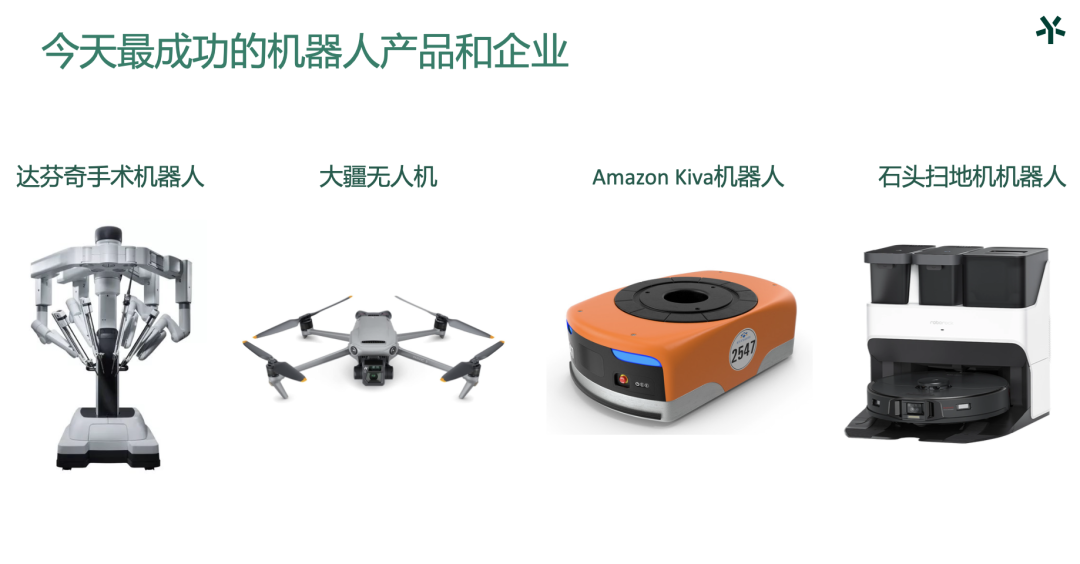
These robotics companies all share one characteristic: they provide a proprietary skill in a high-value domain or massive market, creating direct value for users. By definition, they still belong to the category of specialized robots. Comparing this to the history of smartphones, we can't help but ask: does the robotics field also have an opportunity to transition from specialized to general-purpose?
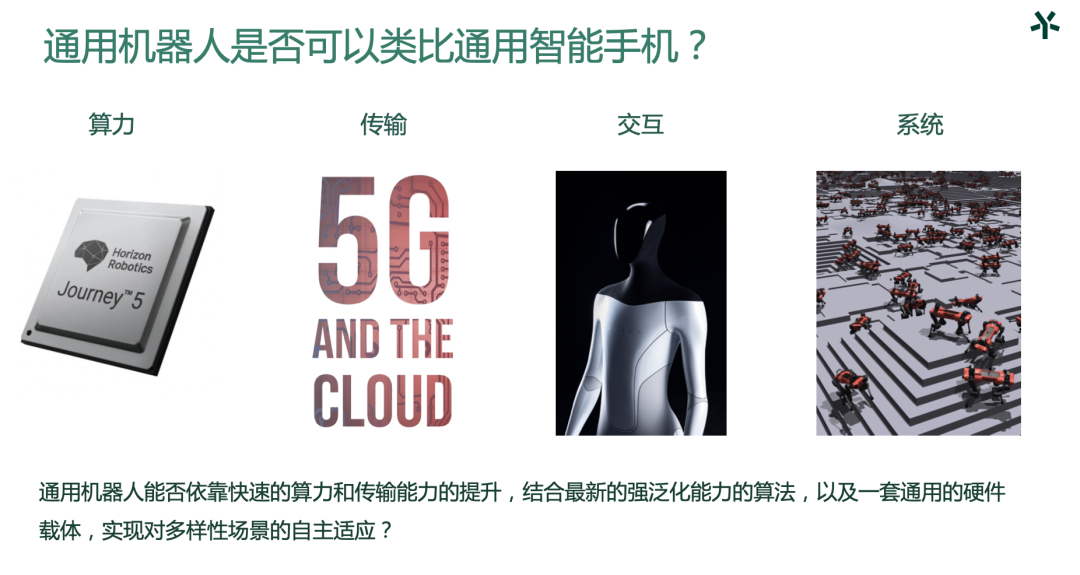
Taking the history of mobile phones as an example, how did a smart terminal evolve from the feature phone era to the smartphone era? I believe there are several key elements. First, computing power and communication capabilities. In the early 2000s, ARM emerged as a low-power, high-performance processor, while 3G networks appeared around 2006–2007, coinciding with the iPhone's development. Additionally, Apple introduced the critical touchscreen, enabling humans to interact in a simple way for the first time. Finally, operating systems: without advanced operating systems like iOS and Android, software development and distribution would have been extremely difficult. On these foundations, feature phones were defeated by general-purpose smartphones for the first time.
So can general-purpose robots be analogized to smartphones at that time? From several dimensions, there are certain similarities. In computing power, we've moved past the simple stage of CPU performance increases. Due to deep learning's development, a large number of high-performance edge AI processors have emerged. At the transmission layer, the appearance of low-latency technologies like 5G has brought enormous improvements compared to ten years ago.
More critically, at the interaction level, all previous robots essentially faced specific scenarios and hardware. Now, companies including Tesla are actively researching humanoid robots, attempting to unify interaction scenarios for robots. This is also a very important change, because only humanoid robots can ideally adapt to different interaction scenarios in human living environments.
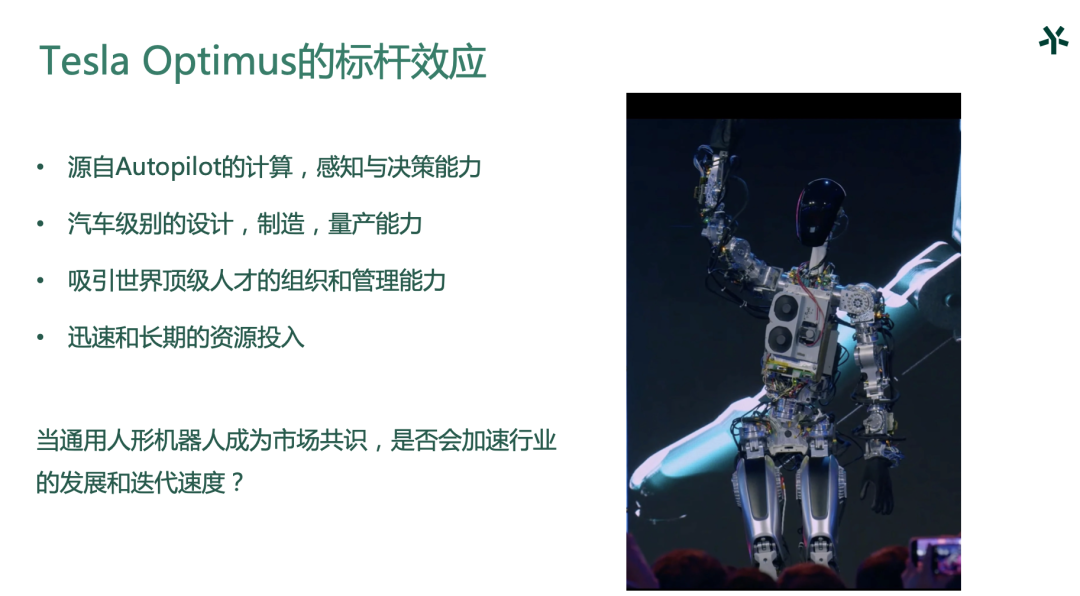
Tesla unveiled its humanoid robot Optimus on September 30, which has strong benchmark significance. Tesla is a company with genuine large-scale automotive-grade mass production capabilities, supply chain capabilities, and algorithm capabilities, with continuous resource investment. Under these conditions, the humanoid robot market may reach consensus more quickly. We're also seeing many companies entering this market, iterating and trying in different ways. We took this opportunity to invite everyone to join the discussion.
5Y Capital pays close attention to innovative robotics companies. We also hope to exchange the latest technical insights and entrepreneurial ideas with you through such events, and to identify and accompany more top Chinese tech entrepreneurs, becoming their earliest, longest-term, and most influential partners.
Roundtable Discussion: Development of Legged Robots
Participants:
- Helei Duan, PhD candidate in Robotics at Oregon State University
- Wei Zhang, Tenured Professor at Southern University of Science and Technology
- Xinliang Zhang, Engineer at Tsinghua University AIR
Moderator:
- Peter, Managing Director at 5Y Capital
Peter: Regarding Tesla's release of Optimus, perhaps everyone can briefly share which aspects exceeded your expectations or previous understanding?
Xinliang Zhang: The overall system probably didn't exceed most people's expectations, but I feel it follows a company's normal R&D process. What somewhat exceeded expectations was some motor selection aspects — Tesla indeed has rich experience in car manufacturing, and their motor design is very systematic. Also, the perception part: with chip support, being able to use such inexpensive cameras to complete mapping and visual perception, this was also beyond expectations.
Wei Zhang: When Optimus was first pushed out by three big guys, people may have had some negative emotional reactions. But if you listened carefully to the entire presentation, you'd find Tesla did this very solidly. It may not necessarily be right, but it's solid. This is important. Musk also said at the end: our solution is just a solution, not that it won't change — we'll keep iterating. My feeling is similar to Xinliang's: the motor selection, the transmission design, the foundation is very well laid. He's thinking and investing in the right way, it's just not particularly perfect yet.
For general-purpose robots to be usable, the most critical aspect is scenarios, and scenarios require strong AI empowerment. Simply having a robot that can walk and pick things up is relatively easy to solve, but having it do many things in an open scenario requires enormous AI capabilities to really work. And Tesla possesses autonomous driving data, chip foundations, and top-tier R&D capabilities that many companies may not have.
At first I also felt a bit disappointed, but then I thought — achieving this in 6-8 months, probably no other company could do it.
Peter: This methodology is also novel for the robotics industry. The automotive industry is highly industrialized — how to define each part, how to test, these things are very mature in the automotive industry. But the robotics industry doesn't really have such development habits. Yet to solve such a complex systems engineering problem, having good development processes and paradigms is critical. Tesla may lead the entire industry in this.
Helei Duan: I also think it's very solid. Two details show they didn't take shortcuts: first, when it walked out, it kept walking straight then suddenly turned, with large turning speed, indicating its dynamics model and overall control are quite solid. Second, in the manipulation demonstration, they were already thinking about using learning-based approaches for online planning — being solid while also considering these issues with foresight, this also exceeded expectations.
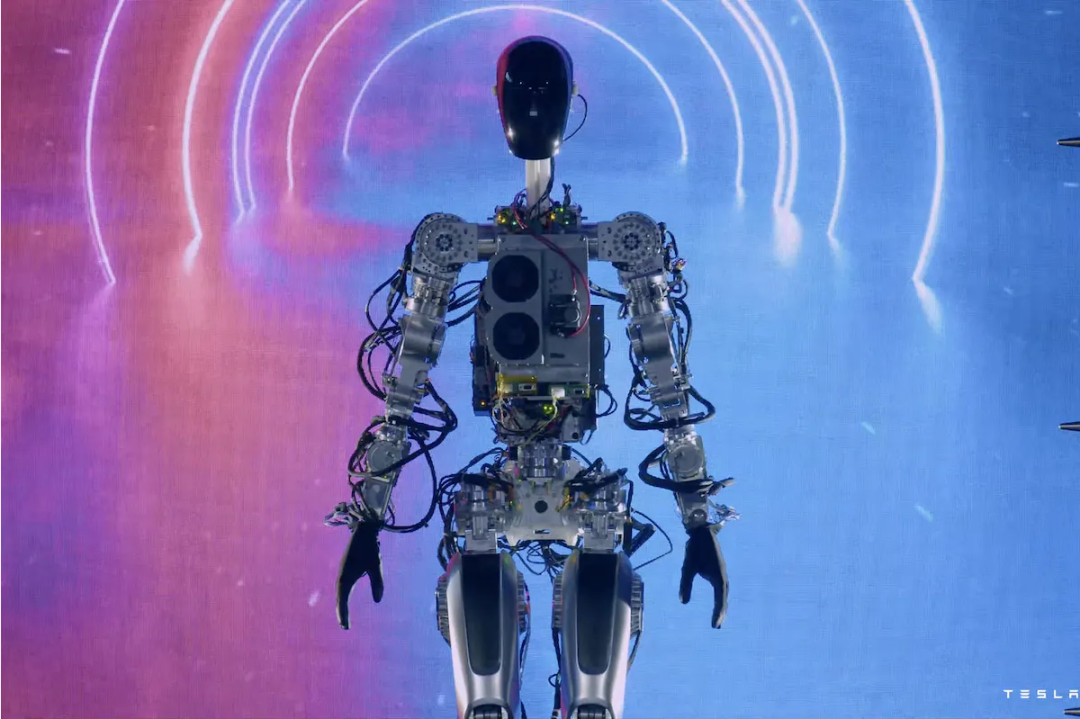
Peter: Actually, for a large number of legged robots, people are already struggling considerably to solve basic locomotion dynamics problems. But Musk is also trying to solve robot manipulation at such an early stage, including handling and pick-and-place processes. I'm curious how everyone views what they've currently demonstrated — is this forward-looking innovation in the industry?
Wei Zhang: It's very good innovation. Within my understanding, various locomotion and manipulation capabilities of legged robots are solvable problems. What's truly difficult is knowing what to grasp, where to grasp it, in complex environments whether to grasp this or that — these may require powerful AI capabilities for significant progress.
Xinliang Zhang: For general-purpose robots, I think Musk first thinks differently from others — it's an AI-type robotics company, not like Boston Dynamics or some control-type labs. In principle, he's aiming for the final form from the start: to replace humans rather than replace a similar specialized machine. Of course, he also has the resources to invest.
Peter: Legged robots have actually developed for twenty to thirty years, yet industrial progress has still been quite limited. Perhaps Tesla has brought a new change. Given today's pace, how do you think they'll evolve in the next five years? Will there be truly commercial products entering the market, and what forms and functions will they take?
Xinliang Zhang: My personal feeling is that general-purpose control will be solved in the next 5 years, while general-purpose perception has some uncertainties. It may have certain perception and decision-making capabilities in some specific scenarios.
Helei Duan: I think within 5 or 10 years, we should see bipedal and quadrupedal robots working within specific boundaries, such as factories, logistics stations, and distribution centers. For home use, much more validation is still needed — robot safety standards don't exist yet, there are no industry regulations. Actually, it's quite interesting: many people may have an illusion that legged robots aren't that dangerous, walking around like us appearing very friendly. But if control or any aspect goes wrong, it can cause serious injury — there's certain risk involved.
Peter: Right, in industrial robotics there are actually quite a few injury incidents. How to achieve safer robots at lower cost and in more compact form remains a large unsolved problem.
Wei Zhang: I think there should be fixed-scenario applications in 3-5 years. If there are processes in factories that need robots, and costs can be kept below $20,000, then they can be used in certain scenarios. Then gradually more open scenarios like logistics, with home service scenarios being even more open. I think special home service applications could appear in about 5 years. The difficulty of landing depends on scenario openness — this doesn't mean throwing a robot at home to do everything, there will be many set constraints. For example, current senior communities can be customized, with IoT cooperation making landing much easier. Additionally, on cost considerations, it may not necessarily be hardware sales for profit — services and various business models have many explorable directions. The key is if the technology truly matures, these things may happen faster than we imagine. I'm relatively optimistic.
Roundtable Discussion: Landing General-Purpose Robots
Participants:
- Xuan Luo, Co-founder of Syrius Robotics
- Qibin Wang, Senior Director of Last-Mile Delivery at JD.com
- Director Zhang, Senior Director of Infrastructure at a major internet company
Moderator:
- Chao Ji, Investment Manager at 5Y Capital
Chao Ji: The question I want to discuss in this session is: before general-purpose robots truly land, are there other intermediate-state opportunities?
If we analyze the time needed for general-purpose robots to land, first, with the advancement of AI technologies like foundation models, I think training general-purpose robots in simulation environments will progress relatively quickly. But two gaps will likely extend the productization timeline for general-purpose robots considerably. One is the Sim2Real gap: although simulation technology has made some progress, simulations of key hardware like sensors and actuators are still not mature enough, and many long-tail corner cases cannot be fully resolved. The other is the engineering gap: moving from demo to mass-produced product depends on scenario data accumulation and the team's engineering and execution capabilities. These two gaps will prolong general-purpose robots' commercialization timeline.
But if we look separately at robot mobility or manipulation, both technology stacks are quite mature, and some new product forms combining both have already emerged — such as composite robots applied in handling, industrial inspection, cleaning, and warehouse scenarios. Their intelligence level still has gaps compared to general-purpose robots, but given the long timeline for general-purpose robots, could composite robots represent a significant opportunity before then?
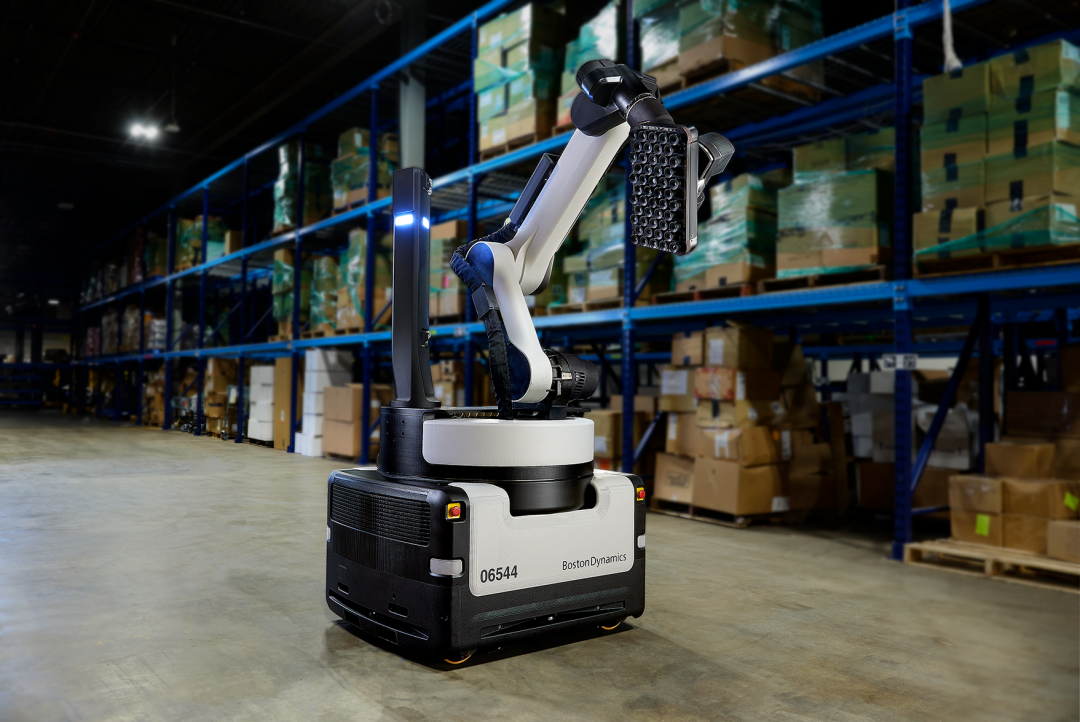
Qibin Wang: I think there's great potential in warehouse robots. Actually, we've been discussing picking scenarios — with adjustments to the front-end end effector, they can adapt to some small and medium-sized item picking. Personally, I believe beyond the gaps just mentioned, the larger gap is the process gap. The essence of doing warehouse processes well is our reinvention of the entire process. Composite robots actually have opportunities, such as picking process reinvention, especially for warehouse scenarios with high-volume, high-efficiency demands.
Chao Ji: In the future, warehouse robot systems may need to integrate with e-commerce business systems to achieve higher efficiency.
Qibin Wang: That's right. Actually, what's currently being solved is still forward processes, while what needs more improvement overall is exception processes — similar to autonomous driving having many corner cases when finally landing. Whether the entire autonomous decision-making can be applied to business systems and grassroots execution systems, this is very important.
Chao Ji: I've been thinking about a question — if composite robots represent a big opportunity, are new players or established players more likely to win? Established players include robotic arm companies or AMR companies, which each possess one part of the technology stack. Who might be in a better position?
Xuan Luo: Actually, I don't think AMR companies are fundamentally different from robotic arm companies — both are in the overall business planning, and it depends on whether their technology stacks can achieve it. I think ultimately it comes down to two aspects: one is calculating ROI, and second is whether my technology has moats. The core logic of B2B is still ROI, while B2C may focus more on other creative points. We're also researching related fields, looking at which domains and markets composite products can truly achieve ROI.
Chao Ji: Analogous to autonomous driving, there are also incremental and leapfrog approaches. Like composite robots, it may be similar to the incremental route in autonomous driving — first achieving a business and data closed loop, then continuously iterating to achieve more general functions. Does general-purpose robot development better suit this model, or is it more suitable for directly attempting the end-state form?
Director Zhang: I've also been thinking about this. I personally feel the entry point for general-purpose robots in B2B is still composite robots in places like warehouses. As for Tesla, I instead think there might be another possibility — like some of their original B2C approaches, taking the cool route to ignite the market. For example, I'm a technology enthusiast who believes robots are definitely the future, so I'll buy one — like how people were still very excited watching the launch event. This approach doesn't consider ROI, but after succeeding, it will still advance the entire business and technology progress. It may ignite something, thereby driving the evolution of underlying generalization technologies.
Chao Ji: Finally, I'd like to discuss with everyone: if general-purpose robots are ultimately realized, do specialized or scenario-specific robots have defensive power compared to general-purpose robots? Where will the boundary between general and specialized lie?
Qibin Wang: I think general and specialized are two curves. Specialized robots' moat lies in whether their performance has advantages, while the general curve will definitely rise. In the early stages, they will certainly coexist. But when general can defeat specialized, it may happen at extremely rapid speed. Like the mobile phone market at that time, it may follow similar business logic and product logic.
So in which year will general-purpose robots truly surpass the specialized curve? Probably at least 5 years after general-purpose robots land. After general-purpose robots explode, it will be a very high acceleration curve — it's hard to say specifically now, and different niche scenarios will also differ.
Director Zhang: Imagining the endgame, if we truly achieve machine "humans" that can replace "humans" to complete tasks, then robots would equal "employees." Observing current production situations, most employees are still "specialized/special-purpose," because the knowledge and operations for executing different tasks differ. If technology can solve the generalization problems of these different professional knowledges and operations, general-purpose robots become possible.
My personal judgment is that achieving the above goals may take considerable time. In this situation, passive defensive power may come from the difficulty of the "general" problem. If seeking active "moats," then deep excavation and accumulation of "knowledge" and "operation execution" capabilities for certain industries is needed.
Xuan Luo: Let me try using phones as a comparison. Phones are completely different from robots — phones' core value is information acquisition, and human-computer interaction forms are relatively simple. But human-robot interaction is too complex. Whether a robot can perform well in various domains like phones do, I have doubts. Of course, I very much hope such products emerge, because this could greatly improve the existing robot supply chain. I believe specialized robots will exist long-term. If general-purpose robots cannot rapidly reduce costs through the supply chain, it will still be difficult to replace specialized robots. I would very much welcome general-purpose robots finding a very large scenario, replacing a large portion of specialized machinery — only then can our industry truly take off.
The new 5Y 3Sigma Roundtable will be held this Sunday, November 6, 9:30-12:30. Theme: AIGC New Species: Content, Interaction, and Commercialization Innovation in the Generation Era
Welcome to [scan the QR code in the poster] or click [Read More] to register and join the sharing and discussion.

Interactive Gift
Welcome to share your views and opinions on general-purpose robots in the comments section. We will select 2 featured comments to receive a 5Y Capital commemorative hoodie. (Comments accepted until November 10. Please reply with shipping information within 24 hours of receiving notification.)





5Y Capital seeks, supports, and inspires lonely entrepreneurs, providing support from spirit to all business operations. We believe that if the "crazy" you in others' eyes begins to be believed in, the world will become refreshingly different.
BEIJING · SHANGHAI · SHENZHEN · HONG KONG