5Y News | No-Code Collaboration Platform "Treelab" Closes Tens of Millions of Dollars in Series A Funding

Empowering enterprises' digital transformation.

No-code collaboration platform Treelab announced the completion of a Series A funding round of tens of millions of dollars, co-led by HSG and a strategic investor, with continued support from existing investors GGV Capital, 5Y Capital, and Future Capital. Mucotton served as the exclusive financial advisor. Following this round, Treelab will increase investment in product R&D, service upgrades, market expansion, and talent acquisition, continuing to drive product iteration and user experience optimization while deepening its focus on industry development in operation-heavy scenarios.

Ricky He
Founder & CEO, Treelab
Q1
In your industry, what "contrarian" thinking do you hold? What's the biggest misunderstanding the market has had about you?
Ricky He: Most enterprises believe that tools struggle to address deep-seated business needs, and that standard products can't truly align with operations — so they rely on custom development instead. But whether you look at cost or demand fit, this approach isn't sustainable.
The essence of general-purpose tools is to maximize the reduction of repetitive labor in business operations. They lower labor costs and improve standard operating procedures through standardization, but they struggle to solve operational pain points caused by rapid market changes. Operations themselves are non-standard and personalized; general-purpose tools can't meet the operational demands that emerge when traditional industries undergo digital transformation.
The most complex processes in any industry tend to be networked rather than linear. Today, more and more enterprises are market- and data-driven. Collaboration within companies and between companies and external parties has become tightly knit and multi-dimensional, forming a bottom-up mode of production — and traditional ERP systems can't solve networked management problems. That's why many companies, after implementing various systems, still spend enormous amounts of time using Excel, email, and other fragmented tools to connect these operational workflows.
Take e-commerce, for example. It's fairly standardized at the surface level — mainly product selection, listing, inventory and fulfillment, and sales management. But when you actually get into implementation, you find that every e-commerce company's "operational workflow" is actually quite different. This is why Treelab wants to help these operationally intensive enterprises from the bottom up, transforming what used to be "invisible" management based on individual experience into "visible," structured, and accumulable management assets — using a modular and component-based product architecture to truly enable operational process management.
The biggest misunderstanding we've faced is the distinction between tools and systems. People think tools can't be industry systems, but tools themselves can function as systems. Excel is incredibly powerful — you can write code in it, connect it to your systems, connect any systems, network it, set permissions. Most people just don't know Excel can do all that.
Q2
How do you imagine your industry and the future? Has this changed since you started your company?
Ricky He: I believe that in the future, the value of digital productivity tools that help enterprises solve personalized management needs will only grow, for two reasons:
First, in traditional industries, market competition will force enterprises to continuously improve their "rapid response" and "flexibility" capabilities, because consumers have become increasingly individualized — even "one person, a thousand faces." And e-commerce technology has accelerated the entire industry's reliance on data and "collaborative efficiency." Shein, for example, has largely built its competitive advantage through proprietary digital productivity tools, giving it both lower inventory risk and faster time-to-market than competitors. In the future, enterprises without digital capabilities will struggle to survive, because market saturation is already too high — it's hard to find so-called "blue ocean markets." So all enterprises should adopt "market-driven" strategies to create their own unique business management systems, which will accelerate the value of digital tools.
Second, every industry will have a few traditional ERP and vertical system leaders that serve as "data standards" for that industry. Kingdee and Yonyou, Jushuitan and Wangdiantong, Moka and Beisen are all typical examples. Because every industry has common problems that can be standardized, and these leading vendors, through SaaS and capital, eventually establish industry consensus. They were the first to "educate" the industry and achieve "scale effects." This is a good thing at the data level — it means data standardization will keep improving, and the difficulty of building enterprise data middle platforms and tools will drop significantly. In other words, traditional ERP is like a company's utilities — it's infrastructure. Going forward, it's about how enterprises use digital tools and personalized middle platforms to integrate and circulate this foundational data across systems.
Since founding Treelab over a year ago, the biggest change for me has been more of a mindset shift. I used to habitually fit product onto customer scenarios or needs; now I require myself and the team to design product from customers' raw needs. The biggest difference between enterprises and individuals is that enterprises necessarily evolve alongside broader industry and industrial changes. These changes aren't fundamentally large or fast — the essence of things generally doesn't change, only the relationships and patterns within them get restructured. Enterprise "procurement," "merchandise operations," and "sales management" are needs that have existed for thousands of years, but as markets and technology evolve, these very primitive needs have seen efficiency gains and pattern diversification. For a highly personalized product like ours, this also means we can excavate relatively "fixed and unchanging" parts to reason out and design our variable parts. In other words, when designing product, we must first understand customers' macro-level needs, then洞察 their micro-level usage needs — not the reverse. Because many enterprises, including individuals within them, aren't necessarily using the most efficient "operations," but their desired outcomes are quantifiable. They actually care more about how you help them improve efficiency than the operation method itself. So we can't design product from existing usage patterns; we need to understand customers' "essential" needs and desired goals.
Q3
In five years or longer, what kind of company do you hope Treelab becomes?
Ricky He: Treelab wants to let every enterprise and individual deposit their management thinking into a personalized digital platform and achieve a "second brain." We want to better connect industry-wide data through a cloud collaboration platform, empowering and accelerating end-to-end industry response speed. In the next five years, as enterprise digitalization in China and across Asia matures, enterprises' reliance on internal data utilization will only grow. Treelab wants to help all operation-heavy industries achieve full-chain refined management, truly realize "digital without boundaries" for enterprises, and help every individual achieve digital transformation for themselves and their companies as simply as using Excel.

Xing Meng
Partner, 5Y Capital
Q1
Why did you invest in Treelab?
Xing Meng: Digital transformation is a global wave, and the post-pandemic era has accelerated digitalization's penetration across industries. At the same time, the supply side of digitalization faces severe shortages. This supply-demand mismatch has accelerated the growth of numerous no-code companies — during the two pandemic years, dozens of no-code unicorns emerged globally. In China, 5Y Capital has long tracked this space; we invested in Treelab's angel round two years ago. Ricky is a rare entrepreneur with intuitive product talent and acute commercial insight, with a maturity completely disproportionate to his age. Series A is a company's most critical milestone, and bringing in the right investors is crucial. We're glad to see new investors joining this round. At the same time, 5Y Capital believes that Treelab, having passed through its product and commercial MVP phase, will enter a period of faster growth.
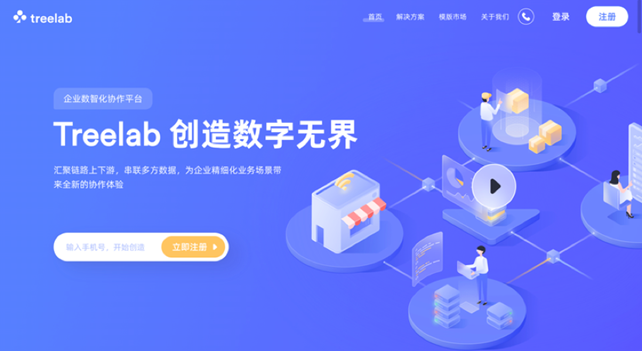
Treelab is a no-code application-level platform service provider founded in 2019, dedicated to providing customers with system tools and solutions based on no-code/low-code platforms coupled with business scenarios, enabling enterprises to achieve digital operations and empowering digital transformation. Its core product — the "Cloud Collaboration Platform" — links various internal enterprise resource systems, breaking down information silos, unifying data tags, integrating and deeply analyzing data, and through a visualized data middle platform, merging internal-external collaboration and business data flow into one, achieving quality improvement, cost reduction, and efficiency gains in enterprise operations.
Treelab's product inspiration came from founder Ricky He's personal experience — he discovered that his family factory still needed to repeatedly use Excel to align data between various systems, and began developing a flexible tool himself, which became the prototype for Treelab.
Treelab's front-end interface is a spreadsheet, while its back-end is a database, allowing users to build required business systems through drag-and-drop. Managers can set data permissions for fields and rows based on different roles, ensuring secure data circulation. From 2019 to now, Treelab's product has undergone rapid iteration, currently focusing on project collaboration management, e-commerce operations management, order collaboration management, product selection, and supplier collaboration.
Currently, in day-to-day enterprise management, traditional ERP systems have a usage rate exceeding 70%. As asset management software, ERP primarily carries standardized outcome management. Faced with rapidly changing markets, most enterprises believe such standardized systems can't truly address the non-standardized and personalized operational management pain points brought by rapid market changes, relying more on custom development to solve them — but whether from cost, demand fit, or flexibility perspectives, this is difficult to continue adapting to enterprise development pace.
Treelab founder and CEO Ricky He stated: "The most complex processes in any industry tend to be networked rather than linear. Today, more and more enterprises are market- and data-driven. Collaboration within companies and between companies and external parties has become tightly knit and multi-dimensional, forming a bottom-up mode of production, and traditional ERP struggles to solve networked management problems. That's why many companies, after implementing various systems, still spend enormous amounts of time using Excel, email, and other fragmented tools to connect these operational workflows."
He also stated: "In e-commerce, it's fairly standardized at the surface level — mainly product selection, product listing, inventory and fulfillment, and sales operations management. But when you actually get into implementation, I find that every e-commerce company's operational workflow is actually quite different. This is why Treelab wants to help these operationally intensive enterprises from the bottom up, transforming what used to be 'invisible' management based on individual experience into 'visible,' structured, and accumulable management assets — using a modular and component-based product architecture to truly enable operational process management."
With no-code and low-code as its development philosophy, Treelab lets people without technical expertise flexibly build their own workplace tools based on their business scenarios. Currently, Treelab mainly provides six signature features: visualized database, multi-user collaboration, extensible plugins, automated data processing, intelligent data analysis, and multi-terminal synchronization — breaking through the three major digital transformation challenges of low development efficiency, high costs, and data silos from multiple dimensions, improving quality, reducing costs, and increasing efficiency for enterprises.
For no-code tools wanting to打通 information flow pathways, an important challenge is connecting with various business systems through API integration. Following this funding round, Treelab will also strengthen ecosystem construction. Currently, Treelab has successfully connected with e-commerce ERP systems including Jushuitan; going forward, Treelab will also cooperate with WeChat Work to better establish closed loops for enterprise internal-external communication.
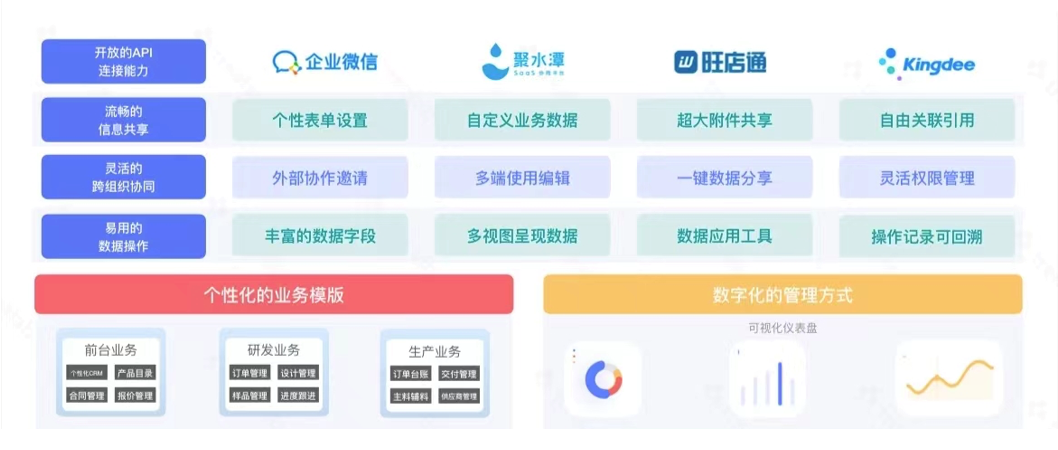
Another question is: Treelab targets operation-heavy enterprises with online+offline scenarios and highly fragmented, complex business scenarios — how does a no-code product consider its position within enterprise IT architecture? He stated: "In enterprise IT architecture, ERP is the core system, and ERP is designed around financial flows, relatively standardized. But enterprise operational scenarios are highly non-standard, which also leads to a wide variety of service software like SRM, SCM, PLM, MES, and so on. In these scenarios going forward, one advantage of no-code is that based on a more flexible underlying engine, enterprises can achieve bottom-up digital transformation implementation, lowering digital transformation risk and forming their own industry competitive moats."
Additionally, alongside announcing its new funding round, Treelab will launch its redesigned website and new domain (www.treelab.com). This website redesign not only comprehensively upgrades visual design and functional layout, but also unveils for the first time the brand vision of "Treelab, Creating Digital Without Boundaries." Users can easily access Treelab's latest updates, industry solutions, and user manuals on the website.




5Y Capital (formerly Morningside Venture Capital) currently manages approximately RMB 32 billion in dual-currency USD and RMB funds. 5Y Capital seeks out, supports, and inspires lone entrepreneurs, providing support from spirit to all business operations. We believe that if the "crazy" you in others' eyes begins to be believed in, the world will become a different place.
BEIJING · SHANGHAI · SHENZHEN · HONG KONG