5Y News | Differential Intelligence (微分智飞) Closes Pre-A and Pre-A+ Rounds, Accelerating Tech Buildout in Aerial Embodied Intelligence

Building the next-generation foundational model for aerial embodied intelligence.

Recently, Weifen Zhifei (Hangzhou) Technology Co., Ltd. (hereinafter referred to as "Weifen Zhifei" or "MicroDivide Intelligence") completed consecutive Pre-A and Pre-A+ funding rounds, raising nearly RMB 200 million in total. The Pre-A round was led by Oriental Fortune Capital and Hongtai APlus, with Yari Capital participating. The Pre-A+ round was led by Meridian Capital, with Shenzhen Capital Group, Shangqi Capital, and Changshi Capital participating. Existing investors Lightspeed China Partners, 5Y Capital, Yinxingu Capital, Shoucheng Holdings, and Baidu Venture continued to increase their investments. This financing will accelerate the company's efforts in technology R&D, product iteration, team expansion, and market development, further strengthening Weifen Zhifei's leading position in embodied intelligence and swarm intelligence for aerial robotics.
As one of the most closely watched teams this year, what kind of company is Weifen Zhifei exactly?
Founded in 2024 as embodied intelligence was gaining momentum, Weifen Zhifei seized the opportunity with precision. Founder Dr. Gao Fei proposed the innovative direction of "flying embodied intelligence," with a clear mission to "let flying robots connect thousands of industries and fly into millions of homes." The company is committed to building the world's leading flying embodied brain and general-purpose swarm intelligence system. Leveraging four core technologies — autonomous navigation, embodied decision-making, end-to-end control, and swarm intelligence — the company breaks through environmental constraints to develop foundational models for flying robots applicable to diverse and complex scenarios, driving the construction of "aerospace intelligent terminals" for homes, industry, cities, and natural spaces.
Since its inception, Weifen Zhifei has consistently adhered to the philosophy of "keeping feet on the ground while looking up at the stars." On one hand, it focuses on landing applications in rigid-demand scenarios, solidifying every step forward; on the other hand, it explores the frontiers of common foundational technologies to provide innovative momentum for embodied flying. It is precisely this interplay of pragmatism and idealism that makes flying embodied intelligence one of the most promising frontier directions.
Feet on the Ground: A Deep Cultivator of Rigid-Demand Scenarios
This March, drawing on years of technical accumulation in flying embodied intelligence, the Weifen Zhifei team launched the P300, a new autonomous exploration flying robot for industry applications. Relying solely on its onboard "big brain and small brain" system — without satellite communications, ground stations, remote control signals, human intervention, or prior information — the product can fully autonomously complete exploration, mapping, and inspection tasks, providing critical technical support for safe production in complex, harsh, and unknown environments.
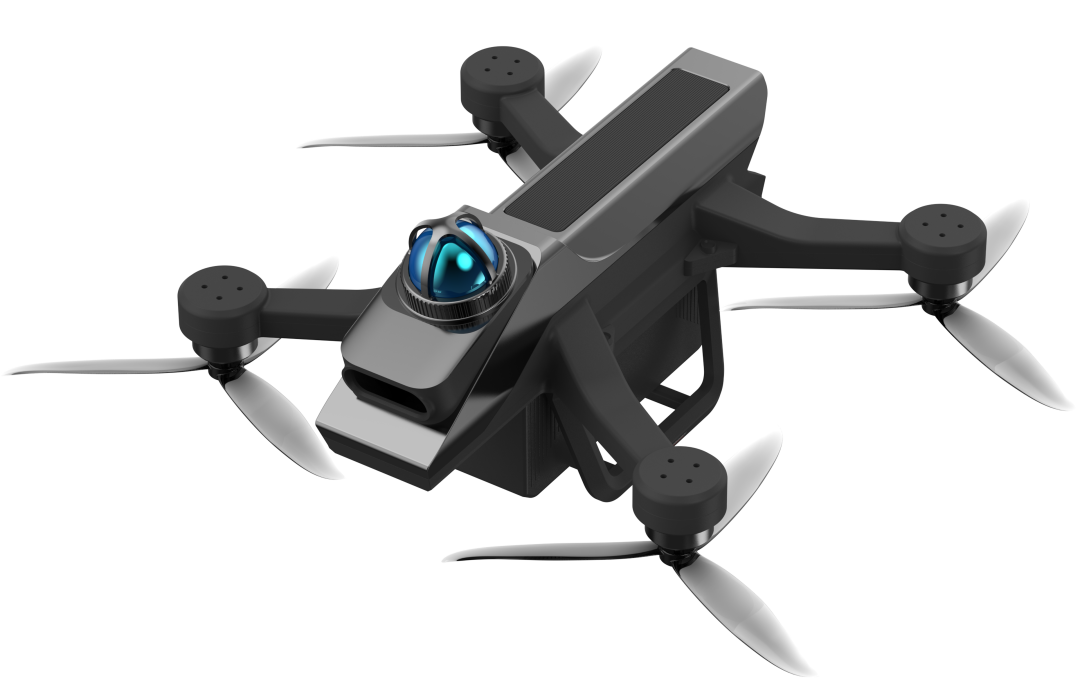
The P300's core advantages are:
-
Autonomous Navigation: Completely free from GPS and external communication dependencies, with no need for manual operation or prior maps, achieving fully autonomous safe obstacle avoidance and navigation in complex enclosed spaces such as mines, forests, and tunnels.
-
Intelligent "Big Brain": Based on self-developed AI decision-making algorithms, driving a data-intelligence flywheel that gives flying robots real-time online decision-making capabilities, forging a "smart brain" for complex tasks.
-
Efficient "Small Brain": Employing a sensor-to-actuator end-to-end control architecture, achieving millisecond-level high-precision control in complex environments, maximally unleashing the maneuverability and dexterity of flying robots.
-
Collaborative Energy: Overcoming technical bottlenecks in distributed multi-agent decision-making and dynamic self-organizing networks, enabling efficient coordination of multi-agent swarms, laying a solid foundation for building distributed robot decision-making and control systems and improving operational efficiency.
Through deep technological innovation, the product has already achieved application breakthroughs in multiple industries including mining, forestry, power, municipal infrastructure, transportation, and emergency rescue.
Looking Up at the Stars: A Pioneer of Frontier Technologies
Breaking Morphological Boundaries, Integrating Flight and Grasping
Humans rely on their hands for grasping and manipulation, while birds can flexibly hunt or perch during flight. However, aerial robots often face a dilemma: "able to fly but not grasp, able to grasp but not flexible." Traditional externally mounted robotic arms have operational capabilities but are bulky and affect maneuverability; lightweight grippers are functionally limited and struggle with complex tasks in real environments. To address this core challenge, the Weifen Zhifei team proposed a new paradigm of integrated flight and grasping: deeply fusing tendon-driven multi-degree-of-freedom joints with a compact quadrotor system, enabling a palm-sized body to achieve both powerful enveloping grasps and delicate fingertip pinching. Relying on high-degree-of-freedom whole-body control for flying and grasping, the flying robot can complete millisecond-level flight control and microsecond-level joint deformation planning, maintaining stability under load changes and dynamic interactions, supporting diverse application scenarios such as unmanned delivery, emergency rescue, and home assistance.
Like a flying "hand," the flying robot can carry a water bottle across obstacles, or precisely pick up paper-thin objects, freely completing grasping, transport, and cross-domain delivery in the air. The Weifen Zhifei team is enabling flying robots to evolve comprehensively from three-dimensional movement to embodied manipulation.
From Pixels to Control: End-to-End High-Precision Autonomous Flight
Inspired by birds' extreme maneuvers, the team achieved precise high-agility autonomous flight surpassing human remote-control limits. This system is based on data-driven technology, directly mapping monocular visual perception data to motor control commands, realizing end-to-end precise flight. Flying robots equipped with this system can complete precise and agile high-attitude autonomous flight without any external positioning, state estimation, or prior target information. Through reinforcement learning training, the model can maximally suppress accumulated system errors and reduce control latency, achieving bird-like dexterous and stable narrow-gap traversal, maximizing the passable range of UAVs, and greatly enhancing the navigation and search-and-rescue capabilities of flying robots in complex and confined areas.
Through end-to-end mapping from perception to action, the robot achieves high-precision high-attitude narrow-gap flight; gap orientation is freely manipulated by humans, demonstrating real-time interactive flight performance without prior information.
Takeoff from Fingertips: An Extremely Lightweight Micro Autonomous Flying Robot
Insects can achieve various dexterous movements with simple compound eyes — do ultra-micro flying robots also have the potential for intelligent flight? The core challenge in accomplishing this task is that micro sensors collect sparse environmental information with significant noise, and micro onboard chips have extremely limited computing resources, placing extremely high demands on the computational efficiency and data utilization of onboard algorithms. To address these challenges, based on data-driven end-to-end machine learning technology, relying solely on sparse perception data from sensors weighing only a few grams and edge computing power from chips costing only a few dozen yuan, the model can achieve end-to-end mapping from raw sensor data to low-level control commands. The total weight is less than 50g, lighter than an egg. This achievement is expected to be applied to various micro autonomous robot systems, with broad application prospects in narrow space traversal, search and rescue, and other tasks.
The aircraft equipped with this solution is extremely lightweight, taking off from fingertips and safely shuttling between outdoor trees and indoor obstacles.
Currently, Weifen Zhifei stands at an entirely new starting point for development, at a critical stage where opportunities and challenges coexist. Facing the future, we will continue to deeply cultivate the fields of general aerial robots and embodied intelligence technology, concentrating efforts to break through multiple core technical bottlenecks including autonomous flight, swarm coordination, and generalizable decision-making, committed to building a new generation of foundational models for flying embodied intelligence, and launching more innovative products that meet market demands.
Continuously expanding application scenarios, Weifen Zhifei will continue to meticulously cultivate areas where it already has significant advantages, such as autonomous detection, emergency safety, and aerial manipulation, solidifying its foundation; at the same time, we will also actively layout more emerging application scenarios from a forward-looking perspective, continuously exploring practical paths for technology empowerment, allowing the value of flying robots to fully shine and be released in broader real-world domains.




5Y Capital seeks out, supports, and inspires lonely entrepreneurs, providing them with support from the spiritual to all operational aspects. We believe that if the "crazy" you in others' eyes begins to be believed in, the world will become a different place.
BEIJING · SHANGHAI · SHENZHEN · HONG KONG