5Y Talk | A Conversation with Kuaishou's Hua Su: The Foundational Principle Is Altruism

On Adventure, Perception, and Inspiration.

Ten years in the making, Kuaishou went public.
In 2011, Yuan Ye, then a partner at 5Y Capital, was still a newcomer to the industry. He found Cheng Yixiao, the creator of GIF Kuaishou, on Weibo, reached out via email, and introduced him to partner Zhang Fei. From there, 5Y had the opportunity to accompany the company from its angel round onward, witnessing Yixiao and Hua Su — a prodigy of a product manager and a technology geek — join forces to pioneer an era of mobile short video.
Recently, Zhang Fei and Yuan Ye, partners at 5Y Capital, sat down with Hua Su, co-founder, chairman and CEO of Kuaishou. Nearly a decade had passed since their first meeting in a small conference room at Huaqing Jiayuan. This time, they talked about that first encounter, lessons learned through entrepreneurship and investing, and their hopes for the next ten years.
Zhang Fei and Hua Su also shared details of an adventurous journey from late 2019 — a trek through mountains at nearly 5,000 meters elevation, with no water and an uncertain route, hiking for nearly 18 hours in a single day. They gained some insights about crossing uncharted territory that may resemble entrepreneurship in some ways, though building a company is clearly far more complex.
We've transcribed their conversation in full. We hope you find it inspiring :)
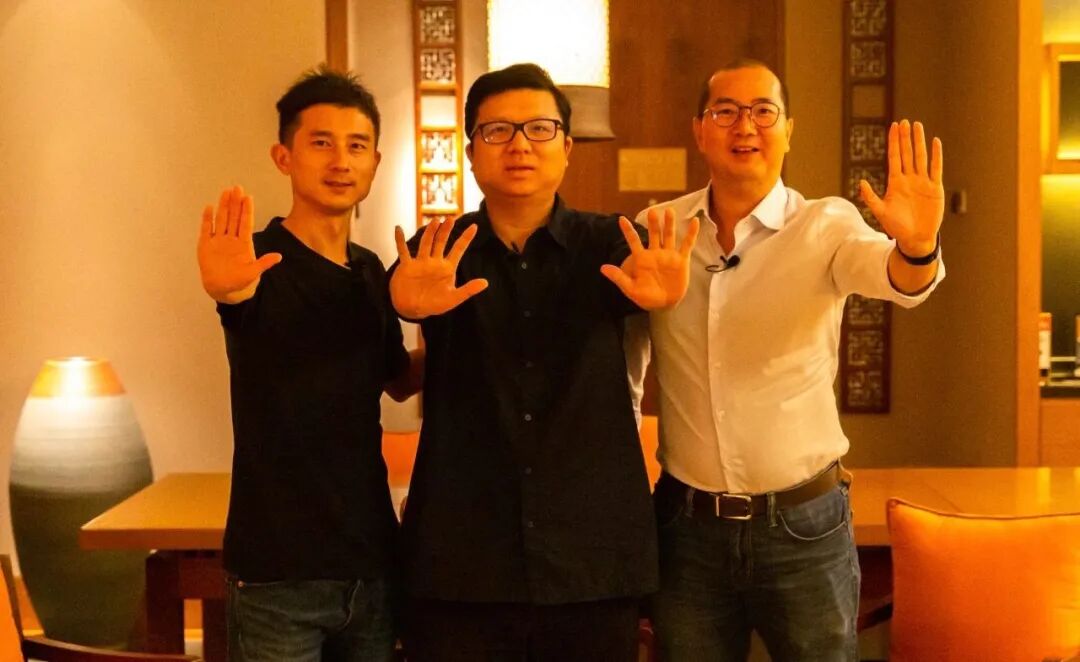
From left: Yuan Ye, Hua Su, Zhang Fei
Chapter 01
First Impressions
Yuan Ye: I'm glad we have this opportunity to talk. I'd like to start by asking you both to recall how you first met.
Hua Su: It was in a small apartment in Wudaokou's Huaqing Jiayuan, on that dirty sofa in our little conference room.
Zhang Fei: An entrepreneur introduced us, said one of Zhang Dong's partners was really impressive, asked if I wanted to chat. So Elwin (Yuan Ye) and I went together.
Yuan Ye: What were your first impressions of each other?
Hua Su: I was thinking, aren't investors supposed to act like money makes them royalty? Why was this guy being so proactive?
Zhang Fei: (laughs) Just barging right into your dark little office, right? What struck me most about Hua Su was that he's a person of very high energy, with a lot going on inside, but he speaks slowly. Not many people have that quality — smart people usually like to show off, they talk fast. Only someone who's been through a lot of grinding and polishing will carefully choose what to put out there. I think that's a very good state to be in.
Yuan Ye: From meeting in 2011 to today, ten years later, what's the one thing that most exceeded your expectations about each other?
Hua Su: I initially thought Fisher (Zhang Fei) was an early-stage investor, but then he kept doubling down in every single round. I had to coordinate that every time.
Zhang Fei: What surprised me most was Hua Su's resilience. Kuaishou has had a really hard time of it over the years, been through many ups and downs. During especially difficult periods we talked several times, and as CEO, the resilience he showed facing enormous pressure, his determination to carry things through — that really impressed me.
Chapter 02
The Foundational Principle Is Altruism
Yuan Ye: Building a company is incredibly hard, physically and mentally. What drives you to keep putting in such extreme effort?
Hua Su: I think the biggest motivation inside is wanting to do things that make the world better. I realized pretty early that finding happiness through helping others is a relatively reliable approach, so I wanted to do things that could help the broadest number of people.
Zhang Fei: Early-stage investing is actually incredibly hard work too. We're dealing with more than one company, and every company runs into all kinds of challenges. If you're heavily involved, the mental toll is severe.
Because if you have empathy, you can feel other people's intense pain very strongly. And if you're deep in it, you're feeling the叠加 of many people's pain. If your will isn't strong enough, it's easy to slide into depression.
But the best thing about this work, I think, is that whenever you're feeling depressed or down, you look at the entrepreneurs around you, doing these amazing things, changing many people's lives, having huge impact on society — and you feel this is truly a career worth respecting. Especially when you see entrepreneurs who've been tortured by pain to the point of being unrecognizable, yet still full of energy. That mutual inspiration is a really interesting thing.
Yuan Ye: Looking at our lives today, we face many choices, different opportunities, different resources, many trade-offs. When you make important decisions, what principles have become increasingly important to you?
Hua Su: I feel like I have quite a few principles in my system. Usually they only show their power when conflicts arise.
The most foundational principle, I think, is still altruism — building my own sense of happiness on a foundation of broadly helping others.
The second principle is what's popularly called first principles thinking. I hope to understand the essence of something thoroughly before making difficult decisions, minimizing fuzzy decisions and impulsive decisions as much as possible.
Then there's the balance between long-term and short-term interests — that's something that needs very careful attention too.
When Kuaishou was small it was a tool, then it became a community, and now it's gradually becoming a comprehensive ecosystem. As the business it carries becomes more complex, how to balance the interests between different businesses becomes an increasingly important question.
Zhang Fei: What resonates most with me today is achieving "selflessness." I gave a talk recently, "Homeless Dog · Missionary · God" — every slide was really written for myself, something it took me a long time to figure out. When you truly achieve no "self," you find that things in the world are actually very simple. You can easily understand what others are thinking, easily do rational interpretation of others' needs, and things become very straightforward.
The second principle is similar to first principles thinking, but I might interpret it as something more interesting. Actually, this complex world is built from simple principles through complex combinations. So when facing complex matters, you need to understand two things: first, what are its simplest, most foundational components? Second, what is its mechanism of combination? If you understand both of these thoroughly, you'll have many unusual insights about complex matters. So for any complex system, I observe and analyze to extract its most fundamental elements, and on that foundation, what mechanism allows it to grow, combine, and mutate.
Hua Su: Actually, I spent a long time hoping for "selflessness," then for a period I felt I should respect the self a bit more. What you mentioned before, like "homeless dog" — that's the natural state of a biological organism. But "selflessness" is not the natural state of a person. Achieving a state of "selflessness" actually consumes quite a lot of energy. While being "selfless," you're also continuously depleting yourself.
Zhang Fei: Right. You feel it's too mentally taxing?
Hua Su: Yes. Of course if you control your energy well, you can be relatively sustained and calm. But only very few people can cultivate themselves to the state of that monk Thich Quang Duc you mentioned in your talk. I probably lean more toward being an ordinary person, achieving a state that's relatively "selfless" among ordinary people.
Zhang Fei: That's quite objective. Though I talk about "selflessness" every day, I'm not at the state where I can completely detach from everything either.
In my own understanding of "selflessness," I divide it into several states. The first state is something I only gradually came to understand in recent years — many of your thinking patterns carry a lot of inherent genetic programming. This programming is like a filter system. The first step of cognition is actually understanding yourself, understanding the defects in your own genetic programming.
The second layer is that you can actually establish a program that lets you step outside and observe your own thoughts. In my brain there's another Fisher that can objectively record "Fisher took what action today for what reason, what consequences might this action have" — a rational, complete causal process. If you have such an objective program constantly forming in your brain, you'll understand yourself more and more.
Actually, as you said, no matter what we do, our underlying genes are tormenting us, consuming our energy. These underlying genetic programs are very hard to eliminate, but you can observe them, experience them, and gradually achieve not being controlled by them. I think that might be a more important state of "selflessness," and it's the stage I'm trying to understand and cultivate today.
Chapter 03
Better Decisions
Yuan Ye: As CEO and investor, you probably make many big and small decisions every day. Compared to three or five years ago, how has your decision-making changed? How do you ensure today's decisions are better than yesterday's, and tomorrow's better than today's?
Hua Su: Our decision-making has a lot to do with the characteristics of the problems we face. Early on I was still on the field playing forward — the problems were relatively concrete. A ball comes to your feet, how do you get past defenders and score. Very concrete, leaning toward user insight and business judgment. Back then I'd start with some intuitive guidance, then go into big data to observe and calibrate, and that could yield relatively efficient, high-quality decisions.
But as the company grew larger, with more layers of filtering, the problems that finally reached me became increasingly complex, with longer feedback cycles.
I'm currently testing two methods. One is more rational: for all relevant information about a problem, we require understanding it fully across time and space — not just looking at ourselves but looking outward, at how they did things in the past, how they do them now, even how they think about the future — so our decisions don't start from zero but can stand on the shoulders of historical giants.
Zhang Fei: Doesn't that require a huge amount of information?
Hua Su: Relatively speaking the research investment is large, the time cycle tends to be long, but it can avoid some低级 mistakes.
The second method is to use existing information, through your own perception of the problem, your sense of the emotions or interests of stakeholders involved, and make decisions more intuitively.
Both are things I've been cultivating recently. The former requires relatively long time, sometimes you might not have enough time, so you can only use this method on very few, extremely important problems. When you encounter many situations requiring relatively fast decisions, you use the second method. As long as your intuition is self-consistent, and you have relatively self-consistent solutions or can give directional opinions when encountering different problems, I think it's fine. But personally I probably still lean toward the former — doing thorough collection of required inputs for a decision.
Zhang Fei: The biggest change in my decision-making over the past few years is that I've come to really dislike mediocrity. I have extremely high expectations of people. I used to think 80 points was okay, but today I want to see everyone at 120 points. If you can't do 120, I'll ask why? Why can't you work as hard as Elon Musk? If he can work 120 hours a week, why can you only work 100?
These standards may seem very harsh to many people, but in an extremely high-pressure situation, you can easily discern a person's quality. I force myself to look at more extreme people, think about more extreme things.
But on another dimension, I've developed more tolerance for gray areas. Many decisions actually have a lot of gray, especially in our field of high uncertainty. Even if you collect all the information, it's still hard to make a high-quality decision, or ultimately there still needs to be a driving factor that pushes you to choose A or B.
I think when we face gray-area choices in investing, there's a particularly good toolbox: weighting. You can carefully design gray areas that work better for you through weighting. When the gray area isn't very favorable to you, use small weights; when it's favorable, use large weights. If you think in terms of gray areas, you'll find that although my demands on people and things are extreme, my tolerance for the probability of things going wrong has increased, because I have the toolbox of weighting.
Chapter 04
Through Uncharted Territory
Yuan Ye: I heard you went on a hiking and mountaineering trip together. I find that quite rare given how busy you both are. Tell me about that experience, what did you gain from it?
Zhang Fei: It was wonderful, I still miss it. I looked at the photos — Hua Su was smiling so happily, but I had a worried face the whole way. I found that strange too, maybe I was just really nervous.
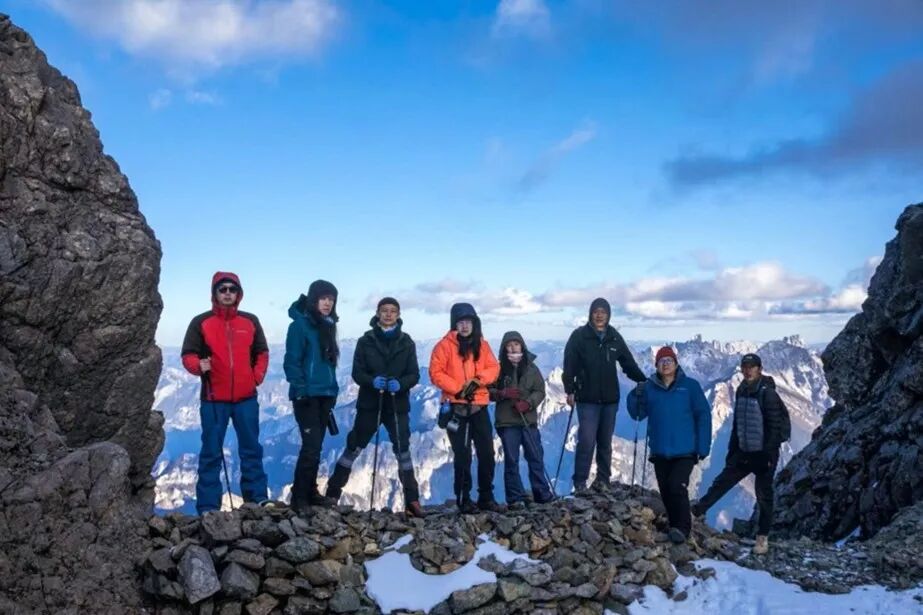
Far left: Zhang Fei; second from right: Hua Su
Hua Su: Right, because you were worried about my safety. It was an undeveloped mountain, nearly 5,000 meters high, though still somewhere ordinary people could go — not a particularly professional climbing route. But Fisher (Zhang Fei) and I were both doing this for the first time. The whole way was scree slopes and cliff faces, with narrow paths paved with rocks alongside the cliffs, just wide enough for a horse, with cliffs below.
Zhang Fei: Right, if you fell you were basically done for. When I first checked Hua Su's backpack I got a little worried — his gear was completely unprofessional. His hiking boots were bought casually at Decathlon.
Hua Su: Because I thought, it's just going out to play, what could happen? I usually wear slippers when I go out. That time I brought high-tops, which was already beyond my底线.
Zhang Fei: And he brought a very thick down jacket, not the kind for mountaineering. No quick-dry clothing, just long underwear.
Hua Su: It got soaked through later.
Zhang Fei: After entering the mountains we'd be there five or six days. Because of the altitude, it got very cold at night. We stayed in a drafty little wooden hut with the horse team.
Hua Su: The water inside the hut was frozen.
Yuan Ye: With such terrible conditions, were you worried?
Hua Su: No, because we had sleeping bags, and the guides had been there before. Although the scree slope looked very steep, but we studied physics, right? A scree slope forms that shape because rocks can't roll further down — it's right at the edge between where rocks can and can't roll. People can't roll down either. So from a rational calculation perspective it wasn't scary, that was the psychological comfort I gave myself. But I did feel those cliff faces were genuinely very dangerous — vertical drops, if you fell it was over.
Zhang Fei: We were riding mules and horses from the horse team. The mountain path was extremely narrow, with snow on the road. Snowy areas were very dangerous because you couldn't tell the depth. If a mule stepped into empty space, it could easily tumble over, with cliffs right there. We actually had an incident — one companion brought his 9-year-old daughter. She fell off the horse, fortunately on the inner side. When she fell, the companion shouted loudly, which scared us all, because we couldn't see what was happening ahead. We were also afraid the shouting would startle the mules — if the mules panicked, everyone could get thrown off. That was quite a close call. Fortunately the little girl wasn't hurt.
But at that moment you feel how small life is, that surviving is really just luck.
Hua Su: It really was. During the walk, I saw across the canyon a mountain with a scree slope, and near the summit there was a faint line that looked like a small path. It really didn't look like somewhere humans could go. But then I found we'd walked to the other side in two days. While walking it looked quite dangerous, but then I thought, life has no hierarchy of value — I was riding a horse, but the horse was under more pressure than me, it also had to cherish its life. Plus from a physics perspective, the scree slope couldn't roll down. These two points gave me enormous psychological comfort.
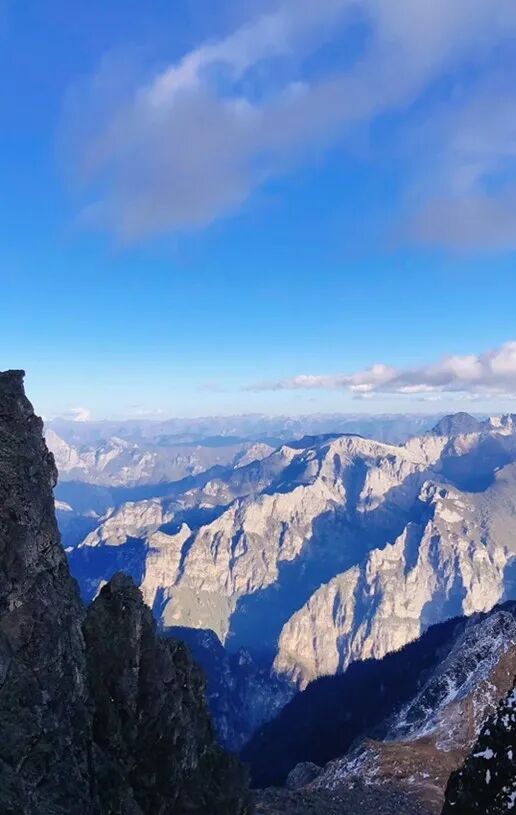
Taken during the trek
Yuan Ye: Even in such critical situations, your thinking remained rational. Did you ever have panic or other emotional reactions that lost rational judgment?
Hua Su: I was generally okay, the whole trip was more thrilling than dangerous.
Zhang Fei: The most thrilling moment was hiking for nearly 18 hours — we set out around 8 a.m. and arrived at our destination past 2 a.m.
Our itinerary was to go from camp at 4,000 meters to a pass around 4,800 meters, cross the pass and go down, then climb up to a pasture on another mountain. When we crossed the pass, it was already dark. Going down in the dark was extremely painful, because you knew going down was just the beginning — you still had to climb up again.
By then I couldn't walk anymore. Hua Su gave me the last mule, and he walked behind. It was so dark you couldn't see the path, with dense forest all around. Constantly you'd be walking and bang a branch hits your head, bang, the mule steps into empty space, nearly falls.
We'd also run out of water that day. I was very worried about getting lost, kept asking the horse team if they'd been here before. They all said no, only one old man from the horse team said he'd been here once many years ago, but couldn't remember the way. But we could only trust him.
Hua Su: Actually I gave away the mule because I thought, I rode going up the mountain, if I rode going down too I'd have no conscience. But who knew the descent was longer than the ascent. And there was no moon that day, so it was pure darkness. I was a bit worried about my headlamp running out of battery, afraid they wouldn't be able to find me, but otherwise wasn't too worried.
Zhang Fei: Because we were on horses and mules, we arrived at the pasture before Hua Su and the others, around past midnight. Everyone was exhausted, the group went into the little hut and quickly fell asleep. I really didn't dare sleep that day, because Hua Su was still behind — from their headlamps you could see they were still coming down the mountain. I waited there until 2 or 3 a.m.
Hua Su: Arrived around 2:30 a.m.
Zhang Fei: Why I said this trip with Hua Su left such a deep impression — when he appeared with the guide, Hua Su was smiling. But I was almost going crazy, my mind kept thinking, if Hua Su dies, how do I explain to his wife in Beijing. I wasn't thinking about company matters then.
Yuan Ye: Finally reaching the endpoint at 2 or 3 a.m., what did it feel like?
Hua Su: I remember when there was still about 1,000 meters to descend, my legs felt like they were about to break. I had to rest every few dozen steps, otherwise my legs would cramp.
Zhang Fei: I went to help him take off that very thick, very unprofessional down jacket. The jacket was dripping water like it had been through heavy rain, completely soaked with sweat. The physical exertion was enormous.
Yuan Ye: Why did you plan such a difficult trip?
Hua Su: During the K3 campaign in 2019, the challenge for everyone was extremely high. A colleague noticed I was under quite a bit of pressure, though I didn't feel it myself.
Zhang Fei: You're someone who can really carry things.
Hua Su: Right, when he told me, I also carefully observed my own state and found it was true. He suggested using extreme physical exhaustion to counterbalance mental hardship, to empty out for a few days.
Yuan Ye: Would you go again? Such a big adventure.
Hua Su: If I went by myself it might be okay, but if I brought Yixiao or other colleagues, I'd probably feel psychological pressure, because I can't convey what the dangerous state is actually like.
Yuan Ye: The uncertainty in such a difficult environment, compared to entrepreneurship, which is harder?
Hua Su: Entrepreneurship has higher difficulty and complexity, but no life-threatening danger. This (outdoor adventure) has life-threatening danger. But I think entrepreneurship is also constantly exploring uncharted territory — it's in places rarely visited by people that you find rare scenery. Liking to explore new paths in rarely visited places may be quite a natural choice for entrepreneurs.
Yuan Ye: We talked a lot about risk just now, but looking at Fisher's photos, the scenery was all incredibly beautiful.
Zhang Fei: Places without people are all quite beautiful.
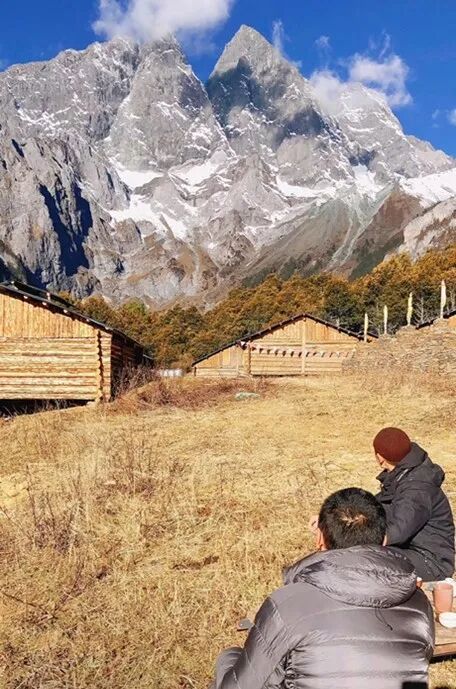
Taken during the trek
Yuan Ye: We bystanders only see the beautiful side, like with entrepreneurship — outsiders may only see the glamorous, successful side, but behind it are countless difficult moments. Analogous to the most dangerous moment in this outdoor experience, has there been such a crucial moment in Kuaishou's history?
Hua Su: For Kuaishou, the 2019 decision to solve organizational vitality through a campaign approach was a relatively big bet. If the overall organizational atmosphere leans Buddhist [passive/complacent], you can't solve it locally, can't adjust it bit by bit. You need a huge momentum to shift the overall style, but first, this had never been done in history; second, if done poorly it could have side effects; third, the investment cost was enormous — requiring full company mobilization and putting all resources into it. This is the most risky thing we've done recently. Other decisions have generally been okay, because most were based on rationality.
Zhang Fei: From an adventure perspective, the K3 campaign was indeed a very critical juncture in Kuaishou's many years. Additionally, I can very clearly feel that in the past year or two, both Hua Su and Yixiao's openness to change and uncertainty has changed greatly. Before it was more of a lagging response, but today they're more proactively and actively finding their better position in a huge dynamically changing environment.
Chapter 05
Inspiration and Expectations
Yuan Ye: You both read a lot. Can you share which books or people have had a relatively deep influence on you recently?
Zhang Fei: I've been recommending The Biography of Masayoshi Son a lot recently. That book had a huge influence on me. What impressed me most was that Son is better than ordinary people at taking things to extremes. For example, once he found his most trusted strategist and asked him to formulate a 300-year strategy for the company. This sounds completely illogical — who knows what the world will be like in 300 years, how can you make a 300-year company strategy? But this guy was just that执着, really made him do a 300-year strategy. After that, he had him do a 30-year strategy, which became extremely clear, because there was 300 years of long-term thinking as foundation.
I think a particularly interesting type of person in history is someone who uses a larger perspective to look at what might happen in the future, then gradually converges to something more observable. If I just make a 5-year or 10-year plan from the start, it's probably not as good as his 30-year plan. This really shocked me. Of course Son remains a very controversial figure today, with many controversial moments in history, but deep down I greatly respect this mode of thinking.
Hua Su: Yixiao and I agreed to read one book each month, usually related to management, organization, or strategy, and we recommend to each other. Recently we read Nonviolent Communication, an entry-level book about communication. The communication methods it mentions are quite different from what we're accustomed to in Confucian communication. In Confucian society, most communication scenarios have hierarchy — like teacher-student, ruler-subject. For example, "if there is fault, correct it; if not, take it as encouragement" — this emphasizes that even if I'm wrong, you listen and accept first. This isn't necessarily called violent communication, but the whole communication system has hierarchy.
In China, scenarios of equal communication appeared relatively late, so relatively few people are truly adapted to it. Western modern enterprise systems appeared earlier, while China previously had more master-apprentice and patriarchal systems. The Company Law only came in 1993, and after 2000, especially with the internet, did companies with equal exchange begin to appear. So only through practice and learning in these last 20 years are people beginning to grasp and apply nonviolent communication methods to solve complex problems. This method isn't actually difficult, but it needs demand, needs enough environment to practice and popularize.
Zhang Fei: You learned nonviolent communication managing a company. I learned it dealing with my kids — violent communication is almost completely ineffective in their world.
Yuan Ye: Last question — if you could set a goal for yourself ten years from now, what would it be?
Hua Su: I would hope that ten years from now I'm better at expressing myself. I don't think I'm a good communicator now, more of an observer and thinker.
Yuan Ye: Fisher, a blessing for Hua Su ten years from now — what do you wish for him?
Zhang Fei: From a career perspective, I really want to bless Hua Su, that he can lead Kuaishou to become an internet video company with a powerful, rich ecosystem — an ecosystem like the Amazon River, with all things growing, flourishing endlessly. That's what I most want to see.




5Y Capital (formerly Morningside Venture Capital) currently manages approximately three billion USD in dual-currency USD and RMB funds. We believe that if the you whom others see as crazy begins to be believed in, the world becomes a better place.
BEIJING · SHANGHAI · SHENZHEN · HONG KONG