5Y Talk|Kai Yu of Horizon Robotics: The "Crazy" You Others Saw, Now Starting to Be Believed

Our hope is to become the Intel of the robotics era — that has been Horizon Robotics' mission from day one.

Recently, Horizon Robotics announced the launch of its Series C fundraising round, with total proceeds expected to exceed $700 million. The company has already completed the $150 million C1 tranche and the $400 million C2 tranche.
Artificial intelligence is one of the few technology domains where Chinese entrepreneurs can compete globally in real time, and autonomous driving has become its most important sub-sector. As an early investor in Horizon Robotics, 5Y Capital had the privilege of hearing Kai Yu's chip ambitions five years ago, and has accompanied and witnessed Horizon's growth from the angel round onward.
As a complete outsider to chips, how did Yu seize opportunity amid controversy and lead Horizon Robotics step by step into the spotlight? We've compiled the transcript of Horizon Robotics founder & CEO Kai Yu's speech at the 5Y Capital CEO Summit. We hope you find it illuminating :)
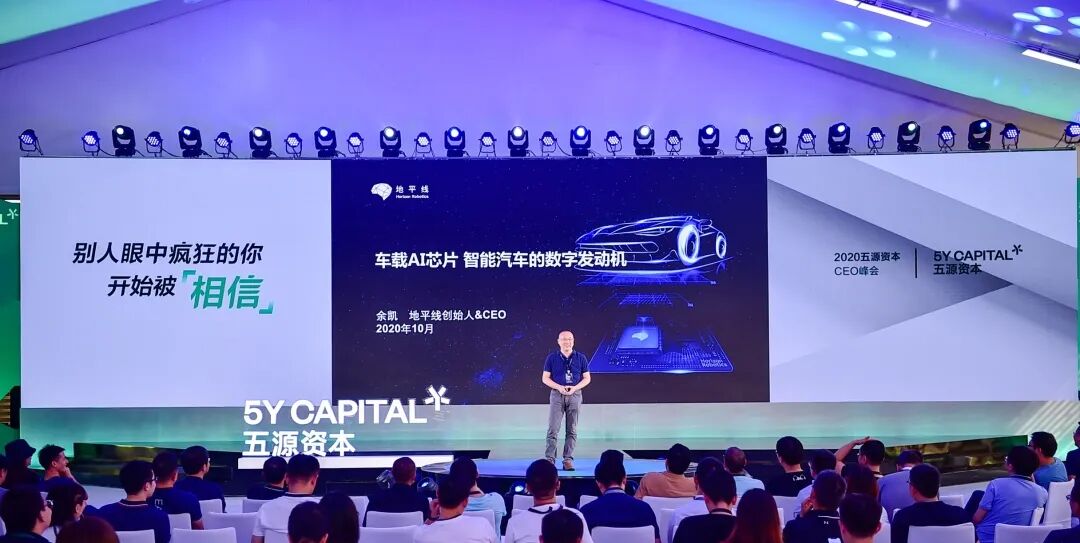
I was 40 years old when I started my company. I had spent over twenty years working in one specialized discipline of artificial intelligence — machine learning — never changing direction. I had always worked in software, never touched a chip, and knew nothing about business or corporate management. Of course, I still don't fully understand them now.
I thought the previous speaker made an excellent point: find young people without experience but with original aspiration and dreams. I think Qin Liu has one advantage — he also seeks out old people with original aspiration but no experience. (laughs)
When we wanted to start a company making chips for intelligent vehicles, the market didn't even exist. In our first funding round, 5Y Capital led the investment. Over five years, they continued to increase their stake, believing with us in the future of in-vehicle computing. So I think the "you" in 5Y Capital's new slogan "When the world sees you as crazy, someone starts to believe" refers not just to us entrepreneurs, but to themselves as well.
01
Becoming the Intel of the Robotics Era
On June 9, 2015, I had just left Baidu to start my company and gave an interview to the media. At that time, we said we wanted to become the Intel of the robotics era — putting deep neural networks into chips, creating the brain chip for robots, realizing the transition from the Internet of Everything to the Intelligence of Everything. We wanted every vehicle, every appliance to have environmental perception, human-machine interaction, and decision-making capabilities.
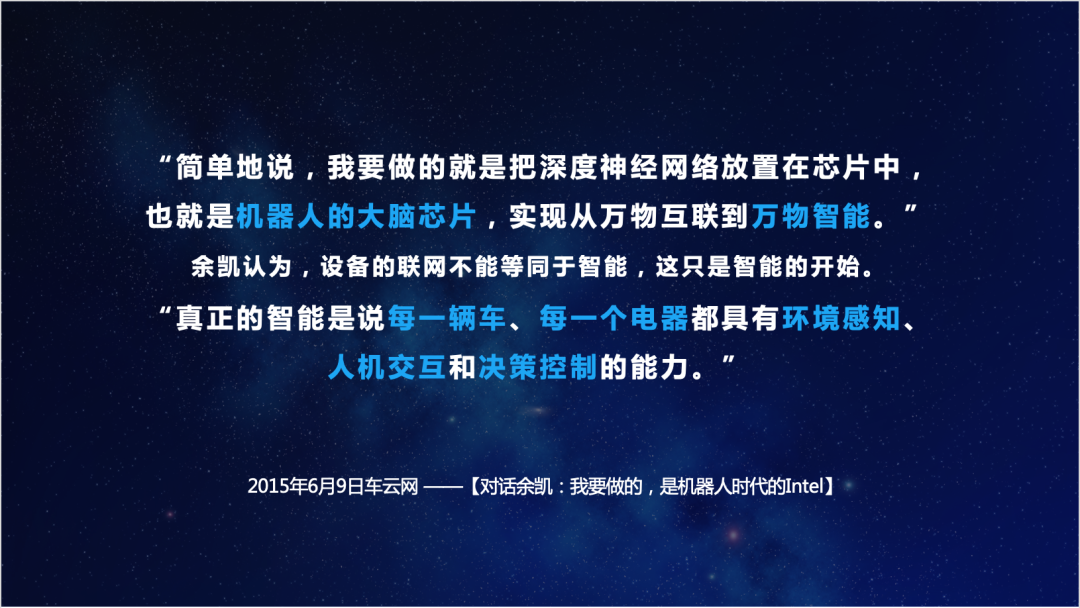
We were arguably the first company in China to work on AI chips, and very likely the first in the world — we haven't found any company that proposed this idea earlier than us. Looking back, it was pretty crazy. I even remember discussing this with Qin Liu. He said the path to making intelligent vehicle chips was too long — how would we survive the journey? So we even considered making toy chips or other short-term things to sustain us through such a long cycle.
Today, I want to tell you that we believe the biggest, most worthwhile robot is still the automobile.
Over the past half-century, the trajectory of semiconductor operating systems and the IT industry has been tied to smart terminals. Today, in semiconductors, TSMC allocates its largest production capacity to which sector? Smartphone chips. Before that, who got the most capacity? PCs. Intel was the global chip leader for a long time. In the smartphone era, we have Samsung, Qualcomm, ARM, and Apple and Huawei making their own chips too. Then there are operating systems like Microsoft and Android. All of these relate to terminal computing platforms — an enormous, vibrant industry.
As technology advances, we're heading toward a future of ubiquitous intelligent machines, ubiquitous smart terminals. Faced with such a massive industry, we naturally ask: What's next? What will be the next terminal computing platform at this scale?
We believe the biggest vertical will undoubtedly be intelligent vehicles. And only by nailing the chips and operating systems for intelligent vehicles first can the future of ubiquitous intelligent machines arrive. Only a trillion-dollar-level industry can attract sufficient talent and investment to activate the entire upstream and downstream supply chain, bringing this industry into ordinary households within the next decade.
Based on this vision, we hope Horizon Robotics can become the Intel of the robotics era — this is our original aspiration. We named the company Horizon Robotics because we wanted to build a horizontal platform, empowering all robotics.
02
Intelligent Driving Computing: An Unprecedented Challenge, and Opportunity
Intelligent driving computing is actually the greatest computational challenge humanity has faced to date.
Today's mass-produced intelligent vehicles are all at L2. Based on autonomous driving levels, the operating conditions they face, and their sensor configurations, we've done some rough calculations. Most of today's intelligent vehicles process data on the scale of several dozen to around 100 terabytes. Each level up in autonomous driving increases data volume by an order of magnitude. At L4, data volume reaches 300T or even 500T. At L5, it rises to around 5,000T.
What's 5,000T? That's the computational scale of the human brain. The data produced by 2,000 L4/L5 autonomous vehicles in one day equals all the data human civilization produced in 2015. And this data isn't stored somewhere to be processed slowly — it must be computed in real time with latency under 60 milliseconds. Moreover, it doesn't happen in data centers with unlimited power and liquid cooling, but across all kinds of operating conditions and road environments.
This is the challenge we face, but it's also precisely our opportunity.
By 2030, intelligent vehicle chips will become the largest vertical market in the semiconductor industry. This market will certainly give rise to companies on the scale of Intel and NVIDIA. The question we want to answer is: can that company be in China, or to put it more directly, can it be us? This is the wildly ambitious goal we're chasing.
In the past, semiconductors weren't actually that important to vehicles. A vehicle contained over a hundred small ECUs (electronic control units), each responsible for one very independent minor function. To optimize costs to the extreme, software and hardware were tightly coupled and inseparable.
Why must we move toward central computers on four wheels? Because only with centralized computing can we have operating systems, and only then can software and hardware separate, enabling continuous OTA updates like Tesla's — adding new features, improving user experience. This is crucial. Because with traditional cars, your relationship with the consumer ends when you sell them the vehicle. But for intelligent vehicles, selling the car is just the beginning of your connection with your user.
So future vehicle architecture must center on the central computer chip, the operating system, and upper-layer application software — including intelligent driving and various intelligent functions in the smart cockpit.
Going forward, intelligent driving and smart cockpit operating systems will certainly merge into one complete intelligent vehicle operating system. And at that point, the intelligent vehicle will begin to take the shape of a robot.
03
Step by Step, Turning "Crazy" into Reality
In 2019, we launched China's first automotive-grade intelligent chip, Journey 2, which achieved mass production last year. In September, we released our second automotive-grade intelligent chip, Journey 3, capable of supporting L3 intelligent driving. It can handle not only forward-facing ADAS perception computing but also surround-view perception computing simultaneously.
Recently, we'll also launch our next-generation flagship automotive intelligent chip — Journey 5. A single chip delivers 96T of computing power, 30% more than Tesla's FSD, designed for higher-level intelligent driving.
Horizon Robotics has considerable unique strengths in algorithm, chip, and architecture design, typically manifested in our ability to achieve more efficient intelligent computing at lower power consumption.
From today's mainstream intelligent vehicles to typical configurations for 2023, we've built out a very complete product matrix at every tier, going into mass production across the board — whether for human-machine interaction in smart cockpits or ADAS autonomous driving. In 2020, we had 6 mass-production models, with over 150,000 vehicles equipped with Horizon intelligent chips. In 2021, we expect 1 million vehicles to carry Horizon intelligent chips.
Currently, only three companies globally have achieved front-loading mass production of automotive intelligent chips: Intel's Mobileye, NVIDIA's Xavier, and Horizon Robotics.
In the past, in the automotive sector, chip vendors were tier-2 suppliers. Among tier-1 suppliers, there were companies like Continental and Bosch Group. OEMs are the vehicle manufacturers. Typically, chip vendors delivered to tier-1s, who did vehicle integration and then delivered to OEMs. But in the intelligent vehicle era, you'll find this traditional cooperation model is undergoing fundamental change. Today, chip vendors work directly with vehicle manufacturers — for example, Mobileye with BMW, and Daimler recently announced a partnership with NVIDIA, even co-developing software together. Horizon Robotics has also established this model. In 2018, we established a joint AI laboratory with Changan Automobile — this was no longer the traditional delivery relationship.
Because looking ahead, there are no so-called mature components in the traditional sense to deliver to vehicle manufacturers. What's most important is no longer delivery, but collaboration — breaking boundaries to jointly define future intelligent vehicle products for consumers. This also enabled our cooperation with Changan to help them quickly launch their new model, the UNI-T, this year.
The UNI-T has been an absolute breakout model in China's auto market this year. It now basically delivers over 10,000 units monthly. Very few models achieve this scale in their first year on the market.
We're replicating this model. Recently, we established the SAIC-Horizon Joint AI Laboratory with SAIC. We're forming similar organizations with FAW, and with the well-known new EV startups you've all heard of — joint development groups to co-define and build future intelligent vehicle products.
Beyond our product and commercial progress, what do I think is more important? That a company must continuously and long-term do the invisible work — including organizational, talent, cultural, and technological accumulation, as well as our religious-like faith and emphasis on function and safety. We are currently the only company in China's AI chip sector to have obtained ISO 26262 ASIL D-level functional safety process certification (the highest safety level in this certification system). So we have the capability to design chips and entire systems with failure and defect rates approaching zero.
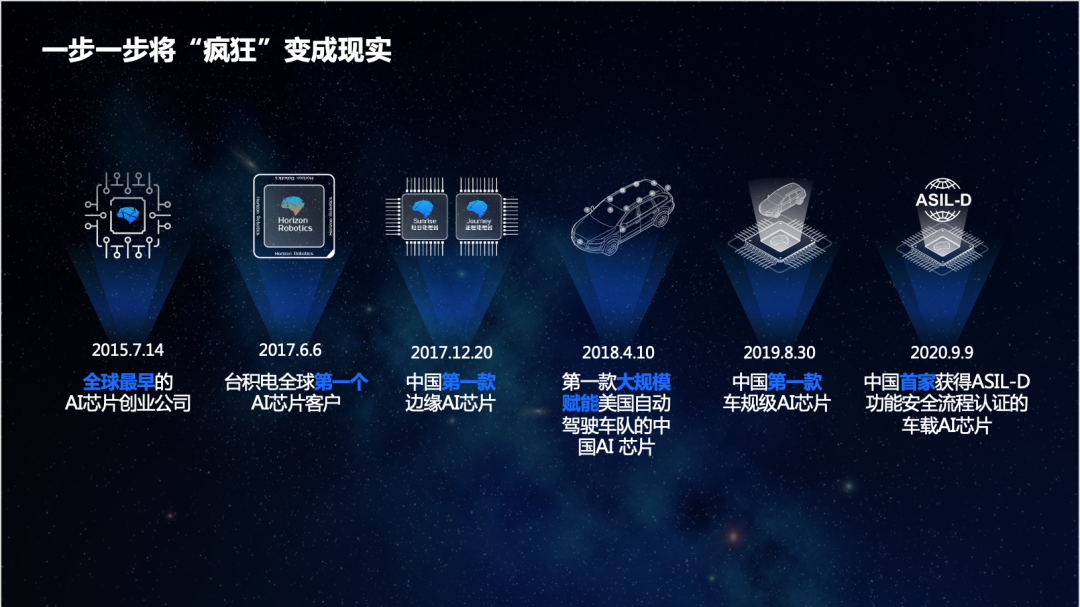
Looking back at Horizon's development, step by step, we feel quite fortunate. At our founding, we became the industry's first edge AI chip startup.
Even today, most AI chip companies are still doing cloud or server-side computing. Horizon Robotics has always firmly believed that the automobile will become a data center and supercomputer on four wheels.
I used to work in the internet industry, where we basically updated and iterated software versions every week. Now, for an automotive-grade chip, from project initiation to earning the first dollar, it took five years. So I think our greatest challenge isn't anything else — it's building an organization and culture suited to such a slow business.
Facing the future of intelligent vehicles, there will certainly be underlying platform enablers on the scale of Intel and Microsoft. Horizon Robotics hopes to become such an enabler, openly embracing the future and working with everyone to build a thriving ecosystem.





5Y Capital (formerly Morningside Venture Capital) currently manages approximately $3 billion across USD and RMB dual-currency funds. We believe that if the world sees you as crazy, and someone starts to believe, the world becomes a better place.
BEIJING · SHANGHAI · SHENZHEN · HONG KONG