5Y Talk|The Next Decade: Embracing the Age of Robots

5Y Capital is always searching for and backing promising technical founders — whether you're working in robotics, AI, or any other technology field, we'd love to hear from you.

Since the birth of the first robot half a century ago, robotics has gradually permeated every aspect of work and daily life. Today, the world stands at the intersection of a new technological revolution and industrial transformation. The vigorous development of intelligent industries represented by robotics is a defining marker of contemporary technological innovation. As the world's largest robotics market, is China ready for its entrepreneurs to seize this "crown jewel of manufacturing"?
This edition of 5Y Talk comes from the Deep Tech Venture Forum lecture series titled "The Next Decade: Embracing the Age of Robotics." Peter Chen, Vice President at 5Y Capital, was joined by three robotics entrepreneurs — Chaohui Gong, CEO of Bito Intelligence; Jiazhi Zhou, Founder & CEO of XYZ Robotics; and Yuqi Chen, Founder & CEO of HAI Robotics — for a discussion covering their original motivations for founding their companies, reflections on the past year, and future market opportunities. Below, we've compiled highlights from their conversation.
About the Deep Tech Venture Forum: A series of venture capital lectures on hard science topics, jointly organized by MIT CEO and student associations from Harvard University, Carnegie Mellon University, and Princeton University.
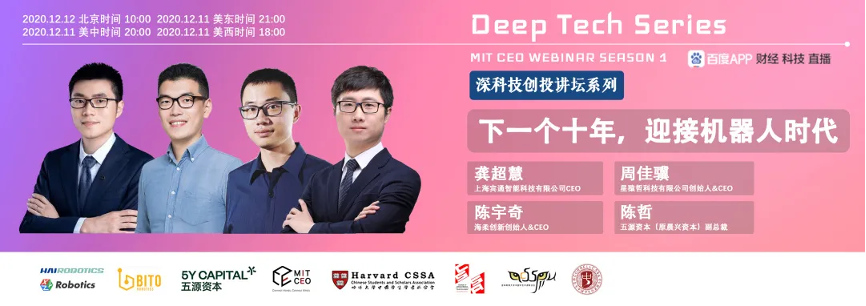
Guest Profiles:
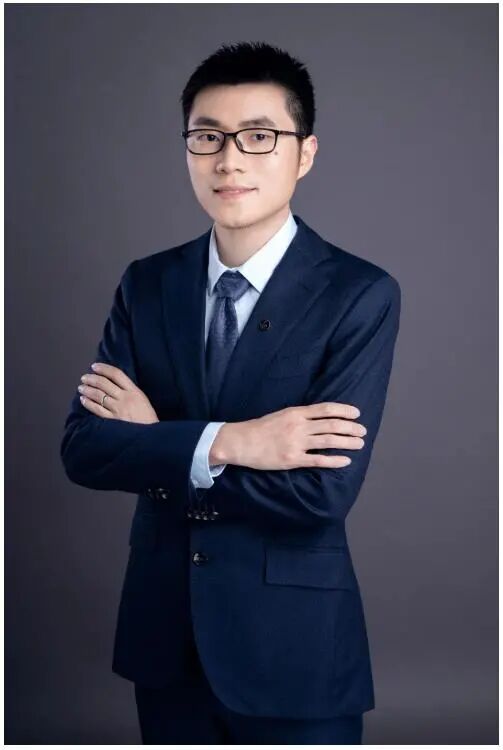
Chaohui Gong
CEO, Shanghai Bito Intelligence Technology Co., Ltd.
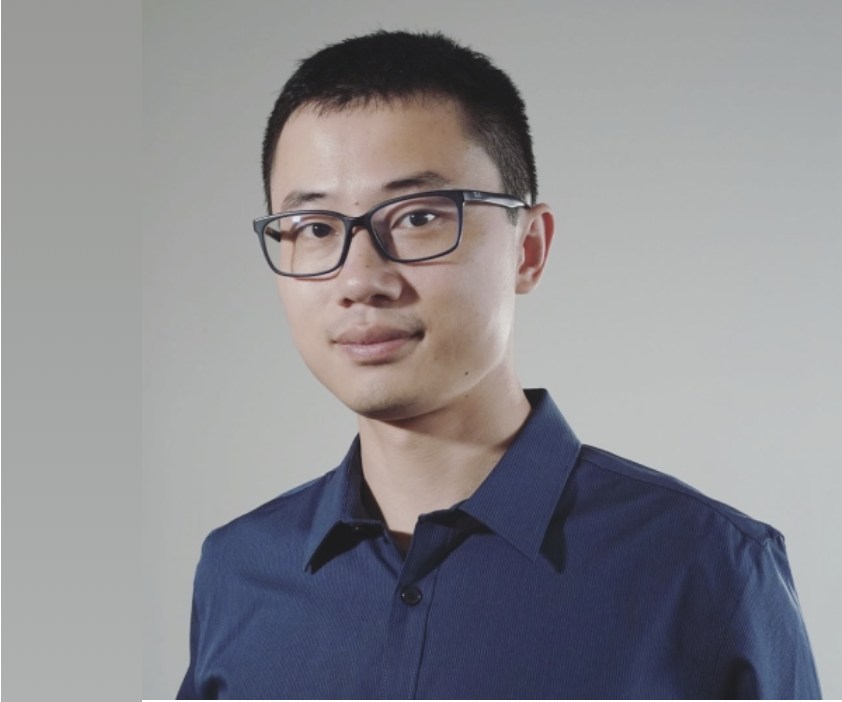
Jiazhi Zhou
Founder & CEO, XYZ Robotics
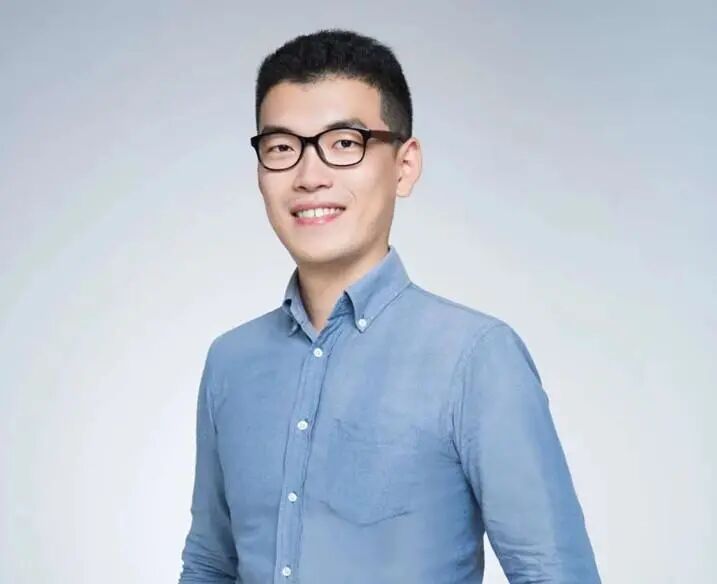
Yuqi Chen
Founder & CEO, HAI Robotics
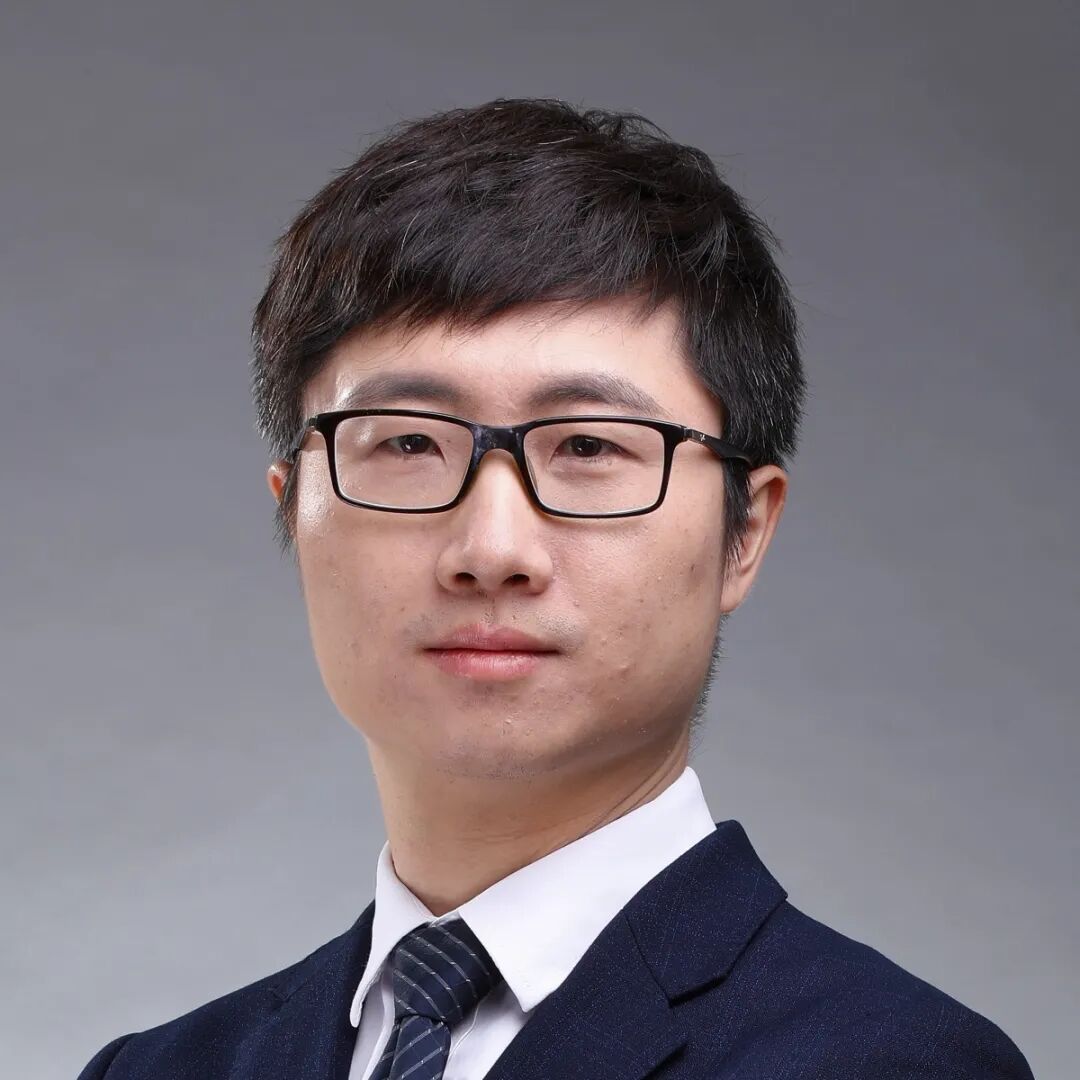
Peter Chen
Vice President, 5Y Capital
Chapter 1
Introductions
Peter Chen: Let's start with each of you introducing your company's direction.
Chaohui Gong: We're an intelligent algorithm-centric company providing flexible manufacturing and smart logistics system solutions. We believe digitalization will become the new infrastructure of future manufacturing, so we aim to reshape the entire industrial landscape through AI and robotics, democratizing the infrastructure for intelligent manufacturing. When industries undergo digital transformation, the efficiency and modes of internal information exchange fundamentally change — production, management, and organizational processes will be completely transformed.
But this is a very long journey, and we can't do it alone. We want to build these technologies into a general-purpose, programmable platform that enables secondary development. System integrators can use our platform for graphical development and adaptation. This way, data is organized in our preferred format, processed through our generalized algorithms, and different manufacturing scenarios can eventually be connected through this universal platform to improve overall production efficiency.
Jiazhi Zhou: I think robotics creates value in two main ways: mobility and manipulation. Mobility is moving yourself from point A to point B. Manipulation is changing the state of your surroundings through physical contact. Our entire company is built around the latter.
In short, we're trying to get as close as possible to what human hands can do, generating value throughout that process. Right now, we can summarize what we do in three phrases: Pick Anything, Place Anywhere, in Any way. Of course, we haven't fully achieved this yet, but along the way you generate different commercial value. For example, many of our current applications involve unstructured sorting in logistics and machine tending in industrial settings. I'll share more technical details and insights later if we have time.
Yuqi Chen: We mainly build tote-handling robots, focusing on one specific scenario in logistics. Our product essentially moves boxes around warehouses. The benefit? "Goods-to-person" dramatically improves human efficiency.
In traditional warehouses, people spend most of their time walking. Say you order a shirt and a tie online — a worker has to find the shirt, then find the tie, pack them, and ship them out. During that process, 80% of time is spent walking. Chinese warehouse workers might walk 30-plus kilometers daily. With robots, goods come directly to the worker, eliminating walking and improving individual efficiency by 3–4x.
Chapter 2
Original Motivations
Peter Chen: I joined 5Y Capital in 2018, during the peak of the AI hype cycle. We'd made investments in several major AI application scenarios like security and autonomous driving, and I was thinking about where the next major AI scenario would emerge. Given my own interests and background, I was very bullish on robotics because I saw computing power and algorithms improving rapidly, sensors advancing, and robot costs dropping significantly. Combined with market demand, I had a gut feeling the timing was right — that's the investor's perspective. I'm curious about each of your founding stories. When markets and demand weren't yet clear, what drove you to start companies in this direction?
Jiazhi Zhou: I actually think the market and technology were quite clear. China is the global center of manufacturing. Supply chains, warehouses, and parcel distribution centers were developing rapidly. This sector employed roughly 100 million industrial workers. Five years ago, that number was about 115–120 million. Industrial output kept growing, so where did those roughly 20 million workers go? Replaced by automation, mostly shifting to internet service industries — food delivery, community group buying, and so on. So the industrial automation market has always been there.
With the market established, the question becomes whether the technology can genuinely deliver value and replace repetitive labor. From day one, we've held that the essence of technology is cost reduction. Most production scenarios are relatively controlled, unlike fully unstructured environments like autonomous driving, so the technical uncertainty isn't as extreme. The key questions are how many different domains your technology can be replicated across, and at what cost. If you stay focused on these two points, work hard, and eliminate the running around and manual work that industrial workers do, you'll inevitably create value. That's always been my thinking.
Chaohui Gong: Jiazhi just mentioned a massive structural opportunity in China, which I completely agree with. When I decided to start my company in 2017, China's manufacturing-related GDP was $4 trillion annually, compared to $2 trillion in the US. But US manufacturing GDP included more high-value activities like chip design, technology licensing, and aircraft manufacturing. China had more large-scale manufacturing activity, and was just beginning to face aging demographics and rising labor costs. On top of that, China's past overcapacity and homogenized competition meant manufacturing needed to become more flexible, more tightly integrated with demand, and more transactionally efficient. These two factors represented a huge structural opportunity.
When judging major trends and opportunities, some might worry about being a year or two early. That doesn't matter. If you're certain something will happen, the cost of missing it far exceeds the cost of being slightly early. So entrepreneurs must endure solitude, make predictions, and persistently optimize their fundamental convictions.
Robotics combined with AI brings something structurally transformative to the economy: the ability to scale non-standardized work. In the past, industrial robotic arms were simply repetitive automation equipment — they weren't really robots. I believe only AI-enabled automation deserves to be called robotics. When scenarios change, it can plan, decide, and adjust its outputs to adapt to environmental changes.
Though we offer standardized AI software, deployed across different non-standard, unstructured scenarios, it gives existing automation equipment greater adaptability and problem-solving capability. Marginal costs can be driven lower and made more scalable, with improving marginal returns as scenarios and data accumulate. This is the profound structural shift we see.
Yuqi Chen: Speaking of original motivation, it's about solving problems. Chinese society faces a massive problem: aging demographics. My founding motivation was to see if I could help address this, through whatever means, products, or solutions — whichever approach I could build advantages in, that's what I'd pursue. That was the biggest driving force.
Why this specific direction? I studied robotics for my master's, so I wanted to do something robotics-related. We researched various scenarios, including elderly care and rehabilitation exoskeletons, but ultimately didn't pursue them because those fields still required significant technical research and development.
Between May and August 2015, I visited about 30 warehouses and found warehouse problems relatively standardized and solvable, so we entered logistics. At logistics trade shows, I saw various automation equipment and wanted to combine some concepts — there were automated storage and retrieval systems (AS/RS) and mobile robots, and I thought about combining the two.
Our current generation uses relatively mature technologies — robot control, navigation, scheduling, and some recognition are all well-established. For us, the challenge is more about making the product truly good: increasingly stable, efficient, and robust. Looking ahead, when XYZ Robotics' robotic arms can pick directly from totes, even that human picking step becomes unnecessary.
Some might say that's cruel, that we're eliminating workers. But in ten years, aging will be an enormous societal problem. We must improve societal efficiency first — solve value creation, then value distribution. So we chose tote-handling robots, and have been at it for five years now.
Chaohui Gong: Following Yuqi's point — what happens when robotics and automation broadly replace simple, repetitive, tedious work? This is something we constantly think about. Why do we want industry to be sufficiently flexible, with data driving daily production and self-optimization, self-decision-making? The goal is for future factories to function like toolboxes — people can design personalized products at the front end, directly connecting to an intelligent, flexible, on-demand production capacity network at the back end. Then people can do more value-added work, pursuing self-actualization and cultural identity. This is the contribution technology can make to society.
Chapter 3
Reflections
Peter Chen: The robotics sector has seen very positive changes this past year. The STAR Market launch provided strong exit channels for hard tech companies. Early this year, successful listings by companies like Roborock and Ninebot brought public attention. COVID-19 accelerated adoption, with many robots finding product-market fit or rapidly deploying in urgent, must-have environments. Meanwhile, declining costs mean more environments are beginning to accept robotic solutions.
I'd like each founder to share reflections or insights from the past year.
Chaohui Gong: For me, two words: "perspective shift." Especially for technical founders, how do you transition from a purely technical perspective to a user-needs perspective? Peter mentioned product-market fit — for AI robotics entrepreneurs, I'd take it further to scenario-technology fit. Never carry a hammer looking for nails.
The other key concept is simplify. Technical founders with strong capabilities tend to believe every problem can and should be solved. But entrepreneurship requires identifying one high-value, quickly deployable application, amplifying that value, before considering anything else. There are infinitely many valuable things in the world, but not every one is right for you to do, and priorities and values differ enormously.
These two points represent my biggest learnings.
Peter Chen: On simplification specifically, do you have any lessons or war stories?
Chaohui Gong: Quite a few. When technology enters a scenario, countless engineering details emerge. When clients make requests, we believe we can handle all of them — various scenarios, various equipment integrations, various complex logics. We absolutely have the technical capability to solve every problem, but not every problem needs solving, and many can be addressed more simply through non-technical means.
For example, when selecting AMR types to deploy, we found some equipment types like forklifts are highly standardized with large installed bases — decades of industrial accumulation. We don't need to radically optimize them or add fancy features; just standardize and adapt them well. This lets us deploy faster. Only when we have sufficient scale do we consider further optimizing these long-established solutions — that's the more appropriate path.
Peter Chen: At this stage of automation and robotics development, many scenarios have urgent unsolved problems. Founders who can stay sufficiently focused on core issues and build decisive advantages in specific scenarios are ones we deeply admire.
On "focus," I particularly want to discuss with Yuqi: HAI Robotics has been singularly focused on tote-handling robots for four to five years, building essentially one product with no market precedent. Five years ago, when China's market was flooded with AGV startups all benchmarking against Amazon's Kiva, what led you to avoid following suit and instead challenge a completely unproven, highly uncertain direction?
Yuqi Chen: We didn't overthink it. We started in 2015, went to trade shows, and saw many already building Kiva-like systems. We felt we couldn't outcompete them there, so we wanted to innovate. We happened to see tote-handling concepts and got inspired to combine totes with AGVs — a box-moving robot.
We spent four years in heads-down R&D. Year one, we built a demo with wooden carts and purchased hardware. Year two, we assembled a team and built a small system, but density and efficiency were insufficient. Year three, we optimized based on those problems, and essentially identified the product's value, though system stability remained inadequate. Year four, we stabilized the system, then began formal sales.
Outsiders might think we accomplished nothing for four years, that persisting until product launch was arduous. But every year brought new progress — it never felt particularly painful. We just kept at it.
Peter Chen: This reminds me of meeting Kiva's founder in Boston. He was searching for automation solutions in the early 2000s — very early. After several iterations, he discovered "goods-to-person." Kiva's real innovation was goods-to-person; the technology and granularity at the time couldn't well realize tote picking and placing, so he used shelf-moving instead. He told me that when he first pitched "goods-to-person" to investors, nobody understood what he was doing. Only when he built and ran the system did people realize it was viable, and Kiva's form factor better suited US e-commerce, enabling mass adoption there.
He also persisted for a long time. This may be an instinct of exceptional founders — willing to focus intensely on something they deeply believe in, polishing it to perfection over the long term.
Yuqi Chen: From our perspective, many formidable large companies operate in our space. Having technology is just the beginning of entrepreneurship. Later on, organizational capability, sales capability, supply chain, strategic ability — these become critical. So if you aren't sufficiently focused from the start, trying to do everything, it's impossible to outperform those large companies.
Peter Chen: Right, the logic is simple, but entrepreneurs in the thick of it often remain opportunity-driven, chasing wherever there's demand and revenue. Returning to your point: to build a successful startup, we first need to solve how to position ourselves in the gaps between giants — companies 100x or 1000x stronger than us.
Yuqi Chen: Speaking of which, I'd recommend a book by an MIT professor: Entrepreneurship 101: Who Is Your Customer? It's about entrepreneurial methodology, especially for those considering starting up — who exactly is your customer?
Peter Chen: Jiazhi, you've been at this for just over two years. Any reflections? Pits you've fallen into?
Jiazhi Zhou: Overall, since robotics companies currently focus on B2B services, there are some B2B pitfalls. As Yuqi mentioned — who is your customer? And among your customers, at what stage do you approach them? What short-term versus long-term value do they bring? We're constantly adjusting and reconsidering this, but often you only develop real intuition and authentic feedback through execution.
Robotics is a hardware-software integration play with high trial-and-error costs, so you must establish rapid feedback mechanisms. Today's robotics entrepreneurs are exceptionally capable — execution speed and quality won't differ dramatically. So the quality and speed of customer and market feedback on your product is crucial.
Another point: human efficiency matters enormously. Early on, we focused mainly on core product functionality — how to improve accuracy from 99.9% to 99.99%. But we were slightly late in building toolchains for human efficiency. Now, many things can't get done in time; throughput is insufficient. Going forward, this will be an important competitive advantage.
Additionally, in China especially for B2B services, people prefer total solutions — hardware, services, and software powering that hardware. You need clear definition of what you're selling. Too broad, and startups risk cash flow crises — one or two projects can kill you. Too narrow, and even if you're the only one, the most special software provider, your actual value within the broader industry chain is limited.
So the trade-off requires feedback — real, authentic feedback — to precisely position your service scope. Sometimes this may not align with your early strengths, but as an entrepreneur, you'll accumulate more resources and strong people around you. Learning from those who truly understand, working together to excel in this role — that's also very important.
Chapter 4
Outlook
Peter Chen: Thank you all for sharing. Having discussed lessons learned, I'd like each of you to look ahead 5–10 years. What do you think is currently undervalued in how people understand robotics? Or what contrarian thinking do you hold?
Jiazhi Zhou: In industrial robotics, as Chaohui mentioned, in the vast majority of use cases, industrial robotic arms are merely programmable multi-joint motor-driven equipment, with very slow sales growth. But I have a bold prediction: currently, very few robots use vision and motion planning — probably less than one in a thousand. But I believe in three years, that figure could reach 25%.
Why this judgment? Major players like Fanuc and ABB already ship roughly one in ten robotic arms with vision and other process capabilities. But these giants don't invest as heavily in single-point products as startups do — this is a precondition for startup success. In vision-to-robot-arm adaptation, a giant might allocate 40 people; in our startup, perhaps 300 of our team focus solely on this. If the startup's leadership outperforms the giant's VP level, and focuses intensely on this, there's a winning opportunity.
In three years, whether through our own efforts or ecosystem partners, I believe we can achieve 25% market penetration. Beyond that, I predict these added vision capabilities won't cost extra — customers will buy a robotic arm and have it adapt to various common vision-driven scenarios out of the box.
Yuqi Chen: Looking ten years ahead, what's undervalued? I'd still say insufficient attention to aging demographics. This is a massive problem affecting everyone. Those of us in robotics need to improve societal efficiency however we can, liberating human capacity.
Chaohui Gong: On contrarian thinking — society needs solutions, not necessarily robots or any specific thing. As Yuqi mentioned with elderly care, the solution likely requires aggregation of multiple technical elements, plus socioeconomic structures, capital structures, social cognition — only then does a solution emerge. Robotics technology is part of it, but actually a very small part. So entrepreneurs must fully recognize that solutions are the essence; technology may be an indispensable component, but positioning must be accurate. This may be an uncommon common sense.
A major trend I see: all companies should evolve toward services. Technology and products may underpin your service delivery. If that has sufficiently high barriers, you can become a platform, then use that platform to deliver services. This will be quite disruptive to conventional wisdom, but it's inevitably coming.
Peter Chen: On solution value — I've discussed with Yuqi and Jiazhi that today, as warehouse robotics companies, we may still be in a hardware-selling phase. But for end customers, what they really need to solve is warehouse automation. So if someday, as technology matures, the combination of AGVs and robotic arms achieves fully automated warehouse operations, then a robot-selling company transforms into an operations company — the AWS of warehousing, living off service rental and sales. If realized, this would undoubtedly be a hundred-billion-dollar infrastructure company.
One final question: all three of you have worked in robotics for several years now. For entrepreneurs considering entering this industry today, what directional advice would you offer?
Jiazhi Zhou: Beyond what I'm doing in 3D, look further down the stack. Industrial robotic arms haven't optimized cost structures in motors, reducers, and other components. I think finding a performance sweet spot for motors, paired with relevant software to deliver certain services with cost and efficiency advantages, is worth exploring.
I also find sensors interesting, especially depth sensors. There's a gap between industrial-grade and consumer-grade products — consumer-grade actually outperforms industrial-grade in many ways, but has its own issues: stability, manufacturing processes, being hyper-focused on specific applications. Can you find balance between these? If you build such a product, we'd be very interested in purchasing.
Chaohui Gong: Good entrepreneurs, as Peter Thiel said, need transformative innovation. We've discussed how AI technologies have potential for non-standard capabilities, but their greatest value is breaking boundaries — bringing opportunities to entirely new application domains beyond conventionally industrial settings.
Just as people once thought AGVs could only follow fixed routes in factories, Kiva combined with application scenarios to achieve "goods-to-person," opening an entirely new track. Everyone must dare to consider what scenarios could bring massive new opportunities. Don't be constrained by the status quo — that's what entrepreneurs should do. We can't give specific advice; you need to think and feel this through from first principles.
Yuqi Chen: We're in logistics, where warehouse automation penetration remains very low. By my rough estimate, across China by area, it's probably below 1%. Even including some European and American countries, I'd estimate overall automation penetration is under 5%. Most warehouses remain manual because many problems remain unsolved. So I believe opportunity exists here. What exactly? You'll need to understand logistics industry pain points, but those interested should explore this direction.
Peter Chen: Thank you all for sharing. On market opportunities — 5Y Capital continuously seeks and cultivates promising technical entrepreneurs. Whether you're in robotics, AI, or other technology fields, we warmly welcome founders with unique ideas and extreme dedication to connect with us.





5Y Capital (formerly Morningside Venture Capital) currently manages approximately $3 billion across USD and RMB dual-currency funds. We believe that if the crazy you in others' eyes begins to be believed in, the world becomes a better place.
BEIJING · SHANGHAI · SHENZHEN · HONG KONG