The World Rewards Those Who Stay Pure for the Long Run | 5Y Talk x SenseTime

5Y Capital congratulates SenseTime on its successful listing on the Hong Kong Stock Exchange.

Today, SenseTime successfully listed on the Hong Kong Stock Exchange.
SenseTime was founded in 2014, right when the mobile internet era was in full swing. The company chose a longer-term path, focusing on original technologies in computer vision and deep learning. That meant resisting short-term temptations, committing to massive long-term investments for an ambitious vision, and putting in tremendous effort. We believe the world rewards those who remain long-term and pure in their pursuits — this is why 5Y Capital and SenseTime have been partners since 2017.
Going public is an important milestone, but also the starting point of a new journey for the AI industry. Artificial intelligence is the defining chapter of our era. The flourishing of China's AI ecosystem owes itself to the collective efforts of countless entrepreneurs, government institutions, and fellow investors — together, all of us have built the hard-tech era. SenseTime has always held to its mission of "upholding originality, letting AI lead human progress." We look forward to seeing SenseTime continue forward in a broader world and create even greater social value. Congratulations, SenseTime!

SenseTime's IPO celebration ceremony
Recently, SenseTime Chairman and CEO Li Xu sat down for a conversation with 5Y Capital partner Zhang Fei and 5Y Capital EIR Hejia Zhao. They discussed the choices entrepreneurs make, a company's convictions, and the future of artificial intelligence. Li Xu spoke about how the true measure of a company's value lies in what it leaves behind in the long arc of history. This is what we've always believed — that the world rewards those who remain long-term and pure in their pursuits.
Once again, congratulations to SenseTime!
01
Jumping Into the Lake
Hejia Zhao: Looking back at the very beginning, why did you go from being a scientist and academic researcher to founding SenseTime?
Li Xu: It wasn't really a choice, actually. Looking back now, that moment was when technology was bringing about discontinuous, leapfrog change. In hindsight, it was excellent timing — for instance, facial recognition accuracy had just surpassed human eye accuracy for the first time. The use of technology in industry differs from academic research: once you cross the threshold for industrial utility, adoption becomes overwhelming.
If everything were gradual and incremental, tech entrepreneurship would be extremely difficult. Without sufficient time windows, it would always be large enterprises steadily pushing forward.
Zhang Fei: Looking back now, that timing seems perfect. But at the time, the mobile internet era was in full swing, and many people were probably busy building apps or doing O2O. Of all the options available, why did you choose this path? Were you anxious that this was quite off-mainstream?
Li Xu: Many choices don't actually have that many reasons behind them. Let me tell a story. When I was at Shanghai Jiao Tong University, I would walk by Siyuan Lake every day, basking in the sunlight — it felt wonderful. When I graduated with my bachelor's degree, I had a strong impulse: why not swim across Siyuan Lake? So I jumped in and swam across.
I can't say it was some grand obsession — it was suddenly seizing on a small impulse within. If someone had happened to say "don't jump," maybe I wouldn't have. Entrepreneurship is similar: at that moment we saw the trend emerging, but whether to act on it still depends on the person. Some people will want to grasp that slight psychological shift. Many choices aren't that rational.
Zhang Fei: You belong to that type with intense passion, quite different from the norm. Many people are accustomed to making choices within a predetermined track — few truly have the courage to jump into a lake.
Li Xu: Perhaps just one or two variables can change your trajectory. For many entrepreneurs, sometimes there's a slight shift within — you can actually seize it.
Of course external conditions matter too. When I finished my bachelor's degree, I resolved to jump in the lake again when I finished my master's. Turns out I graduated in winter.
Hejia Zhao: What has remained unchanged or been consistently upheld at SenseTime all these years?
Li Xu: We believe that when technology-driven productivity improvement reaches an order of magnitude, it will inevitably transform society's way of life and generate tremendous social value — and SenseTime can capture part of that value through original, innovative power.
At the time, our executive team was meeting in Shenzhen to define the company's mission and vision. I said, since we can see the technological breakthroughs and changes, why not truly realize them? Like Armstrong said — one small step for man, one giant leap for mankind. Whether it's a big step or small step by scientists behind it, let's take it. We said let artificial intelligence lead human progress.
Professor Tang said, I'd like to add four characters: uphold originality. Originality itself isn't the purpose of a company's existence — in fact, it's precisely what many people criticize, saying original R&D is extremely difficult to commercialize. But we still added it to our corporate mission. Originality creates incremental value. If you want to measure a company's worth, I believe it's about whether it changed the world even a little bit by the time it's done. The greatest source of change comes from incremental value.
Zhang Fei: Many Chinese technology innovation companies can find prototypes in the US, with paths to follow, so they're not that anxious about direction and strategy. But in AI, the entire world's AI is advancing rapidly, and SenseTime has always been at the forefront. You're doing something extremely cutting-edge, with no real reference standards — it's like walking in the dark. Do you ever panic? How do you know whether this path is right or wrong, whether it can work?
Li Xu: You've asked one of the most core questions in artificial intelligence: how to have a God function for evaluating answers. Much of deep learning attempts to answer this.
Looking at overall temporal trends, I've always believed China has excellent soil for AI development. The current wave of AI follows a big-data inductive approach, which inherently aligns better with China's value system.
Perhaps traditional philosophical-scientific thinking, starting from European deductive methods, with its complete system built over so many years, enabled the Industrial Revolution to push boundaries through deduction and drive mechanistic innovation. The West did lead in this regard and enjoyed the dividends of this development wave. They firmly believe in this mechanistic reductionism's controllability over the world's essence. But I actually don't think it's entirely correct, because after all we're defining mechanism with our existing cognition. And human existing cognition is extremely partial in its understanding of the vast world.
European AI governance has a condition called explainability — there must be an explanation; just giving a formula isn't acceptable. We may not ask whether the underlying principles have complete explainability — as long as boundaries are tested, it can be deployed. So awareness of AI usage is very high in China.
I'm not saying which is superior, but at least at this stage, China possesses the cognitive soil for AI. Often what's missing between technological revolution and true industrial revolution is exactly this cognition. So although we lack so-called reference paths, our soil is more suitable.
Moreover, people may think our cognition of many things is reducible and controllable, but it's actually not. For example, airplane takeoff and bicycle balance remain mechanical problems to this day — but after millions of tests, people consider them safe and use them. Why do some view emerging technologies as floods and beasts? Simply because they don't understand their boundaries. If we can spend time mapping out those boundaries, gradually everyone will find them unremarkable — if it improves productivity tool efficiency, people will use it.
Zhang Fei: Returning to that question — when you're running forward with all your might, do you panic? Do you ever think this path might not be right?
Li Xu: I think being a CEO fundamentally requires being an optimist, with a bit of blind confidence — every path might work out; the question is adjusting your posture in time. And one of humanity's greatest breakthroughs over millennia of evolution is organizational power — organizational power is, in a sense, the transmission of information that makes us believe something can succeed. So we're using humanity's accumulated wisdom over millions of years to solve the problem of path selection. I remain very confident.
Zhang Fei: In this dark tunnel, what do you firmly believe in?
Li Xu: Disruptive technological change brings massive industrial transformation, and we believe this is tied to the production cost of technology. So we need to reduce AI's own production costs, even by orders of magnitude below 100x — then it can exist more universally and become era-defining infrastructure.
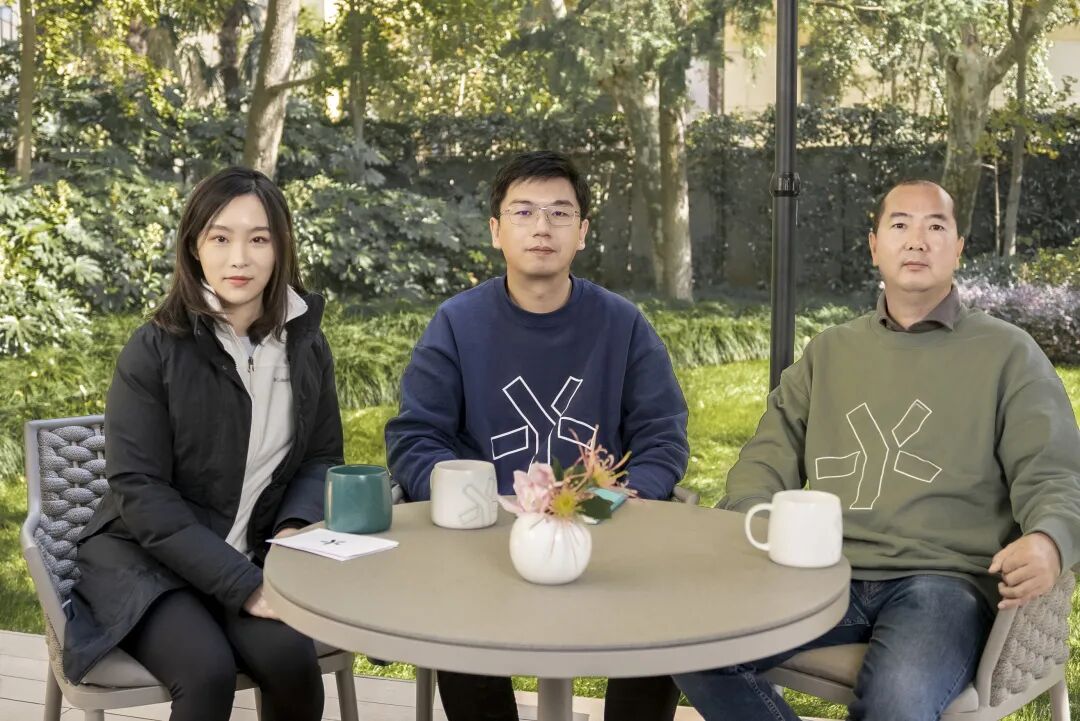
From left to right: 5Y Capital EIR Hejia Zhao, SenseTime Chairman and CEO Li Xu, 5Y Capital partner Zhang Fei
02
Fear Not the Endlessness of Truth
Hejia Zhao: AI is moving toward massive computing power and large models, and SenseTime is making reserves in this direction. From the foundational level, what explorations have we undertaken?
Li Xu: General models suddenly seem very hot — everyone talks about parameter size. But I think in a year or two nobody will care about parameters, because the essence isn't parameters but your methodology for approaching the problem.
When AI first emerged, people said it was data-driven: to recognize a cup, collect cup data and train on it — single task, single scenario, solving a single problem. It appeared to be data-driven logic, but actually recognition itself is a nearest-neighbor problem: when sampling points are dense enough in the entire space, it knows this is a cup. In fact, the stronger the general understanding of the world, the greater the robustness.
So in 2015, we began participating in ImageNet and started adjusting large-parameter models. That year we published SenseNet with 1000+ layer networks. At the time, the mainstream didn't believe scaling up models or more general object recognition had much significance beyond academic value — companies might just focus on one or two vertical domains.
But we found that single-problem, single-solution production efficiency couldn't scale up. Collecting massive data for every object to train on would be extremely costly. For example, a person encounters 600+ objects daily on average. Considering just combinations of three elements, that's over 35 million possibilities. Thirty-five million — no enterprise today can have that many models to cover everything.
Moreover, look at the world's constituent elements: people, vehicles, objects, events, scenes — seen through mobile phones, in-car cameras, smart cities. But today's in-vehicle and smart city perception systems aren't the same system or methodology. We need more业态 data fusion. Our cognition is that we need a more general perception model at a larger level, so that for细分 applications we can use small amounts of data, even zero data, for model training. To make an imperfect analogy: if you want to raise a child to be a mathematician, you wouldn't have them study only math — you'd still have them do sports, painting, even music to help train the brain. Since humans do this, why shouldn't we use this general approach when recognizing these things?
Our investment in large-scale computing power targets the core problem of AI's own production efficiency. Our路线 and layout have been consistent from 2015 to now. The Lingang computing center wasn't built because large models became hot and we decided to build a supercomputer — it's because we began布局 years ago that we have today's computing power.
Zhang Fei: What's the upper limit of computing models, or how far can their boundaries extend — how do you see it?
Li Xu: From a technical perspective, general models divided by scenario can basically deliver value now — urban scenarios, factory scenarios — and may have greater commercial value in the future. Further out, perhaps computing power can advance another order of magnitude.
In fact, over the past decade, top-tier AI algorithms' demand for computing power has increased 1 million-fold. Theoretically, more exquisite algorithms should require less computing power. But actually not, because everyone is searching a larger solution space. So what's interesting is, I've always believed AI next enters a conjecture mode — this is where possible breakthroughs and greater dividends may lie. When entering the computing power dividend era, you'll find data isn't that critical; what matters is computing power's exploration of the solution space. Machines can offer conjectures beyond human cognition, conjecturing the laws of world development.
Zhang Fei: Everyone expects greater breakthroughs from AI. Will these come from next-generation algorithms, or from better-defined scenarios and problems? Some have also said better data. Which dimension do you think could truly take AI to greater heights?
Li Xu: Algorithms are certainly evolving, but I think the underlying thinking logic of algorithms hasn't changed these years — the dividends of this wave haven't been fully released yet. Going forward, the greater the unknown, the less established the original theoretical system of a science, the greater the breakthrough.
Like life sciences, earth sciences, even sociology — machines can offer conjectures from data. AI accelerates our possibility of exploring truth. Why we call our AI equipment a large装置 is because it's analogous to a particle collider — when colliding, there's no expected outcome; what emerges is random, but it can push the world forward.
Zhang Fei: This is quite interesting. 5Y also looks at much frontier technology, and now finds AI is an extremely strong driving force behind nearly all industries. For example, DeepMind's AlphaFold2 for protein structure prediction — they then created a new company, Isomorphic Labs. If we know how proteins bind to proteins, how RNA becomes proteins, how DNA becomes RNA, the entire life mechanism may be discovered. If there's a major breakthrough in this scenario, it would be tremendous advancement for human civilization.
Li Xu: I firmly believe this. Breakthroughs in underlying tools will push our exploration of universal truth one step further. In the next five years, many laws of cosmic operation we've summarized may be overturned by supercomputing power. Machines may conjecture various laws — these laws may not even be true, but they can elevate human cognition, and that's enough.
Some say the universe is something that jokes with you — when you're about to discover its truth, the universe's complexity advances further. Of course this gives us an excuse to lie flat: don't bother searching, if you don't search the universe is only slightly more complex than you, and going further only gets more complex. But computers don't get tired anyway, right? You can let them keep pushing forward.
Zhang Fei: I recently read a particularly profound statement by Peter Thiel. He said two technologies are driving world development now: one is Blockchain, representing typical distributed systems emphasizing individualism; the other is AI, large computing power centralized. What do you think of this categorization?
Li Xu: I think in the long run, AI will certainly bring more普惠. For example, AI entering healthcare or education makes previously inaccessible resources accessible. But simultaneously we must test its boundaries, because this process may also lose humanistic value — for instance, in healthcare, is human care the most important thing? A doctor tells you it's 70% cancer, but also tells you "it's fine, treat it well and you'll be okay" — how much does this matter? We haven't studied this; these may be core points going forward.
Hejia Zhao: What do you think is the greatest challenge to achieving general artificial intelligence, or the bottleneck we most need to break through?
Zhang Fei: Or rather, does the path to general artificial intelligence exist? What might be the greatest obstacle on this path?
Li Xu: It depends on what kind of "general" we mean. Current generality is only general within a specific task. If we talk about AGI as intelligence more like human intelligence, what we're doing now isn't that yet. Humans can constantly change and iterate their own optimization goals, while much of current AI completes assigned tasks.
The greatest obstacle to this wave of technology落地 is actually human cognition. Why did people start discussing AI ethics from 2015-2016? Because previous AI was artificial-guided intelligence — managing machines with methods for managing people, all logic could be straightened out, no problems. But conjecture-form intelligence exceeds human cognitive boundaries. If humans don't timely test boundaries and constrain-optimize it, problems may arise in future use. Many things, if not governed early, will require infrastructure to be torn down and rebuilt later — becoming a major obstacle to落地. At the cognitive level, determining boundaries is crucial.
03 The World Rewards Those Who Remain Long-Term and Pure
Li Xu: Fisher (Zhang Fei) is someone who thinks very deeply. For example, you once gave a share about missionaries and homeless dogs. These kinds of reflections let you view the world with a more macro, holistic methodology. But this may also differ from investment's pursuit of returns. Like saving the world versus pursuing returns — these aren't entirely the same direction. Does this affect how you invest?
Zhang Fei: This doesn't trouble me. I figured this out early. For example, I'm a heavy music lover. Whether you choose the Four Heavenly Kings or Lo Ta-yu in musical taste — this is determined by aesthetics. Everyone has their own aesthetics, which determines who you choose to be with, who you can be physically and mentally comfortable being with long-term.
If it's only for simple commercial goals, it won't last — your self-motivation won't be sufficient. I believe the world still rewards those who remain long-term and pure. My computing power is limited, so I need to optimize in certain dimensions rather than globally.
The world isn't won by market share. The world is actually extremely polarized — if you really listed out the people who changed the world, there aren't that many. If in this lifetime we're fortunate enough to be with some of them, I think that's a great thing both personally and for 5Y. If you try to win everywhere, you'll probably win mediocrely.
Hejia Zhao: Fisher has focused on frontier technology for so many years. What traits or capabilities are we consistently looking for in entrepreneurs?
Zhang Fei: Our standards are actually quite simple. From the human angle, we've always said we seek scarce entrepreneurs. We previously mentioned a standard called 3Sigma. If you look at people on a normal distribution, most people fall within 3Sigma — the two ends are very different people. Of course one end might be antisocial, while the other end — their behavior and values may differ greatly from mainstream society, but their ambition and obsession will change society.
Most who truly change the world belong to these people. We like being with such people. We choose those willing to expend tremendous effort to change the world — these people are extremely rare. This is also the most important reason we can work with Li Xu and SenseTime.
04 Long-Term Slow Choices
Hejia Zhao: We frequently need to make various decisions. What's your methodology? How can we make high-quality rapid decisions?
Zhang Fei: I like making long-term slow choices; I don't have such high standards for fast choices. High-quality decisions will certainly affect your decision speed. So don't agonize over short choices — pay attention to feedback amid change, adjust quickly.
For long-term slow choices, I have several major principles. First, begin with the end in mind. I like the metaphor of having a bird's-eye view — standing higher to see farther, looking at problems from a higher dimension, seeing the greatest long-term possibility.
Second principle: I like people like Elon Musk. I often imagine how he would choose when facing a problem. Truly excellent people can set a better goal, then systematically seek paths to achieve it — I think Musk does this particularly well. Sometimes you're troubled by a problem's constraints, while excellent people give you a good template and guidance.
Your earlier logic was interesting. For example, you hope SenseTime can leave something in history, rather than saying how big this company can become. The dimension you gave is extremely long-term — in the long river of history, not in finite time. Conversely, we also hope to leave something in society with a group of excellent entrepreneurs, to have lasting impact on society, rather than just making some money or causing small ripples.
Li Xu: Investors have an advantage as witnesses of the era. Those on the battlefield may find it hard to truly see what's happening on the battlefield — like some emerging industries moving extremely fast, but much information gets drowned out. When people look back, it's often the victors speaking; the early development is also worth witnessing. Who can truly witness and还原 this magnificent transformation — I believe investors will become such a role.
Hejia Zhao: Looking across past choices, what have been the most difficult or challenging decisions for both of you?
Li Xu: Perhaps from studying to working to entrepreneurship, I've been doing this one thing — that choice was quite difficult. Early on, few classmates and colleagues around me were actually in this industry. This process hasn't always had the time windows we have now. Actually every step could be called difficult but was also inevitable — it's the inevitable law of entrepreneurship.
Zhang Fei: It's like playing a game — looking back doesn't feel difficult, but the process certainly gets harder and harder. The hardest choice is at each moment whether you're willing to challenge something harder. At a certain stage, do you choose to stop and enjoy current success, or continue pushing yourself to your limits? This is a very difficult choice.
This is why I like professional athletes. When reading Andre Agassi's biography, one detail left a deep impression. Agassi was a very famous tennis player. Before each match, he would spend half an hour in the shower — because by the time he reached world champion, his body was basically all injuries, every component had problems. He used that half-hour shower to choose whether to play today. This was a choice of mental fortitude. The most powerful people in the world are those who, having reached a certain stage, still push themselves to fight harder battles — this is very difficult.
05 The Future We Anticipate
Hejia Zhao: Regarding the future, what are your greatest hopes and concerns?
Li Xu: Cixin Liu, author of The Three-Body Problem, once told a story. When discussing whether AI would对抗 or destroy humanity, he said even if AI destroys humanity, it won't be in ways we imagine. For example, humans make an AI robot to make paperclips, and it keeps making paperclips until the entire Earth becomes paperclips, and humanity is destroyed.
War and turmoil can't defeat humanity. It's all subtle, imperceptible changes that are hardest to guard against.
What I most hope for the future is that AI changes our lives through subtle, silent means — presented as a service, rather than human life having been greatly disrupted without our knowing. This requires better space for constraint and optimization on many levels.
Zhang Fei: I have long-standing hopes for AI. I think what constrains societal development is actually humanity's limited computing power — for example, I have very poor memory. I believe AI will gradually solve the limitations of the human brain, which would be tremendous help to human society.
Many worry machines will replace humans, but one day I suddenly figured this out. One day while listening to music, with nothing to do, I suddenly wanted to fast-forward at 2x speed — and the beautiful cello music became unbearable at 2x speed. Actually human aesthetics are tied to physiology — like the frequencies human ears accept. This is a uniquely human advantage. I think the human brain shouldn't compete with machines on computing power, but rather focus more on higher-dimensional thinking, creativity, and aesthetics — society may become very different.
Li Xu: I think productivity changes will arrive quietly. I also hope in my lifetime to gain deeper understanding of the principles by which this world operates. Forty isn't without confusion — it's full of confusion. You'll discover your understanding of the world was very partial, and previously there weren't more tools and space to interpret it. But when such tools appear, you'll want more to understand some truths of the universe. When dawn is right before your eyes, it's very exciting.
Zhang Fei: Like relativity — its impact on society may persist for decades, centuries.
Hejia Zhao: Finally, can you each give the other a blessing?
Li Xu: I greatly admire Fisher's abstraction behind everything. As an investor, I hope you maintain a philosopher's state — this may truly be meaningful for changing the world.
Zhang Fei: Li Xu and I are particularly compatible; every conversation with Li Xu is very inspiring — this is a wonderful thing. I wish Li Xu can lead the company to make SenseTime into greater infrastructure. Moreover, much truth in this world remains undiscovered — I hope SenseTime can make greater breakthroughs in helping humanity discover the truths of the world.
Interactive Gift-giving : )
What thoughts did this article bring you? What insights do you have on artificial intelligence? Welcome to share your views in the comments. We will select 3 readers with featured comments to receive a 5Y Capital tote bag + 5Y Capital hoodie. Note: Comments close January 7, 2022 — come unlock the interview guest's same-style hoodie!





5Y Capital (formerly Morningside Venture Capital), currently manages approximately RMB 32 billion in dual-currency USD and RMB funds. 5Y Capital seeks, supports, and inspires lone entrepreneurs, providing support from spirit to all operational aspects. We believe that if the "crazy you" in others' eyes begins to be believed in, the world will become refreshingly different.
BEIJING · SHANGHAI · SHENZHEN · HONG KONG