5Y View|The Future of Community Is Collaboration — Reflections on Community, Social Networks, and the All-Real Internet

A submission from the CEO of a 5Y Capital portfolio company.



Kai Liu
Partner, 5Y Capital
Looking back at 2020, one keyword undoubtedly dominated the global internet industry: Metaverse. In China, we had a more localized interpretation: the "All-True Internet." Ever since Pony Ma made his startling prediction about the next 20 years of internet development, the entire industry has been heatedly dissecting it.
Today, I'm sharing a submission from the CEO of one of our portfolio companies — hoping it sparks some thought and discussion.
We've recently started working on group features. I'd considered it before. The ideal version of groups sounds great, but there always seemed to be too many variables — small groups too fragmented, large groups too crowded, user needs too fuzzy. So I never pursued it.
But after organizing our beta feedback recently, I gave it more thought. The solution, I realized, lies in community. And if you had to boil community down to one core element, it's collaboration. From this angle, many forms take on new dimensions. So I'm documenting my thinking here. The rough path:
Community key is collaboration -> Define enduring communities -> Break collaboration down further -> Future communities in the All-True Internet
01
The concepts of social, community, and platform
Social: Helps users establish and maintain connections
Community: A group of people gathered around shared consensus to achieve common goals (and over time, getting to know each other better)
Platform: A collection of multiple communities (Tieba), or one supersized community (YouTube)
02
Some easily confused phenomena
- Community ≠ WeChat group
WeChat groups are conversation-driven — more like a multi-person chat system. You can pull people in directly, join without approval, rename after creation. In practice, beyond common work groups and close friend groups, most are临时拉的 [temporarily formed], and inactive ones just sink to the bottom.
While many communities are hosted on WeChat groups, multi-person chat is more a means of serving collaboration, not the end result. After all, groups overload past 100 people.
- Community ≠ social
The purpose of community isn't to get to know everyone in it. Of course, the mutual help and sense of security that emerge from collaboration do facilitate connection. So people mistakenly think community formats are great for socializing. You join a student club, and a year later you've only gotten close to the people you frequently worked with — you know the others by name, but that's it.
- Community ≠ interest-based social platforms
While most public communities take the form of interest-based social platforms. Previously, Tieba and Douban groups were primarily about accessing vertical information, with interaction secondary. That worked when information was scarce — people shared information to gain knowledge and interact. Now the problem is information surplus. If the focus is on information consumption, it's easily replaced by more efficient content platforms. If the goal is interaction, users who don't contribute quality content struggle to feel a sense of presence in the community.
03
Enduring communities need long-term purpose and tight collaboration
"Don't design an island for a million people to visit once. Plan one for ten thousand people to revisit a hundred times."
A community that gives people presence must be worth returning to repeatedly, where they sense their own presence. I see two key elements: long-term purpose and tight collaboration.
Mapping this out:
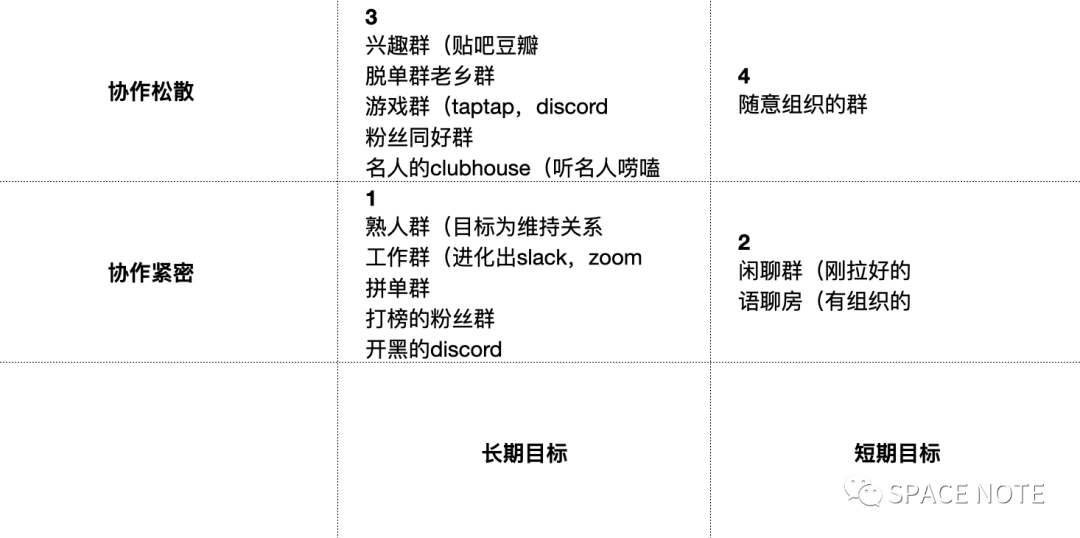
Setting aside short-term quadrants 2 and 4, quadrant 3 is more about information sharing — though there are new scenarios here too, like connections to transactions, which I won't expand on. The focus is on quadrant 1, where the most innovation is happening:
While WeChat, QQ, and Facebook have captured many close-tie scenarios — since even in high-frequency situations, simple conversation serves well — other scenarios are different. Work groups, for instance, have splintered into Slack (channel-based discussion categorization); DingTalk (boss-to-employee direct messaging); Zoom (meeting scenarios); and newer forms like SlackChat (anti-meeting quick voice group chat). Gaming gave rise to Discord. If text channels are simple communication, voice chat while gaming is collaboration.
Fan voting/打榜 [ranking] formats have also proven enduring, and group buying has evolved into community group buying.
04
Breaking down the essence of collaboration
Collaboration breaks down into three stages: information sharing -> communication/interaction -> doing things (achieving goals). Let's map this again: (ignore the ugly arrow)
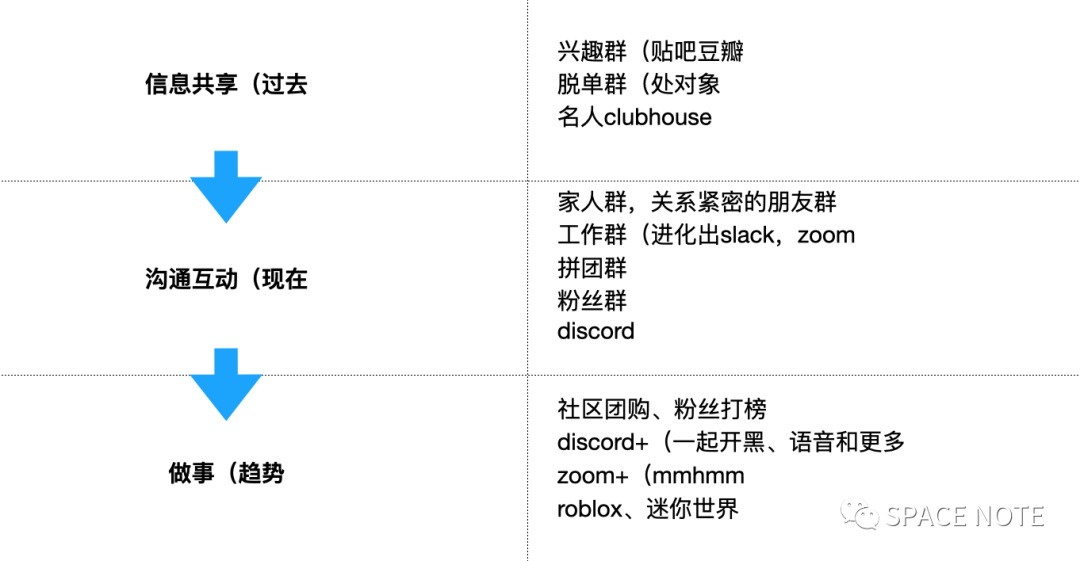
Information sharing mostly falls in quadrant 3. Communication and interaction is quadrant 1 as previously discussed — tight collaboration + long-term goals.
"Doing things" represents the trend in communities. Essentially, doing things is like a tool — it's the final step that lets a community gather, communicate, and then complete their purpose. Zoom handles basic communication; Zoom+ needs to solve what comes after communication. Discord handles daily gaming chat; then scheduling + voice chat + even game distribution helps players achieve the goal of actually playing games together. It forms a closed loop.
05
Communities embracing the All-True Internet
Pony spoke of the All-True Internet — more real, more actual experiences. Using virtual services in reality; online experiences that simulate or even create real-world sensations. For the latter, I see the evolution path as roughly: games/PGC/close ties -> community -> strangers
Take VR: it started with games, then PGC interactive video, close ties interacting in VR feels natural, then more complex group VR scenarios.
PGC has limited interactive forms; close ties need their own space and aren't necessarily always fully present. Games and communities have the most vitality in the all-true realm, and the boundary between games and communities is blurring. More importantly, in an all-true system, there will be new collaborative purposes and new collaborative methods.
Collaboration shifts from:
Information sharing -> communication/interaction -> doing things
To:
Communication/interaction -> doing things -> information sharing
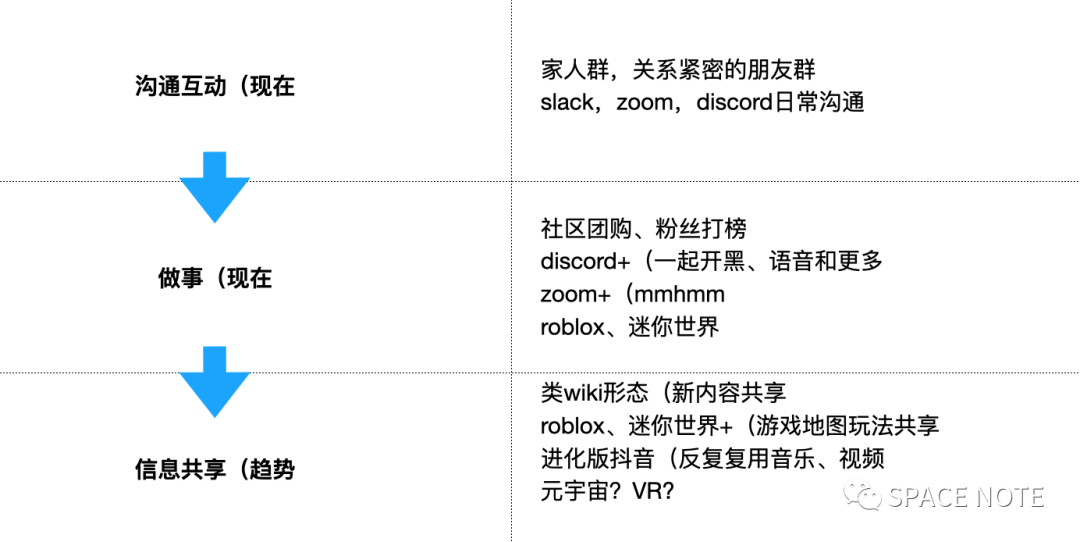
Why? Think of it this way: a group of people build a city through communication and collaboration. If the city is good enough, shouldn't they enjoy the fruits of their labor? Everything in the city is brand new — that makes it worth starting to share all over again.
I've been playing Mini World, the Roblox-like platform. You create maps and share them for multiplayer — that's collaboration on a larger scale. A good map gets played repeatedly, or inspires others' creativity to spawn new maps. It's hard to say whether this is a game or a community. The maps are made by others, you can review them, you can remix someone else's. If future games become more realistic, people will be sharing map after map. I'm playing what you made; what you made is based on someone else's creation.
Beyond game maps — could music and film be reused and remade repeatedly? Could co-op gaming, studying, working scenarios have better experiences and models worth returning to? Say I build a virtual study space, prep all the problems, require 50 problems a day, with tutors available. Others could use my rules and problem sets.
Push further and we're in metaverse territory — getting a bit far out, so I'll stop here.
06
Final random thoughts
Don't try to define community; find better collaboration scenarios:
Say I'm building a gaming squad group. If the group can bind to game rank, position, and mic status, that's probably more efficient than one person shouting into the void. Say I'm building a music beats sharing/production group — that group's file system might need very granular organization, tag-based indexing, and version history.
Find the water:
Slack's channel model is highly efficient, but during the pandemic Zoom suddenly surpassed it from another angle. Not simply by hosting meetings — I've seen scenarios where remote workers keep video on for higher productivity, because it feels like real office presence, seeing each other, questions popping up anytime. It simulates being together in the office. Like water — doesn't occupy your time, but when you use it, it just works.
About Xiami:
Heard Xiami is shutting down. I spent so much time there; even some of my first product's seed users came from Xiami. Early Xiami was collaborative too — users uploaded MP3s, filled in artist info, like a collaborative wiki built by music lovers. I'd upload one album, another user another, I'd upload a live version, and we'd interact. NetEase Cloud's playlists feel more like consumption — you don't have much connection with the playlist creator. Xiami was beautiful but didn't fit the present. Will the Xiami model be revived in a future all-true world?





5Y Capital (formerly Morningside Venture Capital), currently manages approximately US$3 billion across USD and RMB dual-currency funds. We believe that if the world starts believing in the crazy you that others see, the world will be a better place.
BEIJING · SHANGHAI · SHENZHEN · HONG KONG