Qin Liu, 5Y Capital: Great Companies Don't Win a Single Battle — They Never Leave the Field | 5Y View

Emergence, infinite games, growth.

Today's article comes from a talk by Qin Liu, founding partner of 5Y Capital, at the 2025 5Y Capital Founder Annual Meeting.
At this gathering themed "Prompt()·Emergence," he shared his observations on the current entrepreneurial environment, his long-term confidence in Chinese innovation and civilizational resilience, and how to keep iterating with an infinite-game mindset in a new technology cycle — treating both success and failure as inputs through reinforcement learning, and maintaining growth amid uncertainty. The speech was quite long; we've selected excerpts to share with you.
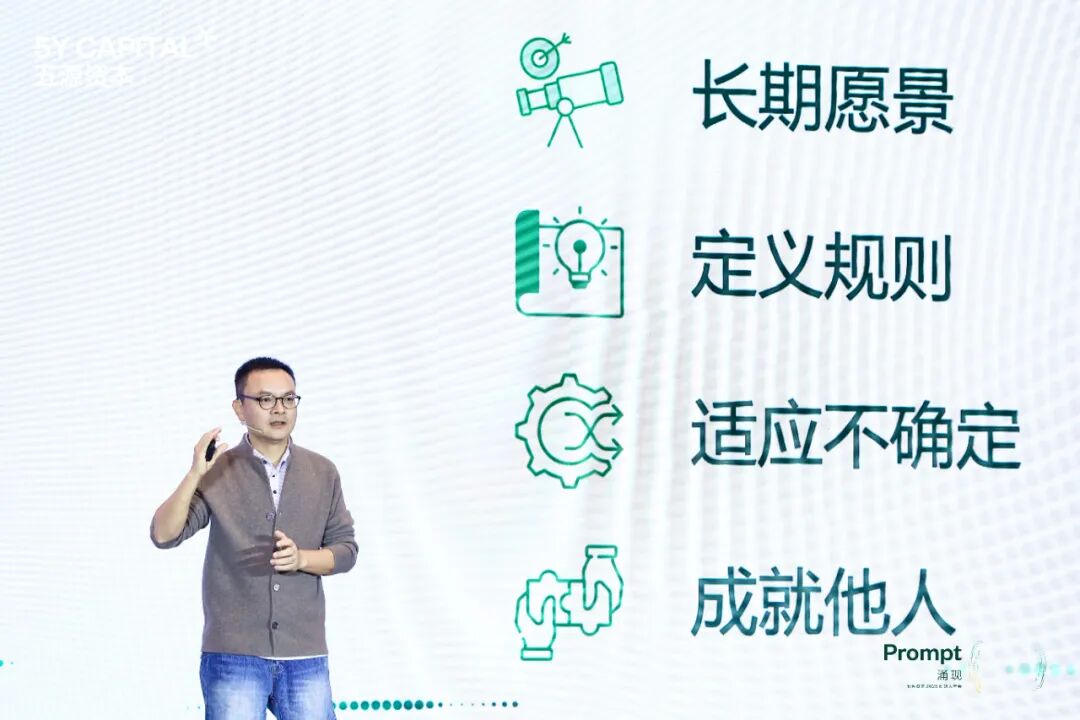
Qin Liu, Founding Partner, 5Y Capital
I entered the investment industry around 1999 or 2000 — more than twenty years ago. China's internet was just getting started then, and today I'd count myself among the "already outdated investors" in tech investing. Between 2015 and 2017, when 5Y internally debated whether to shift from model innovation to hard tech, our knowledge and investment experience were a complete blank slate. When we boldly discussed entering biopharma, I understood absolutely nothing about it.
Recently, many friends in the industry have told me that our biopharma investments seem to be doing quite well. What's interesting is that those who come to discuss this aren't just young people, but also peers who entered the industry around the same time I did. I've gradually come to realize that this isn't really a challenge of industry knowledge or investment capability, but a mental challenge when facing entirely new paradigms.
Our generation of investors has lived through the evolution from PC internet to mobile internet to hard tech, and now we must understand biotech beyond information technology — this is thorough cross-boundary work. Many people ask me: "How did you dare to do it?" I often think about this myself. So I particularly understand the state of founders currently undergoing AI transformation — none of us are "AI-native," nor are we "biopharma-native."
When 5Y entered biopharma, almost no one was optimistic; even internally there was deep skepticism. At the time, I found a young person with zero investment experience named Xutian Jing — "the fearless ignorance of youth." What I was really challenging was a very fundamental question: whether 5Y's methodology possessed "generalization capability."
My undergraduate degree was in automation; I'd studied pattern recognition and early artificial intelligence. Intelligent systems in that era mostly remained at PID tuning, using calculus algorithms for continuous control. Models emphasized "robustness" rather than achieving true "generalization." And what we call AI "emergence" today is essentially generalization — the ability to produce new capabilities in never-before-seen situations.
By the same logic, if our investments could achieve breakthroughs in a completely unfamiliar field, it would demonstrate that 5Y's methodology and investment capabilities truly possessed cross-paradigm generalizability. Those years were extremely difficult, accompanied by much skepticism and self-doubt. But it was precisely through that ordeal that my understanding of the "infinite game" gradually took shape. (The elaboration on infinite games will appear later in the main text of the speech.)
I later concluded that people are often trapped — by their own success, by their own failure, by the time they've invested, by path dependence, by accumulated experience. Past experience is both a source of security and potentially a shackle on forward movement.
The "infinite game" isn't a cure-all theory, but a mindset, a way of thinking that maintains openness and exploration in the face of uncertainty. Breaking through is inherently difficult; it can't be solved simply by saying "play the infinite game." What truly supports it is a whole deeper set of thinking and capabilities — continuous learning, and learning without boundaries.
When you have an infinite-game mindset, no matter what new things you face, you can maintain curiosity and courage without being dominated by fear. Failure is no longer an endpoint, but merely a new input.
Vindicated Optimism
In the years before and after the pandemic, the entire entrepreneurial and investment community was permeated by a relatively pessimistic atmosphere. I felt that 5Y was something of a minority. During that time, we held a belief that China was entering an Innovation 2.0 prosperity cycle. At every LP annual meeting, I would "brazenly" say so, and the LPs in the audience would often ask me in return: "Is China still investable?"
This year, during our founder annual meeting, I felt especially encouraged — precisely because the views I've insisted on expressing over the past few years are being recognized by more and more people. This restoration of confidence manifests not just among investors, but among entrepreneurs as well. For example, Mr. Zhao of DEEPEXI, who just completed his IPO, came back to share his experience. Stories like this are increasingly common, making me genuinely feel a kind of "vindicated optimism." What I believed is finally resonating with the zeitgeist.
Many people ask me: Why can you maintain such optimism? I've spoken about many objective reasons for optimism. For example, although China no longer has a demographic dividend, we have an engineer dividend. I've also proposed an "Innovation 2.0 flywheel effect." These are rational considerations. But there's another part I've never had the chance to elaborate on: my confidence in Chinese culture itself.
Deep in Chinese civilization lies a unique narrative — from myths like the Foolish Old Man Who Moved the Mountains and Jingwei Filling the Sea, to the history of Chen Sheng and Wu Guang's "Are kings and nobles born to their rank?" — reflecting a spirit in the Chinese bones that refuses to accept the status quo, that refuses to admit defeat. I've always believed that the Chinese entrepreneurial spirit is world-class entrepreneurial spirit. It didn't emerge in modern times, but continues a cultural底色 thousands of years old.
Looking back at history, our civilization has been knocked down many times, but never knocked out. Generation after generation has worked toward revival. I often think: compared to the hardships of the 1800s, the early twentieth century, or even the mid-twentieth century, the challenges we face today really amount to nothing. Conversely, Chinese entrepreneurs today may be in one of the luckiest, best-resourced, most creative eras in five thousand years of civilization — the so-called new cycle of revival has only just begun. So the encouragement I feel today comes not just from shifts in market signals, but from my long-term understanding of China. This is my confidence in China, in innovation, in civilizational resilience.
Emergence
The theme of our conference is "Prompt()·Emergence," and what I truly feel today is that every field is demonstrating its own vitality in different ways, through different paths. You can see emergence in biopharma, in new materials, in the diversity of coexistence between internationalization and localization; in AI, some are extending existing businesses, some are transforming and reconstructing — these are all different forms of "emergence."
During the thematic exchange sessions at our event, I ended up joining the consumer group. At first everyone joked, "We probably have the least to talk about with AI." I shared a perspective at the time: AI seems somewhat distant from the consumer industry right now only because it's still in the first half — still in the "building models," "building technology" phase. But when it truly reaches the second half, when AI's value is to be fully amplified, it will definitely be most relevant to you.
The evolution of human technology and commerce is actually a continuously cycling curve. It began with individual handicraft, everything starting from the craftsman spirit, one person taking one thing to its extreme; then entered industrial civilization, emphasizing scaled production and standardization. But now, with the arrival of artificial intelligence, we are entering a kind of "reverse evolution," returning from "large-scale" to "small but strong."
In the future, there will be large numbers of "one-person companies" and "ten-person companies" that may still achieve billions or even hundreds of billions in market cap. Because AI allows "one person" to possess both the creative power of the craftsman spirit and the scaling capability of industrial civilization. One person can mobilize resources that previously required a factory, an organization to complete. This will be an era that belongs to the individual yet possesses industrial-grade productivity.
What truly excites people about AI is not how large its scale is today, how high its valuations are, but that it will eventually become the business of every industry, every person. When AI enters everyone's life, every industry's logic, every enterprise's decision-making — that is when the AI era has truly arrived.
Narrative Creates Miracles
In the AI era, we must also confront another more fundamental question: if AI becomes increasingly powerful, what is humanity's unique capability? I want to shift the angle and ask: why is it that humans created miracles that other species cannot? What is the uniquely human capability?
In a book I greatly admire, Sapiens, there's an answer: humans became the dominant species on Earth not because of muscular strength, nor because of individual intelligence, but because humans possess a special capability — the ability to believe in narratives.
Only humans will cooperate with each other for fictional narratives — civilization, nation, money, religion, law. Based on shared narratives, humans establish institutions, form scaled trust, and transform imagination of the future into present reality. This is a powerful capability. From the pyramids of ancient Egypt to China's Dujiangyan irrigation system — because of belief in a shared narrative, without blueprints, cranes, or modern engineering and technology, people接力 completed systematic miracles.
After entering modern society, humans mastered science and technology, and we've witnessed countless cross-disciplinary miracles, from the moon landing to megaprojects. Behind them lies not merely victory of technology, but victory of narrative. Because only narrative can get millions of people who have never met to march forward shoulder-to-shoulder for the same vision.
Just as in 1962, when U.S. President Kennedy spoke at Rice University: "We choose to go to the moon in this decade and do the other things, not because they are easy, but because they are hard." In that moment he ignited a national-level narrative — that humanity belongs to the future, that we must stride toward the stars and seas. This belief drove more than 400,000 scientists, engineers, and workers to devote themselves fully to the moon landing program.
In China, in September 2025, the Huajiang Grand Canyon Bridge in Guizhou officially opened — a bridge spanning one of the world's deepest canyons, in a region of complex terrain, variable climate, and extreme construction difficulty. This wasn't something any single engineering unit could accomplish; behind it was the coordinated cooperation of dozens of industries. This is also annotating what we often hear as the "great rejuvenation of the Chinese nation" — it's not a slogan, but a civilization-level mobilization capability. When a nation possesses a clear future narrative, it gains the possibility of accomplishing "things beyond present capability boundaries," shaping modern engineering miracles comparable to Dujiangyan.
In the business world, the core capability of entrepreneurs is not merely achieving financial numbers, but constructing a worldview that others are willing to co-build. Truly great companies don't just provide solutions or technological product innovation; they tell a sufficiently attractive future story.

Take NVIDIA, for example. It was never just a chip-selling company, but from the start bet on the future narrative of parallel computing and accelerated computing. In the 1990s, floating-point computing reigned supreme, CPUs were mainstream, and almost everyone considered "parallel computing" a marginal direction — difficult to use, not general-purpose, only suitable for game graphics processing. Jensen Huang firmly bet on this "future that no one else bet on," proposing the concept of the GPU. For a long time, NVIDIA was seen as merely a "gaming graphics card company," yet the company persisted in long-term investment in CUDA for general programming of parallel computing. Until the deep learning era arrived, this narrative finally became the technical foundation of the entire AI world. For a long time the company's market cap was only $1 billion; it persisted in its vision, and today has achieved the $5 trillion dream. Behind every excellent company, there is actually a unique narrative system, and the narrative you believe in is shaping your boundaries.
Infinite Game
So in the business world, how do we define success in the business game? I want to share one perspective: business is an infinite game, not a finite game.
Saining Xie, who won the "Young Researcher Award" at CVPR 2025, recently expressed his concerns about AI research in a talk. Many researchers treat scientific research as a competition to "publish papers," eager to prove they are "first" in the fame game, while forgetting that science itself is an open, endless infinite game.
In his sharing, Saining mentioned that in open science, progress does not come from guarding knowledge, but from sharing knowledge. Only the game of discovery can continue, can keep evolving. One must avoid this trap: from day one holding a rigid idea, then publishing a self-enclosed paper — which is often the most mediocre work.
I told Saining that his sharing resonated with me most this year, and I wanted to share it with everyone at this year's founder annual meeting. I found the original book Finite and Infinite Games, in which author James P. Carse shows us two types of "games" in the world: "finite games" and "infinite games." Finite games are played for the purpose of winning; infinite games are played for the purpose of continuing the play.
In the business world we know, many people chase winning once: market share first, largest funding round, highest valuation. But truly great companies, organizations that truly change the times, or any field pursuing excellence — they all play infinite games.
The difference between finite and infinite games manifests in many aspects. For example, in attitude toward failure: for finite games, failure is the endpoint; for infinite games, both success and failure are inputs to start the next round. Finite games rely on existing advantages; infinite games embrace continuous change. Finite game players are short-sighted, fear the unknown, depend on certainty; infinite games treat uncertainty as soil for growth. Finite games are bound by rules; infinite game players define rules and continuously extend boundaries. Victory in finite games is deterministic reward; meaning in infinite games is continuous discovery.
If you examine the histories of enduring enterprises, those century-old companies, you'll find a commonality: they don't compete with others in the dimension of "finite games," but continuously evolve in "infinite games." For example, Nintendo was founded in 1889, initially making hanafuda playing cards, later entering toys, optical devices, arcade games, and finally the video game industry, gradually developing into a leading global video game software and hardware developer — not to win any particular generation of console wars, but to create new ways to "play."
Another example: 3M was born in 1902, the 28th year of the Guangxu reign in Qing China. Over the past 120-plus years, it has traversed nearly every technology cycle: from handicraft manufacturing to mechanized industry; from the information revolution to the computer and internet era; from medical devices to materials science, electronic thermal management systems... This nimble yet ubiquitous industrial giant has nearly 60,000 distinctly different products and over 40 product divisions. This is the way of infinite game players: continuously expanding boundaries.
Reinforcement Learning
We've spoken so much about infinite games — so what is the essence of infinite games? My answer is: the essence of infinite games is growth through continuous iterative learning.
What people are now most familiar with in AI is reinforcement learning. Reinforcement learning has an assumption: success and failure are not labels, but signals. In human experience, we prefer success and abhor failure, but in RL, failure and success are of equal value — both are reward signals for adjusting strategy. An imperfect agent, through continuous trial and error in the environment, gradually approaches the optimal solution. This doesn't rely on talent or foreknowledge, but on continuous learning and constant iteration across infinite rounds.
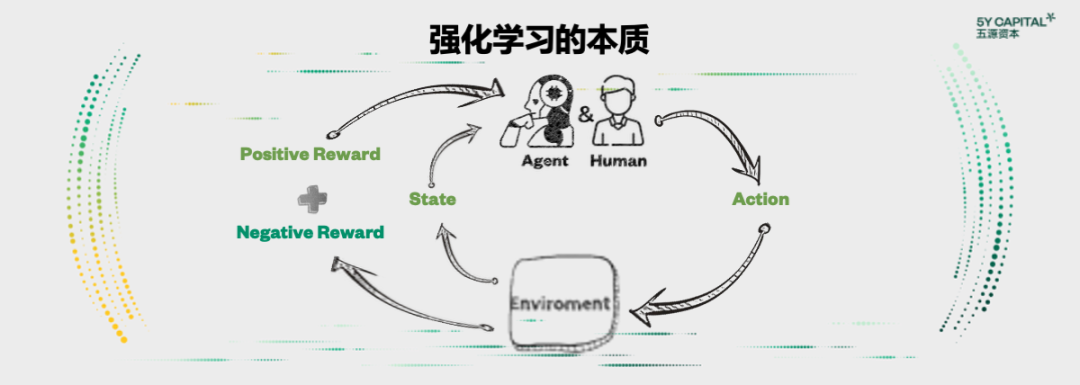
This learning style is not plan-driven, but environment-driven — you must act, must hit walls, must catch every piece of feedback the world gives you. This is the evolutionary path in infinite games. As a SpaceX technical lead once said: "Test early, fail fast, learn faster." This is reinforcement learning in its extreme form.
In my more than twenty years of investment experience, if I were to summarize my true advantages, there are perhaps only two. First, I've failed many times and haven't been knocked out. Second, I've never treated failure as a negative asset. According to reinforcement learning logic, failure itself is a precious learning sample, a dataset for growth. It is these continuously accumulated "failure data" that give me the courage to always set out when facing entirely new fields.
At this moment, we once again stand at the doorway of a new technology cycle. This is a turbulent transformation, destined to be accompanied by enormous uncertainty. For 5Y, we must learn to "reset to zero" — the era where we achieved success through internet model innovation has passed, and we are moving toward a new era centered on hard tech and deep innovation. These fields have no established rules, no preset battlefields. We need to bravely define our own territory, redraw boundaries, not fear failure, treat failure as new input, and lead the organization into a state of continuous learning, continuous iteration, continuous growth.
So the "mental method" I want to share is actually quite simple: if you want to play this game, first you must survive — not just live well, but more importantly, have the capability to keep playing. On the surface, this is the least glamorous thing, but it is precisely the prerequisite for all success. You must dare to break through, dare to try things you haven't done, because the essence of innovation is advancing into the unknown. But at the same time, you must also understand that this means bearing enormous risk, facing frequent errors and failures, and transforming failure into an engine for growth.
Finally, I want to leave entrepreneurs with one sentence: Great companies are never built by winning a single, once-and-for-all war, but by never leaving the field and continuously growing.

Share for Gifts
We welcome you to share your thoughts after reading this, or related perspectives in the comments. We will select 2 featured comments to receive a gift prepared by 5Y Capital :)



5Y Capital seeks out, supports, and inspires lonely entrepreneurs, providing them with support from spirit to all business operations. We believe that if the you whom others see as crazy begins to be believed in, the world will become a different place.
BEIJING·SHANGHAI·SHENZHEN·HONGKONG