Qin Liu: Black Soil, Flowers, Poetry, and the Distance | 5Y View

Growing alongside the next generation of entrepreneurs.

Today's article comes from a speech delivered by Qin Liu, founding partner of 5Y Capital, at the firm's annual partner meeting this past April. Using three keywords — "black soil," "flowers," and "poetry and the far horizon" — he shared his observations on the market and his thinking on investing in disruptive technologies.
He noted, "When it comes to investing in disruptive technologies, you need to deeply understand their underlying principles and stage of development. People tend to overestimate technological progress in the short term while underestimating the transformation it can bring over the long term. We need both vision and conviction, first-principles thinking, and also judgment about technological trajectories and market dynamics — to find viable paths and strategies today, and grow alongside a new generation of entrepreneurs." We've excerpted portions of his speech, and hope you find them illuminating.
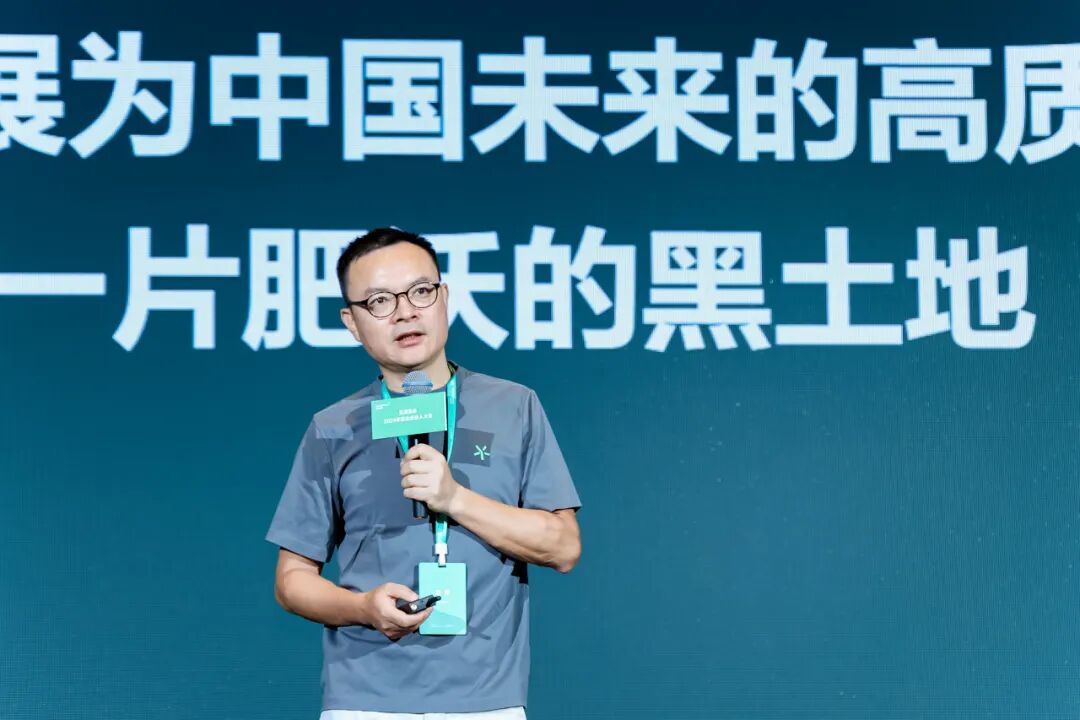
Black Soil, Flowers, Poetry and the Far Horizon
Qin Liu, Founding Partner, 5Y Capital
In recent conversations, I often hear questions about the market. People keep asking me: What do you think? How do you find your strategy and rhythm in such a challenging environment? Today I'd like to share our perspective through three keywords: black soil, flowers, and poetry and the far horizon.
Black Soil
I believe capital markets remain among the smartest and most efficient trading systems. They always anticipate future expectations and price them in. First, facing the current reality, we can basically draw one conclusion: many essential elements that fueled China's economic prosperity over the past three decades are now under challenge. For instance, as population aging intensifies, the low-end manufacturing model that relied on demographic dividends needs to change.
But this is like the black soil of Northeast China — still among the most fertile land on earth. Once covered with dense forests, it gradually transformed through geological evolution into nutrient-rich soil. The complete industrial ecosystem, massive manufacturing capacity, and urbanization built up over 30 years of reform and opening-up — this is fertile black soil for future high-quality growth. It may seem unremarkable on the surface, but it embodies the endogenous forces accumulated through three decades of development.
Within the aggregate picture, you can see numerous structural positives. China's exports to Belt and Road countries and emerging economies are growing; cross-border e-commerce exports are expanding rapidly; new categories like new energy vehicles are seeing very high export growth; and in shipbuilding — a classic heavy industry fused with high technology — China demonstrates strong export competitiveness.
While some industries face slowing growth, compare them against all companies in the CSI 300 index and you'll find many sectors growing far faster than average — they represent structural incremental growth. As the economy continues to develop,下沉 markets (lower-tier markets) are becoming a new driver of domestic demand. Compared with first- and second-tier cities, lower-tier cities show faster growth in disposable income, dining, retail sales, and apparel. This shows China's economy has endogenous growth momentum and resilience, with considerable room to maneuver. High-quality本土 innovation and lower-tier markets are replacing traditional factors to become new engines of economic development.
Flowers
Many facts tell us that new flowers are blooming on this black soil.
First, we've observed that China's forward-looking innovation in technology has moved beyond mere import substitution — it is now genuinely providing the world with next-generation technologies and products.
In biotech, there was no shortage of skepticism in recent years. But starting from Q4 last year, we've seen multinational corporations increasingly acquiring Chinese biotech companies, with deal sizes growing larger. Just two or three years ago, China's biopharma industry still relied mainly on generics, and people questioned whether China had any original drugs. But in recent quarters, international pharmaceutical companies have been buying Chinese original drugs with real money — that itself is the most convincing argument.
In the automotive industry, we long worked as contract manufacturers for others, quietly building the world's most complete auto supply chain in the process. A few years ago, when Elon Musk prepared to mass-produce electric vehicles globally, he chose China to build out the supply chain. Our auto parts went from knockoff imitation to supplying mainstream manufacturers, and now we have our own brands and本土 enterprises.
Starting in 2015, we made forward-looking investments in autonomous driving and electric vehicles. Whether it was our early investments in Xiaomi, Xpeng Motors, Pony.ai, or Horizon Robotics, all have grown into backbone enterprises in this industry.
Another point: a new wave of Chinese companies will gradually shift their target market from GDP (Gross Domestic Product) to GNP (Gross National Product), which includes production activities of nationals worldwide. In other words, future Chinese companies will have more multinational operations; their performance will no longer depend entirely on GDP growth but will be closely tied to GNP. This is also the new business trend we see among many of our portfolio companies. We believe a large cohort of emerging Chinese multinationals is quietly taking shape.
It's worth noting that as the demographic dividend gradually diminishes, we are pivoting toward an engineer and talent dividend. The university expansion policy begun over a decade ago is slowly entering a new harvest period; the number of researchers and influential scientists has grown astonishingly over the past ten years. Moreover, China may be the world's most industrious nation. Thirty years of reform and opening-up have proven the capability and entrepreneurial spirit of Chinese business leaders. Combined with our supply chain and engineer dividends, this constitutes a new comparative advantage.
Poetry and the Far Horizon
Now let's talk about "poetry and the far horizon."
Whenever new disruptive technology emerges, it is often immature and unstable, still iterating rapidly, with business models similarly unclear and undefined. Investing in disruptive technology means bearing the risk of technological change and unclear business models. We need to find appropriate ways to explore it.
Take AI. In human history, major technological transformations may occur once every few decades or centuries. From the steam engine, electric generator, and computer to today's artificial intelligence, each major technological revolution has amplified some human capability, thereby creating new demand and reshaping industry structures. The steam engine augmented our strength; the generator multiplied our energy; the computer expanded our information processing; and today's AI enhances our intelligence — the very attribute that makes humans the most powerful species on Earth. The development of AI foreshadows a potential leap to a higher level of productivity. So today, each of us is working not merely for investment returns, but shouldering the mission this era has entrusted us — to seize this disruptive technological revolution and accomplish industrial restructuring and upgrading.
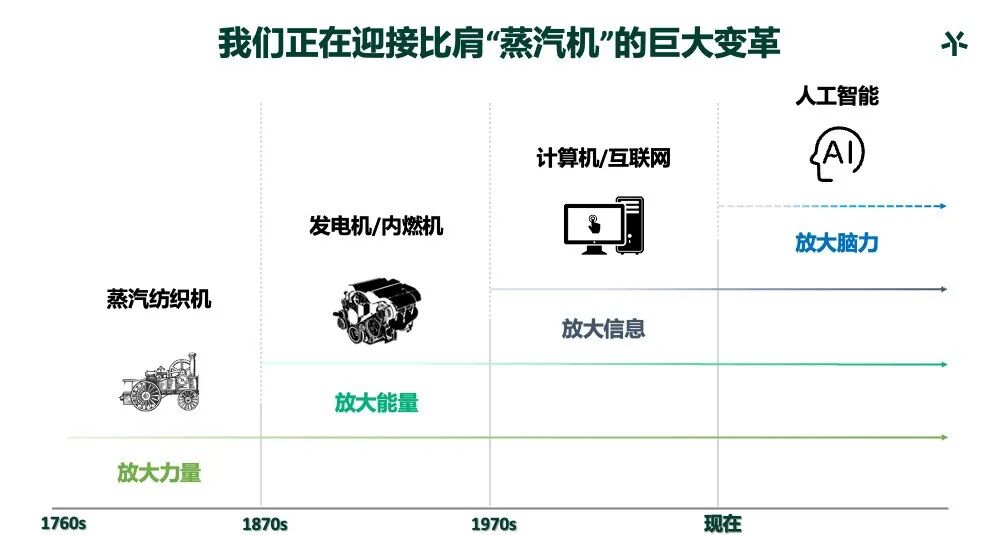
What makes AI so captivating is that it opens infinite possibilities. First, AI is still built upon human intelligence. Unlike other animals, humans invented language and writing, which not only advanced civilization but enabled us to record and transmit knowledge. Whether it's ancient Chinese history, Newton's laws, or Einstein's theory of relativity — this knowledge is preserved through text. Writing itself is humanity's abstract symbolic representation of the natural and physical world, and today this symbol serves as raw material fed into large models. By compressing and learning from this knowledge, AI literally stands on humanity's shoulders, generating a higher-order capability.
As the most intelligent species on Earth, humans have developed every industry through the mining of knowledge. But once human knowledge begins to be mastered and generated by machines, industrial structures across all sectors will be profoundly affected.
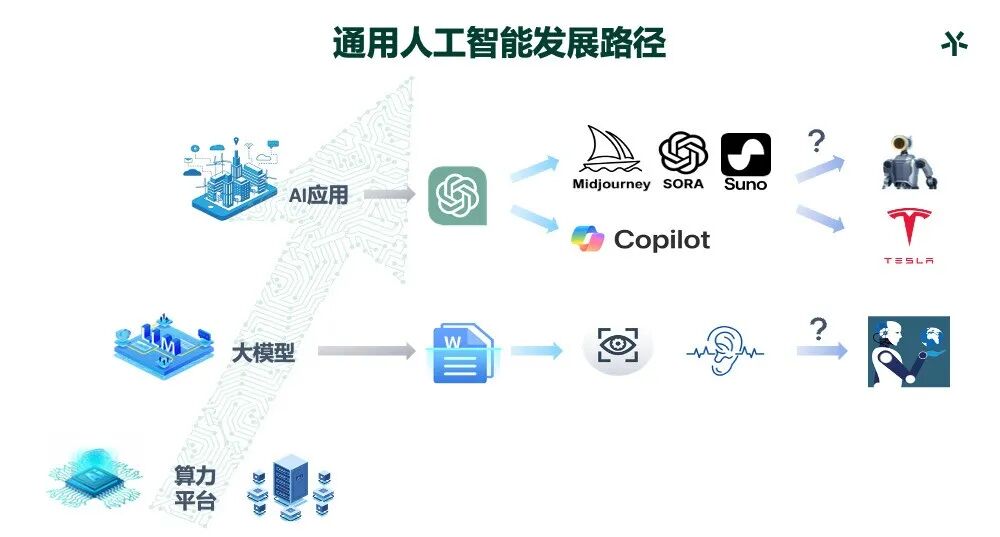
At the application level, language models gave us ChatGPT. We believe that with the development of multimodal intelligent models, applications will emerge for images, video, audio, programming, and a wide range of tasks. Applications and intelligence levels advance hand in hand — the greater your intelligence, the more capable the applications you can produce. Because the models themselves are still evolving, even more powerful product forms may be gradually emerging.
Identifying AI-Native Entrepreneurs
Regarding entrepreneurs, I have a very deep impression: in the traditional computer industry, people with strong engineering capabilities may not understand algorithms, while researchers in large models who understand mathematics and physics may not understand computer systems. To simultaneously conduct research and engineer practical applications requires a cross-disciplinary, cross-boundary team — such talent is extremely scarce.
Second, there's the large-scale cluster that people often talk about. It's like having an alchemy formula but also needing a proper furnace — you need to ignite it, control temperature uniformity, and accurately feed in materials. That's large-scale cluster technology; you need this training capability.
Third, even if you build an impressive large model, if users don't perceive its value, it cannot have real impact. What truly amazed people about OpenAI was how they used ChatGPT as a product to let ordinary users directly experience AI. So you also need very strong product manager sensibility to bring all these capabilities together.
I've been in venture capital for over 20 years. Each time disruptive technology appears, one of our most important jobs as investors is to identify the native characteristics within it. You must understand the nature of the disruptive technology itself to know what capabilities an AI-native entrepreneur needs today.
We've found that AI entrepreneurs must first possess very strong technical insight and technical vision themselves, in order to identify and attract outstanding talent. Entrepreneurs in disruptive technology need dual-core capabilities — not only technical leadership in their own domain, but also strong cross-boundary abilities. Beyond algorithms, you need to solve problems in computing power, capital, product, and more. You can't do this alone; you are not merely a scientist and engineer, but must also become a leader with very strong leadership capabilities.
Identifying AI-native entrepreneurs today is a highly technical and extremely valuable endeavor. If we understand technology from first principles and have accumulated long-term aesthetic judgment in identifying entrepreneurs, we can develop a methodology to find them.
Growing Together with a New Generation of Entrepreneurs
The continuous evolution of AI is something that both excites us greatly and presents significant challenges. We must constantly use first-principles thinking to track and understand these changes. Of course there are many challenges, because we have so much unknown — more unknown unknowns. Today's large models are still imperfect; if they were sufficiently perfect, we should see a flood of applications by now, but reality does not bear this out. From first principles, today's large models are essentially brute force — they process and compress all data, using all data that humans have already abstracted on the internet to generate outputs. You tell me what you want, and I can give it to you.
But what's next? Reasoning. Like how humans can make very abstract inferences without much data, reasoning in large models today is a very challenging problem — one might call it a holy grail of AI research. Compared with GPT-3.5, GPT-4's main advance is in multimodality, shifting from text-only toward rich media. The user experience feels significantly enhanced, but its underlying computational architecture and algorithms are still doing essentially the same thing. There's great anticipation for whether GPT-5 will achieve reasoning, whether it can engage in abstract thinking like humans. Of course, I believe that once a method is found, AI can continue to evolve.
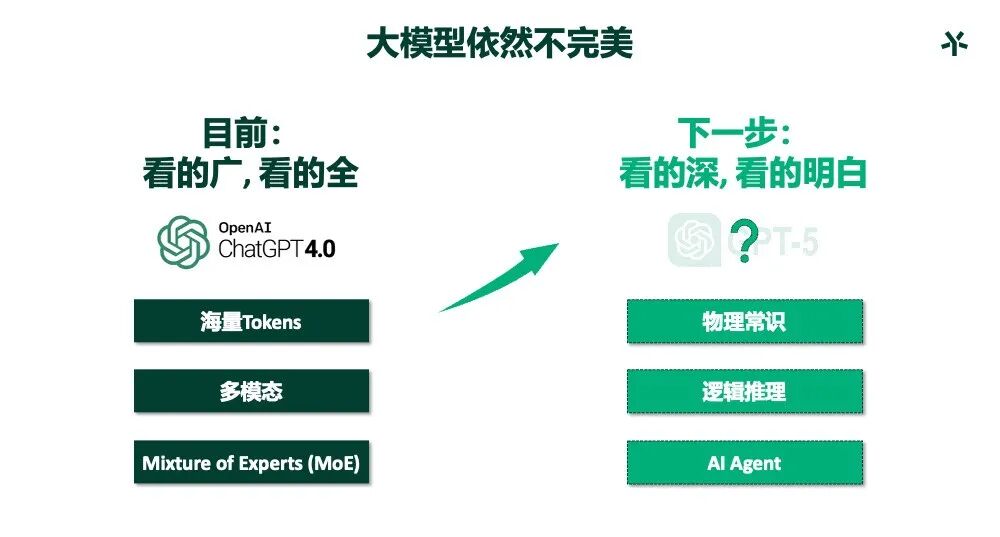
Currently, there isn't yet broad consensus on the understanding and perception of artificial intelligence. Beyond reasoning, physical common sense also faces enormous challenges. Take robotics: when humans grasp objects, we instinctively apply physical knowledge — grabbing an iron block requires considerable force, while holding an egg demands gentleness. This seemingly simple grasping behavior reflects extensive physical prior knowledge in the human brain. To truly produce agents, AI needs to simulate this physical common sense and logical reasoning capability.
Currently, the Scaling Law is advancing triumphantly in the bit world because humans have uploaded nearly all data to the internet, possibly encompassing millions of years of human history. Why hasn't physical world data been similarly utilized? Because physical world data differs from bit-world data. Bit-world data is abstract with minimal human interaction, while physical world data involves robots interacting with the physical world — robots shaking hands with humans, or executing tasks like grasping objects. This data carries dual meaning: first, observed data; second, robot interaction data. It's a chicken-and-egg problem. If the required data is interactive, you first need to build the robot body — no robot, no data. But conversely, without data, building truly intelligent robots becomes extremely difficult.
So, for investing in disruptive technologies, you must deeply understand their principles and stage of development. People tend to overestimate technological development in the short term while underestimating the transformation it may bring over the long term. We need both vision and conviction, first-principles thinking, and also judgment about technological trajectories and market dynamics — to find viable paths and strategies today, and grow alongside a new generation of entrepreneurs.
Share and Win
We welcome your thoughts in the comments section — share your takeaways or related insights. We'll select two standout comments to receive a gift prepared by 5Y Capital :)




5Y Capital seeks out, supports, and inspires lonely entrepreneurs, providing support from the spiritual to all operational aspects. We believe that if the "crazy" you in others' eyes begins to be believed in, the world will become a different place.
BEIJING · SHANGHAI · SHENZHEN · HONG KONG