How to Break Down a Grand Vision: Elon Musk's "Master Plan" | 5Y View

What better master plans are still out there in the business world?

Recommender

Yaopeng Xing, Vice President at 5Y Capital
A great vision usually corresponds to enormous external challenges, long time horizons, and massive resource requirements. How to set goals, break down problems, and design paths is crucial — this is also the key for entrepreneurs to face crises and tests with equanimity. How to deconstruct a vision? Elon Musk's Master Plan, written "at the gates of hell," is well worth reading. (SpaceX's first flight failed in 2006; Tesla was about to enter production hell in 2016.)
The following articles come from Elon's two Master Plans, both originally published as blog posts on Tesla's website. On August 2, 2006, Elon first unveiled the four-step Master Plan. A decade later, on July 20, 2016, Elon published what he called Master Plan, Part Deux.
Great companies usually cannot be created through planning either. Jeff Bezos once said: "Any business plan won't survive its first encounter with reality." The Master Plan also attempts to address this problem — it contains no timeline, but rather establishes some action principles for reaching the goal. From the concise text, we can see that Elon's principles are built on simple business logic, even mathematical and physical laws.
Massive long-term opportunities always come with persistent "fog of war." What other Master Plans exist in the business world? Readers are welcome to discuss.
Reprinted from Tesla's official website
The Secret Tesla Motors Master Plan
Elon Musk
August 2, 2006
As you know, the initial product of Tesla Motors is a high performance electric sports car called the Tesla Roadster. However, some readers may not be aware of the fact that our long term plan is to build a wide range of models, including affordably priced family cars. This is because the overarching purpose of Tesla Motors (and the reason I am funding the company) is to help expedite the move from a mine-and-burn hydrocarbon economy towards a solar electric economy, which I believe to be the primary, but not exclusive, sustainable solution.
Critical to making that happen is an electric car without compromises, which is why the Tesla Roadster is designed to beat a gasoline sports car like a Porsche or Ferrari in a head to head showdown. Then, on top of that, it has twice the energy efficiency of a Prius. Even so, some may question whether this actually does any good for the world. Are we really in need of another high performance sports car? Will it actually make a difference to global carbon emissions?
Well, the answer is no, not much. However, that misses the point, unless you understand the secret master plan alluded to above. Almost any new technology initially has high unit cost before it can be optimized and this is no less true for electric cars. The strategy of Tesla is to enter at the high end of the market, where customers are prepared to pay a premium, and then drive down market as fast as possible to higher unit volume and lower prices with each successive model.
I can say that the second model will be a sporty four door family car at roughly half the $89k price point of the Tesla Roadster and the third model will be even more affordable. In keeping with a fast growing technology company, all free cash flow is plowed back into R&D to drive down the costs and bring the follow on products to market as fast as possible. When someone buys the Tesla Roadster sports car, they are actually helping pay for development of the low cost family car.
Now I'd like to address two repeated arguments against electric vehicles — battery disposal and power plant emissions. The answer to the first is short and the second requires a bit of math:
Batteries that are not toxic to the environment!
The Tesla Motors Lithium-Ion cells are not classified as hazardous and are landfill safe. However, dumping them in the trash would be throwing money away, since the battery pack can be sold to recycling companies (unsubsidized) at the end of its greater than 100,000-mile design life. Moreover, the battery isn't dead at that point, it just has less range.
Power Plant Emissions aka "The Long Tailpipe"
A common argument against electric vehicles is that they simply shift pollution from power plants out of urban areas to the power plant. The obvious response is that we can develop electricity generation sources that have no emissions, including hydro, wind, geothermal, nuclear, and solar. But let's assume for the moment that the electricity is generated from a hydrocarbon source like natural gas, the most popular fuel for new US power plants in recent years.
The H-System Combined Cycle Generator from General Electric is 60% efficient in turning natural gas into electricity. "Combined Cycle" means that the gas goes first through a combustion turbine and then the "waste" heat is used to boil water in a steam turbine. Natural gas recovery is 97.5% efficient, processing is also 97.5% efficient and then transmission average efficiency of the national grid is 92%. Thus, from gas well to electric outlet is 97.5% x 97.5% x 60% x 92% = 52.5% efficient.
Despite the body, tires and drive train designed for high performance instead of maximum efficiency, the Tesla Roadster requires 0.4 MJ per kilometer or, stated another way, will travel 2.53 km per mega-joule of electricity. The full cycle charge and discharge efficiency of the Tesla Roadster is 86%, which means that for every 100 MJ of electricity used to charge the battery, about 86 MJ reaches the motor.
Bringing the math together, we get the final figure of merit of 2.53 km/MJ x 86% x 52.5% = 1.14 km/MJ. Let's compare that to the Prius and a few other options.
For a gasoline car, the well to wheel energy efficiency is equal to the energy content of gasoline (34.3 MJ/liter) minus the refinement and transportation losses (18.3%), multiplied by the miles per gallon or km per liter. So, at the EPA rated 55 mpg, the Prius is actually getting 0.56 km/MJ. This is actually an excellent number compared with a "normal" car like the Toyota Camry at 0.28 km/MJ.
Please note that an electric car like the Tesla is an inherently more efficient machine, whereas the Prius is an inherently less efficient machine that has been optimized. The difference in energy required to move the Tesla and the Prius at 60 mph down the highway is only about 10%. The remaining 90% of the Prius's efficiency gain is caused by things like regenerative braking, a streamlined body and hard tires.
If the EPA rated mileage of both cars is 55 mpg, it is not valid to compare only the EPA rated mileage. The correct comparison is the true well to wheel energy efficiency. The Prius is actually only 49% better than the Camry, not 100% better as the EPA figures would incorrectly suggest.
The CO2 content of any given source fuel is well understood. Natural gas is 14.4 grams of carbon per mega-joule and oil is 19.9 grams of carbon per mega-joule. Applying those carbon content levels to the vehicle efficiencies, including a Honda natural gas burning vehicle and a Honda fuel cell vehicle (assuming hydrogen from natural gas), the hands down winner is pure electric:
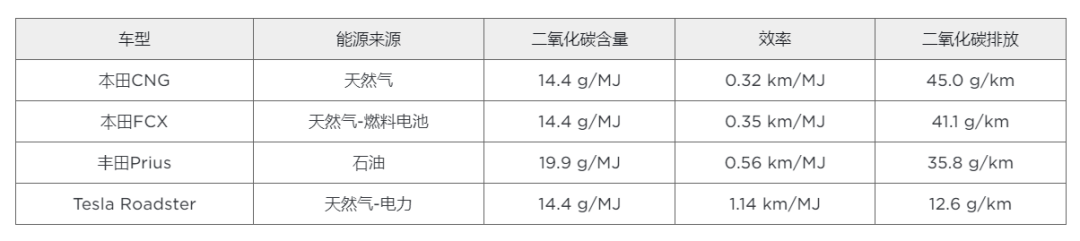
If you assume the average US power grid utilization factor, the Tesla is still winning by a large margin. The California grid is even better because of the higher renewable content. Although coal has higher carbon content than natural gas, that is offset by the zero carbon content of hydro, nuclear, geothermal, wind and solar, which on average make up a larger share of the grid mix than coal. The exact grid mix varies by region and changes over time, so we used natural gas as the baseline for comparison.
Become Energy Positive
I should mention that Tesla Motors will be co-marketing sustainable energy products from other companies along with the car. For example, among other choices, we will be offering a modestly sized and priced solar panel from SolarCity, a photovoltaics company (where I am also the principal financier). This system can be installed on your roof in an out of the way manner, because of its small size, or set up as a carport and will generate about 50 miles per day of electricity.
If you travel less than 350 miles per week, you will therefore be "energy positive" with respect to your personal transportation. This is a step beyond conserving or even nullifying your use of energy for transport — you will actually be putting more energy back into the system than you consume in transportation! So, in short, the master plan is:
- Build sports car
- Use that money to build an affordable car
- Use that money to build an even more affordable car
- While doing above, also provide zero emission electric power generation options
Don't tell anyone.
Master Plan, Part Deux
Elon Musk, July 20, 2016
10 years ago, I published the first section of Tesla's secret master plan, which is now in the final stages of completion. This plan was not all that complicated and basically consisted of:
Step one: Create a low volume car, which would necessarily be expensive;
Step two: Use that money to develop a medium volume car at a lower price;
Step three: Use that money to create an affordable, high volume car;
And...
Step four: Provide solar power. No kidding, this has literally been on our website for 10 years.
The reason we had to start off with step one was that it was all I could afford to do with what I made from PayPal. I thought our chances of success were so low that I didn't want to risk anyone's funds in the beginning but my own. The list of successful car company startups is short. As of 2016, the number of American car companies that haven't gone bankrupt is a grand total of two: Ford and Tesla. Starting a car company is idiotic and an electric car company is idiocy squared.
Also, a low volume car means a much smaller, simpler factory, albeit with most things done by hand. Without economies of scale, anything we built would be expensive, whether it was an economy sedan or a sports car. While at least some people would be prepared to pay a high price for a sports car, no one was going to pay $100k for an electric Honda Civic, no matter how cool it looked. Part of the reason I wrote the first master plan was to defend against the inevitable attacks Tesla would face accusing us of just caring about making cars for rich people, implying that we felt there was a shortage of sports car companies or some other bizarre rationale. Sadly, the blog didn't stop countless attack articles on exactly these grounds, so it pretty much completely failed that objective.
However, the main reason was to explain how our actions fit into a larger picture, so that they would seem less random. The point of all this was, and remains, accelerating the advent of sustainable energy, so that we can imagine far into the future and life is still good. That's what "sustainable" means. It's not some silly, hippy thing — it matters for everyone.
By definition, we must at some point achieve a sustainable energy economy or we will run out of fossil fuels to burn and civilization will collapse. In any event, we must get to a sustainable energy economy eventually, and almost all scientists agree that dramatically increasing atmospheric and oceanic carbon levels is insane. So the faster we achieve sustainability, the better.
Here is what we plan to do to make that day come sooner:
Integrate Energy Generation and Storage
Create a smoothly integrated and beautiful solar-roof-with-battery product that just works, empowering the individual as their own utility, and then scale that throughout the world. One ordering experience, one installation, one service contact, one phone app.
We can't do this well if Tesla and SolarCity are different companies, which is why we need to combine and break down the barriers inherent to being separate companies. That they are separate at all, despite similar origins and pursuit of the same overarching goal of sustainable energy, is largely an accident of history. It is now time to complete the picture. Tesla is ready to scale Powerwall and SolarCity is ready to provide highly differentiated solar, but the costs and complexity of combining them are now unnecessary.
Expand to Cover the Major Forms of Terrestrial Transport
Today, Tesla addresses two relatively small segments of premium sedans and SUVs. With the Model 3, a future compact SUV and a new kind of pickup truck, we plan to address most of the consumer market. A lower cost vehicle than the Model 3 is unlikely to be necessary.
Because the overarching purpose of Tesla Motors (and the reason I am funding the company) is to help expedite the move from a mine-and-burn hydrocarbon economy towards a solar electric economy, which I believe to be the primary, but not exclusive, sustainable solution.
In addition to consumer vehicles, there are two other types of electric vehicle needed: heavy-duty trucks and high passenger-density urban transport. Both are in the early stages of development at Tesla and should be ready for unveiling next year. We believe the Tesla Semi will deliver a substantial reduction in the cost of cargo transport, while increasing safety and making it really fun to operate.
With the advent of autonomy, it will probably make sense to shrink the size of buses and transition the role of bus driver to that of fleet manager. Traffic congestion would improve due to increased passenger areal density by eliminating the center aisle and putting seats where there are currently entryways, and matching acceleration and braking to other vehicles, thus avoiding the inertial impedance to smooth traffic flow of traditional heavy buses. It would also take people all the way to their destination. Fixed summon buttons at existing bus stops would serve those who don't have a phone. Design accommodates wheelchairs, strollers and bikes.
Autonomy
As the technology matures, all Tesla vehicles will have the hardware necessary to be fully self-driving with fail-operational capability, meaning that any given system in the car could break and your car will still drive itself safely. It is important to emphasize that refinement and validation of the software will take much longer than putting in place the cameras, radar, sonar and computing hardware.
Even once the software is highly refined and far better than the average human driver, there will still be a significant time gap, varying widely by jurisdiction, before true self-driving is approved by regulators. We expect that worldwide regulatory approval will require something on the order of 6 billion miles (10 billion km) of autonomous driving. The current fleet learning is happening at just over 3 million miles (5 million km) per day.
I should add a note here to explain why Tesla is deploying partial autonomy now, rather than waiting until some point in the future. The most important reason is that, when used correctly, it is already significantly safer than a person driving by themselves and it would therefore be morally reprehensible to delay release simply for fear of bad press or some mercantile calculation of legal liability.
According to the recently released 2015 NHTSA report, automotive fatalities increased by 8% to one death every 89 million miles. Autopilot miles will soon exceed twice that number and the system gets better every day. It would no more make sense to disable Tesla's Autopilot, as some have called for, than to disable airplane autopilots, which have been commonly used for decades, and which our system is named after.
It is important to explain why we refer to Autopilot as "beta". This is not beta software in any normal sense of the word. Every release is extensively tested internally. What it really means is that it is adding features that have not yet been fully validated in the wide range of real world conditions that we wish to perfect. It does not mean you should use less care. The opposite is true. Autopilot is always off by default and must be explicitly enabled by the driver. If you do not enable it, it will never be on. The driver can override Autopilot at any time simply by steering, touching the brake or touching the stalk.
Sharing
When true self-driving is approved by regulators, it will mean that you will be able to summon your Tesla from pretty much anywhere. Once it picks you up, you will be able to sleep, read or do anything else enroute to your destination.
You will also be able to add your car to the Tesla shared fleet just by tapping a button on the Tesla app on your phone and have it generate income for you while you're at work or on vacation, significantly offsetting and at times potentially exceeding the monthly loan or lease cost. This dramatically lowers the true cost of ownership to the point where almost anyone could own a Tesla. Since most cars are only in use by their owner for 5% to 10% of the day, the fundamental economic utility of a true self-driving car is likely to be several times that of a car which is not.
In cities where demand exceeds the supply of customer-owned cars, Tesla will operate its own fleet, ensuring you can always hail a ride from us no matter where you are.
So, in short, Master Plan, Part Deux is:
- Create stunning solar roofs with seamlessly integrated battery storage
- Expand the electric vehicle product line to address all major segments
- Develop a self-driving capability that is 10X safer than manual via massive fleet learning
- Enable your car to make money for you when you aren't using it




5Y Capital seeks out, supports, and inspires lonely entrepreneurs, providing them with support from the spiritual to all operational aspects. We believe that if the "crazy you" in others' eyes begins to be believed in, the world will become a different place.
BEIJING · SHANGHAI · SHENZHEN · HONG KONG