How to Balance Reason and Intuition When Making Major Decisions | 5Y View

How can we correct bias and make truly rational decisions?

On March 27, 2024, Daniel Kahneman — Nobel laureate in economics, founding father of cognitive psychology, and author of Thinking, Fast and Slow and Noise — passed away at the age of 90. Kahneman's life was nothing short of legendary. His research on human decision-making biases and intuitive thinking inspired numerous economists and earned him the 2002 Nobel Prize in Economics.
Kahneman is widely regarded as one of the founders of behavioral economics. His theories and discoveries include the framing effect, anchoring effect, loss aversion, base-rate neglect, and more. In economics, the assumption of "homo economicus" — that humans are rational actors — is as fundamental as "1+1=2" is to mathematics. Yet Kahneman struck at this very cornerstone, arguing that humans are irrational and prone to all manner of unreasonable errors.
In 2011, Kahneman distilled a lifetime of thinking into Thinking, Fast and Slow. This article summarizes the book's key insights on thinking — we hope you find it illuminating :)
This article is republished from "NoteDAO" (笔记侠)
Now, which of these two lines do you think is longer?
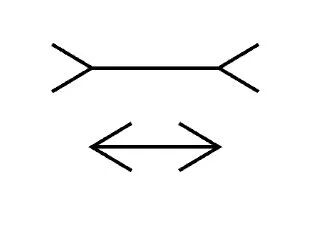
At first glance, you'd no doubt pick the first one. But measure them, and a new belief emerges: the two lines are equal in length.
Where does this cognitive error come from? What determines the outcome of your thinking? And how exactly do you think?
System 1 and System 2
Kahneman proposed that our brains employ two distinct modes of decision-making: fast thinking and slow thinking. Fast thinking is System 1; slow thinking is System 2.
Let's use two examples — an angry face and a multiplication problem — to illustrate this vividly:
1. The Angry Face

From Thinking, Fast and Slow
As you look at this woman's face, you can quickly and confidently determine that this young woman has dark hair. You also know she is angry. Furthermore, you can infer her likely behavior: you sense she is about to say something cutting, perhaps loudly and harshly.
Predicting what an observed person will do next comes easily. This activity is unconscious and effortless.
This is fast thinking.
2. What is 17 × 24?
You'll have a vague intuitive sense of the answer's magnitude. You can immediately tell that 12,609 and 123 are impossible. But without taking time to calculate, you cannot confirm that 568 is wrong either.
Unable to produce a precise answer, you feel you must decide whether to tackle the problem at all. If you haven't already, you should try — even completing part of it would help.
This step-by-step computational process is slow thinking. It is mental work, requiring deliberate, effortful, and orderly execution — a hallmark of slow thinking.
When System 1 Runs Into Trouble, System 2 Steps In
While we are awake, both System 1 and System 2 are active.
System 1 operates automatically, excelling at its job: in familiar situations, its patterns are accurate; its short-term predictions are precise; and its first responses to challenges are swift and generally appropriate.
Yet System 1 carries biases. In many specific circumstances, this system is prone to systematic errors. You'll find it sometimes oversimplifies genuinely difficult problems, and it knows virtually nothing about logic or statistics.
System 2, meanwhile, typically rests in a relaxed, low-effort state, operating with only partial capacity. System 1 continuously feeds System 2 impressions, intuitions, intentions, and feelings. If System 2 accepts this information, it transforms impressions and intuitions into beliefs, and impulses into voluntary actions.
Usually, everything proceeds smoothly. System 2 makes slight adjustments or accepts System 1's suggestions wholesale. Thus, you generally trust your first impressions and act on your own ideas. Usually, this works out fine.
When System 1 encounters obstacles, it calls upon System 2 for support, requesting more detailed and explicit processing to resolve the current problem:
① System 2 is activated when System 1 cannot provide an answer.
This is like encountering "17 × 24" — System 1 has no answer, so System 2 is mobilized to solve it.
② When you encounter something surprising, you likewise feel a sudden surge of conscious attention.
In System 1's world, lamps don't jump, cats don't bark like dogs, and gorillas don't stroll across basketball courts.
③ System 2 is also activated when something violates System 1's model of how the world works.
With it, you maintain propriety even when angry; with it, you stay alert when driving at night. When you're about to make a mistake, System 2 is triggered to accelerate.
Think how hard it is to swallow words that are on the verge of offending someone.
In sum, most of what you (or your System 2) think and do is initiated by System 1. But when things get difficult, System 2 takes over the hard problems — and with System 2 on the case, everything gets solved.
The division of labor between System 1 and System 2 is remarkably efficient: minimum cost, maximum effect.
System 1: The "Seeing Is Believing" Bias Leads to Hasty Decisions
Consider this statement:
"Would Mednick make a good leader? She is intelligent and strong..." An answer immediately springs to mind: "Of course." You selected the best answer based on very limited information, but you acted too quickly. What if the next two adjectives were "corrupt" and "ruthless"?
System 1 began operating autonomously after the first adjective appeared: intelligence is good; intelligent and strong is even better. System 1 effortlessly generated this impression. If new information emerges (say, Mednick is corrupt), the story gets rewritten — but System 1 does not wait, nor does it experience subjective discomfort.
The combination of coherence-seeking System 1 and lazy System 2 means that System 2 will endorse many intuitive beliefs that accurately reflect the impressions generated by System 1.
I will also use the "seeing is believing" principle to explain many biases in judgment and choice. Here are some of them:
As the seeing-is-believing principle indicates, neither the quantity nor quality of evidence has much bearing on subjective confidence in System 1's view.
Each person's confidence in their own ideas depends mainly on how fluently they can narrate what they have seen — even if they have seen almost nothing.
We often fail to consider that we may not yet possess the evidence crucial to our judgment, yet we consistently believe that seeing is believing.
System 2: Cognitive Load and Pupil Dilation
Although System 2 believes it chooses people's thoughts and actions, these choices are actually guided by System 1 — System 1 is the true protagonist of this story.
Yet some crucial tasks can only be performed by System 2, because they require effort and self-control to suppress the intuitions and impulses generated by System 1.
If you want your System 2 running at full capacity, try this exercise. It will push you to your cognitive limit within 5 seconds:
First, generate a string of different 4-digit numbers and write them on an index card. Then place a blank card on the table. The task you're about to perform is called "Add-1." Here's how it works:
Next, tap out a steady rhythm (ideally with a metronome set to one beat per second). Move the blank card, read the number aloud. Then wait two beats, and say a new number (derived by adding 1 to each digit of the original number).
For example: if the card shows 5294, the new number should be 6305. Keeping pace is important.
Few people can handle more than 4 digits in the Add-1 task, but if you want to challenge yourself, try Add-3.
If you want to know what your body is doing while your brain races, try this:
Stack two piles of books on your desk. Rest your chin on one pile. Place a camera on the other.
Turn on the camera and stare into the lens while doing Add-1 or Add-3.
Then, through the camera's faithful recording, you'll discover that your pupil size changes with your level of effort.
Pupil size data closely matches subjects' experiences:
The more digits, the more the pupils dilate; task difficulty corresponds to effort expended; maximum pupil dilation coincides with maximum effort.
When we give subjects numbers beyond their capacity, their pupils stop dilating or contract.
The "law of least effort" — the efficient division of labor between System 1 and System 2 — holds that:
When multiple methods can achieve the same goal, people tend to choose the easiest one. In economic behavior, effort is cost; learning skills serves the balance between benefit and cost.
Because laziness is human nature.
So what makes some cognitive tasks more difficult and effortful than others?
A crucial capability of System 2 is that it can handle "multitasking" — it can draw on memory to execute instructions that inhibit habitual responses.
Consider this task: count the number of times the character "的" appears on this page.
You've never done this before; it's not easy to perform smoothly. But your System 2 can manage it.
Starting this exercise is not easy, and though you improve with practice, completing it remains strenuous.
Now suppose that after finishing this page, you receive another instruction:
Count the commas on the next page.
This task is even harder because you must suppress the tendency you just developed to focus on "的."
One of cognitive psychologists' major discoveries in recent decades: switching from one task to another requires effort, especially under time pressure. The difficulty of Add-3 and mental multiplication stems partly from both tasks requiring rapid switching.
To perform Add-3, you must simultaneously hold several numbers in working memory, each associated with a specific operation:
Remember the converted digits to say later, have one digit in conversion, and others waiting to be converted.
Current working memory tests require individuals to switch constantly between two demanding tasks — remembering one result while executing another. Those who perform well on these tests generally score well on general intelligence tests.
Yet the ability to control attention is not the measure of general intelligence. Time pressure is another driver of effort.
In Add-3, your haste comes partly from the metronome, partly from memory load. You're like a juggler keeping multiple balls in the air — you cannot afford to slow down. The rate of memory decay drives your pace, forcing you to continuously update and rehearse before the information fades entirely.
Any task requiring you to hold many ideas simultaneously is rushed. Unless you're fortunate enough to have large working memory capacity, you just have to push through.
The most mentally demanding forms of slow thinking are those that pressure you to think quickly.
You've surely noticed that during Add-3, your brain operates at unusually high speed.
Even if you make your living by mental labor, your daily work rarely includes challenges as demanding as Add-3 or memorizing 6-digit numbers on the spot.
We typically break tasks into simple steps to avoid overloading our brains.
This way, we can store intermediate results in long-term memory or on paper, rather than simply accumulating them in working memory.
We approach our goals slowly and indirectly, managing our mental activities through the law of least effort.
How Do Biases Affect Decision-Making?
1. The Illusion of Knowing
Suppose a low-risk surgical procedure encounters an unexpected accident, and the patient dies. Afterward, juries tend to believe the surgery was inherently risky and that the lead surgeon should have known better than anyone.
Even when the decision-making process was sound, this outcome bias makes it nearly impossible to properly evaluate the decision.
Baruch Fischhoff (Howard Heinz University Professor) first revealed the "hindsight" phenomenon while still a student in Jerusalem.
Hindsight bias has a pernicious effect on evaluators of decisions: it leads observers to judge a decision's quality not by the soundness of its process, but by the quality of its outcome.
Hindsight is especially unforgiving to decision-makers who act as agents for others — doctors, financial advisors, coaches, CEOs, diplomats, and politicians among them.
When good decisions produce bad outcomes, we blame the decision-makers.
And decision-makers who made choices that only appear correct in retrospect receive no credit. This is the classic "outcome bias."
The illusion that humans "know the past thoroughly" breeds a deeper illusion — that we can predict and control the future.
These illusions bring comfort; they also reduce the anxiety we would otherwise experience.
We all need reassurance — to know our actions will yield appropriate results, that wisdom and courage will lead to success.
The same person behaving the same way is "methodical" when things go well and "rigid" when they don't. The halo effect is so powerful that you may find yourself resisting this idea.
The halo effect: a psychological phenomenon where, after forming a positive or negative impression of someone's trait, we tend to infer other characteristics of that person from it.
Because of the halo effect, we discard causality. We easily believe a company failed because its CEO was rigid, when the reality was that the company was already declining.
This is how illusions are born:
A book resonates with readers by providing what the human brain craves — stories about why companies succeed or fail, while ignoring the decisive role of luck and the inevitability of regression.
These stories create and sustain illusions, teaching readers lessons of little lasting value — yet these readers are all too willing to believe them.
The routine limitations of the human brain make it incapable of reconstructing past knowledge structures or beliefs.
Once you adopt a new worldview (or your view of some aspect of the world changes), you immediately lose much of your ability to recall what you thought before your perspective shifted.
Your inability to reconstruct past thoughts inevitably leads you to underestimate how much you were influenced by past events.
2. Intuition Is Sometimes Unreliable
A brain governed by the "seeing is believing" principle can become overconfident by ignoring what it doesn't know.
So it's no surprise that many people place great confidence in intuitions that lack factual basis.
Gary Klein (the renowned American cognitive psychologist) and I eventually agreed on an important principle:
People's confidence in their intuitions is not a reliable indicator of the validity of their judgments.
In other words, when someone tells you to trust their judgment — don't trust them. Don't trust yourself either.
If subjective confidence is untrustworthy, how should we assess the validity of intuitive judgments?
Answering this requires considering two basic conditions for skill acquisition:
① A predictable environment with sufficient regularity;
② An opportunity to learn these regularities through prolonged practice.
When both conditions are met, intuition can be cultivated.
Chess, for instance, is played in a highly regular environment. Bridge and poker also provide strong, skill-supporting statistical regularities.
Doctors, nurses, athletes, and firefighters all face complex but fundamentally orderly situations.
By contrast, stock investors making long-term predictions and political scholars operate in environments with zero validity.
Their failures reflect the fundamental unpredictability of what they attempt to forecast.
In such an unpredictable world, prediction errors are understandable.
But when professionals believe they can successfully predict the unpredictable, we can fault them.
Claiming accurate intuition in an unpredictable environment is at best self-deception — sometimes worse.
Without valid cues, the "accuracy" of intuition is either coincidence or deception.
If this conclusion surprises you, you still believe intuition is miraculous.
Remember this rule: When the environment lacks reliable patterns, don't trust intuition.
3. The Planning Fallacy
The planning fallacy is just one manifestation of a universal optimistic bias.
Most of us believe the world is good, but it is less good than imagined;
We believe our contributions are significant, but they are less significant than we think;
We believe our goals are easily achievable, but they are less achievable than we assume.
We also tend to exaggerate our ability to predict the future, leading to excessive optimistic confidence that can affect decision-making.
When interpreting the past and predicting the future, we emphasize the causal role of skill while neglecting the influence of luck.
Thus we develop the "illusion of control."
We value only what we know and ignore what we don't, making us overconfident in our beliefs.
Colin Camerer and Dan Lovallo coined "competitive neglect," illustrated by a remark from the chairman of Disney Studios.
When asked why so many high-budget blockbusters open simultaneously, he replied: It's all arrogance.
If you only care about your own business, you think: "I have an excellent editorial team, a great marketing department — we'll make a good film."
And you assume nobody else thinks this way.
But on some weekend during the year, you might find five films opening simultaneously — so not many people will see yours.
This candid answer mentions arrogance, but it's not arrogance in the sense of superiority over other studios.
People simply fail to factor competition into their decisions, because a difficult problem is once again replaced by an easier one.
The problem to be solved: consider what others will do, how many will see our film.
What the studio executives actually consider is simpler, requiring less thought: how is our film, do we have strong departments promoting it?
Competitive neglect produces many excess entrants: numerous competitors enter the market, making profitability impossible. On average, the result is losses.
For new market entrants, this outcome is disappointing — but the overall economic impact may be positive.
Indeed, the failure of some innovative enterprises signals that the new market needs more capable competitors.
Scholars call these innovative firms "optimistic martyrs" — beneficial to the economy, harmful to investors.
How to Correct Biases?
How can we correct biases and truly make rational decisions?
Essentially, slow down. Actively activate the slow system to compensate for the fast system's deficiencies. The book offers two recommendations.
Recommendation one: Don't make decisions in isolation. Listen to others' advice and criticism. In major decisions, self-criticism causes immense psychological pain, but questioning others is much easier. This is the psychological basis for "the onlooker sees most of the game."
Recommendation two: "Pre-mortem." It sounds grim, but it means this: when making a decision, first assume it will fail. Then everyone writes down possible reasons for failure, based on their own understanding. This serves as a reminder to prepare for rainy days and improve the odds of success.
Finally, let's remember this golden line from the book: Humans have two thinking systems: the intuitive system and the rational system. Irrationality is the basis of most of our actions.




5Y Capital seeks out, supports, and inspires lone entrepreneurs, providing support from the spiritual to all operational aspects. We believe that if the "crazy" you in others' eyes begins to be believed in, the world will become a different place.
BEIJING · SHANGHAI · SHENZHEN · HONG KONG