Two Decades of Breaking Through: Only by Turning the Blade Inward Can a Company Find the Right Path | 5Y View

Era, value, humanity.

Recommender
Kai Liu, Partner at 5Y Capital
Pessimistic takes are easier to write because their content tends to feel fresher, and they only need to focus on recent events. Optimistic narratives require revisiting long histories and the arc of how things develop — things people are always forgetting, and that take tremendous effort to connect the scattered facts.
This is the story of a self-made entrepreneur who is a top-tier executor, possesses top-tier strategic vision, and is a thinker with profound humanistic literacy and leadership. A sharing from a contemporary first-tier Chinese entrepreneur who embodies all three — no one should miss it.
Originally published on Inovance's official WeChat account, by Zhu Xingming
This article is a transcript of a speech by Zhu Xingming, Chairman of Inovance. Inovance currently has a market cap of 160 billion RMB, with revenue surging from 11 million RMB in 2004 to 23 billion RMB in 2022 — an increase of more than 1,400x. It stands as one of the most successful enterprises founded by Huawei alumni. The speech exceeds 20,000 Chinese characters and covers five topics, centrally addressing one question: What transformations has Inovance undergone over the past two decades? And what patterns lie behind these transformations?
Below is the full transcript of Zhu Xingming's speech:
After watching Inovance's 20th anniversary corporate video — A Letter to Twenty Years Ago — I wonder if it moved any of you? That letter made me cry three times. The first time, when I completed the script with my team, I was alone in my office, emotions welling up like a spring, tears streaming down uncontrollably. The second time, when our cinematographer finished the first cut, I watched it alone in the screening room and was deeply moved again, tears filling my eyes. The third time, watching it here today, I fought hard to hold them back.
I know this letter cannot be sent in the physical world, but I sincerely hope that in the realm of consciousness, it can reach every person's heart — including my own, every employee who participated in building Inovance, and those who have since left. Today, I equally hope it reaches yours.
The letter is emotional. Next, I will present something more rational: What transformations has Inovance undergone over the past twenty years? And what patterns lie behind these transformations?
Inovance, born in 2003, has now walked twenty years. In preparing for this speech, I agonized over finding the most precise, profound word to describe Inovance's current state and its two-decade journey. Finally, I found it — "breakthrough."
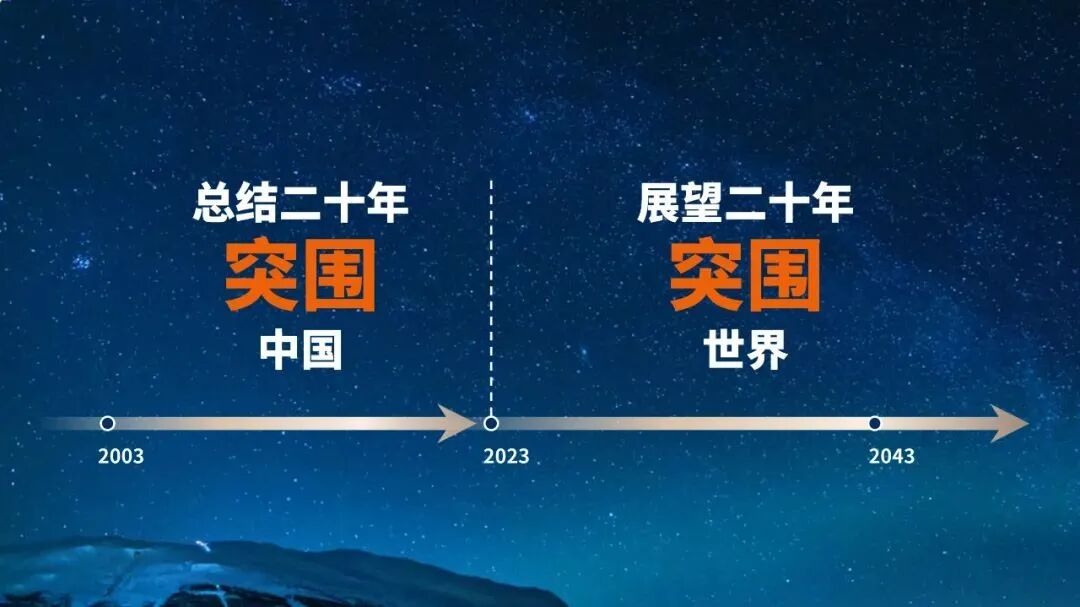
In 2003, we bravely embarked on the entrepreneurial path. At that time, China's industrial control market was almost entirely monopolized by foreign brands. Yet through twenty years of unrelenting effort and persistence, we have not only achieved breakthrough in the Chinese market but are determined to continue challenging the global market in the next twenty years.
With "breakthrough" established as the narrative theme, how to select appropriate dimensions and construct a narrative framework to comprehensively deconstruct and thoroughly examine this two-decade journey from dozens to tens of thousands of people became the key to crafting this speech. After prolonged contemplation and repeated discussions, we ultimately decided to trace back to the original intention — to two conversations in 2003 — where we found our inspiration.
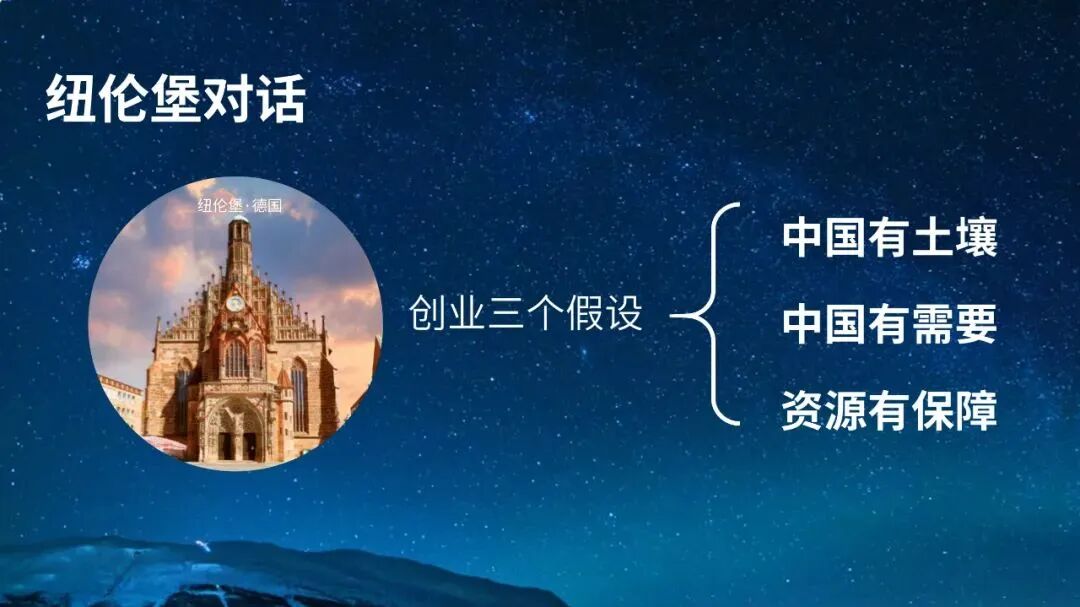
Turning back to early 2003, I had a conversation with foreign friends in Nuremberg, Germany. My partner asked me: "You earn several million a year as an executive at an American company. Why start a business? In Europe, someone like you starting a business is inconceivable — incredible!" I told him three sentences, which were my founding hypotheses:
First, China has the soil. China would certainly become the fourth major automation market after the US, Europe, and Japan. Where manufacturing thrives, there must be fertile ground for excellent automation companies to grow.
Second, China has the need. China was then undergoing a leap from imitation to independent manufacturing. The great development of manufacturing would necessarily create demand for excellent localized component vendors, giving us vast room to grow.
Third, resources are guaranteed. I chose to start a business at age 36. With the resources and experience accumulated up to that point, I could ensure I would do things well and create value for customers.
Based on these three hypotheses, I firmly told my German friend I was returning to China to start a business. What they thought impossible then, we have now achieved. These three hypotheses are actually two categories: one and two are hypotheses about the era — China has the soil, China has the need; three is a hypothesis about value — we have resources. Here I found two threads — era and value.
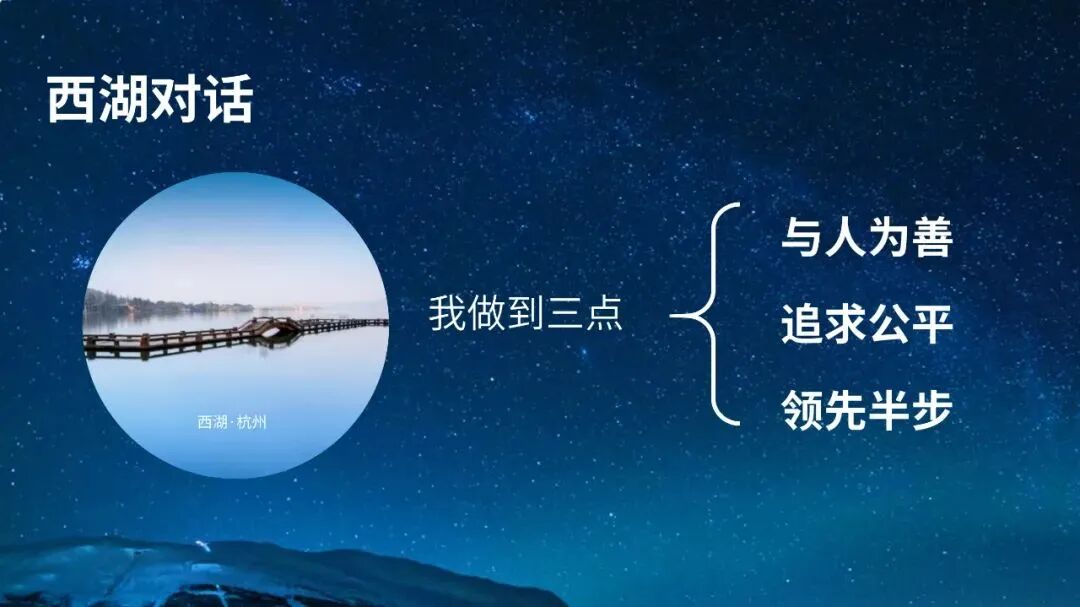
Also in early spring 2003, one evening by a lakeside, an old friend said to me earnestly: "Mr. Zhu, I don't think you can succeed. The 18-person founding team you lead — how to go the distance? It's an impossible mission!"
Yet I replied: "Although I am a novice entrepreneur, I firmly believe I can do three things well: First, be kind to others — this is what my parents taught me from childhood; second, pursue fairness — though absolute fairness is hard to achieve, we must strive for it, because it is the cornerstone of human relationships; third, stay half a step ahead — I will always be the most dedicated person in the company. I am dedicated in order to stay half a step ahead of my colleagues, to guide their thinking. If I can do these three things, I refuse to believe I can't build this team!" This conversation was actually about humanities — the founding entrepreneur's most original deep hypotheses about human nature, human relationships, and growth.
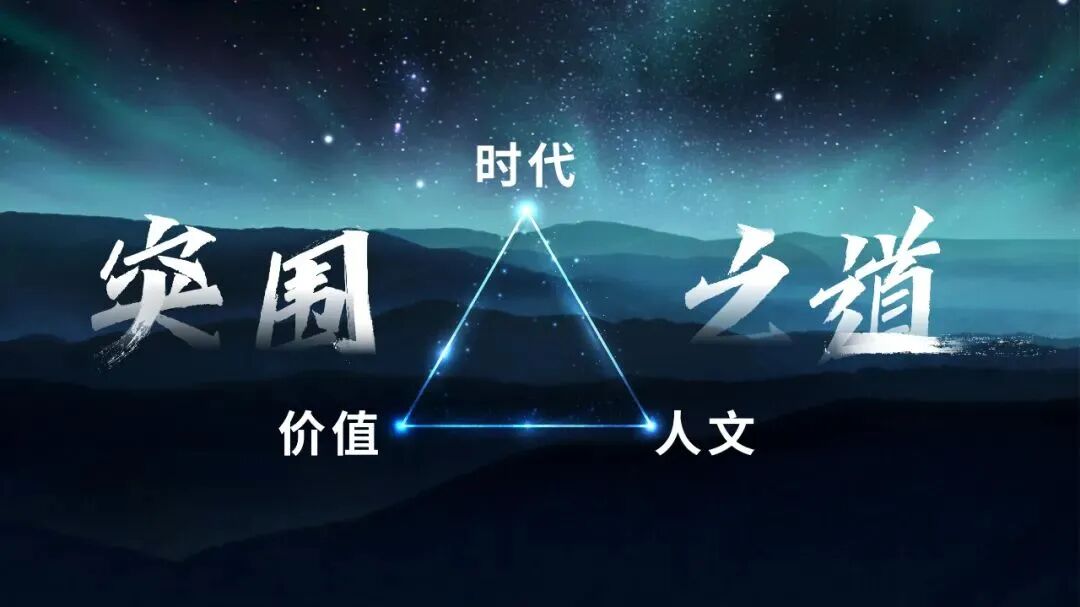
Revisiting these two conversations from twenty years ago, I discovered three keywords to parse Inovance's growth: era, value, and humanities.
So my speech outline today is: Breakthrough China, Era, Value, Humanities, Breakthrough World.
01
Breakthrough China
1.1 Product Lineage
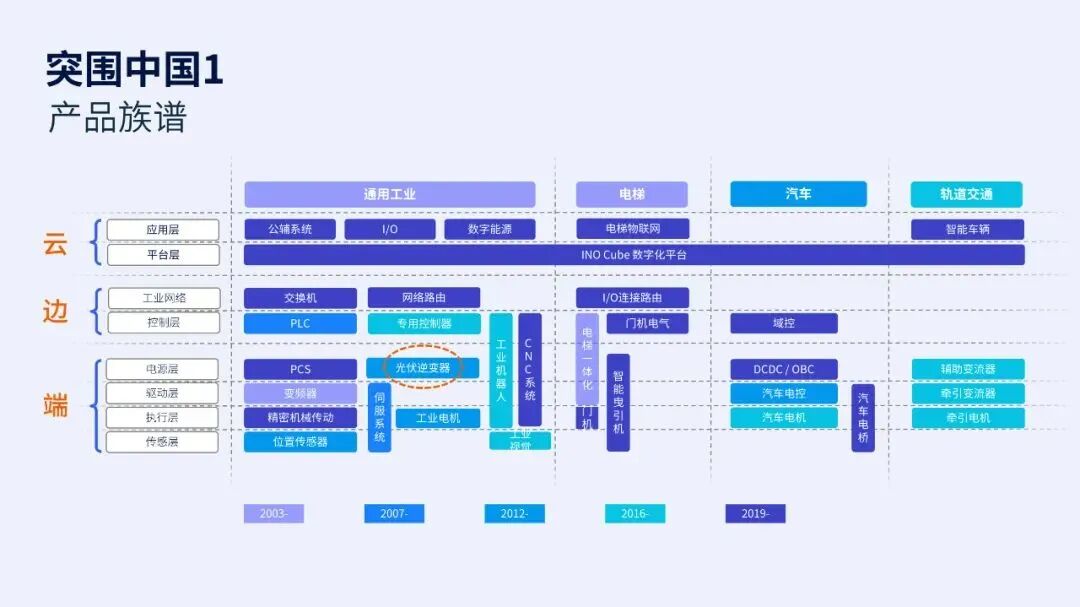
Like all entrepreneurs, we started with a single product. First we had technology, then we built products.
In 2003, our company mastered only one technology — vector control for inverters — and had only one product: inverters. Then we developed our second product: elevator integrated controllers. These two products brought us into general industry and the elevator sector. I must especially thank Mr. Jin and his father, old Mr. Jin, of Jiangnan Jiajie — they brought Inovance into the elevator industry. The elevator integrated controller actually pioneered Inovance's customer-customization business model.
In 2007, domestic Chinese automation manufacturers only had inverter products, but I judged that the future of automation would inevitably be a stage for integrated products, and that servo systems would be the king of future drives. That same year, I wrote a letter to company executives — The Future of China's Automation Development — describing future demand trends in Chinese automation and explicitly stating that we must begin developing PLCs and servo systems while we were still slightly profitable. Starting in 2007, driven by PLC and servo products, we moved from the drive layer into the control layer of automation.
After Inovance's 2010 IPO, we expanded our product line, entering solar inverters, automotive air conditioning, commercial vehicle electronic controls, industrial motors, and sensors. At this point we still didn't have many products, but we began testing the waters in new energy vehicles. Notably, Inovance once ranked second in China's solar inverter industry, but in 2016 we abandoned solar inverters — the biggest strategic mistake in Inovance's history. We missed a tremendous opportunity of the era. This mistake was fundamentally due to unclear understanding of the era and insufficient resolve. So-called insufficient capital or lack of excellent teams were all excuses to comfort ourselves.
By 2016 we were making more and more products, and Inovance began large-scale expansion into rail transit traction systems, new energy vehicle motors, industrial vision, and industrial robots. In 2016 I told the robotics team: "The core product of future intelligent manufacturing will not be servo systems, but industrial robots." This hypothesis has now become reality. That same year, we made another major strategic move — fully entering the new energy passenger vehicle industry. The four pillar businesses of Inovance that you see today took formal shape in 2016: general automation, elevators, new energy vehicles, and rail transit.
In 2019, Inovance entered yet another new era — the ecosystem era. We made a comprehensive push into industrial software and further strengthened our product portfolio at the axis and edge levels across all four pillar businesses, successfully building an integrated cloud-edge-device IoT solution platform.
This is the product genealogy Inovance has built over twenty years. Regarding this genealogy, we've achieved several things:
First, Inovance products cover all categories of manufacturing;
Second, Inovance provides all components and solutions for optical, mechanical, electronic, hydraulic, and pneumatic control;
Third, Inovance is one of the very few companies in the world that fully possesses complete "cloud-edge-device" CNC solutions, and the only one in China.
Inovance has developed so many products over twenty years. What is the logic behind how we built our business? This is the first question I want to answer today.
1.2 Revenue
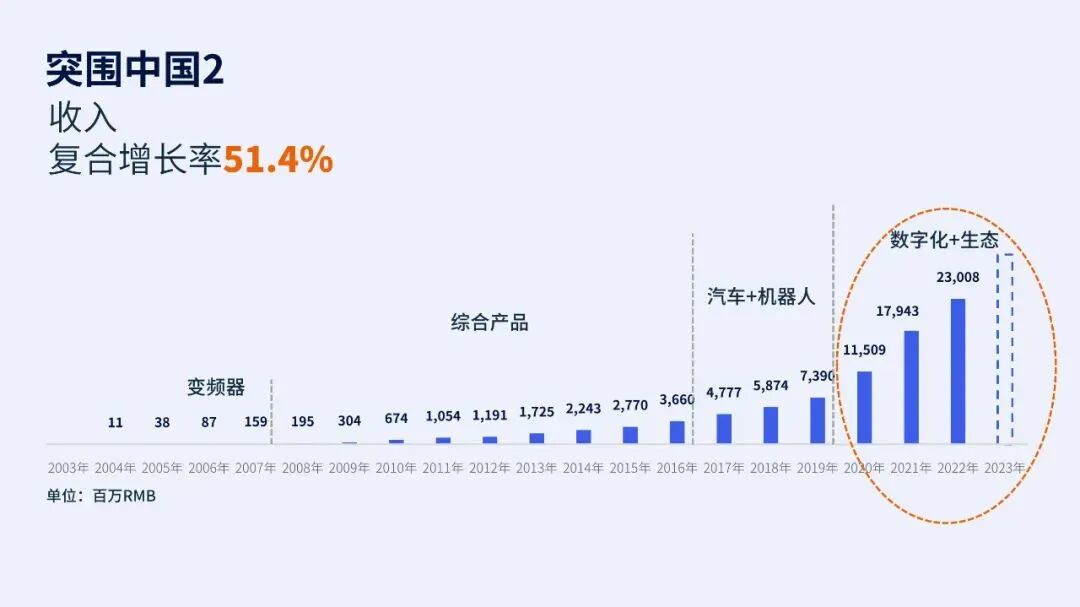
The chart above shows Inovance's revenue data over twenty years. This curve looks quite "sexy." For two decades, Inovance's revenue compound growth rate has maintained 50%, with particularly rapid growth in the last three years. Why has Inovance been able to transcend cycles? How do we stockpile the ability to survive winter before winter arrives? When winter does come, how do we use "crisis" (opportunity within danger) to achieve historical comebacks and reshape the landscape? How has Inovance developed this crisis-resistance capability over the past decade? This is the second question I want to answer today.
Inovance is a company that eats from a hundred bowls. A couple days ago I hosted President Zhao of NAURA, and he said the auto industry can achieve tens or hundreds of billions in revenue selling just tens of thousands of vehicles. Inovance's products average only a few hundred yuan in price — it's hard to imagine how Inovance achieved 30 billion yuan in sales. How many products does 30 billion require?
How does an industry like Inovance's achieve sustainable growth? What factors triggered Inovance's strategic direction adjustments? This is the third question I want to answer today.
1.3 Profit
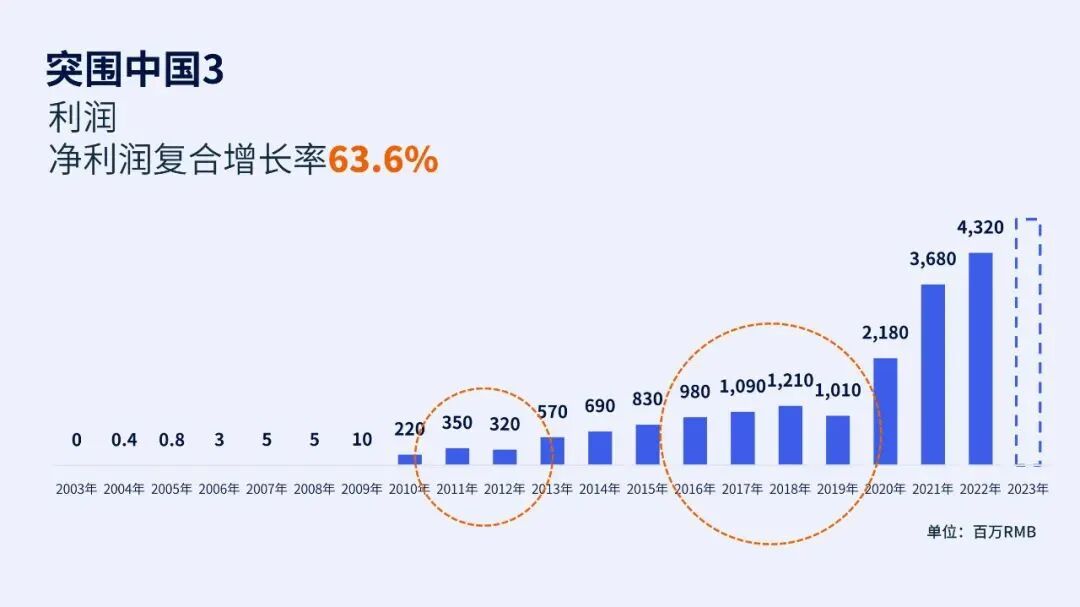
Inovance's profit situation is public, and its growth curve is equally "sexy." Over the past three years, our profits have achieved high-speed growth. However, in the company's growth journey, the profit curve also experienced major dips — in 2012 and 2019. Between 2013 and 2018, despite sustained high-speed revenue growth, profit growth did not keep pace. What exactly happened during this period?
Most entrepreneurs love to leverage small bets for big gains. Setting aside capital markets, we industrialists are no exception — we relish this. Before 2012, Inovance was a master at leveraging small for large. However, in 2013 and 2014, my partners and I began contemplating a question: How can we "leverage large for even larger"?
Without this shift in business philosophy, we would not have chosen to enter the automotive industry in 2016. And it was precisely this choice that caused company profits to hit their lowest point in 2019, facing enormous pressure from capital markets and beyond, with the stock price also hitting bottom.
At the 2019 company annual meeting, I firmly told the team: "As long as Inovance isn't ST'd, we will see the automotive business through to the end!" For us, the automotive business was not only a critical step for Inovance to "leverage large for even larger," but also an important testing ground — a mark of Inovance's capability growth and maturation. This wasn't a business issue; it was a company capability issue. Therefore, we treated it as our top priority.
Today, I stand here to announce: our automotive business has achieved stage success! Though challenges remain, I firmly believe we will be even more successful. Every decision and effort made in the past has been worth it!
1.4 Product Position
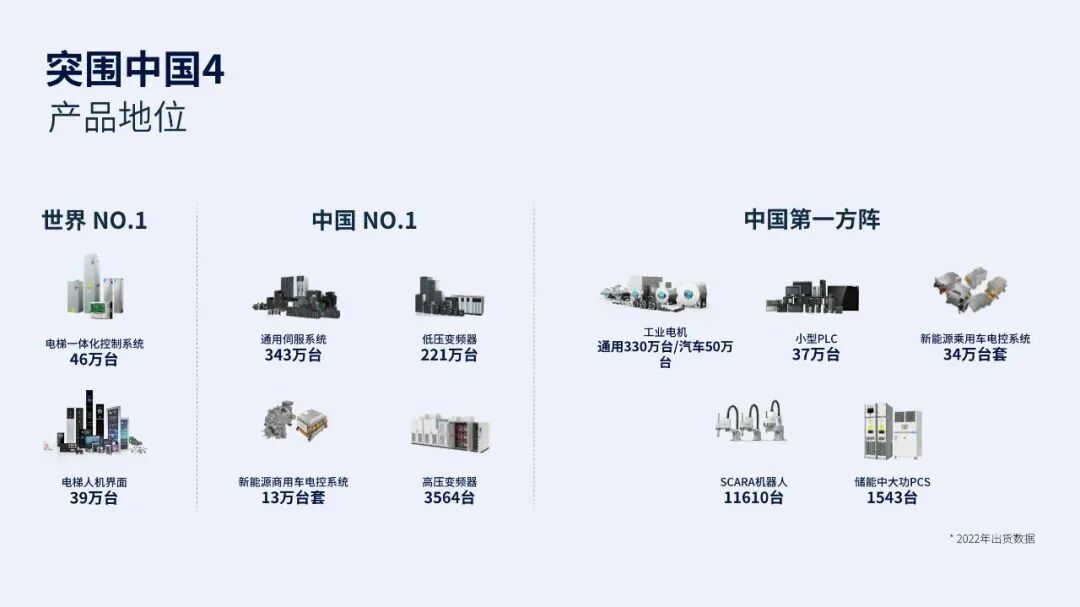
Over twenty years, Inovance has successfully broken through in the China market. Let's look at Inovance's current product position in China: we have two products with world #1 market share, four products with China #1 market share, and several others ranked second or third, firmly in the first tier and on track to become #1.
Some of these products have had very important impact on Chinese manufacturing — I want to especially thank Chairman Wang of Lead Intelligent Equipment. Ten years ago, Chairman Wang told me: "Mr. Zhu, get motors right, and the motor business can add another ten billion for you." Today, our dream is nearly realized! There's also commercial vehicle and passenger vehicle powertrain systems. A couple days ago, Inovance's Changzhou factory achieved the offline production of two "one million unit" products — one for motors, one for powertrains — marking Inovance's motor control and powertrain systems as already formidable in China and globally in the new energy vehicle market. We started from zero and created an industrial miracle in just eight years. This is truly remarkable.
People may wonder why I always emphasize "first." Because this is Inovance's character. How do we make "forever striving for first" into company character? How did we do it? This is the fourth question I want to answer today.
1.5 Market Share
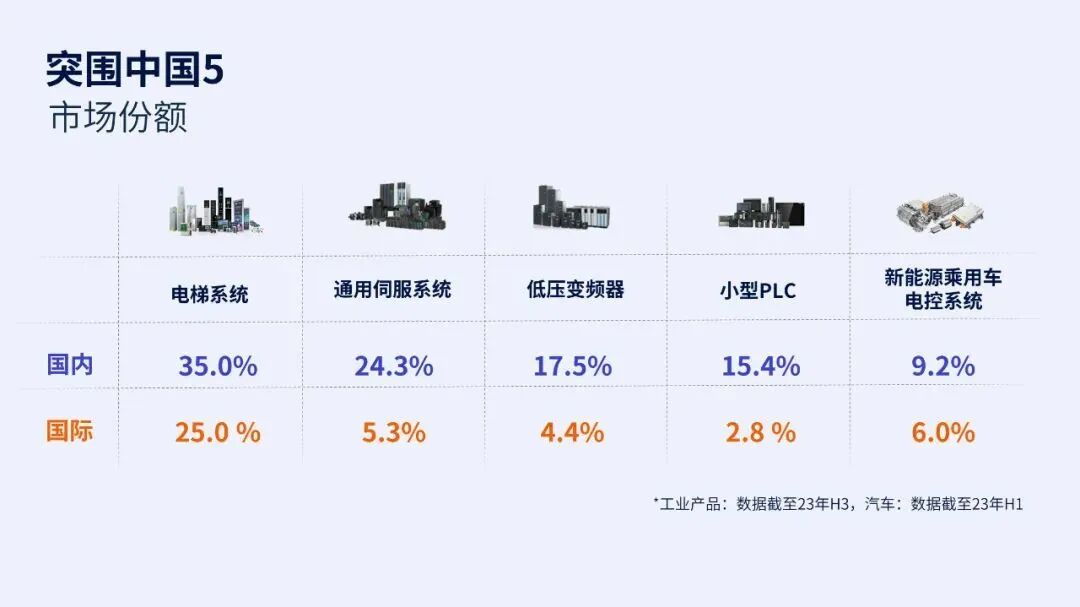
Though we've broken through in China, how substantial are the results? We got a general picture from qualitative descriptions just now; let's go deeper with quantitative data. Although several of Inovance's star products rank first or second domestically, market share isn't actually that high. Take servo products: while ranked #1 in China, leading #2 by more than ten percentage points, our market share is only 24.3%. Inovance's breakthrough pace in China cannot stop — we must continue breaking through without slackening. Our goal is to go from first to absolutely first, achieving at least 50% market share.
Our global market share is even smaller, so we must now break through to the world. 2022 was Inovance's internationalization theme year. We organized a cohort of Chinese business backbone to go overseas, while also recruiting many international professionals to Inovance's Suzhou base for technical and cultural training. 2022 became the inaugural year of Inovance's world breakthrough.
To continue "breaking through China" while also "breaking through the world" — where is our motivation? Like an engine, without fuel it won't run. So in the introduction above, I mentioned Inovance's breakthrough posture, both qualitative and quantitative. Though we've obtained two "sexy" curves, behind these curves are many qualitative and quantitative shortcomings — how do we improve them? This is the fifth question I want to answer today.
I believe our employees, former entrepreneurship participants, and all guests share these same questions. In today's Inovance twentieth anniversary graduation defense, I will answer them from three dimensions: Era, Value, and Humanity. This is actually the same as the philosophy of China's ancient sages — "heavenly timing, earthly advantage, human harmony" — nothing esoteric.
What is Era? Recognizing trends and riding with them is the mission Era gives us.
What is Value? Creating value is how you win the market.
What is Humanity? Humanistic cultivation is how talent flourishes.
02 Era
Era is the highest probability of business success.
Companies need the capability to manage era cognition. These capabilities didn't exist when Inovance was founded — they were gradually cultivated over twenty years.
2.1 Understanding GDP
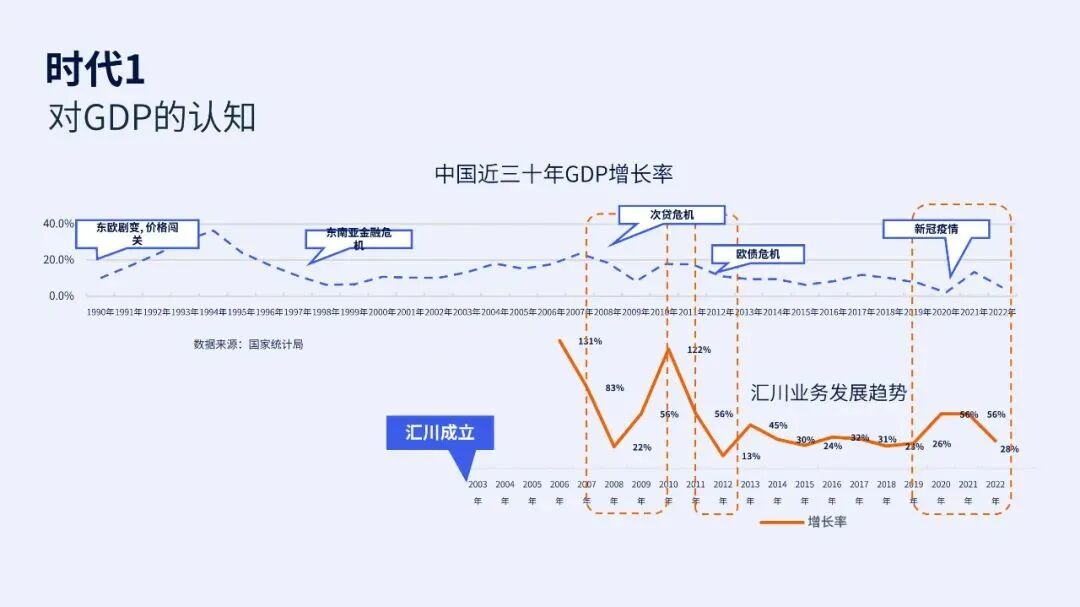
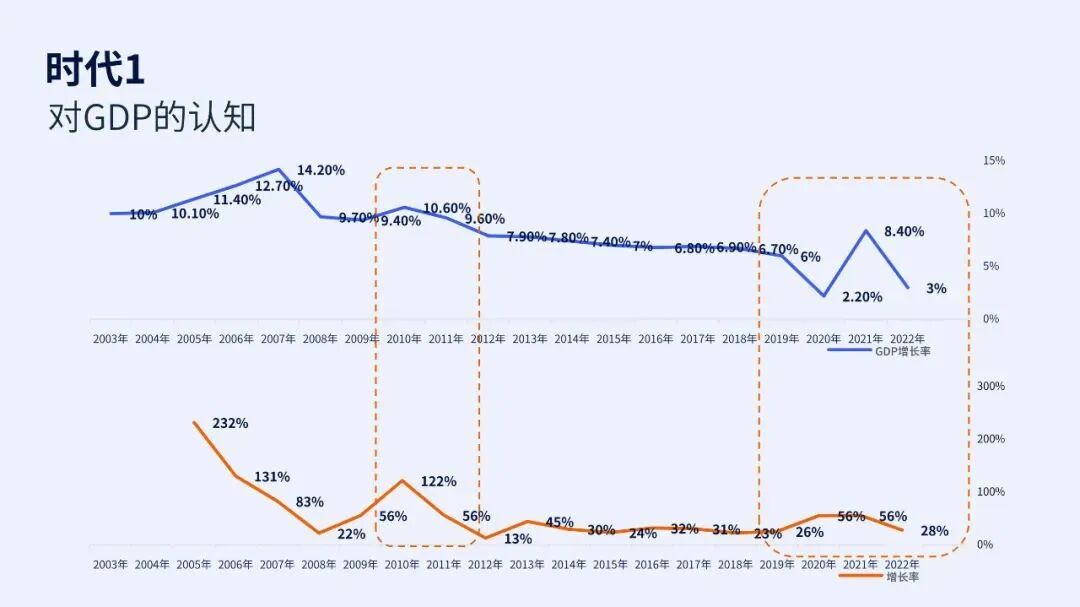
As a manufacturing enterprise, you must closely watch national GDP.
Over the past thirty years, China's GDP curve has shown roughly a cycle every ten years.
1990 to 1993: Eastern European upheaval — I was in school;
1998: Southeast Asian financial crisis — I was working at Huawei;
2003: China's economy developed at high speed, Inovance was founded then, riding the momentum;
2008: Affected by the US subprime mortgage crisis, China's economy trended downward, and Inovance's growth also experienced a cliff-like drop;
2008 to 2009: Stimulated by the 4 trillion RMB stimulus policy, Inovance's growth rebounded;
2012: European debt crisis, China's GDP growth rate declined, and Inovance's growth rate again fell to its historical low of only 13%. By then we were already listed, and many people thought Inovance was a company whose performance suddenly changed after IPO, believing we lost growth momentum after going public.
At that time, my partners and I were thinking: why does Inovance's fate always resonate in frequency with GDP? We looked inward — how can Inovance avoid fluctuations in China's GDP? How can we transcend cycles and achieve sustainable growth?
After discussion, we identified three problems:
First, wrong customer structure. Our customer structure was previously dominated by low-end industries easily affected by exports. When the subprime mortgage crisis and European debt crisis arrived, consumption problems in European and American markets affected all these export enterprises.
Second, small customers lacked capability and had no resistance when external crises hit. Therefore we proposed making large customers a strongly developed customer segment. We established a Key Account Department at that time, and specifically designed a customer development IPD process for key account expansion.
Third, organizational structure lagged behind business development — this was also what I considered most important. To serve large customers required greater professionalism, expert teams, joint co-creation with large customers, and a professional, deep, complementary joint operations organizational structure. Therefore we decisively implemented industry line operations in 2014, and summarized the five great tools of industry marketing.
After experiencing the pain of "growth rate falling to its lowest point," Inovance began accumulating capabilities to respond to crises and the ability to evolve itself in the face of crisis.
When the 2020 COVID-19 pandemic arrived, Inovance's agile organizational system played an enormous role.
At the time, Inovance supplied the servo control systems for 80% of China's mask-making machines. No manufacturer could keep up with demand then, and Inovance's own supply was extremely tight. Throughout the pandemic, Inovance adhered to two principles: First, no price increases. The marketing department was forbidden from raising prices for any manufacturer urgently trying to build mask machines — this is basic corporate conscience. Second, we only supplied to customers capable of building quality mask machines. If a customer had never built a mask machine before, we wouldn't sell to them at ten times the price! For strategic materials, wartime management is essential. How to build such mechanisms under emergency conditions, how to develop such rapid response capabilities — these are critically important. Tested by the pandemic, Inovance gained a new instinct: "the ability to manage crises." This is truly remarkable.
Today, as we feel the winter chill across industry, don't lose heart. This is precisely the time to quiet down and search for solutions. Only by turning the blade inward can we find the right answers — this is how Inovance grew. The two troughs of 2013–2014 and 2018–2019 gave us painful opportunities for transformation and allowed us to be reborn from the brink.
From Inovance's experience, we can summarize what businesses actually manage when navigating macro cycles. First, every entrepreneur and senior executive, when viewing macroeconomic cycles, should look at: first, the global economic cycle; second, China's economic cycle; third, the industry cycle — for example, power batteries were booming in recent years but have cooled somewhat this year, which is normal, that's the industry cycle; fourth, the company cycle. Second, identify which factors and indicators are strongly correlated with your business.
Crossing cycles stems from crisis management.
2.2 Understanding Manufacturing PMI
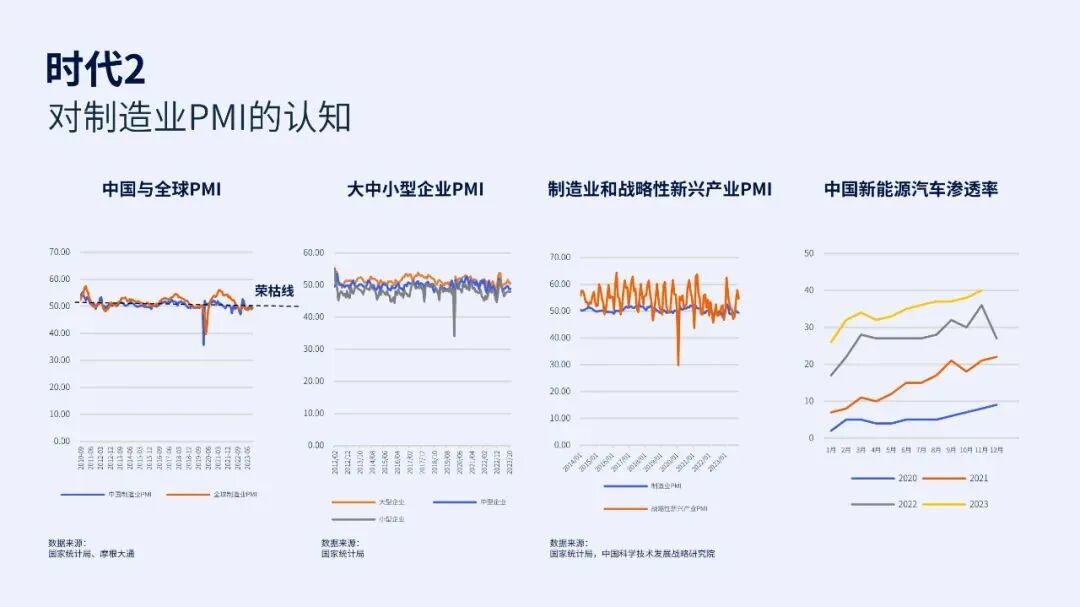
We also need to pay attention to the global Purchasing Managers' Index (PMI). This data helps us judge economic cycles.
When the manufacturing PMI exceeds 50, it indicates high prosperity; below 50 means danger. We need to look at PMIs for small, medium, and large enterprises separately. In China in recent years, large enterprises have shown the highest prosperity, medium enterprises next, and small enterprises the weakest.
Within manufacturing PMI, all emerging manufacturing sectors score far higher than the composite manufacturing index. How to select emerging manufacturing customers, and how to implement this selection well, is a question every growing enterprise must face.
New energy vehicle penetration rate refers to NEVs' share of total vehicle sales. Inovance began laying out its NEV strategy in 2016, but at that time penetration was only 5%–10%. We had thousands of R&D engineers struggling through what was then a muddy, pitch-black racetrack. Every year I encouraged them: the company's investment in automotive business is unwavering, we persist in customer value and long-termism, and I believed Inovance would emerge from this track.
Today China's NEV penetration has reached 40%, ten years ahead of schedule — this is the "China miracle"! This is the message the era has given us, and Inovance has become a leader in core components for new energy vehicles in China and even worldwide.
Using the era as our reference, we should observe from macro economy to macro industry, then to sub-industries and sectors. In this observation process, we captured top-tier (TOP) customers and captured emerging industries — these are the most important results we achieved from observing the era.
2.3 Understanding Other Macro Indicators
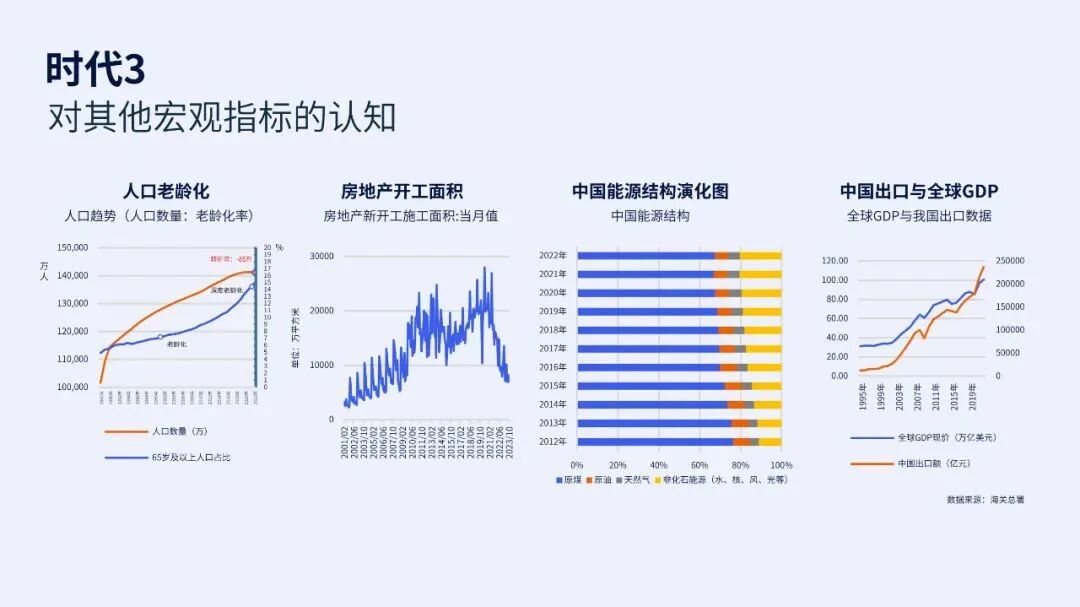
There are other important era elements worth our attention.
First, population aging. China has reached an inflection point in both total population and age structure; the era of deep aging has arrived.
Second, real estate. The past 20 years were the golden age of Chinese real estate, and also the golden period when Inovance's elevator business grew rapidly. However, in the past year or two, real estate construction starts have fallen to 2009 levels, forcing Inovance's elevator business to accelerate its transformation.
Third, energy structure. China's energy structure is shifting from coal and other fossil fuels to new and renewable energy — this trend is irreversible. With the national dual-carbon strategy, coal's share will eventually fall to just one-third, foreshadowing a tremendous revolution in China: the digital energy revolution. This will generate enormous business opportunities. Five years from now, where will all the energy we consume come from? How will it be stored? In what form will it reach us? How will it be billed? The emergence of new models like virtual power plants, where electricity consumers can generate power and trade it on the grid, seems fantastical but is actually a foreseeable future.
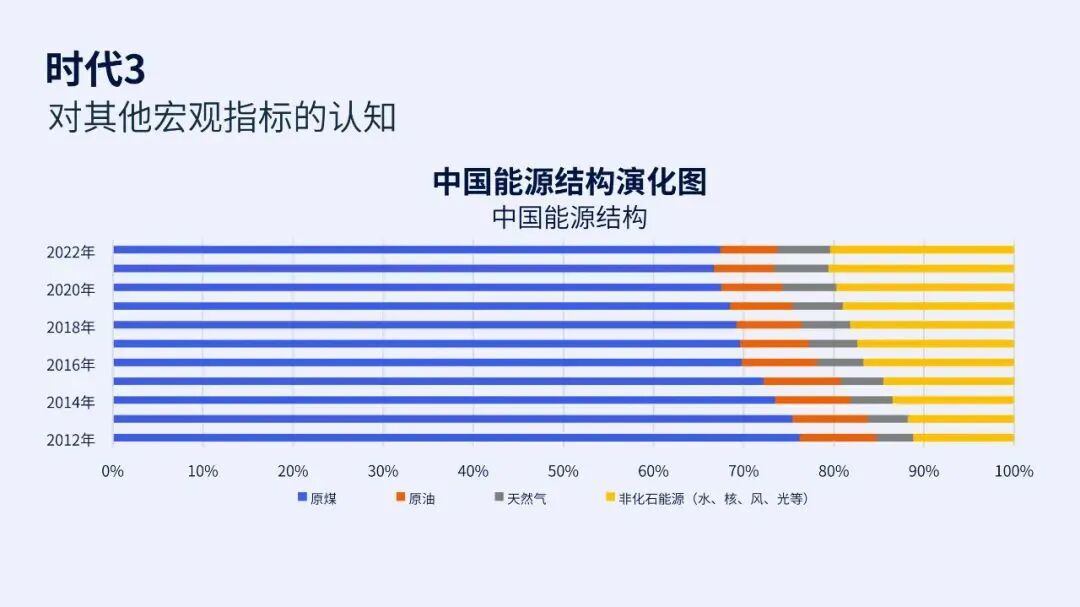
In 2016, Inovance terminated its photovoltaic business precisely because we didn't have the chart above — we hadn't recognized the importance of energy structure. If we had this chart, we wouldn't have abandoned it even if we had to tighten our belts.
Fourth, global GDP and Chinese export data are basically consistent. To understand China's export data, you must understand global GDP.
Observing these macroeconomic data at different levels, we find this era truly "turbulent seas." Real estate, new energy vehicles, photovoltaics... players in every industry have experienced setbacks and failures; only truly valuable "gold" remains. Those of you here today are the best among that "gold" — this is "in turbulent seas, true heroes reveal their character."
2.4 Managing Awareness of Major Domestic and International Events
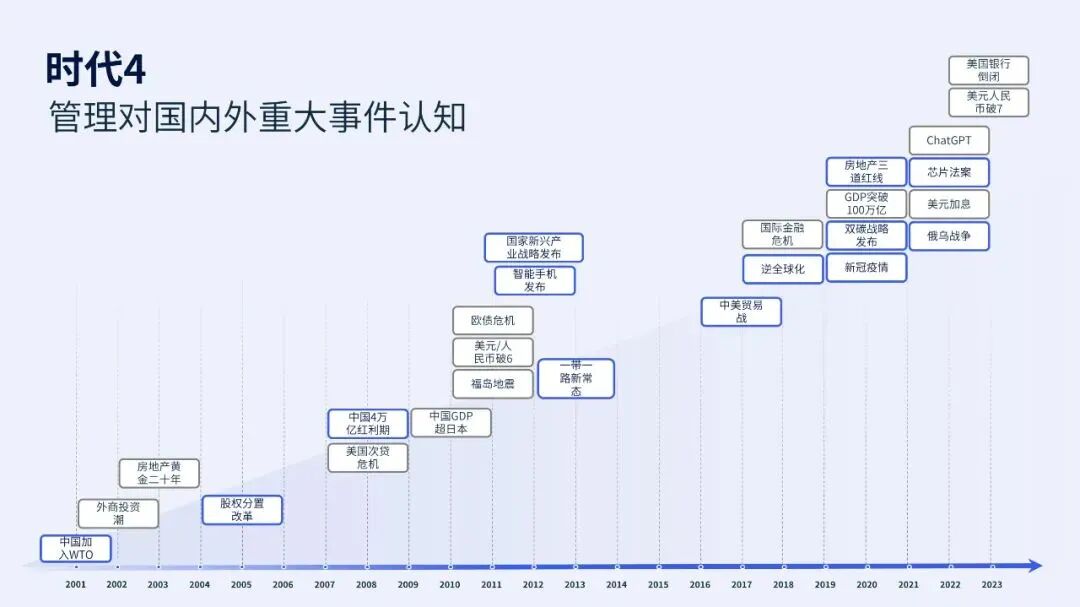
Beyond managing data, Inovance has a habit of managing major events. Running a business cannot be done with "ears shut to outside matters, mind only on reading sacred texts." Since Inovance's founding, I have paid attention to major world and China events that significantly impact the company.
In 2001, China's accession to the WTO was a landmark event.
In 2003, China's real estate golden twenty years began, and the split-share structure reform was implemented — against this backdrop, Inovance was founded.
In 2010, the US subprime mortgage crisis, the 4 trillion yuan stimulus, and China's GDP surpassing Japan's were all landmark events during Inovance's IPO period.
In 2012, the smartphone was launched; many customers here today are beneficiaries of the smartphone industry.
In 2017, the US-China trade war not only changed the global economic landscape but also profoundly affected Chinese manufacturing and Inovance. Though it was a crisis, Inovance effectively converted it into opportunity. Combined with the COVID-19 impact, Inovance achieved industry restructuring during economic downturns. Every crisis is the beginning of restructuring. In this restructuring, whether we can seize opportunities, continuously innovate, and expand markets will determine our fate.
In 2022, China's dual-carbon strategy and the US CHIPS Act are major events that will profoundly affect the data we mentioned earlier and will deeply influence every enterprise's operational decisions and strategic direction. Therefore, we must learn to manage major events.
Since 2016, whenever a major event occurs, I write an article analyzing its impact on Inovance's operations. Over the past three years, we have institutionalized and systematized this capability.
2.5 How to Manage
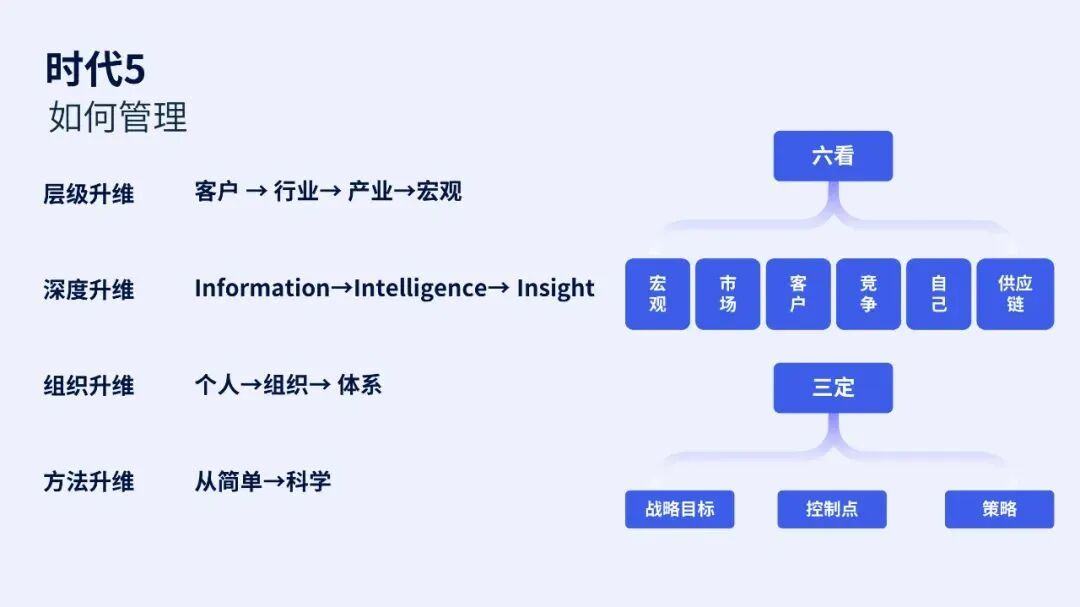
Since 2019, we have elevated era-awareness management to organizational behavior and managed it systematically, achieving four progressive dimensional upgrades.
First, hierarchy upgrade. We used to only look at customers, then gradually expanded our vision to industries, then industries in the aggregate, then the macro level.
Second, depth upgrade. From Information to Intelligence to Insight. Information plus thinking equals intelligence; intelligence plus thinking equals insight. Each step forward is the result of our deep thinking — don't parrot others. In this era of information overload, everyone must have independent thinking ability to achieve this cognitive depth upgrade from information to intelligence to insight.
Third, organization upgrade. Initially, enterprise insight mainly depended on the entrepreneur's and founder's perceptiveness; later it upgraded to organizational insight, and finally to systematic insight.
Fourth, methodology upgrade. We advanced from simplicity toward scientific rigor. 2019 was a landmark year for Inovance in era management — we introduced very scientific methods. Early on it was called "Five Looks, Three Decisions"; later I developed it into "Six Looks," with the new element being supply. During the three pandemic years, what Inovance did best was supply. There was a market saying then: "Having inventory is competitiveness" — this benefited from the "Six Looks" capability we began building in 2019.
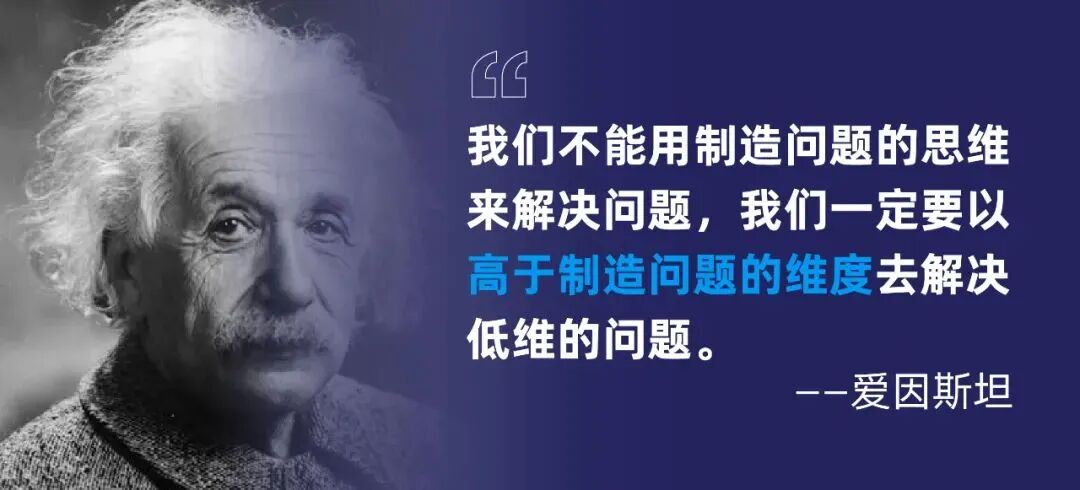
Here, I'd like to share a quote from Einstein — "We cannot solve our problems with the same thinking we used when we created them. We must elevate our thinking, jump out of the phenomenal level, and return to the fundamental level to solve problems." Today, as we discuss the industry's winter, if we only look at this era from the industry and enterprise level, I believe it's insufficient. If we upgrade our thinking through the four dimensions above and then tackle the problems, we will surely find "a village bright with willows and flowers beyond the dark willows and flowers."
2.6 Hypothesis Management: From Cognition to Direction
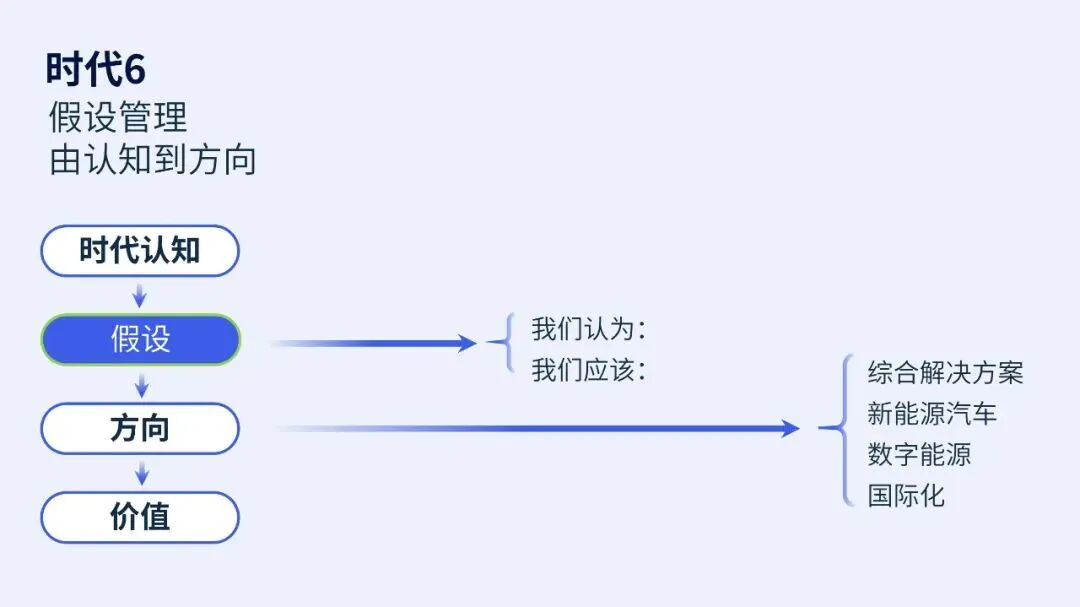
From understanding the era to choosing a direction, there lies a hypothesis in between. What is a hypothesis? It's two sentences — "we believe" and "we should." We believe that during an industry winter we should contract — that's a hypothesis. We believe dual carbon represents a massive future opportunity, and that we should commit to a dual carbon strategy — that's also a hypothesis. Based on these hypotheses, we determine our direction.
In 2007, I made a hypothesis for everyone: in the future, industrial automation would be dominated by integrated products, not by variable frequency drives alone, and servo would become the most important drive product. So we began developing servo systems.
In 2016, I made another hypothesis: automotive was a critical historical opportunity for Inovance to leverage its position for something far greater, so we made a strategic commitment to the new energy vehicle track.
In 2020, I hypothesized once more: digital energy would be the most important and enduring track in China's future energy revolution, so after abandoning our PV inverter business, we re-committed ourselves to digital energy. Despite the fierce competition in the industry today, I firmly believe Inovance will stand out in this track and develop in a very healthy manner.
In 2022, after the Russia-Ukraine war, I hypothesized again: the reshaping of global geopolitical and economic structures represented a tremendous opportunity for internationalization. So Inovance applied contrarian thinking and began actively expanding into international markets.
These are some hypotheses derived from our elevated understanding of the era. They have determined the fundamental direction of Inovance's business development. Whether these directions can be executed, and how, depends on the two most important words — value.
03
Value
If there is only direction without value, there is no reason to act.
3.1 Direction — Value
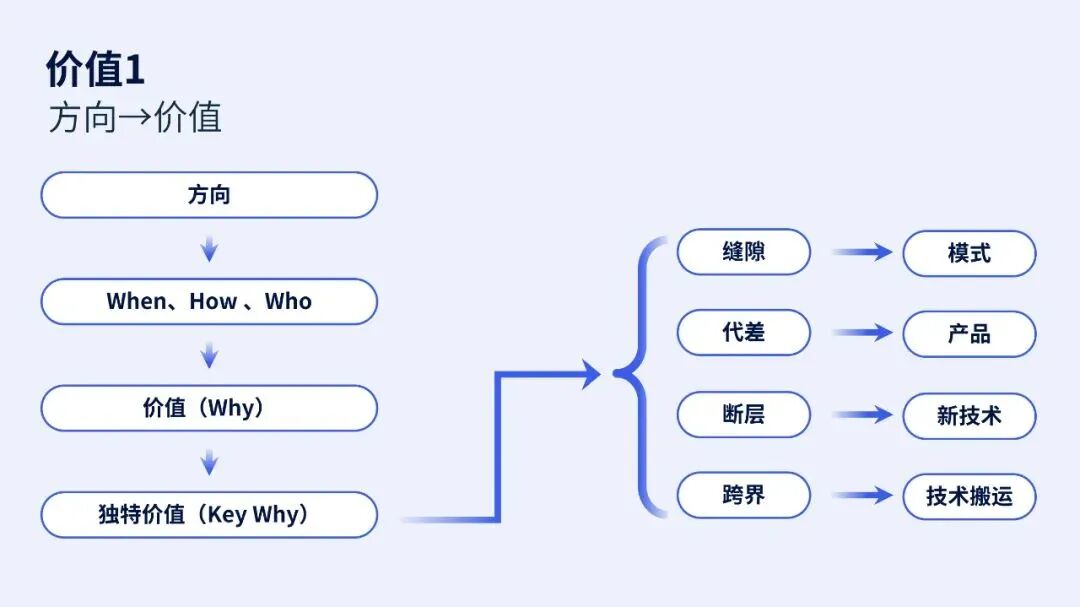
After determining direction, we can clarify when to act, how to act, and who will act. Then we need to answer why we should act — what is the value? Value is the Why, and especially we must answer the Special Why, the Key Why: what is the unique value and the critical value?
What exactly is Inovance's unique value? Here are my reflections, summaries, and arguments:
First, gaps. When there is a gap between customer needs and what we supply, a gap emerges. If we can fill that gap, that is our value and our reason for existence.
Second, generational difference. Every company must upgrade and replace its products periodically. In its early days, Inovance's product upgrades were rather haphazard. The market would casually request something, and R&D would start changing things, leading to enormous cost and quality expenses that affected customer experience. Therefore, in recent years Inovance established a requirement: without generational-difference-level iteration and advantage, products are not allowed to be changed casually. What counts as generational-difference-level? It must be either connection value, performance value, or cost value. Inovance requires that the generational-difference-level be defined in the product iteration process.
Third, technological discontinuity. Many of Inovance's products have led industry revolutions by precisely targeting discontinuities in industry technology evolution. For example, elevators moving from machine-room to machine-room-less, from magnetic to non-magnetic; industrial motors moving from asynchronous to synchronous; automobiles moving from fuel-powered to new energy vehicles — these are all technological discontinuities in their industries. The unique value an enterprise can provide to an industry lies in being either one step ahead in time, or possessing a capability and spatial advantage when industry technology reaches a discontinuity. Time difference and positional difference are the unique values we contribute amid industry technological discontinuities.
Fourth, cross-industry transfer. Inovance serves hundreds of industries. We've found that a technology mature in one industry may be entirely new and unfamiliar in another. For Inovance, technological cross-industry transfer is extremely valuable. The cross-industry value we create allows the same machine equipment to serve multiple purposes in manufacturing, so many of Inovance's products are engaged in cross-industry innovation.
Unique value is the soul of value — this is what Inovance has distilled from twenty years of countless experiences and lessons.
3.2 The Dual Triangle of Value Engineering
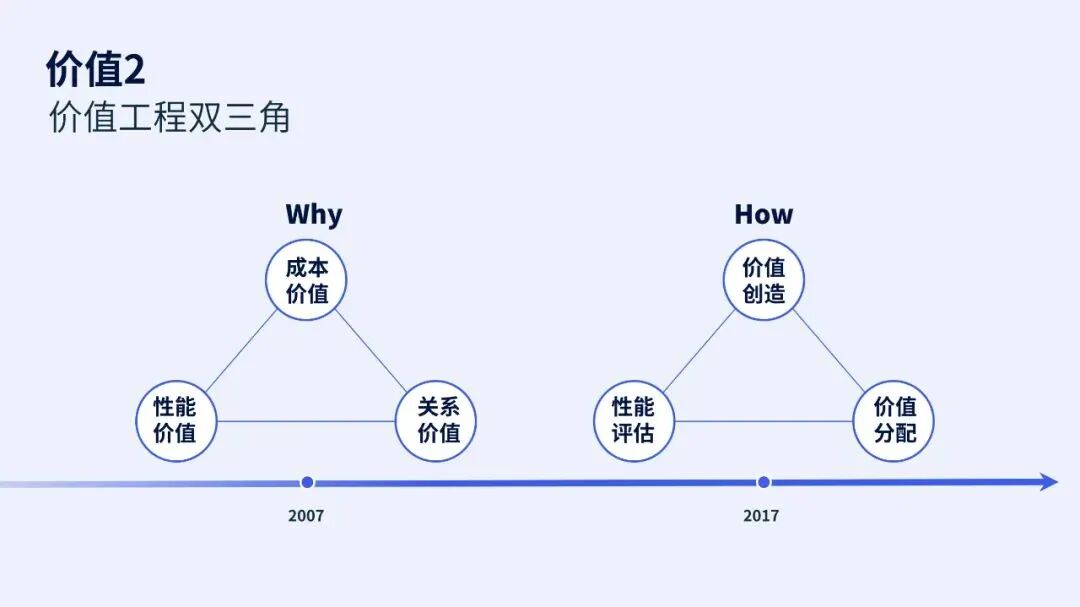
In 2007, Inovance introduced the concept of "value engineering." At that time, I asked everyone to read a book called Beating the Low-Cost Competition, which specifically mentioned that value has three dimensions: cost, performance, and relationship. The first version of Inovance's "value engineering" was built on this framework.
In 2017, Inovance proposed a new framework: value creation, value assessment, and value distribution. These two triangles represent Inovance's understanding of value, and they form the basic framework for what I will explain next.
3.3 Roadmap of Value Upgrade in Chinese Manufacturing
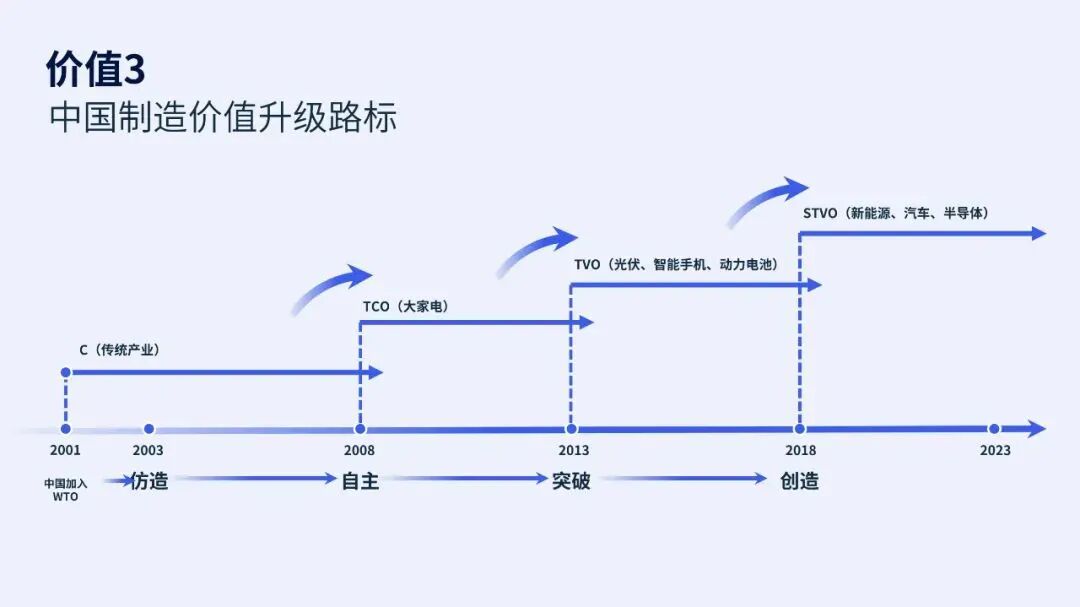
Over the past two decades, how has the value creation capability of Chinese manufacturing changed?
First, after China's WTO accession, a large number of traditional European, American, and Japanese enterprises entered China, optimistic about China's demographic dividend. Through this opportunity, China rapidly achieved a transformation of market access in exchange for technology and talent.
When Inovance was founded, Chinese manufacturing was experiencing a wave of imitation. At that time, a well-known company proposed the view that "imitating well is innovation," which left a deep impression on me. That company is also doing very well today.
In 2008, China's white goods industry began to rise, and manufacturing started on the path of independent innovation, particularly in the equipment manufacturing sector. In 2013, the PV, smartphone, and power battery industries began to break through and innovate. In 2018, semiconductors, automotive, and other sectors truly began creating Chinese solutions. Although only in select industries, this marked a milestone in Chinese manufacturing's development.
Throughout this process, we found that the way Chinese manufacturing creates value is changing.
Initially, traditional industries pursued reducing material procurement costs, or C (Cost);
At the independent innovation stage, we began pursuing reducing comprehensive costs including materials, manufacturing, service, and R&D, or TCO (Total Cost of Ownership);
At the breakthrough stage, we found that Chinese manufacturing began creating performance value that foreign brands could not provide for customers — whether high safety and high speed, or high precision — or TVO (Total Value of Ownership). This was particularly successful in PV, smartphones, and power batteries. Some of these products had a very important impact on Chinese manufacturing. Many industry leaders here today achieved new breakthroughs against foreign manufacturing during this stage. How did they create value for customers? Through breakthroughs in industry know-how;
Now at the creation stage, an increasing number of industries, beyond industry breakthroughs, are bringing disruptive innovation to their sectors. For example, the new energy vehicle industry successfully achieved lane-changing overtaking — this is super value, or STVO (Super Total Value of Ownership).
I believe these are the four stages of Chinese manufacturing's development.
This morning, when communicating with an entrepreneur, he asked for my views on the Chinese economy. I shared one perspective: after this round of economic downturn, Chinese entrepreneurs' understanding that "innovation is the only path to high-quality development" has become fundamentally different from what it was two years ago — I believe this is an awakening of consciousness and cognition. What is innovation? Innovation is creating TVO value for customers. In China, this has become the hallmark of a collective cognitive awakening.
3.4 Staying One Step Ahead, Building Capabilities and Platforms
What has Inovance done over the past twenty years for the evolution of value creation in Chinese manufacturing?
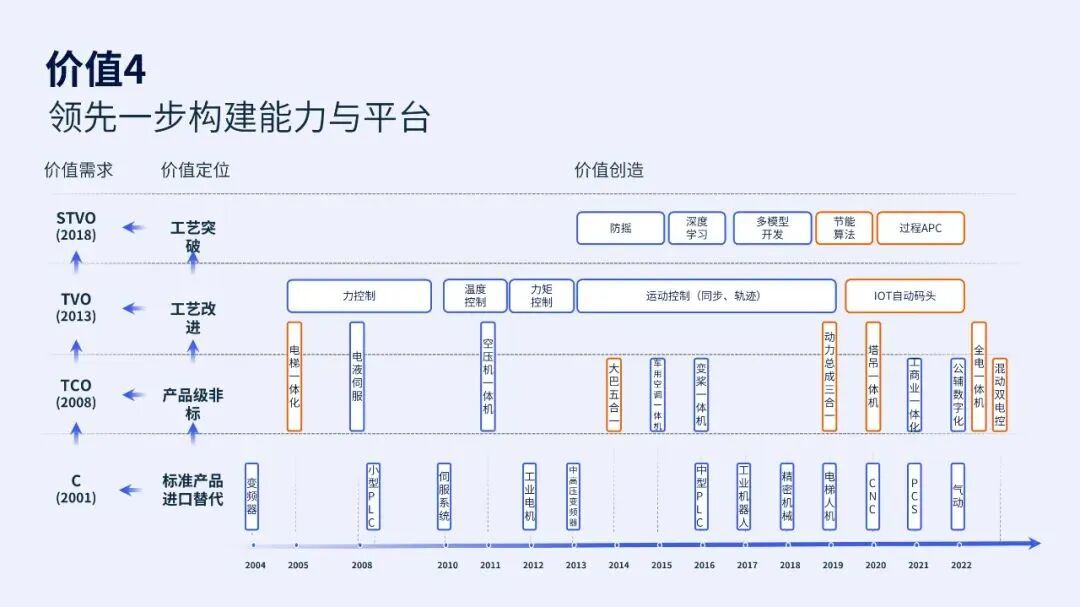
Since 2001, Chinese manufacturing's value demands have evolved from C to TCO to TVO to STVO. In response to this evolution, Inovance anticipated trends ahead of time and built capabilities, enabling us to calmly and rapidly switch to the most targeted strategies when value demands changed. For customers concerned with procurement cost value, we adopted standard products to replace imports. Inovance was a benchmark for import substitution in its startup phase and successfully went public.
However, Inovance did not only do import substitution. As early as 2005, we were thinking about how to change the elevator industry's status quo. At that time, I proposed a view: the elevator industry must be broken before it can be rebuilt, and Inovance must break before we build! We launched integrated elevator products and solutions, and began customizing product-level non-standard offerings for customers and industries. The construction of this capability and platform led the industry's concentrated value demand explosion by a full three years.
Some of these non-standard products in the diagram currently have tremendous influence in the Chinese market. Let me give a few examples: the integrated elevator controller's influence is beyond doubt — it not only changed China's industry landscape but changed the global elevator industry; the new energy bus five-in-one assembly we co-developed with Yutong is now an industry entry threshold, and helped Yutong become the world's largest new energy bus producer by market share; we jointly developed tower crane integration with Zoomlion, shaping a new pattern of full variable-frequency tower cranes, and subsequently promoted lightweight structural improvements in tower cranes; in the new energy passenger vehicle domain, the passenger vehicle powertrain three-in-one is a landmark product that changed the technical path of China's new energy passenger vehicles; recently, our hybrid dual electronic control has also become the most influential solution product in China's hybrid market.
There is a very harsh but unavoidable reality: all B2B business is essentially non-standard business. After recognizing this first principles insight, we provided two targeted types of improvement for customers' TVO and STVO: process improvement and process breakthrough. For example, around 2006, we improved the tension control process algorithm for variable frequency drives, thereby changing the wire drawing machine industry; in 2009, with the launch of servo products, we improved motion control synchronization and trajectory process algorithms, which was 4-5 years ahead of the industry's value demand at the TVO level.
What differentiates Inovance from other companies is that we not only provide customers with a platform for process improvement, but also provide a team for joint problem-solving. Inovance has always worked with leading customers on joint problem-solving and development, collaboratively improving processes, ultimately achieving process breakthroughs.
To summarize, gaps, generational difference, discontinuity, and cross-industry transfer — these four methods have been widely applied throughout Inovance's process of creating unique value.
3.5 The Escalation Path of Relationship Value
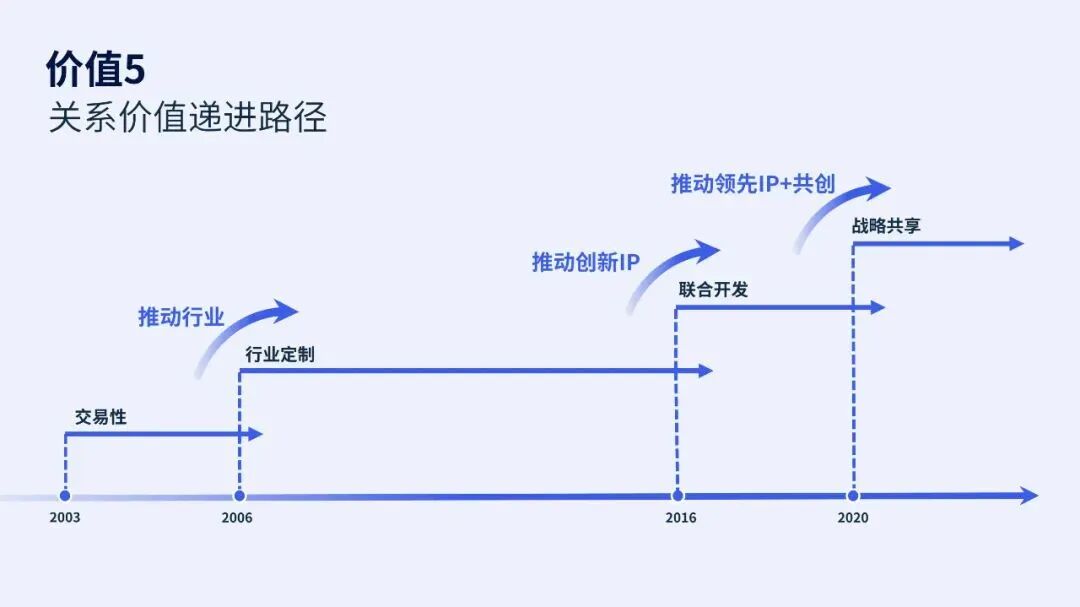
Relationships were a key tenet of Inovance's 2007 value "trilogy" — value creation ultimately comes down to relationship value. Over two decades, Inovance's relationship with customers has gradually deepened.
Early on, our customer relationships were purely transactional. Starting in 2006, however, we built on this foundation by launching industry-customized products with disruptive designs — integrated elevator controllers, air compressors, electro-hydraulic servo systems, and other industry-specific products that reshaped entire sectors.
By 2016, as Chinese manufacturing shifted from TCO to TVO, many leading customers wanted to partner with Inovance on customer-specific customization, not just industry-level customization. That same year, we began joint development with top-tier customers and established strict policies to "drive customer innovation and protect customer intellectual property."
By 2020, Inovance had achieved strategic sharing with select customers — they began sharing their future equipment and production facility plans with us, exploring what forward-looking technical solutions Inovance could provide. Just yesterday, I met with a customer from a great company to discuss joint development and strategic sharing: What goals do they hope to achieve in five or ten years? What unique value can Inovance offer? How will Inovance help this customer become the king of their industry?
This is the relationship value between Inovance and our customers — evolving from simple transactions to industry customization, customer customization, joint development, and ultimately strategic sharing with key accounts. This is how Inovance has deepened its customer relationships over twenty years.
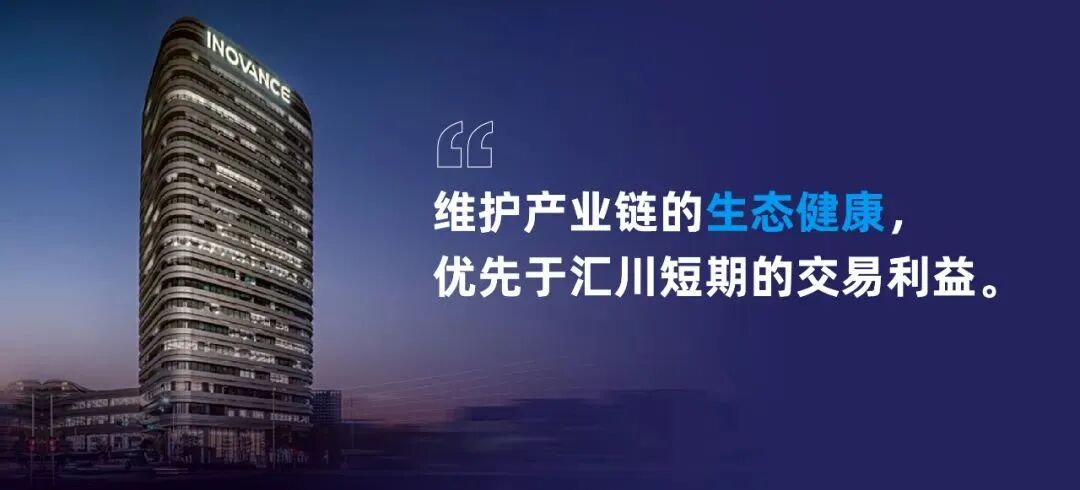
Protecting customer innovation is the only way to ensure the living source of Inovance's own innovation. If we want to be a company that innovates continuously, and if we fail to protect this wellspring of "customer innovation" — if we pollute the source — we cannot survive. Maintaining the ecological health of the industrial chain takes priority over Inovance's short-term transactional interests. This is not only our commitment to all customers but also a requirement for all employees, and the prerequisite for our sustainable development.
3.6 The Evolution of Value-Creation Organizational Models
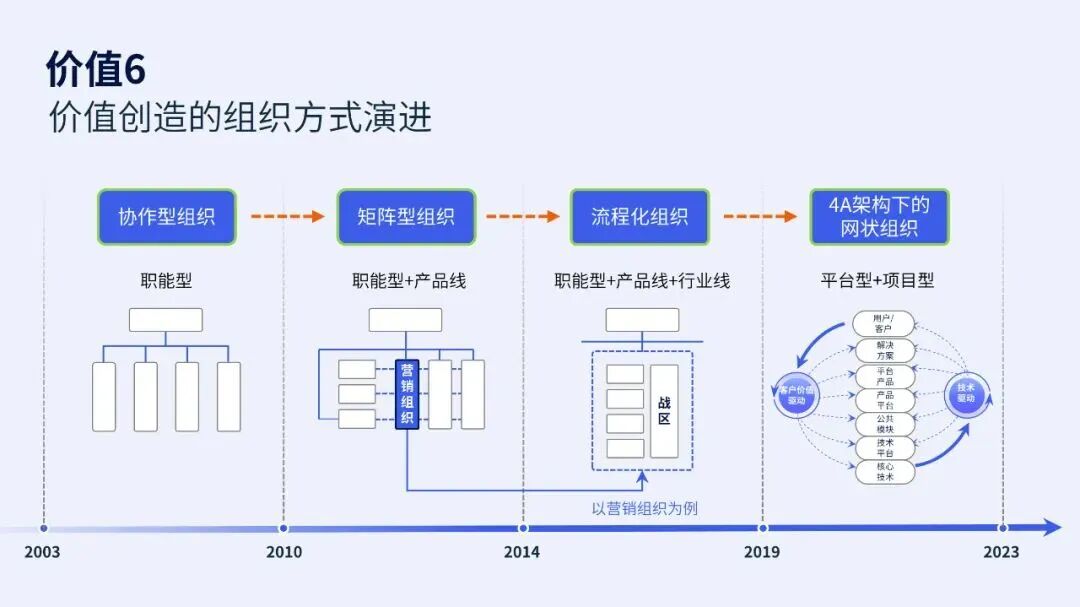
How do we create unique value for customers at different stages? Easier said than done. "Who does the work?" is the core question. After deeply reflecting on Inovance's four major organizational transformations, I've found that this question is inextricably linked to company performance and the accumulation of value creation.
Before going public, Inovance was a very simple functional organization with only three elements: "managers, managed, and tasks" — very much in line with Taylor's classical management control theory.
As our product portfolio expanded post-IPO, we adopted a matrix management model combining product lines with functional organizations. It worked to some extent, but we quickly hit a bottleneck. This weak matrix introduced five elements at the management level: beyond the original "managers, managed, and tasks," there were now "coordinators and coordinated." The matrix model failed to efficiently manage these two additional elements.
In Q3 2014, we began by "operating" on the marketing organization, restructuring it into a regional plus industry-vertical model. This organizational adjustment was essentially a transformation from matrix to process-based organization.
By 2020, with the rise of Inovance's digital business, we realized that the future requires a platform-plus-project network organizational model. Platforms represent capabilities — each platform's responsibility is to serve as a capability center, accumulating and enriching capabilities, thickening the soil's fertility. Projects are about fighting battles; when mobilized, they become what Huawei calls "legions." The "legion model" is essentially the network organizational structure that inevitably emerges after digitization. I believe all excellent enterprises will eventually become networked, and Inovance is actively striving toward this goal.
3.7 Digitization Under the 4A Architecture
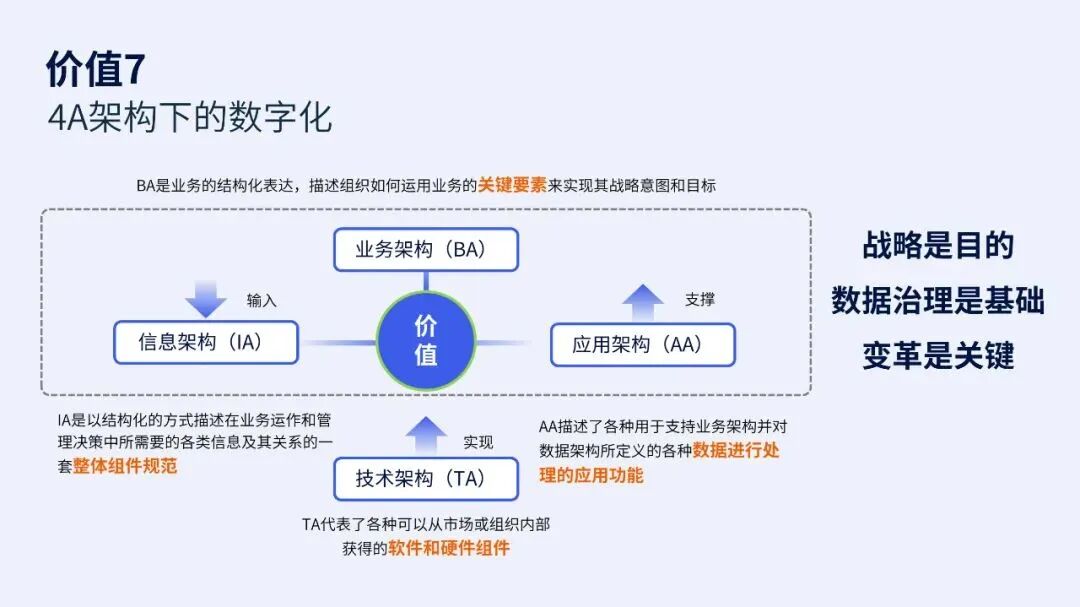
The network organizational structure I just mentioned has a prerequisite — the enterprise 4A architecture. What is the essence of 4A architecture? I borrow a quote from Huawei's Sabrina Meng: "Strategy is the purpose, data governance is the foundation, and transformation is the key." Inovance's transformation is built on 4A architecture theory to construct our current comprehensive digital landscape. Once digitization is achieved, the entire company forms an efficient, network organizational structure. This structure is highly agile — it only needs one office as a war room, one defined theater of operations, and personnel drawn from platforms to assemble a vanguard unit ready for battle. Whether winning customers, seizing market opportunities, tackling technical challenges, or implementing IT projects, victory can be achieved. This management architecture represents the bold experimentation that enterprises must undertake in their evolutionary process, with the prerequisite of building a solid digital system. Inovance is also committed to becoming an enabler of digitization in the future.
The industrial internet sector is currently in a deep freeze. I predicted today's situation four years ago. However, Inovance has been walking a distinctive path in digitization, and now we can see the first light of dawn. I hope that when I tell Inovance's digitization story ten years from now, I will feel even prouder than when I tell our new energy vehicle story. In the automotive business, Inovance changed only one industry; but on the path of digitization, Inovance will transform all of Chinese manufacturing. I firmly believe Inovance will succeed!
3.8 The Evolution of Values
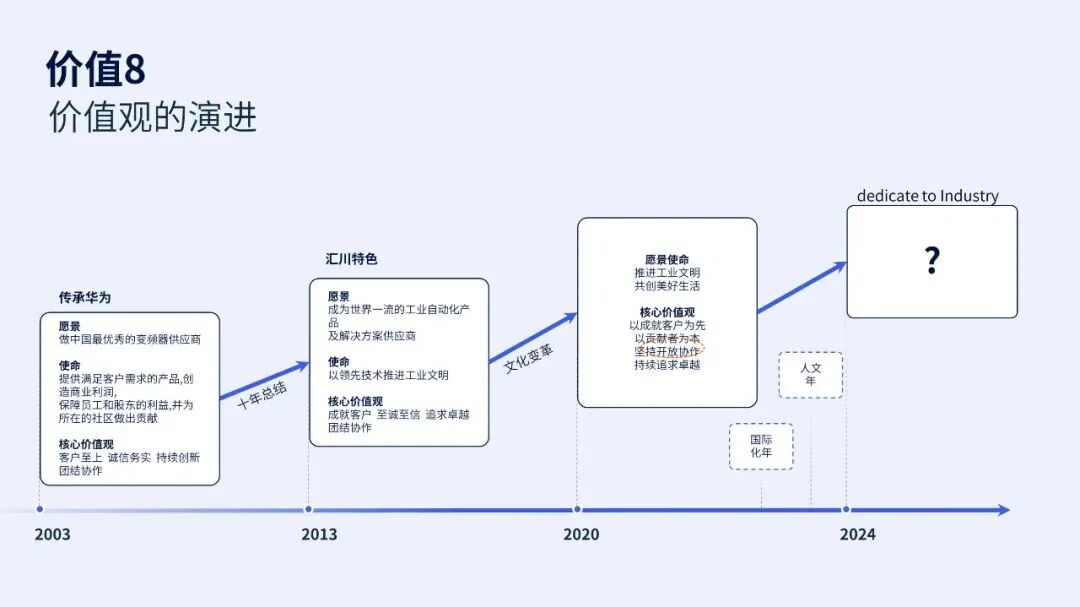
Value creation itself requires the nourishment of values and culture. Values provide emotional value to value creators — otherwise, where does a company's motivation and vitality come from? Where is the sustained vitality to break through in the world? Therefore, a company must have excellent values. Inovance's values did not evolve overnight; they have gone through three stages and are about to enter a fourth.
The first stage was at Inovance's founding. Our vision, mission, and values all bore traces of Huawei.
The second stage came at Inovance's tenth anniversary in 2013. We organized a values discussion that lasted a year and a half, hoping that Inovance's new values would come from the hearts of every employee. Only values that originate from employees can nourish employees, and they must enter the eyes and hearts, and more importantly, the soul. This version of values was formally released in 2015, mostly describing what kind of supplier Inovance aimed to become. Looking back, these values were not sophisticated — they clearly showed we wanted to do business and sell things.
The third update came in 2020. With guidance from senior experts, we distilled the mission and vision of "Advancing Industrial Civilization, Creating a Better Life Together," which immediately expanded Inovance's horizons.
In a company's development, vision, mission, and values must be continuously upgraded. Once a company reaches a certain scale, only by working with people who share the same mission, breathe the same air, and share the same destiny can we progress together. Those whose missions diverge significantly from the company's, who cannot share its destiny, or who are merely temporarily assembled for economic gain — they will leave sooner or later. Though many among them are talented and capable, reality is this ruthless. I believe the entrepreneurs here share the same helplessness. What is our mission and destiny? We must articulate it so that those with shared mission and vision know they can become part of your team, while those with different paths will choose to leave earlier. Therefore, Inovance believes that a noble mission is crucial to company culture and values.
Inovance's first two versions of values barely addressed employees, but in the 2020 values, we paid special attention to employees, placing customers first and employees second. "People-oriented based on contributors" is critical and has greatly influenced the company's value evaluation and value distribution.
2022 was Inovance's "Internationalization Year," and 2023 was our "Humanities Year." So what should our theme be for 2024? The fourth cultural upgrade is imminent. In 2024, we will refresh our corporate culture and values, because in our current internationalization process, we face intense collision between Chinese and Western cultures. The new values must be more inclusive, open, and integrated with global norms — only then can we embrace the world.
Culture is an all-hands project, and even more so, a CEO project. Culture must penetrate business and permeate business rules.
3.9 The Theoretical Framework for Building Corporate Culture
How do the three elements of culture, value, and era combine to influence business operations? I borrow Edgar Schein's "water lily" model, which is the core theoretical foundation of this speech.
Edgar Schein is a great master of psychology and organizational studies, and the founder of corporate culture theory. He divided corporate culture into three layers: artifacts, espoused values, and basic underlying assumptions (logic). With his academic background in psychology, Schein believed that the most fundamental part determining a company's culture is actually the entrepreneur's basic underlying assumptions, also called deep logic.
After learning this theory, looking back at numerous companies including Inovance — some with good fortunes, others with bad, with vast differences between them — I realized that this gap stems from the entrepreneur's basic underlying assumptions, which determine the company's values, the entrepreneur's understanding of the era, and the company's strategic decisions. Basic underlying assumptions are the humanistic foundation of a company; values are merely the stem of the "water lily," while the entrepreneur's basic underlying assumptions are the root. This was an especially significant insight for me.
One crucial lesson I've gained in entrepreneurship is that the structuralization of humanistic knowledge is the foundation for cognitive improvement and the most important means of enhancing cognitive ability — just as Edgar Schein structured corporate culture. Here, I especially recommend a famous Western management book — The Pyramid Principle — which provides methods for structuralization.
3.10 The Panoramic View of Business Operations
We've covered era, assumptions, and direction; we've discussed value creation; and we've talked about culture and values. Using Edgar Schein's model, I've combined and analyzed these elements. At the top level is understanding the era and the strategy that emerges from it, shaped by the entrepreneur's deep-seated assumptions. In the middle triangle are value-creation activities (I've only discussed value creation here, not value distribution or value assessment). At the base are culture, mission, and values. I've walked you through Inovance's twenty-year evolution of values — why it had to evolve, and what effects that evolution produced.
Next, I want to explore with you: What are the deep-seated assumptions of the entrepreneur group? How are they blinded by the era, and how do they resist that blindness? How to renew and elevate those deep-seated assumptions will determine a company's fate. This is the humanistic dimension.
04 Humanism
4.1 The Entrepreneur's Deep-Seated Assumptions
The most fundamental determinant of a company's survival and development is the entrepreneur's deep-seated assumptions. This is a company's humanistic foundation.
This humanistic foundation is the root of sustainable corporate development, yet it's often overlooked. It exists in our world of consciousness and humanism, rarely studied by those from technical backgrounds. Over the past two to three decades, businesses across industries have experienced many events. I've paid attention to and reflected on both positive and negative incidents, and found that the problem often lies right here.
Schein said, "The so-called deep-seated assumptions of entrepreneurs are unexpected, deeply held beliefs, perceptions, thoughts, and feelings. They are the direct root of our corporate values and behavioral manifestations." In other words, deep-seated assumptions are each entrepreneur's "three philosophical questions" — Who am I? Where did I come from? Where am I going? They are the expression of the entrepreneur's outlook on life, the world, and values.
Of course, we must also recognize the resistance to blindness. Every entrepreneur's deep-seated assumptions must adapt to changes in the era. Change is forced upon us. For example, if you don't understand young people today, you can't be an excellent HR professional, you can't attract talent, and ultimately your career cannot succeed. We must change with the times, using the era to reconstruct and correct our established deep-seated assumptions, redefining corporate values and strategy, thereby better serving value creation. Only then can a company achieve sustainable development.
Internal friction in a company stems either from the entrepreneur lacking deep-seated assumptions, or from the entrepreneur not articulating them, leaving employees to guess — and guessing often leads to more problems. I never let employees guess what I'm thinking; I believe that path is destined to fail. Another scenario is having deep-seated assumptions but failing to reach consensus with employees. Do Inovance's executives create internal friction within the organization? Have they articulated their deep-seated assumptions and reached consensus with subordinates? This is my personal experience and pain.
This pain has never ceased in my twenty years of entrepreneurship.
Behind every glamorous entrepreneur lies tribulation.
4.2 The Mental Journey Through Tribulation
What tribulations have we experienced?
Right after the company was founded, our former employer sued us and froze our accounts. When the lawsuit hit, key people left, attempting to pull the rug out from under us.
In 2006, a famous multinational, a Fortune Global 500 company, wanted to acquire us. When you're exhausted, someone offers you a rose — comfortable, right? At that time, I met a very important person at Xiangmi Lake and asked whether I should sell the company. He said something extremely encouraging: "There are many people doing business in China, but those with entrepreneurial spirit are only one in ten thousand. You have the makings of an entrepreneur." Wasn't that the answer? After this conversation, I decided not to sell.
Inovance's IPO in 2010 was itself a major test of how to properly face "fame and fortune."
In 2013, when Inovance was undergoing product line and industry line reforms, a major crisis emerged: organizational reform crisis and management trust crisis. Inovance's founding shareholders basically all developed serious psychological issues around 2016–2017 — what I call "45-year-old menopausal syndrome." I've found that people experience menopausal syndrome three times. The 50–60 age range is physiological menopausal syndrome; there are two additional career-related ones: the first around age 35, from solving subsistence to financial freedom; the second around age 45, from financial freedom to power freedom.
In 2019, we encountered a reform crisis. When the company first began implementing reforms, some executives explicitly opposed them. Yet half a year later, they became the most forceful supporters of reform. Everyone needs a process of accepting new things and changing their cognition; we must give them time and opportunities to grow.
We are now facing an overseas humanistic crisis. Last month I went to Europe and found this problem very serious, but I believe it can definitely be solved.
The tribulations of entrepreneurship cannot be avoided, but they help temper the mind. I've gradually grown from a humanistic novice into a humanistic manager capable of building a team of tens of thousands — all gifts of tribulation.
How did we change through this process? I unconsciously adopted some methods, which I'll share:
First, external seeking. I very much like listening to experts. Although their views aren't always correct, they help me find clues to the essence of problems. For example, the "Xiangmi Lake conversation" about abandoning the acquisition I mentioned earlier is a good example.
Second, internal seeking. In 2007, I began self-studying The Art of Living. In 2011 and 2014, I twice convened company executives to study Kazuo Inamori's management books. Later, when the company entered the automotive sector and profits declined, a capital market friend said to me in Nanshan Park: "Lao Zhu, if you keep doing this, I'll dump Inovance stock." I said: "You can dump it. I must follow the laws of business." Inovance's stock price once plummeted, but I wasn't moved in the slightest. During Inovance's 2019 reform, when we encountered the reform crisis, Teacher Fan from Chuan Shi Wisdom and I had a very candid dialogue by Taihu Lake. Teacher Fan asked me: "Mr. Zhu, why do you want to reform?" "Because I hope Inovance becomes China's eternal calling card. I hope that when Inovance leaves behind Lao Zhu, Lao Liu, and Lao Tang, Inovance will still be Inovance! I want to build a system through reform, so that Inovance thrives endlessly through the operation of that system!" Teacher Fan said: "Mr. Zhu, with such thinking, you will certainly succeed!"
Entrepreneurs must move from external seeking to internal seeking, changing not only themselves but also their teams. What methods should be used to change a team? I organized extensive learning, reading, and discussion within the company, while establishing new phased goals at different stages. For example, in the entrepreneurial stage, we resolutely chose entrepreneurship and abandoned being acquired; after our 2010 IPO, we set a goal: Inovance must become "dual stars" — a star in both industry and capital markets. This was a "trap" our founders set for ourselves. To become an industry star, everyone had to work hard; relying on me alone was impossible. To become a capital market star, Inovance had to follow all capital market rules. Later we established Inovance Academy, firmly committed to digitalization and internationalization strategy... All of this came through tribulation: first external seeking, then internal seeking, sharing cognition, then through certain measures pulling our humanistic force toward a standard of consensus. This consensus standard advances with the times and best aligns with the company's development direction. It may seem unrelated to business, but operating humanistic construction this way is a company's true soft power. This humanistic soft power continuously nourishes value creators, enabling them to keep moving forward.
I'd like to share a quote from Kazuo Inamori: "A person's awakening is 1% due to others' reminders, and 99% due to being cut by a thousand knives." I think every entrepreneur here hearing this will resonate with me — we've all been through being cut by a thousand knives. Being cut by a thousand knives is not a bad thing; it's the best opportunity for a person to awaken, for an organization to awaken. Today's industry winter is not a bad thing either; it's the best scenario for a person, a company, an organization to awaken. Viewing problems this way, you can find the correct path to solving them.
4.3 The Architecture of the Entrepreneur's Deep-Seated Assumptions
How do entrepreneurs structurally construct a set of deep-seated assumptions? I've read many books and constructed a framework, finding it very useful when doing a twenty-year retrospective. Deep-seated assumptions can only build the best architecture when they come from practice, return to practice, and are tested there. This structure is my summary — very simply, seven outlooks: outlook on human nature, outlook on physical nature, outlook on affairs, outlook on interpersonal relations, outlook on development, outlook on space-time, and outlook on truth.
4.4 Outlook on Human Nature — Good and Evil
Humans are an integration of good and evil; human nature is oriented toward goodness. If you believe people are evil, you will never build a good company. Altruism ultimately benefits oneself, so there must be an altruistic spirit. Choosing who you journey with determines your growth. My entrepreneurial partners are excellent — thank you!
When drafting company rules and policies, prioritize aligning with the good in human nature through incentives, but remain vigilant — you must also guard against the bad in human nature through constraints. Remember this: "Human nature cannot withstand temptation." Our systems must include both rewards and penalties. Simplify management based on trust — this is a fundamental principle.
4.5 View of Human Nature — Talent Philosophy
In Inovance's experience, what most reveals whether a company — especially an innovative one — possesses human-centric strength is how it treats its mavericks. Cherishing mavericks is the highest expression of a company's humanistic power.
What are mavericks? They are not unrestrained or unhinged people. They have four traits: good intentions; uncanny foresight on matters; though socially withdrawn, they reject conformity and always think differently from the crowd; and they pursue perfection in their craft. Someone with three of these qualities is exceptional.
How you treat mavericks, particularly the attitude of entrepreneurs and senior executives toward them, determines a company's success or failure. This is easy to say but extraordinarily hard to practice. At Inovance, we'd rather let a maverick rest 300 days — if they contribute on just one day, we gladly harness their talent. Only such people can break through ceilings and dig deep into foundations. At Inovance, anyone who cannot utilize or even excludes mavericks will never become a senior executive. I believe entrepreneurs should treasure mavericks. Despite their many flaws, they possess one incomparable advantage: when you need them most, they can solve your biggest problems.
4.6 View of Physical Nature — The Enterprise
What separates good companies from bad ones? Good companies have three positive criteria: those that solve customer problems, those that solve industry problems, and those that solve industrial and societal problems. Bad companies have three negative criteria: those that perform poorly and only harm themselves, those that perform poorly and harm their upstream and downstream partners, and those that even harm society.
4.7 View of Physical Nature — Products
To become a good company, you need products with generation-gap-level advantages. A generation-gap-level advantage is the soul of a product, a crucial element of its unique value. World-class experts for planning, China-class experts for execution, and极致利用中国供应链 — achieve these three points, and you can create generation-gap-level advantages in connectivity value, performance value, and cost value. This gap is not measured against competitors, but against your own product's previous generation. This is unified in the entrepreneur's underlying logic.
4.8 View of Physical Nature — Wealth
Wealth distribution tests us most severely. Inovance's principle is 2:1:1 (enterprise : shareholders : employees). Of the company's earnings, half goes to reinvestment, a quarter to shareholders, and a quarter to employees. Here "employees" means contributors — otherwise "contributor-centric" becomes empty talk, and you cannot build an incentivizing core capability. Our drive to break through in China and globally comes from two sources: material motivation and spiritual motivation (i.e., humanistic motivation). Only when these two motivations complement each other can we sustain our breakthroughs and achieve success.
4.9 View of Affairs
A great company's growth follows a hierarchy: employee satisfaction is the foundation, above that is customer satisfaction, then industry benefit, and ultimately societal benefit. Societal benefit is the highest order, which in turn constrains industry benefit; industry benefit constrains customer satisfaction; customer satisfaction constrains employee satisfaction. We must be conscientious enterprises. If any action violates this paramount point of societal benefit, I tell myself we will eventually be punished. Throughout Inovance's two decades, I have steadfastly upheld this. I believe this principle should be the bottom line for entrepreneurs' conduct, and going forward it will guide all employees' actions and mindsets — this is the most powerful, most consensus-building, most friction-reducing, and most creativity-igniting key.
Customer satisfaction most importantly means protecting innovation; industry benefit most importantly means a healthy ecosystem. We have the responsibility and obligation to maintain a healthy ecosystem for China's industrial development in our domain.
Currently, societal benefit most importantly means anti-corruption in business. In commercial society, business anti-corruption is something all entrepreneurs must undertake. Inovance will wholeheartedly advance business anti-corruption. For social welfare, we are willing to sacrifice short-term transactional interests — we must have this resolve, because it benefits society as a whole. Only by thinking from this perspective can a company possess positive energy.
4.10 Interpersonal View
There is a famous saying: "The greatest driver of management improvement is relationships, not power." Especially as an organization grows larger, with coordinators and those being coordinated, managers often have no authority over coordinators — so how do you get things done? The larger the company, the more management improvement depends on relationships: healthy, positive, goal-aligned interpersonal relationships are what drive all management improvement, not power. Overused power becomes a counterforce to management improvement.
Individual interests must yield to collective interests. When personal interests are harmed, one should make concessions for the greater good. This is the most foundational principle for building interpersonal relationships.
4.11 Development View
Inovance does not pursue what is easily achieved. We choose what is difficult but correct, and invest for the long term.
4.12 View of Truth
Who represents truth must be determined. Some say the boss represents truth; some say the department head represents truth. This is one view of truth. At Inovance, who represents truth? For difficult and major matters, truth often lies with a minority. At such times, do not use democratic methods. If we had used democracy, Inovance would have no servo business, no new energy vehicle business. It was a minority who grasped the truth, who perceived opportunities through a broad worldview.
How do we judge people? On small matters, we look at character; at critical junctures, we look at whether they take responsibility; on major matters, we look at capability. Entrepreneurs often cannot correctly judge others' character. In my experience, 80% of judgments about a person's character are wrong. To truly understand someone's character, we need those who work with them to make accurate assessments. Therefore, in handling interpersonal relationships, we must adopt democratic methods, especially soliciting opinions from those around them. Entrepreneurs are easily blinded — subordinates always show their best side to you. So we must break through this blinding effect, as shown by the Dunning-Kruger curve:
Most people "don't know what they don't know." Only a minority "know what they don't know," and then begin to awaken from "knowing what they know." None of us can escape the constraints of this curve, no matter how brilliant.
On the view of truth, I believe this statement is crucial — it is what Inovance now practices: "Democracy on human rights, centralization on decision rights." Professional matters should be decided by professionals, not by power.
4.13 View of Space-Time
What is the view of space-time? It is simply one's perspective on time and space. When we look at time, we must understand that it has cycles and duration; when we look at space, we must understand that it has positional differences. We build potential difference by constructing spatial difference, and potential difference generates energy. This energy can be activated — this is an important theory in management, and also my secret weapon.
Iteration is the combined effect of building both temporal difference and spatial difference. The iteration I speak of today is the same as what the I Ching describes as yuan, heng, li, zhen — ancient Chinese philosophy and Western management are remarkably similar. The first curve and second curve that the West used to talk about, and now the third curve — these are very close to the cyclical curve of yuan heng li zhen recurring endlessly. The curve represents endless vitality, which is what we mean by the view of space-time.
Many people ask me: "Mr. Zhu, how do you manage your time?" I answer: "1:1:1." One portion of time is spent with customers, to set direction; one portion is spent thinking about people — whether we have enough, whether they are competent; one portion is spent thinking about systems — whether the company's systems are sound, what needs to be built, whether transformation is needed.
Cultural construction and systemic transformation are the CEO's job. The CEO's allocation of time becomes one of the most important factors in a company's growth. Yet many people overlook this. I have recently reflected deeply on this, so I must be disciplined and manage my time well. The time of founders, chairmen, and CEOs is a company's most precious resource. If department heads cannot manage their time well, it is the greatest dereliction of duty toward their departments.
4.14 The Evolution of Humanistic Power
From 2003 to 2024, I have gone from a novice in humanistic thinking to awakening to humanistic power, from building humanistic power to today's speech, and in the future I hope to become a master of humanistic power.
From era, assumptions, strategy, and direction selection, we form operational value; we begin to create value, evaluate value, and distribute value. This value engineering is influenced not only by operational value but also by culture and values. Later we discovered that what determines all of this is its root — the deep-seated assumptions of the entrepreneur. These deep assumptions influence both culture and our understanding of the era and our assumptions, influencing our strategy. This root must in turn be nourished by the era, enabling us to overcome our blind spots, so we must constantly follow the changes of the era and upgrade our values.
"Our ancestors told us only that there are three things: favorable timing, advantageous terrain, and harmonious people," but they did not tell us how these three things can be structured at the enterprise level, at the commercial level. The structured logic I am sharing is distilled from more than twenty years of practice; only in recent months have I been able to draw it out, ultimately forming this diagram of the breakthrough path.
This diagram is the result of prolonged deep thinking, identifying what key priorities need to be addressed in the coming one to two months. Every Inovance employee must go back and think carefully, deeply understand this diagram, and compare it with their work. You won't find this diagram in any management textbook in China. Summed up in 24 characters: Read the trends, ride the momentum. Unique value, win the customer. Humanistic cultivation, talent flourishes. This is what the Chinese mean by "favorable timing, advantageous terrain, and harmonious people."
05 Breaking Through to the World
5.1 Understanding the Era
What will the world look like in the future? There are many certainties that we in manufacturing must see clearly:
Globally: 1. Decoupling in manufacturing; 2. The world order moving from unipolar to multipolar; 3. AI; 4. Life sciences; 5. ESG.
Domestically:
-
Dual circulation;
-
Dual carbon — carbon emissions will be a crucial asset in the future;
-
New internationalization, or what resonates with entrepreneurs now: the localization of internationalization. First go global, then localize in the host country — this is the path of new internationalization for China in the future;
-
New urbanization — our country's cities will change in the future; friends in real estate need not be too pessimistic;
-
Digital economy, AI. AI is very hot right now; we believe only a very small number of manufacturers will succeed with large AI models. Small models and applications built on top of large models are where AI's vitality lies. Inovance is committed to R&D in small models, in domain-specific scenarios, applying AI tools to industrial settings.
5.2 Technology Trends
The way Inovance changes world industry does not blindly follow "establish the new before abolishing the old" — sometimes we must "abolish the old before establishing the new."
What enables two servos to achieve high-precision coupling in four directions? Wireless technology. Compared to traditional signal line transmission, Inovance adopts wireless technology, eliminating cumbersome signal line routing while achieving signal transmission through antennas. This is the most important weapon, we believe a far-leading weapon, with which Inovance will change world manufacturing in the future.
Wireless technology achieves a safety level of 99.9999%, with latency of only 1 millisecond, capable of precisely controlling 32 axes. Wireless technology will bring infinite possibilities to global industry in the future, and wireless communications is an industry where China has the greatest advantage. How to transfer excellent cross-boundary technologies into industrial scenarios — this is Inovance's future mission. Inovance will productize this technology; it will transform entire industries, with enormous application space. Because Inovance provides a scenario with the highest safety requirements, the highest real-time requirements, and the greatest difficulty, it can cover a large number of lower-requirement scenarios — a dimensional reduction strike within the industry.
Going forward, we will work with top customers across all industries in China and worldwide to achieve breakthroughs in manufacturing processes. Inovance has dozens of PhDs and several labs, all engaged in joint process breakthrough projects with our customers. Rest assured about process and IP confidentiality — protecting our customers' innovation is the living source of Inovance's innovation. Inovance will next build a process development system together with our customers.
Inovance has already begun radiating worldwide from its China base, advancing according to the rules of globalization. I believe Inovance's goal of breaking through to the world will not be far off! In ten years, I will still be here sharing with you all, and I will certainly give you the most satisfying answer. "Advancing industrial civilization, creating a better life together" — today I have spoken to you from the emotional to the rational, and I hope you have gained something. Thank you all!
5Y Capital seeks out, supports, and inspires lone entrepreneurs, providing them with support from the spiritual to all operational aspects. We believe that if the you whom others see as crazy begins to be believed in, the world will become a different place.
BEIJING · SHANGHAI · SHENZHEN · HONG KONG