Where Does Imagination Come From? | 5Y View

Imagination is a critical human capability.

What is imagination? The foundation of inspiration, the wellspring of creativity, the starting point of all that lives and grows. Imagination can break through the constraints of time and space, creating mental images that do not directly stimulate the senses, even conjuring things that do not exist in reality at all.
Imagination is one of humanity's key capabilities — but where does it come from? This article by Andrey Vyshedskiy, a neuroscientist at Boston University, explains from a scientific perspective how human imagination came to be. We hope you find it illuminating.
Author | Andrey Vyshedskiy, Neuroscientist at Boston University
Translator | Ami Guoba
Source | Neureality (ID: neureality)
You can effortlessly imagine yourself riding a bicycle through the sky, even though this could never happen in real life. You can envision things you've never done, even imagine how to make yourself impossibly cool.
Imagination can create mental images that do not directly act upon the senses, even bringing into being things that do not exist in reality. Imagination is one of humanity's key capabilities — but where does it come from?
As a neuroscientist who studies how children acquire imagination, I find the neural mechanisms of imagination especially compelling. Once we identify the brain structures and connections needed to construct new things and scenes in our minds, scientists like myself can look back through evolutionary history: when these brain regions emerged, and how they gave rise to the rudiments of imagination.
The First Step Toward Imagination
Life appeared on Earth roughly 3.4 billion years ago, and organisms gradually evolved toward greater complexity. Around 700 million years ago, neurons formed simple neural networks; by about 525 million years ago, these networks had evolved into brains and spinal cords.
Eventually, dinosaurs appeared roughly 240 million years ago, with mammals emerging a few million years later. Though they shared the world, dinosaurs proved exceptionally skilled at preying upon small, furry mammals. Fortunately, dinosaurs were cold-blooded — like modern cold-blooded reptiles, they could only move and hunt effectively during warm daylight hours. To escape predation, mammals stumbled upon a solution: hiding underground by day and emerging by night.
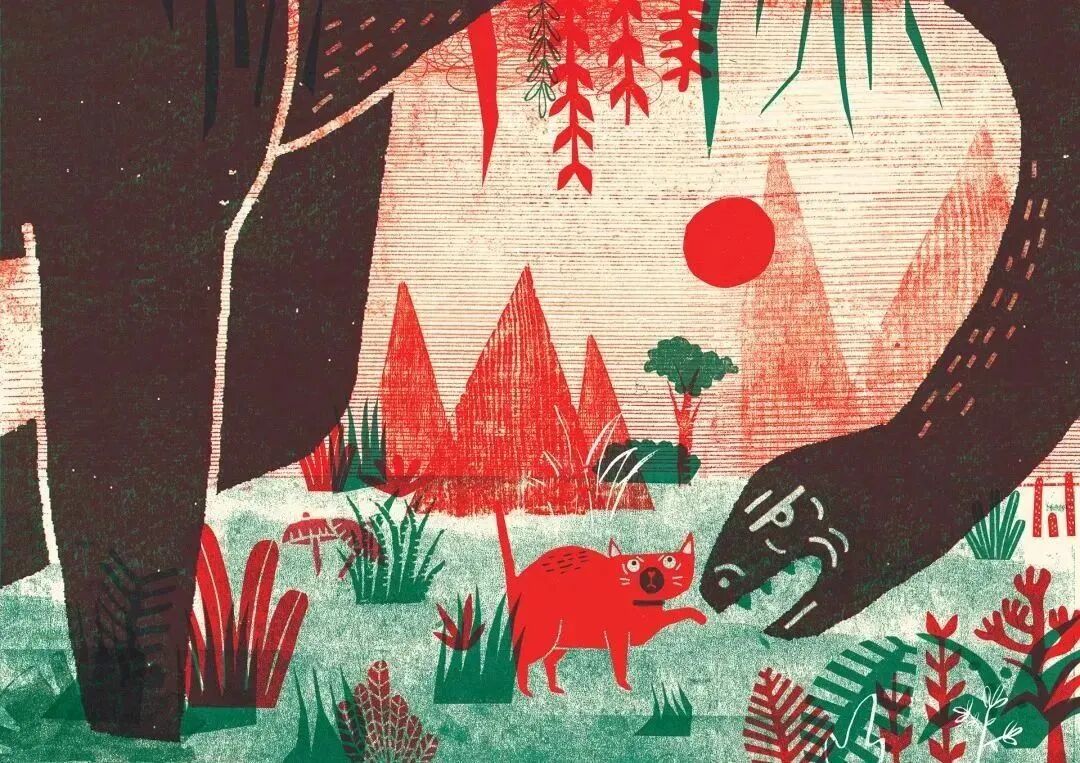
When cold-blooded dinosaurs hunted relentlessly during the day, hiding away served mammals well.
Florencia Gavilan
But there wasn't enough food underground. Mammals had to return to the surface to forage — and the safest time to venture out was at night, when the dinosaur threat diminished. Evolving into warm-blooded animals allowed mammals to move in darkness, but this solution came with trade-offs: mammals of the same body weight had to consume vastly more food than dinosaurs to sustain their rapid metabolism and maintain a constant body temperature of around 37 degrees Celsius.
Our mammalian ancestors had to find ten times more food within brief waking periods, and they had to do it in the dark. How did they manage?
To optimize foraging, evolution connected the parts of the mammalian brain that recorded sensory information about locations — their appearance, smell, and so on — with the parts responsible for navigation, forming a new system that could effectively remember previously visited foraging spots. They stored location-feature information in the neocortex, the outermost layer of the brain, while the navigation region resided in the entorhinal cortex; the hippocampus connected the entire system. Humans still use this memory system today to recognize objects and recall past events — for instance, identifying your car and remembering where you parked it.
Clusters of neurons in the neocortex store memories of objects and past events; recalling something reactivates the same neurons. Nearly all mammals can recall and re-experience remembered objects and events by reactivating these neuron clusters. This neocortex-hippocampus memory system evolved 200 million years ago and became the first step toward imagination.
The ability to construct fictional "memories" was imagination's next component.
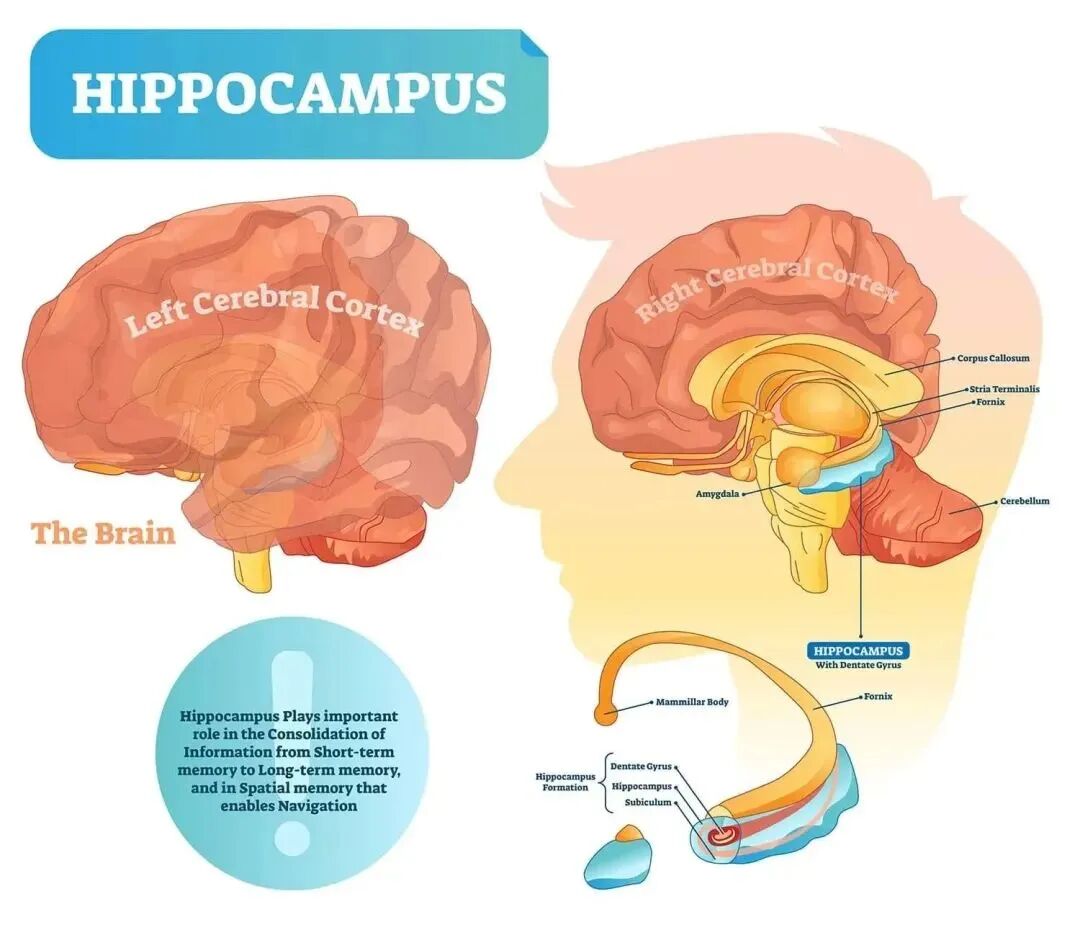
The hippocampus, a structure deep within the brain, helps synthesize different types of information to create memories.
simplypsychology
"Memories" Fabricated Unintentionally
Dreams are the simplest form of imagining fictional things — vivid, fantastical unconscious visions associated with rapid eye movement (REM) sleep.
Scientists hypothesize that any species experiencing REM sleep while at rest also dreams. Marsupial and placental mammals undergo REM sleep, but the egg-laying monotreme echidna does not, suggesting that REM sleep emerged after monotremes diverged from the other two mammalian groups 140 million years ago. In fact, recordings of special "place cell" neuron activity show that animals can even visit places they've never been in their dreams.
For us humans, envisioning things in dreams can help solve real-world problems. Spontaneous scientific and engineering solutions emerging during sleep are well-documented throughout history.
The neuroscientist Otto Loewi dreamed of an experiment revealing that nerve impulses are transmitted chemically; upon waking, he rushed to his laboratory and completed the experiment from his dream. This discovery later earned him a Nobel Prize.
Elias Howe, father of the sewing machine, claimed he achieved his core technical breakthrough in a dream, receiving the inspiration to place the needle's eye near its point.
Dmitri Mendeleev described seeing in a dream "a table where all the elements fell into place." He woke and immediately set to writing — and thus the periodic table was born.
The mechanism behind all these discoveries was the same unconscious imagination that mammals first acquired 140 million years ago.
Deliberately harvesting inspiration from brainstorming sessions benefits from our ability to control imagination.
Teresa Ester Lopes
The Imagination Breakthrough
The difference between voluntary and involuntary imagination is analogous to that between voluntary muscle control and muscle spasms. Voluntary muscle control involves deliberately combining different muscle movements; spasms are involuntary and uncontrollable.
Similarly, voluntary imagination allows people to deliberately combine ideas: imagine joining two identical isosceles right triangles along their hypotenuses, and you'll see a square in your mind's eye; imagine cutting a circular pizza with two perpendicular lines, and you'll see four equal slices.
This purposeful, rapid, and reliable ability to combine and recombine mental objects is called "prefrontal synthesis." It depends on the prefrontal cortex at the very front of the brain to exert control over the entire neocortex.
When did humans acquire prefrontal synthesis? Artifacts from 70,000 years ago suggest their makers likely lacked this capacity. But 70,000 years later, numerous artifacts clearly demonstrate its presence: lion-headed human figurines, bone needles with "eyes," bows and arrows, musical instruments, dwellings, elaborate burials preparing for an afterlife, and more.
- ROHAN DAHOTRE -
Around 65,000 years ago, multiple archaeological artifacts definitively associated with prefrontal synthesis appeared simultaneously across the world. The historian Yuval Harari termed this mutation of imagination the "cognitive revolution." Notably, the cognitive revolution roughly coincided with the large-scale migration of Homo sapiens out of Africa.
Genetic analyses indicate that a small number of individuals first acquired prefrontal synthesis, then used imaginative strategies and newly developed weapons to eliminate contemporary males from other groups, allowing their genes to spread widely.
In sum, our species traversed millions of years of evolution to acquire imagination. While most non-human mammals may involuntarily imagine fictional objects or events during REM sleep, only humans can use prefrontal synthesis to innovate consciously in our minds.
This article originally appeared on the WeChat public account "Neureality."




5Y Capital seeks out, supports, and inspires solitary entrepreneurs, providing everything from spiritual backing to operational support. We believe that if the "crazy" you that others see starts to be believed in, the world will become a different place.
BEIJING · SHANGHAI · SHENZHEN · HONG KONG