Creative people can be exceptions | 5Y View

Creativity is humanity's greatest asset.
Creativity cannot exist without divergent thinking. Creativity is an innate human ability. Yet today, we often face information overload that prevents us from thinking divergently, thereby limiting the generation of innovative ideas.
How can we enhance creative thinking? This article is by Alice Albrecht, an AI developer and one of the smartest, most experienced, and most low-key developers in artificial intelligence. Alice builds software tools to augment human creativity. She has extensive knowledge of the research literature on "what creativity is" and "how humans can better harness creativity," and she shares that here.
This is a detailed, actionable, science-based guide to creativity. We hope it inspires you :)
This article is republished from the WeChat account: 36Kr Shenyi Bureau
Translated by Jane; original author Alice Albrecht
Creativity is humanity's greatest asset. Beyond the personal joy of creative expression, creative thinking and problem-solving are key drivers of economic growth. Although many people may not consider themselves "creative types," everyone has the capacity for creative thought. In this sense, creativity is democratic. And as AI advances and computing becomes cheaper, the barrier from idea to final output is gradually lowering.
Still, even with the best tools for turning ideas into something more concrete, we still need to supply the initial seed of an idea and judge whether we're heading in the right direction. We remain the creative directors of our own minds.
Given this innate ability, how can we enhance creative thinking? As a scientist and builder, my approach is to understand the "system," then find ways we can augment it. Knowing your own cognition makes it easier to change.
The Science of Creativity
Creativity is the ability to produce products or ideas that are both novel and useful within a particular social context (some definitions of creativity also include "valuable" as a necessary condition). For children, novelty can simply be an interesting concept. In creativity research, novelty can mean an idea that arises from a connection that has never happened before or is new to the individual, even if that connection may already be well-known to others.
Researchers generally agree that creativity is a two-part process. The first part is generating "candidate ideas" and forming new connections and associations between them. The second part is narrowing down to identify the most useful idea. The generative step in this process is divergent thinking. Divergent thinking is the ability to recall, associate, and combine various kinds of information in novel ways to generate creative ideas. Convergent thinking, by contrast, considers goals and constraints to ensure a given idea is useful. Divergent and convergent thinking can be used together — first diverge, then converge. If you've ever done a "brainstorming" exercise, you've engaged in exactly this kind of thinking.
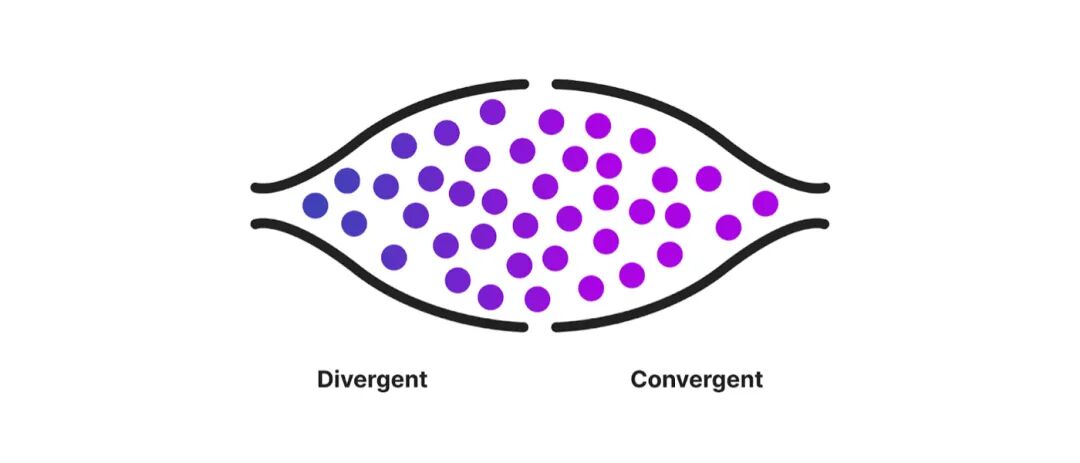
Divergent and convergent thinking
When our brains begin to dance between divergent and convergent thinking, we first need some understanding of "how the world works" and some ideas we can draw upon. We might call this collection of our own thoughts and experiences "knowledge." This is why memory is such an important component of creativity. Memory is a complex topic, but at a high level, when language-related information (semantic information) and sensory-related information (perceptual information) enter the brain, they are encoded as contextual episodes or time periods.
When memories transfer from short-term to long-term storage, the content represented in that memory becomes associated with existing memories (also known as "schemas"), and your overall understanding of the world shifts slightly. If new information relates to something you already know, integrating it into existing schemas helps you understand it faster because you've seen something similar before. For example, after reading this article, your understanding of creativity will change. The way memories are associated allows you to connect your various ideas later on. In fact, recent evidence suggests that semantic memory structure — the way we connect conceptually based on meaning — is one of the strongest predictors of creativity.
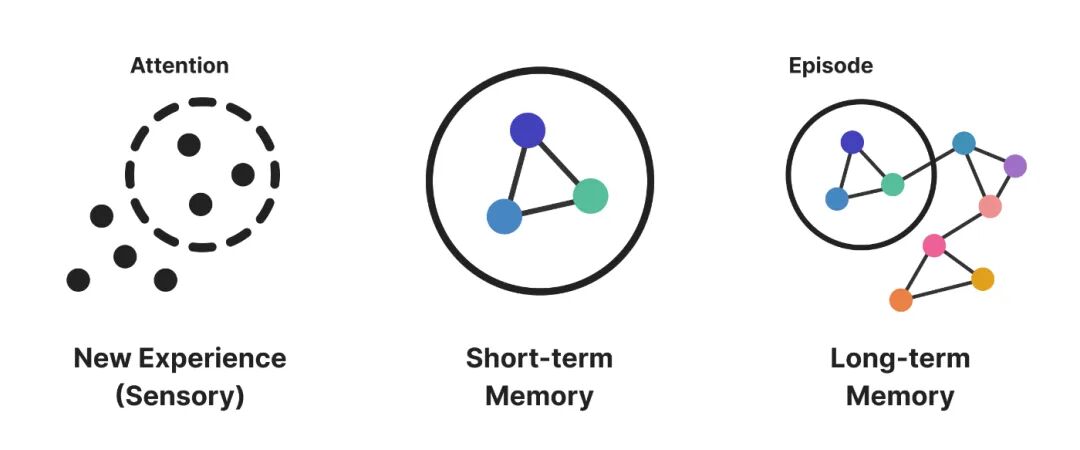
Image source: every.to
While we can study the outputs of the brain's creative process by measuring "how people perform on different creativity tests," understanding "how our brains generate creative experiences" helps us grasp the process more deeply and fills in a key missing component: attention.
Using neuroimaging techniques, scientists can peer into the "black box" of our brains and study what happens in the brain when someone has a new idea. Suppose we are such scientists. If we put a research participant (let's call her Delilah) in an fMRI scanner and ask her to come up with as many creative uses for a shoe as she can in one minute, we would observe a cascade of activity between specific brain networks.
When Delilah thinks of all these different uses (i.e., engaging in divergent thinking), a network of brain regions called the "default network" is activated. In imaging studies, this network shows the highest activation during spontaneous, self-generated thought processes, including mind-wandering and task-unrelated stream of consciousness. Delilah's task doesn't necessarily cause spontaneous thinking, since we've asked her to think of uses for a shoe. But perhaps she happens to feel hungry and thinks of a way to use a shoe for fishing.
Controlling this process is a "control network" that enables us to think flexibly, suppress external distractions, and extract information from our own memory. The "control network" helps Delilah rule out "walking down Fifth Avenue in this shoe" while also capturing her attention so the fMRI machine's noise doesn't distract her. You can think of this network as a mechanism supporting our convergent thinking — much like the saying goes, "constraints breed creativity."
The switching between the default network and control network is believed to be governed by the "salience network," which helps us engage each network efficiently. The stronger the creative thinking, the stronger the coupling between these networks. If Delilah produces a long list of shoe uses, we should be able to observe tighter connections between her default, control, and salience networks.
Now that we have a higher-level understanding of the components and systems underlying creative thinking, we can begin to explore "how to better upgrade our own creative system."
Build a Strong "Memory Bank"
Stock the materials for creation
"Memory" is the material creative thinking requires. You can stimulate creativity and deepen existing connections by reading or listening to others' ideas. In theory, to expand divergent thinking, we could try seeking out new ideas maximally different from our own. But in practice, this usually doesn't work. The best approach is actually to progress gradually beyond your cognitive boundaries, because new information must overlap to some degree with what you already know in order to be effectively linked and absorbed. Reading widely and deeply engaging with diverse content can build a richer memory bank for you.
"Interact" with the materials
Our brains are highly efficient — if something isn't being used, it's not worth spending resources to keep it readily available. If you read many books but never revisit or use that information afterward, some of it may enter your memory, but the connections between what you just read and your existing knowledge will be weak and will fade over time. Taking notes, highlighting, and reviewing what you've learned are good ways to maintain and strengthen connections.
Another good way to interact with materials is to actively use them. The ability to quickly form connections is one of the hallmarks of highly creative people. These connections can happen spontaneously, often when we're daydreaming or not particularly focused.
A good way to revisit materials is to connect new ideas to existing ones. And if you find such connections difficult to establish, there are many tools and methods available, such as the Zettelkasten method. People deliberately use these tools and methods to build connections, hoping that over time, creative ideas will emerge. Unfortunately, many of the software tools people use to record and build these connections, like Roam and Obsidian, fail in predictable ways.
While you should indeed do some creative exercises, you can't force it too much. Connecting ideas on schedule doesn't produce the "lightbulb moments" we experience in daily life, and creative ideas often only emerge after a period of creative incubation.
Pay attention to your emotions
Our mental state has a significant impact on creativity. The optimal state for creative thinking work depends on the type of work, your attentional state, your mood, and your level of engagement. As for emotions, being in a positive emotional state helps. But this doesn't mean you won't have any creative ideas if you're feeling a bit down, although negative emotions do have an impact.
Attention is key
In a culture obsessed with productivity, it's easy to assume that if we go all-in and focus on our work, we can generate more creative thinking. Counterintuitively, the harder we try to force ourselves to concentrate, the more narrow our thinking may become. "Mind-wandering" allows us to explore and experiment with different ways of connecting our memories. So next time you find yourself "drifting off," let yourself rest.
Surrounded by modern technology, rather than being too distracted, we have become victims of the attention economy — we become overly focused and often get stuck in the memory-gathering part of the creative thinking process, abandoning the necessary stream of consciousness or mind-wandering. We need a delicate balance: maintaining focus on creative work by letting the control network do its job, without missing potentially useful novel conversations happening behind us at the coffee shop.




5Y Capital seeks out, supports, and inspires lone entrepreneurs, providing everything from spiritual to operational support. We believe that if the "crazy" you in others' eyes begins to be believed in, the world will become a different place.
BEIJING·SHANGHAI·SHENZHEN·HONGKONG