Compound Returns in Both Directions | A 5-Year View

Change, and yet remain the same.


Kai Liu
Partner, 5Y Capital
There's a famous commentary on the story of Cook Ding carving an ox in Zhuangzi's Annotations: "Things obstruct because they exist; the Dao flows because it is empty. Before one has heard the Dao, all one sees are things; once one has heard the Dao, all one sees is the Dao. Meeting it with the spirit rather than the eyes — this illustrates that one who has heard the Dao can connect with it through the heart, not through knowledge or recognition." Translated into plain language: the reason Cook Ding could wield his knife with such supernatural skill was that he had internalized the higher-level Dao, allowing him to move effortlessly through the complex anatomy of the ox. Zhuangzi believed that while the world is chaotic and tumultuous, the Dao is the fundamental law governing how things operate — an unchanging truth. People should strive to pursue the authentic essence of life and the world.
Similarly, the world we inhabit today is also changing rapidly — the intensity exceeds even Zhuangzi's era — and everyone is swept up by the times, anxious beyond measure. Are there fundamental principles of how things develop, a Dao that could enlighten and guide our present lives? My answer is yes.
The author of today's recommended article applies a few simple mathematical concepts with remarkable creativity to entrepreneurship, investing, life planning, and even hit TV dramas. Whether the forward compounding and reverse compounding the author discusses constitute universal truths — well, perhaps each reader will find their own answer.
Article reprinted from the WeChat account "Lonely Brain," author: Lao Yu
This article centers on the "reversibility" of exponents and logarithms. My goal isn't to help everyone review math, but to explore the following important and fascinating topics:
-
Smart trial and error is a process of reverse compounding, which can help us approach the correct answer at an exponentially accelerating rate;
-
The vast majority of achievements are realized through the compounding effect. But compounding is difficult. In this article, I will discuss the bidirectional test of compounding, constructing a calculable scaffolding for reliable compounding;
-
Pushing to both extremes is the most important yet overlooked part of Elon Musk's "first principles";
-
The Kelly criterion establishes a mathematical relationship between maximum returns and bet sizing. This formula is derived by taking the logarithm and then differentiating the probability-based compounding formula;
-
Since we've mentioned logarithms, we naturally must discuss the magical natural logarithm e, and the limits of natural growth. Revisiting logarithms in a perceptible way can help us understand the underlying algorithms of this world from first principles.
log10(10)
The fifth game in Squid Game is "Glass Bridge." Sixteen contestants must cross a glass bridge in order. The bridge consists of 18 segments; each segment has two panes of glass side by side — one regular glass, one tempered glass. The rule: contestants must correctly identify the tempered glass. Step on regular glass and you fall to your death instantly; only by stepping only on tempered glass can you pass. A binary choice — even pure guessing gives you a 50% success rate.
Yet while each segment offers only 2 possibilities, two segments mean 2×2, and 18 consecutive segments means 2 to the 18th power — a staggering 262,144 possibilities. This is exponential growth. The probability of guessing correctly 18 times in a row is 1 in 2^18, roughly 1 in 300,000 — about half the probability of dying from a fall down stairs. Yet in Squid Game, three people ultimately survive. Aside from a few segments where the glass factory worker identified the glass by sight, most were guessed correctly at the cost of human lives.
Theoretically, if people didn't kill each other, even by pure chance, more than three should have survived.
Why could a game with roughly a 1 in 300,000 success rate be beaten by just over a dozen people? Because this was 18 serial binary choices, with 18 people guessing with their lives — equivalent to a reverse exponential effect, using extremely limited trials to locate the single correct possibility among 262,144. I call this: reverse compounding.
As you clever readers know but may have long forgotten: the enormous uncertainty of the glass bridge game (262,144 possibilities) comes from exponential growth, while eliminating that uncertainty relies on the inverse of the exponential function: the logarithmic function.
log10(100)
Let's play a simple game: There are two drawers, each containing one black and one white box — four boxes total. One box contains a large diamond; guess correctly and it's yours.
You may ask any question. The host must answer, but can only say "yes" or "no." What's the minimum number of questions needed? Perhaps you've played something similar in your dorm days: asking questions continuously, getting "yes or no" feedback, and step by step solving the puzzle.
The answer is two questions: First: Is it in the left drawer? (Yes = left; no = right.) Second: Is it in the black box? (Yes = black; no = white.) This is a simplified version of the "glass bridge" game. Blind guessing with an algorithm is sometimes not blind at all. Nearly 300 years ago, the Reverend Thomas Bayes designed a thought experiment:
- He sat with his back to a table, on which lay a white ball whose position he didn't know.
- Then he had an assistant randomly toss black balls onto the table; where they landed was completely uncertain.
- After each toss, he asked the assistant the white ball's position relative to the black ball. For instance, if the assistant said the white ball was to the right of the black ball, he'd guess the white ball was perhaps a bit to the right.
- Then the assistant tossed another black ball, and told him this time the white ball was to the left of the black ball. So he updated his guess — maybe the white ball wasn't that far right after all.
- The more black balls tossed, the closer he could approximate the white ball's true position.
Is this "boring" game reliable? In this experiment, using only fuzzy relative relationships, one can gradually infer the result. I'll discuss this further in another article, Going Against the Wind (about pressure differentials and probability differentials).
In fact, Bayes's thought experiment was a counterattack against Hume's causal skepticism. The result was a kind of "inverse probability calculation" — reasoning from effect to cause — that continues to profoundly transform the world to this day. You might wonder: how long must one guess like this? Like crossing the glass bridge, Bayes's calculation also has a reverse exponential effect, capable of rapidly converging on the white ball's true position.
log10(1000)
In the glass bridge game, each segment has 2 possibilities; 18 consecutive segments means 2 to the 18th power — an exponential operation. The result: 262,144 possibilities. So if we only know there are 262,144 total possibilities, but don't know how many bridge segments there are, how do we calculate it? This is the inverse operation of exponentiation: the logarithm. If a to the power of x equals N (a > 0, and a ≠ 1), then x is called the logarithm of N with base a, written as x = logₐ N. Here, a is called the base of the logarithm, and N is called the argument. What logarithms mean: How many copies of a number multiplied together give you another number? For example, 2 to the 3rd power is 8. So conversely, how many 2s multiplied together give 8?
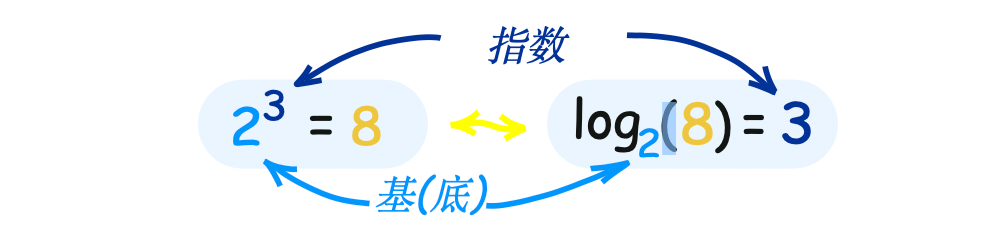
Through logarithmic calculation, we know log₂(8) = 3. In the glass bridge game, 2 to the 18th power equals 262,144, so: log₂(262,144) = 18.
Exponentiation can rapidly make a number very large;
Logarithms can rapidly make a number very small.
Together, they form a bidirectional "compounding effect."
log10(10000)
Not fearing failure, actively experimenting — this is already a tired cliché.
In Love in the Time of Cholera, it is written:
"Take advantage of it now, while you are young, and suffer all you can, because these things don't last your whole life." Why make mistakes while young? What is smart mistake-making?
I recall a scientist once said: An expert is someone who has made all possible mistakes within a very narrow domain. Consider the following diagram:
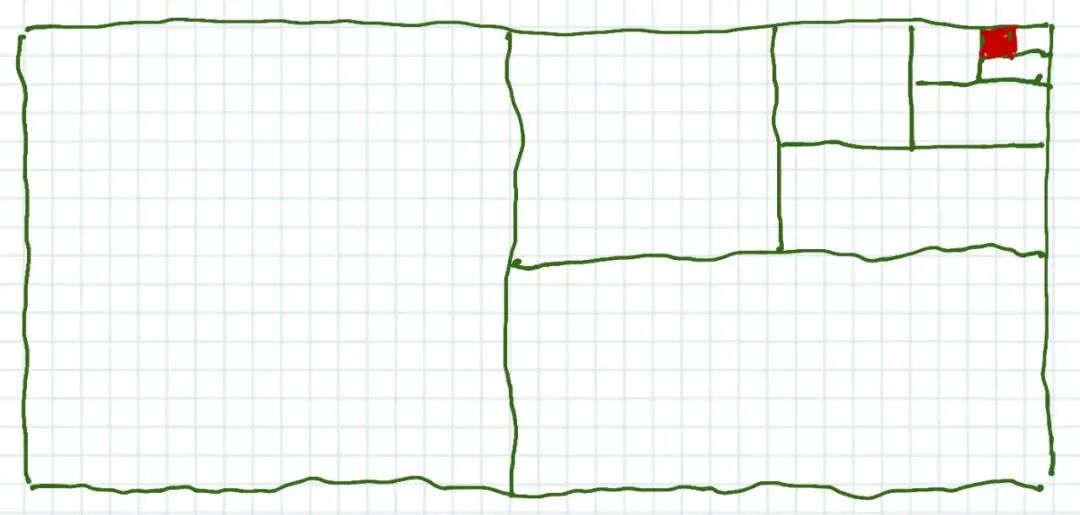
You're searching for the small square hiding treasure in the diagram. Even if you can only test it like crossing the glass bridge — guessing half each time — you will converge on the treasure very quickly. But the following preconditions must hold:
-
There must be boundaries. Even reverse exponential effects are powerful, but they struggle with unbounded problems;
-
There must be an algorithm. For example, crossing the glass bridge seems brutal, but it's actually composed of a series of binary choices, mathematically calculable, capable of continuously converging on the answer;
-
There must be feedback. Guess the glass right, live; guess wrong, die. But for the system as a whole, if it's just a game (not actually dying), then in terms of information transmission, guessing right or wrong is equivalent;
-
It must be traversable. Participants must not only make all possible errors, but also survive after making them. For entrepreneurs, this means burning through cash quickly, failing fast, and finding a way to survive.
Coca-Cola CEO James Quincey said: "If we're not making mistakes, we're not trying hard enough." Netflix's Hastings believes: "We have to take more risks... try crazier things..." (On the 22nd of this month, Netflix lost $310 billion in market cap overnight.) Bezos treats "bold bets" that are likely wrong as experiments:
"Since they're experiments, you obviously can't know in advance what they'll accomplish. Experiments, by their very nature, are prone to failure. But a few huge successes can compensate for dozens and dozens of things that didn't work."
Yet the so-called "failure is the mother of success" — in our evolutionary world, for the vast majority of people, simply doesn't hold.
Even if you are brave in failure, constantly exploring, if your mistakes aren't smart enough, random enough, or lucky enough, success still won't come. Smart, active mistake-making requires boundaries, algorithms, feedback, and traversability — and also some madness, randomness, and redundancy. Hayek said:
Although evolution is often summarized as "survival of the fittest," what actually drives evolutionary progress is often the unfit. And though we instinctively assume that complex problems require carefully designed solutions, evolution has no plan whatsoever.
Astonishingly complex things emerge from simple processes: trying variations of what already exists, eliminating failures, and replicating successes.
So the fundamental problem with success studies is that it ignores the silent failures that disappear after the fact, oversimplifies causality, even reverses it — and assumes that success can be designed and replicated.
log10(100000)
Regarding people's enthusiasm for discovering patterns and designing causal chains, Hayek criticized:
People always think they can design this or that, but in reality they know almost nothing about what they are trying to design. The distinctive task of economics is to demonstrate this ignorance of theirs.
Hayek's words apply especially well to education.
What is the purpose and meaning of education? It used to be about cultivating skills — so you could work on the assembly line spinning yarn or building cars. That has long since changed. The prolonged years of schooling are a form of redundancy mechanism in human society. For a child, the most valuable thing may be to make every possible mistake in life at low cost, during the protected years of childhood and adolescence.
So, as Hayek said, education should allow children to expose their ignorance and foolishness through making mistakes. But what is the reality? Making mistakes, being ignorant — these are the most intolerable things in school. Thus the absurdity: a person goes through more than a decade of education, constantly pursuing how to achieve "making no mistakes" with knowledge they will almost never use again, endlessly memorizing airtight causal relationships by rote, while their most precious individuality is erased because it cannot manifest, and priceless diversity is processed by a unified assembly line into a single mold.
Yet the complex real world before us increasingly resembles what Hume said centuries ago: "We cannot know causal relationships; we can only know that certain things are constantly conjoined." Traditional education, born in the Industrial Revolution, can no longer cope with the nonlinear, uncertain present. If education that transmits deterministic knowledge merely becomes an intelligence testing system — selecting talent by destroying it — then this cost is too high for both society and the individual.
A girls' school created a project called "Failure." The person in charge, Rachel Simmons, said something very Bayesian: "What we want to tell people is that failure is not a mistake made during the learning process, but a feature of the learning process." Education teaches us to learn and think (exponential growth), and more importantly, teaches us how to excavate our own unique treasures (logarithmic approximation). Nature achieves a kind of algorithmic randomness, and schools should do the same. So-called teaching according to aptitude is not about customizing luxury watches or designer bags — it is about providing an algorithmic system, and by simulating the real world, allowing children to explore freely, make bold mistakes, expose their ignorance without reservation, and present their true nature, thereby discovering their endowments and igniting the ideals they are willing to pursue for a lifetime. Next, I will use reversible exponential and logarithmic operations to discuss the two-way test of compound interest.
log10(1000000)
"Strangely," the invention of logarithms preceded modern exponents. The reason was that logarithms were simply too practical in navigation and astronomy. Logarithms can reduce higher-order operations to lower-order ones — for example, turning exponentiation and root extraction into multiplication and division, and turning multiplication and division into addition and subtraction — thereby greatly reducing computational workload. Exponents and logarithms are "inverse functions" of each other; the relationship between them is reversible. First, look from exponent to logarithm:
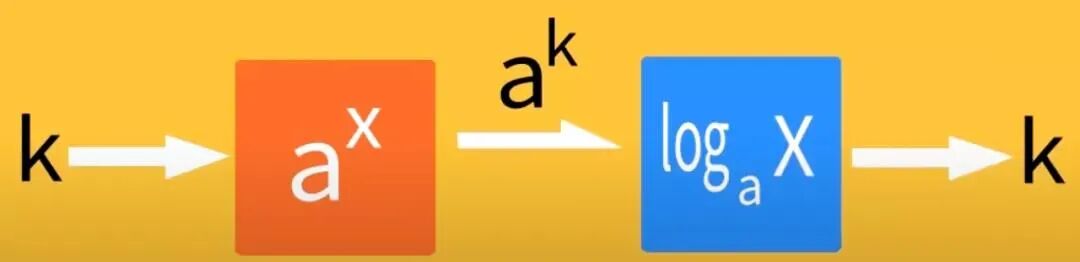
We input k into the operator above, after exponential operation we get a to the power of k, then substitute into logarithmic operation, and output k again. Reversed, from logarithm to exponent, it's the same: input K, output k.
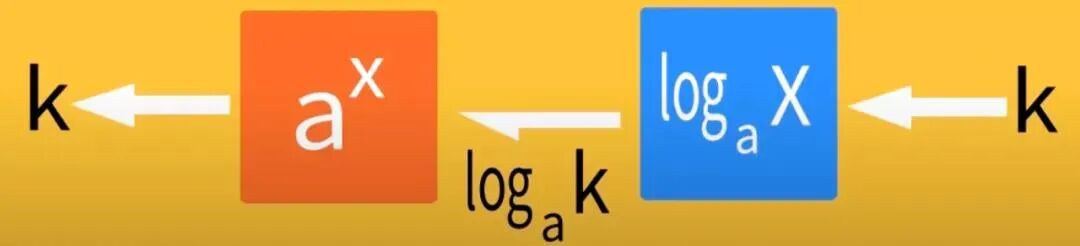
With the operator above, we can input from the left and output from the right; or input from the right and output from the left. Just as Bayes proposed inverse probability, enabling us to "infer cause from effect" — the two-way operation above is both inferring effect from cause and inferring cause from effect.
This method can help us test our own beliefs.
For example, if you see that someone is very smart and hardworking, and therefore made a lot of money in real estate. You can do a two-way test:
- From "very smart and hardworking," can you infer "made a lot of money in real estate"?
- From "made a lot of money in real estate," can you infer "very smart and hardworking"?
If not, we may need to redefine that belief. (This is merely an incomplete thought experiment.) What I will discuss below is absolutely not packaging success studies with formulas, but sharing an interesting "perception." I believe that if you understand entrepreneurship and also understand exponents and logarithms, you will surely smile knowingly at what follows.
First, a definition: success in the secular sense is mostly achieved through large-scale replication. Companies replicate products, individuals replicate IP, genes replicate life. Successful replication is taking something valuable and repeating it enough times to achieve compound interest. The more powerful the replication, the more exponential the effect, with decreasing marginal costs and network effects.
So, replicate what? In exponential operations, what is replicated is the base. For example, 2 to the 18th power is 262,144, where the base is 2 and the exponent is 18. Back to entrepreneurship. The well-known lean startup has at its core the idea of first putting a minimal prototype product into the market, then through continuous learning and valuable user feedback, rapidly iterating and optimizing the product to adapt to the market. The three main tools of lean startup are: "minimum viable product," "customer feedback," and "rapid iteration." Before large-scale replication, entrepreneurs must validate whether the product meets user needs at the lowest cost and in the most effective way, finding valuable insights in the shortest time. Guessing quickly, trial-and-erroring smartly — like the balls Bayes threw behind him, and the bold leap across the glass bridge. This valuable insight is the base in exponential and logarithmic operations.
- The first stage of entrepreneurship, from 0 to 0.1 or from 0 to 1, is like a logarithmic operation;
- After validation and iteration, explosive growth is achieved. This is like an exponential operation.
The president of Alibaba Cloud believes technology has only two core values: First, for validated or nearly mature businesses, rapid scaling to achieve exponential growth. If going from 1 to 10 took 10 days, then going from 10 to 100 should take only two days or one day.
Second, help business teams fail fast. Get the product online quickly, don't care about architecture — with feedback you know whether this business works, whether it can survive. So, the entrepreneurial process intertwines logarithmic and exponential operations. We need to input numbers from both ends, test back and forth, to discover the kernel, then conduct large-scale replication. One end calculates the base as the replication kernel; the other end calculates the scale of exponential growth. In The Life Algorithm, I extended this to personal evolution:
- The first half is a process of cutting diamonds, with the purpose of constantly finding the smallest kernel that truly belongs to you.
- The second half is how to maximize the smallest kernel through replication.
Why use the "smallest kernel" as the base for exponential operations?
The key to compound growth is the continuity and stability of replication. Physically removing redundant parts, informationally removing noise — this makes replication of the smallest kernel more sustainable. This process is always accompanied by breaking and rebuilding. New director Zhang Ziyi believes that directing is a process of "breaking the bottle": "You have to smash the bottle, stick your head out for some air, then crawl into another bottle."
Nietzsche was wrong. It is not "what does not kill you makes you stronger." Rather, your strength needs to be revealed by killing the "not strong enough."
Just as the trilogy of evolutionary algorithms: variation, selection, replication.
Variation is a certain insight, which is placed in a specific environment in the form of some minimum viable product, continuously iterating through bidirectional selection with the environment. Once its survival model is validated, it is replicated at scale.
The greatest secret of success for a person or an organization is: finding a "high-probability event" that can be replicated at scale (with continuity).
log10(10000000)
In fact, the first principles that Elon Musk always mentions also contain a similar two-way derivation. Previously, people's understanding of "first principles" was mainly: reducing things to their most fundamental principles, especially laws of physics, with less analogy and less layered explanation. But it goes beyond that.
Musk says another method is: thinking in extremes. If you are thinking about something while expanding it to a very large scope or a very small scope, what happens?
For example, whether building electric cars or rockets, if parts are too expensive and costs too high, you can think:
- If annual production were one million units? Would it still be expensive?
- If one million units per year is still expensive, then quantity is not the reason your thing is expensive — the fundamental problem lies in the design.
- Thus the design must be changed, components changed, to fundamentally solve the price problem.
This is deriving from the limit of scale.
Then, reversed, deriving from the limit of the basic unit, all the way to the atomic level. For example, producing rockets, decomposing down to initial resources and raw materials:
- If you look at the raw materials of a rocket, you find aluminum, steel, titanium alloys, special alloys, copper, etc.;
- What is the weight of the constituent elements of each component, what is the value of the raw materials?
- Without changing the raw materials, the above questions set the asymptotic limit for the rocket's cost.
- Going further, arranging atoms into the final shape — this will be the minimum cost of your product.
In Musk's view, a product's manufacturing cost asymptotically approaches the value of its raw materials. So, the first principle about products is: Try to imagine the perfect product or technology, whatever it is. Then think: how can atoms be perfectly arranged? And then figure out how to obtain an object with this shape.
But most of the time, people remain in the "layered" middle. Conceptually clinging to what already exists, tending to use tools and methods they are familiar with. Musk's way of thinking is, through two-way derivation:
- On one hand, we can discover the perfect product under scale effects (exponential operation);
- On the other hand, create tools, methods, find materials, and construct basic units from the atomic level (logarithmic operation).
From cause to effect, then from effect to cause, two-way derivation to the limit, creates astonishing miracles.
log10(100000000)
In Squid Game, in the fifth challenge "Glass Bridge," when a person jumps forward, whether they step on tempered glass or unfortunately shatter regular glass, they provide information to the team.
This information is achieved by eliminating uncertainty. As for information itself, "correct" or "incorrect" are equivalent. The difference is that the "correct" person has the chance to step on the next pane of glass. So, how should we measure information?
Shannon introduced the concept of the "bit."
The bit comes from binary. Shannon believed the simplest possible source of information was a coin toss — heads or tails, yes or no, 1 or 0. This is the most fundamental unit of information that can exist.
Like the atom of information.
A bit is the amount of information generated by choosing between two equally likely possibilities. So "a device with two stable states... can store 1 bit of information."
Returning to the diamond-guessing game: how much information do you need?
- Choosing between left and right drawers corresponds to 1 bit;
- Then choosing between black and white boxes corresponds to another 1 bit;
So you need 2 bits total to select one box out of four. In the glass bridge game, there are 262,144 possible configurations, but since this consists of 18 sequential binary choices, let's calculate how much information that requires: computing the base-2 logarithm of 262,144 — log₂262144 = 18, essentially the inverse of 2 to the 18th power. Why use logarithms? Because: using the logarithm of a probability distribution as a measure of information has the property of additivity. Due to this logarithmic relationship, there is an inverse exponential effect. The accelerating effect this produces, I call inverse compounding.
Despite the many possible configurations of the glass bridge, the information required is only 18 bits. So each person who jumps, regardless of whether they fall (just as a coin toss yields the same information whether it lands heads or tails), gains 1 bit.
Of course, if they don't fall, they also gain another chance to test in the next round.
Thus, each jump yields one piece of information and eliminates some uncertainty. Textbooks describe it this way:

Shannon imported the concept of entropy from thermodynamics into information theory, so it is also known as Shannon entropy or information entropy. In information theory, entropy measures uncertainty. In the information world, higher entropy means more information can be transmitted; lower entropy means less information is transmitted. Its formula is as follows:

Where p(xi) represents the probability that random event X takes the value xi. Let's continue with the coin toss example. For a single toss, the probability of heads is p₁ = 0.5, and the probability of tails is also p₂ = 0.5. So according to the formula: H = -(0.5 × log₂(0.5) + 0.5 × log₂(0.5)) = 1 bit. But if the coin is rigged, so that the probability of heads is 0.7 and tails is 0.3, what is the information entropy of "tossing this coin once"? The calculation is: H = -(0.7 × log₂(0.7) + 0.3 × log₂(0.3)) = 0.88 bit. If you were to play a coin-tossing game and knew that one table had rigged coins with 70% chance of heads, you would certainly choose that table and bet on heads every time, because its information entropy is lower — meaning the "uncertainty" is reduced compared to a fair coin. In Squid Game, the glass factory veteran used his expertise to reduce the information entropy of each guess, just like that rigged coin. Therefore, his "ability" to eliminate uncertainty was stronger.
log10(1000000000)
Returning to the theme of compounding. The basic formula for compound interest is an exponential operation.

Compound interest is simple to calculate but difficult to achieve:
- Truth 1: The world is dominated by randomness;
- Truth 2: Continuity is hard to maintain;
- Truth 3: Reality is non-uniform;
- Truth 4: Returns are asymmetric;
- Truth 5: Capital is limited.
Expressed in terms of the compounding formula: 1. The interest rate r (return) and the number of periods n are both unpredictable; 2. Even when return r is decent, the number of periods n never lasts long; 3. The interest rate r (return) always fluctuates, sometimes good, sometimes bad; 4. A large present value PV (principal invested) does not necessarily mean a large future value FV (final return); 5. In absolute terms, the principal is too small. In proportional terms, the principal won't last until the profitable moment. So is the compounding formula still useful? In the real world full of uncertainty, describing an event with probability is rational and wise.
The compounding formula is no exception. The compounding formula under certainty is:

But in the real world, return r is uncertain, so we use probability to describe it.
Example: If an investment has a 60% win rate (p = 0.6, q = 0.4), and the investor receives even odds when winning (b = 1). To avoid ruin, the bettor controls the betting proportion each time, let's call it x. Then for n consecutive bets, the expected value calculation is:
f(x) = (1+x)^(n × 0.6) × (1-x)^(n × 0.4)
As shown, this is essentially a compounding formula for the probabilistic world. First, there remains an important prerequisite: positive expected value. Otherwise it's just gambling. At this point, we find that if the betting proportion x is too small, you won't make money; if x is too large, you might blow up, failing to achieve ergodicity and thus "enjoy" the positive expected value. Is there a method to control the value of x, like using a valve to regulate water flow, adjusting each bet proportion to maximize returns while ensuring you don't go bust? Translated into a mathematical problem, this means finding the maximum of f(x) above. When Thorp consulted Shannon about optimal betting proportions under expected value advantage, Shannon recommended a formula from his colleague Kelly.
Somewhat resembling Thorp's own information entropy formula, the Kelly criterion takes the logarithm of the compounding formula in a probabilistic world and then finds its extremum.
The goal of the Kelly criterion is: to maximize the growth rate of capital, that is, to maximize the expected value of the logarithm of wealth. Let the initial capital be 1, each betting proportion be f, with probability p of winning at odds b. The expected logarithm of wealth is calculated as follows (this is the result of taking the logarithm of both sides of the probabilistic compounding formula):

To find the f that maximizes this expected value, we simply set the derivative of E with respect to f equal to zero:
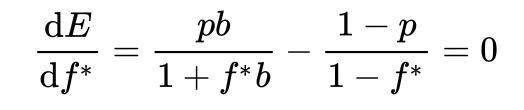
Solving the above equation yields the Kelly criterion:
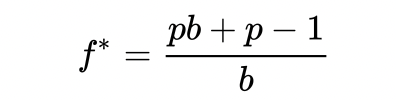
A graph makes it easier to see how the Kelly criterion works:
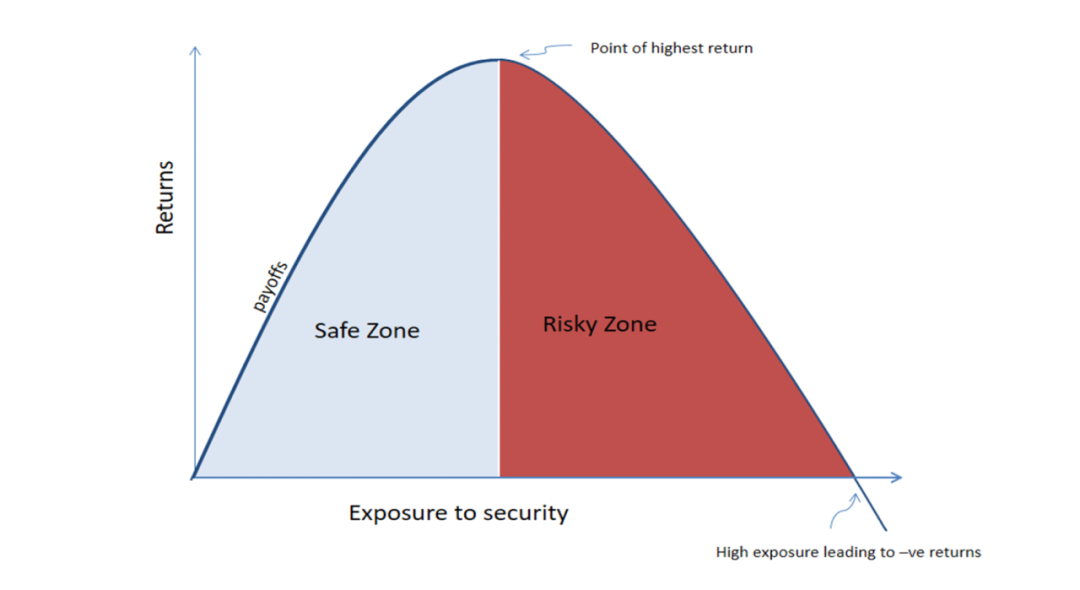
The horizontal axis is betting proportion, the vertical axis is return. Bet too small, and it's safe but returns are low; bet too large, and while potential returns are high, the risk is enormous. The Kelly criterion helps us find the peak in this graph, corresponding to the optimal betting proportion. A person's life is a string of many bets. Though not as binary as the glass bridge, it is equally full of massive uncertainty. Each time you make a decision, calculate the probabilities of winning and losing, figure the returns, and constantly remind yourself to control the betting valve — never go all in. That peak point at the top of the Kelly criterion working diagram is perhaps the position we seek in life: survive, and thrive.
log10(10000000000)
As described above, logarithms relate to compounding-style growth. Suppose we deposit 100 million in a bank with 100% annual interest. If interest compounds once per year, we know the year-end account balance (in hundreds of millions) is:

But if we switch to monthly compounding, and reinvest each month's interest into principal, the year-end balance becomes:

Going further, if we switch to daily compounding, reinvesting each day's interest into principal, the year-end balance is:

What if the bank agreed to pay interest every second, and you withdrew and redeposited that interest every second — would compound interest skyrocket? It wouldn't. Your balance would be $2.7182817813. So for 1 yuan deposited for one year at 100% annual interest, no matter how you compound it, there's a ceiling you can never break. That ceiling is e ≈ 2.71828...
e, as a mathematical constant, is the base of the natural logarithm. It's also known as the natural constant, the natural base, or Euler's number. In Google's 2004 IPO, the fundraising amount wasn't a round number — it was $2,718,281,828, taken directly from e. In a 2005 follow-on offering, the amount was $14,159,265, related to pi. e and π are indeed the two most magical numbers. The essence of e is the limit of natural growth.
e is everywhere in nature. The most famous example is the equiangular spiral, also called the logarithmic spiral or growth spiral. For example:
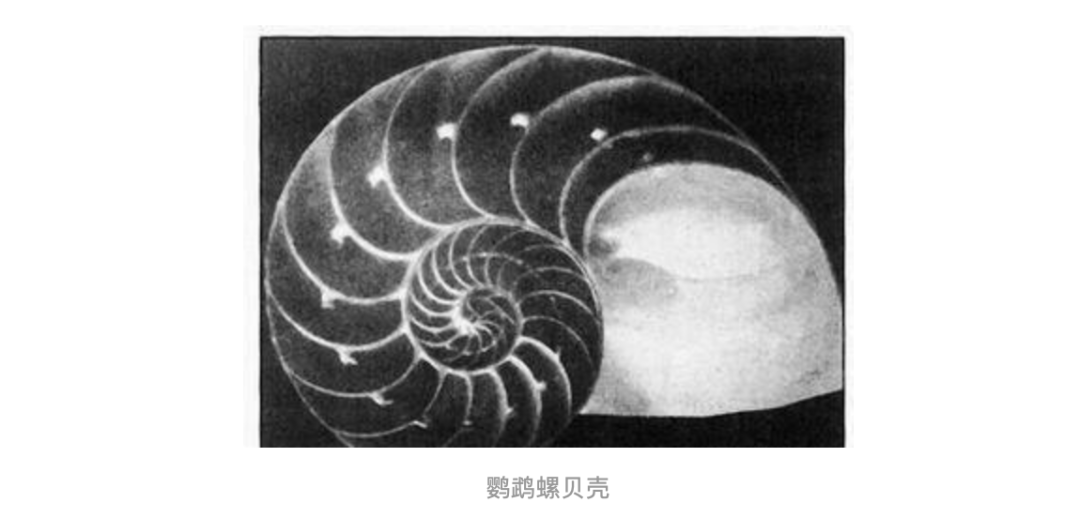
Also:
- Insects approach light sources in equiangular spirals;
- Spider webs are constructed similarly to equiangular spirals;
- The spiral arms of spiral galaxies are roughly equiangular spirals. The four major arms of the Milky Way have an inclination of about 12°;
- The appearance of low-pressure systems (tropical cyclones, extratropical cyclones, etc.) resembles equiangular spirals.
Jakob Bernoulli was particularly fond of the equiangular spiral. He discovered that the equiangular spiral remained an equiangular spiral after various appropriate transformations, and was deeply amazed and appreciative of this property.
- A logarithmic spiral, when magnified or reduced, remains similar to the original figure.
- It also has rotational self-similarity: a rotated logarithmic spiral remains similar to the original figure.
Thus, Jakob Bernoulli requested that an equiangular spiral be engraved on his tombstone, with the inscription: "Eadem mutata resurgo" ("Though changed, I arise the same").



5Y Capital seeks out, supports, and inspires lone entrepreneurs, providing them with support from the spiritual to all operational aspects. We believe that if the world begins to believe in you — you whom others see as crazy — the world will become a different place.
BEIJING · SHANGHAI · SHENZHEN · HONG KONG