Creating More Possibilities in Limited Time | 5Y View

We can't predict the future, but we can create it.
Compared to the age of the universe, a human life is vanishingly brief. And within that limited time, we seem unable to avoid wrestling with energy and disorder — entropy's increase appears to be time's inevitable consequence.
But entropy isn't cause for pessimism. This article shows us another angle: entropy doesn't just slow things down; it propels us forward. It is precisely because the future is unknown and infinitely open that we possess free will at all, and strive to make the world better. I hope this piece offers you something to think about :)
This excerpt is taken from The Skeptic's Guide to the Future, by Bill Nye, edited by Corey S. Powell, published by CITIC Press Group.
In my quieter moments, I often find myself thinking about the number 30,000. That's how many days make up a long life: 82 years plus seven weeks, 30,000 shadows cast around a sundial. You might meet someone who lives longer on any given day. Picture a famous football stadium in your mind. If you sat in a different seat every day, you'd still only cover about a third of the total. That's your life — if you're lucky.
Our time is short. Compared to the age of the universe, the finite span of a human life seems utterly insignificant. Yet that same number reminds me of how much can be packed into those 30,000 days. Consider how much information and experience you can accumulate, how many people you can learn from, how many you can influence, and especially how much action you can take. Adopt this perspective, and you stand a decent chance of leaving a sizable mark on our small planet.
My father always said he wanted to pass on two ideas to his family: everyone is responsible for their own actions, and you must leave the world better than you found it. The first is straightforward. No one else is accountable for what you do or fail to do. If you cut corners, you own the consequences. But if you help someone out of a jam, the rewards are yours too. The second idea is more complex. To genuinely achieve a "better" outcome, you have to put in serious work — filtering information, thinking critically, and examining many different viewpoints with honesty and generosity. You need to pay close attention to the design and execution of whatever project you're pursuing. Even then, you can't be certain you're making the world better. Who hasn't wished to peek into the future and see how things turn out? Who hasn't wondered whether they've really made any difference at all? I suspect this is why time travel became a staple of science fiction, dating back at least to H.G. Wells's The Time Machine in 1895 — the very book that paved the way for the Back to the Future and Terminator film series.
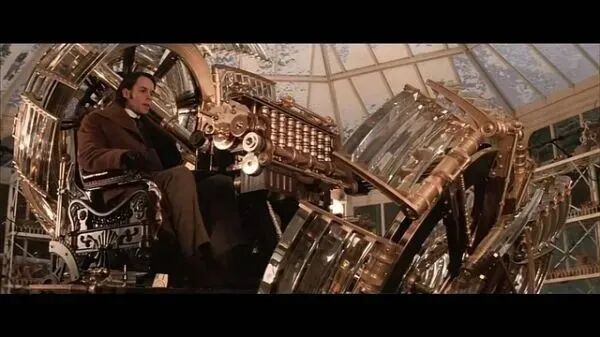
The Time Machine still
Everyone yearns for a preview of what remains of our 30,000 days, and what lies beyond. Physics offers a disappointing answer: time travel is impossible. We remember the past, not the future. Information flows in one direction only. We are all prisoners of the so-called "arrow of time," which seems tied to an unbreakable rule of nature: the steady growth of entropy. Physicists define this as a measure of a system's disorder. Leave a large collection of matter — say, air molecules in a room — to itself, and it will naturally progress from order to disorder. Consider this example. Imagine a cup of hot tea and an ice cube on a saucer. They contain different amounts of thermal energy, each isolated from the rest of the room. They exist in a high-order state: all the high-energy molecules in the teacup, all the low-energy ones in the ice cube. Bring them together, and their thermal energy disperses into a less distinct intermediate state — lukewarm. Leave them apart, and the same thing happens. The tea cools to room temperature; the ice melts and also reaches room temperature. Everything tends toward a middling state of energy homogeneity. Without the steady stream of energy from the sun, Earth's energy would run down. In trying to change the world, everything we do ultimately amounts to struggling against the trend of energy and disorder. That trend is entropy, and entropy seems to be the natural result of time.
Some theorists argue that the arrow of time is a consequence of entropy. The distinction doesn't much matter for the rest of us. What matters most is that we call the direction of time "forward." Though we all wish we could turn it back, set things right, or make things better, we simply can't. If you feel like you're constantly battling chaos, that's because the laws of nature demand it. Entropy is part of the change that must happen. The metabolism in your body is a lifelong fight against entropy. Every cell in your body is doing the same thing, trying to influence the future. Your existence, and everything you do, is a battle against entropy — restoring order from chaos, assembling a person from certain compounds.
Entropy isn't evil, any more than gravity is. Without entropy, the world wouldn't function, and time wouldn't flow. We run our airplanes, trains, automobiles, and electrical grids through our understanding of entropy. The famous Second Law of Thermodynamics describes mathematically how entropy operates; it also tells us how energy moves through engines, chemical reactions, collapsing magnetic fields, or insulated houses. Because we thoroughly understand this natural law, we can produce vast quantities of plastics and effective medicines through the finely controlled transformation of energy in subtle chemical processes. Thoughtful nerds have discovered nature's rules through the scientific process and found ways to harness them for human benefit. So entropy doesn't just slow things down; it moves us forward — I mean, it drives us forward. Imagine if you could somehow defeat entropy, if you could reverse the trend of energy's diffusion and dissipation. What would your life look like? You would violate the laws of thermodynamics and of time itself. The end result: you could predict the future. If someone told you the exact time and circumstances of your death, how would you act any differently? You couldn't do anything to change it, or our foreknowledge of the future would be meaningless. Either you'd be trapped by some fate, or the future would be fundamentally unpredictable.
There is an unbreakable link between free will and rational action on one hand, and the unknowability of the future on the other. It is precisely because the days ahead hold infinite possibility that we analytical nerds and ordinary people alike possess freedom. This makes us more optimistic, driving us to pursue goals and make the world a better place. Over the years, I've come to realize that most of the time, you won't regret what you've done — you'll regret what you haven't done. How many times have you told yourself: "What I should have done is..." A highly useful filtering technique is to think about what you'd regret not doing. This helps you think clearly about what to tackle going forward. That's why I quit my job at Sanderstam Data Control, Inc. one day in 1986. What are you doing with your freedom? More importantly, what should you be doing with it that you aren't? We cannot predict the future, but we can create it. "Big-picture thinking" gives us a toolkit to recognize problems and identify solutions in the most honest, effective way possible.
Beyond that, we can do even more: scientific knowledge allows us to make educated predictions, enabling us to foresee how problems will evolve and how solutions will play out. This is another way we combat the unknowability of the future. We can get close enough to future conditions to redirect the arrow of time. This is the hard-won result of centuries of data collection, critical thinking, and testing hypotheses through the scientific method: we don't need to plunge headlong into a crisis to know it's coming. Right now, we are uneasily aware that if we don't address climate change, the world will descend into serious crisis. More oil pumps, or more wind turbines? We don't need to guess which is better for the planet. Greenland ice cores, supercomputer models, satellite observations of Earth, and studies of Venus and other planets all point to the same conclusion. Here, we all need to do our part and make the most of our 30,000 days (hopefully more). We understand the reality around us by gathering information and testing ideas. "Big-picture thinking" means working at the largest scale possible, then filtering your results with the strictest standards. Without filtering techniques, humanity couldn't accomplish this work. Even with them, it's no easy task.
For each of us, critical thinking, open-minded listening, and a rigorous, honest attitude don't come naturally — at least not from birth. These skills must be learned, practiced repeatedly, and internalized until they become instinctive. Then you face the challenge of putting ideas into action. Bold thinking alone in a room accomplishes nothing. We all need to follow the news, find like-minded people, and work with them; find people who disagree with you and try to understand them — they know things you don't. And you need to support the projects and causes you believe in. Entropy limits our time on Earth, so find inspiration within that constraint. My father gave me one more piece of life advice, though he didn't articulate it as clearly as the first two. It shaped my life just as deeply. That advice was: be kind to others, and respect them. This simple principle illuminates the purpose behind everything else we do — it's the "better" in "making things better." This is what all technology ultimately works toward. We use data and personal experiences of success and setback to inspire people to tackle global challenges. If an idea doesn't work, we keep testing, adjusting, reflecting. We remain conscious of our 30,000-day limit, but also take the broader view of the generations before us who led us here, and the generations after who depend on us. We must remember Earth's smallness and fragility, and seize the opportunity to care for our planet. Because the Second Law of Thermodynamics is inescapable, we cannot predict our descendants' future — so we must create it for them as best we can.



5Y Capital (formerly Morningside Venture Capital) currently manages approximately RMB 32 billion across USD and RMB dual-currency funds. 5Y Capital seeks out, supports, and inspires solitary entrepreneurs, providing them with support ranging from the spiritual to all aspects of operations. We believe that if the "crazy" you that others see begins to be believed in, the world will become a different place.
BEIJING · SHANGHAI · SHENZHEN · HONG KONG