5Y Capital's Qin Liu: White Doves and Menlo Park — Genius Inventors and Tech Entrepreneurs | 5Y View

Tech innovation requires "dual-core" entrepreneurs.
These are two stories about entrepreneurs. On one side, the white dove; on the other, Menlo Park. One challenges the boundaries of human intelligence, the other explores the possibilities of human collaboration. One is technology, the other is business.
This story comes from history, speaks to the present, and is about the future. Entrepreneurs across generations share certain constant traits. And right now, technology is shaping our industries, society, and daily lives in unprecedented ways. The new generation of entrepreneurs is digging deeper and more fundamentally into technology, while also becoming more open and more imaginative.
Today's article is drawn from a speech by Qin Liu, founding partner of 5Y Capital, at the 21st China Equity Investment Annual Forum hosted by Zero2IPO and PEDaily. The theme was "The White Dove and Menlo Park: Genius Inventors and Technology Entrepreneurs." We've excerpted portions of it, and hope you find it inspiring :)
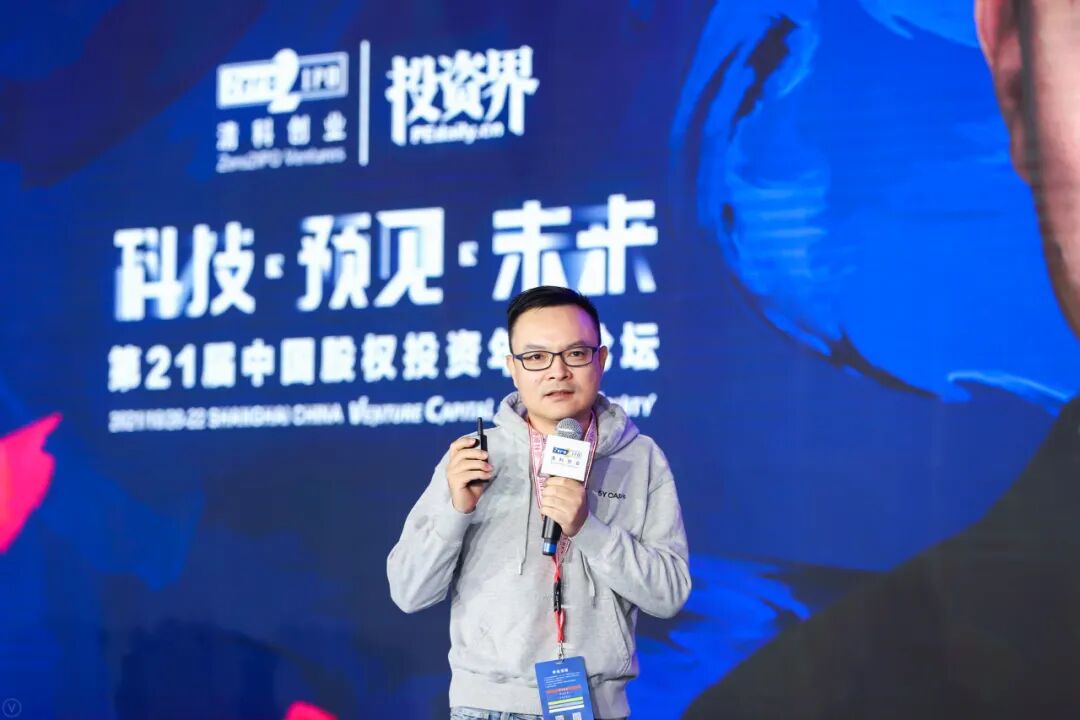
The White Dove and Menlo Park
The title of today's speech is "The White Dove and Menlo Park" — two stories about entrepreneurs.
Everyone knows Tesla the company, but you may not know that it was named to honor a legendary inventor: Nikola Tesla.
Nikola Tesla was a genius inventor. He is best known for designing the modern alternating current (AC) electrical system. He was also a mechanical engineer, electrical engineer, and futurist. He made multiple revolutionary inventions in the field of electromagnetism, and his patents and theoretical work on electromagnetism laid the foundation for modern wireless communication and radio. His name was even adopted as the unit of magnetic flux density in the International System of Units.
This genius died alone at age 87, of heart failure, at the Wyndham New Yorker Hotel. In his later years, Tesla was destitute, moving between hotels in New York, unable to pay his bills. Westinghouse Electric, which had benefited from Tesla's AC patents, paid his rent in his final years and provided him with financial support for the rest of his life. He lived as a recluse and developed a great fascination with pigeons. He considered them his inspiration. He was particularly fond of one white dove, saying she had "a dazzling light" in her eyes. He even built a special device to support the injured wing and leg of this pigeon.
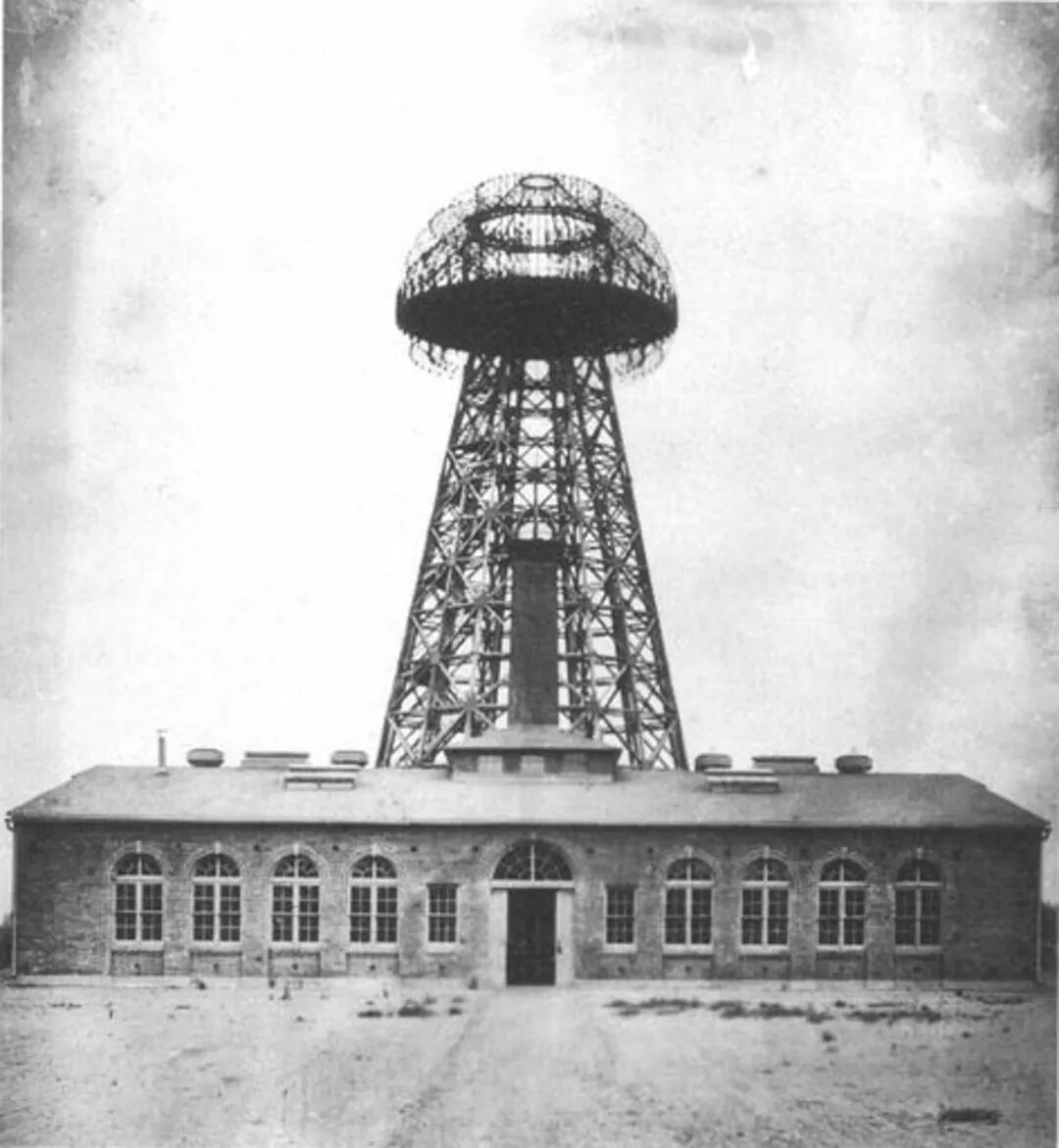
Tesla had very unique traits. The image above shows the "Tesla Tower," which embodied his wild vision of the future. In 1901, Tesla began building this tower with $150,000 invested by J.P. Morgan. He hoped the tower could transmit not just electricity, but also communications — a monumental attempt at the time. But the Tesla Tower failed. By the end of 1901, J.P. Morgan withdrew his investment, and Tesla was left with enormous debt. Tesla made several attempts at business, none particularly successful. Yet this cannot obscure his genius as an inventor. He was extremely偏执, never married, devoted his entire life to science and technology, and is often considered the archetype of the "mad scientist."
Speaking of Tesla, we must mention another inventor of the same era: Thomas Edison. Edison and Tesla had an employer-employee relationship — Tesla worked in Edison's laboratory, where he invented alternating current, which posed a major disruptive challenge to Edison's direct current technology.
Of course, our purpose today is not to revisit the history of the War of Currents or their disputes, but to analyze their fundamentally different traits. Unlike Tesla, Edison was also an entrepreneur. He could be described as the first person in the world to apply mass production principles and the industrial research laboratory to invention. Edison accumulated more than 1,500 patents across the United States, United Kingdom, France, and Germany. Many of his inventions were successfully commercialized, including the light bulb, the phonograph, and the motion picture camera.
In 1876, Edison moved into a laboratory in Menlo Park, New Jersey — one of the world's earliest industrial laboratories. Here, he broke down R&D activities into discrete parts, allowing each researcher to focus on a specific slice of work. He scaled innovation through an industrialized, collaborative approach — in a sense, he "re-innovated" the model of innovation itself.
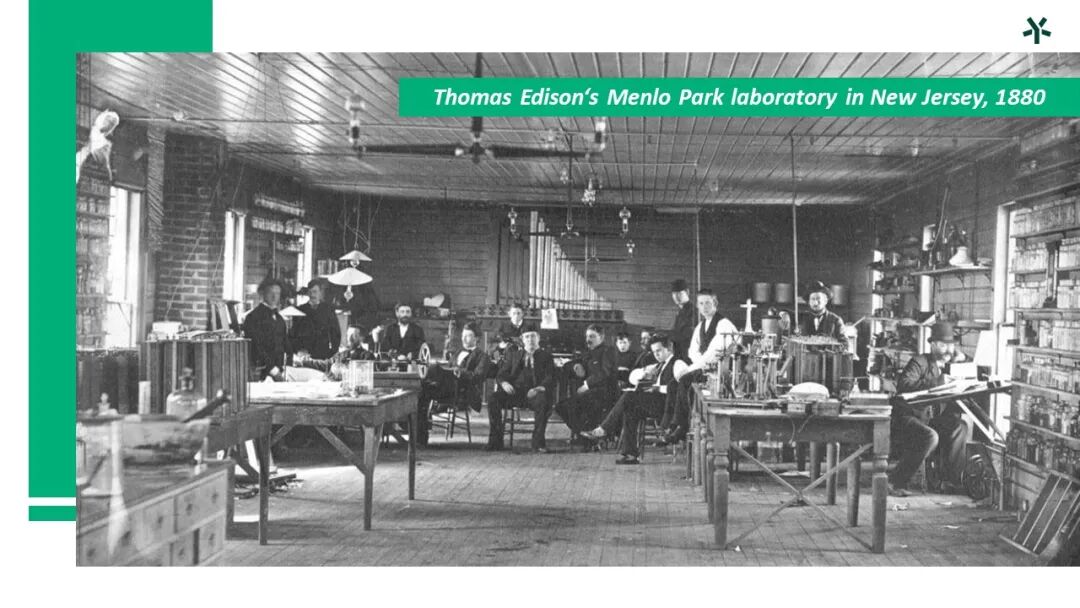
Edison's industrial laboratory was quickly emulated by other enterprises. By the 20th century, industrial laboratories had become standard equipment for large corporations, becoming important sources of innovation alongside universities and academies of science. Edison also pursued systematic solutions to serve his commercial system. In 1878, he founded the Edison Electric Light Company, the predecessor of General Electric (GE).
The white dove and Menlo Park are the stories of Tesla and Edison, embodying two types of technologist-inventors. One is the genius, the individual hero. The other scales innovation through collaborative means. This is also the difference between scientific invention and technology enterprise. The former is individual high-intelligence work, challenging the boundaries of human intellect. The technology enterprise is a multi-person collaborative system — humans creating value through organizational means. Many successful inventors in modern Western history were not necessarily the first to achieve a technical breakthrough from zero to one, but they popularized new technologies and inventions in people's lives through commercial means, creating enormous social value.
Deeper and Broader Innovation
Contemporary entrepreneurs are exploring forms of human collaboration that are broader and deeper than ever before. In fact, the successful entrepreneurs we see all possess "dual-core" traits in both technology and business.
Take Elon Musk. He holds a grand vision for advancing sustainable transportation and constantly experiments toward it — from cars, to tunnel transit, to hyperloops, to rockets. He has also supported the popularization of technology by open-sourcing Tesla's patents. But much of what Musk does is not simply whimsical brainstorming; it is grounded in highly rational business thinking. Tesla, SolarCity, and SpaceX support and complement each other in both the short and long term — they are not isolated projects. Behind each project lies systematic thinking about design, technology, and business. Musk is far from being a pure individual hero, though he possesses a very strong personal aura.
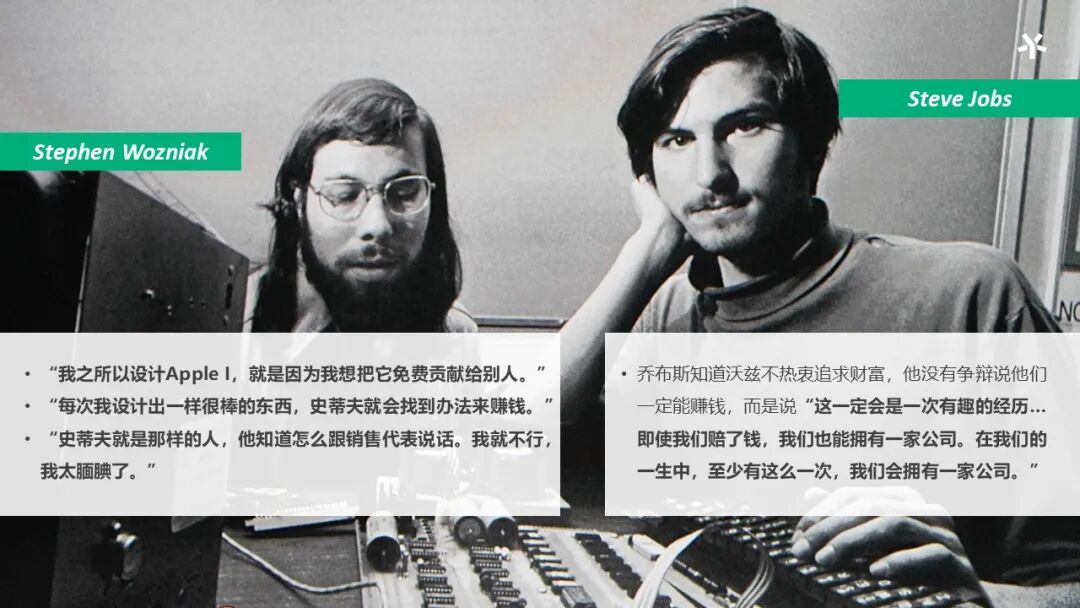
Apple's two founders, Wozniak and Steve Jobs. When designing the Apple I, Wozniak said, "I designed the Apple I because I wanted to give it away to others for free." Jobs knew Wozniak wasn't driven by wealth. He didn't argue that they would definitely make money. Instead, he said, "This is going to be an interesting experience... Even if we lose money, we'll have a company. At least once in our lives, we'll have a company." Wozniak had strong geek traits, while Jobs possessed vision, business acumen, and storytelling ability — both were indispensable to Apple.
Finding "Dual-Core" Entrepreneurs
Technology innovation requires "dual-core" talent that possesses both commercial and technical capabilities. We recently conducted a survey of technology companies in our portfolio. Our investment colleagues and founders together mapped out the companies' commercial capabilities and technical architectures. On the technology side, the new generation of technology companies generally has very high technical barriers — they dig deeper and more fundamentally into technology, with more cross-disciplinary integration. On the business side, they are more open, more imaginative, and more globally collaborative.
The technological differentiation of today's technology companies is incomparable to the industrial era. The current era places extremely high demands on entrepreneurs' cross-domain knowledge and collaborative capabilities.
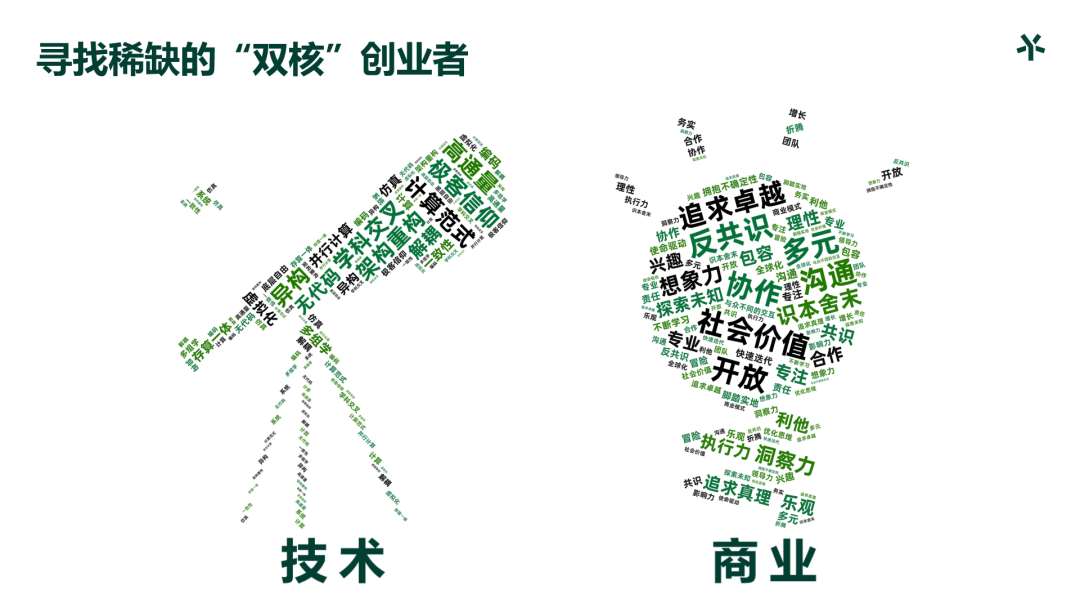
What 5Y Capital hopes to find are scarce "dual-core" entrepreneurs. They must have very strong technical capabilities, judgment of technology trends, and the qualities of a technology evangelist. At the same time, they must have very strong commercialization capabilities and collaborative abilities. They are not only excellent technical CTOs, but also very strong CEOs and leaders. A dual-core talent pays attention to cross-domain matters. This kind of cross-domain ability is extremely difficult, but combining these two scarce traits is the challenge that the new generation of entrepreneurs must face.
The technological innovation we believe in is not about simply predicting the future. We believe innovation can be repeatedly achieved through scientific methodology. We hope to continuously find those scarce dual-core entrepreneurs. This is also the message our slogan conveys: "When the you that others see as crazy, begins to be believed." We believe that what is called "crazy" is a kind of innovation, a kind of non-consensus that needs support and help. Entrepreneurs need to keep pace with the times, and we also need to keep pace with the times together with entrepreneurs, undertaking the mission of this era and creating more value for this era.



5Y Capital (formerly Morningside Venture Capital) currently manages approximately RMB 32 billion in dual-currency USD and RMB funds. 5Y Capital seeks out, supports, and inspires lonely entrepreneurs, providing them with support from the spiritual to all operational aspects. We believe that if the you that others see as crazy begins to be believed, the world will become a different place.
BEIJING · SHANGHAI · SHENZHEN · HONG KONG