Find Something Worth Repeating, Then Repeat It | 5Y View

Focus on slow but steady compound growth.


Kai Liu
Partner, 5Y Capital
Munger once said there's an old rule in science and business, one that works in two steps: first, find a simple, fundamental truth; second, act very strictly in accordance with that truth.
Every event that seems trivial can, through compounding, produce significant impact. Excellence isn't achieved overnight — it's a long process.
Today's article tells the story of how the power of repetition changes daily habits and persists through them, focusing on slow but steady compounding. I hope it offers you some inspiration.
Originally published on 36Kr's "Shen Yi Ju," by Steph Smith. The article represents the author's views only. Original title: How to Be Great? Just Be Good, Repeatably
Everyone has tasted success and experienced failure to varying degrees.
As I accumulated more experiences of success and failure, I began thinking about which experiences were truly "good" and why.
Interestingly, I realized that excellence isn't achieved overnight, but through a long process; those events that seem trivial at every turn can, through compounding, yield significant rewards.
This led me to think further about what excellence truly means. I learned that it's not overnight success or a flash of brilliance, but the accumulation of repeatable habits.
Perhaps, excellence = doing good + repetition.
Ask Yourself a Question
Before starting this article, I want to clarify two things:
- Excellence is not achieved overnight
- Excellence is earned
The first step toward pursuing excellence is recognizing that you are likely not yet excellent. In fact, you need to recognize that there is no such thing as excellence within a single moment. Excellence is a reflection of effort over a period of time; excellence in a single event may be due to luck.
Moreover, "excellence" doesn't mean being better than others. It's about being reliable and demanding of yourself, something you ultimately need to earn.
In theory, many people want to pursue "excellence." In fact, every month countless people search for "how to become outstanding," "how to become perfect," "how to become the best," looking for the correct answer on how to go from zero to one. Yet many people in life don't want to put in sustained effort over time to truly reach zero to one.
Therefore, before continuing to read this article, I hope every reader will consider:
If excellence is truly something non-instantaneous, something that requires effort to earn, ask yourself whether this is the life you want? Ask yourself whether you're willing to spend your days, weeks, months, and years in constant hard struggle?
If you ultimately find this isn't what you want, that's fine! It doesn't mean you're not a good person. At least you've broken your obsession: thinking you wanted to do something but not understanding why you didn't persist. If that's the case, go relax, don't stress yourself out, there's nothing to blame yourself for.
Now, let's delve into what truly makes someone "excellent."
Consistency Is Hard
There's a false impression that success requires making yourself conspicuous.
This perception comes from media attention on outliers — whether events or people — who are different from ordinary folks.
This not only encourages people to pursue fame for fame's sake, even if it's infamy (think Elizabeth Holmes, the notorious founder of blood-testing company Theranos), but also leads others to believe that correlation equals causation; in other words, these people's success was due to their deviance from the norm.
But here's another storyline: the most certain, and therefore best, way to "succeed" is through consistency.
Unless you're working as hard as the people you admire, don't attribute their success to luck.
— James Clear, Atomic Habits
To be clear, consistent effort isn't necessarily the easiest path to success, but it offers greater certainty — you're not hoping to win the lottery or for someone to "discover" you.
Sustained effort is a more deliberate approach that, when it meets two conditions, leads to excellence:
- Consistent investment over a period of time
- Purposeful investment that produces expected output
Consistency
Anyone who gets up before sunrise 360 days a year won't let his family live too poorly.
— Outliers
Napoleon Hill famously said: "If you cannot do great things, do small things in a great way."
If you don't have the opportunity to "do big things," focus on consistently achieving small victories. These small things don't actually need to be done in an outstanding manner — just done well, repeatedly. In fact, I suggest not focusing on perfection, which is often the enemy of success.
There's much debate around unpredictability, but in reality, being predictably good is far more difficult, and therefore more impressive. Consider a few examples:
- Getting up when you "feel like it." Easy.
- Maintaining a 6 a.m. wake-up routine every morning. Hard.
- Moving from side project to side project, chasing the next shiny new thing. Easy.
- Sticking with one side project for years, likely without profit for a long time. Hard.
- Abandoning existing partners when you hit obstacles or encounter new potential partners. Easy.
- Being loyal, investing decades in a relationship. Hard.
We usually start life with good intentions. We plan to establish a morning routine, or build a profitable business.
We imagine that as we invest in something, we'll naturally continue moving in the right direction. Things will get easier and easier, won't they?
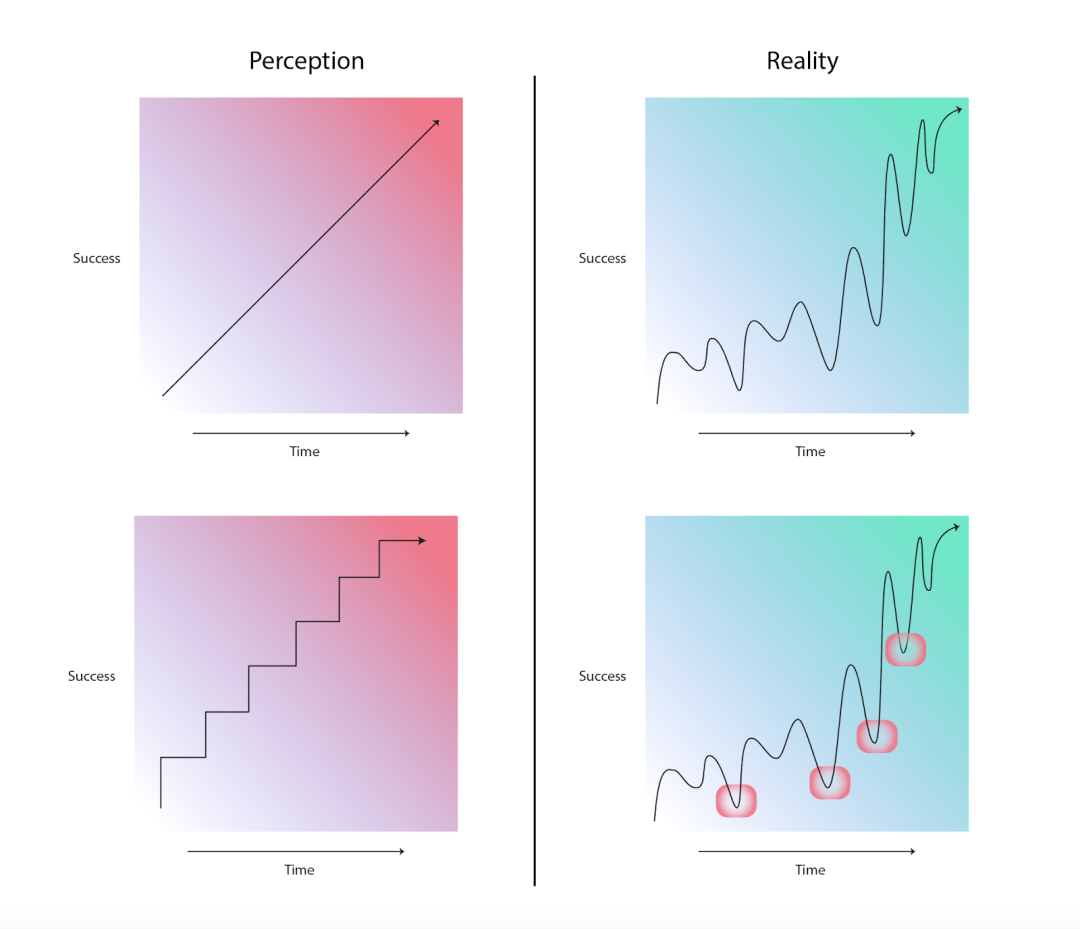
The curve on the left above is what we expect: predictable, linear, directly reflecting the effort we put in. Few successes actually look like this.
Life is a series of tiny nodes; reality looks more like the right side. In this more realistic chart, two key factors are worth noting:
- Compounding is always present. In any process, early stages will be more strenuous, yet we can hardly imagine the compounding effects that may appear later.
- What goes up must come down. This seems obvious, but when we're in a low period, we often forget it. We give up at these local minimums (the red highlighted portions above) because we can't see the next peak around the corner.
Being addicted to success is what makes you feel unsuccessful when you don't get the immediate dopamine hit of "success" from your work.
— Casey Neistat (@Casey), February 7, 2019
According to the "hedonic treadmill" theory, despite many positive or negative events occurring in life, an individual's "customized" subjective well-being eventually returns to a relatively stable level, like running hard on a treadmill without actually moving from your spot.
According to this theory, when a person earns more money, their expectations and desires increase simultaneously, so there is no permanent gain in happiness.
Essentially, when someone achieves new success in various aspects of their life, their expectations and desires are re-established as well. There is no net gain in happiness, and maintaining "peace of mind" during low moments becomes more difficult.
This is precisely why seeking specific success creates problems. Rather than looking for unsustainable shortcuts in life, it's more effective (and healthier) to target consistent habits, treating success as a byproduct rather than the ultimate goal.
The only way to become excellent is to be endlessly obsessed with doing the same thing repeatedly. You have to fall in love with boredom.
— James Clear, Atomic Habits
Input → Output
The second important aspect of achieving excellence is acting with purpose.
Your actions and results don't always reflect your intentions, but as you move toward "excellence," you should have a better idea of which inputs produce outputs.
You'll still make mistakes — we all do — but you'll have a better grasp of what's more likely to succeed. For example, your success rate might be 30%, while someone groping in the dark has only a 5% success rate.
Let's look at a simple example.
Imagine Company X has two salespeople. Salesperson A happens to close a $1 million deal in the first week. However, over the next six months, he struggles to make any substantive progress. Meanwhile, Salesperson B successfully develops a process in the first month that brings in only $100,000 in revenue, but he is able to scale it and double sales revenue month over month.

You might be thinking: "So what? This is just a typical example of compounding."
Yes! But that's precisely the point. The best things in life often don't require miracles, but rather thoughtful, sustainable approaches. The same is true for businesses, marriages, and almost anything with repeatable elements. If you invest time in continuously solving the problems that lead to success, you'll reap these benefits for years to come.
Therefore, even in the least quantifiable situations, reflect on what makes past failures the foundation for future victories.
Think about the best companies over the long term — none appeared overnight, and no single inflection point determined these companies' success or rise to prominence. Throughout history, the dividing line between "great" companies and "less great" companies has been their ability to withstand the test of time.
Would you rather be Juicero (which raised $100 million but went bankrupt within a year of its Series C) or Zoom (which took nearly eight years to raise over $30 million, and is now one of the most profitable and closely watched "unicorns" in Silicon Valley)?
On the foundation of consistency, excellence comes from asking the right questions and iterating to understand which inputs drive favorable outputs. "Greatness" comes from a defined or research-validated process that, when followed, produces results with a certain degree of certainty.
"Move fast and break things" is not a strategy unless you've clearly defined a learning process.
The Habit of Progress
The definition of insanity is doing the same thing over and over again, but expecting different results.
— Albert Einstein
Understand that to achieve what you want in life, you need to build a habit of progress.
One thing needs clarification: this habit of progress must be accompanied by the right inputs. Staying consistent with something headed in the wrong direction will only take you further in the wrong direction.
Therefore, if you're unsure, stop until you're certain what the correct inputs are.
Before you find the path you want to double down on, this habit of progress takes the form of iteration. I see many people stuck at this stage, feeling like they're making no progress. Perhaps they spent a year on a degree only to find it wasn't the right fit. Perhaps they worked at a company for two years and found that wasn't right either.
If you're struggling to identify the right path, create more optimization nodes.
For example: if you make changes once a year, you might only have 80 changes in your lifetime. Instead, try intentionally testing something every month or even every week. Create more testing nodes, then double down when you find your path to "good."
You might ask: "What is good?"
Ask yourself this question: "If I do this every day for the next year, will I be in a better position?"
If the answer is yes, you've found a path to "good."
Once you've found your direction for inputs, you can then turn these inputs into the right habits through deliberate practice. That is: you'll be in a transition from good to excellent.
This process of switching between iteration and consistency is all part of cultivating the habit of progress. Once you make this habit your compass, you no longer rely on some "major breakthrough" or for that company to "give you another chance."
Two Steps Forward
As you move toward "excellence," remember that it may need to happen slowly — don't rush.
When I think about people's life and growth trajectories, change always happens slowly. Whether it's a close family member falling into serious mental illness, or friends building a business to near-unicorn valuation, none of it happened overnight. What's more notable is that no one would have anticipated these results years ago.
I think this is because you can only see two steps ahead — what does this mean?
Suppose life has 100 levels of happiness; of course, life is far more complex and dynamic than this.
Let's say you're on "Level 57." You might be able to see Level 58 and Level 59, but I think it's almost impossible to fully empathize with, or even understand, Level 21 and Level 89 unless you've been there before. But even if you have, it becomes a distant memory that's hard to fully internalize.
Please remember, the hedonic treadmill is almost always in effect.
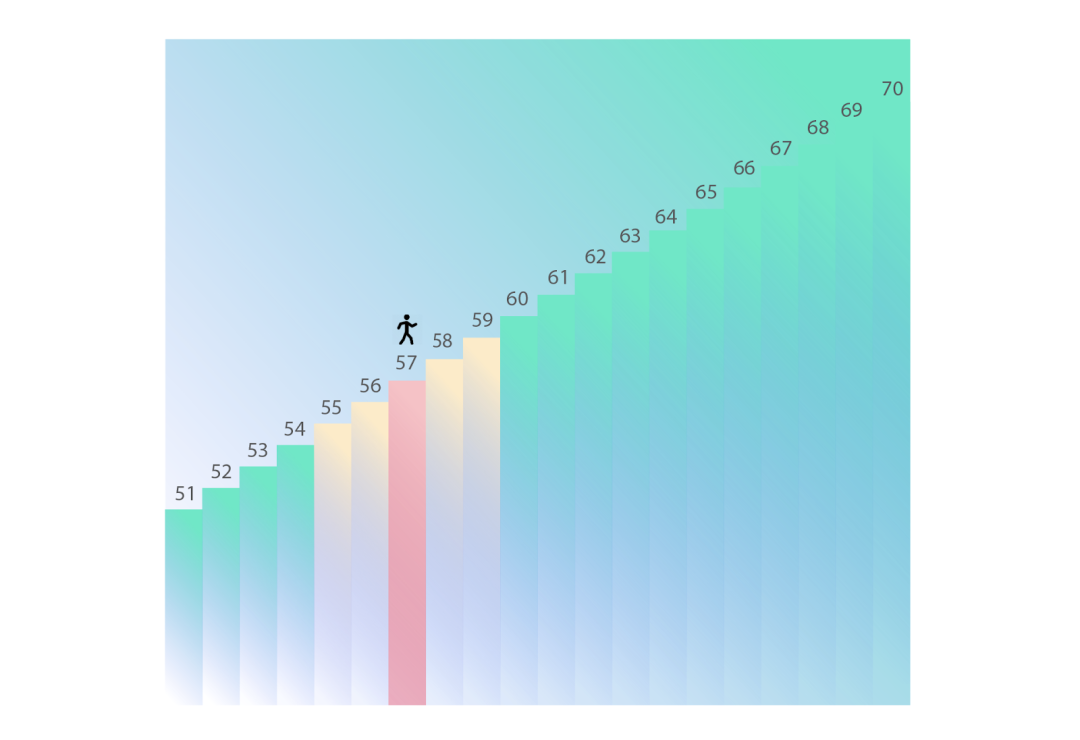
Why does this matter? Everyone wants to improve their standard of living while simultaneously improving their happiness.
To reach top-tier levels, we can't hope for everything to happen out of thin air. We must expose ourselves to various inputs that may lead to better outputs, and train ourselves to recognize which inputs are effective.
And this is precisely what continuous improvement means. Since we can only ever see "two steps ahead," without slow but repeatable change, we cannot discover these new inputs. We must explore 58, then 59, and then suddenly, 61 appears — a place we never considered before.
To give a more concrete example, when I worked in an office, I simply couldn't fully imagine remote work. I knew it existed, but I couldn't truly envision this new way of life. Even after I started working remotely, it took several years of iteration and adjustment to expand into what I now call my own lifestyle. Of course, there may be more levels to explore that I haven't yet imagined.
To exist is to change, to change is to mature, to mature is to continuously create oneself.
— Henri Bergson
This is precisely why we must continuously invest in new environments and exposure to new people, and focus on slow but steady compounding.
As you iterate, try to remind yourself that there are new levels you don't even have a concept of now. No matter how far you've progressed, know that these new levels will emerge as you work toward the next one or two levels. Soon, you'll be 10 levels ahead of what you could have imagined.
Stop Guessing
I've seen unrealistic and impossible things accomplished. All it takes to achieve the impossible is an optimistic attitude and never giving up.
— The Woman Who Smashed Codes
A study is mentioned in which students in Jerry Uelsmann's University of Florida photography class were divided into two groups. The first was the "quantity" group, while the second was the "quality" group. The former would be judged entirely on the number of photos they submitted, while the latter would be graded on the excellence of individual images.
The interesting result of the experiment was that the best photos didn't come from the "quality" group, but from the "quantity" group. Why? While the "quality" group spent their time guessing what perfection was, the "quantity" group took action to test what true perfection actually was.
It's easy to get bogged down trying to find the optimal plan: the fastest way to lose weight, the best program to build muscle, the perfect idea for a side hustle. We focus so much on finding the best approach that we never take action.
— James Clear, Atomic Habits
In other words, "seeking" excellence is often misguided, perhaps because the excellence we imagine isn't actually that great to begin with.
Rather than guessing what will make you excellent, get out there and start taking action. Don't look for perfection or greatness — look for signs of "good" and start making tangible progress.
How to Be Excellent?
If you're still asking "How do I become excellent in life?" I want you to reframe this question as "How do I become good in life," and focus on cultivating these habits, repeating them over time. Make these habits your baseline.
Remember, there is no "magic moment" that makes you excellent, so if you're looking for the path to excellence, stop looking for "excellence" — your most viable path is to focus on what's good.
If you know what inputs produce favorable outputs, then keep moving in that direction. Soon, you'll be doing "not bad," you'll have persisted, and you'll have learned something along the way.
Please remember: excellence = doing good + repetition.




5Y Capital (formerly Morningside Venture Capital) currently manages approximately RMB 32 billion across USD and RMB dual-currency funds. 5Y Capital seeks out, supports, and inspires lone entrepreneurs, providing them with support from the spiritual to all operational aspects. We believe that if the "crazy you" in others' eyes begins to be believed in, the world will become a different place.
BEIJING · SHANGHAI · SHENZHEN · HONG KONG