How Does the Fusion of Science and Art Spark Creativity? | 5Y View

Every artist is busy questioning and studying the world, just like a scientist.
Why would something as "dry" as scientific research have anything to do with art?
This article answers that question — science and art both value simplicity and intensity, and both ask questions of the world. Every artist is busy questioning and studying the world, just like scientists.
Creative interdisciplinary collaboration can "refocus attention on the curiosity, care, and uniquely human nature we need to practice science." Hope you find it inspiring :)
Originally published by the Swarma Club (集智俱乐部) Author: Toni Feder; Translator: Zhang Yi
After watching the film Little Shop of Horrors, Andrew Pelling and his research group wondered if they could create a plant with muscles. Their inspiration came from "Audrey II," the man-eating monster plant from the 1986 film. They tried growing muscle tissue on a leaf, but failed. Yet that attempt sparked a research direction that has flourished for Pelling's team over the past decade: growing mammalian tissue using plant- and polymer-based scaffolds. Pelling says they have recently discovered that a scaffold derived from asparagus can guide neuron growth for treating spinal cord injuries. They have also been studying a new polymer scaffold developed by a textile artist in their lab.
From the very beginning, Pelling's research group in the University of Ottawa's physics department has included both scientists and artists — sculptors, painters, digital media artists, and others; currently, about 3 out of 15 members are artists. Pelling says: "Every artist I know is busy questioning and studying the world, just like scientists." Pelling's goal is to ask questions that haven't been asked before. "For me, the best way to do that is to bring different people together, share lunch, and chat. That interaction brings both museum collections and scientific advances."
Science and art are usually separate, as are subdisciplines within science. But it hasn't always been this way — Leonardo da Vinci studied friction and other topics, as did Piero della Francesca, a 15th-century painter and author of mathematical treatises who was Da Vinci's contemporary. Today, connections range from science-inspired art, to art as a tool for explaining or illustrating science, to science explored by artists, to collaborations that promote scientific understanding.
01 Indirect Inspiration
Agnes Mocsy is a professor of physics and astronomy at Pratt Institute in Brooklyn, New York, an institution that emphasizes art, design, and architecture. For her, Joseph Stella's paintings of the Brooklyn Bridge sparked a discussion about the Doppler effect. Jackson Pollock's paintings suggest momentum, energy, and fluid dynamics. Sculpture can be used to talk about mass and space, and general relativity. Comparing artworks from Eastern and Western cultures can illustrate different senses of space and time. "When you face a painting or a sculpture, there is no right or wrong answer, so people can feel more comfortable opening up," says Mocsy, who previously worked in heavy-ion theory at Brookhaven National Laboratory and now focuses on physics education with an emphasis on the intersection of physics and art. She continues, physics often alienates people. "I am interested in enriching the stories we tell about physics. In my work, art, science, and social justice are interconnected."
Like Mocsy, Katherine Schaffer left a research-intensive career to teach physics to artists. Since 2009, she has overseen the science program at the School of the Art Institute of Chicago. There she launched a scientist-in-residence program and frequently invites scientists to give lectures. She says that while science doesn't depend on art, science is "indispensable in the art world" — from tools and techniques to the subjects artists tackle. Still, she says, artist-scientist collaborations have value for scientists that is difficult to measure. For example, creative interdisciplinary collaboration can "refocus attention on the curiosity, care, and uniquely human nature we need to practice science."
In 2003, when Bjørn Jamtveit became director of a new center on the physics of geological processes in Oslo, Norway, he brought in painters, photographers, and other artists to collaborate with the center's scientists. A composer worked with a scientist studying rock deformation stress, using geological sounds to create pieces; one was a walk-in installation that surrounded visitors with the sound of rock fracturing. (Examples of sounds from art-science collaborations can be found in the online version of this story.) Jamtveit says scientists should be objective, but they often see what they are looking for or what they recognize as familiar. Jamtveit initially sought collaborations to increase future funding opportunities through excellent outreach. He says: "Because of my interactions with artists, I have become a better observer."
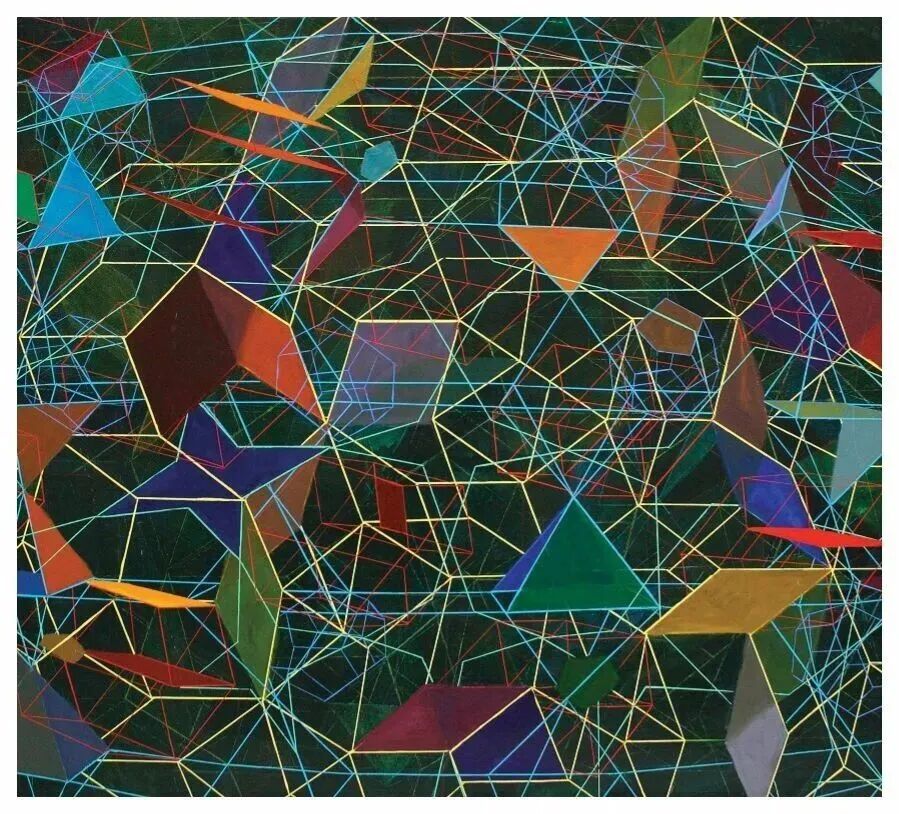
Figure 1. This work, dated June 2006, is an acrylic painting, 56 × 70 inches, from the artist's collection. Courtesy of Tony Robbin.
Artist Tony Robbin, who works closely with mathematicians, depicts curved three-dimensional lattices. The woven lattices are color-coded and identified by different polyhedra. He explains that in higher dimensions, the lattices flow above and below each other, but in projection they appear to intersect.
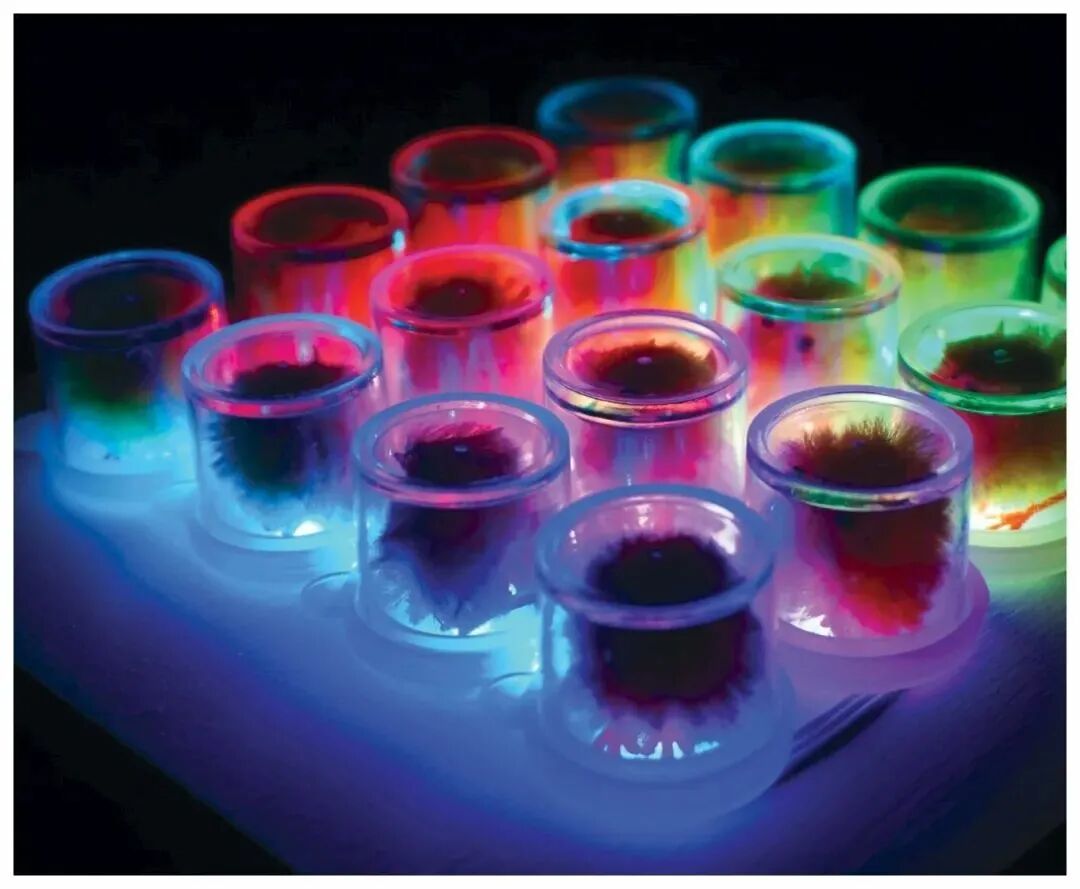
Figure 2. Courtesy of Andrew Pelling
The Chixel Array is a light sculpture made from dollar-store finds and dumpster discoveries. It started with the idea of lighting up toy chickens with pixels, and involved designing circuits and coding. "It's both silly and profound," says Andrew Pelling, a biophysicist at the University of Ottawa. But, he says, "it symbolizes how my lab works. Behind all this, we are cultivating a science team that can take on any project — one that is comfortable troubleshooting, iterating, and pivoting as a project progresses."
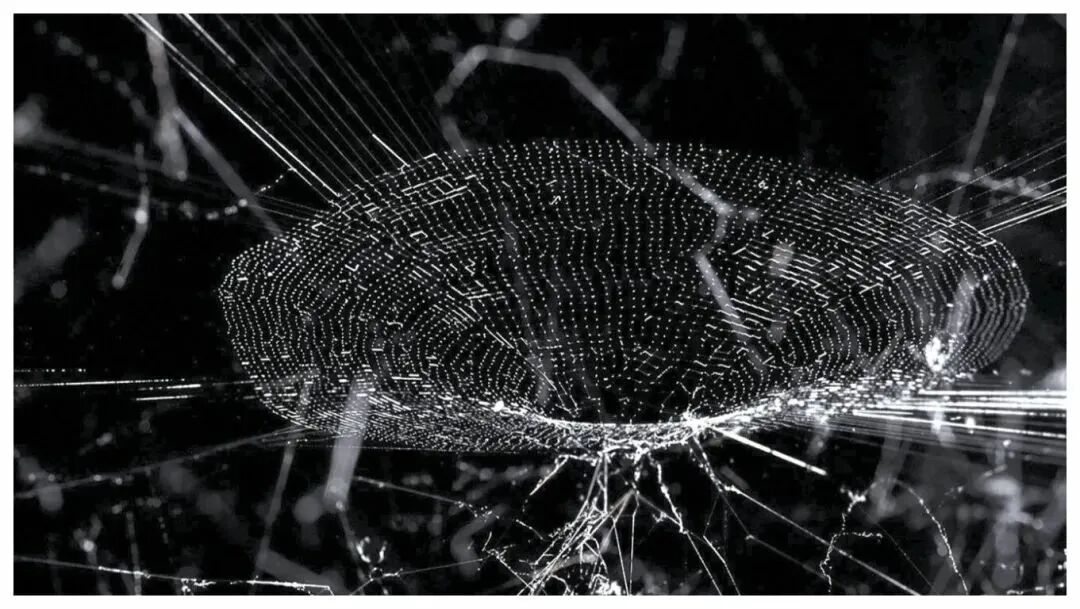
Figure 3. Image by Andrea Rossetti Photography, ©2013.
The tangled web in this image was woven by different species of spiders. It comes from Arachnophilia, an interdisciplinary research project initiated by Berlin-based artist Tomás Saraceno to study spider web structures, vibrational signals, and more. Saraceno developed a scanner to digitize spider webs and record the sounds of their vibrations.
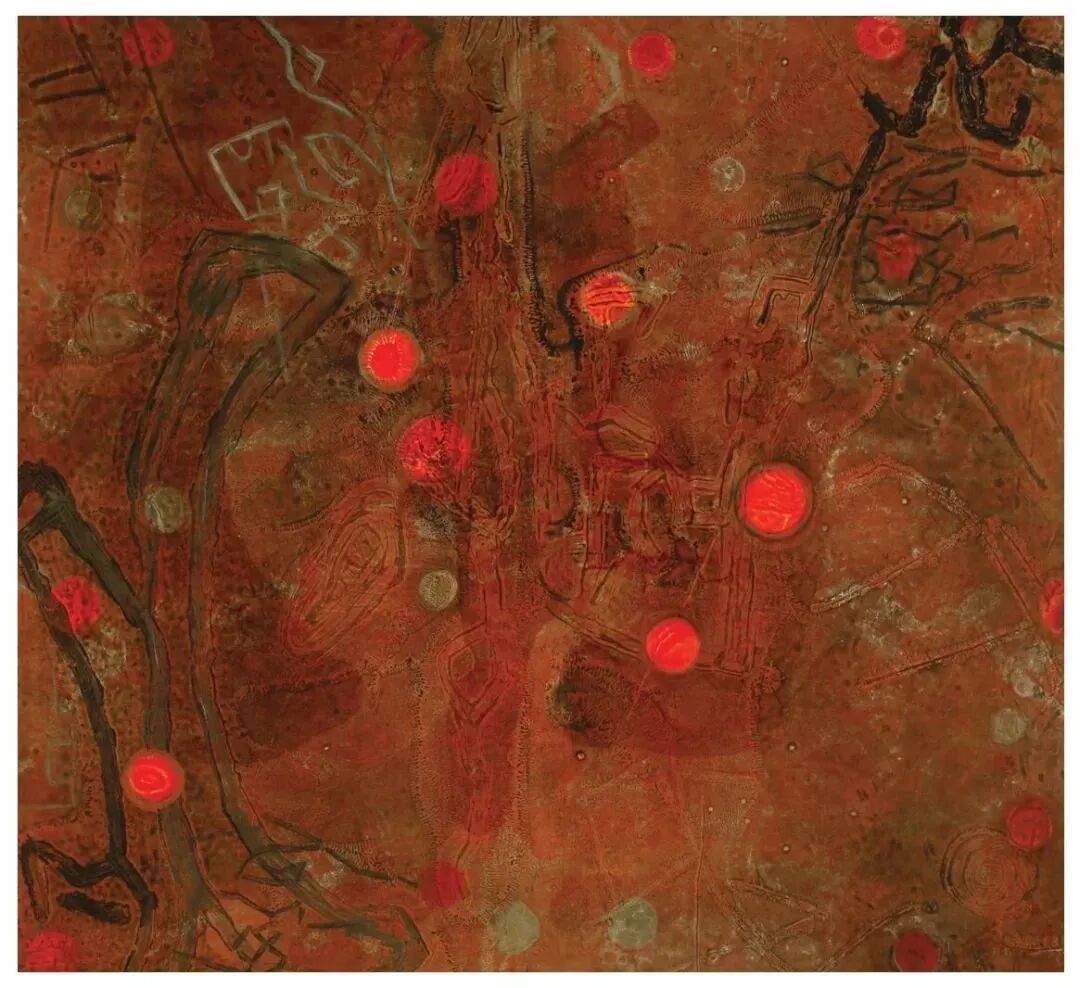
Figure 4. Courtesy of Ellen Karin Mæhlum [3]
Geoprint is a series by artist Ellen Karin Mæhlum. She joined scientists from the University of Oslo's Center for Physics of Geological Processes on an Arctic expedition to Svalbard to explore the relationship between rock and life forms in Martian environments. These images, based on forms and patterns at different scales — including the P0911 shown here and V7010 on the cover — were created using layered intaglio, drypoint, and stencils.
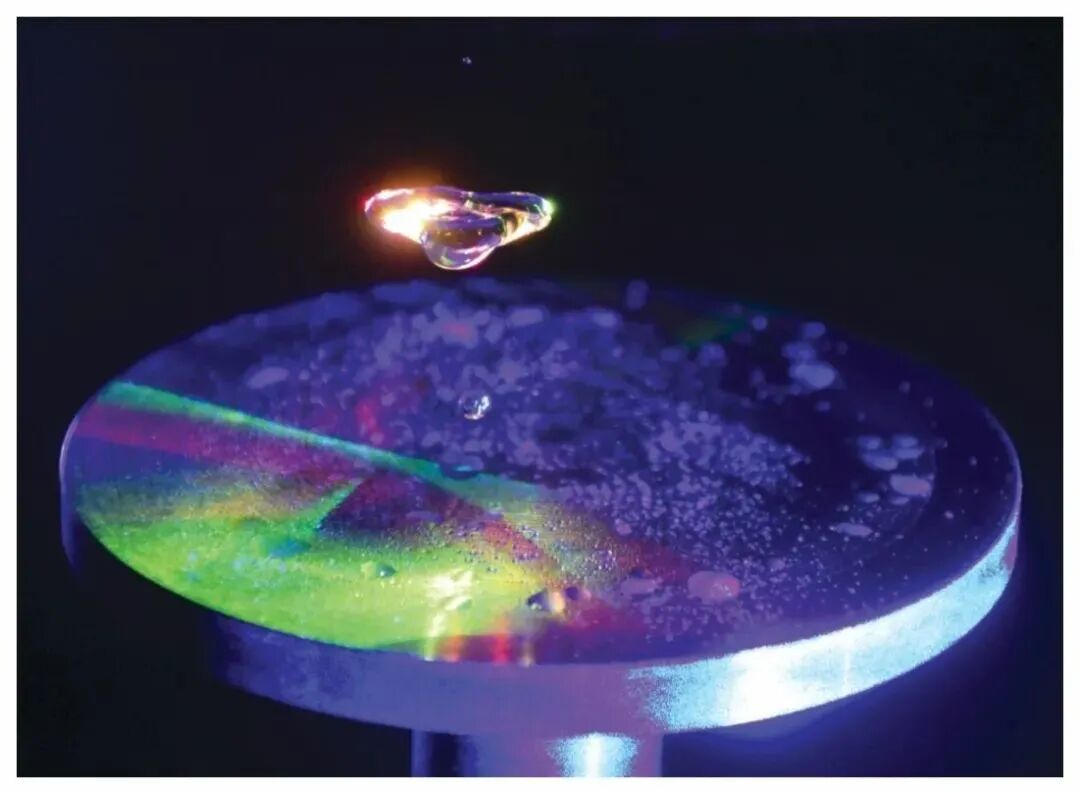
Figure 5. Courtesy of Evelina Domnitch and Dmitry Gelfand
Acoustically levitated water droplets resonate, vaporize, and recombine while rotating with minimal shear force. Creators Evelina Domnitch and Dmitry Gelfand describe Force Field (2016) as excavating the three-dimensional spatiality of sound, the elusive physical properties of water, and the rotational dynamics of celestial and subatomic objects.
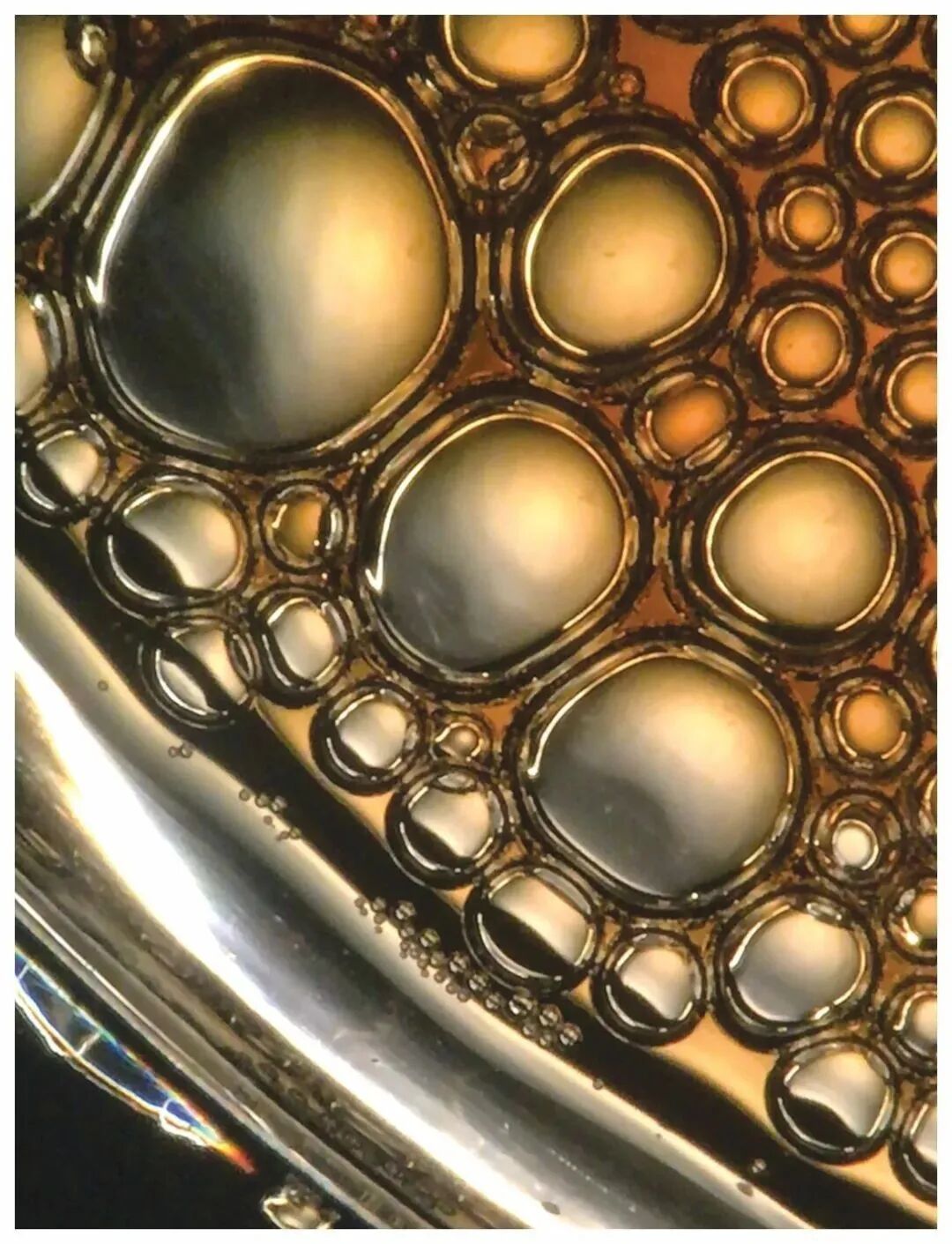
Figure 6. Coffee foam moves and ruptures. This photo was taken through a microscope with a smartphone adapter. Courtesy of Felice Frankel.
George Whitesides of Harvard University recalls that early in their long collaboration, photographer Felice Frankel told him his photos of water spreading on surfaces were "boring" and she could do better. Whitesides says this challenge and her interest in aesthetics led her to deep insights into fluid behavior at small scales. "Nothing grabs the eye like a good photograph. If you see a striking photo, you ask, why is this happening? That's the wealth of science."
Frankel says scientists often clutter images with captions, scale bars, and so on. "Compositionally, you don't know where to look." She asks scientists what they want viewers to see first. She says: "My purpose in using design principles is to communicate science, not to create art. People become more engaged when they understand what they are seeing."
As scientists are increasingly asked to justify their use of taxpayer money, outreach has expanded. This includes illustrations in journals, grant proposals, and public events. Geraldine Cox, an artist with an undergraduate degree in physics, works in the physics department at Imperial College London. She creates workshops for children, the public, and physicists. They explore the sun, atomic spectra, and other phenomena through painting, light, and poetry. For example, in an activity based on the work of sculptor Alexander Calder, she had atomic physicists make wind chimes from items found in their labs. Cox says: "People created things about atoms and light, life and research, or set themselves practical goals like building an upside-down wind chime. It was a joyful and open afternoon."
Klaus Mølmer, a quantum theorist at Aarhus University, says Denmark has a long tradition of public science outreach, and it "exploded" after the 2005 World Year of Physics. Mølmer notes, "When artists and scientists get to know each other, you get collaborations."
Mølmer has collaborated with artists, including composer Kim Helweg. "We discuss quantum mechanics in detail, he asks me questions, and then goes off and does what he wants to do," Mølmer says. "Inspiration goes both ways indirectly." The questions artists ask him "open his eyes," he adds, "I don't think the sources of inspiration for physics and art are very different."
Another quantum physicist-composer collaboration is between Maciej Lewenstein at the Institute of Photonic Sciences in Barcelona, Spain, and Reiko Yamada. Composer Yamada says the goals of experimental musicians overlap with those of scientists. "We push boundaries, make discoveries, and experiment in new territories." In one project, she incorporated random vibrations produced by quantum processes into musical timbres. "We compare these sounds with classical randomness. Is it different? Is it distinguishable?" Yamada says. Early data suggest the timbres are distinguishable. Lewenstein says: "If people can hear the difference, this leads to questions about cognition." He adds: "The quantum world is not intuitive, so it triggers public interest and excitement."
02 Scientific Tools
David Goodsell, a structural biologist at the Scripps Research Institute in La Jolla, California, says art plays two main roles in science. "Visualization tools help scientists see their science, and art is used to communicate science. I have been working on a third aspect, where I use art to generate scientific hypotheses. My art focuses on being a tool for science."
Goodsell has depicted the life cycle of coronaviruses, influenza vaccines, lipid droplets, and other subjects. He combines existing knowledge with educated guesses, aiming to expand scientists' intuition and understanding. The paintings involve many approximations and decisions. For example, the SARS-CoV-2 spike protein undergoes complex conformational changes as it guides viral fusion with cells. He says: "Structural snapshots are available for the starting and end states, but I use art to speculate on intermediate states. I have to choose among various hypotheses. I work with experts to make these images. Getting them to commit without qualifications is often difficult." Yet he says the paintings give scientists freedom because they are "artistic interpretations."
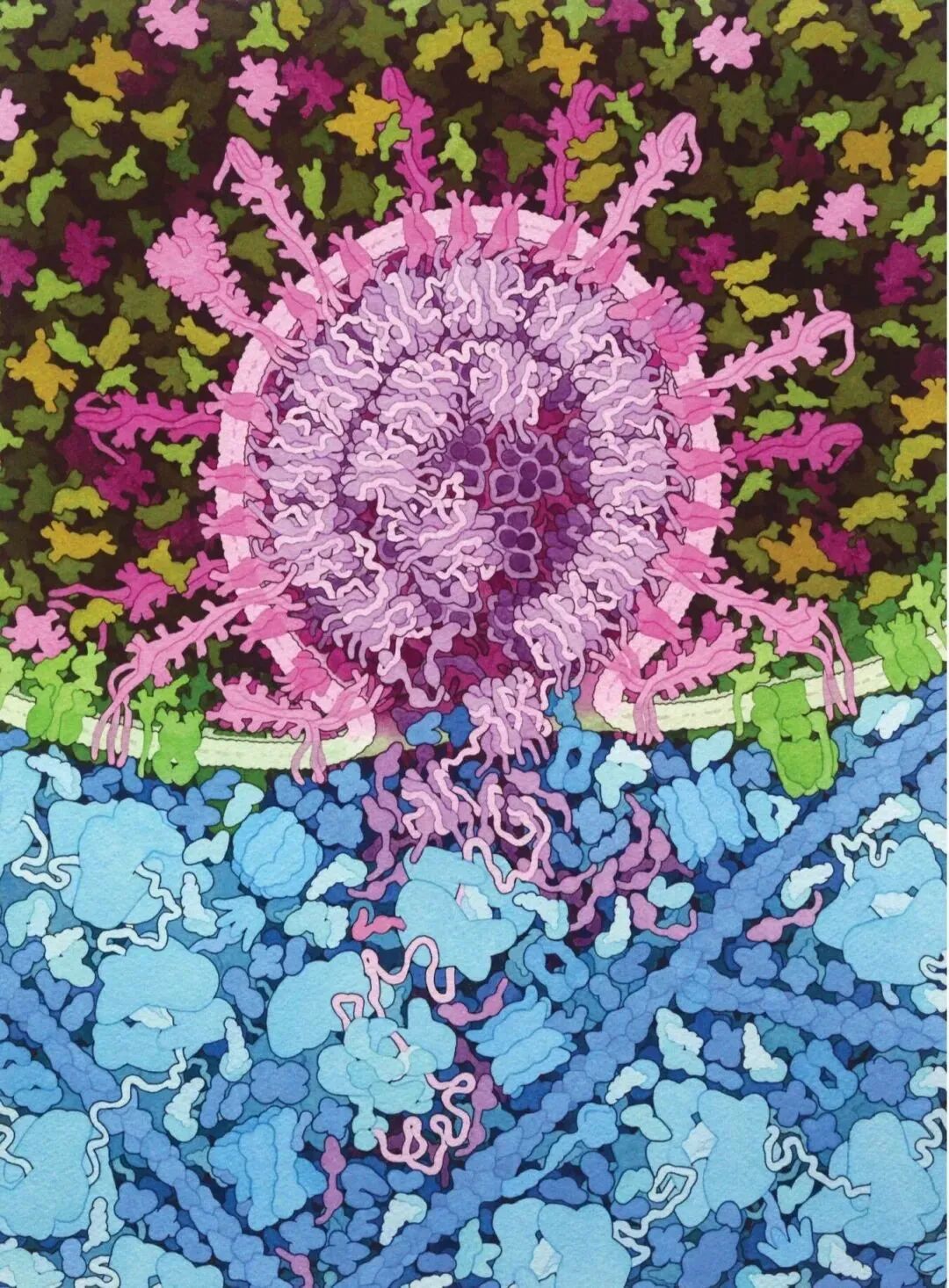
Figure 7. Illustration by David Goodsell, RCSB Protein Data Bank; doi:10.2210/rcsb_pdb/goodsell-gallery-026.
Structural biologist David Goodsell's paintings combine known information and best guesses to depict detailed views of molecular structures. This watercolor is titled SARS-CoV-2 Fusion, 2020.
Francesca Samsel uses her skills and sensibilities as an artist to help scientists extract more information from large datasets. For nearly a decade, she has worked closely with several scientists at Los Alamos National Laboratory on topics including climate modeling, marine biogeochemistry, and waves from asteroid impacts. A current project with ocean modeler Mark Petersen and others involves Antarctic ice melt and ocean circulation.
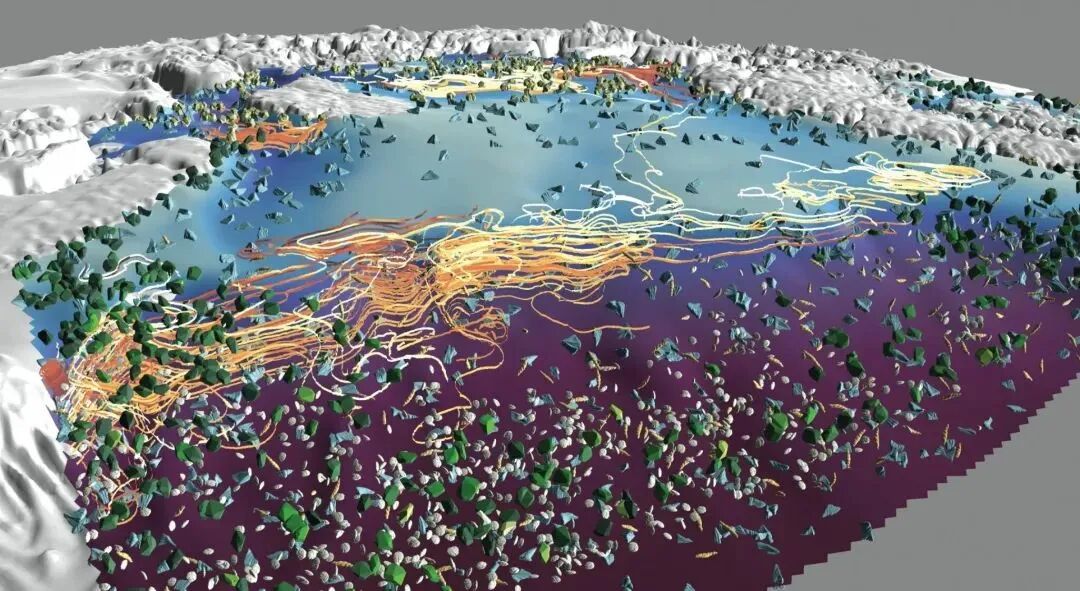
Figure 8. Courtesy of The Sculpting Vis Collaborative, Daniel Keefe and Francesca Samsel, funded by National Science Foundation #IIS 1704604 and 1704904.
Simulated ocean circulation provides clues about climate change. This is a photo of the Antarctic ice sheet. Yellow and orange curves indicate ocean currents, light blue to purple shows increasing water depth, transitioning to purple for the continental slope. Tracers show parameters such as salinity and ice-shelf water. The US Department of Energy's Energy Exascale Earth System Model integrates hundreds of variables at 10-kilometer resolution.
Samsel says: "In art, we are trained to use visual elements — line, shape, color — to establish relationships between variables, organize content, and guide attention." She adds that this can be done with color, "but you have to know how to use it." She points out that traditional rainbow color maps can create visual artifacts. More importantly, in such maps fully saturated colors are adjacent, which causes visual vibration and fatigues the viewer's eyes.
Samsel says the key to artist-scientist collaboration is not rejecting hypotheses. "Scientists have to set aside that my ideas might be flaky. I have to work hard to understand the science, the scientists, and their needs." She adds that the process is iterative. "It's rich in subject matter and symbiotic." Petersen notes, "Francesca is deeply embedded, she is part of the team."
To depict simulations of waters beneath Antarctic ice shelves, Samsel introduced tracers based on hand-carved forms. Tracers with different textures, shapes, and shading allow observers to distinguish multiple variables — temperature, salinity, water flow, depth, and more. Such images are easier to understand than those representing variables with colored spheres. In virtual reality, scientists can swim closer or zoom out, studying data from a range of angles. Samsel says: "Our goal is a complex environment without noise, a calm, clear environment of visual cues."
03 Different Questions
Evelina Domnitch and Dmitry Gelfand are an artist couple based in the Netherlands who create performances and installations deeply rooted in science. Gelfand says: "We are interested in art that stimulates unknown perceptual, physical, and philosophical territories." When they began collaborating more than 20 years ago, he says: "We chose to research gases, fluids, and wave phenomena. This is an unorthodox constraint in the art world. It was inspired by quantum theory."
The duo's explorations include sonoluminescence, acoustic levitation, black holes, and ion traps. Domnitch and Gelfand study the relevant science. "One of the reasons we confront these exotic physical phenomena is to recognize the nature of reality," Domnitch says.
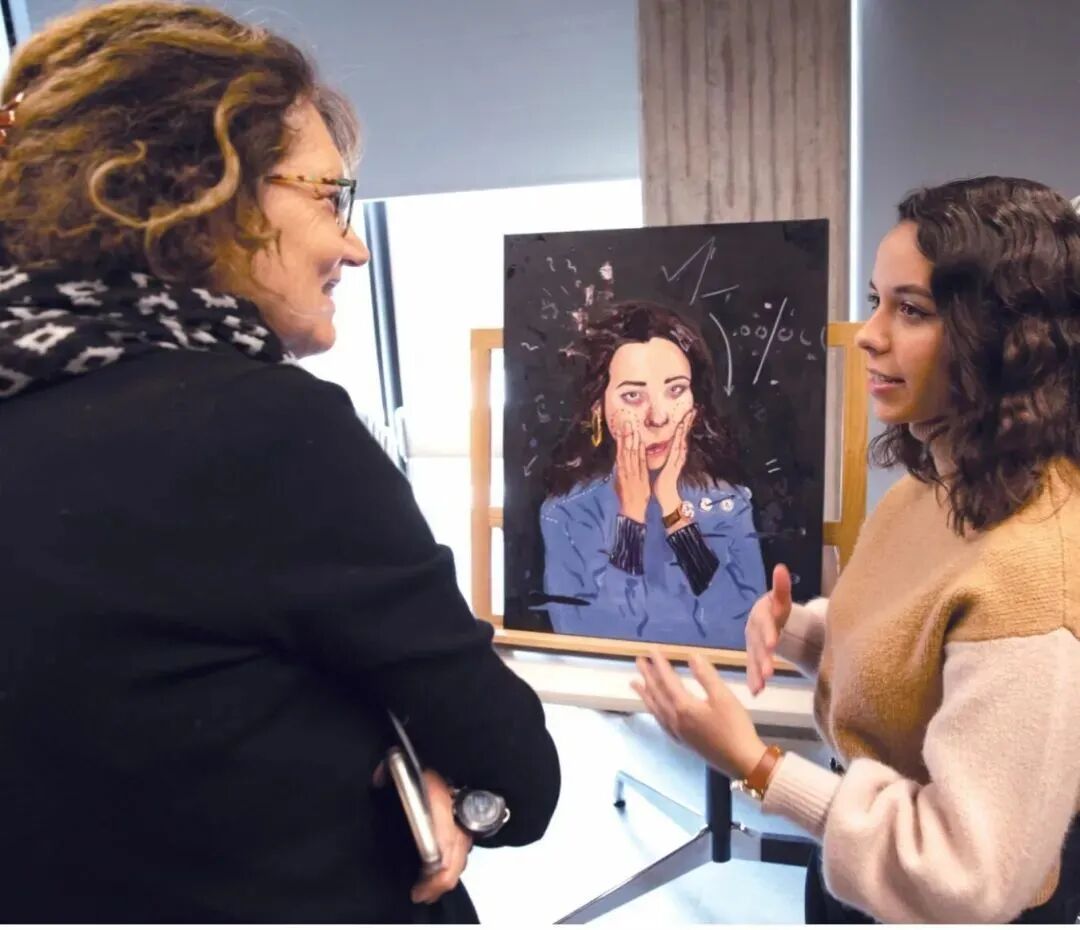
Figure 9
Susanna Brown (right, Figure 9) discusses her painting dis,oRdered with Yale University Art Gallery curator Stephanie Wiles. This self-portrait explores entropy, heat transfer, and time, drawing analogies to everyday chaos and stress. Brown painted it in 2019 for the undergraduate course "Physics and Art," taught by Agnes Mocsy, a visiting professor from Pratt Institute in Yale's physics department.
In their work Camera Lucida, the artists send sound waves into a 60-liter glass sphere containing gas-infused water, producing sonoluminescence. "High-frequency sound creates microbubbles. When they collapse, their temperature reaches that of the sun's surface and emits faint flashes," Domnitch says. Kyichi Yasui, a theorist at Japan's National Institute of Advanced Industrial Science and Technology in Nagoya, says observing bubbles and sonoluminescence in the work is interesting because the vessel is much larger than in laboratories. Though not directly connected to his research, he adds, "When I see art, the stress in my research disappears, and my passion for art is useful for my research."
Another artist whose work is suffused with science is Tomás Saraceno, an Argentine artist based in Berlin. He says: "We need to reinvent our models of collaboration and work across disciplines." Because the problems facing humanity are so serious: global warming, mass extinction, human suffering. Saraceno's projects include digitizing and reconstructing spider webs, and recording vibrations spiders produce on their webs. He says: "Now I think of the web as a musical instrument, spiders sense and locate prey by tuning the web; energy propagates through the network." He notes that people have compared three-dimensionally reconstructed spider webs to cosmic webs. "You can scale up and think about visual effects, harmonies, and scales."
Andrea Polli's installation Particle Falls is similarly based in science. The University of New Mexico professor and environmental artist displays particulate matter concentrations on streets in Philadelphia and other cities. The data updates every 15 seconds and is projected onto a building, making invisible pollution visible.
Tommaso Calarco, director of the Institute of Quantum Control at Forschungszentrum Jülich in Germany, says art can help science by opening doors to things that need to be understood. Artists ask different questions and stimulate new ways of thinking. Artists express ideas in ways that are "beautiful, engaging, exciting, and emotional." Calarco says Domnitch and Gelfand make scientific experiments "look beautiful and thought-provoking." They create a sense of whimsy that can inspire scientists to approach their research differently.
Calarco says interaction with art and artists "forms a powerful mental pillar and inspiration that shapes the direction of his work in quantum thermodynamics." He says: "If we forget that science is beautiful, we might have innovation for tomorrow, but not for the day after tomorrow. It is wise to pursue the useless side of knowledge."
Roald Hoffmann, Nobel laureate in chemistry at Cornell University, says art and science both value simplicity and intensity. "This is obvious in poetry, and in the other case, equations or explanations communicate best when they are concise." But he says the difference lies in emotion. "Artists, poets, musicians, dancers are good at communicating with emotion. But science largely excludes the influence of emotion." He says, "This is absolutely wrong." He points out that science lectures are often more interesting than papers, "because they are weaving a story with emotional descriptors." Communicating emotion is something science can learn from art. "I am interested in building a community of knowledge. We need to build bridges between the humanities and science."
References: [1] Wörner C. H., Rojas Roberto. Classical Doppler Effect in Some Accelerated Systems[J]. The Physics Teacher, 2021, 59(4).
[2] physicstoday.org/schaffer
[4] "Lessons learned from the World Year of Physics," by Laurence Lavelle, Physics Today, December 2005, page 15
[5] Xiong Yuanrong. 液体的声致发光 [Sonoluminescence of Liquids][J]. Chinese Journal of Nature, 1991(04): 259-260.
[6] Shen Changle, Xie Wenjun, Hong Zhenyu, Wei Bingbo. 声悬浮技术的发展及应用 [Development and Application of Acoustic Levitation Technology][J]. Modern Physics, 2010, 22(03): 10-13.
[7] Zhou Haolin. 小型化质谱设计的探究 [Exploration of Miniaturized Mass Spectrometer Design][J]. Instrumentation Technology, 2014(04): 1-6.




5Y Capital (formerly Morningside Venture Capital) currently manages approximately $5 billion in dual-currency USD and RMB funds. We believe that if the you whom others see as crazy starts to be believed in, the world will be a better place.
BEIJING · SHANGHAI · SHENZHEN · HONG KONG