The Charismatic Copernicus | 5Y View

He changed humanity's imagination of the world.

Copernicus is widely recognized as the founder of modern science. In his work On the Revolutions of the Heavenly Spheres, he overturned the geocentric model and proposed the heliocentric model, transforming humanity's imagination of the world.
New ideas and new things inevitably face obstacles in their early days. Why Copernicus proposed the heliocentric model, and how it came to be accepted, remain contentious questions.
Drawing on Copernicus's text On the Revolutions of the Heavenly Spheres, as well as works by American historian and philosopher of science Thomas Kuhn and UC San Diego history professor Robert Westman, this article clarifies some previous misconceptions and presents a richer portrait of Copernicus. I hope it offers you some food for thought :)
This article is republished with permission from Dushu magazine.
Author: Guosheng Wu
Copernicus is widely recognized as the founder of modern science. His heliocentric model has become common scientific knowledge. A 1996 China Public Scientific Literacy Survey Report showed that 80.3% of Chinese knew that "the Earth orbits the Sun" rather than "the Sun orbits the Earth," while a 2014 National Science Foundation survey in the United States found that only 74% of Americans knew this. Chinese people appear to lead the world in awareness of Copernican heliocentrism. Yet as Hegel said, familiarity is not true knowledge. We Chinese actually know very little about Copernicus and his historical achievements.
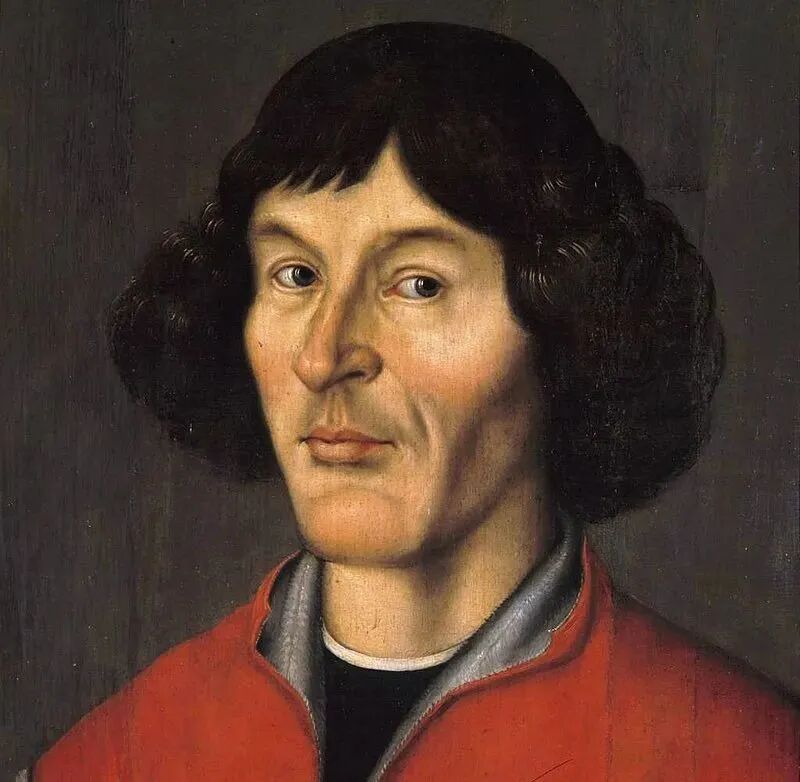
Portrait of Copernicus (Source: wikipedia.org)
Who was Copernicus? Why did he replace the geocentric model with the heliocentric model? The usual answer is: Copernicus wrote a work called On the Revolutions of the Heavenly Spheres, in which he proposed the heliocentric model; he replaced the geocentric model with the heliocentric model because the latter better fit astronomical observations. In fact, these answers are all specious.
01
Copernicus was not a professional astronomer. After graduating from university, he served as a canon at Frombork Cathedral throughout his career. He pursued his beloved astronomical research in his spare time, and in his final years wrote his great work. This enduring masterpiece was written in Latin, with the original title De revolutionibus orbium coelestium. In China, the book has always been translated as Tianti Yunxing Lun (On the Revolutions of the Celestial Bodies), but this translation is incorrect. The problem lies in the understanding of the word orbium. For Copernicus, this word did not mean "celestial bodies" as we understand it today, but rather transparent "celestial spheres" that carry the bodies along. From ancient Greece through Copernicus's time, Western astronomers firmly believed in celestial spheres. Today we do not acknowledge the existence of celestial spheres, so we casually changed "celestial sphere" to "celestial body."
This mistranslation was not pioneered by the Chinese. The 1879 Mendelsohn translation rendered the title as Über die Kreisbewegungen der Weltkörper (On the Circular Motions of the Celestial Bodies), where Weltkörper means "celestial bodies." The two English translations that appeared in the twentieth century did not repeat this error. Charles Glenn Wallis's 1939 translation was titled On the Revolutions of the Celestial Spheres; this translation was later included in Volume 16 of Great Books of the Western World, retitled On the Revolutions of Heavenly Spheres. The English translation Rosen provided for the Complete Works of Copernicus in 1978 was titled On the Revolutions of the Heavenly Spheres, and the German translation published the same year also revised the title to Vom Umschwung der himmlischen Kugelschalen (On the Revolutions of the Heavenly Spheres).
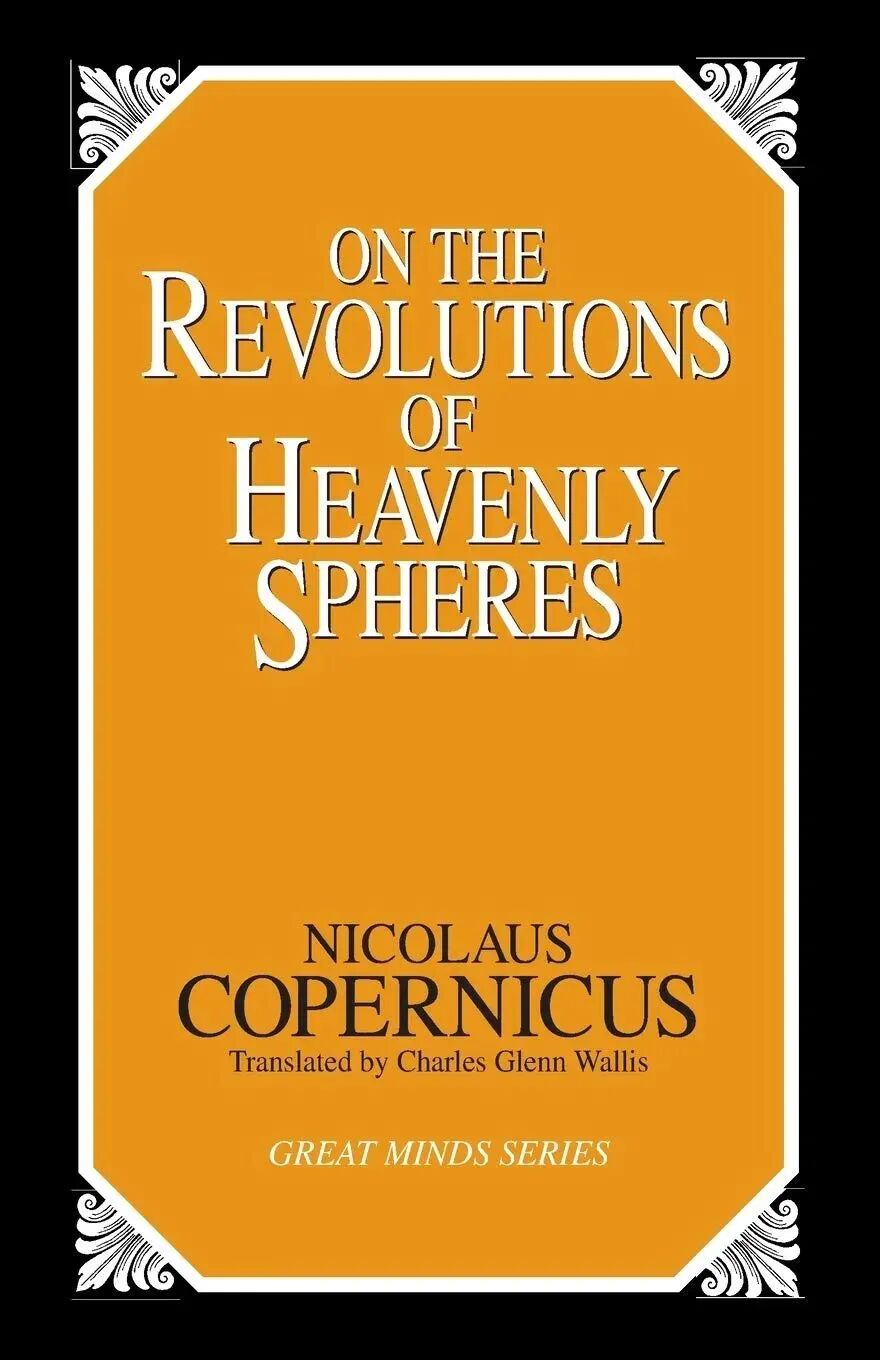
English translation of On the Revolutions of the Heavenly Spheres (Source: amazon.com)
The celestial sphere was the fundamental assumption of Greek mathematical astronomy. The first hallmark of Greek rational cosmology was the introduction of the "celestial sphere" concept. The cyclical, daily rotation of the stars relative to the Earth indicated to humanity the periodicity and stability of celestial motion, as well as the central position of the Earth. Having the stars embedded in the celestial sphere, rotating uniformly with it, reflected an understanding of the sky as determinate and eternal. Anaximander of the Milesian school first proposed the concept of the celestial sphere, while the Pythagorean school explicitly introduced the concept of cosmos, laying the foundation for scientific astronomy. The original meaning of cosmos is "order," as opposed to chaos. The Pythagoreans were the first to use this word to refer to the "universe" — that is, they were the first to see the "universe" as a "harmonious," "proportionate" whole.
The concept of cosmos was embodied in the two-sphere model of celestial spheres enclosing the Earth. Imagining celestial bodies as embedded in nested celestial spheres was a great creation. Though from today's perspective this was an error, since "celestial spheres" do not actually exist. According to modern scientific understanding, the heavens are in continuous change, just like the terrestrial realm. However, the celestial sphere concept was the earliest embodiment of scientific thinking: the goal of science has always been to see through diverse, complex, changing phenomena to perceive the singular, simple, unchanging essence behind them. The celestial sphere concept was the earliest expression of this "invariance."
Plato, Aristotle, Euclid, and Ptolemy all endorsed the celestial sphere concept and used it as the foundation for constructing cosmology. In Book I, Chapter 3 of the Almagest, Ptolemy devoted special discussion to the problem of "celestial sphere motion." He used the cyclical motion of the stars to refute the view that stars move in straight lines, and also refuted the ancient notion that stars are lit before sunrise and extinguished after sunset, emphasizing that celestial bodies move in circles centered on the Earth.
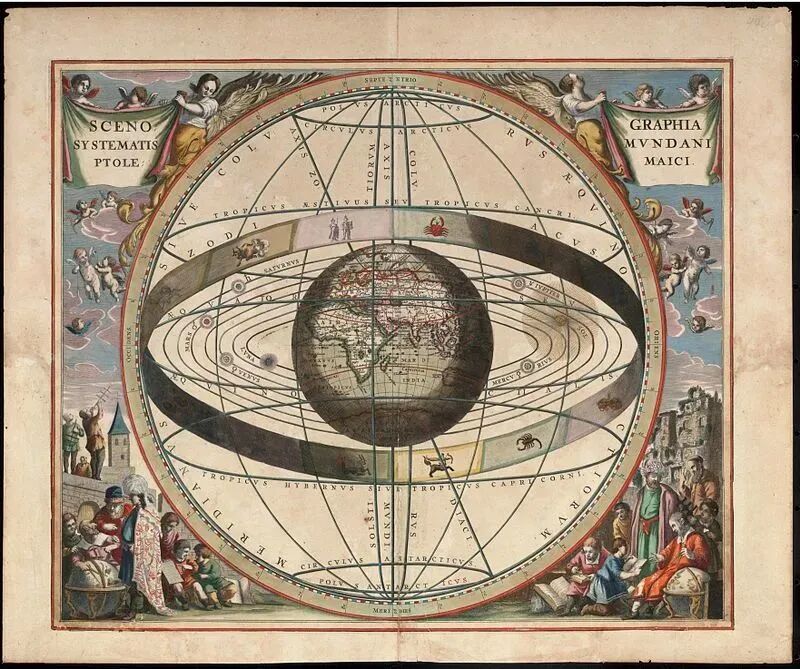
Diagram of the Ptolemaic system (Source: wikipedia.org)
As the legitimate heir to Greek mathematical astronomy, Copernicus fully inherited the concept of "celestial sphere motion." In the opening chapter of Book I of On the Revolutions of the Heavenly Spheres, he explicitly declared that the universe is spherical, and in Chapter 4 stated that the fundamental pattern of celestial sphere motion is uniform circular motion. It should be particularly noted that Copernicus attributed to the Earth not only the daily rotation and annual revolution familiar to us today, but also a third motion. According to Copernicus's conception, the Earth's annual motion was actually the Earth fixed on an imaginary celestial sphere, moving in a circle centered on the Sun. Since the Earth's axis of rotation is not perpendicular to the ecliptic plane, as the "terrestrial celestial sphere" rotates annually, the Earth's axis cannot maintain a fixed angle with the ecliptic plane. To address this, Copernicus specifically added a third motion — a conical rotation of the Earth's axis — to counteract the change in the axis's direction caused by the annual rotation of the "terrestrial celestial sphere." The existence of this third motion reminds us that even the Earth's motion around the Sun was, in Copernicus's eyes, carried out in the manner of celestial sphere motion.
"Celestial body" or "celestial sphere" — this one-word difference relates to the historical attitude we should have when evaluating scientific theories, and to the theoretical depth we can achieve when reflecting on modern science. Changing "celestial sphere" to "celestial body" is at least an unconscious or conscious elevation of Copernicus through modern eyes, reflecting the level of history of science research and science communication concepts in China at that time.
02
Why did Copernicus use the "heliocentric model" to replace the Ptolemaic geocentric model that had persisted in the Western world for over a thousand years? According to the Chinese understanding that seeking truth from facts is the scientific spirit, it would of course be because the heliocentric model better fit astronomical observations, while the geocentric model fit less well.
This claim is not true. Before the 1950s, Western philosophy of science also held that science was nothing more than theories with internal logical structure that also fit observational facts. If a scientific theory did not fit observational facts, it was falsified; if it fit, it was confirmed. This philosophy of science was called logical positivism or logical empiricism.
In 1962, American historian and philosopher of science Thomas Kuhn published The Structure of Scientific Revolutions, breaking the monopoly of logical positivist philosophy of science and initiating historical philosophy of science. Kuhn emphasized that understanding science cannot stop at the logical structure of scientific theories, but must delve into the actual historical development of science; it should not be limited to discussing science in isolation, but should consider the philosophical, religious, and cultural backgrounds beyond science; the basic unit for understanding science is not theory but paradigm; pure scientific logic cannot explain the actual history of scientific development, and requires introducing the sociological dimension of scientific communities. Kuhn's enormously influential work in philosophy of science actually had a precursor historical work, namely The Copernican Revolution: Planetary Astronomy in the Development of Western Thought, published in 1957.
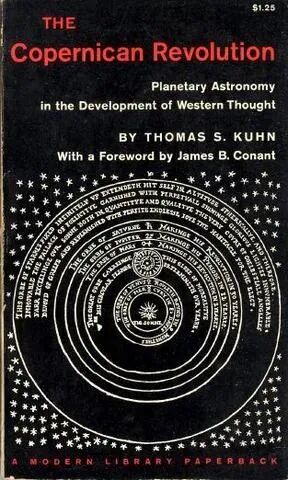
First edition cover of The Copernican Revolution, 1957 (Source: timetoast.com)
In The Copernican Revolution, Kuhn pointed out that Copernicus's dissatisfaction with Ptolemy's geocentric model was not because he possessed new astronomical observational evidence that the Ptolemaic system could not explain — such evidence would have to wait over seventy years, until the invention of the telescope and its turn toward the skies. Copernicus was not an observational astronomer; beyond the astronomical observation materials inherited from history that everyone shared, he did not possess more precise or systematic astronomical data. Moreover, in accommodating and integrating observational data, the Ptolemaic system inherently had powerful capabilities, because Greek mathematical astronomy was fundamentally aimed at "saving the phenomena." In the Ptolemaic system, any old or newly discovered irregular planetary motions could be simulated through epicycles, deferents, eccentrics, equants, and their complex combinations. If the old Ptolemaic system simulated poorly, a new Ptolemaic system could be designed. As far as the Ptolemaic geocentric system itself was concerned, there were no astronomical phenomena that it could not in principle simulate and explain.
Kuhn believed that what led Copernicus to abandon the geocentric model and propose the heliocentric model was complex and diverse historical causes and cultural contexts of the era. First, since antiquity there had existed a tension and difference between the Greek physical tradition (cosmological tradition) represented by Aristotle and the Greek mathematical tradition (astronomical tradition) represented by Ptolemy. Aristotle adopted the homocentric sphere model popular in his era, while Ptolemy's introduction of the epicycle-deferent model clearly conflicted with it. The goal of the mathematical tradition was to save the phenomena — that is, to simulate and predict celestial appearances — without concern for the actual physical construction of the heavens, and without necessarily requiring complete adaptation to existing physical theories. Copernicus knew full well that the heliocentric model sharply conflicted with Aristotle's physical world picture, yet he could still invoke this ancient dual-track system of physics-mathematics to defend and bolster himself. In his dedication to the Pope in On the Revolutions of the Heavenly Spheres, he specifically noted that "mathematics is written for mathematicians," emphasizing that he belonged to the mathematical/astronomical tradition since antiquity, and could freely conceive cosmic systems without censure.
Second, Copernicus's era was one in which skepticism and criticism of ancient thought gradually became fashionable. Nominalist scholastic philosophers, brandishing the banner of God's omnipotence, tentatively challenged the various "impossibilities" set by Aristotelian physics (no vacuum exists, motion without external force is impossible, etc.). Columbus's voyages reaching America showed that Ptolemy's geography contained serious errors. The Julian calendar, used by the Catholic Church for over a thousand years, contained serious errors and urgently needed correction — this was a consensus within the Church at the time. Copernicus's ability to propose the revolutionary heliocentric model to replace the geocentric model was related to this climate of questioning and criticism.
Third, the Renaissance revival of Neoplatonism by humanists — with its belief in the mathematical simplicity of nature and its worship of the Sun — directly influenced Copernicus's proposal of the heliocentric model. Copernicus explicitly stated that the Ptolemaic system was a monster, its parts insufficiently coordinated and unified: "In determining the motions of the sun and moon and the other five planets, they do not employ the same principles, hypotheses, and explanations of apparent revolutions and motions"; "many of the ideas they introduce clearly violate the first principle of uniform motion"; "they are also unable to derive or deduce from the eccentrics the most important point, namely the structure of the universe and the true symmetry of its parts." Simply put, the Ptolemaic system was very unaesthetic, not fitting the Greek ideal of beauty. This was Copernicus's main motivation for proposing an astronomical revolution.
03
When was Copernican heliocentrism accepted by the world? If the heliocentric model replaced the geocentric model because it better fit astronomical observational facts, then it would seem that Copernicus's theory gained universal recognition as soon as he proposed it. However, the heliocentric model was not the result of observation-guided research, but of aesthetics-guided research; consequently, the fate of Copernicus's theory was far from the smooth sailing that people today imagine.
The heliocentric model did indeed display many of the aesthetic advantages Copernicus had hoped for. First, once the Earth was set in motion, the apparent major irregularities in planetary motion, such as stations and retrograde motions, became merely apparent — only seeming irregular relative to the moving Earth. Copernicus also naturally explained why retrograde motion always begins when planets are brightest. Second, it naturally explained why Venus and Mercury always stay near the Sun, unlike Mars, Jupiter, and Saturn, which can freely increase their distance from the Sun. Finally, and most captivatingly, the heliocentric system gave a determinate order of the planets' distances from the Sun from smallest to largest, according to their orbital periods: Mercury, Venus, Earth, Mars, Jupiter, Saturn. In the previous Ptolemaic system, since Mercury, Venus, and the Sun had the same average period of motion along the ecliptic, it was actually impossible to determine the relative distances of these three from the Earth (which occupied the center of the universe). Indeed, Copernicus demonstrated the heliocentric system's "astonishing symmetry" and "clear harmonious connection between celestial motions and their sizes."
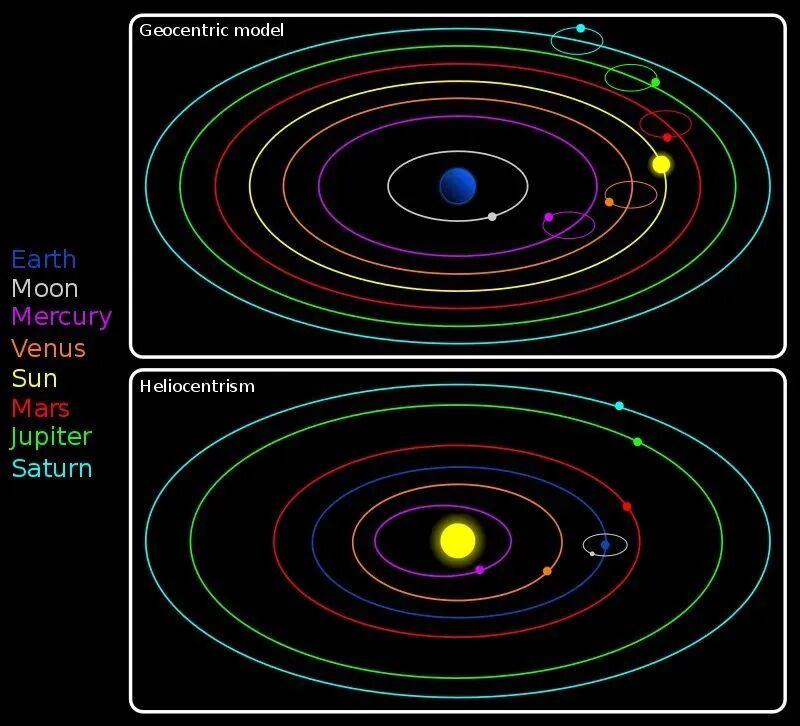
Comparison of geocentric (top) and heliocentric (bottom) models (Source: wikipedia.org)
However, Copernicus did not deliver on all the aesthetic promises he made in Book I of On the Revolutions of the Heavenly Spheres. Since planetary orbits are actually ellipses rather than perfect circles, in order to "save" the phenomena, Copernicus — faithful to the Greek perfect-circle model — had to add small epicycles and eccentrics just like Ptolemy. The result was that Copernicus also adopted more than thirty circles, achieving little difference in simplicity from Ptolemy. "The Copernican system was neither simpler nor more accurate than the Ptolemaic system," Kuhn stated; "this is the great irony of Copernicus's life's work."
Moreover, the Copernican system brought two nearly fatal difficulties. First, the Earth's annual revolution around the Sun would necessarily produce annual stellar parallax. Viewing a distant star from two different positions in the Earth's orbital path, the star would necessarily show different positions. Yet since ancient times, no one had ever detected annual stellar parallax. Copernicus's explanation was that the stars were too far from Earth for the tiny annual parallax to be detectable. From today's perspective this explanation is of course correct, but for people at the time, the absence of evidence was a serious flaw.
The second, more serious difficulty was the physical problems raised by Earth's motion. Aristotelian physics explained why stones fall to the ground, why the Earth rests at the center of the universe, and other common-sense phenomena; once the Earth moved, this physics was directly challenged. Particularly when this physics was combined with Christian doctrine, the challenge took on religious significance. This doomed the Copernican theory to a bumpy fate.
Throughout the sixteenth and seventeenth centuries, the main task of astronomy remained providing a mathematical foundation for astrology; accurately calculating and predicting planetary positions in the zodiac remained astronomy's primary goal. Though Copernicus introduced a very peculiar cosmic system, his mathematical calculation methods were recognized as reliable and advanced. Astronomer-astrologer colleagues universally acknowledged Copernicus as the greatest living astronomer, the Ptolemy of his age. Erasmus Reinhold (1511–1553) did not endorse the Earth's motion, but his Prussian Tables, compiled using Copernicus's mathematical methods and published in 1551, immediately became an essential handbook for European colleagues. If one considered only astronomical calculation without involving cosmology, Copernicus actually achieved quiet victory in astronomers' small circles from the very beginning.
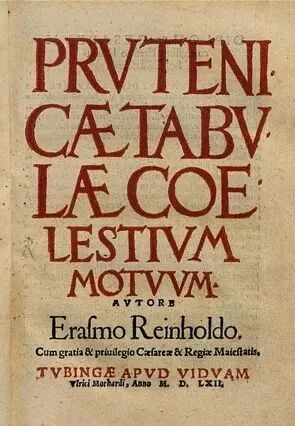
Reinhold's Prussian Tables, 1562 edition (Source: wikipedia.org)
However, Kuhn said, the Copernican Revolution was not merely an astronomical revolution in the sense of computational technique, but also a cosmological revolution, a physical revolution; Copernicus only initiated this revolution, far from completing it. When Kepler published Astronomia Nova in 1609, and Galileo published Dialogue Concerning the Two Chief World Systems in 1632, Copernicus had been dead for nearly a hundred years, yet the heliocentric model not only failed to gain wide recognition but instead provoked greater opposition. Kepler, based on his own elliptical heliocentric model, compiled the Rudolphine Tables (1623), which, like the Prussian Tables seventy years earlier, once again conquered astronomer-astrologer colleagues. Yet the two fatal difficulties Copernicus faced remained unsolved, so astronomers still accepted Kepler's mathematical calculations without accepting the heliocentric model. Stellar parallax would have to wait another two hundred years (1838, Bessel). Tycho Brahe, Kepler's teacher and a famous observational astronomer, insisted on geocentrism precisely because he could not observe stellar parallax. Newtonian physics, which would thoroughly replace Aristotelian physics, would need another half-century to arrive — Newton published Philosophiæ Naturalis Principia Mathematica in 1687.
Newtonian physics was not immediately accepted upon the publication of the Principia, and as its foundation, Copernican heliocentrism was even less so. In the last decades of the seventeenth century, the Copernican, Ptolemaic, and Tychonic systems could be taught side by side in Protestant universities. It was not until the end of the eighteenth century — two hundred fifty years after Copernicus's death — that his theory slowly became European consensus. Though stellar parallax still had not been discovered, Newtonian physics had achieved comprehensive victory in many fields, and Copernican heliocentrism, as a prerequisite of Newtonian mechanics, was taken for granted.
04
Kuhn's The Copernican Revolution not only previewed his later "scientific revolution" narrative but also provided a classic formulation for evaluating the historical status of Copernican heliocentrism. More than half a century later, Copernicus scholarship has once again refreshed its understanding of Copernicus. In 2011, Robert Westman, professor of history at UC San Diego, published The Copernican Question: Prognostication, Skepticism, and Celestial Order, deconstructing Kuhn's "Copernican narrative."
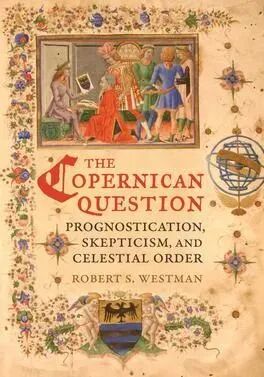
English cover of The Copernican Question
In the 1940s and 1950s, science historians represented by Alexandre Koyré (1892–1964) pioneered the research program of history of scientific ideas, viewing the history of science as a history of the evolution of ideas, and depicting the scientific upheaval of sixteenth- and seventeenth-century Europe as a "scientific revolution," creating an influential narrative mode of scientific revolution. Though Kuhn had a clear trend of expanding history of scientific ideas toward history of scientific sociology, in a sense he inherited the program of history of scientific ideas and consolidated the "scientific revolution" narrative.
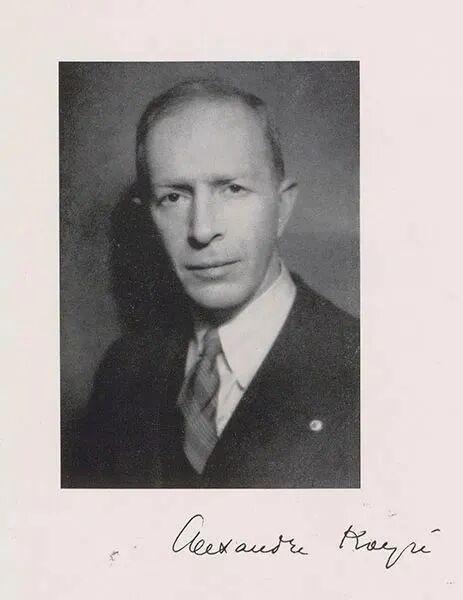
Alexandre Koyré (Source: lindahall.org)
Since the 1980s, Western history of science has undergone an overall historiographical transformation, placing greater emphasis on returning to original contexts and more strongly opposing Whig history, dissolving grand narratives into more microscopic and concrete social operations as much as possible. Represented by Shapin and Schaffer's Leviathan and the Air-Pump: Hobbes, Boyle, and the Experimental Life (1986), placing the establishment of scientific facts and the constitution of scientific discourse within concrete historical situations became mainstream historiography of science. Along this historiographical line, Shapin in his The Scientific Revolution (1996) thoroughly negated the "scientific revolution" narrative, arguing that no such "revolution" existed at all, only gradual, multidimensional, complex changes.
Westman's The Copernican Question is the concentrated embodiment of this historiography in Copernicus studies. This massive work, exceeding one million Chinese characters, adopts anthropological methods more extensively, conducting in-depth investigation of the writings, statements, and social relations of dozens of relevant figures over the more than two hundred years from Copernicus to Newton. He argues that understanding the proposal and acceptance of Copernican heliocentrism must consider the thread of astrology. Previous Copernicus researchers had more or less neglected the importance of astrology in the fifteenth, sixteenth, and seventeenth centuries, and thus necessarily could not fully understand Copernicus's story.
Westman believes that the 1496 publication of Pico della Mirandola's (1463–1494) Disputationes adversus astrologiam divinatricem (Disputations Against Divinatory Astrology) in Bologna was an important historical event. In this work published after Pico's death, Pico systematically refuted astrology, arguing that it "undermines faith, promotes superstition, advocates idolatry, and invites misfortune and tragedy." Pico's most important argument was that the astronomy upon which astrology based itself contained fundamental uncertainty: the twelve signs of the zodiac were entirely human-defined, their boundaries unclear, with astronomers of different eras failing to reach agreement on this; the length of the tropical year had no determinate value; it was impossible to precisely determine when the Sun entered a particular sign; and the planetary order so crucial to astrology was entirely undetermined in the Ptolemaic system — the distances of the Sun, Venus, and Mercury from Earth were almost anyone's guess. Westman believes that the deep reason prompting Copernicus to replace the geocentric model with the heliocentric model was to respond to Pico's challenge. The so-called "Copernican question" was: by rearranging the planetary sequence (particularly the order of the Sun, Mercury, and Venus), to respond to Pico's critique of astrology (based on questioning and negating planetary order).
Twentieth-century Copernican narratives, including Kuhn's, all obscured the thread of astrology, avoiding this so-called "Copernican question." This too had its reasons: people had never seen any text related to astrology in Copernicus's extant works. Previous scholars had precisely for this reason judged Copernicus to be a pure stream in that era who rejected astrology. Westman explains that the reason Copernicus did not discuss astrology in On the Revolutions of the Heavenly Spheres was that he followed the tradition since Ptolemy of strictly separating astronomical writing from astrological writing. In fact, during his studies in Bologna, through Novara, Copernicus was already very familiar with the movements in astrological circles. Copernicus's true student and successor Rheticus believed in and practiced astrology. The word "revolution" in the title On the Revolutions of the Heavenly Spheres also shows a connection to astrology, because "never before had an astronomical author juxtaposed the concept of revolution with celestial spheres."
Traditional Copernicus research not only neglected this main thread of astrology but also narrated Copernicus's story in an overly "Whig" manner. Westman believes that throughout the sixteenth and even seventeenth centuries, there simply did not exist clear camps of "pro-Copernicus" and "anti-Copernicus" facing off against each other; not even the classificatory concept of "Copernicanism" existed (this concept only emerged in the nineteenth century). Therefore, the holistic concept of a "Copernican Revolution" simply did not exist. In Westman's view, Kuhn failed to notice that his so-called Copernicans were actually highly heterogeneous celestial scholars, possessing different philosophical ideas, religious beliefs, and astrological traditions, each having to engage in complex interactions and negotiations with power strata such as princes and nobles, the papal court and church, and universities. For example, among so-called Copernicans, Galileo and Kepler always had a complex and subtle relationship, sometimes supporting each other, sometimes scheming against each other. Another example: not everyone in the seventeenth century who accepted Kepler's elliptical theory accepted the Earth's motion. In fact, the heliocentrism that came to be accepted through the success of Newtonian physics was already neither Copernicus's heliocentrism, nor Galileo's, nor Kepler's.
The story of Copernicus is indeed utterly fascinating.
This article is reprinted from Dushu magazine. Works cited: On the Revolutions of the Heavenly Spheres by Copernicus, translated by Butian Zhang, Commercial Press, 2014; The Copernican Revolution by Kuhn, translated by Guosheng Wu et al., Peking University Press, 2020; The Copernican Question by Westman, translated by Wenli Huo et al., Guangxi Normal University Press, 2020.




5Y Capital (formerly Morningside Capital), currently managing approximately five billion USD across USD and RMB dual-currency funds. We believe that if the crazy you in others' eyes begins to be believed in, the world will be a better place.
BEIJING · SHANGHAI · SHENZHEN · HONG KONG