Industrial Internet Investment: What Exactly Is "Platform Thinking"? | 5Y View

How do you make judgments when every industry is so different?

Author
Xiao Zhou
Vice President, 5Y Capital

In this article, we'll share our investment methodology for industrial internet from a theoretical perspective, and examine which factors matter more for company performance in China's unique environment. Written from an investor's lens, we hope it offers some useful insights for founders :)
Since we began focusing on industrial internet, we've been pleased to see more and more companies dedicated to industrial innovation move beyond early-stage into growth and explosive expansion phases. On Chinese soil, we're increasingly seeing business models born from distinctly Chinese market conditions — like KE Holdings — alongside globally leading digital supply chains like SHEIN.
Doing industrial investing in China can no longer follow the simple playbook of mapping against American companies. We're finding that this vibrant land is giving birth to world-leading business models. This shift actually raises the bar for industrial investors: identifying innovation opportunities within industries demands non-consensus thinking that stays ahead of the curve.
When doing industrial investing, the question we face most often is "Every industry is so different — how do I make judgments?" Amid endlessly shifting market forms, we've tried to distill some unchanging, fundamental logic to better understand industrial investing.
Today we want to share some of the fundamental logic 5Y considers when making industrial investments — for the industry's and founders' feedback.
01 Intelligence Is the Endgame for All Industries
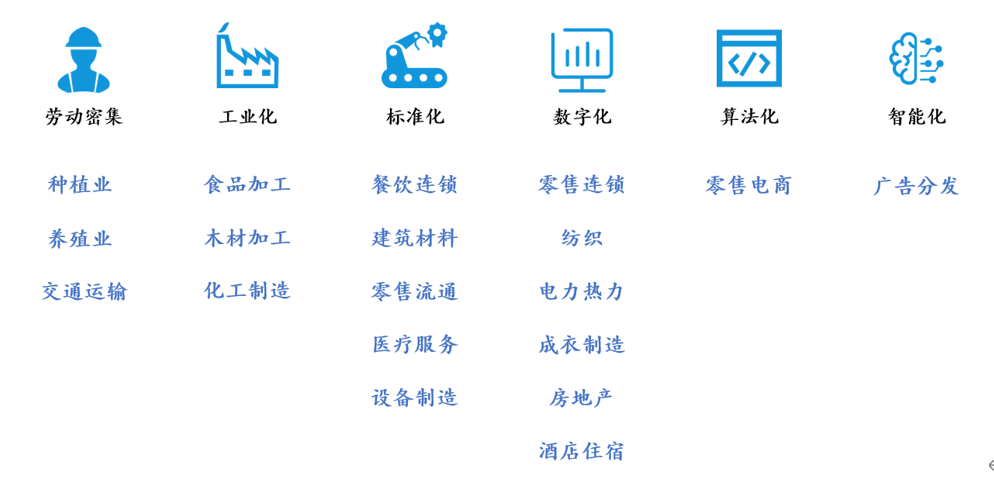
From the internet's birth, a new parallel universe opened. Every entity in the physical world gained a digital counterpart — tagged, formatted, existing in a new state. Today, ad distribution has fully reached the intelligence stage because information flows are the easiest to distribute through tagging; new media channels have made ad placement more precise.
E-commerce's path to intelligence hasn't been as smooth as advertising's, because goods in e-commerce transactions carry an extra layer of offline attributes compared to information flows: which city is the inventory in, when did it enter the warehouse, what's the delivery path and timeline — all directly determining whether final delivery costs are optimized. In the e-commerce supply chain platform space, 5Y invested in Xingyun Group. When the separation of production, supply, and sales became an established trend, and both brands and traffic grew increasingly fragmented, a digital e-commerce supply chain platform became a critical central nervous system for improving overall e-commerce delivery efficiency.
Drawing on e-commerce's evolution, we've roughly divided industrial evolution into six stages as shown. Industries currently moving from industrialization to standardization, and from standardization to digitization, signal emerging potential for algorithmization — making them particularly worth watching.
Moving from industrialization to standardization means dramatically fewer SKUs to manage, with overall delivery shifting from disorder to relative rules and logic — a prerequisite for digitization. One key indicator of whether an industry has entered digitization: server count and cloud computing spending growth trends among its enterprises.
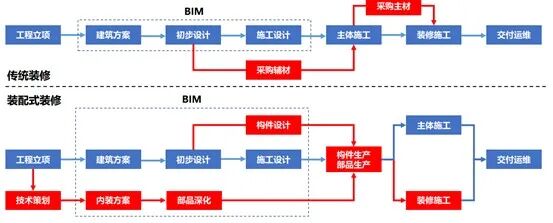
Comparison of traditional vs. prefabricated construction workflows
Take building materials. Traditional construction delivery follows the designer's plans, with construction crews ultimately transforming sand, cement, and tiles into a home's final form. Rising labor costs, environmental policies, and compressed delivery timelines have given rise to prefabricated construction. Here, upstream component factories complete production, and crews assemble on-site — delivery shifts from non-standard to standard, a massive signal of change in building materials. Upstream and downstream players in traditional construction may forge entirely new production relationships through this transformation. As an early-stage industry with huge variables, this space has attracted considerable capital attention this year; we've positioned in MiaoXiang, a prefabricated construction SaaS tool.
02 When Cost-Profit Tension Reshapes Supply-Demand Relations
Industries entering standardization and digitization represent just a阶段性 outcome. For early-stage investing, capturing signals before this stage, locking onto industries with transformative potential for focused observation, advance calculation, and preemptive positioning requires another methodology: the per-capita output vs. wage model.
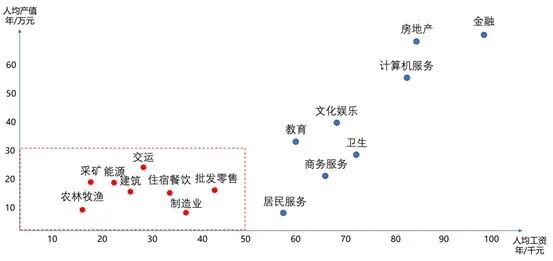
The National Bureau of Statistics divides all Chinese industries into 20 major categories and 220 subcategories. Using per-capita output on the vertical axis and per-capita wages on the horizontal, we map the 20 major categories as shown above. Industries with both low per-capita output and low wages typically harbor room for informatization or technological optimization to structurally transform their cost-profit models.
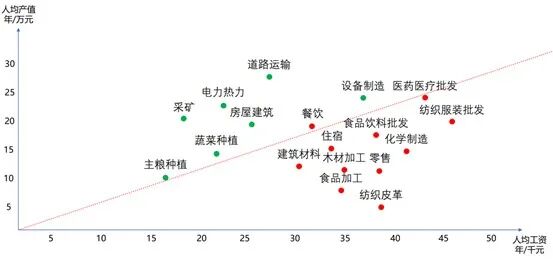
Zooming into the lower-left corner and drawing a regression line through all data points, we find industries below the regression line share a pattern: low per-capita output but high per-capita wages. These industries face relatively acute cost-profit tensions — our priority targets for observation and early positioning.
03 Connecting Supply-Demand Doesn't Make a Platform — Reshaping Does
Once we've locked onto an industry, we see varied playbooks and models, broadly three types: battlefields, nations, and arms dealers.
In e-commerce, Taobao is the battlefield, brands are nations, TPs, Taoke affiliates, and MCNs are arms dealers. Battlefields — transaction platforms — are the crown jewel of venture capital, the biggest whale to catch in industry transformation opportunities. But transaction platforms require many preconditions, and must continuously build long-term moats through asymmetric competitive advantages. The notion of simply matching supply and demand and calling oneself a transaction platform is perhaps the most beautiful misunderstanding of this business model.
We decompose supply-demand relationship characteristics across industries into two factors (bilateral/multilateral, symmetric/asymmetric), yielding four states: bilateral symmetric markets, multilateral symmetric markets, bilateral asymmetric markets, and multilateral asymmetric markets. Bilateral means supply and demand identities don't shift — in ride-hailing, passengers and drivers have fixed roles. Multilateral means supply and demand coexist in the same identity: one entity may simultaneously be buyer and seller, as with most wholesalers in trade. Symmetric means stable supply-demand relations; asymmetric means highly volatile, unstable supply-demand relations.
All great transaction platform companies transform originally asymmetric markets into symmetric ones, building deep moats and competitive barriers. Take Meituan. Catering was inherently fragmented and asymmetric — nobody wants to eat at the same restaurant all day. Meituan's original model was simple information matching, driving traffic to merchants through group buying, only to discover countless ways for consumers and merchants to connect and bypass the platform. But connecting this market through logistics created an insurmountable delivery barrier: no individual merchant could economically build its own delivery network. So Meituan Food Delivery found a scenario within a bilateral asymmetric market, built a bilateral symmetric market, and became a $200 billion company. The massive variable seized here: the scale of commercial flow from catering industry digitization, combined with the exponential decline in logistics costs driven by algorithmic technology.
Thus in early-stage investing, discovering asymmetric markets and observing technological or business model iterations that generate massive variables is crucial for identifying transaction platform opportunities. An asymmetric market's persistent existence always has deep historical roots. So when an industry begins evolving from asymmetric to symmetric, what elements should we watch?
Production method transformation: Does the industry have a new production method making previously unscalable elements scalable?
Supply-demand digitization level: Does the industry's upstream and downstream have sufficient digital infrastructure for transactions to occur online, becoming measurable and adjustable through subsidies?
Key scaling element: With the first two conditions met, what's the core production element enabling rapid scaling? Capital? Algorithms? Traffic? Non-market factors? What we often call the fulcrum of leverage.
First cosmic velocity critical point: First cosmic velocity is the critical speed for spacecraft to escape Earth's gravity; here, it means the point where a business model gains more acceleration momentum than competitors.
This is quite abstract, so here's a case 5Y invested in last year: Tongyu Technology, serving securities firms' financial derivatives businesses. With national encouragement of direct financing markets, China's financial derivatives market saw nominal principal grow 160% month-over-month in 2020. Many securities firms' legacy systems couldn't support rapidly expanding asset management scale, so Tongyu first provided a cloud + local position risk management system (production method transformation). Previously, each securities firm had its own standards and logic for derivatives products; today Tongyu's management system serves 24 of 37 licensed securities firms (first cosmic velocity critical point), while also providing a standardized derivatives product design tool (supply-demand digitization). Products must be sold, so Tongyu added a quoting system,切入 into transactions. Derivatives markets are inherently multilateral asymmetric: securities firms simultaneously hold buyer and seller identities, with natural quoting needs driving trading activity (key scaling element). A originally multilateral asymmetric market is becoming multilateral symmetric.
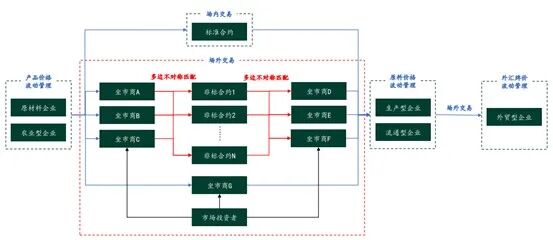
Financial derivatives market transaction flow
So Tongyu's position management business, collecting annual fees, looks like an enterprise service company; its derivatives design tool, collecting license fees, looks like a tools company; its quoting business, collecting information service fees, looks like a transaction platform company. But we also call them an industrial internet company.
04 China Will Birth World-Leading Business Models in Industry
The geographic distribution of production versus consumption shapes the development patterns of industrial internet versus consumer internet. Production locations and population distribution are influenced by historical evolution and natural climate — factors that will significantly determine divergent paths for Chinese and American industrial companies.
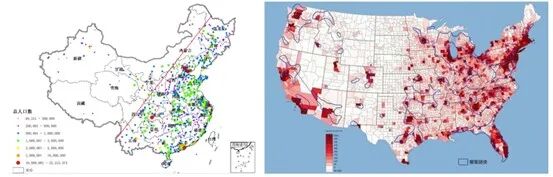
Population distribution: China vs. US
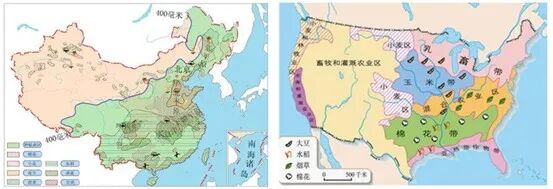
Major crop production regions: China vs. US
With only 600 years of history, the US has high urbanization and population concentration, well-planned industrial belts, and a temperate continental climate producing relatively regular agricultural belt distribution. China, a 5,000-year-old civilization, has population relatively evenly distributed east of the Hu Line. With a temperate monsoon climate, our agricultural belts are more dispersed due to monsoon influence. Concentrated industrial belts and concentrated population distribution led American industrial companies to achieve scale largely through capital mergers and acquisitions, easily maintaining bilateral symmetric market structures. China's more dispersed industrial belts and population form a "Local to Local" industrial supply chain格局. Due to asymmetric supply-demand distribution, our industrial companies struggle to achieve scale effects through M&A. Copying American peers in China easily leads one into a ditch. But we also possess distinctive endowments for this era: broader digital infrastructure and world-leading algorithmic technology. This land has the soil to nurture world-leading business models. Today, large numbers of Chinese industries still harbor "asymmetric" markets. Digital penetration across industries and maturing algorithmic technology will become China's unique industrial internet development model. Discovering massive variables through technological and business model innovation, and backing founders shaping world-class companies for China's industrial upgrade, is the historical mission of our generation of venture capitalists.
5Y hopes to engage with innovators using technology and algorithms to transform industries, and looks forward to working with you to make our nation's industrial innovation even better.



5Y Capital (formerly Morningside Venture Capital) currently manages approximately $5 billion in USD and RMB dual-currency funds. We believe that if the crazy you in others' eyes starts to be believed in, the world becomes a better place.
BEIJING · SHANGHAI · SHENZHEN · HONG KONG