The Longest-Running Animated Film Production in History: How Their Obsession and Madness Changed the World | 5Y View

Some people burned through their youth and, in doing so, shaped the generations that followed.

Today's post is about the animated film that took the longest to make in history, and the story behind it.
The Thief and the Cobbler, as the film is called, may be unknown to most people, but it profoundly shaped the landscape of Western animation and remains forever etched in the memories of animators.
Behind it lies more than three decades of people burning through their lives, pouring their youth and heart into this work. Their obsession and madness influenced the industry and countless who followed.
I hope this story offers you some inspiration :)
Do you know how long the longest film production took? In 1954, German director Leni Riefenstahl's Tiefland took 20 years — but that's merely the record for live-action. The longest production in cinema history belongs to an animated film, far surpassing Tiefland's two-decade mark. From 1964 to 1995, it consumed 31 years, with countless missed deadlines along the way.
It gathered the most talented people of the era, united by a shared ideal; and during those three decades of production, the director "casually" picked up three Oscars in his spare time — yet the work to which he devoted half his life remained largely unknown.
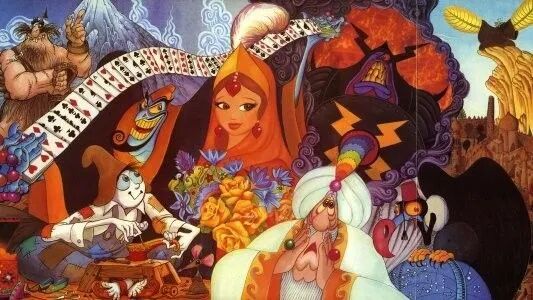
Though this animated film's name may be unfamiliar to most, it profoundly shaped the Western animation industry and will be forever remembered by animators and scholars alike. Its name is The Thief and the Cobbler.
The story begins with a Canadian animator who emigrated to Britain: Richard Williams. Williams taught himself animation from age 12, and by 22 had opened his own studio in London. In 1958, he produced his first animated short, The Little Island, which won that year's BAFTA for Best Animated Film — he was just 26. Then in 1962, A Lecture on Man won the satirical prize at the Annecy International Animation Film Festival.
Young and successful, with a smooth career trajectory, he began pursuing higher-quality animation. And so, he set out to challenge something no one had ever seen: an animated feature tackling serious themes — and in 1964, the legend began.
Initially, it was called Nasruddin, the figure familiar to Chinese audiences as Afanti in Middle Eastern folklore. The source material came from Idries Shah's The Tales of Nasruddin, and the author and his family privately financed the feature adaptation.
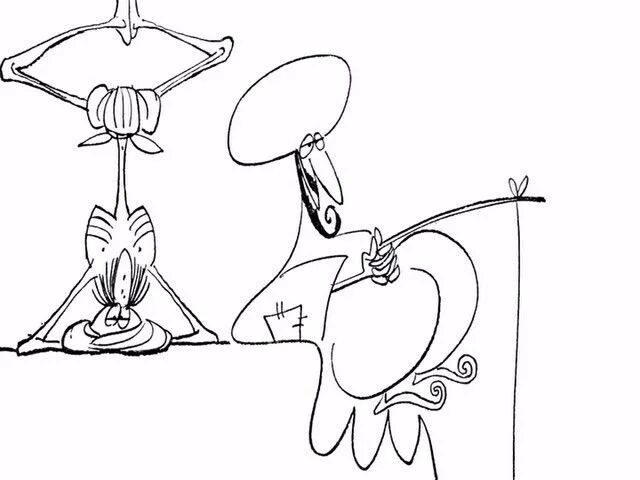
The original story was about Afanti and a thief. For the first five years, Williams continued taking commercial advertising jobs to fund production; then after studio work ended each day, he'd return to Nasruddin, running dual shifts around the clock.
Though Nasruddin offered no additional salary at the time, Williams still assembled notable animators — including Roy Naisbitt, who had worked on 2001: A Space Odyssey, as the film's art director and lead layout designer, and Warner Bros. veteran Ken Harris, famous for the Looney Tunes series (Bugs Bunny, Daffy Duck), as lead animator.
During Nasruddin's production, Williams took a commercial gig: a TV short of A Christmas Carol for ABC. It unexpectedly won the Academy Award for Best Animated Short, bringing more attention to Nasruddin.
The Oscar was a pleasant surprise for Williams. In his own words, A Christmas Carol was practice for Nasruddin — a test of their pipeline management, weaknesses, and stress tolerance, training before the marathon. The short's success drew more people to the project, and with a screenwriter joining, the slender story collection was reshaped into a complete narrative.
Everything seemed to be falling into place. Yet for this legendary animated film, the real trials had only just begun.
Nasruddin was privately funded by the author's family, who demanded 50% of the film's profits — already a harsh condition, but Williams had no alternative. They also controlled company management and finances, and the accountant they appointed even cooked the books to let the author's brother embezzle funds.
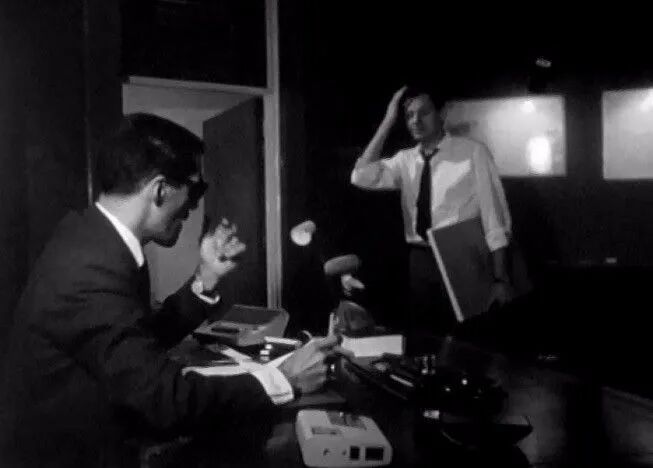
On the left: the author's brother, who made off with company funds. In 1972, after discovering the accounting fraud, Williams fell out with the family and parted ways. By then, Nasruddin had been in production for nearly eight years, with nearly three hours of footage completed — but Williams could no longer finish it, and had lost the rights to the protagonist Nasruddin (Afanti). Eight years, and the studio's finances were still empty, all energy poured into Nasruddin.
A normal person would have given up after such a blow. But Richard Williams was perhaps the most obsessive madman in all of animation. He cut every scene featuring Nasruddin (Afanti), redesigned a new character — the cobbler Tin Tack — kept the thief's footage, and changed the title from Nasruddin to The Thief and the Cobbler. The crew set sail again.
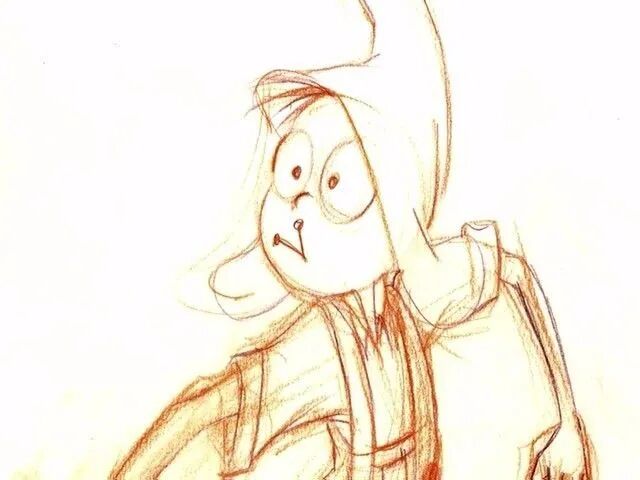
Afanti became the cobbler Tin Tack. In 1973, production was essentially back to square one, and the financial situation was direr than before. Fortunately, several names of enormous significance in animation history joined Williams's studio, chief among them the legendary animator Art Babbitt, who had been silent for years. Babbitt had been one of Disney's dominant animators in the 1930s: among the first to attempt realistic characters at Disney, introducing live-action reference; the creator of Goofy; and the pioneer of "breaking joints."

The Goofy character was designed by Art Babbitt during his time at Disney.
But in 1941, he participated in and led the Disney animators' strike, was subsequently cold-shouldered by Disney, and forced to leave. For nearly three decades afterward, his name was largely forgotten, with no particularly influential work — just some shorts and commercials.
When Williams came to him, Babbitt simply looked through the materials he'd brought and said: "You're doing animation wrong." Williams replied: "Then please come teach us."
And so Babbitt went — and taught for twenty years.
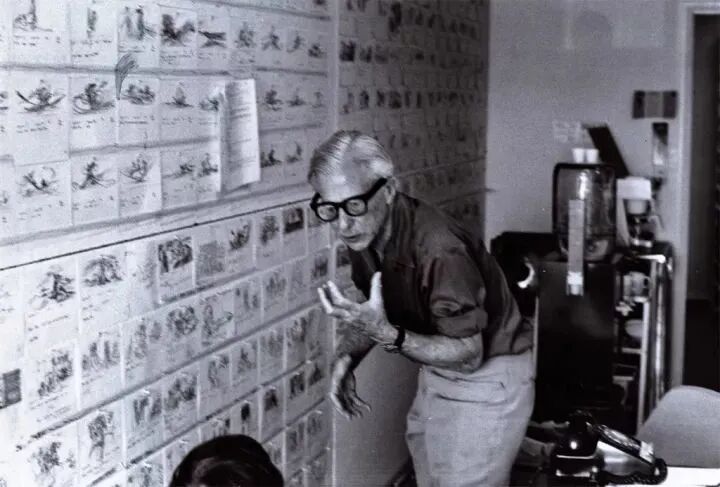
Babbitt teaching at the studio
At the time, Babbitt's animation instruction was acclaimed not just within the studio but across Europe. His action analysis was extraordinarily methodical; he could pinpoint flaws in others' animation with crystalline clarity — a natural teacher. He passed on the essence of what Disney had distilled to a new generation of European animators.
Babbitt trusted Williams deeply, believing that what Williams was doing couldn't be done anywhere else in the world. He even said that Williams was saving animation, saving an art form sliding into the abyss. That everyone working on this film was saving the art of animation, leading it beyond where anyone had gone before.
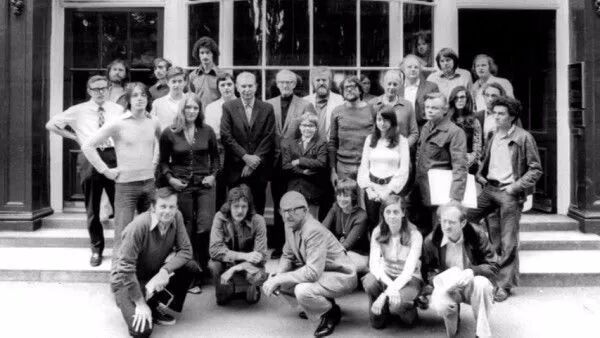
1975: group photo of Richard Williams's studio
This was no exaggeration. It was the 1970s; American animation's golden age had passed. Warner Bros. and MGM had closed their animation studios; only Disney maintained a feature every few years, but the quality paled next to the 1940s–60s. What dominated the market were TV cartoons relying entirely on gags and voice acting to pander to audiences — barely animation at all. Apart from occasional eye or hand movements, the bodies remained still. Some TV animation didn't even bother animating lip sync, simply compositing in filmed real lips. It was arguably the darkest period in American animation history.

Some TV animation was so lazy it wouldn't even draw lip sync
Yes, "saving animation" — he meant it literally. This was why he threw himself into The Thief and the Cobbler without regret. He had watched American animation decline step by step, powerless to stop it; in a sense, Williams had saved him.
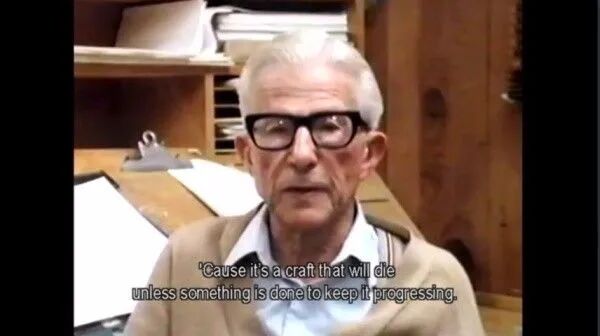
"Animation is a craft. If no exceptional works push it forward, it will die."
Another veteran from American animation's golden age in the crew was Ken Harris. With Nasruddin's collapse, Harris had the most cause for complaint. Since joining the studio in 1967, he had animated the largest share of footage over four-plus years as lead animator.
When told they'd have to abandon nearly all that work, he simply shrugged calmly: "Well, looks like I'll have to redraw it all." Harris was profoundly humble and low-key, like a dedicated craftsman. His animation matched his character — unlike many Warner animators' wildness, it was disciplined, focused, logical, and methodical.
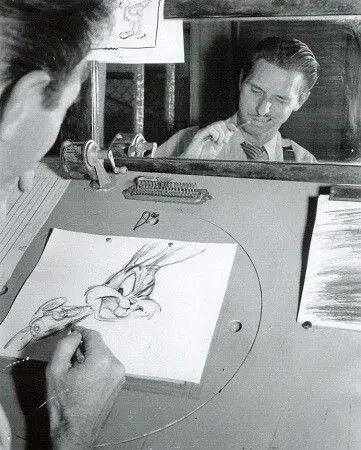
Young Ken Harris working on Bugs Bunny animation. At the time, Babbitt wasn't what he once was, while Harris remained the most spry of the old guard, handling the most animation in The Thief and the Cobbler's sample reels — the vast majority of shots for one of the protagonists, the thief.
John Culhane, a crew member at the time, recalled: "It was ambition. In this world, if you're an artist, and there's a chance to participate in making the best possible work to end your life... no one would refuse."
Beneath his unassuming manner, Harris perhaps harbored the most fervent belief of anyone. Day after day, he animated for The Thief and the Cobbler, uncomplaining through endless script revisions. For most, this was an ordeal with no end in sight; Harris simply didn't care.
In 1979, The Thief and the Cobbler completed a nearly 10-minute sample reel, the "War Machine" sequence. Harris animated most of it. In 1982, Ken Harris died at 83, after 14 years on The Thief and the Cobbler. The film still had no full financing.
Richard Williams was a pathological perfectionist, and many of his actions seemed outlandish to ordinary people. As director, he personally did clean-up for the veterans, even drew in-between frames himself.
This is the most junior position in mid-production, typically filled by newcomers; most animators start as in-betweeners. With production schedules already tight, the director was still doing the most fundamental, most detail-oriented work.
Williams himself knew that the artistic shorts he'd won awards for early in his career hadn't demanded much drawing skill; to make perfect work, he had to fill in his gaps. Such obsession made every project exceed its schedule — yet it was precisely this obsession that made him one of the finest animators of his era.
From The Thief and the Cobbler's beginning, he barely had time for family, always animating alone in silence. He paid a price for his obsession — his first wife finally couldn't bear it and divorced him.
For over two decades, scripts were endlessly revised, completed shots repeatedly scrapped and redone; production seemed endless, and many wondered if this film would ever be finished. One young animator recalled: "My wife was ill, but I could only visit her during lunch breaks. From then on, I thought: maybe I should choose to live for myself." He left the crew in 1980.
The newcomers had families, lives, their own goals. So they came and went, while the old guard held fast. The turning point came in 1984. Williams's studio took a series of Disney-Fanta collaboration ads. In these, they achieved seamless integration of live-action and animated characters for the first time.
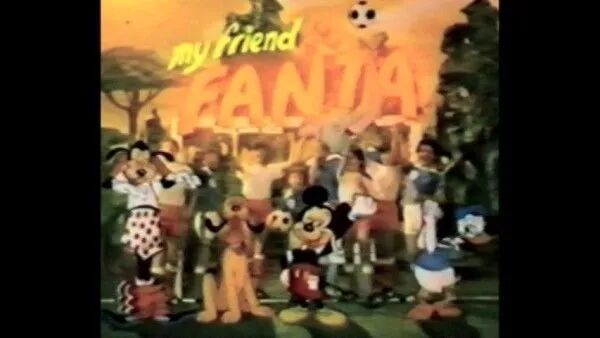
The Disney-Fanta collaboration ads, produced by Richard Williams's studio
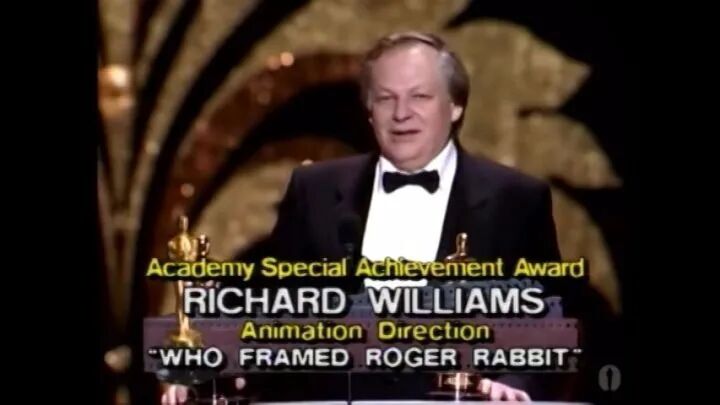
Steven Spielberg saw these ads and contacted Richard Williams — what he was doing aligned with a film Spielberg had long wanted to make: live-action and animated characters interacting in the same world, which became Who Framed Roger Rabbit. After seeing The Thief and the Cobbler's sample reels, Spielberg and Robert Zemeckis (director of Forrest Gump) were stunned by the quality, and invited Williams to direct the animation for Who Framed Roger Rabbit, with an agreement that Disney and Spielberg would later help distribute The Thief and the Cobbler in return. Who Framed Roger Rabbit was released in 1988; in 1989, Richard Williams won two Oscars for it — a Special Achievement Award and a Visual Effects Award.
Investors finally recognized his ability to helm large film projects, and his value. At last, Warner Bros. invested in The Thief and the Cobbler, signing a deal with Richard Williams. From 1964 to 1988 — 24 years — The Thief and the Cobbler had been made in the crew's spare time without full financing. Now, investment had finally arrived.
It seemed like hardship rewarded. But Williams would later recall this period with deep regret over signing with a major mainstream company.
With funding came the hiring of many new animators. In 1989, The Thief and the Cobbler began full-throttle production.
Many say The Thief and the Cobbler "reinvented" animation. Much of what the film displayed had never been attempted in any other animated feature: extended background animation, constantly shifting complex perspectives, and backgrounds and objects with excruciating detail; extensive parallel-point perspective (similar to what Chinese tradition calls "scattered-point perspective"), Persian miniature-influenced panning shots.
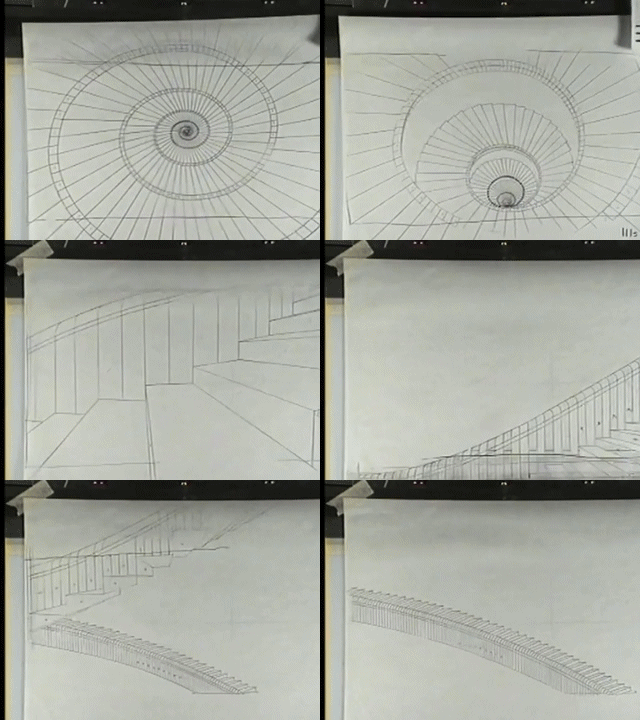
Can you imagine? Such complex perspective shifts, all hand-drawn?
It was filled with repeating, fractal, symmetrical pure geometric patterns, like a modern M.C. Escher, fully displaying graphic paradoxes and illusions.
To secure Warner's investment, Williams signed an agreement: if the film wasn't completed on schedule, Warner would assign Completion Bond Company to take over production. This agreement led to The Thief and the Cobbler's tragedy.
By late 1991, approaching the deadline, Completion Bond inspected the studio's progress as agreed, then reported to Warner that production was far behind schedule and severely over budget. Warner immediately demanded a workprint showing current progress and complete narrative structure. Williams assembled completed shots with uncolored pencil tests and some storyboard-only sequences, submitting it to Warner in May 1992. But by then it was too late — Disney's upcoming Aladdin made them anxious: if Aladdin released first, a Middle Eastern-themed Thief and the Cobbler would likely bomb. And so Warner threw him off the lot, canceled the investment; per agreement, Completion Bond took over production. The Thief and the Cobbler's tragedy began.
In March 1992, Art Babbitt passed away. He hadn't completed all the king's shots he was responsible for, but was spared, at least, the grief of watching his work desecrated.
In May 1992, Completion Bond selected Fred Calvert as new producer. Calvert cleared everyone out. When people returned to the studio two weeks later, they found only empty rooms.
Calvert took all the materials.

May 1992: empty animation cabinets
Calvert was a producer of cheap TV shows, utterly ignorant of animation. Such a person had no concept of animation quality; he simply needed to finish it as quickly and cheaply as possible.
So he drastically restructured the story, nearly eliminating the thief, turning The Thief and the Cobbler into The Princess and the Cobbler — a fable-like silent pantomime became a princess-falls-for-cobbler Hollywood musical romance, utterly typical and uninspired.
Calvert's greatest crime: he treated completed footage like garbage to be thrown away, including Ken Harris's final original drawings, those completed "War Machine" sequences.
Massive quantities of original drawings were sent to Asia for unprotected outsourcing, some damaged or lost.
In 1993, The Princess and the Cobbler opened in Australia and South Africa; then in 1995, Miramax further recut the film, retitled it Arabian Knight, and quietly released it in the US — grossing just $300,000.
One can only imagine Williams's reaction. It was virtually his sole reason for existence, his child. One animator recalled: "I watched the video at home and nearly cried. It was heartbreaking, an absolute disaster."
Later, Roy E. Disney attempted to restore the film through Disney's power, but with his death in 2009, restoration stalled again. Such was the fate of a legendary film. Richard Williams never spoke of The Thief and the Cobbler in public again, and stepped back from animation's front lines.
But this is not the story's end. The Thief and the Cobbler's influence was only beginning to ferment.
If you know Disney, you know they had a long slump from the 1970s through the late 1980s. This was the dark age of all American animation; Disney simply wasn't spared. But starting with The Little Mermaid in late 1989, Disney began its renaissance.
The true catalyst for this revival was 1988's Who Framed Roger Rabbit — Disney had sent animators to train at Williams's studio, dramatically elevating their skills, a crucial factor in the renaissance for a Disney that had suffered a decade-plus gap. The most famous among them: Andreas Deja, who later drew Scar in The Lion King.
During that long American animation dark age, Williams's studio was virtually the only commercial animation operation pursuing high drawing quality, preserving a spark of hope for Western animation. Throughout the three-decade production, Williams's studio educated numerous renowned animators.
Such as Tom Sito, one of DreamWorks's founding veterans;
Such as concept designers Rowland Wilson and Suzanne Wilson, the husband-and-wife team behind The Little Mermaid, Tarzan, Hercules, Anastasia, and others;
Such as Eric Goldberg, animation supervisor on Disney's The Princess and the Frog and Paperman;
Such as Neil Boyle, French director Sylvain Chomet's go-to animator. And more.
These are merely the animators directly educated; know that nearly everyone who studies animation has, knowingly or not, benefited from Richard Williams and this work — Williams compiled his experience into animation history's most classic tutorial, The Animator's Survival Kit. Over 80% of Western animation principle textbooks today are based on teaching from Williams's studio. Whether Tony White (Animation from Pencils to Pixels), Tom Sito (revised Timing for Animation), Eric Goldberg (Character Animation Crash Course!), or Nancy Beiman (Animated Performance), their pedagogical approaches trace back to Richard Williams's studio.
This is because early Disney instructional materials covered only Disney style; other companies' internal training covered only their own strengths. Only Williams's studio, gathering veterans from the golden age across different companies (Fleischer, Disney, Warner, UPA), could synthesize all strengths and meticulously organize all American animation styles.
It was Art Babbitt's rational, detailed teaching practice and the veterans' experience from across the industry that enabled Richard Williams's studio's exhaustive analysis and summary of animation principles. The entire Western animation principle teaching system was built upon the foundation of Art Babbitt and Richard Williams's studio.
In animation style, Richard Williams and The Thief and the Cobbler influenced Disney's subsequent aesthetic toward full animation — extreme, extensive use of animation on ones began here. The Thief and the Cobbler was likely the only animated feature in the world using animation on ones throughout. Before this, in the 1950s–60s, Disney used animation on twos as the baseline, with only occasional ones; after the Disney Renaissance began, the proportion of ones grew ever larger.
Richard Williams also served as the principal force spreading Milt Kahl's style (one of Disney's Nine Old Men) to Europe; the elongated limbs and broken joints in The Thief and the Cobbler became common features of European 2D animation. For instance, the animation performance in French director Sylvain Chomet's films is essentially an evolution of Milt Kahl's style.
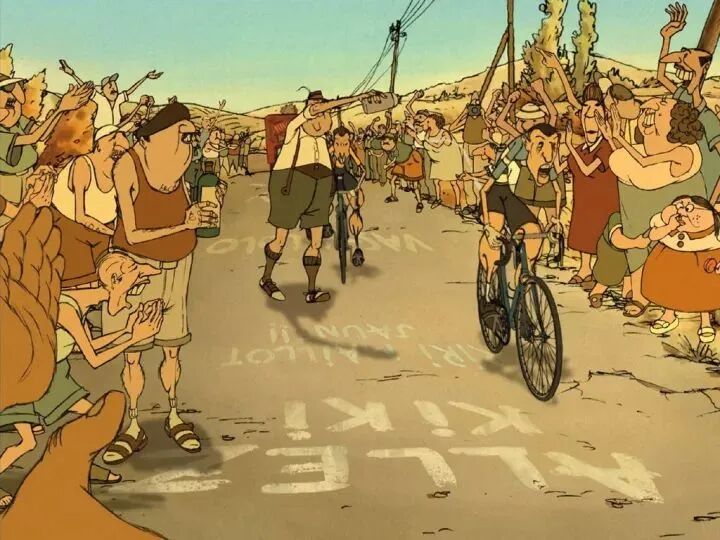
Sylvain Chomet's stylistic approach derives from Milt Kahl and Richard Williams
Richard Williams paid a price for his obsession. Pursuing perfection too intensely, the chaotic production site with endless repeated revisions and delays ultimately sank the film. But precisely because of his obsession, countless people benefited from their efforts; this film ignited passion in countless people to enter animation. This sole spark during American animation's dark age ignited the 1990s 2D animation renaissance. Art Babbitt's words about "saving animation" were vindicated. An unfinished film, with such impact on Western animation. If it had been completed? No one knows.
It likely would have struggled commercially — almost no plot to speak of, more like a pure visual experiment. An experiment bringing animated film closer to animation's essence.
What is animation? Most see it as entertainment, some as commerce; but they saw it as pure art. For this pursuit, some burned through their lives, others spent most of their youth. This vast, protracted sacrifice was interrupted, but those who received its grace will carry their light forward, singing their story forever.




5Y Capital (formerly Morningside Capital), currently managing approximately $5 billion in dual-currency USD and RMB funds. We believe the world becomes a better place when the crazy you in others' eyes begins to be believed.
BEIJING · SHANGHAI · SHENZHEN · HONG KONG