Why Is Imagination Humanity's Most Valuable Survival Tool? | 5Y View

Humanity began by asking the simplest questions, and grew ever more astonished by complexity.

Why Do We Need Imagination?
Imagination is not an accessory or ornament — it is a vital survival tool. As Guido Tonelli, professor of general physics at the University of Pisa, discusses in today's article, imagination allows us to experience emotion and fear, grief and danger. It lets us see the future and find the motivation to move toward it.
When imagination is cultivated within a group, it becomes a powerful survival instrument, giving you the energy to carry on even in the most desperate circumstances.
Great inventions and creations also spring from imagination — creators break through countless constraints, and on the foundation of experimental verification, arrive at more inventive technologies and bolder hypotheses.
Hope this article offers you some inspiration :)
This article comes from the WeChat account: Jiemian Culture (ID: BooksAndFun). Reproduction without authorization is prohibited. Author | Guido Tonelli; Translator | Wang Ningyuan
In his Theaetetus, Plato has Socrates say, "A certain kind of infection is peculiar to the philosopher: it is wonder, thaumazein. And philosophy has no other starting point than this." The word contains the root thauma (meaning "marvel" or "wonder"), which also appears in thaumaturgy ("magic"). Thaumazein is often translated as "wonder." Philosophy is born of wonder, mixed with curiosity — a curiosity that arises in moments when we confront something that fascinates us, transcends us, and defies explanation. Aristotle explicitly writes that humans begin by asking the simplest questions, increasingly marvel at complex things, and finally experience wonder by studying the moon, the sun, and the stars, and by inquiring into how the universe itself came to be.
When we look at a sky full of stars, the sense of wonder we receive is a powerful feeling. Even today, it remains an intense, even emotionally moving experience. This feeling connects us to the ancient, reverberating wonder shared by thousands of generations before us. But perhaps this feeling is not enough to help us understand the origin of that deep-seated, urgent, primal, almost innate need to seek answers to the great questions.
The contemporary philosopher Emanuele Severino has raised this theme again, insisting on translating thauma as "wonder mixed with pain." In this way, we recover the original meaning of the word, and knowledge serves as "an antidote to the terror provoked by the sudden appearance of devastating events."
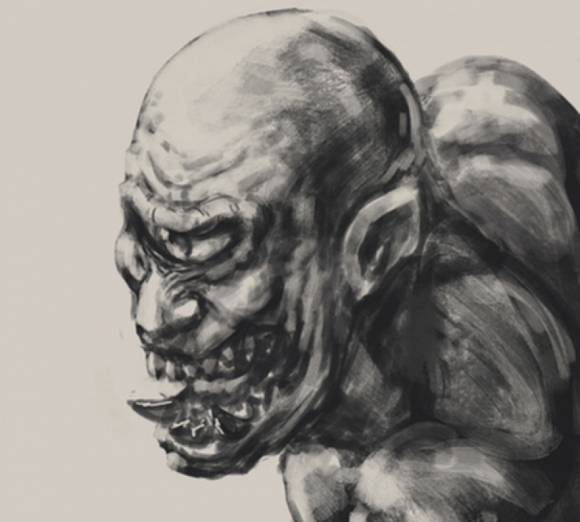
Wonder that borders on terror: the astonishing scale and scope of the universe inspires a painful sense of wonder, not unlike what a Cyclops evokes. Image: DomCritelli / Shutterstock
Indeed, Homer uses the word in this way too, mentioning thauma in his description of Polyphemus — the Cyclops who dismembers and devours Odysseus's unfortunate companions. In this case, the implicit connection to pain is self-evident. To see the mythical Cyclops — a gigantic creature — provokes both wonder and terror. This giant, symbolizing nature's untamable forces, fills us with wonder at his inconceivable power, even as we are plunged into deep anguish at our own vulnerability and sense of meaninglessness. The forces unleashed by nature, such as volcanic eruptions or terrible hurricanes, simultaneously fascinate and terrify because they shatter our world or swallow us in an instant. In this larger picture, the role played by small, fragile lives like ours — constantly exposed to suffering and death — is utterly insignificant.
It is in moments like these that the narratives and explanations of myth, religion, philosophy, or science can comfort and reassure us, imposing order on uncontrollable chains of events and in this way protecting us from pain and fear. In such narratives, everyone has their role, everyone plays their part, and it gives meaning to the great cycle of existence. We are consoled because we feel protected, and our fear of death subsides. We remain fully aware that for us, everything will end, and that compared to the long evolutionary cycles of the material structures around us, we will end quickly. But when we learn that this whole obeys the order described in our narrative, we feel reassured.
For millions of years, humans had to face the harshness of life every single day. Only since a few decades ago, and only for part of the world's population, has this experience of extreme fragility and total instability gradually receded. But deep in our souls, we still feel that ancestral pain. We are all like Leo, the young protagonist in Melancholia, seeking protection and solace in the face of an inevitable disaster about to strike Earth. He needs someone to tell him: Don't be afraid, you will be all right. He finds this solace in his aunt Justine. Justine suffers from severe depression, but when the crisis comes, when all the rational and normal people lose their minds, she proves to be the most lucid and summons enough resilience to preserve her humanity. The small tent she and the child use for shelter cannot protect them from the coming catastrophe, but until the very moment of impact, in his aunt's warm embrace, listening to her calm storytelling, Leo feels safe.

We are all like Leo, the young protagonist in Melancholia, seeking protection and solace in the face of an inevitable disaster about to strike Earth. Still from 2012. Image: Columbia Pictures
Art, beauty, philosophy, religion, science — in short, culture — is in some sense our magic tent, which we have urgently needed since ancient times. They were likely born simultaneously, as different expressions of symbolic thought. It is not hard to imagine that the rhythm and sound of words facilitated the spread of origin stories, and that songs and poetry developed in this way; something similar probably happened with the signs and symbols depicted on cave walls, which grew increasingly complex and refined in form; in the rituals and ceremonies accompanying mourning, regular sounds were often accompanied by bodily movements or the songs of wise men and shamans. Science is part of this story; it is no accident that episteme (knowledge) and techne (craft or art) are intertwined, that knowledge is linked to the capacity to produce tools, artifacts, and machines.
For the Greeks, techne — the root of the English word "technique" — also indicated the common ground between artisan and artist. This is why, in the production of a flint knife, technical requirements — that is, making a sharp, easy-to-handle cutting tool — were intertwined with aesthetic requirements: producing something symmetrical, refined, perfectly balanced. In short, it should be exquisite, like a work of art.
These pressing needs seem to have constituted something irresistible for all human groups that have walked the earth for thousands of years. Even the most isolated remote tribes in the forests of Borneo or the Amazon have developed their own rituals, specific forms of artistic expression, and their own symbolic universes, all supported by an overarching story about their origins. Without such narratives, it would be impossible not only to build great civilizations, but even for the most basic social structures to survive. This is why all human groups on our planet possess such intense cultural characteristics.
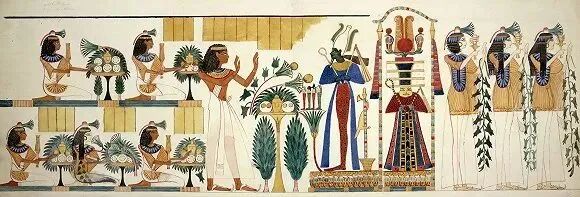
Rituals, specific forms of artistic expression, and their own symbolic universes — all supported by an overarching story about their origins. Egyptian tomb mural. Image: British Library
Culture — the awareness of our deepest roots — is a superpower that allows us to survive even under the most extreme conditions. Imagine two primitive social groups, two small Neanderthal tribes, living in isolation from each other in the icy Europe of that era. Now suppose that one of these groups happens to develop its own unique vision of the world, cultivating and perpetuating it across generations through rituals and ceremonies, and embodying it visually in cave paintings, while the other group does not — that is, it develops no complex cultural forms.
Now let us assume both groups suffer a catastrophe: a flood, or a period of cold more extreme than usual, or a ferocious beast attack, leaving behind only a lone survivor. In both groups, this last survivor will have to overcome countless dangers, face all kinds of difficulties, perhaps migrate to other regions, even need to evade human hostility. Which of the two will show the greatest resilience? Who will have more chance of survival?
A creation story, a narrative of origins, gives you the strength to get back up when you've been knocked down, the drive to keep enduring in the most desperate situations. We cling to the straw that gives us protection and identity, and we find the strength to resist and carry on. We place ourselves and others in our family within a long chain of events beginning in a distant past, and this allows us to imagine the future. Those who possess this knowledge can place the terrifying unpredictability of the present within a broader framework, giving meaning to suffering and helping us overcome the most terrible tragedies.
This is why, thousands of generations later, we still assign value to art, philosophy, and science. Because we are the inheritors of this natural selection. Those individuals and groups best equipped to develop symbolic universes enjoyed significant evolutionary advantages, and we are their descendants.
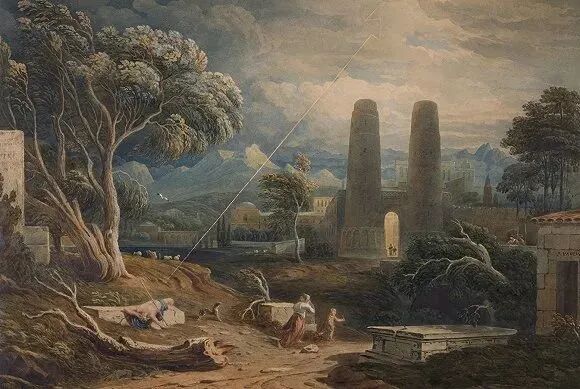
Placing the terrifying unpredictability of the present within a broader framework, giving meaning to suffering, helping us overcome the most terrible tragedies — this is why, thousands of generations later, we still assign value to art, philosophy, and science. A Thunderbolt. Image: Birmingham Museums Trust
We should not be surprised by the power of the symbolic and the imaginative. The condition of being a social animal is something far deeper and more intrinsic than the simple fact of our living in organized groups of individuals.
In recent years, highly ambitious projects have been launched around the world to study the functioning of the human brain. These are well-funded, resource-rich multidisciplinary projects, mobilizing thousands of scientists. In many cases, to understand some of the brain's basic mechanisms in detail, scientists use electronic technology to simulate neuronal networks and their interactions. All these efforts are very useful for understanding certain dynamics of brain operation. So why do neuroscientists — who welcome technological development — tell us that scaling up these basic structures to create an artificial brain would be pointless?
This is not merely a matter of overcoming major technical difficulties. Our cranium carries nearly 90 billion neurons, each capable of establishing up to 10,000 synapses with neighboring neurons. The problem is a deeper one. Even if we could build an electronic device so complex that it could technically reproduce the structure of our brain, it still would not be a human being. Something fundamental would be missing from this faithful copy, something whose replication in electronic form would be incalculably difficult. What would be missing from this copy is interaction with other human brains, the mediation carried out through language, bodily and emotional relationships. In other words, a person becomes human through others' perception of them, in others' eyes and in emotional exchange with them, through interaction with other humans in the social group to whom we are related.
The pliable brain of a newborn infant takes shape in relation to the world mediated by the adults who care for her, beginning with the mother's gaze. A baby looks into the eyes of the one feeding her, their relationship reacts upon itself, and on this basis reshapes his synapses. What we call the human brain is born from the interaction between such plastic systems — capable of adapting and being shaped by stimuli from outside — and the series of relationships established with other members of the social group: relationships nourished by hopes and desires that begin to take shape even before the embryo in the maternal womb. The new life dialogues with the parents' wishes before birth, and comes into contact with the past and with the humans who await it. It is projected into the future through fantasies that build the small social group surrounding the new life: grandparents or parents and other family members discover resemblances connected to ancestral stories, and old fears and new expectations arise. No electronic device could ever reproduce all of this.
To confirm the importance of what we are trying to describe, we need only think of the examples of young children lost or abandoned in the wild, raised in the company of animals. Their brains are structurally identical to those of their contemporaries, but due to the lack of human contact, they fail to become fully human. No amount of later contact or rehabilitation attempts can fill the void created by this missing early interaction.

The pliable brain of a newborn infant takes shape in relation to the world mediated by the adults who care for her — beginning with the mother's gaze. Image: Minnie Zhou / Unsplash
When imagination and narrative are cultivated within a group, they become powerful survival tools. Those who can listen to and imagine others' experiences gain genuine knowledge in this way. Narrative condenses the long-accumulated experience of previous generations, enabling us to experience and understand — allowing us to live thousands of different lives. Imagination lets us experience emotion and fear, grief and danger, the values of the group, reaffirmed and remembered through the efforts of generation after generation.
Imagination, developed and encouraged in socially and culturally more advanced groups, is the most effective weapon we have ever developed. Science too originates in imagination: by choosing to ground its narrative in experimental verification, it arrives at more inventive technologies and bolder hypotheses. To explore the more hidden corners of matter and the universe, science has had to overcome all kinds of constraints and transform the story of origins into an extraordinary journey.
In doing so, it has often needed to change the very patterns of how humans think about things. Throughout history, from Anaximander to Heisenberg and Einstein, it has done this many times, and continues to do so. Science advances unceasingly; it changes the way we see and describe the world. Whenever this happens, everything changes. Not only because of the new instruments and technologies that result, but more importantly, because changing paradigms transforms all our relationships. When we see the world through different eyes, our culture changes along with our art and philosophy. Understanding and predicting these changes means possessing the tools to build better human societies.
For this reason, art, science, and philosophy remain essential disciplines that give us continuity as humans. This unified worldview, born from our most distant past, remains the most suitable tool for meeting the challenges of the future.
This article was originally published in Nautilus magazine under the title "Most Effective Weapon Is Imagination." The original author, Guido Tonelli, is professor of general physics at the University of Pisa and a visiting scientist at CERN. His new book, Genesis: The Story of How Everything Began, was translated by Erica Segre and Simon Carnell. Translation: Wang Ningyuan. Editors: Huang Yue, Lin Ziren. Reproduction without authorization is prohibited.



5Y Capital (formerly Morningside Venture Capital) currently manages approximately $5 billion across USD and RMB dual-currency funds. We believe the world would be a better place if those who seem crazy in others' eyes begin to be believed.
BEIJING · SHANGHAI · SHENZHEN · HONG KONG WWW.5YCAP.COM