Good Questions Matter More Than Perfect Answers | 5Y View

What Will the World Look Like in the Next 5,000 Days?



Xiao Zhou
Vice President, 5Y Capital
Today's post features a talk by Kevin Kelly, founding editor of Wired magazine, delivered in October 2020.
Kevin Kelly's book The Inevitable was written in 2015. We didn't need to wait until 2050 for his predictions to materialize — within just five years, AI's ability to predict human behavior had already become extraordinarily precise. Big data, cloud computing, the Internet of Things, and other emerging technologies have thoroughly reshaped how people live.
Some believe because they see; others see because they believe.
Foreseeing the future requires vision and perspective, but more importantly, conviction — and the courage and persistence to push through the dim light.
Below is the full transcript of Kevin Kelly's talk:
If we compare ourselves to who we'll be thirty years from now, we know essentially nothing. We're still in the first hour of the first day — the beginning of the beginning. We must believe in the impossible.
I want to talk about where technology is headed over the next twenty years. Technology always moves in a certain direction. I call this the inevitable — trends as certain as gravity. Given chips and radio waves, the internet was bound to emerge; given the internet, mobile phones were bound to follow.
I'm not talking about whether Apple will win, whether Tesla will win, what will become of China, or what will become of America. That's not the kind of inevitability I mean. I'm talking about broad trajectories that I believe can be predicted, even if their specifics cannot.
The telephone was inevitable; Apple was not. I want to discuss long-term trends — these inevitable forces that intertwine and depend on one another, yet all push in the same direction.
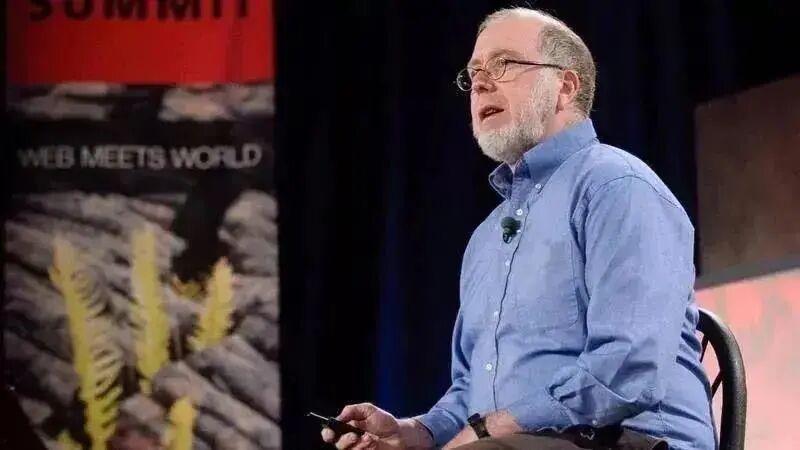
Kevin Kelly, founding editor of Wired magazine
Becoming — Everything is constantly upgrading
We can never trace the exact path of a single raindrop into a valley, but we know its direction — down, because of gravity. Similarly, while business trends are inevitable in their overall direction, they are unpredictable in their specifics.
We still have choices. New technologies will inevitably emerge, but we can choose what forms they take — that is, "what exactly appears" remains within our control.
The trends I'll discuss today are interdependent and mutually reinforcing. In the future, everything will flow and transform into something else. This fluidity is already underway.
Tangible products are becoming intangible subscription services. Where once we bought goods in stores, we now purchase services online — services that happen to include the goods we need.
We're moving from hardware to software. Everything is becoming software; this is the direction of flow. Nouns are becoming verbs; the tangible is becoming intangible. Products are transforming into services — from selling finished goods to offering subscriptions.
We inhabit a liquid world where everything is in constant flow, constantly upgrading. Take the car — perhaps the most tangible object we can imagine. Yet while you sleep, your Tesla keeps upgrading. It literally gets better overnight. This is the new world we're entering.
What does this mean for us?
First, lifelong learning — never stop. When you're perpetually learning, you remain perpetually new. Everything is uncertain; you are perpetually ignorant. Whatever your age, whatever your life stage, something new will always emerge. We must remain in a state of constant learning.
Second, everything exists in a state of becoming. What we once saw as products, we now recognize as processes. We used to receive published encyclopedias; Wikipedia is not an encyclopedia but a process of creating one — perpetually changing, perpetually in creation.
Cognifying — Your paycheck will depend on how well you collaborate with AI
The impact of future technological change will be permanent. Technology will converge with artificial intelligence. Its purpose is to make everything smarter, and this process of cognification is what technology brings.
AI represents a fundamental shift for society, perhaps comparable to the printing press.
Many things have already grown intelligent. Radiologists reading X-rays will be replaced by AI. Legal AI can review documents more efficiently than human paralegals.
Consider pilots: on a twelve-hour flight, human pilots work only seven or eight minutes; AI flies the rest. This is already happening.
Why do we need AI to help us drive? Google's self-driving cars, for instance. Because they think differently than we do — they don't get distracted by irrelevant concerns; they simply focus on driving.
What we're doing with AI isn't making it smarter than humans in every way — it already surpasses us in many. We're creating diverse forms of AI with multiple modes of thinking.
Google began training AI to play video games ten years ago. They never taught it how to play; they taught it how to learn. The difference between AI and humans lies only in how they think.
In the future, tens of thousands of startups will apply AI to specific domains. The more people use them, the smarter machines become — a snowball effect.
We've historically understood intelligence as one-dimensional. We shouldn't anymore.
Our intelligence is like different instruments playing different melodies; different people produce different music. Animals, humans, and machines operate at different rhythms, so their intelligences differ.
Many worry that robots will take our jobs. Some tasks can indeed be handed directly to robots. What we're doing with AI isn't making it smarter, but enabling it to learn independently, to develop more ways of thinking. Many new jobs will involve robots assisting you — job positions will continue to grow.
AI helped humanity advance from the electrical and steam ages to today's vibrant modern world. Today's cars let human hand muscles control 250 horsepower. Imagine converting that 250 horsepower into 250 minds — you'd no longer be driving a car but an automated computer. Humanity's future goal is to transmit intelligence as a service, as electricity is transmitted today.
So jobs requiring low efficiency suit humans best. Creative work, for instance — because creation inherently defies efficiency; it need not concern itself with correctness. This is work humans are suited for.
Anything that looks repetitive, uninteresting, devoid of pleasure — machines can handle. AlphaGo competing against humans was an unfair match; AI had absorbed all historical patterns.
In every future field, it will be the smartest humans plus machines. Your compensation will depend on how well you collaborate with AI. You must cooperate with machines, not fight them.
Screening — Any surface can become a screen
This trend already surrounds us. Screens are everywhere. Any flat surface can become a screen — the book you read, every surface you touch. Some people's clothing may become screens.
Different screens form an ecosystem. Not only do we watch them; they watch us. Screens can track your gaze, know where your attention focuses, what you value, then adjust what they display.
Emotion tracking is a prime example. Screens can monitor attention and emotion, adapting accordingly. They'll know when you're happy, when you're troubled. We're entering the age of screens — ubiquitous screens. We used to read books; now we read screens.
Books once conferred authority; now we inhabit a fluid, open, messy world where truth must be continuously assembled.
Flowing — Every business you run is a data business
Three phases of computing: first folders, then networks, now we're in an era of data flow. The cloud forms various streams — through WeChat, Weibo, Facebook, and others. We stream music, stream movies and TV. Everything has become a flow.
What is flowing? Data. Whether you're in real estate, medicine, chemicals, or education, your business is data. Business is data business. Ultimately, you're processing data. Processing data matters as much as serving customers.
The entire world pulses to the same economic rhythm. Companies cannot grow forever. But cities can — cities always grow.
The internet resembles a city, not a company, precisely because it possesses this quality of infinite growth.
Many companies have recognized this. So much data forms a superorganism far exceeding human brain capacity — a vast machine planet operating globally. The world economy seems to beat with the same pulse, to behave in the same patterns.
Remixing — Most innovation is recombination of existing things
Economists have found that genuinely new things are rare. Most innovation is recombination of what already exists. This recombination is what I call remixing. It's the direction the world is heading, a crucial trend.
To remix, you must first deconstruct — break things down to their most elemental states, then recombine them differently, cycling through this process repeatedly, like disassembling and rebuilding with LEGO.
Newspapers work this way too. A newspaper isn't a single object but a combination — sports, weather, book reviews, recipes, all assembled together. The internet does the same: different information combined, all previous newspapers deconstructed and reassembled.
Similarly, we can deconstruct banks — break down different banking functions and recombine them. Cars too. Essentially everything can be treated this way.
Apply chemistry's concepts to business. Like a periodic table of elements — examine the necessary elements in your business, deconstruct and recombine them repeatedly, and new things emerge. For companies to upgrade, they must deconstruct their composition, then recombine, generating new things in the process.
Filtering — If you capture attention, you make money
This is the other side of the coin. Choices abound — 6 million new songs yearly; we can't listen to them all. Movies, books, magazines, articles — same problem.
We'll need help finding what we truly need. This is filtering. Everything grows more abundant; the only thing growing scarce is human attention. No technology can expand your attention span.
Money follows attention. Capture attention, make money. Wherever people spend attention, value must be created. Work there, and you'll profit.
Since attention is the world's most precious resource, if I pay attention, I should be compensated. If I watch an ad, I should get paid.
Interacting — Its impact will be as profound as AI
In my view, interaction may prove as consequential as AI. Computers depend on interaction.
Why is television so engaging now? It used to be just a switch or channel change; now we interact with it, search on it, do countless things.
What will computers look like in 2050? Essentially, you'll interact using your entire body without obstruction — computers will be machines you can interact with in every dimension. Like a symphony conductor. Some nanoradar technologies can interpret the meaning of your finger movements.
What comes after smartphones? One possibility is VR — virtual reality, wearing a machine on your head to see things.
The second is MR — mixed reality. Put on such goggles, and everything exists in 3D. You can manipulate this reality with your hands, and you'll genuinely believe this reality exists.
Accessing — Ownership value becomes usage value
"Accessing" is hard to explain. Previously we owned products; now we use services.
Uber is the world's largest car company but owns no vehicles. Facebook is the world's largest media company but owns no content. Alibaba is the world's largest retailer but holds no inventory.
Ownership matters less now. In many ways, using is better than owning — immediate access, immediate discard, certainly better than possessing things. Because your goal is usage, but ownership burdens you with responsibility.
The concept of ownership has shifted; access trumps ownership. For many things, we need only use them, not maintain, store, or manage them.
Much software now follows this path — not purchased but subscribed. This shift extends beyond digital to physical industries, including cars. DiDi and Uber exemplify this. We need not own cars; we need only use the service.
In the future, on-demand services will outweigh ownership. The on-demand economy is Uber for every industry. Tangible businesses are transforming too.
We call young people nomadic — they travel the world carrying nothing, accessing whatever they need wherever they go.
In twenty or thirty years, emerging generations will travel without carrying anything. At any hotel, they'll provide clothes you want; you leave them behind, and the hotel handles cleaning.
You won't even need a phone. Any tablet you see will recognize you and become your screen. Any phone will recognize you and become your phone.
The entire world will be yours, knowing you intimately, providing whatever you need, delivering wherever you want. No luggage, no possessions — services for everything. A new kind of nomad, unburdened, roaming the world.
Sharing — The core isn't sharing, it's collaborating
People often talk about the sharing economy; I want to expand this concept.
First, today's sharing remains primitive. The world is vast; much can be shared. For entrepreneurs, the challenge is: what can we do so that the more we share, the more value increases?
When we discuss sharing, we don't mean sharing in the ordinary sense. We mean collaboration — sharing equals cooperating. Collaboration at scale, enabling hundreds of millions to interact cooperatively, can drive social transformation.
This scale was previously unimaginable. This is where sharing trends — not merely sharing devices, but generating enormous value and wealth, driving massive social change.
Beginning — Technology's purpose is discovered through use
Regarding technology: when something new first appears, no one knows its best use. Edison's phonograph — Edison had no idea what it was for.
The phonograph gradually found two applications: recording last words, and recording church sermons and songs. Eventually it was mainly used for the latter.
So purpose is often discovered through use — continuous experimentation. At the moment of invention, we can't envision everything. When new technology emerges, we don't know what it's for; only through use.
To evaluate technology, we must use it, not merely speculate. Because this trend is inevitable, to guide and control technology's direction, we must use it, then debug and optimize, making it better.
These are very new things. Though we spend over five hours daily on social media, we still don't understand what benefits it brings us. These questions remain unanswered. It demands that we truly learn it, use it — this takes time.
The work we do now may be completely different in two years. 150 years ago, 70% of Americans were farmers; now it's 1%. Did those 69% become unemployed? No. Imagine: years from now, jobs as we know them may not exist. We continuously evolve with changing times.
Act first, try, explore, then think, plan, iterate. Do, then think; do again, then think again. Thinking without doing is mere armchair theorizing.
So we must keep learning, keep acquiring new skills and knowledge. We must adapt to this era's changes; everyone is a beginner.
Learning is continuous innovation. How to create new things, how to create and lead — not merely learning, but thinking, bravely experimenting (don't fear mistakes). Error and learning cannot be separated.
Tolerance for persistent small errors enables large innovative leaps. Most crucial: you need a thinking prototype, then extend it.
Questioning — Good questions matter more than perfect answers
Today, finding answers is easy. You can ask Baidu, ask Google, ask various AIs — they're excellent. Answers grow cheaper.
But simultaneously, questioning grows more expensive. We must train people to question, to create questions. A good question is more valuable than a perfect answer.
You need excellent command of questioning as a mode of thinking, because questions themselves can open new territories. They're the best propulsive force, like engines driving human minds to continuously create.
Questions matter more than answers. Good questions are new territories. To ask a good question requires the ability to command questions. You must consciously excavate questions, whatever your assumptions — pose the question.
Disruption — Internal causes are never the main reason
Finally, disruption — where does our creativity come from?
When we think about disruption, four principles apply:
-
Whatever your industry, disruption never comes from within; it's driven from outside. Search engine innovation didn't begin with search.
-
Seemingly sudden phenomena and technologies only appear abrupt; they've existed behind the scenes for years. VR is twenty-five years old — it simply hadn't met the threshold for productization, so remained invisible to the masses.
-
Creation or invention is an unprofitable market. Most inventions fail; risk is extremely high. Initial quality is very poor, meaning profit margins are very low. Any businessperson will tell you: investing here makes little money.
-
Small markets and uncertain futures are startup coordinates. Successful companies needn't bear these risks. But startups have no choice — they can't break into large, profitable markets, so they must start with what looks unpromising.
Next waves of technological disruption:
-
Drones will disrupt airlines. Drones already carry people; more development will follow. Aviation's disruption comes from drone companies.
-
Banking's disruption comes from outside companies like Alipay.
-
Telecom disruption won't come from mobile phones or networks, but from wireless internet.
-
Automotive disruption won't come from cars, but from Tesla — computers on wheels.
-
In evolution, species continuously evolve to improve fitness; low-fitness species are eliminated, high-fitness species survive.
All enterprises constantly pursue excellence to improve fitness. When excellent companies in an ecosystem seek higher peaks, they must first descend (reducing fitness) before ascending to greater heights. The more successful the company, the harder to descend.
Conclusion
To conclude: the future is incredible. Years ago when I discussed computers, they were enormous. If I'd said computers would fit in bags, even clothing, people would have thought me foolish.
Over the years, I've learned: we must believe in the impossible. Things that seem unlikely to ever serve us will eventually become ours. We're still in the beginning of the beginning, the first hour of the first day.
No one is an AI expert today — many know AI, but no one is an expert. Compared to ourselves thirty years hence, we know nothing.
We look back thinking the past was a good time to start a business. Equally, the future is the best time. We're in the best era for entrepreneurship because we're still at a starting point.
If we were already twenty years ahead, what would people say? Perhaps: I wish I'd lived in 2021, started a business then, because that was the best time — opportunities were easy to spot, changing the world was simple.
The greatest things in the world haven't been invented yet. Starting now, you're not too late.




5Y Capital (formerly Morningside Venture Capital) currently manages approximately US$3 billion across USD and RMB dual-currency funds. We believe that when the world starts believing in the crazy ones, the world becomes a better place.
BEIJING · SHANGHAI · SHENZHEN · HONG KONG