5Y View|How to Think Independently and Outpace Your Peers

The most valuable ideas are found where no one is looking.

Kai Liu
Partner, 5Y Capital
Worth reading on independent thinking.
I remember coming across a line once: " Believing that the masses are rational and thoughtful is itself the greatest irrationality and thoughtlessness ." Product managers in tech will also tell you: don't make users think. And it's true — our brains, shaped by hundreds of millions of years of evolution, are primarily designed to get you to "survive and thrive." Information that doesn't feel immediately beneficial gets filtered out automatically, without further processing. That's human nature; no point in blaming anyone for it.
But in this era of information explosion, the frontier prospectors of the last two centuries have evolved into idea prospectors. We still need to mine valuable signals from an infinite ocean of information, and only by becoming independent thinkers do we stand a better chance of doing so.
Recently, Paul Graham published a new essay, How To Think For Yourself. I've adapted the Chinese title slightly: How to Think Independently and Get Ahead of Your Peers — because our brains are naturally averse to independent thinking, but they're more than willing to outcompete others.
I've translated the more readable first half of the essay below. The original second half can be found via the link in "Read Original." The back half actually contains what I consider the most important point: only by nurturing curiosity and doing what genuinely interests you can you become someone who thinks independently.

How To Think For Yourself
There are some kinds of work that you can't do well without thinking differently from your peers.
To be a successful scientist, for example, it's not enough to be right. You have to be right when everyone else is wrong. You can't publish papers saying things that other people already know. You need to tell people things they don't already know.
The same is true of investing. In public markets, it's not enough to be right about how a company will perform. If many other investors make the same prediction, the price will already reflect it, and there's no room to profit. The only valuable insights are those most other investors don't agree with.
The same applies to founders. You shouldn't start the startup that everyone thinks is a good idea, or that other people are already working on. You want the idea that most people think is bad, but you know isn't. Like writing software for a few thousand hobbyist users of a new type of computer, or building a website where people can sleep on strangers' air mattresses.
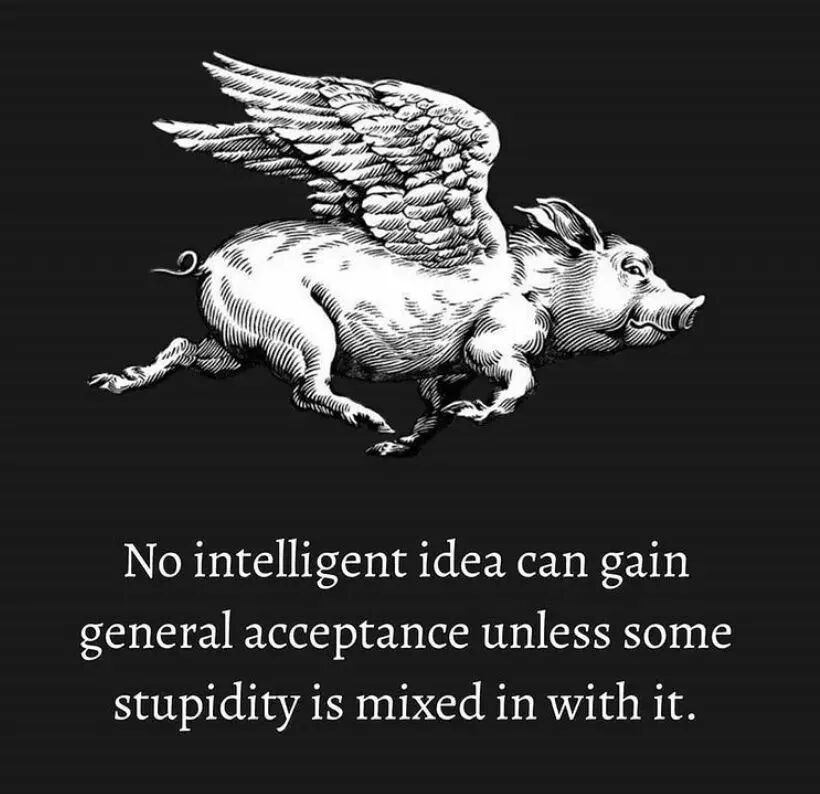
But this pattern isn't universal. In fact, it doesn't apply to most kinds of work. In most jobs — being an administrator, for instance — all you need is to be right. You don't need to be novel. You don't need everyone else to be wrong.
There is room for some originality in most kinds of work. But in practice there's a fairly sharp distinction between the kind of work where you need to be independent-minded, and the kind where you don't.
I wish someone had told me this when I was a kid, because it's one of the most important things to consider when you're deciding what kind of work to do. Do you want to do the kind of work where you can only win by thinking differently from everyone else? I suspect most people's unconscious minds answer this question before their conscious minds even get a chance to. I know mine did.
Independent-mindedness seems to be more a matter of nature than nurture. Which means if you pick the wrong type of work, you're going to be unhappy. If you're naturally independent-minded, you'll find being a middle manager exhausting. If you're naturally conventional-minded, you'll be sailing into a headwind if you try to do original work.
But there's a complication here: people often get wrong where they fall on the spectrum from conventional to independent-minded. Conventional-minded people don't like to think of themselves as conventional-minded. At any given moment they feel they've independently decided to do what everyone else is doing. And independent-minded people are often unaware how different their ideas are from others' till they say them out loud.
Can you make yourself more independent-minded? I think so. Even though this quality is largely innate, there are ways to amplify it — or at least, not to suppress it.
One of the most effective tricks is one practiced by a lot of nerds: simply to avoid conventional-minded people. It's hard to be conventional-minded if you're not in the path of conventional ideas. A person who spends a lot of time urgently trying to find out what other people think is probably not very independent-minded.
Who you surround yourself with matters. If you're surrounded by conventional-minded people, you'll find it hard to express your own ideas, and that will in turn constrain what ideas you have. But if you're surrounded by independent-minded people, you'll have the opposite experience: hearing other people say surprising things will make you want to do it too.
Independent-minded people who feel surrounded by conventional-minded ones tend to self-segregate as soon as they have the opportunity. We all had this problem in high school: there was no way for independent-minded kids to find each other. And high school is often a closed little world whose inhabitants lack confidence, which magnifies the forces of conformism. So for independent-minded people, high school is often a bad experience. But at least it teaches you what to avoid. If you find later in life that you're in a situation that feels like high school, you should leave.
Another place where conventional and independent-minded people are mixed together is in successful startups. The founders and early employees are almost always independent-minded; otherwise the startup wouldn't be successful. But as the company grows, the conventional-minded people greatly outnumber the independent-minded ones, and the original spirit of independent thinking is inevitably diluted. From then on the startup begins to decline. And the most frustrating thing of all is that the founder finds themselves able to speak freely with founders of other companies, but not with their own employees.

Fortunately, you don't need to be constantly surrounded by independent-minded people — one or two you can have regular conversations with is enough. Once you find such people, they'll usually be as eager to talk as you are; they need you too. Though universities are no longer as exclusive as they used to be, a good one is still an excellent place to meet independent-minded people. Most students will still be conventional-minded when they arrive, but you'll at least find clumps of independent-minded ones, unlike in high school where you might not find any.
You can also go in the other direction: in addition to cultivating a small number of independent-minded friends, try to meet as many different types of people as you can. If you're part of several different worlds, the proximity of any one of them will matter less to you. And you can also import ideas from one world to another.
By different types of people, I don't mean demographically different. I mean people who actually think differently. So while it's a good idea to travel to other countries, you may well find someone who thinks differently right around the corner. When I meet someone who knows about something I don't, I try to learn from them things that other people don't know — and I'm often rewarded with surprises. When you meet a stranger, asking them questions is good conversation, but I'm not doing it to be polite. I genuinely want to know.
Reading history helps too. When I read history I don't just try to learn what happened, but to get inside the heads of people who lived in the past. What was it like to be them? What did the world look like to them? That's hard to do, but worth the effort for the same reason it's worth going on a long journey to see something in person.
Having a critical, skeptical attitude toward received ideas also helps protect you from automatically accepting them. When you hear someone say something that sounds very plausible, pause and ask yourself: "Is that actually true?" You don't have to burden others with your skepticism, but you should burden yourself.
You can make a game of this. You know that many ideas currently accepted as true will later turn out to be wrong. See if you can guess which ones. The goal here isn't to show that other people are wrong, but to find the treasures hidden among the broken ones — new ideas. It's an exciting hunt for novelty, not a tedious exercise in intellectual superiority. When you start asking "Is that actually true?", you'll be surprised how often the answer is not immediately yes. If you have imagination, you'll have more to think about, not less.
In general, your goal should be to let nothing into your mind unexamined, especially ideas that are merely assertions. Much of the influence is subtle. How do you notice when you've unconsciously lost your independence? What you need to do is step back and observe how other people form their opinions.
When you stand far enough away, you can see ideas spreading through a crowd like waves. This phenomenon is most obvious in fashion: you notice a few people wearing a certain kind of shirt, then more and more, until half the people around you are wearing it. You may not care what you wear, but intellectual fashions are the same way — and you really shouldn't be part of them. Not just because you want to think independently, but because unconventional ideas are the ones that lead to the best outcomes. The most valuable ideas are found where no one else is looking.





5Y Capital (formerly Morningside Ventures), currently managing approximately $3 billion across USD and RMB dual-currency funds. We believe the world will be a better place when the crazy you that others see starts to be believed.
BEIJING · SHANGHAI · SHENZHEN · HONG KONG