5Y View | Zhang Fei of 5Y Capital: Stray Dogs, Missionaries, and Gods

Life's experiences are a personal practice — and every one of us is on that path.
The following is adapted from a keynote speech delivered by 5Y Capital partner Zhang Fei at the 2020 CEO Summit:
Today's talk is titled Stray Dogs, Missionaries, and God. These reflections represent my personal summation of the past few years—filled with immature ideas, biases, and errors. Still, I wanted to share them in hopes of sparking intellectual exchange and perhaps offering some insight. It's a difficult topic, and I'll attempt to address it through seven fragmented thoughts.
Chapter 1
Francis Bacon's Contempt for Atheists
Francis Bacon was a renowned English scientist and philosopher. In his essays, he wrote a piece specifically on atheism, arguing that atheists were profoundly base. He quoted a line from the Bible: "The fool hath said in his heart, There is no God."
For us atheists, it's hard to understand what God is, why one should believe, or what the relationship between humans and God might be.
Bacon was clever. He used remarkably simple logic to explain why people believe. The relationship between humans and God, he said, is like that between dogs and humans. Why?
There are two kinds of dogs: strays, and dogs with owners.
A stray lives in a terrible state. To survive, it will do anything—ferocious, without bottom lines. But a dog with an owner is completely different. It shows extraordinary affection, willing to accompany you anywhere in the world—perhaps the best companion you'll have after your spouse. It's loyal, brave. To this dog, you are its god.
Why?
Because you care for it, provide for it, give it everything. And the owner frequently does things the dog cannot comprehend, beyond its cognition—your intelligence and capabilities far exceed its understanding. You are its great god.
Under this divine summons, the dog becomes loyal and courageous. When its owner's life is in danger, it will leap into icy waters to save them. This is the dog-human relationship, and the human-divine relationship is the same. The character and aspirations of those who believe and those who do not are worlds apart.
Chapter 2
No-Self
What is the "self"?
I love a quote from Mahatma Gandhi: "The best way to find yourself is to lose yourself in the service of others." Profoundly philosophical. Chinese Chan Buddhism also asks: what is the "self"?
Who am I? I'm Zhang Fei, partner at 5Y Capital, early investor in Kuaishou—there are many descriptions. But if we erase all connections between the "self" and environment, family, company, world—who is the "self"? Simple question, terribly difficult answer.
You might say: strip away all connections, and I still have a body, a continuously thinking brain—that's the "self."
But look closely. Your body is actually a concentration of particles and fields, what Buddhism calls "emptiness" and "dependent origination." Your perceptions and cognitions don't equal the "self."
Think about it: can you control your perceptions? Your cognition? In fact, perception and cognition control you. Perception and cognition are not the self. So there is no "self." The "self" does not exist.
I'll use this somewhat uncomfortable image to illustrate a true state of no-self.
A Vietnamese enlightened monk named Thích Quảng Đức. The president of South Vietnam was Catholic, deeply hostile to Buddhism, actively suppressing it. One morning in June 1963, Thích Quảng Đức walked into the street. His disciples poured gasoline over him. He sat quietly, lit himself, and burned alive in roaring flames.
This photograph won a Pulitzer Prize, captured by an American photographer. The photographer wrote that throughout the burning, Thích Quảng Đức's body showed no movement, his facial expression not a flicker of change. His expression remained constant, utterly serene—as if this had nothing to do with him.
This monk had built 31 temples in Vietnam, a man of profound practice and cognition. During that burning, imagine all muscular agony converging in his mind, the survival instinct gripping him tight—yet he was like a detached observer, calmly watching these perceptions and thoughts.
He treated these sensations of pain, these survival desires, like observing a surging river—slowly flowing past, never controlled by these thoughts. This is no-self at a very high level.
Chapter 3
"Reality" Is Connection
What is "reality"? A philosophical question, also a physics question.
In the classic film The Matrix, Neo faces the same dilemma: blue pill or red pill—choose a programmed world or a real one. Our brains cannot distinguish program from reality.
Physics has actually given "reality" a precise definition: "Reality exists only in relation. Without connection, there is no thing."
Look at any object. At its most fundamental level are the smallest physical units—perhaps loop quantum gravity, perhaps superstrings. These minimal units connect into networks, composing the endlessly varied world.
Life is the same. A sperm and egg's remarkable union—this miraculous connection creates more miraculous life, then more beautiful things.
Notice something? The physical explanation of "reality" closely resembles the definition of "self."
Chapter 4
Spacetime Is the Gravitational Field
"What is time, what is space?" This physical topic is nearly equivalent to "what is the self."
What is space? Today we're in beautiful Sanya. Suppose we erase everything—the tables, the beach, the buildings. What remains? Empty space. But is space truly nothing?
No. Space is actually a vast gravitational field—proven by today's physics. This field isn't static; it can warp, deform, stretch.
And within this vast field, what are its smallest units? Spacetime's minimal units are identical to matter's minimal units—perhaps loop quanta, perhaps superstrings. These minimal units connect with each other, forming complex networks, composing what we perceive as mysteriously empty spacetime. Time and space are inseparable. Spacetime, too, is about connection.
Our spacetime is like a vast net. When a massive object appears in this net, it creates enormous distortion (like an iron ball dropped onto a stretched bedsheet). The curvature of this spacetime distortion equals gravity. This elegantly simple theory is Einstein's general relativity. A world-changing theory.
Look at this painting—Van Gogh's famous The Starry Night. Painted in 1889 at an asylum in Saint-Rémy-de-Provence. The changing, kinetic, energy-filled sky matches Einstein's gravitational field theory remarkably. Others painted skies as peaceful, serene. Only his was strange, twisted, deformed—yet almost perfectly aligned with modern physics' spacetime theory.
That year, Einstein was only ten years old. Strange: how could a mad artist paint an abstract work so classically consistent with Einstein's theory? We know Van Gogh suffered terribly from syphilis. Sometimes I wonder if syphilis might help us see the world more clearly.
Chapter 5
Love and Redemption
We all have seven deadly sins (lust, greed, anger, envy, pride, fear, depression and cold indifference—my version, detailed in my 2018 talk Embrace Pain, Stay Crazy).
The seven deadly sins aren't religious definitions—they're programmed by our genes, brain firmware we struggle enormously to overcome.
The eccentric Elon Musk is my favorite entrepreneur. He created Neuralink brain-computer interfaces, connecting chips to human and pig brains. He was astonished to discover that 90% of the brain's computing power is occupied with calculations about "sex." Consider: what was God's purpose in making us?
Christianity has some very practical methodologies for our genetic programming defects. Christianity's core doctrine is redemption and love. We all have original sin, so we need redemption. The method of redemption is "love"—love God, love your neighbor as yourself. Love is a fascinating thing. Love is connection. You use love to connect various people together.
So you see why Western civilization is about connection. Western civilization excels at building complex systems—universities, law, technology, sports, companies, government. Western values tend to produce very great individuals, connected to underlying values of "love" and "connection." Eastern civilization pursues wisdom, sudden enlightenment; Eastern civilization has many remarkably translucent people.
Chapter 6
Missionaries Change the World
"Missionary" traditionally means "a believer commissioned to fulfill God's mission." Today I use it more in the sense of missionary spirit. Missionary spirit is a very scarce quality in human civilization.
This is a photo of the Cambridge Seven. In 1885, seven talented young men at University of Cambridge—some excellent athletes—donned Chinese clothing and traveled from London to China, to save over 300 million Chinese people struggling through war, disaster, and famine. They actually had many interesting influences in China, and their actions are still discussed today.
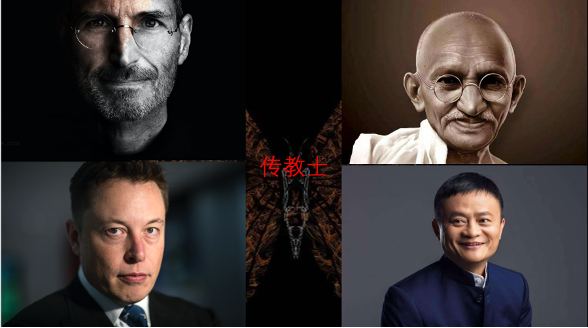
These are missionaries we all know well, including commercial missionaries—from Steve Jobs, Elon Musk, Jack Ma, Mahatma Gandhi, and others. Gandhi was a fascinating man. "Mahatma" means great soul. Gandhi once said something very interesting: "I am a Muslim, and a Hindu, and a Christian, and a Jew." He believed all religions should be equal, that people shouldn't discriminate because their gods differed.
Gandhi observed silence one day each week, believing silence brought inner peace. For three and a half years starting at age 37, Gandhi refused to read newspapers. He found worldly noise more unbearable than his own inner turmoil. He didn't drink milk—a monk had told him milk could trigger sexual desire. After 36, he was a committed ascetic. If you study why and how he gradually trained himself in asceticism, these are very strange and peculiar stories.
Though many of Gandhi's actions remain hugely controversial, his attainment of "no-self," his control and cognition of his own desires, reached a very high level.
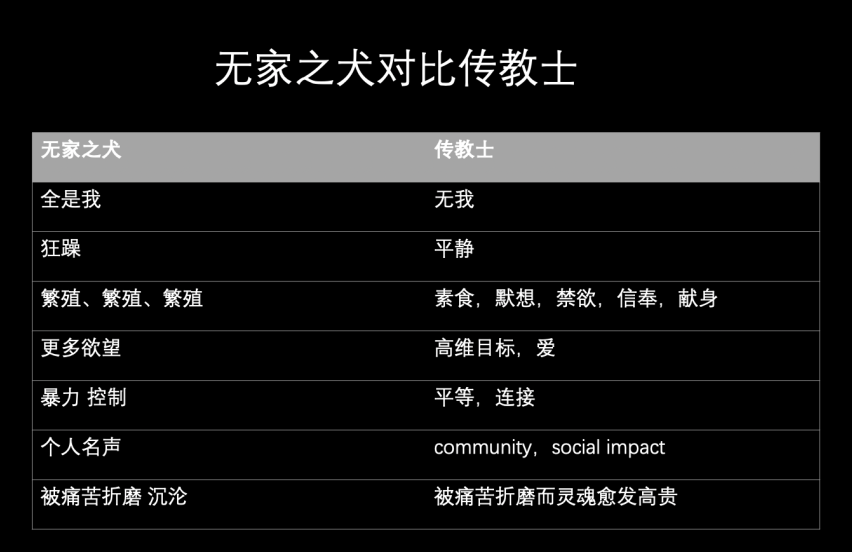
Let's compare the behavioral and thinking patterns of stray dogs versus missionaries.
Last Chapter
Belief and Connection
Finally, I hope I can clarify these questions, though there is much I haven't figured out.
What is belief? Belief is the brain's highest objective function. If you've worked in AI, you know the objective function determines everything. The greatest belief can represent a goal you'd sacrifice everything to achieve—like belief in God.
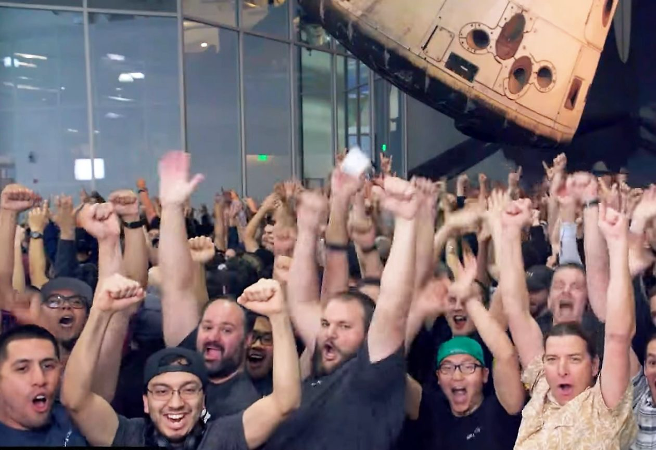
Our brains have a mysterious switch. When flipped, people are easily connected and ignited. The physically slight Gandhi, through tenacious belief, ignited the Indian people's resolve for national independence. When SpaceX's rocket first launched successfully, every employee was ignited by Elon Musk's ideal of conquering space.
I believe "God" is an emergence of belief—a higher-order intelligence transcending our current cognition.
Focused belief plus massive connection demonstrates unusual attractive force, like a black hole—creating an enormous reality distortion field.
I particularly love this image of a black hole. A black hole is a classic example: when matter's density reaches a certain stage, it generates a distortion field. Its gravity grows stronger, its connectivity more powerful.
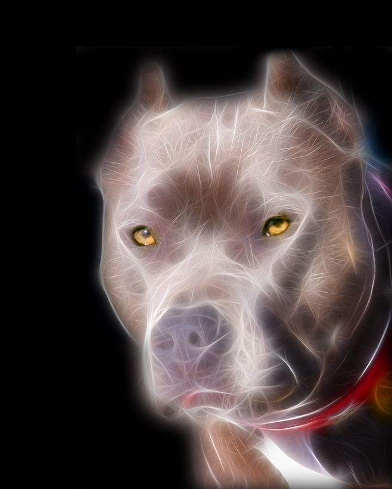
In truth, each of us is a stray dog. It is connection to God that makes us human. Because of shared belief, our ape ancestors who emerged from the forests connected together—we hunted great beasts together, created miracles together, conquered the oceans together, ventured into space together, created interstellar civilization, even conquered the universe.
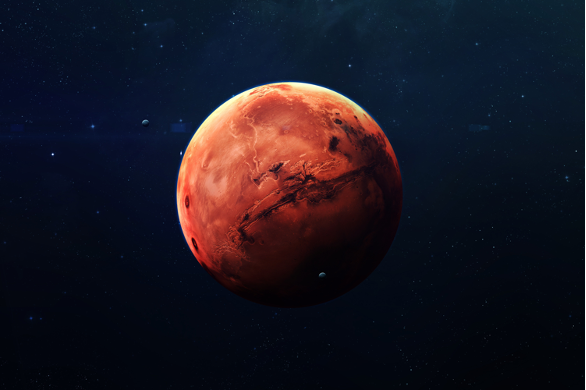
It is our belief in God that creates our great souls. Finally, I wish each of you finds your own God. Thank you all!

5Y Capital (formerly Morningside Venture Capital), currently managing approximately $3 billion in USD and RMB dual-currency funds. We believe that if the you whom others see as crazy begins to be believed in, the world becomes better.
BEIJING·SHANGHAI·SHENZHEN·HONGKONG