How Do Consumer Brands Survive Cycles? | 5Y View x Make Essense x Surpine

Great brands are built through endurance.

Great brands are built through endurance. The journey involves innovation and setbacks, constant strategic adjustments, and the resilience to weather market fluctuations and consumer scrutiny — gradually distilling a brand spirit.
This conversation is also a story about consumer entrepreneurship. Huang Weiqiang, founder of MAKE SENSE; Zhao Bing, founder of Surpine; and Yuan Ye, partner at 5Y Capital, reflect on how the consumer market has changed. The two entrepreneurs share their journeys, experiences, and insights — covering how brands connect with consumers, lessons learned from world-class consumer brands, what matters most in the current environment, and perspectives on the future. We've selected some highlights that may offer you something to think about :)
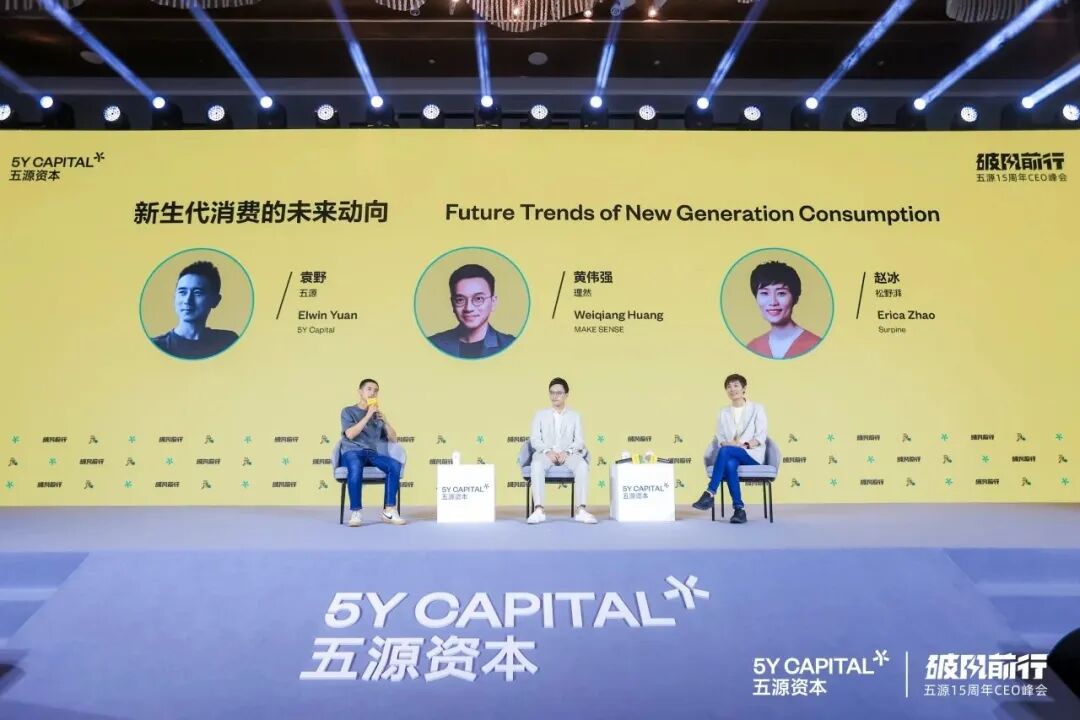
This episode's guests:
Huang Weiqiang, Founder & CEO of MAKE SENSE
Zhao Bing, Founder & CEO of Surpine
Yuan Ye, Partner at 5Y Capital
01 Brand as a Vessel of Shared Belief
Yuan Ye: The consumer market experienced explosive growth over the past few years, then suddenly hit the brakes. At this moment, looking back at the consumer industry feels especially fitting — to understand what's happening now and how to think about the future. Both of you have worked at international consumer brands. Looking at the world's top consumer brands, what do you see as the key to their success? What lessons do they offer for Chinese consumer brands aiming to succeed?
Huang Weiqiang: Hearing this question, the first thing that comes to mind is what these top brands have in common: they've survived for a very long time. Okamoto is a 100-year-old materials company, evolving from rubber and latex materials into application areas. In consumer goods, condoms make up a huge portion of its business, which is deeply tied to its sustained research in materials — mastering core raw materials and continuously iterating.
This influences my current entrepreneurship by making me think about how what I'm doing relates to the essence of the industry. In men's personal care, especially facial skincare, the impact of androgens is significant. So we study how male androgens affect our products and what fundamental differences exist from women's skincare — a major insight from my time at Okamoto.
The key to top brands' longevity lies in their unusually high investment density in specific areas, far exceeding competitors. Also, a brand is a vessel of shared belief; long history means sufficient time to propagate values and philosophy. We see how major world religions are deeply connected to time and historical cycles. We're thinking about how to become a company with long-term brand value — what is our essence across such a long cycle, and how do we continuously communicate our philosophy to users and consumers.
Zhao Bing: For me, Nike stands out for its brand spirit and connection with consumers. Its slogan "Just do it" deeply moved me as a consumer. I used to wonder how it maintained such strong consumer connections over so many years. After joining the company, I discovered that "Just do it" isn't just a slogan — it's infused into every layer: product, sales, marketing. It's become part of the brand's DNA.
Each generation's values and trends differ, yet how has this decades-old slogan maintained value-based connections with consumers across eras? It comes down to returning to the spirit of sport itself — sport carries an inherent spirit and inner strength. Like 5Y Capital's cycling events, where people challenge themselves, whether through a small breakthrough, self-transcendence, or simply pausing to photograph beautiful scenery and feeling moved inside — these are profound experiences sport brings us.
Over decades, trends, fashions, and styling may change, but the spirit of sport remains constant. Early on, champion spirit was emphasized more; now younger consumers value self-transcendence more, even incremental progress. This is the core of sport spirit, and one reason I chose to build a sports brand.
Yuan Ye: Today's world-class brands have numerous strengths and highlights. As emerging entrepreneurial brands, what unique advantages do you most hope to build to grow into long-term exceptional brands amid competition?
Huang Weiqiang: In cosmetics, men's personal care is often a market that major conglomerates overlook, so their short-to-medium-term strategic investment is limited. For us, precisely what they dismiss in the short term — and what may seem like pure spending without immediate returns in the medium term — is where we should invest aggressively. Over the long term, this builds stronger moats and possible competitive advantages against them.
Zhao Bing: Sports and cosmetics are somewhat similar — fiercely competitive with many giants. Before starting, I examined my own strengths and resources, looking for points where I could enter the market quickly or break through among established players. With limited resources, I chose the niche of base layers for sports.
In outdoor activities, there's a three-layer system: base layer, mid layer, and outer layer. Most outdoor brands or giants tend to neglect the base layer, yet it's essential for outdoor enthusiasts — even life-saving when climbing snow mountains or peaks. Starting from this layer, combined with our R&D capabilities, we could quickly let consumers feel product differentiation. This was our short-term market entry.
Long-term, we aim to build a great sports brand. Having established first-mover advantage in the short term, we must gradually build our moat, continuously improving product-to-market R&D capabilities. While developing products, we also need to learn from major brands like Nike in building spiritual-level connections with consumers. This is where we'll continue investing, and what makes building a sports brand so interesting.
02 The Entrepreneur's Balance
Yuan Ye: Some fascinating phenomena have occurred in recent years. Perhaps the same group of people who thought consumer opportunities looked great, all wondering when China's L'Oréal and Patagonia would emerge. But once the market cooled, the concern shifted to when cash flow would come, when profitability would arrive. For entrepreneurs still in growth phase, how do you view this contradiction in market sentiment?
Huang Weiqiang: We've discussed this internally many times, and the answer always comes back to the same place: return to why you started this in the first place, and what you're truly trying to achieve.
On sunny days, everyone wants to travel and hike; in rain, we all want shelter. But entrepreneurs have no choice — you're always on the road. What you focus on is how to move forward a little better each day. Whether markets are good or bad, keep advancing toward established goals. Market changes are closely tied to our rhythm, testing our ability to forecast weather and read the road. So each time you fall in the rain, you can only think about how to fall less painfully next time.
Zhao Bing: On this question, everyone's answer is probably "both." Our long-term vision is to become a great brand, continuously advancing on this path. Of course, early on we must do product R&D well, move seed users, and let them perceive Surpine's advantages in base layer products. Long-term, we'll continuously provide customers with products across different functional tiers to meet more outdoor sports scenarios.
Looking back at Patagonia, Nike — across decades of development, they inevitably experienced economic ups and downs, and inventory or growth issues that all apparel companies face. But they survived, became today's industry giants, and continued solving problems and growing. So we must be mentally prepared: from day one, we knew this would be a long-distance run. We also thank 5Y Capital as our angel investor for believing in our craziness; as we gradually progressed, consumers also came to believe in our craziness. Of course, more challenges lie ahead.
Returning to cash flow operations, our current strategy is efficient operation. Going forward, we'll strive to unify brand effect with product benefit, ensuring high and stable ROI while driving business growth within limited resources. We launched this project in 2019, weathered three years of pandemic, and this steady, small-step, fast-run strategy is what kept us going.
03 Consumption Upgrade or Downgrade?
Yuan Ye: 5Y Capital also hopes to find and support representative brands that can become defining works influencing how today's young generation lives. Both MAKE SENSE and Surpine are just starting out. In your industries, what latent future consumer needs remain unmet? Could you share some of your insights?
Huang Weiqiang: The cosmetics industry was historically driven by chemical engineering R&D logic. But today, due to transformations in life sciences and dermatology, the entire industry has begun shifting — product logic is fundamentally different from the fine chemical era. Now, biotech and dermatological technologies form the foundation, combined with materials science, advanced preparation, and AI tools all being applied to cosmetics R&D.
Due to androgen differences between men and women, skin manifestations also differ. MAKE SENSE focuses on studying various male skin problems. We work on matching targets with corresponding ingredients to develop more effective formulations. We've also found that today's consumers are more information-sensitive than before, capable of understanding deeper-level information. So we believe there's massive opportunity ahead, and we're now in an irreversible trend.
Zhao Bing: For the broader outdoor market, overall growth has been strong these past two years, especially post-pandemic as people crave returning to nature and enjoying various sports. I see consumers becoming more rational — saving where they can, buying where it matters — so brands today must provide products with genuine perceived value.
When this ski season began, we made a bold attempt, something like an upgrade prediction: a disruptive Merino wool product. It achieves one-way moisture-wicking breakthrough on Merino wool foundation, delivering revolutionary body feel, though at higher cost and price point. But from early August to now, sales and feedback have exceeded expectations. So you can feel that although budgets are tight, when consumers recognize that your brand and product help them enjoy life and sports more, they're willing to pay.
Yuan Ye: Weiqiang mentioned AI; Zhao Bing mentioned consumption upgrade. In recent years, "consumption upgrade" first became popular, with the belief that Chinese brands should upgrade toward international brand standards. After pandemic and economic challenges, Pinduoduo's rise made "consumption downgrade" the new market trend. How do you view this phenomenon? Can brand companies achieve downgrade? Does pursuing downgrade conflict with building a brand?
Huang Weiqiang: Whether upgrade or downgrade, one issue cannot be ignored: what core consumer need does this product actually solve? When markets are relatively optimistic, consumers see future possibilities, hoping for more experiences beyond core needs, thus willing to upgrade. When uncertain about the future, they want core needs met first — then consumption seems to downgrade.
Looking back, brand is a vessel of shared cognition. Meeting consumers' core needs is itself meeting shared cognition. In communication, tell consumers that when we meet this need, your life becomes better, your life gains more inspiration — they'll be motivated by having this need met. This communication is unaffected by upgrade or downgrade dynamics.
Zhao Bing: Exactly — consumers still aspire to beautiful lives; this macro trend has always been clear. Under this, consumers think about how to better please themselves, what products to buy, what experiences to seek for greater comfort and enjoyment in sports. So consumers want to spend where it pleases them; for brands, building high-value products becomes especially important.
Currently, the trend in outdoor sports demand is increasingly positive. Before, people knew they needed professional base layers for skiing, but didn't know what kind — maybe just wearing regular gym clothes. After we emerged, consumers discovered there were ski base layers with such superior body feel. So even with major brands like Arc'teryx serving the market, consumers' segmented needs remain unmet, making them willing to pay for high-quality products and services.
04 Only Focus and Persistence
Yuan Ye: In your industries, not every new brand chooses to do both online and offline, but both of yours have both. Could you share whether you started from online or offline? Some entrepreneurs strongly prefer offline, believing it's the real business; others prefer online, thinking offline lacks datafication. What do you think?
Huang Weiqiang: Whether online or offline, there are many channel types, and many show红利 at different stages. So when we spot channel红利, we go all-in as much as possible. But阶段性红利 don't always appear — they often emerge suddenly and disappear quickly.
When we don't see more new opportunities, we try to be present wherever consumers can reach us, making our business more robust and providing many opportunities for structural profit improvement. There are downsides too — it makes operations more complex. So here, we must also make trade-offs, calculate continuously, keep洞察 and understanding the market, thinking which channels we should lay groundwork in at present. When红利 comes, strive to be the fastest company.
Zhao Bing: Early on, we made a trade-off: starting from offline ski shop distributors. Because ski retail is relatively traditional, with many offline ski shops whose distributors are China's ski veterans and big names. They love skiing and became industry practitioners.
With limited resources, our first-year priority was validating product. With zero brand power, the fastest way to validate product was giving it to those who understand product best or can give feedback fastest. These ski shop distributors deeply understand skiers and ski enthusiasts; they purchase our products with real money to sell. So they're highly professional in base layer consumer needs, quickly gave us feedback, and placed pre-orders. From about twenty distributors initially to over 130 now, this gave us tremendous motivation. Though we experienced the pandemic these years, this provided early encouragement and recognition. With brand power still being built, product power is the only driver for continued growth.
After validating product power, we began C-facing brand operations to reach more skiers and sports enthusiasts. In 2021 we launched our online store; now we've reached top-tier sales in our细分 category. Online stores' advantage is: wherever consumers are, we can go provide service — they can quickly purchase products and have professional ski base layers before departure.
Going forward, our brand strategy is omni-channel reach and service. Offline will become an important environment for sports enthusiasts to experience products and interact with the brand; online will focus more on multi-touchpoint communication and service. Together, online and offline can more立体 and comprehensively serve sports enthusiasts.
Yuan Ye: I'd like to ask both of you — if setting strategy today, do you prioritize revenue, profit, cash flow, or brand value, or something else?
Huang Weiqiang: The perfect answer to this question is: all of the above.
Yuan Ye: If you could only choose one, what do you think is the highest priority for your company today?
Huang Weiqiang: We need to clearly think through what metrics we must achieve, what we can definitely accomplish. MAKE SENSE has set a must-achieve goal within three years: become the absolute top brand in men's grooming and men's cleansing细分 categories. And we hope that while becoming a top brand, we can bring something new to the industry. To achieve this, we must meet those "all of the above" key points; all our actions revolve around these two core goals.
Zhao Bing: What we're doing today is focus and persistence. Surpine's 3-5 year short-term goal is to become the first choice for sports enthusiasts' base layers. For this goal, we've made many trade-offs these years, currently focusing only on sports base layers, providing better body feel for users. After establishing category recognition, we'll gradually expand; the entire operational strategy is steady, small-step, fast-run.
As founder, my primary responsibility is ensuring the company survives better. Under this premise, building a sports brand is a protracted war, requiring more attention to how to achieve良性运营, letting the brand develop better sustainably. Whether product positioning, values communicated to consumers, or building brand connections with consumers — must be focused and坚定地 walking our own path. We have confidence, believe in our own craziness, and more sports enthusiasts will come to believe in our craziness.
What comments and perspectives do you have on their conversation? Feel free to share in the comments. We'll select 2 featured comments to receive a mysterious gift package from 5Y Capital portfolio companies :)




5Y Capital seeks, supports, and inspires lone entrepreneurs, providing support from spirit to all operational aspects. We believe that if the "crazy you" in others' eyes begins to be believed in, the world will become refreshingly different.
BEIJING · SHANGHAI · SHENZHEN · HONG KONG