Kai Yu: What Horizon Robotics Has Truly Believed In These Six Years | 5Y Talk

The forces that keep us moving forward.

What path does a hard-tech startup take?
During this year's 3Sigma Bootcamp, Kai Yu, founder of Horizon Robotics, shared the company's entrepreneurial journey with young founders. Yu said, "A researcher with zero business sense who keeps making mistakes along the way, and six years later the company is still alive — that itself might give people more confidence."
Yu shared many lessons and insights. He said these are things the organization and team at Horizon truly believe in, things that have carried the company to where it is today. We've excerpted a portion below, hoping it offers some inspiration :)
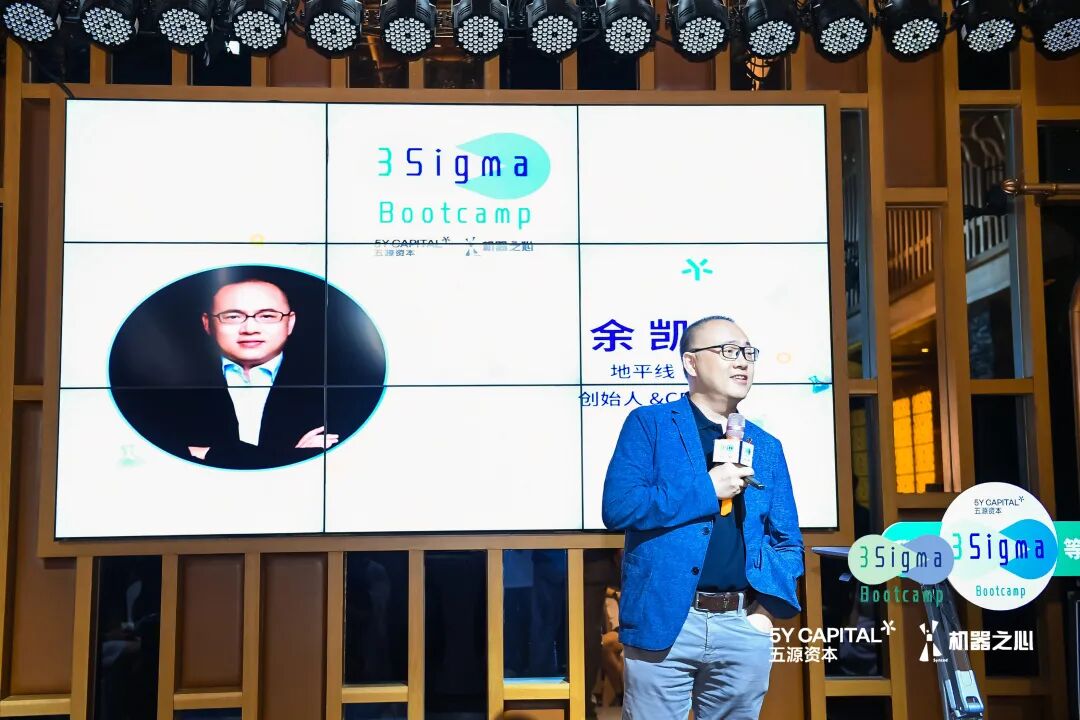
Kai Yu speaking at 3Sigma Bootcamp
In 2015, I left Baidu to start Horizon Robotics. 5Y Capital was our first angel investor and remained our largest shareholder for a long time.
My first conversation with Richard (Qin Liu) was at a hotel in Beijing, from 8 p.m. to 3 a.m. Consumer internet still ruled the world back then; few investors wanted to listen to someone like me ramble on with little sense for business design. But Richard was willing to indulge this strange founder, and he was genuinely excited. He talked with me about the historical interplay between Apple and Microsoft — both competition and, at a certain point, Steve Jobs' more inclusive approach to partnering with Microsoft, which gave Apple greater vision.
Five or six years ago, unlike today, we rarely studied the growth paths of American tech companies from the 1970s, 80s, and 90s. In reality, hard-tech development follows many similar trajectories worth learning from, and today we need to study them seriously. As China's economy transforms, hard-tech companies will only multiply. Entrepreneurship at this stage necessarily faces different challenges than the consumer internet era. Horizon's path can serve as a reference for vision-driven, long-term technical entrepreneurship.
Horizon itself is a special case: a researcher with zero business sense who keeps making mistakes along the way, and six years later the company is still alive. That itself might give you more confidence — you probably have a better chance of succeeding than you think.
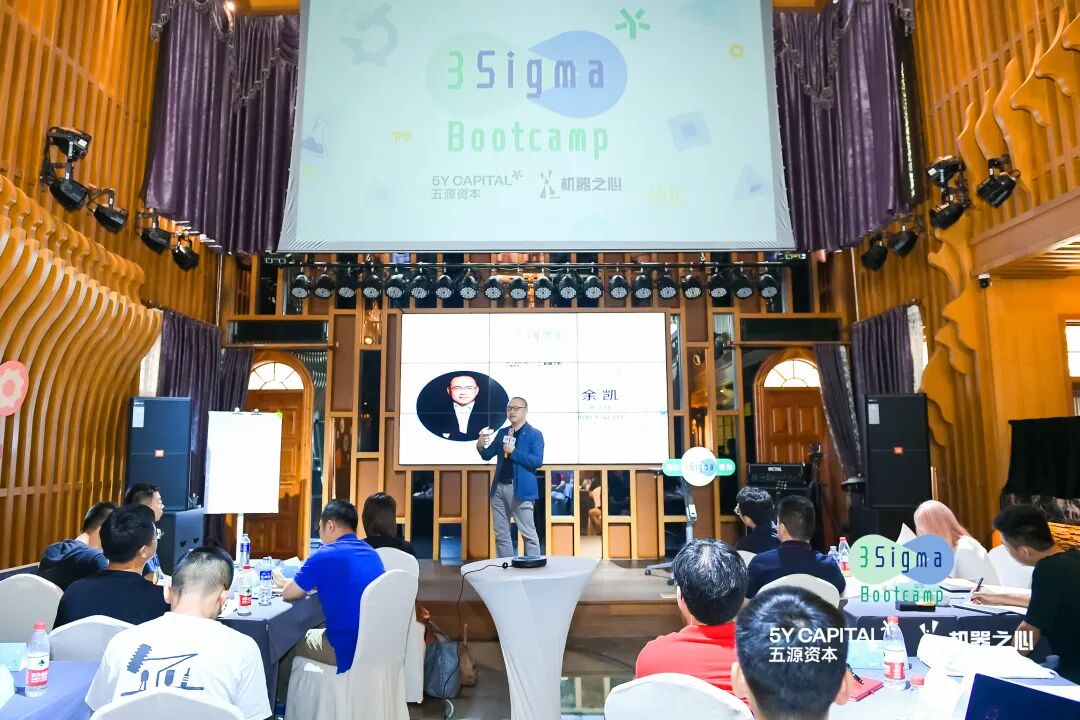
Kai Yu speaking at 3Sigma Bootcamp
01 Long-Term Vision, Inflection Points, and Entrepreneurial Rhythm
In 2015, we set out to build dedicated chips for deep neural networks. At the time, we were the only company in China doing this — and looking back, we were likely the first in the world.
Chips were deeply unsexy then, even in Silicon Valley. Investors would basically walk away at the word "chip." Semiconductors are inherently long-cycle, capital-intensive, slow-to-profit businesses. Most of the semiconductor companies we know were founded in the 1970s and 80s; few memorable new chip companies emerged after 2000.
Horizon started from long-term vision. We were thinking: we're not just designing chips for autonomous vehicles, but dedicated brain chips for all future robots. From PC to mobile, what would be the next smart terminal? We believed it would be泛 robots, including autonomous vehicles. So Horizon's original aspiration was quite audacious — based on a 20- to 30-year vision of the future.
What did we face in the early days? No business, no demand, no customers, no competitors — no entry point for this business at all. The founding team had never started a company, had no feel for business design, no instinct for organization. How do you find the entry point and match between your technology growth curve and commercial demand before your company dies? This is excruciating — and perhaps the most compelling part of entrepreneurship.
Actually, everyone can see the long-term, shared trends in human society: we'll live in a world of ubiquitous robots, autonomous driving will benefit everyone. The key question is: how do you grasp the entry point, the rhythm, the inflection point of entrepreneurship? How do you build an organization suited to this type of entrepreneurship, what kind of corporate culture do you establish? These are the challenges of vision-driven entrepreneurship.
Horizon went through many twists over six years, with various adjustments along the way. The remarkable thing is, six years later we found our business aligned exactly with our original vision. In intelligent driving chips, we're one of three companies globally capable of mass production, alongside Intel and NVIDIA. Many people may not know that we're also a leading provider of smart chips for the robot vacuum industry. Our vision of giving every vehicle and every appliance environmental perception, human-machine interaction, and decision-making capability is becoming reality step by step.
02 From 0 to 0.1: Horizon Took Five Years
The first phase a startup goes through is the strategic experimentation period, from 0 to 0.1. This stage is really about whether the founder's idea holds up — this is the company's DNA, its grand vision. But you need to find the commercial entry point, so you trial and error, iterate. Luck varies by company.
Some companies might start from a real, immediate opportunity, making the 0 to 0.1 phase relatively quick. But a business like Horizon's, built on a vision of the future, has no clarity on how to make money now or who the customers are. It may take years of trial and error. Horizon took about five years. There were many dark moments, like walking through a tunnel with no light in sight.
In 2019, the smart vehicle market hadn't yet taken off, and as an upstream supplier we had even less opportunity. That was a darkest hour. You couldn't expect much from the team at that point — setting KPIs was problematic. How do you set KPIs when the business isn't even designed? So talking about process or management was premature. The only thing to do was for the founder to iterate his understanding, and for the team to maintain trust in each other and belief in the general direction.
There's no great strategic framework for this phase. You just endure, survive until that moment arrives, find the business entry point, and win in chaos. Once you find your first customer, achieve front-loading mass production, you start to realize this business design isn't accidental — it follows patterns. A second customer, a third customer, and it becomes a clear, universal, validated demand. Then you've reached the 0.1 to 1 phase.
Finding a real market and commercial entry point is the hardest thing for a startup. Many companies never get past this.
We passed through this around 2020–2021, then gradually converged: the battlefield became clear, the team reached consensus on broad strategy, and we found the ignition point. The team could iterate on consensus and execute efficiently within a framework. The next 3–5 years are the strategic expansion phase — we need to build efficiency, find the leverage, flywheel, and key points in the commercial machine to expand faster and more efficiently.
Kai Yu speaking at 3Sigma Bootcamp
03 Victory Is Decided Before Engagement
In the 0 to 1 phase, we developed some mental models. First is the circle of competence model. I'd done research for over twenty years, mostly writing papers and deriving formulas. If you asked me to do consumer or social, I'd be completely lost. But with chips, operating systems, software-hardware architecture, I have natural sensitivity. I can make the key calls here. So you must operate along the extension of your own capabilities.
Another is endgame thinking. At every strategy meeting, we'd spend 70% of our time discussing the biggest trends that will inevitably unfold over 10 or 20 years — it sounds incredibly abstract. Then we'd place Horizon within that trend: either ride the wave, or pull the trend closer and accelerate it.
If you discuss the 10-year macro trend first, three-year targets become very easy. In fact, you barely need to discuss them — you can derive one-year targets for every department, every team, every individual. An endgame-first strategic framework helps the team reach consensus quickly.
You might win by looking one or two steps ahead, but I think it's inferior to reasoning backward from the endgame. Too many temptations, opportunities, distractions, and noise lie in the immediate present. And for long-term vision-driven technical entrepreneurship, the immediate one or two steps may be especially hard to find.
Also, never follow the crowd — be non-mainstream. There's no opportunity for startups in mainstream markets; you can't assume you're uniquely gifted. When Horizon internally discusses talent advantages, our conclusion is that we have none. Every leading company recruits top students from elite universities every year. Will this year's recruits be fundamentally different from next year's? No. So don't assume talent advantage either. Companies doing well today succeeded because they made certain key decisions and organizational preparations three or five years ago, building core capabilities.
We must compete where there is no competition. Don't harbor侥幸心理 — once you fall into that quagmire of hand-to-hand combat, it comes down to luck. Even if you win, it's a pyrrhic victory, lacking momentum or elegance. We often say let victory be decided before engagement — keep looking ahead, iteratively updating our understanding.
Then there's the pressure principle. Once you identify an explosive point and validate real demand, the best move is to pour all your ammunition there — 10x pressure, 10x firepower to take that hill.
Of course, all these mental models are just Horizon's path, just one tool you might reference. They're not truth, and they may not suit everyone.
04 What We Truly Believe In Today
For Horizon, because we're doing something with such a long cycle, constantly searching for direction in darkness and despair, surviving is no small feat. The mutual psychological support among founders is crucial.
Founders must be able to speak truth to each other — not necessarily correctly, but truthfully. When you're being偏执, someone needs to poke you, activate your neurons, make you realize there are other things worth considering.
For co-founders and core management, vision and leadership matter more than professional capability. Entrepreneurship confronts you with many unknowns; you can't assume you can learn everything. What you do is elevate your vision and leadership, find people smarter than you, and outsource the computation.
During our 0 to 1 phase, many excellent people came and eventually left. Later we realized that when a company is winning in chaos and finding direction, much talent can't really shine. Only when direction is found and professional capability is matched does everything click. If you're still finding direction, or if it's a false demand, better professional capability just means bigger mistakes. So at this stage, the core capability is heart over head.
Now we're entering a 1 to 10 strategic development phase — expansion, quality, efficiency, process. We need to recruit large numbers of 1-to-10 talent, and build organization and culture matched to strategy.
Initially we wrote seven corporate values on the wall. Now we ask ourselves: what do we truly believe? What carried us from darkness to a glimmer of light, to a market of enormous value creation? What sustains our team, what moves our customers? We discussed this extensively and found what was already etched in our hearts: eight characters — "Serve customers, endure solitude."
We believe altruism and self-interest are fundamentally the same thing; serving customers is serving yourself. Enduring solitude means not chasing what's hot and noisy; it means long-termism, willingness to be the assist rather than score yourself, it means critical thinking, delayed gratification, focusing on the present and doing well what's before you.
These are what Horizon, this organization and team, truly believe in today.



5Y Capital (formerly Morningside Venture Capital) currently manages approximately RMB 32 billion across USD and RMB dual-currency funds. 5Y Capital seeks out, supports, and inspires孤独的 entrepreneurs, providing support from spirit to all business operations. We believe that if the "crazy" you in others' eyes begins to be believed in, the world will become别开生面.
BEIJING · SHANGHAI · SHENZHEN · HONG KONG