What Happened During the 72-Hour AI Survival Challenge?

Some people are training AI companions, others are building virtual livestreaming studios, and still others are burning through their budgets constructing systems and debugging plugins...
Seven participants from wildly different backgrounds — a Big Tech product manager, a 20-year-old college student, an indie developer, a large-model algorithm engineer, a Golden Rooster Award–nominated director, an AI PhD student — spent 72 hours in a sealed AI-only space. No smartphones. No apps, browsers, or any internet or mobile internet products. Just AI tools and 100 yuan in seed funding. They had to survive on AI alone, and ideally create something along the way.
From May 15 to 18, 2025, after nearly three months of preparation, 5Y Capital's AI survival challenge finally landed in Shanghai.
Over 72 hours, one participant trained an AI friend. Another wrote a survival anthem. Someone generated a film. Another built a virtual livestream room. And someone burned through their entire budget debugging plugins and building systems... Every step felt like "rewriting life" with AI.
Here, eating, shopping, searching, expressing — every daily operation had to be "redefined" through AI. All real-world "cheat codes" — phones, QR codes, WeChat, quick-access shortcuts — were blocked. Players had to learn an entirely new language to coexist, collaborate, struggle, and create with AI.
More important than the outcomes were the problems and possibilities exposed along the way. AI can help humans survive, but can it truly understand emotion, rebuild connection, solve loneliness? Where do we see the boundaries?
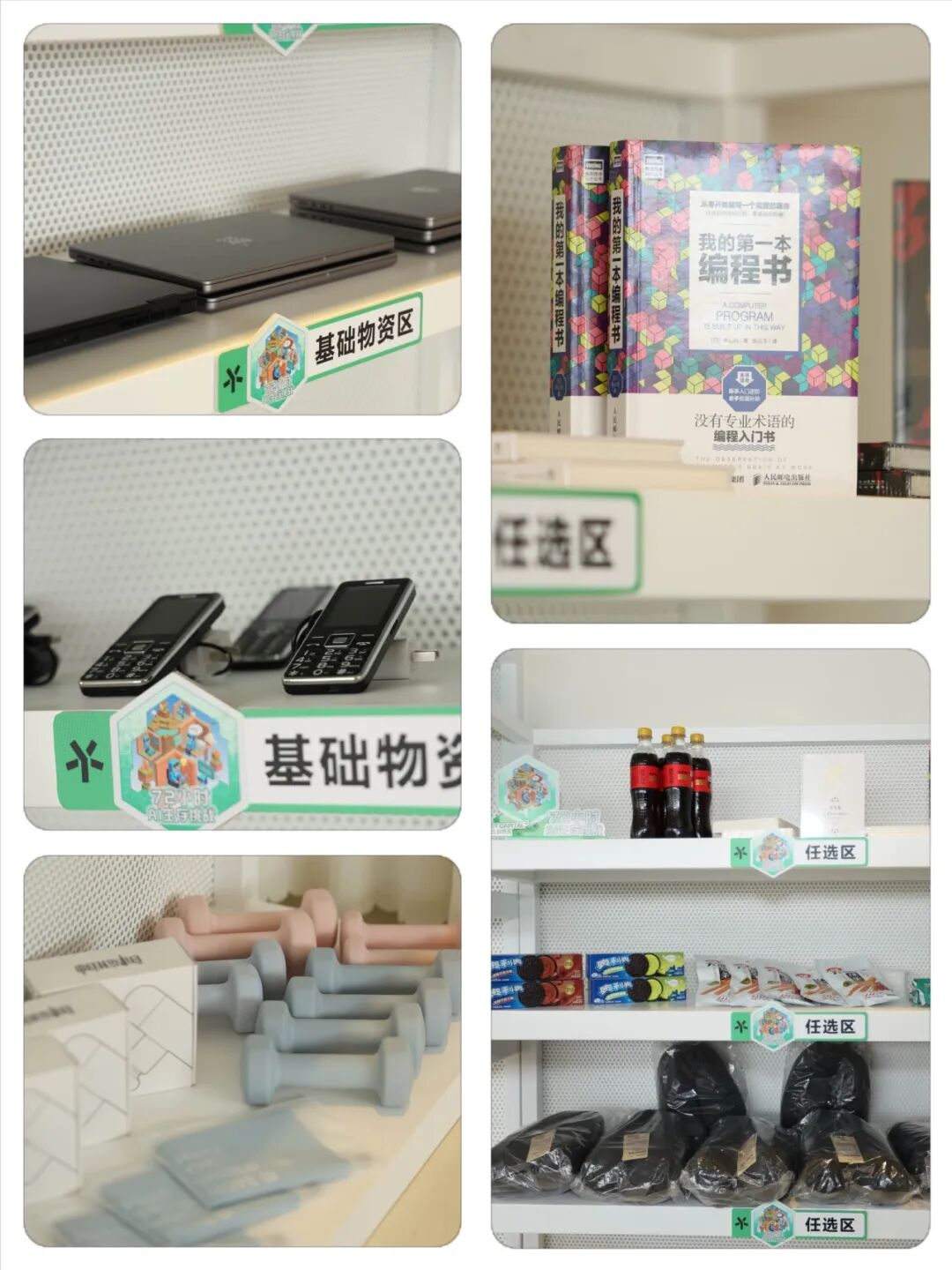

When each player entered their room, they were equipped with only an internet-connected computer and a non-smartphone for emergency contact. The computer came preloaded with some AI tools:
1. General-purpose large language models
With text generation, conversational interaction, logical reasoning, and knowledge-query capabilities, these served as players' "main tool" for tasks like communication, writing, planning, and asking questions.
2. Programming and development assistance tools
Cursor, Trae, local Python environments, and more. Some technically oriented players used these to develop browsers, virtual assistants, or attempt to connect purchasing workflows, build web pages, and call APIs.
3. Multimodal generation tools (image / audio / video / script)
Supporting content creation, emotional expression, poster design, and other tasks.
All existing internet and real-life "cheat codes" were banned: smartphones, browsers, WeChat, social media...
Inside the sealed space, eating, ordering, searching, communicating — every daily operation needed its logic "rewritten." Each player could only use AI tools to solve survival needs. The "convenient entry points" common in real life were completely blocked — no social platforms, no QR-code logins.
This wasn't a competition. It was more like a sealed experiment. When platforms and apps are blocked, when even ordering takeout requires rebuilding a closed-loop logic from scratch, using AI is no longer a "shortcut" but a tool that must be relearned.
There may be no standard answer, but every confusion and attempt along the way is itself the point.
01
Didn't Make Any Money,
But Got AI to "See" the Computer
Chen Ruixuan and Ou Hannan are both 20, freshmen at Zhejiang University. We discovered during interviews that they were already practically inseparable, running a startup together, so they teamed up for this challenge too. As AI-natives, exploring various AI technologies is already their daily routine. When asked about their motivation for joining the survival challenge, they half-joked "three days without class," but more importantly, they wanted to explore the actual boundaries of current AI.
They planned to "fully automate order-taking and money-making with AI" and "double development time, leaving other players in the dust." They posted multiple gigs on freelance platforms: "AI image generation, logo design, coding problem-solving" for you... trying to use AI to select orders, communicate, and complete tasks.

However, due to complex implementation paths and limited resources, they ultimately failed to hit their monetization goal. "Our main quest was pretty disappointing — didn't earn a single cent," they laughed. "But we developed a computer-controlling agent that's even better than Browser Use."
In executing their "let AI take jobs and make money" plan, they encountered many unexpected technical difficulties. CAPTCHA alone stalled them for over 10 hours. To get around this obstacle, they tried four technical approaches in succession:
First approach: Computer use tool
The initial idea was to directly control the computer through an AI computer-use tool. This tool allowed AI to interact with the desktop environment, providing screenshot functionality and mouse/keyboard control. But since the tool was still in beta without corresponding permissions, they were forced to abandon it.
Second approach: Self-developed computer control agent
They pivoted to having AI directly control local computer operations, simulating clicks and keyboard inputs to interact with the local device. The challenge was insufficient positioning accuracy: AI could identify general areas but couldn't click precisely, frequently "missing the mark."
Third approach: Self-built image recognition pipeline
The plan was to use an open-source framework to locally deploy an AI vision module, understanding the interface through periodic screenshots and recognition to perform operations. Due to network restrictions and insufficient server resources, deployment was painfully slow. They had to instead build a simplified pipeline: take screenshots, upload them to a webpage, and let Browser Use recognize them.
Unfortunately, this method ultimately failed because it "couldn't run." They plan to continue iterating at home and have already purchased servers.
Fourth approach: The "crude and stupid" AI recognition box
Finally they tried the simplest path: have AI directly recognize operable areas on screen, judge and select. Low success rate, but quick to validate. They self-deprecatingly called this "the dumbest method," yet it was also the most realistic choice at the time.
Chen Ruixuan explained: "Essentially there were two approaches: the first was trying to 'coast' on open source, the second was building a pair of eyes ourselves." Though they didn't make money, they did get AI to "see" the computer.
For Ou Hannan, this AI survival challenge wasn't just a technical experiment but an active exploration oriented toward the future. He said: "What we set wasn't a competition task, but rather using this opportunity to explore AI's current capability boundaries and its possible future manifestations."
He mentioned that previously he'd participated in projects more as a product manager, without particularly strong technical background. After getting hands-on this time, he discovered that with basic syntax mastery plus clear understanding of project structure, it was enough to use Cursor to write runnable product prototypes. "We're already discussing making everyone at our company full-stack. Programming is no longer just for geeks — even product and operations people can gain basic development capabilities by quickly picking up tools."
Chen Ruixuan mentioned he "started learning programming in second grade" and "machine learning is the hobby I've stuck with longest." They've always been searching for "possibilities outside the rules": trying to use AI to make web pages, run code, connect payments, exploring how to recreate real-world service flows in an AI world. Even on the internal message board, they always wanted to "test the edges of the rules."
This challenge also clarified some real-world "boundaries" for them: "For example, the CAPTCHA problem we encountered is a very typical case. AI can automate many tasks, yet gets blocked by verification mechanisms designed by humans."
"This made me realize that today's entire internet system is too dependent on fixed terminals," Chen Ruixuan said. Many functions only default to serving "smartphone users" or "browser users," which paradoxically becomes an obstacle to AI adoption. If we don't redesign these interaction paths, AI may remain stuck no matter how intelligent it gets.
While many are still arguing "how many jobs will AI replace," they're already thinking "how to get AI to learn human ways of working." Perhaps the true future lies in the courage to let AI try and fail.
02
What Humans Want from AI:
Efficiency Replacement or Emotional Resonance?
Ming works as an algorithm engineer at a large-model company — a "professional technical player" through and through. Sure enough, she "struck efficiently" right at the start of the 72-hour AI survival challenge — solving the ordering task on the first night.
She found an automated operation approach on GitHub for exploring how AI could assist with web-based account login and checkout flows. The next day, she further attempted to build an AI interaction environment in an Android emulator, using scripts to guide takeout ordering, and shared this exploration path with other players.
With survival handled, she returned to the direction she most wanted to try — training a long-term companion AI Agent named Ethan.
Over three days, her rhythm was clear:
Day 1: From ordering to engineering setup
Completed automated ordering, used Cursor to build front-end and back-end architecture, connected weather, search, and other basic functions
Day 2: Feature expansion and experience testing
Optimized the Agent interface, increased interaction capabilities, connected different models and tools
Day 3: Experience refinement and boundary reflection
Tested multi-turn dialogue, long-text comprehension, execution of work-related tasks
She hoped this Agent could not only complete basic life tasks like ordering meals, calling cabs, checking weather, but also play videos, watch shows together, generate work summaries, order takeout, manage health — ultimately becoming an intelligent companion for the long haul. With continuous optimization, AI friend Ethan gradually could share stock market updates and even learned to say sweet nothings, to the point where Ming remarked "it's honestly a bit greasy, need to dial that back when I get home."

On "technical difficulties of using AI Agent to control computers," Ming shared her understanding: "It depends which path you take. If it's just controlling the browser, it's relatively simple — try using AI to parse web structure, identify operation areas, and simulate human operation flows combined with natural language instructions." But the real challenge is having AI control the entire computer, i.e., "Computer Use Agent." This control method relies on screenshots plus multimodal understanding. "Right now it probably can't be that granular."
"Although many people are currently using MCP [Model Context Protocol] solutions to call tools, the problem is that many key tools, like mainstream apps, simply haven't opened interfaces for AI to use. For an Agent to do things, the tools must first 'connect.' So I think what's most urgently needed now is building a complete AI tool-calling system."
And her motivation for setting up an AI friend in this challenge also stemmed from a real relationship experience. Ming had been in a long-distance relationship with her ex. Despite emotional intimacy and frequent communication, reality often rendered them powerless — having to face moving, illness alone. "We were taught from childhood to pursue understanding and resonance in relationships, but this experience made me ask: If people only have emotional understanding without practical support, is the relationship really stable?"
So she tried the opposite approach, setting up a "functional" AI friend. Maybe it can't truly understand you, but it can place orders, run scripts, help you get things done when you're too drained to move. "It doesn't just say 'drink more hot water' — it actually brings the hot water."
Can AI help us understand human emotion better? Neither Ming nor we have a clear answer. But it at least opens a new outlet, giving humans new experimental space between love and need.
03
Wanting to Be the First Generation of AI Directors:
Art Carries People Further
Li Yuchen is doing his PhD at the world's first AI university, working on 3D and video content generation. He flew back from Abu Dhabi for this challenge because "AI is here, wanted to do something meaningful." For this event, he flew 9,000 kilometers. "This three-day experience was different. I think it was worth it."
During these three days, Li Yuchen attempted creating an AI browser, ordering takeout, content creation, AI songwriting, MV dance generation, zoetrope-style videos, and more — he rapidly "hand-built" a browser after entering his room, and tried using AI for product search, adding to cart, filling in addresses, and checkout, buying AI-recommended waffles on day one. "Since it's AI's recommendation, I'll leave it to fate. Turns out I went broke right after buying. By day two when I learned to order takeout, I had no money left."
On day two he shifted focus to exploring AI tools, trying to use AI for research, generating PDFs, and using Browser Use to operate takeout platform H5 pages for ordering. He started learning MCP architecture, and even imagined whether he could "make money with AI" — he tried sending generated videos to social media supporting MCP integration, even attempted "cyber-begging" to see if anyone would order him takeout, but without success.
On day three, he pivoted entirely to creation: used DeepSeek to analyze chat logs in the room to generate lyrics, and tried multiple styles including "roast version," "love song version," "red song version," ultimately generating over a hundred AI songs spanning C-pop, hip-hop, and other genres. He selected one upbeat, roughly two-minute piece: "72-Hour AI Warrior Still Standing."
For MV production, "I originally wanted to run more advanced dance video generation models, but my laptop couldn't handle it. Tried multiple solutions on GitHub, including ComfyUI tools and LoRA models, all ending in failure. Finally used Keling AI to successfully generate anime-style related images and video materials."

He says he "wants to become the first generation of AI directors." This time he also chose the most emotional direction: using AI to generate a zoetrope-style memoir. "In such a sealed environment, the more everything 'external' was stripped away, the more I felt it was art and emotional expression that carried me further. The impact of visuals and music makes you re-feel the meaning of life."
The inspiration came from a late-night conversation with a friend in Japan. At the time they were discussing "what can AI actually do," and the friend shared something: his family had made a memoir for his grandmother — through oral storytelling, recording, transcription, organizing fragments of her life into a book, distributed to everyone in the family. "Her physical body may leave, but her stories, voice, and emotions can still be preserved."
He said, our generation actually knows very little about our elders, but many elderly people are willing to share — they just lack tools and aren't given the right to be recorded. And AI happens to offer a new possibility. "Even just recording through voice, letting AI organize, polish, and turn it into readable stories — perhaps that's also a form of 'digital immortality.'"
AI's boundary may not lie in functionality, but in the depths of human desire. Using AI to record life is more like a philosophical question about existence: When we're gone, can we still leave something behind? What do we leave?
04
Exploring AI, Privacy, Expression, and Emotional Outlets
Chen Zhiyue graduated with a journalism degree and now works as an indie developer. She candidly admits that it was thanks to AI tools that she could make the "social sciences to coding" transition. Before the challenge, she already had her plan in mind: building an AI virtual livestream product.
Her previous job was as an AI product manager, often questioned by programmers: "You don't even understand code, this requirement can't be implemented." After that she started self-teaching programming, from awkward Indian tutorial videos to trying AI-assisted programming tools, gradually摸索ing the linguistic logic of the coding world. She said, without AI tools, she would have had almost no chance to truly "write a product." Now, as long as she can clearly express requirements, she can partner with AI to turn an idea into a demo, into a product.

On day one of the "72-Hour AI Survival Challenge," Chen Zhiyue's goal was clear: first solve the big matter of "eating." She initially adopted a seemingly rigorous approach: writing automated scripts to implement complete web shopping flows.
This approach sounded feasible, but she quickly ran into many practical problems — page elements were hard to identify, like accurately locating search boxes or "add to cart" buttons in new windows — simple for humans, extremely difficult for machines to pinpoint.
From 7 p.m. debugging deep into night, repeatedly encountering bugs, ultimately failing to successfully place an order. "I was so anxious I couldn't sleep." In the middle of the night she decided to overturn her original logic and find another way, using a second method: using an open-source framework to generate a "fake webpage" environment, simulating an e-commerce platform interface, rendering its homepage locally, then guiding AI to execute purchase flows on this simplified page — finally succeeding at dawn.
After solving survival, she began advancing her own development rhythm with product thinking. She envisioned creating a "virtual livestream room" — no real viewers, only AI-generated bullet comments, reviews, and interactions. To realize this concept, she collaborated with AI through continuous iteration, eventually deciding on a combined architecture of "ASR [automatic speech recognition] + emotion recognition small model + large language model generating comments" to build an automatic response, automatic resonance livestream mechanism.
Behind this small product was also an exploration of privacy, expression, and emotional outlets. "In the real world, expression is hard; in the AI world, it's easier," she said. "Even if there's no one in the livestream room, it's a comfort." "Sometimes I'm not a perfect, kind person. I might have some selfish, even 'slightly evil' thoughts. I wouldn't dare say this stuff even to very intimate partners or family. But if there's a space where no real person is listening, just AI, then I can be completely myself."
Exchanges with other players were also an unexpected surprise in this challenge: "Everyone would share fruit, scripts in the group chat. Someone even developed a small game. I'd play games to decompress when my code wouldn't run."
In this "AI-only" sealed space, human connection unexpectedly revived.
05
Telling Good Stories Within AI's Upper Limits
Li Jianlei is a director from traditional film and television — undergraduate at Central Academy of Drama, master's at Peking University, former Walt Disney Imagineer, and theater director in London's West End. In recent years he's shifted creative focus toward the fusion of "image × artificial intelligence," also an emerging AIGC image creator whose AI work Red Umbrella was nominated for the 2024 China Golden Rooster Film Awards mobile film program.
Yet in this AI survival challenge, as a "non-technical player," he got stuck the longest on the most basic "securing survival supplies" step. After a full day of failed attempts, he finally opened the help blind box prepared for "tech novices" to successfully order his first-ever "AI takeout."
Freed from survival anxiety, he quickly returned to his most familiar territory — image narrative. Throughout the process, he mainly worked with three categories of tools: image generation, video generation, and AI voice acting.
The experience of being blocked by supplies also became creative inspiration — he recorded his frustration at AI's runaway efficiency, and the "flowing warmth between humans" when other players actively shared code and lent supplies. Thus was born his creative theme: In the standardized procedures of algorithms, human emotion is training material that AI can never reach.
On day two, based on each creator's facial features, he generated a "fashion concept film" for every participant on site. Additionally, lying in bed hearing airplane roars outside his window, sudden image fragments of the Malaysia Airlines incident surfaced — that state of "being disconnected" resonated with his three-day "disconnected" experience in this sealed AI world. Thus, "air disaster" became a symbolic scene in his final work.

Li Jianlei's work also surprised other players: "Why are the tools he uses clearly the same, yet the results completely different?" Director Li's method was direct — the key isn't how well you can tune prompts or how well you understand tools, but whether you can truly understand AI's upper limits, then subtract and tell stories within those limits.
"For example, in my entire film, there are almost no complex actions or dense lines. I had this awareness from the start — current AI still can't handle image creation rich in action and dense in language information well. So I deliberately avoided such scenes from the script stage, choosing forms of expression that AI can currently handle to unfold the narrative," he said.
At the same time, he strongly felt that AI still can't create independently without the internet. He used to find style images, character photos, sound materials online, achieving overall stylistic consistency through precise control. But images and sound effects generated in a disconnected state were more like "luck-based" combinations, lacking systematic aesthetic guidance and material support — the director's "scepter" was almost entirely stripped away.
Li Jianlei candidly admitted: "Actually, I used to be in an arms-length relationship with technology. This time, it was my first true face-to-face conversation with technology." He gradually shifted from the mindset of "AI is just a tool" toward an integrated co-creation approach — "Technology may not be the best art, but without technology, much art would also be hard to achieve."
On the last night in the AI room, he said: "This is our sealed space's last night. Try to have a conversation with this space. It may bring you inspiration, or like it brought me last night, emptiness, loneliness, solitude. But please remember this feeling. It's a very important part of our lives."
Within AI's limits, he completed a symbiotic experiment of image and technology, and also a return journey about people, space, and imagination.
06
An Internet Product Manager's AI Attempt
Shiyi is 30 this year, an internet product manager at a Big Tech company. Joining this 72-hour AI survival challenge was for her more an active attempt to "force myself into a new world."
She admitted that just months ago she was still quite unfamiliar with AI, having only learned some "course-style" theoretical knowledge with few real hands-on opportunities. Yet this 72-hour challenge became like forced practical training.
On day one she didn't have a strong goal, mainly familiarizing herself with systems and tools. But unexpectedly, despite seeing Ming's shared takeout-ordering method, she also spent an entire day completing her first order, getting stuck on many steps for hours — a process full of backtracking and struggle, like a "willpower test" for non-technical players.

Afterward she tried using Cursor to make a small, beautiful product, ultimately designing an AI plugin based on "working people's" daily emotions: "Workhorse Timer" — tracking work hours, calculating daily salary, judging based on efficiency whether your day of "wage labor" was worth it. This product inspiration came directly from her own real emotions facing "996" and "being squeezed dry" year after year.
After the three-day challenge, Shiyi gained a more three-dimensional understanding of the AI product manager path. She mentioned that first, the most intuitive change was: having hands-on tried multiple tools herself, she now has actual perception and accumulated experience of current AI's capability boundaries, and this experience greatly lowered her psychological threshold for getting technical, "a lot of things aren't as hard as imagined."
She also discovered many subtle boundaries in the process. For example, on the final day, her main goal was polishing visual style and improving interaction experience for her product. She tried using multiple AI tools for design, but found AI still struggles to accurately understand human aesthetics, ultimately choosing a simplified solution.
But at least, the process of using AI to conceive and hands-on build a product from zero to one, however rough or lightweight, gave her creative satisfaction.
AI won't be the cure-all for all anxiety, but perhaps it can become the first interface for stepping out of where you stand.
07
What Matters Isn't Surviving, But Seeing What Becomes Possible
When 5Y Capital partner Xing Meng discussed the original intention behind this "72-Hour AI Survival Challenge," he recalled the classic 1999 "72-Hour Internet Survival Experiment." "Back then the internet was just starting out, e-commerce and online payments weren't yet widespread. Someone proposed a radical hypothesis: if relying only on the internet, can a person survive?"
In that era, sending an email to order, manual bank transfers, waiting painfully for logistics — that already counted as "internet survival." But it was precisely this challenge that ignited the imaginations of countless 1990s tech idealists — how would the internet change our lives?
Twenty-six years later, we stand at the doorway of another technological wave — AI is changing the world at unprecedented speed. "As investors, we encounter new products daily; as entrepreneurs, we use AI to test various ideas. But for the broader public, what does AI actually mean? This question, like when the internet first began, deserves to be re-asked."
Meng mentioned that this time, they wanted to launch a similar experiment — not to compete over who wins or loses, but as a social practice to collectively explore one question: for ordinary people, what can AI actually do?

In his view, AI won't sweep the world in some "tyrant" posture, but more like water, electricity, air — quietly integrating into daily life until we take it for granted.
As the father of a one-year-old, Meng also mentioned that exploring AI's meaning extends beyond technology itself to how we grow together with the next generation: "In the AI era, what should children's education look like? In the future, will we accompany our children to do an AI project together, solve a problem together? Can we transform from traditional parent-child relationships into some kind of partnership?"
In his eyes, this "co-evolution" is a deep possibility that AI brings — technology is not just a tool, but may also restructure relationships.
This challenge was more like a microcosmic human rehearsal: in three days, we compressed work, collaboration, learning, creation, even emotional exploration. If we extend the time dimension, this was actually an experimental field about future human lifestyles, education models, and human-AI relationships.
"The real charm isn't in certainty," Meng said. "We don't know what everyone will ultimately create, but it's precisely this uncertainty that is AI era's greatest charm — it always brings boundaries beyond your imagination."
Special statement: All challenge-related operations were conducted in a sealed environment for AI technology exploration only, and do not constitute advice or guidance for the public.