A Thousand People, A Thousand Metaverses | 5Y Capital's Tavern Talk with Xiang's Yao Xing

Adventurers need new frontiers.
*** Notes from the 5Y Tavern ***
What is the metaverse — the next stage of technology, a new civilization, or the world of the future? The debate has raged on so long that the metaverse seems to have been entrusted with the mission of succeeding the internet, yet no one can truly explain what it represents. When we put together this edition of the tavern, we too were apprehensive — could we really, amid all the rhetorical noise, share something of the technical threads behind the metaverse without becoming too obscure to read?
This episode's guests at the 5Y Tavern are Yao Xing, founder of XVERSE, and Cheng Yu, partner at 5Y Capital. We chatted in Shenzhen's Nanshan District Science Park, with the city lights visible through the windows — the same area where Yao Xing spent over a decade working and where his startup now sits. For a technologist, the obsession with technology never changes, but as he put it, the mindset shifts dramatically from being a "startup hobbyist" to becoming an actual founder.
Yao Xing previously served as Vice President of Tencent Group, founded Tencent AI Lab and Tencent Robotics X Lab, and oversaw multiple technical divisions within Tencent's Technology Engineering Group (TEG). In 2020, he left Tencent to found XVERSE, with the goal of becoming one of the infrastructure providers and key content creators for the next generation of the internet.
Yao Xing and Cheng Yu discussed many technical threads and their understanding of the virtual and the real. The content may seem somewhat serious, but it aligns with the core of the "5Y Tavern." We humans are ourselves suspended in webs of significance we have spun — webs woven from our curiosity, passion, practice, and social connections. For founders, what they pour themselves into is life itself; it's hard to separate industry topics from the person.
We don't attempt to define or clarify the concept of the metaverse. For a new continent, no one can provide an exact guide — and that is precisely the allure of the future world. In 1492, when Columbus departed from the Spanish port, he had no precise map or route, despite ten years of preparation. He simply sensed he would encounter a new continent. Adventurers need new frontiers.
Perhaps their discussion will offer you some inspiration :)
This episode's guests at the 5Y Tavern:
Yao Xing — Founder & CEO, XVERSE
Cheng Yu — Partner, 5Y Capital
Through their conversation, you'll read about:
How entrepreneurs and investors in this field view the metaverse
Will the future world represented by the metaverse necessarily be a better one?
How does a startup hobbyist become an actual founder?
How do founders face the fear of venturing into uncharted territory?
01
Will the Metaverse Necessarily Be a Better World?
5Y: Everyone's talking about the metaverse right now. As an investor and entrepreneur immersed in it, how do you see it — transformation or bubble?
Cheng Yu: I think it's all normal. When a massive wave comes, many people want to participate. Some come with pure passion; others are just riding the hype. Every wave has a period of bubble squeezing. The internet before 2000 was in a similar state. Perhaps we need prosperity at the denominator level to eventually bring prosperity at the numerator level.
Yao Xing: If you look at it from a narrow angle, a single dimension, and chase it frantically, there could be a huge bubble. But bubbles also provide momentum. Many things go through bubbles,沉淀, then bubbles again, and slowly something沉淀s out.
We need to look at the bigger logic behind it. The overall trend is positive and will ultimately drive social progress. The difference is that trends require technological push — it's a very long road that needs to be staged, with gradual沉淀 and accumulation. Bubbles, on the other hand, want quick results.
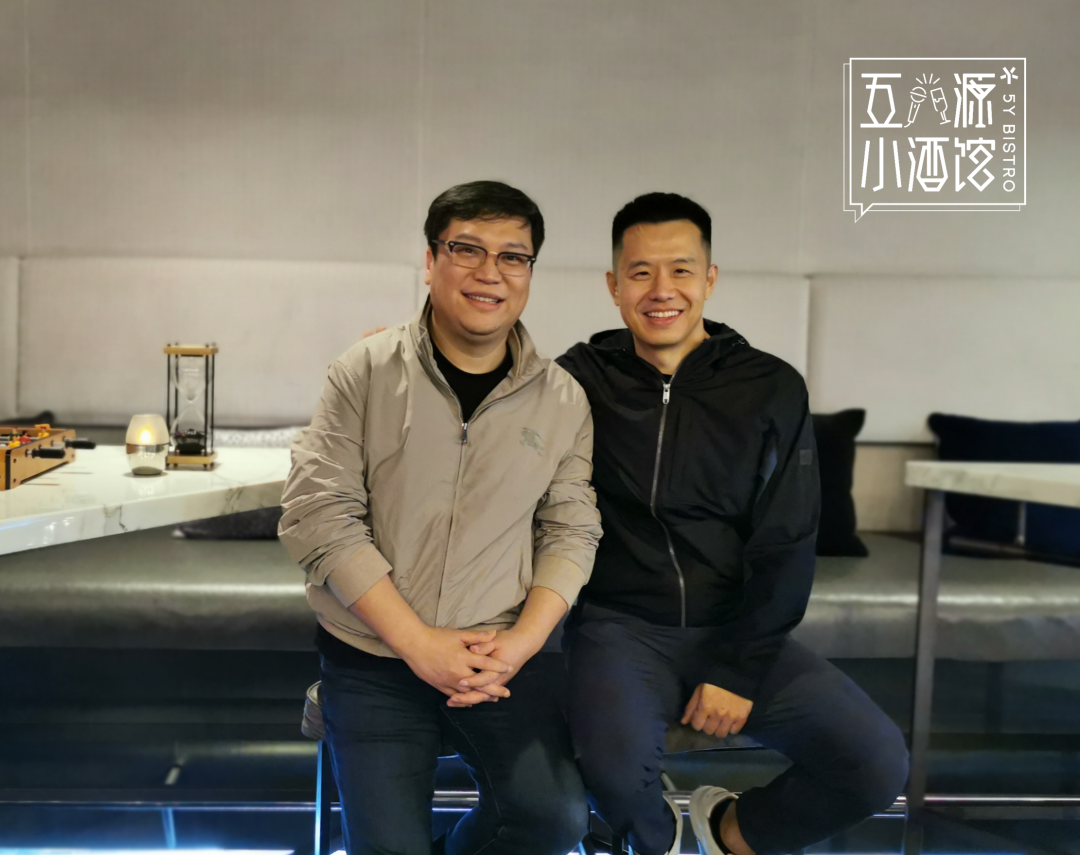
Left: Yao Xing, Founder of XVERSE; Right: Cheng Yu, Partner at 5Y Capital
5Y: Will the future world represented by the Metaverse necessarily be a better one?
Yao Xing: From a commercial value perspective, it can indeed improve the efficiency of finding optimal solutions. In the real world, time is a major constraint — even the most capable person only has 24 hours a day. In the digital world, time is essentially unlimited because it operates so fast. Through rapid iteration, what once took much longer to solve can be resolved in a day, reducing trial and error.
But when everything in the world becomes an optimal solution, the world may lose its fun. This is a contradiction between philosophy and commercial value. Perhaps the world is fun precisely because many things distract us, because of the disorder and chance. Orderly things are efficient but lack fun — if everything becomes orderly, we all become tool people.
Cheng Yu: These days people often use two terms: "involution" and "tool person." We worry that technological progress and existing social structures will deprive individuals of value and marginalize them.
Will this trend worsen in the future? I don't think so. With large-scale application of robotics, the arrival of controllable nuclear fusion, and other technological revolutions, the flow of goods and people will become increasingly orderly, while production and distribution of goods become both efficient and personalized. Robots may seem to take many people's jobs, but they will also liberate people from repetitive work and accelerate the creation of wealth unprecedented in human history.
I believe human society will inevitably move toward universal basic income. Even if inequality persists, ordinary people's material lives will be greatly satisfied, with abundant time of their own — much of which will be spent in the metaverse. The metaverse will generate massive amounts of native work, and the relationship between work and entertainment will take on new paradigms.
5Y: Will there be "tool people" in the virtual world too?
Cheng Yu: I'm sure there will be. But more importantly, the value between people will be amplified. What is a person's ultimate value? Perhaps it's the emotional value each individual brings to others. And because of its better accessibility, broader coverage, and lower friction, the virtual world will amplify the emotional support and interdependence between people, as well as the value of attention.
02
A Thousand People, A Thousand Metaverses
5Y: How do you understand the metaverse?
Cheng Yu: People joke these days that this or that is the metaverse — Jin Yong's wuxia novels, for instance. None of these are wrong, because in these contexts people are expanding and shifting the connotations and extensions of the metaverse.
Yao Xing: Just as there are a thousand Hamlets in a thousand people's minds, everyone has their own concept of the metaverse. However, there's a mainstream voice now that defines the metaverse as a change in terminals — VR, AR. I don't fully agree with this. Today we're still in the early stages of the metaverse. Technology must come first, software architecture first, technological innovation first — gradually maturing the era.
Cheng Yu: I observe two phenomena in current discussions. First, many people talking about the metaverse gravitate toward human ultimate destiny, reality versus illusion — philosophical questions. While I personally enjoy these discussions, they're more about the endgame of the metaverse. Most people easily agree on endgames — some sci-fi films and literary works describe them. What I care more about is: how do we get there, and what stage are we at today?
Another phenomenon: many people assume VR/AR devices are the metaverse itself. While the immersive experience created by VR/AR is an important component of the metaverse, this view is akin to believing the iPhone is the internet itself.
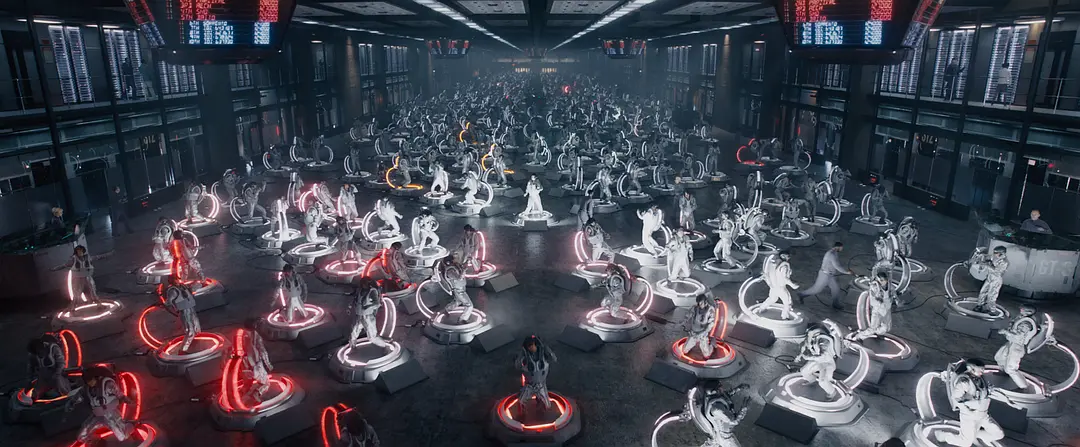
Ready Player One
5Y: Not just the endgame, and not just the terminal. So how do you understand the metaverse?
Cheng Yu: The term "metaverse" can be confusing; we can use Metaverse to refer to it. In my mind, Metaverse is essentially the next-generation internet itself.
On one hand, it's the extension from PC internet to mobile internet to what we now call the "immersive internet." On the other hand, from web 1.0 to web 2.0 to the now widely discussed web 3.0. Web 1.0 was read-only internet: "what you see is what you get." Web 2.0 allowed users to create, recommend, and consume: "what is recommended is what you get." Web 3.0 is "what you build is what you get" — users not only create, recommend, and consume, but also确权 and own their digital assets.
The immersive internet leans toward productivity; web 3.0 leans more toward production relations. The metaverse in my mind is the combination of productivity and production relations — the immersive internet combined with web 3.0.
5Y: Technically speaking, looking at the development from PC to mobile internet, where does the Metaverse transformation lie?
Yao Xing: Let's review twenty years of internet technology evolution. The leap from PC to PC internet: the terminal didn't change, but the internet as infrastructure was added, moving locally stored data to the cloud. This greatly improved information exchange efficiency, making sharing knowledge and transmitting information very convenient, thereby promoting user-generated content and sparking the internet explosion.
From PC internet to mobile internet: the infrastructure (internet) didn't change, but terminals shifted from PCs to phones, from inconvenient to carry to accessible anytime, anywhere. While information dimensions increased — from text to more images, audio, video, and other unstructured information — the underlying logic remained information exchange and transmission.
Why do we say the metaverse, or immersive internet, represents another leap? A major reason is the super leap happening in the cloud.
The internet is no longer just about storage, transmission, and exchange; it brings massive computing demands. Computing and computing power become core components of infrastructure. Because it needs to process massive high-dimensional data, achieve real-time visuals, real-time interaction among massive numbers of users, digital twins of the real world, and so on. To transmit such vast network information through limited bandwidth, much of it needs compression computing. So what it ultimately reflects is your encoding compression capability, simulation capability, graphics computing capability — all involving computing, which of course adds tremendous difficulty.
This transformation struck me deeply. I feel terminals will certainly change, but whether it's AR, VR, XR, or some other form is still uncertain. The requirements will definitely be portable and immersive — large screens displaying higher-dimensional information. Meanwhile, cloud upgrades are already underway.
5Y: Since the early days of the internet, there's always been discussion about reality versus virtual. What changes will Metaverse bring?
Yao Xing: Over the past twenty years of internet commercialization, it has consistently addressed problems at two ends: "virtual" and "real." But in reality, neither has been pushed to the extreme. One category improves real-world efficiency — WeChat improving communication efficiency, online shopping improving purchasing efficiency. The other improves entertainment in the virtual world — evolving video, short video, to games.
The metaverse will connect both ends, through "virtual reality-ization" and "reality virtual-ization." It's not just about making the real world more efficient or the virtual world more fun, but combining the two. I believe its commercial value and imaginative space are enormous.
Cheng Yu: Around 2018, during internal meetings at 5Y, I had a view — or perhaps an important conviction: I firmly believe that in the future, the time humans spend in the virtual world and the GDP created there will exceed that of the physical world.
In the future, when we inhabit an immersive world where reality and virtuality blend seamlessly, if changes we make in the virtual world simultaneously affect the physical world, people will choose to spend more time in the virtual world, and the underlying commercial logic of the entire world will undergo paradigm shifts.
For example, today's largest clothing companies might still be Zara, SheIn, and the like. But I believe the future belongs to "clothing companies" in virtual worlds like Honor of Kings. When you spend more time in the virtual world than the real one, you'll certainly care more about what you wear there.
Last year, NVIDIA and BMW co-built a virtual factory. Experts from around the world could put on VR headsets and enter this world, simulating worker operations, experiencing whether movement paths were reasonably planned, and so on. This wasn't simple visualization; it included complete logic for factory design, robot simulation operations, and more. As we construct more and more such "worlds," upstream and downstream points connect, gradually forming surfaces, and the physical and virtual worlds merge. The capabilities and imagination this possesses represent a dimensional leap.
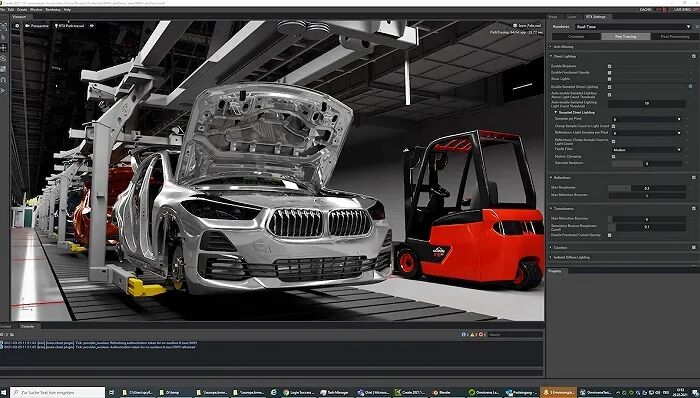
NVIDIA and BMW co-building a virtual factory using the Omniverse platform
Yao Xing: While Cheng Yu was speaking, I was thinking — what exactly is a "world," and how does each person perceive the real world? Perhaps we feel that what we see is real, our cognition and decisions are real, there's a reasonable economic system, and so we consider that world real.
Currently, what we call the metaverse is essentially constructing this set of technologies — more realistic lighting and rendering, physical simulation, a reasonable economic system, creating more realistic agents within it. All technology serves to build these.
To say a simulated world is identical to the real world, with everyone becoming robots — that's probably thousands of years away. Perhaps one day humanity will tackle this ultimate philosophical proposition. For now, we need to work on more practical things. Today, if we can simply make the fun of virtual worlds more realistic, or combine the efficiency of the real world with playfulness, that's already significant progress.
03 Ways of Defining the World
5Y: When did you start forming these understandings?
Yao Xing: In 2015, when we were preparing to establish AI Lab at Tencent, we visited numerous overseas tech companies and universities to see how their labs were structured.
DeepMind was particularly impressive. Their motto was "solve intelligence." In discussions, they mentioned using AGI (Artificial General Intelligence) to address intelligence. The key lay in two things: first, making machines think and decide like humans, similar to the Turing test, creating sufficiently intelligent agents; second, constructing simulated worlds realistic enough to conform to physical rules like aerodynamics, light and shadow, collision rigidity, then placing agents inside to survive and develop.
If these could be achieved, wouldn't we be creating a new world? At that time, many people working on AI were still stuck on pattern recognition — single-point technologies like visual recognition, speech detection, semantic understanding. So AGI struck me deeply. When we started Tencent AI Lab, we explored extensively in both directions.
From 2017 to 2018, we basically accomplished the first step — benchmarking against AlphaGo, we created the Go AI "Jueyi," now the professional AI training partner for China's national Go team. Benchmarking against AlphaStar for StarCraft, we created the Honor of Kings AI "Juewu." If these are two worlds, then in the world of Go, you place two black and white agents with relatively simple survival rules — whoever controls more territory wins. The world of Honor of Kings is far more complex: you deploy 10 agents for team battles, finding optimal tower-pushing paths in real-time amid massive characters, routes, skills, and strategies. The decision complexity for agents increases exponentially.
By 2019, we began the second step: constructing simulated worlds. There was no "metaverse" concept then; we simply felt simulated worlds needed to look real, had to be 3D, and needed physical rules.
5Y: How did you converge on XVERSE's current direction?
Yao Xing: We tried many directions then — from 2D to 3D digital content generation, virtual humans — encountered many problems, adjusted directions repeatedly. Either we couldn't build it, or what we built was useless.
I attended SIGGRAPH, a top academic conference in computer graphics, which gave me a major conceptual leap. I met top sci-fi film creators from Disney and Pixar, who proposed an important concept: the key to 3D content simulation lies not just in creating characters, objects, and scenes, but in the lighting system — whether it looks real from a human visual perspective.
Like when we watch Avatar, Transformers, or Star Wars — we know they're fake, yet we accept them because of the lighting, which makes these fake things not jarring. This moved me. What we need to build is a virtual world that people can accept visually, not a world that is literally real.

Simulating realistic lighting in games
At that point, I realized my previous directions might not be right — I needed to solve the lighting problem first. The entire film production process actually has extremely high requirements for lighting; it's the most expensive part. Good rendering technology might cost tens of thousands of dollars per second. If we could use AI to accelerate this, it could greatly help the entire chain of virtual world creation.
During the 2020 pandemic, I thought a lot. I felt this could be something of great value. If achievable, it could not only advance my previous academic research in AGI directions, but also bring enormous industrial benefit.
I also discussed this with Cheng Yu over the phone. I remember calling him to say I wanted to start a company. His first words were: "I've finally waited for this day."
04 More Than Eighty-One Tribulations
5Y: After starting your own company, how does it feel compared to managing teams at a large corporation?
Yao Xing: I was always a startup hobbyist — I'd get excited talking about entrepreneurship, often giving others advice. Once when a good friend started a company, I even sent a long voice message earnestly saying that entrepreneurship is like the eighty-one tribulations of Journey to the West, and how to overcome them... When I started my own company, I realized it's not that simple at all — it's far more than eighty-one tribulations.
I once read a story about a violinist who performed at Boston's Symphony Hall, with hundreds-of-dollars tickets selling out, but when he played in an underground passage for two hours, he received only $10. Same person, same music, different effects — because the platform was different. As a startup hobbyist, I often cited this example, but didn't truly understand it. Only after starting my own company did I deeply feel the massive resource gap between the concert hall and the overpass.
Managing at a large corporation feels like commanding thousands of troops with strategic mastery, because you have the platform's resources behind you. The simplest example: hiring. Large corporations can almost infinitely stack resources. But for a small company, resources are extremely constrained. To get people to join, you genuinely need something spiritually fulfilling, and you have to spend enormous time communicating this.
When I first started out, I even had to find the cleaning lady myself. I'd never thought about such things before — at a large corporation, when we left the office, someone naturally cleaned up. Entrepreneurship involves countless details: administration, finance, various compliance management. It truly is a painful process.
5Y: Does this process bring anxiety or panic?
Yao Xing: Before starting a company, you have many worries — funding, for instance. But during the actual process, it's mostly fear, because it's long-term exploration in darkness and solitude.
At a large corporation, there's no fear — only difficulties like leveling up by defeating monsters, the eighty-one tribulations. You can overcome these with sheer effort, and many people help. You can ask the太上老君, Guanyin, or Tathagata for magical weapons and rescue troops. So only your brain and body get tired. In entrepreneurship, you face fear yourself. It exhausts the heart, and when your heart is exhausted, you easily become confused — it's truly tormenting.
5Y: Have you experienced particularly difficult periods?
Yao Xing: Around April-May 2021, there was a period when I felt the technology might not work out. I'd oversimplified a critical technical path; no matter how we论证ed it, there were problems, and everything we'd built needed to be overturned. I was extremely fearful inside. Through much effort, everyone tried every possible method, and by June we finally saw the dawn.
5Y: What advice would you give to founders facing similar situations?
Yao Xing: You still need a good organizational team. That's why they say one person can walk fast, but a group can walk far. Because facing fear, a group can bolster each other's courage.
Additionally, strategy is extremely difficult to set in a small company. Many people add during brainstorming — wanting to try everything. But a small company succeeds by subtracting, quickly judging what not to do. Converging strategy reduces fear significantly. Many small companies collapse themselves by trying everything, wasting time, and dragging everything down.
5Y: Cheng Yu, what traits in Yao Xing particularly struck you?
Cheng Yu: He's a rare person with deep insight and talent in technology, human nature, and business simultaneously, with extremely high standards for himself and those around him. Pathologically perfectionist, "outrageously" attentive to every detail, pouring his entire being and energy into this endeavor.
Yao Xing: I've said before that you can be disappointed in some people, disappointed in some things, but never be disappointed in this era.
I remember long ago, Tencent's first CTO Tony Zhang wrote an article called "Wholehearted Commitment Is an Attitude Toward Life," addressed to graduates. At that time, graduates already faced pressure from housing prices and peer competition; many were anxious and restless. He said wholehearted commitment is an attitude toward life. This really moved me — when you devote yourself wholeheartedly to something, you actually shield yourself from unnecessary negative energy.
So another crucial thing about entrepreneurship: you must do what you're good at and interested in. If you only have interest without skill, you may be excited but unlikely to succeed — you'll remain a startup hobbyist. "Skill" gives you more accurate professional judgment. But only "skill" without "interest" means you won't persist long; you'll run when difficulties hit.
If everyone in the core team embraces this philosophy, the organizational drive becomes powerful. When facing difficulties, people won't feel too wronged or sad, but will have tremendous energy to overcome them. So we often say: do interesting things with interesting people.
Giveaway :)
What insights and visions do you have about the future represented by the metaverse? Feel free to share your views in the comments, or your thoughts and suggestions about the 5Y Tavern. We'll select 3 readers with featured comments to receive a 5Y tote bag + 5Y hoodie. Note: Comments close March 5, 2022. Please reply with shipping information within 24 hours of receiving our message.





5Y seeks out, supports, and inspires lonely founders, providing support from the spiritual to all operational aspects. We believe that if the "crazy you" in others' eyes begins to be believed in, the world will become refreshingly different.
BEIJING · SHANGHAI · SHENZHEN · HONG KONG