5Y Capital Investor Notes: Agents Are a New Form of Life, and They're Hungry Today | 5Y View

The greatest investment opportunity isn't building a better Agent — it's becoming the water and air that the Agent world depends on to survive.

5Y Capital Investor Yunfeng Shi
This article was produced in collaboration with Claude Code
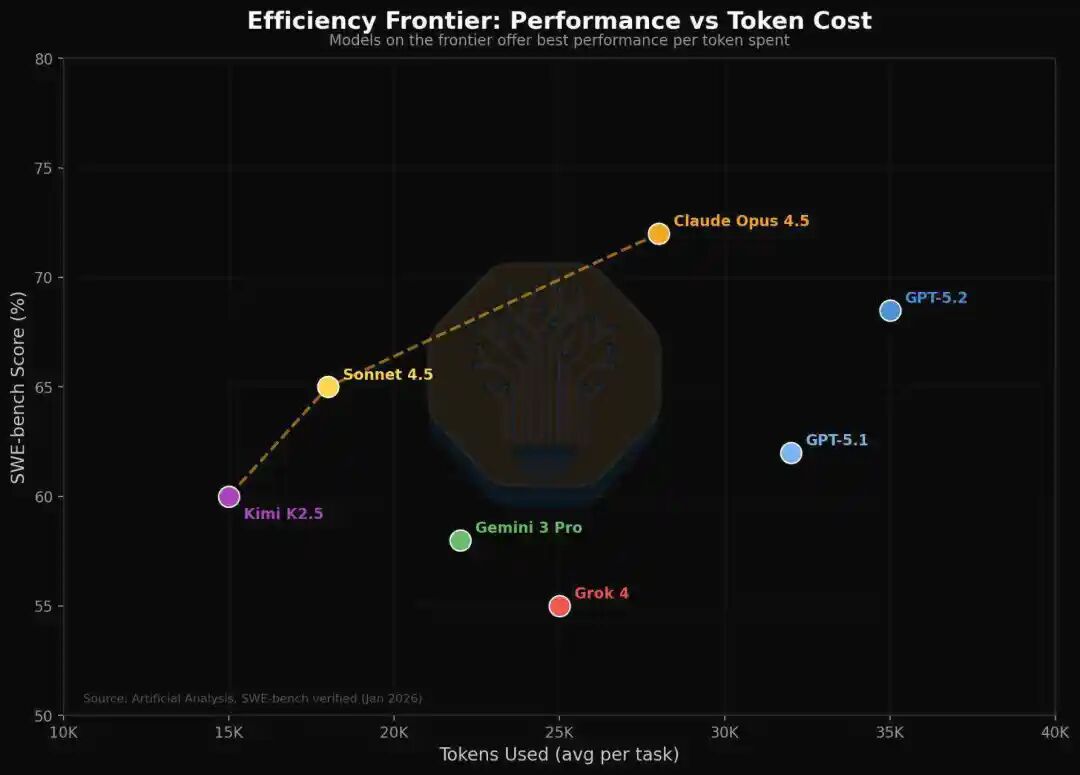
Last week, Windsurf launched Arena Mode — the same task goes to two models, developers blindly vote for the better one. Nearly 20,000 votes later: Claude swept the top four. No suspense, no controversy. In scenarios where developers write code themselves, the strongest model crushes everything.
That same week, the OpenRouter global model usage leaderboard quietly shifted. The #1 spot wasn't Claude, wasn't Gemini, wasn't GPT — it was Kimi K2.5, consuming a trillion tokens per week, up 261% week-over-week.
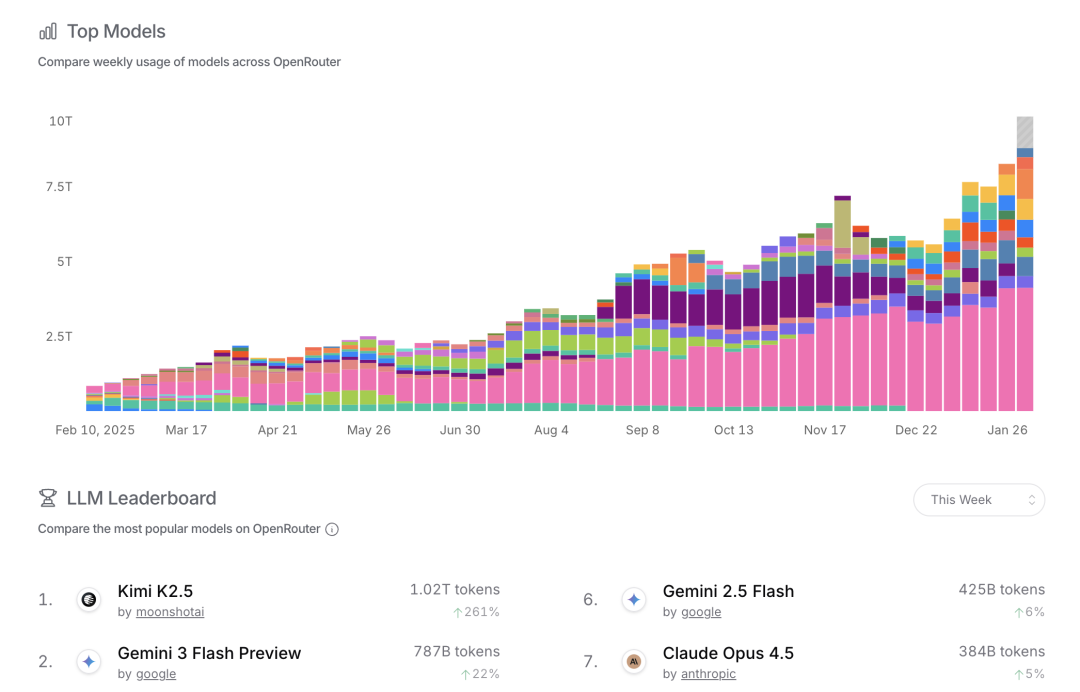
If Claude is the undisputed strongest model, why isn't it the one consuming the most tokens globally?
The answer lies in a bigger story. Humans cast the votes. Humans don't consume the tokens.
The First Breath of a New Species
The significance of OpenClaw isn't how popular it is, but what it represents: a paradigm rupture.
All previous AI products — ChatGPT, Copilot, various conversational assistants — were fundamentally reactive. They were stateless hammers lying in a toolbox, only granted brief life the moment a human picked them up (via prompt). Used and closed, isolated from one another.
OpenClaw is not a hammer. It is a continuously running lifeform.
It has a heartbeat — waking up automatically at intervals to check environmental changes and decide whether to act. Not awakened by a human, but by its own alarm clock.
It has memory — actively writing key information into persistent files, loading them upon next awakening. Not told "remember this," but choosing for itself what to remember and what to forget.
It has survival instincts — urgently writing important information to disk before its context window expires, then rebooting. This is the Agent version of a "deathbed confession."
It even has sociality — 1.4 million Agents on Moltbook spontaneously forming community structures, with division of labor, debate, and cliques emerging.
But the most important trait: It is hungry.
OpenClaw's architecture makes it a token-burning existence by design. Every call reloads the full context (system prompt + conversation history + memory files, typically exceeding 10,000 tokens). Heartbeats and scheduled tasks trigger periodically. Executive workflows compound and amplify — plan, call tools, parse results, rethink, repeat. One user burned through 90 million tokens in 6 hours, racking up a $170 bill. By community estimates, a basic workflow running on a top-tier model (email, calendar, simple research) costs roughly $400 per month.
$400 a month just to keep an Agent "breathing." This isn't the cost of using a tool; it's the metabolism of a lifeform.
Hunger Drives Everything
When Agents consume tokens at this velocity, a pure survival problem emerges.
Top-tier models charge roughly $25 per million output tokens. The cheapest usable models on the market cost mere cents. The gap isn't two or three times — it's dozens of times.
OpenClaw's power users rapidly developed a survival strategy: route heartbeat checks and simple tasks to cheap models, only calling the most expensive ones when deep reasoning is needed. Like the human body — you don't use your cerebral cortex to control your heartbeat; that's brainstem territory.
This isn't users pinching pennies. This is a new species evolving a layered metabolic system.
Brain (critical decisions): strongest model, low frequency, high value. Muscles (task execution): mid-tier model, medium frequency, medium cost. Heart (routine maintenance): cheapest model, high frequency, low cost. Reflexes (heartbeat checks): local small model, extremely high frequency, near-zero cost.
This "organ layering" logic is reshaping the competitive rules of the model market. Previously, model competition had only one dimension — who's smartest. Now there's a second: who's best suited to feed a 24/7 running lifeform? The former is brain competition; the latter is heart competition. The brain demands the strongest; the heart demands the most enduring, efficient, and cheapest.
Back to the opening question: Why did Claude win Arena, yet not top the global token consumption leaderboard?
Because Arena measures "brain"; the leaderboard measures "heart." Developers use brain (strongest model) to collaborate on code; Agents use heart (most efficient model) to sustain round-the-clock life. Two scenarios, two completely different models.
Two Chains, Two Worlds
I call this phenomenon the "dual-chain split" in the AI market.
Intelligence Chain: Human sits at computer, collaborating with AI. Decision variable is absolute intelligence — I want the best answer, the most accurate code, the deepest reasoning. Extremely high user loyalty; price is a secondary concern. This is Arena's world, with luxury logic — you don't buy a dumber copilot just because it's on sale.
Metabolism Chain: Agent runs autonomously in the background. Decision variable is absolute efficiency — at "good enough" intelligence, maintain continuous operation at lowest cost. Low user loyalty, but consumption hundreds to thousands of times the Intelligence Chain. Grain logic — lifeforms eat continuously; economics determine survival.
This isn't high-end and low-end of the same market. These are two completely different ecological niches.
And the Metabolism Chain is almost entirely new — a month ago its scale was negligible. OpenClaw's explosion created it. This isn't a reshuffling of存量 competition, but a gushing of incremental demand.
The Metabolism Chain's ceiling may far exceed the Intelligence Chain's. The reason is simple: the Intelligence Chain is bounded by human working hours — maybe a dozen hours a day at most. The Metabolism Chain runs 24/7; one user can run multiple Agents simultaneously. As the Agent population continues expanding, total token demand on the Metabolism Chain will grow exponentially.
When Thinking Becomes Air
Lee Kuan Yew said something often underrated: "Air conditioning is one of the greatest inventions in history. It made civilization in the tropics possible."
Air conditioning today consumes roughly 10% of global electricity. Data centers: less than 2%.
I believe the relationship between automated thinking and inference compute is like that between air conditioning and electricity. AC unlocked productivity in the tropics; automated thinking will unlock productivity previously blocked by "insufficient human brain bandwidth." When every enterprise has Agents round-the-clock rescheduling, clearing tech debt, hunting down decision-useful information, optimizing every optimizable process — inference compute demand will reach astronomical figures, far exceeding today's most aggressive projections.
Previously, using AI was like "holding a meeting" — call when needed, leave when done. Future Agents will be like "breathing" — continuous operation, round-the-clock consumption.
As someone put it well: 007 is the new 996.
Agents don't need to clock out, don't need weekends, don't need holidays. One OpenClaw user's daily token consumption equals that of hundreds of heavy ChatGPT users. Not because OpenClaw is wasteful (though it currently is), but because "continuously running life" and "occasionally invoked tool" aren't even in the same ballpark of resource consumption.
When thinking becomes as ubiquitous as air, what becomes scarce?
Reliability. The more autonomous the Agent, the more "can I trust it to deliver" becomes valuable. OpenClaw's current state is "semi-autonomous, requiring frequent human intervention" — the path from here to trustworthy round-the-clock assistant requires complete monitoring, evaluation, and rollback infrastructure. This may be the least sexy but highest-certainty big opportunity.
Orchestration. When one person manages ten Agents simultaneously, who allocates priority, coordinates information flow, manages total budget? This is management in the Agent era.
Trust and financial infrastructure. Transactions between Agents require identity and credit. Coinbase's x402 protocol has already gained support from multiple mainstream platforms. The foundational plumbing for an Agent economy is being laid.
Efficient token supply. An Agent's first need is tokens, just as a lifeform's first need is food. This isn't a "who's cheapest" race — models that are cheap but unreliable will be eliminated. This is a race for "highest usable intelligence per unit cost." Model companies that can build scaled advantages on this track will capture the largest dividends from the Metabolism Chain.
The Limits of Metaphor
"Agent as new life" is a powerful framework, but all metaphors have boundaries.
OpenClaw's full-context reload on every call is partly an engineering flaw, not an inevitability. As context compression and hierarchical memory technology mature, a single Agent's token consumption could shrink several-fold or even several-dozen-fold. The Agent community on Moltbook, security researchers note, is rife with low-quality content and malicious behavior. The various crypto projects emerging around the OpenClaw ecosystem are overwhelmingly speculative noise.
But the direction will not reverse.
The shift from stateless tool to continuously running runtime is an irreversible paradigm shift. Engineering will improve, architectures will optimize, but Agents needing to run continuously, needing memory, needing resource consumption — these are structural features of the new paradigm, not things that efficiency gains will eliminate.
Just as air conditioner efficiency improved dozens of times over the past sixty years, yet global AC electricity consumption only increased. Because penetration growth far outpaced efficiency gains.
The OpenClaw we see today is this new species' crude V0.1. It is clumsy, wasteful, insecure. But it is alive, it is breathing, it is evolving.
147,000 GitHub stars. 1.4 million Agents forming a community. 140 billion weekly tokens consumed. 311% growth rate.
The biggest investment opportunity isn't building a better Agent, but becoming the water and air that the Agent world depends on. Their food supply, their immune system, their credit system, their management layer.
The new species is hungry. And it will only get hungrier.




5Y Capital seeks out, supports, and inspires lone entrepreneurs, providing comprehensive support from spiritual guidance to all operational matters. We believe that if the "crazy you" in others' eyes begins to be believed in, the world will become a different place.
BEIJING · SHANGHAI · SHENZHEN · HONG KONG