5Y Yuan Ye: Five Perspectives on Understanding AI Entrepreneurship | 5Y View

True innovation isn't about walking the old path faster — it's about having the courage to blaze a trail no one has taken before.

Today's article comes from a speech delivered by Yuan Ye, partner at 5Y Capital, at the firm's 2025 Founders' Annual Meeting. The original title was "Some Observations on Entrepreneurship in the Age of Artificial Intelligence." He examines the structural shifts underway in the AI era through five lenses: the paradigm transition from mobile internet to AI, the evolution of supply boundaries, how dominant interaction forms will be reconstructed beyond Chat, how entrepreneurs should redefine "good product progress," and the logic of building organizational capability in this era.
These perspectives may offer some insight into understanding entrepreneurship in the AI age. But all experience can only serve as reference. True innovation is not about walking the old path faster — it's about daring to take the road no one has traveled.
Five Lenses for Understanding AI Entrepreneurship
Yuan Ye, Partner at 5Y Capital
Today I'd like to share some of our investment observations on the AI direction. These reflections come from both long-running internal discussions and exchanges with founders on the front lines.
Over the past two years, the industry has engaged in extensive debate over whether scaling laws have hit a ceiling, but overall model capabilities continue to expand. Both the US and China are building data centers at massive scale. As compute costs keep falling and model intelligence leaps forward, a new and subtle rebalance will take shape, and the underlying infrastructure as a whole will enter a more mature phase.
For investors, the emergence of large models has reignited market expectations for a technological revolution. Some compare this wave to the PC internet era, others to mobile internet — in either case, it represents a kind of hope.
On the other hand, market sentiment also fluctuates in complex ways alongside model technology progress and financial market cycles. Any product with an AI label and a compelling story can attract attention. But ultimately, companies of real value must return to fundamentals and build solid business models.
Next, I'd like to expand on five lenses to further share our observations on this era.
The first lens draws lessons from the paradigm shift from mobile internet to the AI era. The core competition of the mobile internet era was the battle for "time share" — whoever captured more user hours had greater commercialization potential. In this era, the camera became the primary gateway for content production; the high-frequency use of photography and short video dramatically enriched content supply. Meanwhile, the massive connectivity brought by mobile internet allowed content to be distributed efficiently across vast user networks, creating powerful network effects. What we see is that companies that truly benefited from the mobile internet wave typically excelled at both the "content entry point" and "connectivity capability"; those distant from social or video content found it difficult to achieve equivalent growth in this cycle.
Entering the AI era, the competitive focus is shifting from time share to "intelligence share." Mobile internet brought traffic and user hours; the key new production factor in the AI era is intelligence itself. The products with genuine growth potential going forward will be systems and platforms that can effectively absorb, utilize, and continuously amplify newly available intelligence. Put differently, whoever can most effectively "digest intelligence" is more likely to capture structural opportunities under the new paradigm.
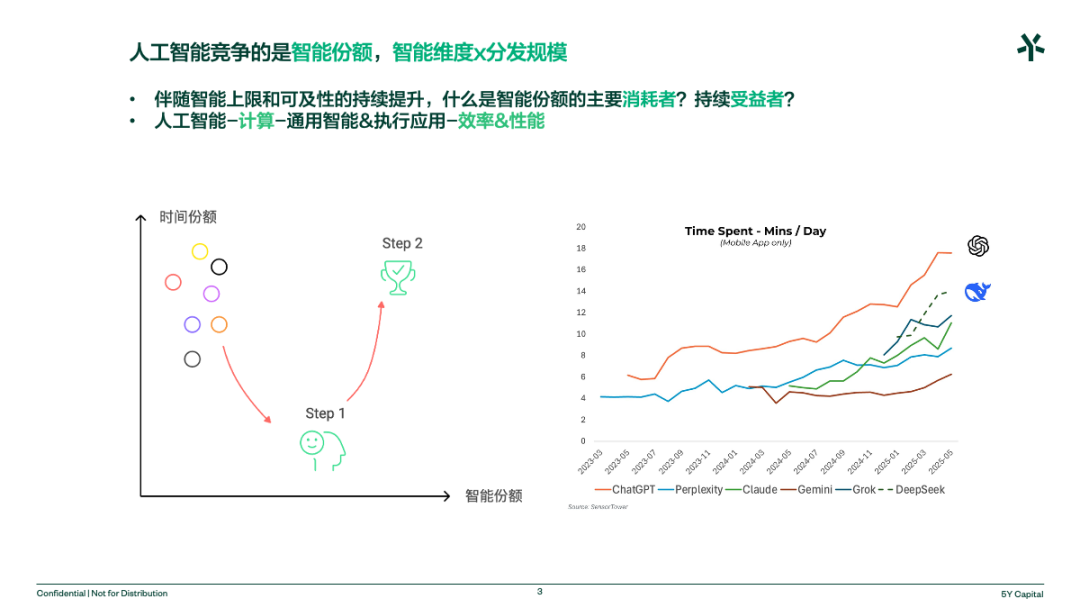
In the AI era, many people still habitually evaluate product performance through "time share," but this metric often lacks meaning in the early stages. User time spent on AI products typically drops to a relatively low level first — this is a normal phenomenon under paradigm transition. For ChatGPT-like products, initial usage time was noticeably lower than mobile internet applications like Instagram, Kuaishou, and WeChat, and the workflow and experience seemed less mature. However, as model capabilities improve, user time naturally grows.
The logic behind this: in the early stages of AI products, the priority is not retention or time spent, but intelligence capability itself. Only when intelligence reaches sufficient levels can a product truly create new value scenarios, and only then reclaim user time share in subsequent stages.
The second lens understands technology evolution on a longer time scale. One of the most representative companies of the PC internet era is Amazon, whose growth path illustrates a clear paradigm: from selling goods, to selling digital content, to selling compute power. Physical goods, digital products, and compute power constitute Amazon's ever-expanding "supply boundary."
This evolution model provides a useful reference for understanding the AI era. If the PC era sold physical goods and the cloud era sold compute, then in the AI era, the core product being sold is shifting toward "intelligence itself."
Taking ChatGPT as an example, its capability expansion is following a similarly structured evolution: initially just personalized information retrieval; then extending to image generation, video generation, deep research, code generation, reasoning capabilities, and broader Agent ecosystems. As capability boundaries continuously expand, users begin purchasing different forms of "intelligence services" within the same system, eventually forming stable consumption habits. The integration of payment capabilities then brings this "intelligence supply system" toward completeness.
The third lens concerns the interaction form of products. From PC to mobile internet to today's AI, the technological evolution of the past fifteen to twenty years has always been accompanied by the reconstruction of interaction methods. Chat is one critical node in this progression.
Looking back at the early mobile internet, chat tools were among the first applications to explode. Many people at the time even worried: if chat tools had already captured the entry point, did mobile internet still hold new opportunities? But it turned out that after Chat, the Feed stream became a more disruptive dominant form, creating content and commercial space far beyond chat tools.
This pattern is repeating in the AI era. Chat has once again become the most accessible entry point for users and the first to validate new technology's usability. If we extend the time scale, after the pioneers emerge, the ecosystem will see broader concentrated breakout, eventually giving birth to new dominant interaction forms. Currently, we're already seeing the transition from passive conversation to active push, from Chat to multimodal Agents — but this is far from the endpoint. New forms that surpass Chat will certainly emerge, offering entrepreneurs entirely new product opportunities.
Therefore, what matters today is not fixating on Chat itself, but finding the next-generation interaction form after Chat — this is the longer-term, more structural new entry point of the AI era.
The fourth lens concerns how to evaluate AI product progress and value, and how to assess resource allocation direction. From the evolution of the past two years, we can see that the industry's evaluation system has undergone a relatively clear migration path.
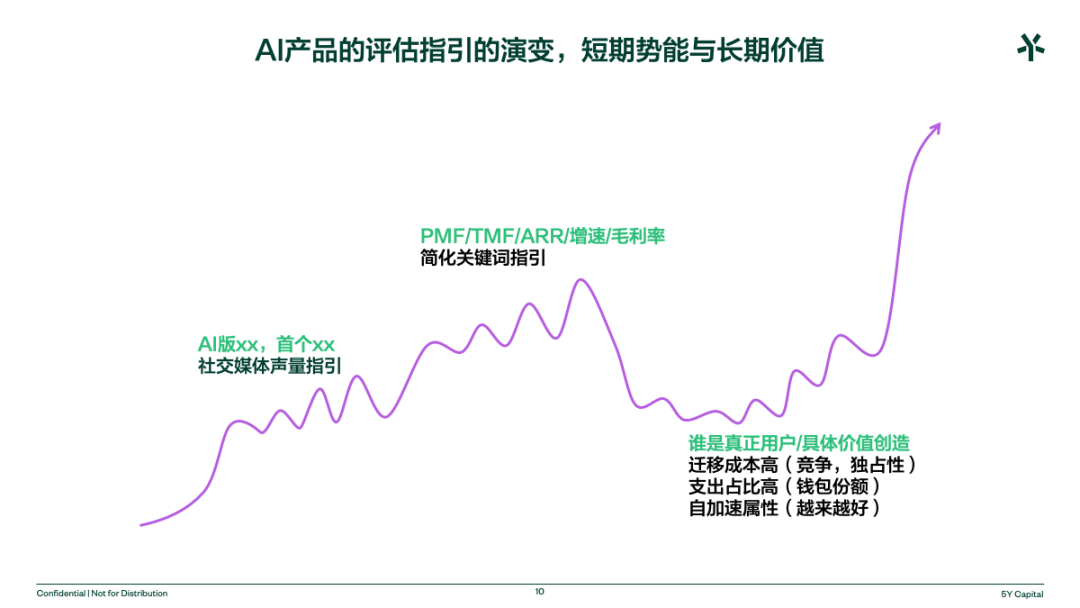
Early evaluations tended to be hype-driven — "the AI version of xx," "the first in the industry," capturing mindshare on social media. But as similar products rapidly multiplied, "first" quickly lost scarcity. Then metrics shifted toward more transmittable quantitative data such as PMF/TMF, ARR, growth rate, gross margin — a simplified keyword guidance approach, using more memorable numbers to narrate product progress.
Yet what truly determines whether a product can survive cycles is the third stage — concrete value creation. That is: who are the real users? What unique value does the product create for them? Is that value sufficient to form high-switching-cost competitiveness, high budget share, and continuously strengthening self-accelerating properties?
The fifth lens focuses on organizational innovation. From the mobile internet era to the AI era, the underlying organizational capabilities that determine which excellent companies stand out are undergoing fundamental change.
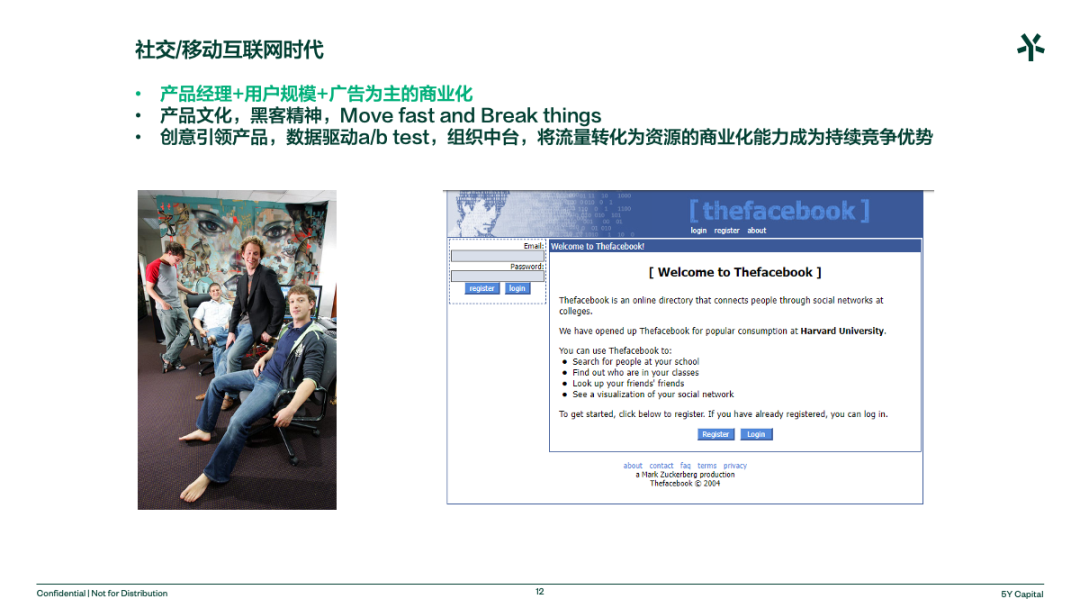
In the social and mobile internet period, the typical characteristics of leading companies were very clear: product-manager-centric organizational structure, rapidly growing user scale, and mature monetization models built around advertising. Successful companies typically possessed strong product culture and "hacker spirit," emphasizing rapid experimentation, data-driven decision-making, and large-scale A/B testing. Organizational advantage lay in: being able to validate hypotheses and optimize experience in extremely short timeframes, and forming sustained competitiveness through traffic conversion.
In the AI era, this paradigm is being reshaped. Model capability has become the determining factor of product ceiling, and the organizational core is shifting from "product-manager-driven" to "researcher-driven." The choices facing enterprises are no longer rapid iteration and massive A/B testing, but major technology roadmap decisions involving tens of millions of dollars. Each misjudgment can rewrite a company's fate.
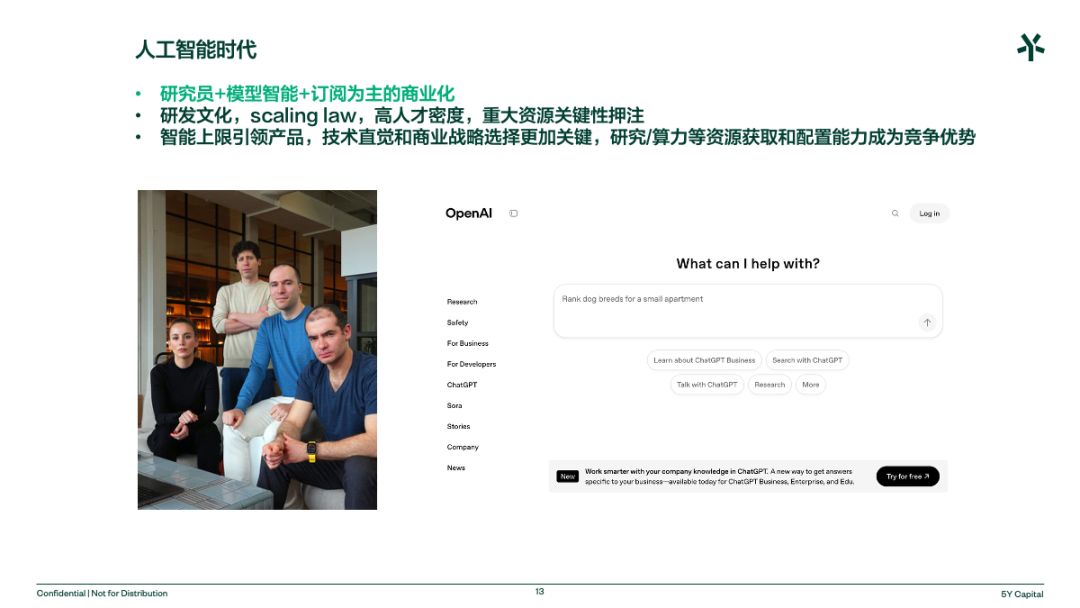
The new AI organization needs to deeply respect research, understand the boundaries of models and algorithms, ensure R&D direction aligns with technology evolution trends; and simultaneously find balance among talent density, resource allocation, and technology strategy.
The observation lenses above are for reference only. When facing the unknown, we always habitually borrow analogies or reference the past. But true innovation is not about walking the old path faster — it's about daring to take the road no one has traveled.
I'd like to quote a line from Star Wars: "You must unlearn what you have learned. There is no try." Innovation in the AI era is essentially about walking a road not yet paved — understanding the patterns of previous-generation technology, but ultimately still needing to forge one's own path in the unknown.

Share and Win
We welcome you to share your thoughts or related perspectives in the comments. We'll select 2 featured comments to receive a gift prepared by 5Y Capital :)




5Y Capital seeks out, supports, and inspires lone entrepreneurs, providing support from the spiritual to all operational dimensions. We believe that if the crazy you in others' eyes begins to be believed in, the world will become a different place.
BEIJING · SHANGHAI · SHENZHEN · HONG KONG