5Y Capital Yuan Ye: Some Observations on AI | 5Y View

The best way to predict the future is to create it.

This article comes from observations and reflections on AI shared by Yuan Ye, partner at 5Y Capital, during the firm's annual partner meeting in April. We've excerpted portions that we hope will offer some inspiration.
He noted: "AI-era entrepreneurs must pursue the agility of startups while also having the courage to make decisive bets. We believe that a new generation of entrepreneurs will continuously evolve their capabilities in pursuit of their mission, and design organizational forms oriented toward the future. In the AI era, every founder is an architect of the future."

AI Is the Mega-Trend of Today and Tomorrow
Technological innovation is cyclical. Each time a new technological revolution emerges, it kicks off a mega-trend innovation cycle. A mega-trend is universal and enduring — not limited to specific industries, not merely a fleeting explosion.
The formation of a mega-trend typically involves three elements:
- Sustained breakthroughs in new technology alongside innovation fatigue on existing platforms.
- A wave of cross-border entrepreneurs entering the arena, with newcomers and veterans competing side by side.
- New user needs being stimulated and new business models being created.
AI is currently undergoing a similar transformation. Innovation on mobile platforms has plateaued, while model algorithm innovation represented by LLMs continues to emerge, and underlying computing chips and cloud services keep improving. Over the past decade, academia and industry have accumulated a critical mass of AI talent, and this wave of innovation has attracted even more newcomers. Cross-border newcomers often bring fresh perspectives and fearless energy — more willing to challenge "rules" and break "boundaries" — while industry veterans' professional experience and business acumen are essential for executing the translation of technology into commerce. The collision and convergence of these two mindsets and skill sets provides the organizational environment for innovation to continuously ferment. ChatGPT may have been one of the few genuinely large-user-base innovation categories in app stores over the past year, pioneering efficiency-first user needs beyond social, shopping, and entertainment, and exploring business models fundamentally different from search and information feed products.
The Inevitability and Value of "Excessive" Investment
In economist Carlota Perez's long-term research on technological revolutions, she typically divides technological innovation into two cycles and four stages. Borrowing this framework, AI is currently in the first stage — the eruption phase — where technology and the economy have not yet fully integrated.
At the tail end of the previous technological innovation cycle, the conversion of technology into productivity gains hit a bottleneck, and economic growth slowed. New technology has emerged, capital and resources are flowing into infrastructure construction, but these investments have not yet translated into productivity improvements or commercial value creation. At this stage, investment efficiency will be questioned in the short term. However, this "excessive" investment in infrastructure lays the groundwork for subsequent innovation ecosystem prosperity. Through "excessive" investment, computing costs will decline more rapidly, talent will be drawn into the AI industry more quickly, and users and customers will accelerate their embrace of AI through a process of "wonder — skepticism — experimentation — conviction."
The Trap of Continuity Thinking
Historical experience shows that the success patterns of the previous technological cycle often become traps in the next. In the early mobile era, searching for "the next search engine, browser, or security software for phones" easily caused one to overlook innovations like mobile social networking, short video, ride-hailing, and food delivery. In mobile's mature phase, the market evolved from text to images to video in a rich-media progression; continuity thinking led to more immersive, more interactive Metaverse becoming the "heavily anticipated" direction. When Web 2.0-born social networks achieved "monopolistic" positions globally, market expectations of "decentralization" fueled a period of Web 3.0 explosion. In recent years, cash-flow-first, PMF-first survival strategies became mainstream consensus. But the long-term growth engine of a company depends on investment in the future — especially when a trend-level opportunity from technological revolution arrives, investment in frontier technology and top talent will convert into higher-quality cash flow in the future.
Linear extrapolation based on the entrepreneur profile, organizational form, and commercial path that succeeded in the previous cycle can become a trap. Just as companies born in the mobile era differed greatly from those of the PC internet era, AI-era companies may be radically different from mobile-era ones. We need entirely new perspectives to understand entrepreneurs of the new cycle, and to support their proactive investment in the future.
The Underestimated Evolution of Interaction Paradigms
In the AI era, new interaction paradigms may become "default" value, but their importance is often underestimated. In the early days of search engines: why did we need search? How did we translate needs into keywords? Web directories persisted for a period in the early internet, yet search eventually became a default interaction paradigm. In the early information feed: why double-tap? Why scroll up and down (far more than left and right)? When initially novel interaction patterns become habitual "defaults," the lock-in value of resulting user behavior tends to be underestimated.
Today, chat is evolving into an important default interaction paradigm. From experimenting with AI conversation to expanding more scenarios and needs within conversation — from efficiency tools to emotional companionship, from text to voice interaction. The evolution from information feed to chat will bring new interaction innovations that will be invented and become the "defaults" of the future.
Text Is the Starting Point of Internet Innovation
From the earliest web to today's AI, text has consistently been the starting point of internet innovation.
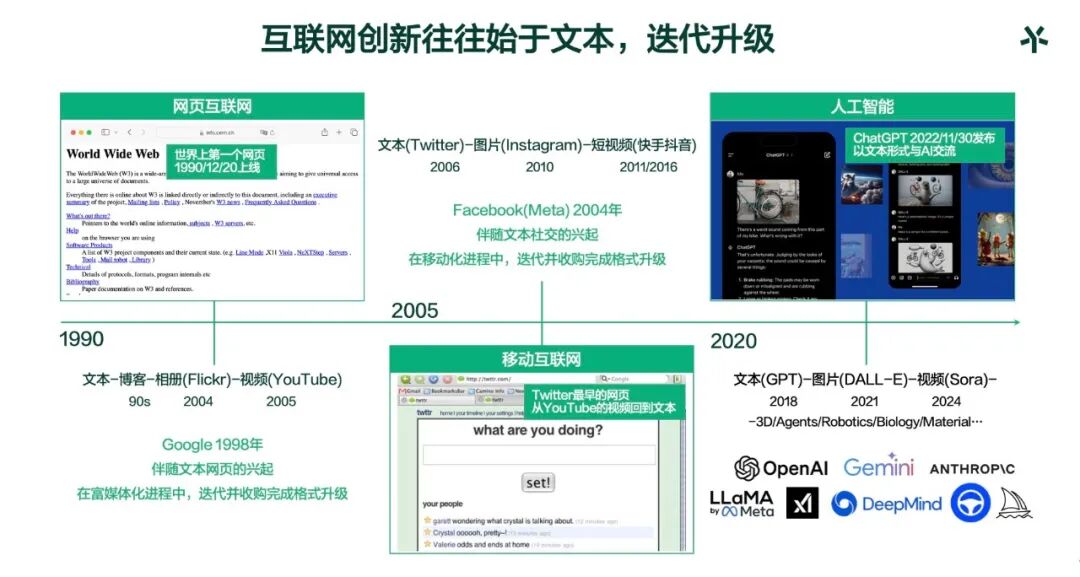
The first webpage went live on December 20, 1990 — text only. Blogs emerged in the 1990s, photo albums in 2004, video in 2005.
Transitioning from PC to mobile, although video services represented by YouTube had already flourished on desktop, early mobile hardware capabilities and network bandwidth constraints meant the mobile application innovation wave still started from text. Early Twitter users could only send text messages within 140 characters. Early Facebook was a social sharing platform dominated by text updates. WhatsApp began as a text messaging service. As network conditions matured, Instagram, Snap, Kuaishou, and Douyin followed.
Today's AI has similarly returned to text as its starting point — from the initial version of ChatGPT, to DALL-E/Midjourney, to Sora. Whether Google's search or Facebook's sharing, text has always been the key to connecting users and creating value. Internet innovation is not continuous; it often returns to text as its starting point. The importance of text may be underestimated, and this cycle may prove quite enduring. Companies that seize the wave of format upgrades have the opportunity to become future winners within the mega-trend.
LLM-Driven AI: The Petroleum Industry of a New Era
Borrowing the analogy that "data is the new oil," if we compare LLM-driven AI to the petroleum industry of a new era, we are in an early stage full of unknowns and possibilities. Just as the development of the petroleum industry gave rise to the modern industrial system, LLM-driven AI may usher in an entirely new technological and commercial era.
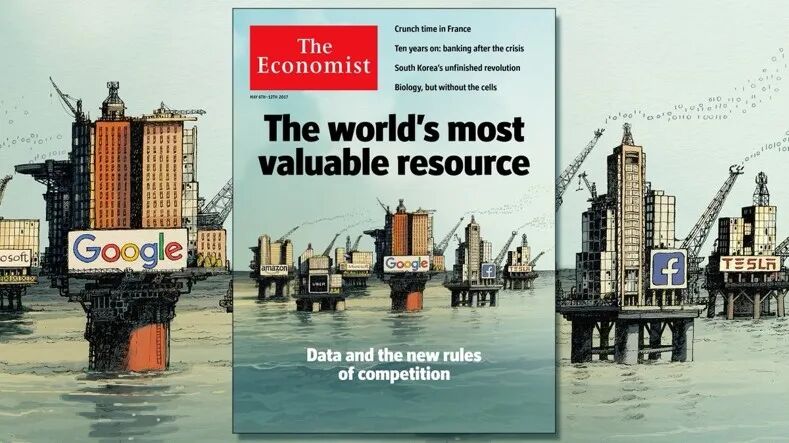
The petroleum industry originated with crude oil refining. Initially, people didn't know that crude oil contained so many important compounds. Kerosene, widely used as lighting fuel, was followed by the refinement of gasoline, diesel, and lubricants with the rise of the automobile industry, and later extended to chemicals and biomedicine — thereby spawning the entire modern industrial system.
In the LLM-driven AI era, we remain in a very early stage. What has first been "refined" is text, followed by images, music, video, proteins, and so on. The intelligentization of the future internet may have only just begun.
General and Generative
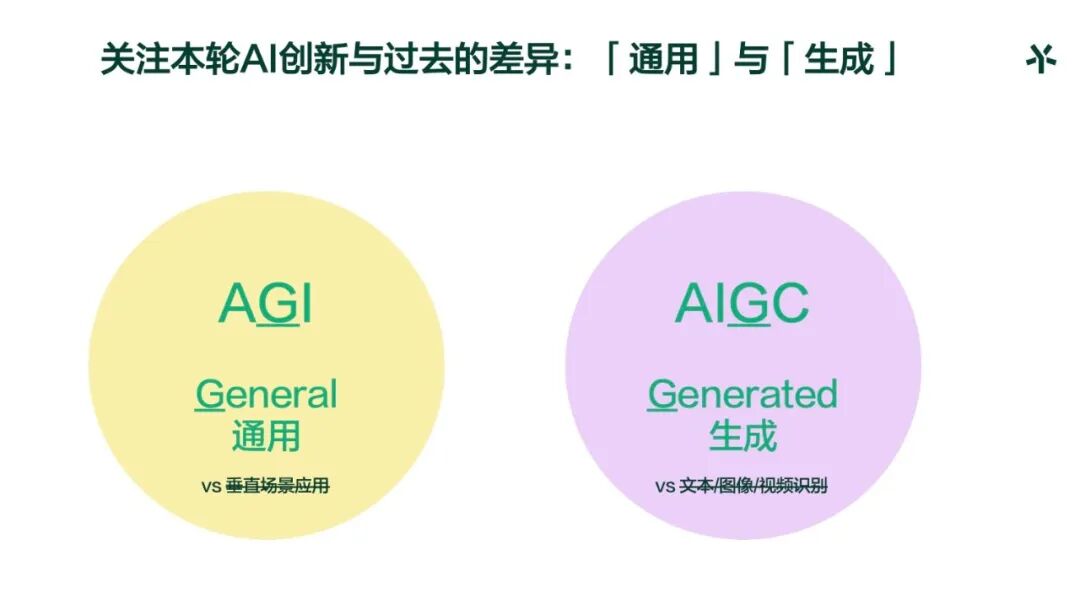
The differences between this round of AI innovation and the past are captured in at least two "Gs": the first is "General," the second is "Generative." Around AI's "General" and "Generative" dimensions, much innovative investment is needed, and much new possibility can be created.
From Time Share to Intelligence Share
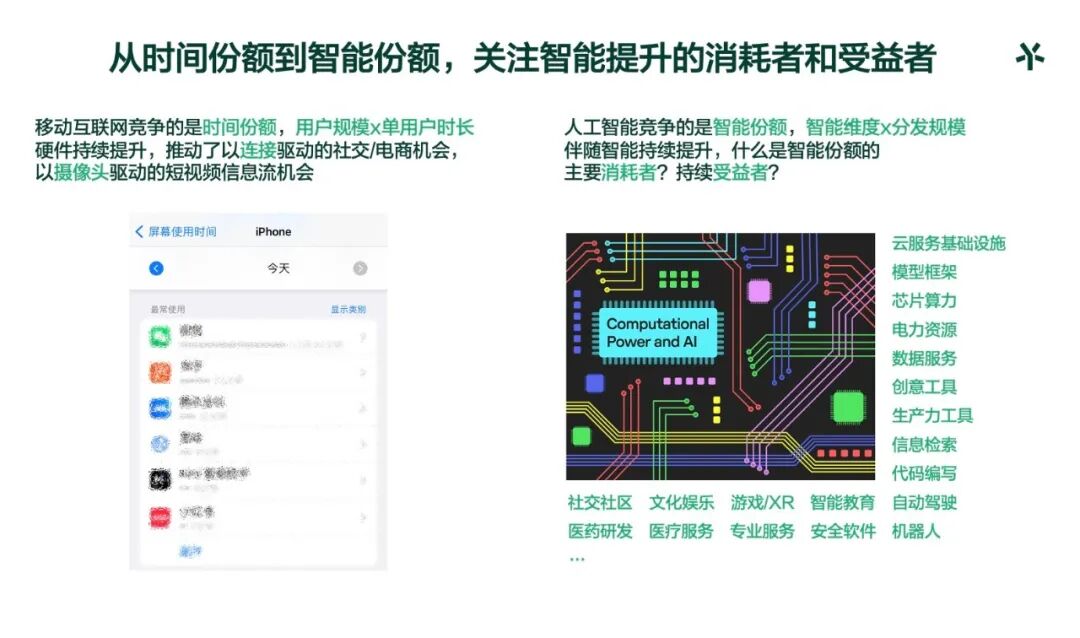
One foundation of value creation in the mobile internet was user time: more time share meant more commercial conversion opportunity. Commercial competition in the mobile internet era was competition for time share. In this contest, social networks connecting users and short video information feeds based on camera capabilities were important forms for acquiring users and capturing duration.
In the AI era, there is limited room for further growth in per-capita user time, while the potential for intelligence enhancement is enormous. Companies that can capture more intelligence share in the future are better positioned to benefit continuously from the trends of improving infrastructure, declining computing costs, and advancing model capabilities.
AI-Era Entrepreneurs and Organizations
In the AI era, entrepreneurs need capabilities different from those required before. High-quality decision-making, cognitive judgment, and deep technological understanding become paramount.
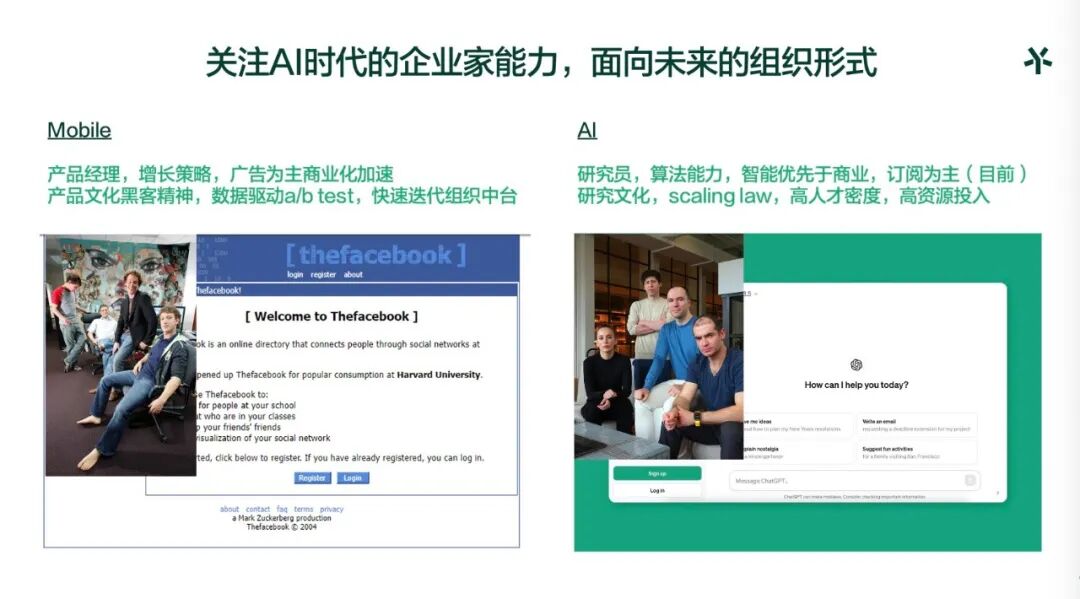
In the mobile era, rapid iteration was critical. Companies that were data-driven, efficient at A/B testing, and possessed strong organizational middle platforms could better leverage their advantages. Entrepreneurs typically embraced hacker spirit, were bold in pushing boundaries, quick to trial and error, skilled at insight into human nature for product design, and seized every available opportunity for growth.
In the AI era, due to the nature of the business, each model training consumes enormous resources — making iteration through rapid trial and error impossible, as with mobile app products. This requires entrepreneurs to pursue startup agility while also having the courage to make decisive bets. We believe that a new generation of entrepreneurs will continuously evolve their capabilities in pursuit of their mission, and design organizational forms oriented toward the future. As Alan Kay said: "The best way to predict the future is to invent it." In this AI era full of challenges and opportunities, every founder is an architect of the future.



5Y Capital seeks out, supports, and inspires lonely entrepreneurs, providing support from the spiritual to all operational aspects. We believe that if the "crazy" you in others' eyes begins to be believed in, the world will become altogether different.
BEIJING · SHANGHAI · SHENZHEN · HONG KONG