The Future of AI: Directions for Technology, Product, and Innovation | A 5-Year View

Discussing Entrepreneurial Opportunities in AIGC

AI breakthroughs and innovations are reshaping our world at a staggering pace, opening up new opportunities and transformations for entrepreneurs. As the AIGC industry enters a growth phase with increasingly diverse application scenarios, how to build product competitiveness has become a key concern for startups.
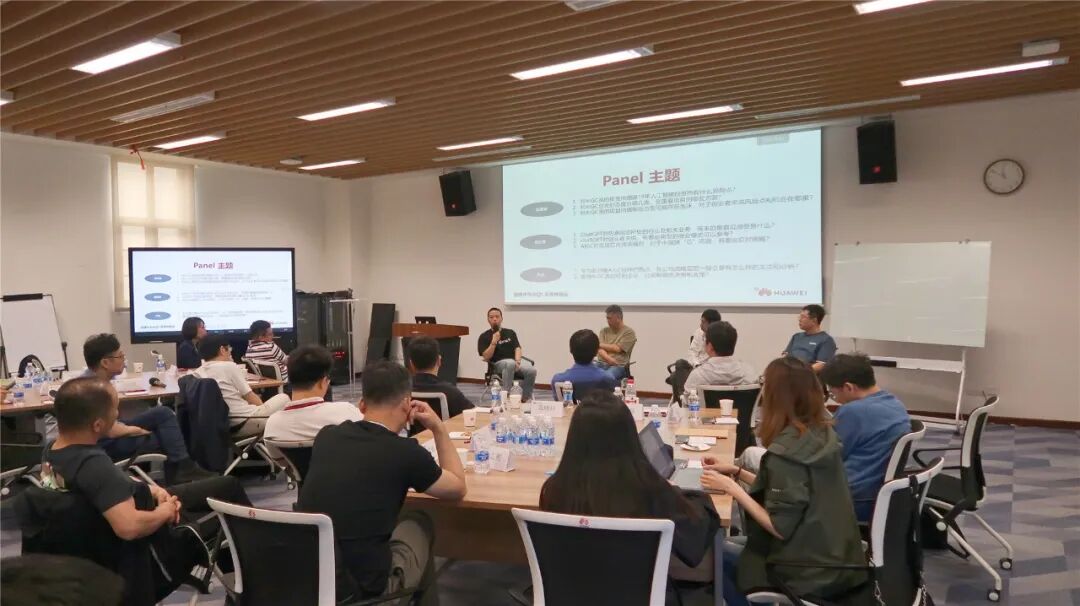
How transformative will AI be? What disruptions will entrepreneurs face, and what new possibilities will emerge? Recently, 5Y Capital and Huawei Cloud co-hosted "5Y Portfolio Company Visit to Huawei AIGC Innovation Day," bringing together over 30 CEOs and CTOs from 5Y's portfolio companies to engage with investors, industry experts, and AI evangelists in exploring the opportunities AIGC presents.
During the event, 5Y Capital partner Liu Kai, Kingsoft Office VP Yao Dong, a Huawei Cloud strategic planning expert, and Huawei's developer ecosystem operations director participated in a roundtable titled A Conversation on AIGC Entrepreneurial Opportunities and Challenges, analyzing AI's impact on industries and entrepreneurs from different perspectives. We've compiled excerpts from the discussion — we hope you find them insightful :)
Q: How does the current AIGC boom compare to the AI investment frenzy of 2019? How do investors view AIGC startups today?
Liu Kai: This wave represents a massive shift compared to 2019. In Bill Gates's words, after nearly five or six decades in the industry, there have been only two developments that truly excited him: Windows and the current large language models.
Many investors believe large models represent the most important innovation since mobile internet. I personally lived through the entire mobile internet era, but the pace and diversity of innovation in AI today far exceeds that period.
Around 2010, mobile internet produced several critical value points — what industry insiders called "tickets." Mobile internet offered three such tickets: mobile phones and communications, payment-centered business models, and short video. Large models have been around for three years now; by conventional patterns, something with massive commercial value should have emerged already, but it hasn't. Yet the large model itself is already a crucial ticket, with hints of this visible through Microsoft and OpenAI's collaboration.
Training a general-purpose, large-scale model requires scarce talent and enormous costs. In the Chinese market currently, no fewer than 50 major tech companies and startups have announced or secured funding to build large models, with more companies joining continuously. Meanwhile, open-source community iteration is extremely rapid, and how long large models themselves will remain dominant — whether they're as definitive a ticket as smartphones — remains debated.
As an investor, my mindset is quite complex. The pace of change and iteration in this field is extraordinarily fast, and new phenomena keep emerging around usage methods. The entire large model ecosystem will spawn numerous industries and companies. In the US, many startups have already raised funding for foundational large model infrastructure, countless middleware algorithm deployment companies exist, and application-layer companies are even more numerous. The entire Chinese investment community is extremely excited about large model entrepreneurship.
Q: Where might valuations for AIGC projects be inflated? What are the risks and opportunities for entrepreneurs?
Liu Kai: When a product achieves such rapid influence and penetration, some degree of bubble is inevitable. It's precisely because of this bubble that numerous entrepreneurial opportunities arise, though in the short term it's difficult to distinguish which will create genuine value.
There's also what some in AI entrepreneurship call "value-destructive" domains, where partial consensus has already formed in the US. Initially, many thought large models would benefit SaaS, since software could layer on large models to do many things. But months later, it became clear that large models might fundamentally reshape software's user interface, interaction patterns, and business models. Today, entrepreneurs are finding that many SaaS sub-sectors have simply disappeared. In the US, some SaaS companies have experienced cliff-like revenue drops, with disruption outpacing transformation by a wide margin. For instance, in SaaS, general-purpose models can already replace certain scenarios, particularly in customer service call centers and marketing, where general models can easily accomplish many functions.
Some relatively superficial business models are being disrupted, and what new value will be created after the disruption remains unclear. There will likely be many future opportunities, but first you must actually start using the technology, and second, you need to fine-tune a small open-source model. Regarding business models, if you go back to day one of entrepreneurship, from zero to one with this tool in hand, you need to think clearly about what you can do with it, rather than building on existing business models.
Q: What has been the most immediate impact of the ChatGPT craze on your industry and related business? AIGC has strong demands for underlying chips — what strategies can address China's chip shortage?
Yao Dong: The most immediate impact for us is that this represents the direction of next-generation human-computer interaction. Human-computer interaction requires foundational technology, something like large models for language understanding. Decades ago, the mouse was a major invention; graphical interfaces needed mice, while touchscreens work better for smart devices. The next generation of human-computer interaction is voice-based, requiring speech recognition.
A few years ago, deep learning was considered the next-generation technology. However, even with speech recognition, machines still struggled to understand what users wanted to do. If you made multiple requests in a single sentence, the machine might not grasp your intent. But large language model technology offers a potential solution. You can speak to ChatGPT, make requests, and it roughly understands what people want; the remaining issues are mainly its own knowledge limitations, which can be addressed through increased parameters, expanded training data, and some human annotation.
Overall, it can basically become the direction for next-generation human-computer interaction, with the remaining task being gradual promotion and application. Just as the previous generation's mouse took perhaps a decade from invention to widespread adoption, with early mice being extremely expensive — much like today's large models.
For office productivity applications, large models point in roughly three directions. First, generative construction, such as editors that can generate outlines and body text, continue writing, or rewrite content. Second, information retrieval applications — based on language models and sophisticated natural language understanding capabilities, large models can extract knowledge from many sources. Third, the ability of software to operate on the world. We see today that large models can write code; this isn't simply replacing programmers, but rather generating code instructions that can help us perform automated software operations, thereby producing substantive effects on the real world and achieving the next generation of natural language-based human-computer interaction.
Q: For Mr. Fu from Huawei's strategy department, what are your observations and analysis regarding hotspots like AIGC?
Huawei Cloud Strategic Planning Expert: Regarding large models, people may have initially felt alarmed and somewhat uncomfortable, but now we're seeing a pleasantly surprising phenomenon: by using very small inference for training, we can solve many problems, and all attention has shifted to this.
Previously, people would discuss general-purpose technology emerging across various industries, but OpenAI and ChatGPT have brought us a new model. While this business model hasn't been fully established, AI as a standalone product can be sold in the market — this is completely different from the past.
I believe that first, you must build your own large model; only then can you establish a business model. From the chip perspective, training may be problematic, while inference is relatively simpler. To summarize, regardless of the application, the ultimate result depends on how much computing power you possess — this is a threshold. The second critical point is data; who possesses data from different industries will become a key factor. This hasn't changed much compared to the past emphasis on computing power and algorithms.
Q: What policies and decisions has the company made regarding AIGC startups?
Huawei Developer Ecosystem Operations Director: Looking across the development of the technology sector, after any concept is proposed there comes an explosive phase with numerous companies emerging. After the explosion, there will be mergers and bankruptcies. What kind of companies survive this is what we focus on. From these rounds of technological transformation, the companies that truly survive are those that integrate with their respective industries, possessing unique capabilities and business models within those industries.
We often talk about planning for the next ten years — that's fine. But to actually survive, you also need to think about the next year, and your strategic objectives should reflect goals that are half a step or one step ahead. Taken together, we hope to see more scenarios and cases where startups integrate with industries. We're also identifying developers and partners, providing greater empowerment including business models and technology to help partners and developers succeed. Over the coming period, we'll focus on improving mechanisms, strategies, and capabilities to open up our company's capabilities more rapidly and with higher quality.




5Y Capital seeks out, supports, and inspires lonely entrepreneurs, providing support from spiritual encouragement to all operational matters. We believe that if the "crazy" you in others' eyes begins to be believed in, the world will become a different place.
BEIJING · SHANGHAI · SHENZHEN · HONG KONG