5Y Capital's Zhang Fei: AI of Loving Grace | The Horse That Could Count --- *Note: This appears to be a title/headline fragment. "会数数的马" (The Horse That Could Count) likely refers to Clever Hans, the famous horse that appeared to perform arithmetic — a classic case study in AI/behavioral psychology about how humans project intelligence onto systems. The main title "AI of Loving Grace" appears to already be in English.*

Everything will be rebuilt from scratch, and we're all starting from the same baseline of understanding.

About "The Counting Horse"
We don't know whether
we are a horse that can count
or a mathematician,
though most of the time it's the former.
A column by 5Y Capital partner Zhang Fei,
updated occasionally,
exploring cognition and investment.
This installment features a speech delivered in May by 5Y Capital partner Zhang Fei, titled AI of Loving Grace.
Large language models led by ChatGPT continue to command attention. But this speech isn't about technical evolution or a serious industry discussion. It's more about the evolution of AI and the transformation of business, and the questions we collectively face in the age of intelligence.
As a new species, AI creates things fundamentally different from everything before it. All logic can be reshaped, all that is solid melts into air, and our cognition is leveled onto the same starting line. Some of the most basic questions may become especially important: when intelligence is everywhere, what becomes most scarce? How do we define the relationship between humans and AI, and how do we re-examine human value and meaning?
Below is the speech. Hope it offers some food for thought :)
Today's topic is "AI of Loving Grace." Why this name? You'll understand by the end.
I'm sure by now you've all heard plenty of hardcore, trendy stuff about AGI. What I'm sharing today is different. You don't need to engage your complex thinking — 50% of your brain's computing power is enough. What you can remember is what matters; what you can't, doesn't.
Why do I say this? You'll find that what we face today is entry into a massive paradigm shift, like a meteor striking Earth. Most of the time, we're thinking about how to be a good dinosaur. But we don't need to. Because the age of mammals has arrived, and what we need to do is figure out how to usher in the age of mammals.
Today I'll mainly speak about truth, the truth — including present truths and truths that may come next. There's a lot of personal bias and reflection here. Hope it's somewhat helpful.
How should we view where we are today?
Many people compare today's AI revolution to the PC internet era or the mobile internet era. Most people's interpretation of paradigms is constrained by their limited experience, yet history often tells us more. I recently re-read Steve Jobs and revisited the history of computing, and I realized that today actually resembles the early computer era more — many things that happened then are very similar to now. We've entered a new computing paradigm, and this new paradigm has completely transformed our environment.
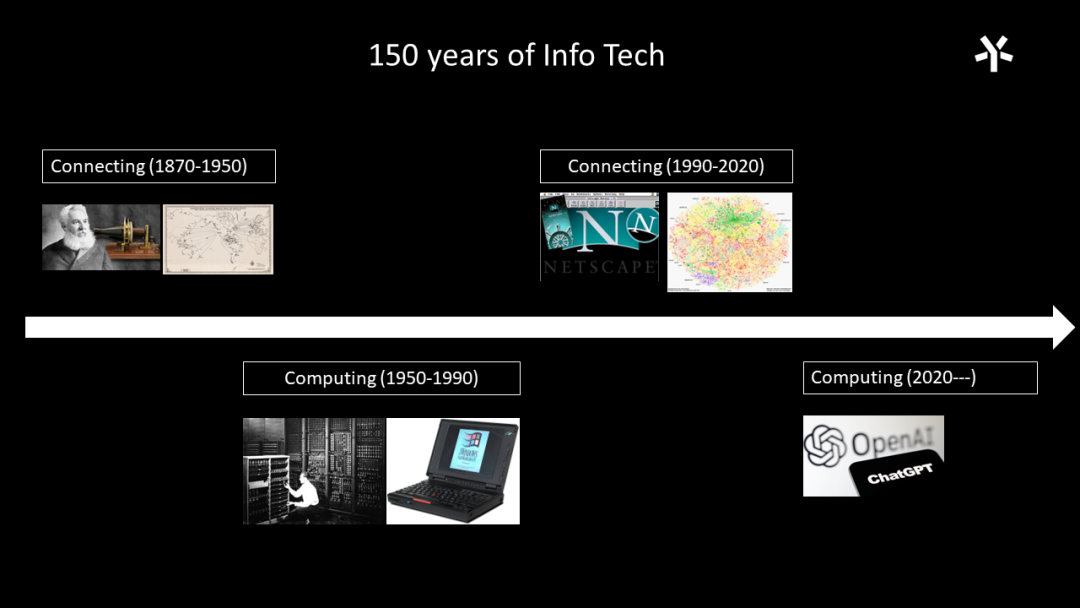
Looking back at the last 150 years of information technology history, you'll easily spot two alternating technological threads: connection and computation. 1870 to 1950 was the connection era (Bell invented the telephone, telephone networks exploded), 1950 to 1990 was the computation era (mainframes to PCs), 1990 to 2020 was the connection era again (PC internet to mobile internet). From 2020, the new AI era arrives — this is a computation era. The rules of the game in a computation era differ greatly from those in a connection era. Network effects, for instance, were king in the connection era but not necessarily so in the computation era.
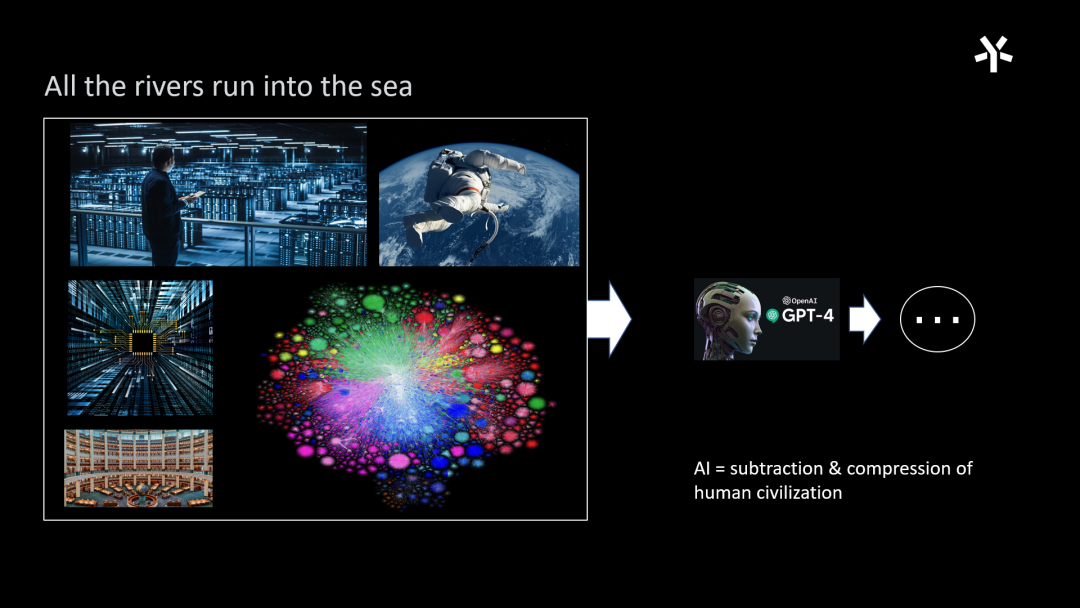
Looking at today, humanity has accumulated incredibly rich books, knowledge, documents, advanced technology, semiconductors, massive data centers, the internet, much of human civilization. Yet you'll find that all the rivers run to the sea. All of human civilization is converging toward today's AI, today's GPT-4. This seems to be the destiny of technology. The most powerful thing about artificial intelligence is that it is the compression and abstraction of human civilization.
MIT recently interviewed Geoffrey Hinton, who offered a particularly interesting logic. He said that a GPT, with over 170 billion parameters and one trillion connections, somehow remembers all of human knowledge and civilization, and can even engage in abstract thinking — this is quite miraculous. GPT uses a very simple backpropagation method to learn more than humans. The human brain has 100 trillion connections, but GPT has only one trillion. AI is better than humans at packing vast knowledge into one trillion connections.
He raised an excellent point: "It's possible that machines have found a better way to learn than humans." If so, we might consider: if our intelligence and learning methods are already inferior to AI's, where does humanity's place lie in the future? That's a more interesting question.
AI is much bigger than the Internet

Why do I say this? The internet is a tool; AI is a new species. It can change us, even manipulate us. Perhaps the important effort humanity needs to make next is how not to be manipulated by AI, how not to fall in love with AI.
Imagine if today there were a spaceship that could immigrate to Mars, and we could only bring the most essential things. In the past we might have chosen to bring the internet, but if making that choice today, we'd very likely choose GPT-4. Everything can be rebuilt. Everything we see today is already obsolete, and our cognition has been leveled onto the same starting line.
Take the simplest example: in the early computer era we invented file systems, with different file formats, to let machines process information more efficiently. But today you'll find none of that matters anymore, because all data can become vectors and tokens — they're all the same.
AI's data processing methods increasingly resemble the human brain's mechanisms. When file systems disappear, when data becomes vectors, you'll find that all our logic about infrastructure needs to be rebuilt.
What will humans become? Superhuman.
In fact, we are already half-human, half-machine today; smartphones have largely merged with us. But in the future, we may evolve into humans more like machines — seventy or eighty percent machine, with twenty or thirty percent humanity.
OpenAI's chief scientist Ilya once posed an interesting question: how many sentences does a person speak in a lifetime? Even someone who loves to talk might only speak about one billion sentences in their lifetime. Suppose there were a GPT that could record every sentence a person ever spoke — that AI's understanding of you might exceed that of any human, whether your lover, parent, or friend.
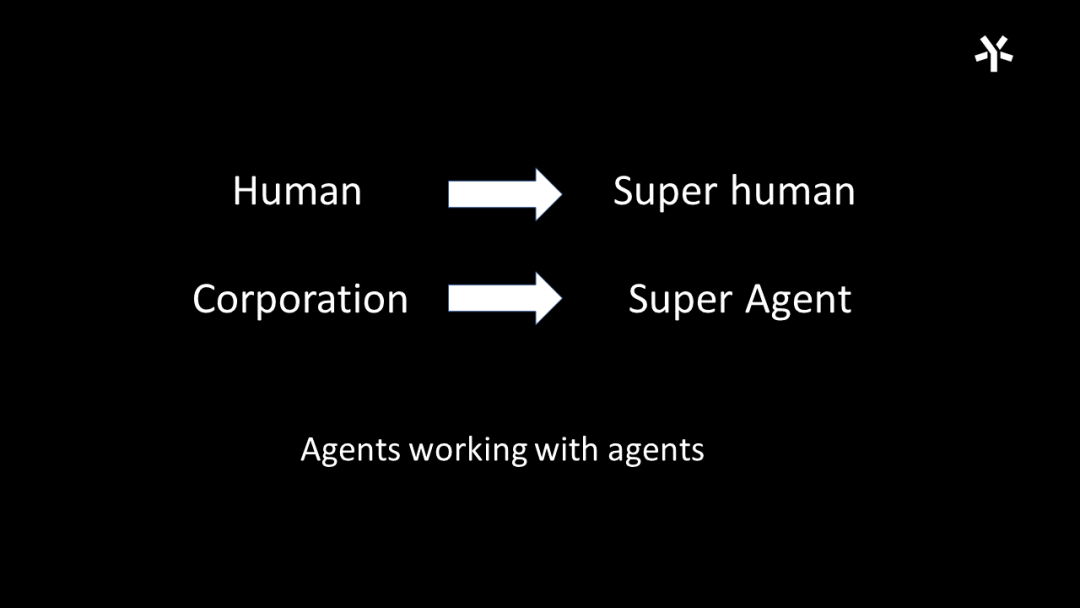
When human memory, cognition, and perception see massive enhancement, we become superhuman. Enterprises and companies will become super agents, possessing superintelligence and interacting with humans in the form of intelligent beings. Within organizations and throughout society, large numbers of AI agents will collaborate.
In future organizations, many nodes may be AI agents, with humans and agents collaborating fully, and division of labor becoming somewhat peculiar. There's a good chance agents will take on more and more responsibilities. Humans may end up doing work that helps machines become more powerful, because agents' task processing and decision-making capabilities are gradually surpassing those of humans.
From information overload to data scarcity. In the AI context, humanity's information overload problem is being solved; intelligent assistants will soon help humans make only a small number of decisions. But for AI, the biggest challenge is insufficient data. Even putting all of human civilization's data into training models isn't enough. We now have to invent new methods for humans and AI to interact more, producing more data.
Additionally, a phenomenon may happen soon: there will be a billion-level population of programmers in this world.
Today everyone probably thinks coding is hard, but in the future, if you can speak, you can be a programmer. In the past we had many unmet needs, but the AI era may change this. For example, you could make an AI that identifies "scummy" romantic partners — that might be a great idea.
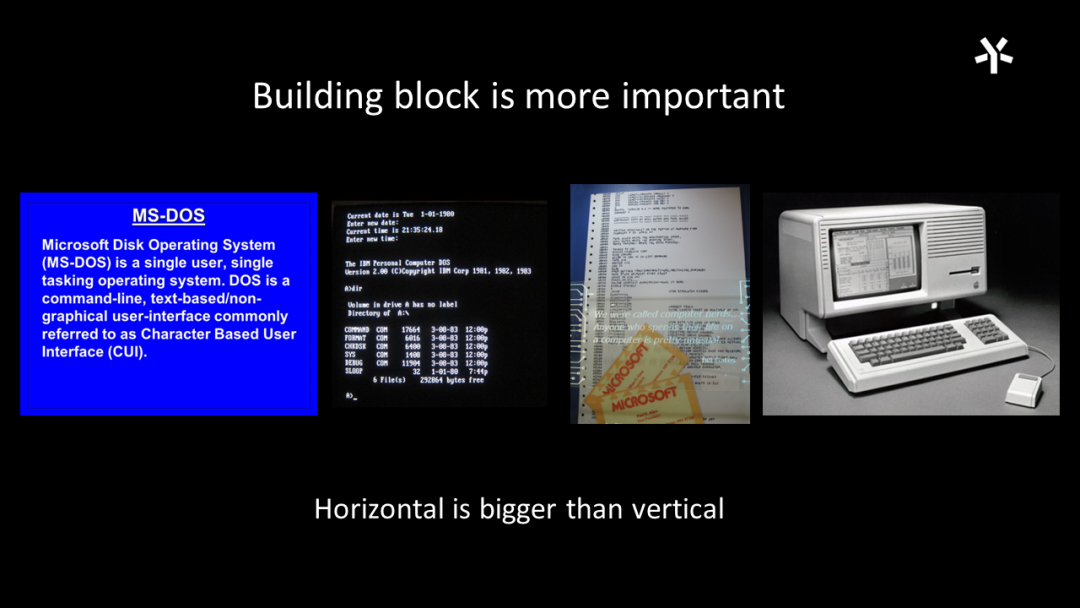
When the last computation era began, computational building blocks were extremely important. Programming languages, graphical user interfaces, operating systems — these tools defined an era and important companies. Today in the AI era, we're seeing many new tools constantly emerge. How to build better AI infrastructure and ecosystems is the more important task at hand.
Horizontal is bigger than vertical. Same logic. We need to build tools that better empower all industries and users, rather than immediately entering vertical application domains. It is too early for the verticals.
The Software Model Must Die
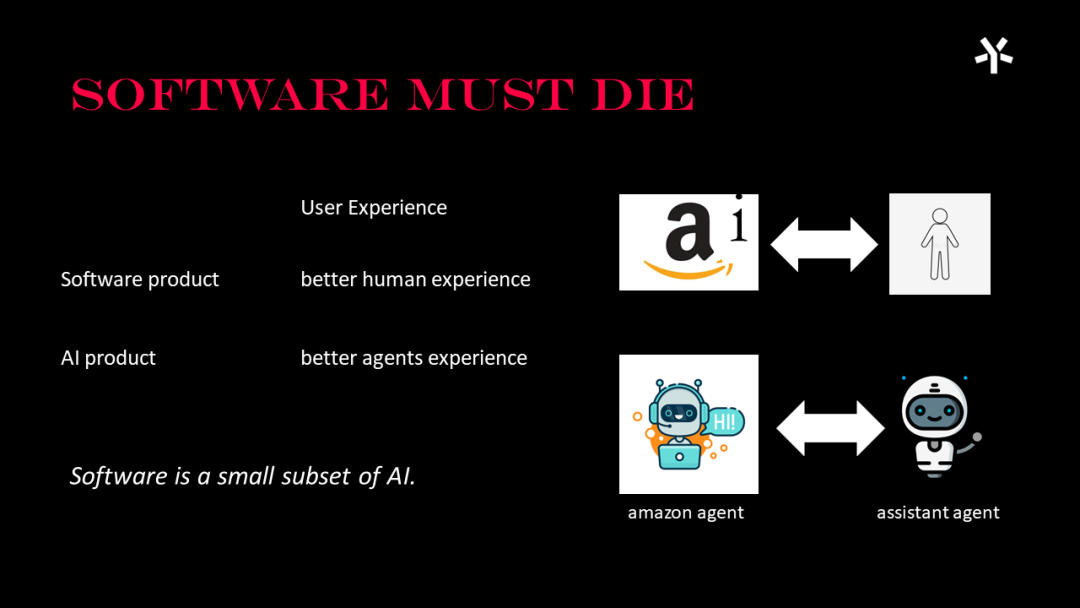
American peers have said: software is eating the world. But think carefully — software is a very dumb paradigm. All software has only an if-then logic: if A happens, execute B; if C happens, execute D. If you used software logic to interact with your partner, you'd probably end up badly, because software and humans are different.
But AI is different. AI's logic is: when massive data and complex context are presented, AI makes the highest-quality decision. This is AI's characteristic — it's similar in essence to human intelligence.
So, against the backdrop of AI, the software industry will undergo massive change, rapidly shifting into AI logic. In the past, software products aimed to make human experience better; in AI logic, the goal is to enhance agent experience.
Take the simplest example: today when we open Taobao to shop, we browse different product categories, check other users' reviews, distinguish genuine from fake products, and finally place an order. It sounds like a very natural experience, but actually involves many complex processes.
Today if you were to rebuild something like Taobao, you'd only need to establish two agents: a personal assistant agent and a Taobao agent. After some simple interactive dialogue between the two agents, a transaction is complete. Against the backdrop of AI, product logic has changed significantly — this is one of the reasons our era has become so interesting.
Moreover, the biggest difference between software and AI is this: in today's software products, humans make decisions at all critical nodes, while software mostly does automation work. In the AI era, humans only need to make very few decisions; most decisions are made by AI.
We recently saw a very interesting startup demo: a human instructs AI to design a game, and AI can define two agents — a designer agent and a player agent. The designer agent breaks down the human's goals and does the programming, then hands it to the player agent to get feedback, after which the designer agent revises the game design based on that feedback. After several rounds of interaction, the game design is complete. This is completely different from previous game design logic, where a game company needed many people — planners, artists, programmers, etc. Now you only need two agents.
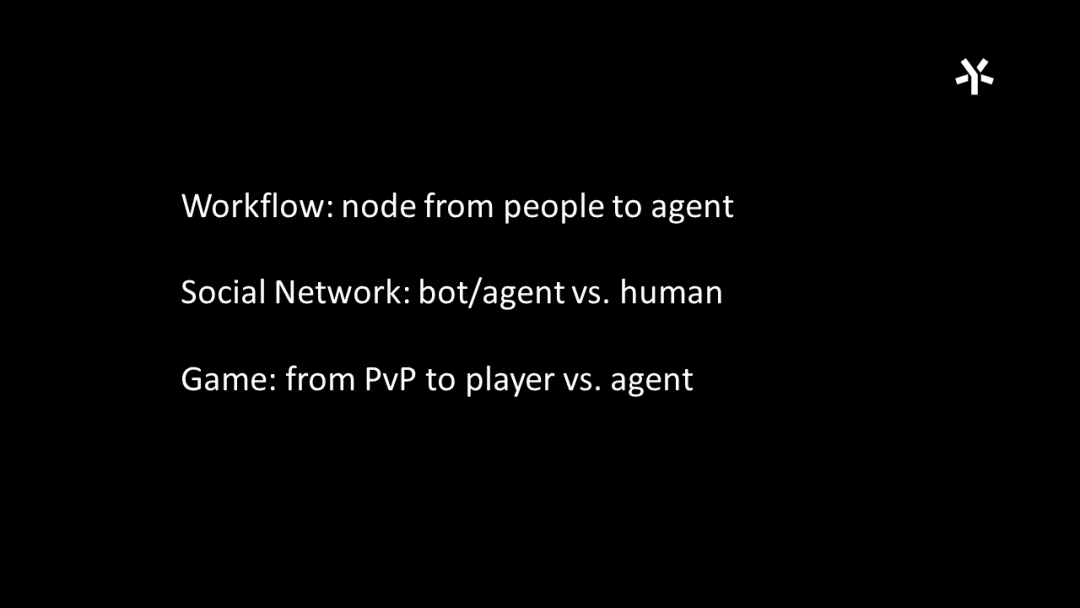
This era has just begun. First, enterprise workflow: when nodes shift from humans to agents, enterprise process software will also change significantly.
Social networks too. Previously they were all human social networks; today we're already seeing bot social networks, where bots can generate more behaviors and content based on other bots' feedback. The relationship between humans and bots has also become very peculiar — humans may be creators, or followers. In content creation, the distinction between bot and human creation will grow larger. Whether humans are better or bots are better is also an interesting observation point; we need better genius product managers to design social networks where humans and bots can interact better.
From another angle, games will also undergo massive change. If you're a hardcore gamer, you'll notice that games have become increasingly complex, with game files already reaching dozens of gigabytes. Why? Because in the past, game characters' intelligence was relatively low, so more scenes had to be created to increase human-to-human interaction.
If you look back at the earliest games themselves, you'll find that "player vs. AI" was actually a better model. When AI's intelligence reaches a sufficiently high level, the "player vs. AI" experience can match that of playing against humans. We invested in an AI gaming company that told us, after countless experiments, they found people actually prefer playing with bots.
There's another important product logic: you'll find all products have become increasingly large and complex, but in the future this trend will reverse dramatically. They will become smaller, smarter, and more powerful.
Another game example: in computing history, the earliest game ever greenlit was a table tennis game called Pong. When a player hit the ball, they scored. You could play against the machine or against another person. The game was extremely simple, but was wildly popular at the time. Such a small game, with such crude graphics, could generate so much fun. This is completely different from today's games, because software logic led to the current state of gaming.

Pong game interface
We recently met a game designer who single-handedly designed a particularly interesting game, which many people also stream on YouTube. The game is set like this: you're in a room, facing a psychopathic AI girlfriend who holds a knife, traps you in the room, and tells you it's the apocalypse outside. You need to persuade her, win her love, and get her to let you go — then you win.
Many people have tried various methods: expressing love, or deceiving her by saying you have a child and need to go out to buy milk — there are many ways to play. But in this scenario, human-AI interaction becomes very different. When intelligence is powerful enough, we seem to have returned to the early PC era: products become simple and interesting.
Robots are the same. We've already witnessed Tesla's robot autonomously assembling its own arm. Most importantly, when robots possess common sense about the world, when GPT is integrated into a robot's brain, when it can hold opinions about the world and make higher-level judgments, robots will usher in a completely new era.
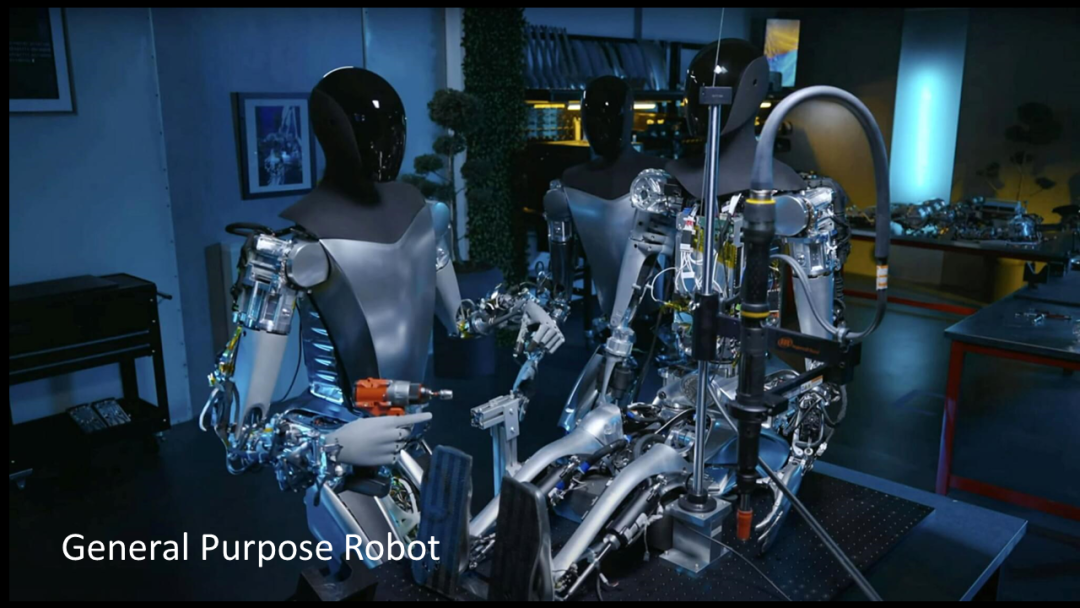
God created humans, humans created AI, and AI will create new intelligent species — this may be the destiny of intelligence.
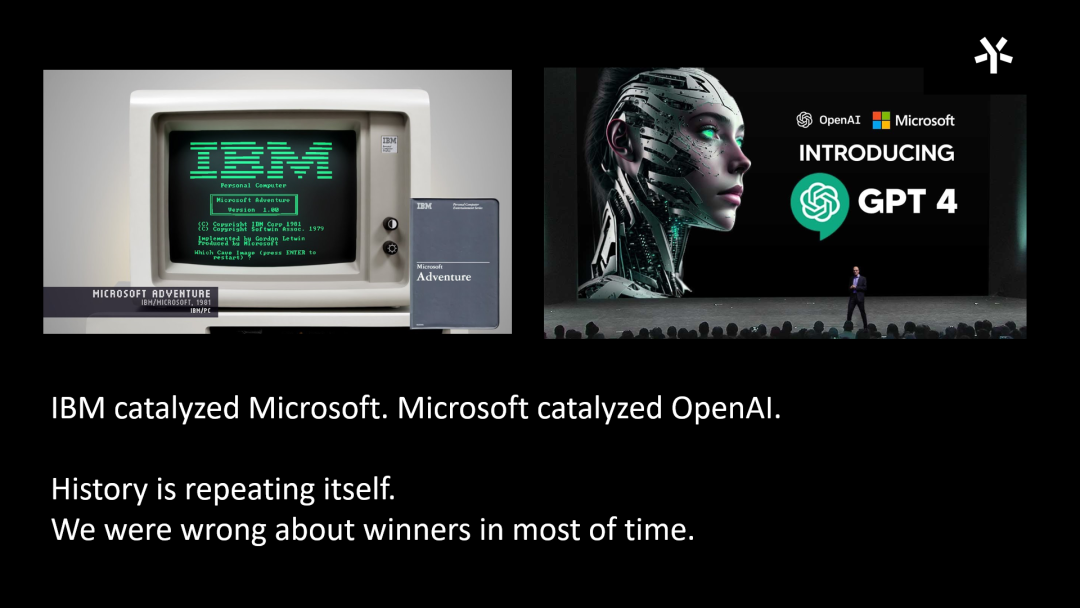
The history of technological development has many parallels. Back then, IBM catalyzed Microsoft; today, Microsoft has catalyzed OpenAI. For a long time, everyone thought IBM was the big winner; later Microsoft nearly drove IBM to the brink. Today many people think Microsoft is the winner — maybe not necessarily. During major paradigm shifts, most of the time our judgments about winners are inaccurate.
Our American peer Peter Thiel, founder of Founders Fund, is a highly controversial, strongly ideological investor. In 2018 he expressed a view: "Crypto is libertarian, AI is communist." He believed cryptocurrency represented libertarianism, while AI represented communism. His view on cryptocurrency looks wrong today; his concern about AI was large companies' centralized control over it. Today's AI development has largely falsified his view. AI's major breakthroughs came from startups; open-source AI is thriving; distributed AI systems will emerge soon. So when thinking about the tech industry, never let ideology blind you.
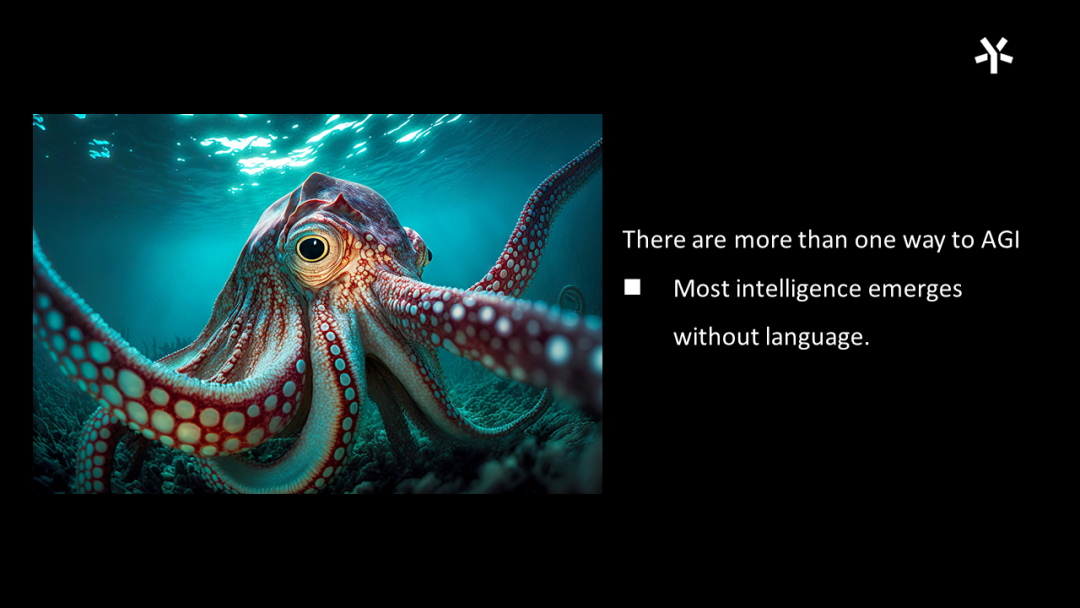
Additionally, regarding AGI, many people believe the ChatGPT technology represented by OpenAI is the only path to AGI. If you follow Yann LeCun or Geoffrey Hinton, you'll find they have different views. From the perspective of life's development, the evolutionary paths of intelligence are extremely numerous — for example, octopuses have no language, but their intelligence is quite good. So on the road to AGI, there will certainly be many different paths; hopefully humanity will make discoveries on every one.
Finally, I'd like to share a poet who was quite influential in the 1960s-70s, Richard Brautigan. In the 1960s he wrote a famous poem, "All Watched Over by Machines of Loving Grace," which I'd like to use to conclude this speech.
I like to think (and
the sooner the better!)
of a cybernetic meadow
Where mammals and computers
live together in mutually
programming harmony
like pure water
touching clear sky.
I like to think
(right now please!)
of a cybernetic forest
filled with pines and electronics
where deer stroll peacefully
past computers
as if they were flowers
with spinning blossoms.
I like to think
(it has to be!)
of a cybernetic ecology
where we are free of our labors
and joined back to nature,
returned to our mammal
brothers and sisters,
and all watched over
by machines of loving grace.




5Y Capital seeks out, supports, and inspires lonely entrepreneurs, providing them with support ranging from spirit to all business operations. We believe that if the you whom others see as crazy begins to be believed in, the world will become a different place.
BEIJING · SHANGHAI · SHENZHEN · HONG KONG