Heaven's Feel: The Root of AI and Gaming | 5Y View

Any sufficiently advanced technology is indistinguishable from magic.

Recommender

Tong Ji, 5Y Capital
"AI isn't magic. AI is sorcery. Sorcery is a miracle that no amount of time or resources can achieve."
"AI isn't just an efficiency revolution — it will bring an experience revolution. AI's impact on gaming is overestimated in the short term and underestimated in the long term."
"AIGC is the first time creators have touched the possibility of infinite content."
This article raises many interesting points. If you have a basic understanding of the technology, you can start from Part Two. In the future AGI era, perhaps the boundary of AI is the boundary of our imagination. If you're also an entrepreneur looking to bring an experience revolution through AI, we'd love to hear your ideas.
WeChat: jerryjtong
The following article is republished from the WeChat account Alpha Mage, author: Spike
Over the past few months, AI has stirred up massive waves worldwide. The speed at which consensus has formed around this wave is the fastest of any trend in recent years. The essence is that the breakthrough experiences of ChatGPT and SD/MJ have, for the first time in human history, reached the threshold of what the general public expects from "real AI."
"Any sufficiently advanced technology is indistinguishable from magic." Arthur Clarke's famous quote is the best annotation for the AI frenzy.
That AI will become a copilot for all industries is already consensus. However, the gaming industry will remain special. In an era where everyone talks about using AI to cut costs and boost efficiency, I prefer TYPE-MOON's worldbuilding distinction between magic and sorcery:
Magic and sorcery are different. Magic is merely the acceleration of what is possible through common sense, achieved through uncommon means. Using magic to summon rain and artificial rainmaking differ only in method.
Sorcery, by contrast, is a miracle that cannot be achieved no matter how much time or resources are invested — something utterly impossible for human effort alone. Only that which is beyond human capability qualifies as a miracle.
Under this premise, Aoko began her explanation: "Sorcery, Soujuurou, is simply put, a shared principle. You could say it's a universal textbook. With this textbook, anyone can become a sorcerer depending on their bloodline. But sorcery is different from magic. Sorcery isn't derived from the 'Swirl of the Root' like magic is — it's directly connected to it. Speaking of the Swirl of the Root... it's something like the sun."
"Magic merely makes use of the sun's blessings. The essence of magic is imitating or compensating for natural phenomena. We merely learn mystery, practice it, and reproduce it — but we cannot create mystery itself. Sorcery, however, makes use of the sun itself. You can use it to reach places no one has been, and cause miracles no one can imitate. Technology that humanity can never obtain, no matter how much money or time is spent — that is sorcery."
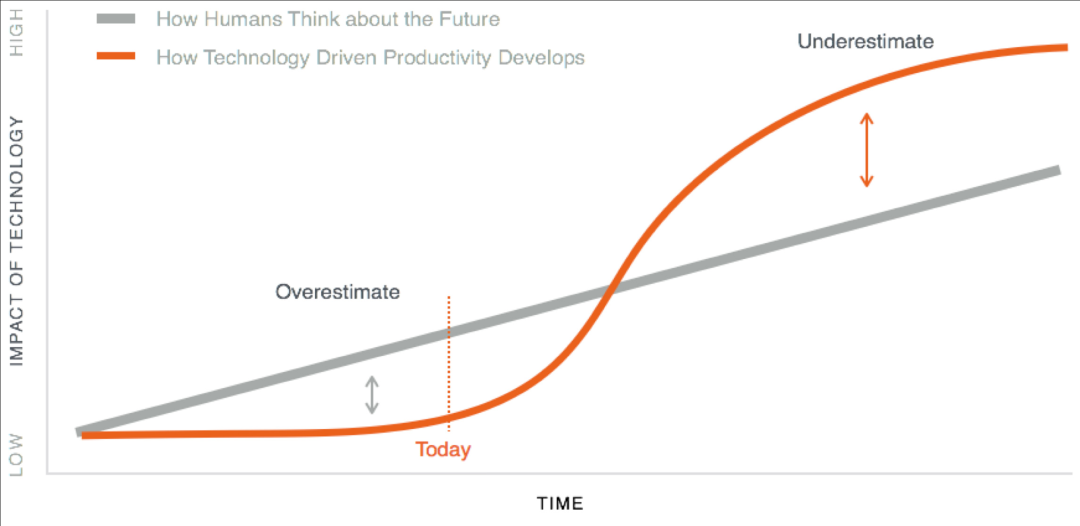
AI isn't just about faster game production. Perhaps AI is only an efficiency revolution for other industries, but for gaming, AI will certainly bring an experience revolution. As Amara's Law has repeatedly proven: people tend to overestimate a technology's impact in the short term and underestimate it in the long term. After conversations with friends at leading projects who are actively trying to implement AIGC, we've all confirmed: in the short term, AI's impact on the gaming industry is being overestimated, while its long-term impact on gaming is being greatly underestimated. The future of AI in gaming is far more than "magic" that cuts costs and boosts productivity — it's "sorcery" that truly reaches toward the root, creating unprecedented dreamlike experiences.
I. The Hunyuan Entropy Theory:
Four Critical Questions About Generative AI
AI is not a new concept for the gaming industry. Long before this wave of AIGC hype, AI's development had already profoundly influenced gaming:
NPC intelligence has always been a core problem in level design. Enemy AI implementation has evolved from simple conditional judgments to state machines, and then to behavior trees with complex hierarchical structures. Over the past decade, TGA Game of the Year winners have all used behavior tree frameworks.
Recommendation and advertising systems are both driven by machine learning. Algorithms, empowered by data, have dramatically improved the precision of ad-user matching, fundamentally changing how the gaming industry acquires users — shifting from channel dominance to advertising dominance.
Without AI-bot technology, there would be no numerous PUBG-style mobile games. Mainstream high-DAU session-based games widely use reinforcement learning-based AI-bots to enhance player experience, solving the critical problem of "everyone wants to win, so who loses?" Data has validated that human-machine matches are highly effective at mitigating the frustration of defeat.
In an era where everyone pretends to understand AI, understanding the evolution of underlying theory and defining the scope of AI capabilities is crucial. Which are genuinely new technological paradigms, and which are "old wine in new bottles" repackaged with new concepts for hype? What is the connection between AI text-to-image and large language models? Will AI's future be monopolized by OpenAI? How is the progress of domestic tech giants' catch-up efforts?
The following four critical questions are extremely important to the future of generative AI, yet rarely discussed or even deliberately conflated. Truly understanding these four questions will give you deeper insight into AI's essence and boundaries than 95% of the market.
1) What's Different? What Exactly Is the Difference Between Current AI and What Came Before?
1.1 Paradigm Shift: From Induction to Deduction
From the perspective of machine learning principles, AI models can be divided into two categories: Discriminative AI and Generative AI. Discriminative models learn conditional probability distributions in data, while generative models learn joint probability distributions in data. Each excels at solving different problems:
Discriminative AI excels at induction — discovering patterns from existing data and using historical patterns to predict new data. There are two major application scenarios: one is assisting decision-making, such as recommendation algorithms and transaction risk control; the other is decision-making intelligent agents, commonly used in autonomous driving and gaming AI.
Generative AI excels at creative imitation after induction — innovating by imitating based on existing data. Deepfake based on GANs, and SD/MJ based on Diffusion, are all practical applications of generative AI.
ChatGPT stunned the world because, in essence: generative AI empowered by large language models (LLMs) demonstrated comprehension, reasoning, and deductive capabilities that previous AI lacked. This is a qualitative difference in underlying paradigm, not a continuous optimization of performance.
The essence of past machine learning paradigms was "fitting" (data fitting) — finding "correlations" in data. By designing optimization objectives to optimize specific equations, it sought to find the relationship between X and Y. When correlation learning was effective, upon encountering an unknown X, it could also deduce what Y was based on patterns.
When task boundaries and rules are clear, fitting based on historical data is highly effective. For example, short video platform recommendation algorithms are the best case of transforming a "business problem" into a discriminative AI "optimization problem."
In The Three-Body Problem, human fundamental scientific theory is locked by sophons, yet pushing applications to the extreme can still build space fleets — this is precisely the portrait of the machine learning field's journey in recent years. No matter how incredible discriminative AI performs on specific tasks, the underlying principle remains correlation fitting analysis of data. Seemingly breakthrough game AI like AlphaGo, capable of defeating the world's strongest humans, essentially transforms game rules into local abstraction of problems + optimization equations + self-play training — not a breakthrough in fundamental principles.
When AlphaGo first appeared, many media outlets sensationalized how humanity's greatest minds were utterly helpless before AI, fanning fears that we should "beware of artificial intelligence." The ML community laughed this off. Those in the industry knew well that machine learning models optimized for specific tasks, based on statistics and induction, could never be the path to AGI (Artificial General Intelligence).
In recent years, the product form closest to ChatGPT was task-oriented conversational AI assistants. Amazon's Alexa, Google's Assistant, and the smart speakers followed by various domestic tech giants all operated on the same fundamental principle: "form-filling" (Slot filling): using NLU (Natural Language Understanding) to recognize user intent, determining how to fill user intent into a pre-designed form, then calling the appropriate interface to complete the task. Such AI still relied on human design for specific tasks — product managers designed it, then programmers coded this form. Once conversation exceeded the scope of the designed "form," artificial intelligence instantly became "artificial stupidity."

Traditional conversational AI assistants and the essence of "form-filling" behind them
Clearly, the most critical problem with all AI we have seen before is: lack of common sense, inability to generalize, inability to truly "understand." These three points are bottlenecks that all top ML scholars have desperately sought to break through.
1.2 Key Capability: Scale Effects and Emergence
Quantity leads to qualitative change. The "scale effects" of large models led to the appearance of "emergent abilities," and these "emergent" new capabilities are precisely the key to generative AI's performance breakthrough.
There are already many reviews and interpretations of LLM "emergent abilities" in the Chinese internet. I more recommend reading Google and Stanford's paper "Emergent Abilities of Large Language Models" directly — it explains things very clearly. Here I'll provide a simple review in plain language, showing how large models solved previous AI's problems of "lacking common sense, inability to generalize, inability to truly understand."
"Scaling effects" are linear improvements. In a 2020 paper, "Scaling Laws for Neural Language Models," OpenAI demonstrated that independently increasing training data volume, model parameter size, or extending training time all improve model performance — particularly for knowledge-intensive tasks like those shown on the left side of the figure below. The significantly improved commonsense capabilities of LLMs compared to previous AI come precisely from increased training data and parameter scale. GPT-3's 300 billion-word training corpus and 175 billion parameters store massive amounts of knowledge.
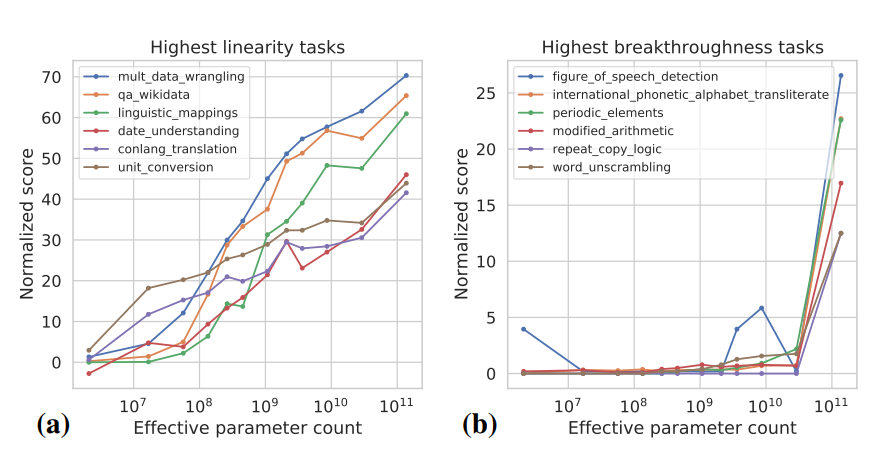
"Emergent abilities" are nonlinear — capabilities that don't exist in small models and are unique to large ones, suddenly appearing after model scale reaches a critical threshold. Here I'll focus on the two most crucial of these abilities:
① In-context learning
In traditional machine learning, fine-tuning involves feeding large amounts of training data to a model, using backpropagation to adjust parameters and retrain — a clear learning process. In-context learning, by contrast, simply gives an LLM a few examples as templates, without modifying parameters or retraining. It's as if the LLM merely "glances at" the examples and then performs well on new predictions.
This fundamentally changes how models are applied to new tasks: making the task adapt to the model, rather than the model adapting to the task. This is the foundation upon which AI capabilities can truly "generalize."
② Complex reasoning using chain-of-thought
In a paper titled "Beyond the Imitation Game: Quantifying and extrapolating the capabilities of language models," Google noted that tasks exhibiting "emergent abilities" share a common characteristic: they all consist of multiple steps. Solving them typically requires first resolving several intermediate steps. Multi-step math problems have long been a weakness of previous AI systems. LLMs address this through a "chain-of-thought" reasoning strategy, using prompts that include intermediate reasoning steps to solve tasks step by step and arrive at final answers.
It's difficult to truly define "understanding." But GPT's ample knowledge reserves, its ability to generalize and reason by analogy, do make it more akin to a person who has achieved sudden enlightenment and gained understanding: capable of grasping abstract concepts, forming internal logic, better comprehending what we're saying — historically, the first to reach the threshold of public expectations for AI capabilities.
1.3 Large model capabilities currently lack interpretability
Even OpenAI, the creator of GPT, and top academic researchers have yet to reach consensus on the near-magical "emergent abilities" of LLMs.
Microsoft itself raised this question in its paper on GPT-4: How does it reason, plan, and create content? Why does GPT-4, which is essentially just composed of simple algorithmic components — gradient descent, large-scale Transformer architecture, and massive amounts of data — exhibit such general and flexible intelligence?
A recent Stanford paper proposed that "emergent abilities" may be an illusion, caused by flaws in measurement methods and metric selection. If different continuous, smooth metrics are used, the emergent phenomenon becomes far less pronounced, appearing more like the linear improvements under Scaling Laws.
Turing Award winner Yann LeCun maintains that autoregressive large models like GPT are approaching their limits, and that his "world model" is the path to AGI. OpenAI co-founder and Chief Scientist Ilya Sutskever has expressed views in public interviews that directly oppose LeCun's.
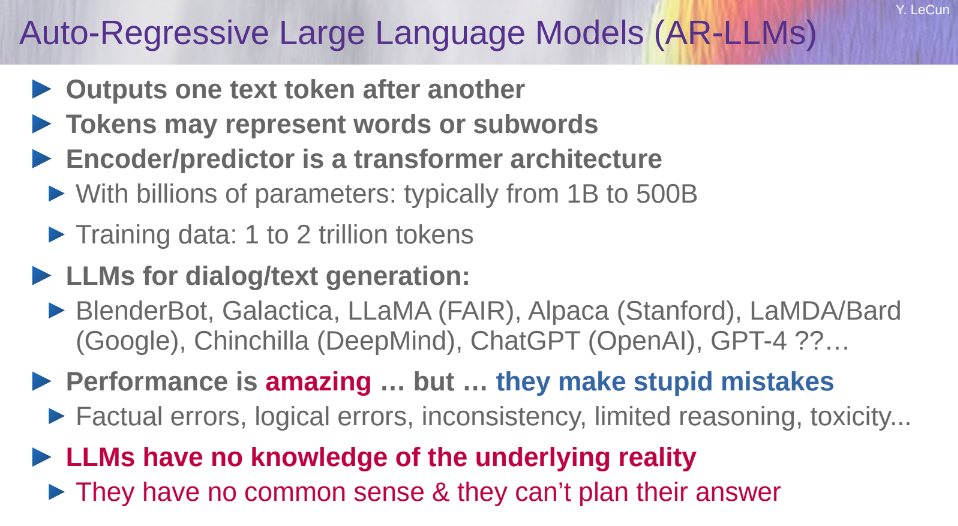
LeCun's critique of autoregressive large models
At a frontier where even the leading researchers haven't reached consensus on generative AI principles and directions, we're destined to live with uncertainty. But after understanding the evolution of foundational principles, we can at least clearly distinguish the new species from the old paradigm:
AlphaGo, in-game AI bots for DOTA and Honor of Kings, game intelligence operations, recommendation algorithms — these all still belong to decision-making AI, supreme understanders within defined boundaries and rules. They certainly have value in specific commercial scenarios, but in terms of essential principles, they are fundamentally different from the generative AI currently driving the wave.
2) What are the similarities and differences between LLMs and AI image generation?
In the second half of 2022, AI image generation applications (SD/MJ) broke into mainstream awareness, followed by ChatGPT's explosion in popularity at year-end — each leading the trend in succession. Interestingly, when people talk about generative AI, they often tend to conflate the two.
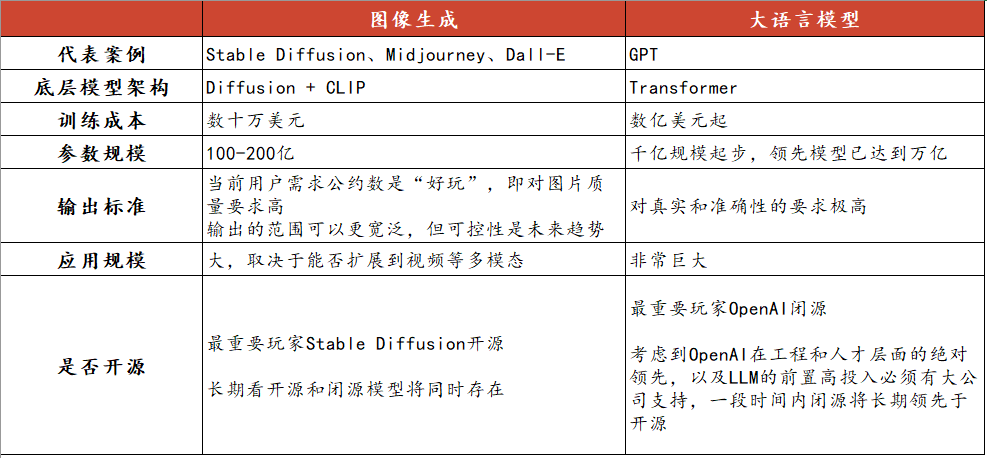
In reality, image generation models and large language models differ enormously in underlying architecture, barriers to entry, and potential application scale. Clearly distinguishing between image generation and LLMs is crucial for judging the future. We summarize the core differences in this chart.
2.1 Image generation and LLMs are based on completely different foundational models
As is well known, the underlying model for LLMs is Transformer, proposed by Google in 2017. The image generation field, meanwhile, rests on diffusion models and the multimodal CLIP model. Here's a brief introduction to the development of these two models:
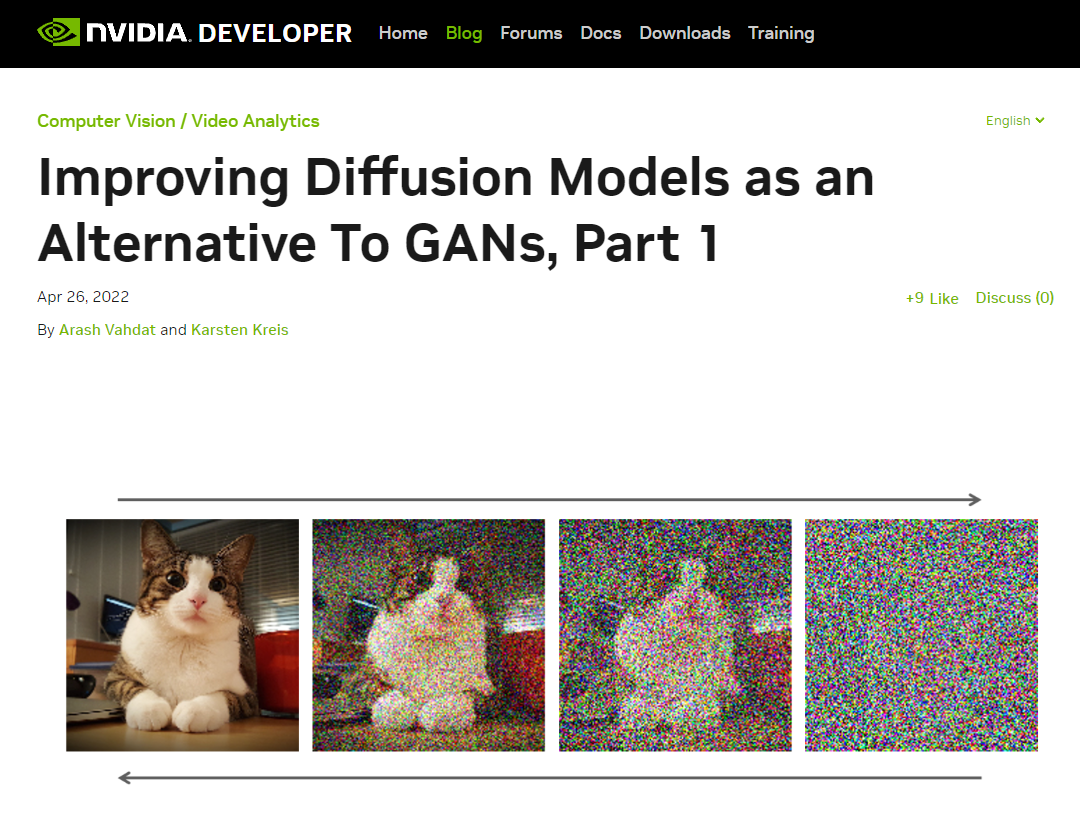
Diffusion Model, proposed in 2015, draws on the conditional probability transfer method of diffusion processes in thermodynamics. It actively adds noise to destroy training data, then trains repeatedly to figure out how to reverse the noise process and restore original images. Once training is complete, Diffusion can apply denoising methods to synthesize novel "clean" data from random inputs.
Before Diffusion's emergence, GANs (generative adversarial networks) were the more popular architecture in the CV field. Diffusion significantly outperformed GANs in generation quality and image resolution, but at substantially higher computational cost — training times were too long for the GPU configurations of academic research labs, so it didn't become mainstream when first proposed. However, with recent breakthroughs in computing power, Diffusion has gradually become the more dominant image generation architecture. Interestingly, NVIDIA, the main provider of this computing power, seems to have been a key driver of this shift.
CLIP model (Contrastive Language-Image Pre-training): In 2021, OpenAI published "Learning Transferable Visual Models From Natural Language Supervision," proposing the CLIP architecture and open-sourcing it. The community went on to do further improvement work like OpenCLIP. CLIP models extensively use images with text descriptions from the internet as training samples, collecting over 4 billion "text-image" training data pairs. They can associate text and images, finding a meeting point where the two modalities can communicate — the cornerstone for generating images/video/3D content from text.
Simply put, Diffusion solves the "image content generation" problem, giving AI the ability to generate high-quality images, but doesn't solve the input problem — it can only complete "image-to-image" or "AI face swap/retouching" tasks. CLIP, meanwhile, further enhances the connection between human language and images, enabling a qualitative leap in the "text-to-image" experience.
2.2 LLMs are a vastly larger opportunity than AI image generation
The game industry's current enthusiasm for AI focuses mainly on image generation applications like SD/MJ. But OpenAI's strategic decision is quite intriguing — after completing the most important work in both LLMs and image generation, they chose to go all-in on large language models, closing off GPT to increase competitive barriers, while freely open-sourcing the CLIP model for the image generation community to build upon. Their own text-to-image application DALL-E is more like a "demo for experience," as if indifferent to Midjourney's commercial success.
The reason behind this: Compared to the enormous significance of "language," "images" pale in comparison. Language is humanity's most important invention, the greatest distinction between humans and other species. Abstract reasoning, developing complex concepts, transmitting ideas to one another, forming trust and collaboration — all of this depends on "language." One could say that without language, modern civilization would be impossible. So OpenAI judged that LLMs represent an opportunity several orders of magnitude more important than image generation.
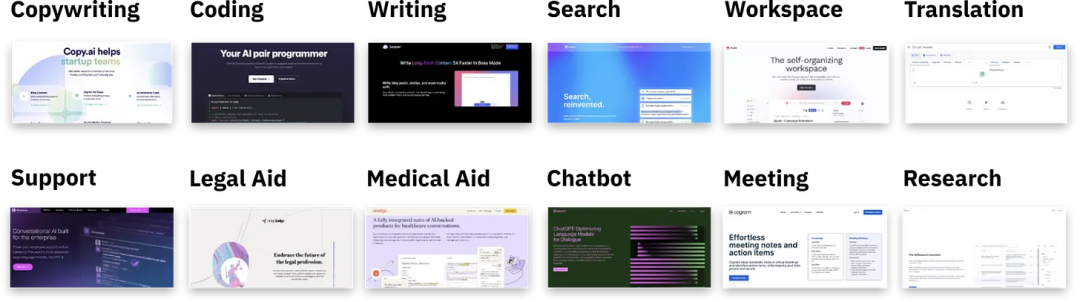
Language models have far broader application domains than image models
VCs give fundamentally different valuations to companies in these two fields. The difference in market size makes the competitive landscape in each field starkly different:
a. Image generation models cost far less to train and deploy than LLMs. The massive parameter scale of LLMs brings extremely high training costs. Imagen and DALL-E, used for image generation, have parameter scales only 1/20 that of early GPT-3 and 1/100 that of GPT-4; Stable Diffusion cost only a few million dollars in GPU time to train. This is why OpenAI needed to ally itself deeply with a tech giant like Microsoft, while Midjourney, the leader in image generation, operates with a team of only about ten people, has taken no external funding, and still achieved leading text-to-image experience.
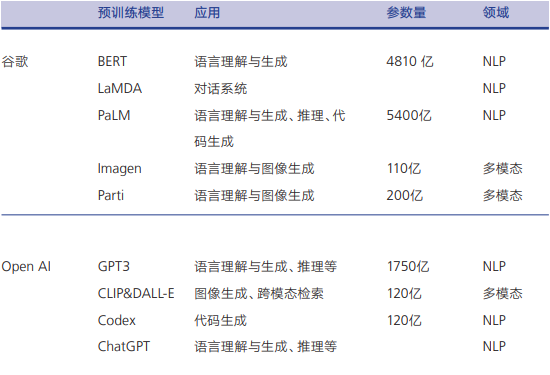
Comparison of parameter scales across different domain models
b. Image generation models more easily clear the threshold of what ordinary users consider acceptable. Aesthetic taste is deeply personal, and people's standards for images are inherently more subjective than their standards for text. Factual errors and grammatical mistakes in text are easy to spot, but the range of what's acceptable as an image "answer" is vastly wider. Swapping two pixels won't change an image much; swapping two words can completely alter a sentence's meaning. On top of that, everyone commands a language, but drawing is a specialized skill. AI-generated art is more likely to impress untrained casual users at first glance.
c. LLMs must be general-purpose; image generation needs stylization. Language demands high generality—you need at least basic common sense to understand what users are inputting. But the real power users of AI art, professional designers, typically need output confined to one or two specific styles. They need specially trained, highly stylized models. Graphic designers commonly use Midjourney, while anime artists prefer nijijourney, which does stylized training on top of Midjourney's base model.
The endgames for LLMs and image generation will be fundamentally different. LLMs have higher barriers to entry—hard requirements around capital, compute, and data scale that shut out most startups and small teams. Image generation models don't need massive parameter counts; with low barriers to entry, fuzzy performance standards, and fragmented user demand, this will necessarily be a low-concentration market. Open-source community leaders like Stable Diffusion, general-purpose closed-source models like Midjourney, and various specialized stylized models (imagine subdivisions into American comic style, Miyazaki style, miHoYo style) will all have their place in the future.
2.3 Future Variable: When LLMs Enter the Multimodal Domain
An exciting question: what happens if we scale image generation models to LLM-level parameter counts?
Looking at recent product iterations from Stable Diffusion and Midjourney, current AI image generation applications focus more on improving "quality of generated content." This creates a significant pain point: weak comprehension of input prompts and poor output controllability.
Today, using SD/MJ still heavily depends on so-called "spells"—even spawning interesting peripheral ecosystems like The Elemental Codex and prompt markets, half-jokingly called "gacha-style creation." This differs markedly from ChatGPT's natural, fluid input; it more closely resembles the "alchemy" of traditional machine learning.
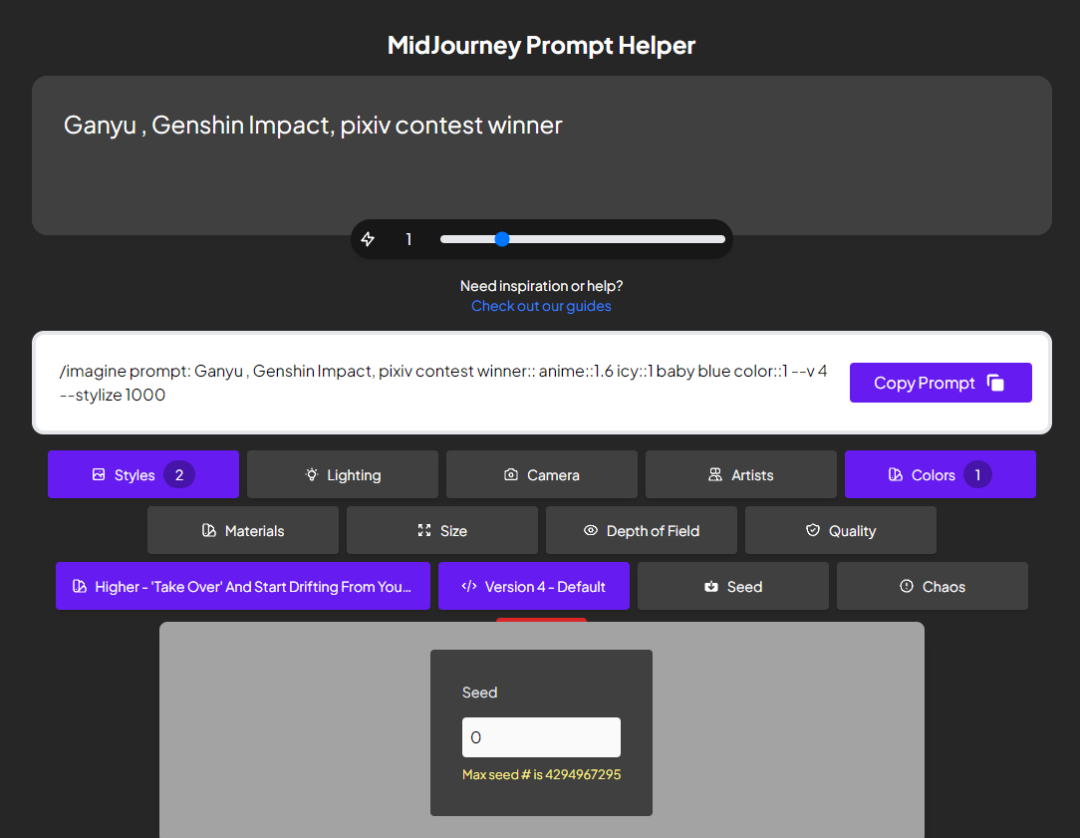
On the output side, we still can't anchor specific colors, compositions, and character poses with natural language, nor support further local refinement and replacement. The current workaround for insufficient text comprehension is enhancing control over generated images through non-text-modal adapters, like ControlNet and Tencent's T2I-Adapter—but these solutions also raise the usage barrier considerably.
In short, our interaction with LLMs closely resembles chatting with a person, without carefully engineered prompts, while AI art is more like opening blind boxes. The essence behind this is that small models' knowledge reserves and language comprehension capabilities remain very limited.
OpenAI's key bet is precisely this: language is everything. Every product in history that truly revolutionized paradigms maxed out on usability. LLMs with zero usage barrier and stronger comprehension are the ultimate solution for controlling image generation.
GPT-4 is already expanding into multimodal domains. Technology spillover from LLMs benefiting other fields has many precedents. For example, LoRA was originally proposed as a training method to reduce fine-tuning costs for large language models, and is now widely used in Stable Diffusion. When LLMs enter the multimodal domain, there may not be qualitative improvement in "generated content quality" in the short term. But the consensus from discussions with multiple frontier ML scholars is this: LLMs will inevitably transfer their text comprehension to image comprehension, bringing breakthrough improvements to AI image generation's understanding of text input.
An AI art experience where you can easily describe needs in natural language and be truly understood may not be far off.
3) Open Source vs. Closed Source?
3.1 Scale as Shackle
The competition between closed and open worlds is a main theme extending from the PC era to today. Windows and Linux, IE and Mozilla, iOS and Android... technology has never been monopolized by one or two companies in history. Laggards choose to form alliances through open source to counter leaders' advantages. The war between open and closed source constitutes the foundational framework of the information world we see today.
Machine learning has a long tradition of open scientific research. Unlike traditional software development, ML academia exerts enormous influence on industry, making open source typically the default option. Even OpenAI's great work was done in an atmosphere of continuously open research, standing on the shoulders of prior giants. For instance, OpenAI's InstructGPT paper notes that GPT's core ideas came from two prior research lines: LLMs and RLHF (Reinforcement Learning from Human Feedback). Specifically:
LLMs are based on the Transformer architecture, which itself was proposed to address problems with earlier sequence models like LSTM and RNN.
The classic RLHF text is Sutton & Barto's Reinforcement Learning. In 2004, Pieter and Andrew Ng used RL to propose a method called Apprenticeship Learning for teaching machines complex actions. Starting in 2017, DeepMind's series of work (game/Go AIs, etc.) gave reinforcement learning greater influence, and ChatGPT's training was deeply shaped by these prior works.
Friends accustomed to the dark-forest competition of domestic tech giants often tell me in conversation that "OpenAI choosing closed source is perfectly normal competitive strategy." But the problem is that building large models is fundamentally frontier scientific exploration, requiring extremely high talent density. Top ML talent mostly has deep academic roots and strong technical ideals—completely not the MBA business mindset.
—For example, former Google principal software engineer and Transformer author Noam Shazeer, and LaMDA development leader Daniel de Freitas, left Google in anger and co-founded Character.AI because Google's reluctance to open-source LaMDa violated their technical vision. Several frontier ML researchers I've spoken with also feel that criticism of OpenAI's closed-source stance within the community is entirely justified: your model architecture was proposed by others, your training dataset was produced by internet users at large, you benefited from open research in machine learning, yet your own model's training methods remain vague—not particularly decent.
The key factor driving this shift from open to closed source is LLMs' extremely high training costs. Scale is both the root of magical capabilities and a shackle. Past cutting-edge AI achievements mostly emerged from academia, but it's hard to imagine universities一次性 disbursing tens of millions of dollars in research funding—the reality is that a lab with a few dozen A100s counts as top-tier.
The most critical decision in OpenAI's development was its deep binding with Microsoft—the founders knew that as a nonprofit, they couldn't handle large models; compute, data, and money were all far insufficient. So they accepted Microsoft's $1 billion investment, and Microsoft indeed threw its full support behind them, several times "righteously destroying kin" by reallocating compute resources from internal AI teams to OpenAI.
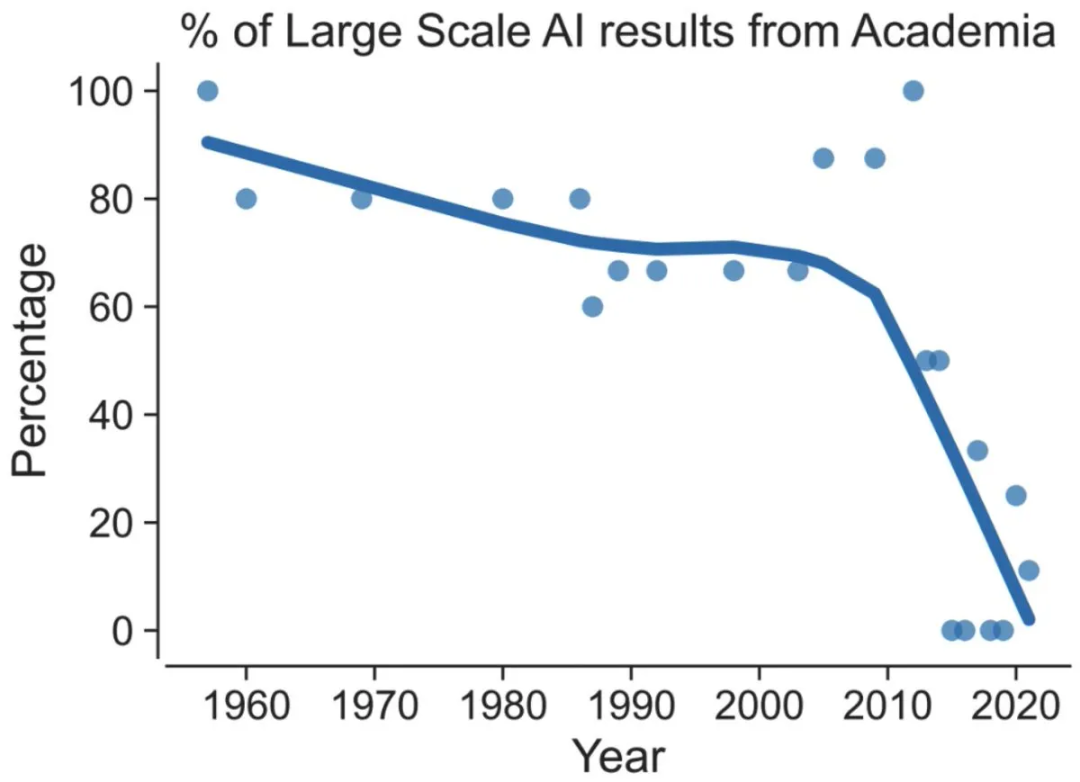
Academic contributions to large model research are rapidly declining
Behind the伯乐与千里马 story, giants' genuine financial investment necessarily demands commercial returns: open source benefits the entire industry; only closed source increases a company's own commercial competitiveness. More and more tech giants' LLM research divisions have indicated they will stop publicly publishing research results, thereby reducing competitors', open-source communities', and academia's understanding of frontier progress in the field.
In the shadow of the giants, academia is increasingly finding itself outmatched in the large model game.
3.2 Open Source is Immortal
However, I am not pessimistic about the open world's future.
Setting aside commercial interests, open-source models will be superior to closed-source ones in the long run—the open-source spirit is the faith of many tech geeks, and community support is crucial. The evolution of AI image generation provides us with an excellent observational perspective:
Initially, closed-source models like Imagen and DALL-E emerged; no matter how good the results, everyone could only watch enviously. Stable Diffusion's open-source completely reversed this state, crushing DALL-E in popularity and trending upward, with massive algorithm-level iterations and innovations emerging in its ecosystem—developer community and academic forces almost entirely converged on Stable Diffusion. Current SOTA solutions like ControlNet, T2I-Adapter, and LoRA all became modular plugins for Stable Diffusion.
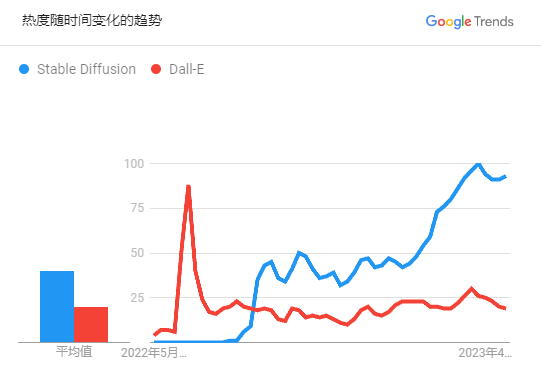
SD rapidly achieved dominance,
making OpenAI's closed-source solution irrelevant
An OpenAI employee lamented in a blog post that "the talent hired by tech giants is ultimately just a small fraction of all human talent; open source means Berkeley professors and Stanford students are all advancing this ecosystem." Open-source community strength translates to product experience as a generational difference in feature extensibility. If we only consider ease of use and generated image quality, Midjourney is certainly the best. But several artist friends have expressed that no matter how cool MJ is, it's just a toy; SD with its powerful plugin ecosystem is the real productivity tool with potential to improve efficiency.
Now, even among Midjourney's paying user community, there's growing dissatisfaction with how far behind its extensibility has fallen. The comment below is fairly representative:
After using Stable Diffusion on my own computer for two days, the control it offers is far beyond what MJ can reach, which makes MJ's service seem almost laughable... Why can't we have advanced plugins and features like ControlNet, in/outpainting, Dynamic Prompts, and so on?

There's no doubt that, given the extremely high barriers to compute, capital, and talent, closed-source LLMs owned by tech giants will maintain their lead over open-source alternatives in the near term. But stretch the timeline out, and open source will remain an extraordinarily important force in the AI world.
First, open source is the best competitive strategy for those who are behind.
Beyond technological idealism, open source is a classic counter-positioning strategy in commercial competition.
In past technology cycles, the most successful open-source projects were typically orchestrated by large companies to counter more dominant rivals. One approach was to sponsor existing open-source projects — Linux received substantial backing from IBM in the 1990s to compete against Microsoft. Another was to lead open-source initiatives directly — Google used Android's open ecosystem to compete with Apple.
The LLM war will be no exception. The top-ranked companies (Microsoft, Google, Anthropic) will of course keep their models closed to maximize their competitive advantage. Meanwhile, companies that are temporarily behind (Meta? A domestic giant?) have a high probability of choosing the open-source path, bringing in academic and community forces to build an ecosystem and compete for dominance as the open-source LLM ecosystem's standard-bearer.
Once an open-source model emerges with performance only slightly trailing the leading closed-source alternatives, the same kind of弯道超车 (corner overtaking) that Stable Diffusion pulled off will happen again — community interest will shift wholesale toward secondary development and fine-tuning based on the open-source model.
Historically, open source tends to achieve higher concentration and more unshakeable ecosystem moats than closed source. Network effects similar to those of internet products will emerge among the participants coalescing around open-source models, and we're already seeing the early outlines of this on Hugging Face.
Second, private deployment is the only way to guarantee data security.
On April 25, OpenAI published a new blog post titled "New ways to manage your data in ChatGPT." Both points it raised concerned privacy and data security:
-
Users can now turn off chat history in settings, with conversations prohibited from being used to train and improve models, to protect personal privacy.
-
In the coming months, OpenAI will launch ChatGPT Business, a product aimed at enterprises, to allow companies to use GPT services while ensuring their data remains secure.
"AI safety" is currently the hottest topic in Europe and America. After all, OpenAI put it quite bluntly in its official FAQ: your personal data is the fuel we use to train our models.
we use data to make our models more helpful for people. ChatGPT, for instance, improves by further training on the conversations people have with it.
The pressure around AI safety comes partly from government regulation. Italy once banned ChatGPT, accusing it of illegally processing user data, while France, Spain, and Germany have all launched investigations into OpenAI. But it also comes from more direct commercial competition. Amazon — Microsoft's biggest rival in cloud services — has already sent an all-hands email through its legal department prohibiting the use of ChatGPT at work, especially for inputting information involving Amazon's internal data. Apple quickly followed suit, banning employees from using external AI tools.
Mutual trust between different camps and entities with divergent interests is virtually impossible, not to mention that algorithms are black boxes lacking interpretability by nature. TikTok's predicament in the US is the perfect case study: you say data is stored locally in the US and secure, you say ByteDance headquarters cannot access overseas user data — will the other side believe you? More often than not, "belief" is a matter of whose interests are at stake.
Traditional apps could only collect limited dimensions of in-app user behavior data, but generative AI involves far more sensitive information input. Whether using SaaS-ified closed-source AI products or calling APIs, regardless of what user agreements guarantee, data transmitted through interfaces is fundamentally insecure from a technical standpoint. The chain of suspicion always exists.
TikTok's data security crisis will inevitably replay itself with closed-source AI models — this will happen both between different countries and regions, and between competing tech giants. China's internet giants and government SOEs cannot feel comfortable calling American LLM APIs; Tencent, Alibaba, and ByteDance won't allow employees to use each other's AI products either.
Privately deployed open-source models may be the optimal solution for balancing efficiency and data security in the AI era.
The force of open-source AI is flourishing. Following the leak of Meta LLaMA's parameters in March, the open-source community saw an enormous wave of innovation. The emergence of LoRA (Low-Rank Adaptation, which represents model weight updates in low-rank decomposition form to enable model fine-tuning) significantly reduced the computational cost and training time for fine-tuning, once again lowering the barrier to large-scale community participation.
A Google researcher wrote with some frustration in a leaked internal document: "We have no moat... We should learn to cooperate with forces outside Google. When free, unrestricted alternatives are of comparable quality, people won't pay for restricted AI models. We should think about where the real added value lies."
The whole world is waiting for the "Stable Diffusion moment" of large language models. Perhaps in the endgame of LLMs, we'll see a protracted war between three to five closed-source model companies and one "chicken dinner"-winning open-source model community.
4) Can China Catch Up Quickly on Large Models?
4.1 OpenAI's Victory Is One of Product and Engineering
There's one unavoidable question when discussing LLMs: why did OpenAI become the winner?
This puzzlement is actually raised more often by friends who've spent years on the ML front lines at universities and big tech companies. Outsiders watch the spectacle, but to insiders who've been tracking Google and OpenAI's papers for years, the technological evolution follows a discernible thread: from deep learning frameworks to pre-trained language models (PLMs) to large models, Google proposed Transformer and T5, and until InstructGPT's release in 2022, Google was the pacesetter of the race. So how did OpenAI suddenly cross the finish line?
As everyone knows, LLMs have three core elements: model architecture, compute, and data:
Model architecture is public. Everyone is now following the path GPT validated: "autoregressive language model + prompting."
More compute? Perhaps during the exploratory phase, but once consensus forms, compute can't be the bottleneck — American tech giants aren't being "choked" on chips.
Better data? OpenAI isn't an internet company with vast proprietary data. Most training corpora is scraped public data; data quality mainly depends on human annotation. No major tech company lacks the budget for outsourced labeling.
But why does ChatGPT deliver a clearly superior, perceptibly better experience compared to all competitors?
One point where consensus has formed: "top-tier talent density" is OpenAI's core advantage — frontier exploration and executing deterministic tasks require completely different kinds of people. Software development and similar deterministic work involves architects doing overall design, with PMs packaging and delegating tasks down the hierarchy. But frontier exploration is highly uncertain, which means the team can't have cogs — everyone must be a hexagonal warrior, a combination of scientist and engineer. What matters here is "talent density," not "absolute talent quantity." Google's absolute talent quantity far exceeds OpenAI's, but these people are scattered across different teams, unable to concentrate force and push in one direction.
Another point where OpenAI significantly differs from all competitors is rarely mentioned: product-driven research.
Academia doesn't lack top talent, but research is often paper-publication-oriented. This evaluation system doesn't fundamentally change even in big tech research departments: a group of people come up with something decent, they write a paper, do some PR, and call it a day — rarely pushing to integrate with and land in their own company's products. DeepMind's AlphaGo and AlphaFold followed this pattern too.
OpenAI essentially positioned itself as a startup, not a research institution subordinate to a tech giant. Sam Altman is no professor-turned-founder — having led YC for years and participated in numerous startups from 0 to 1, he's unquestionably one of Silicon Valley's most business-savvy people. Starting from GPT-3, OpenAI established a product playbook adapted to LLMs: from opening API access, to launching ChatGPT to enter the application layer (meaning competing directly with API customers), to building a plugin ecosystem to disrupt the interaction interface. Firm productization, firm establishment of self-sustaining revenue, firm pursuit of commercial success. This approach is unimaginable to the hothouse flowers of academia and big tech labs.
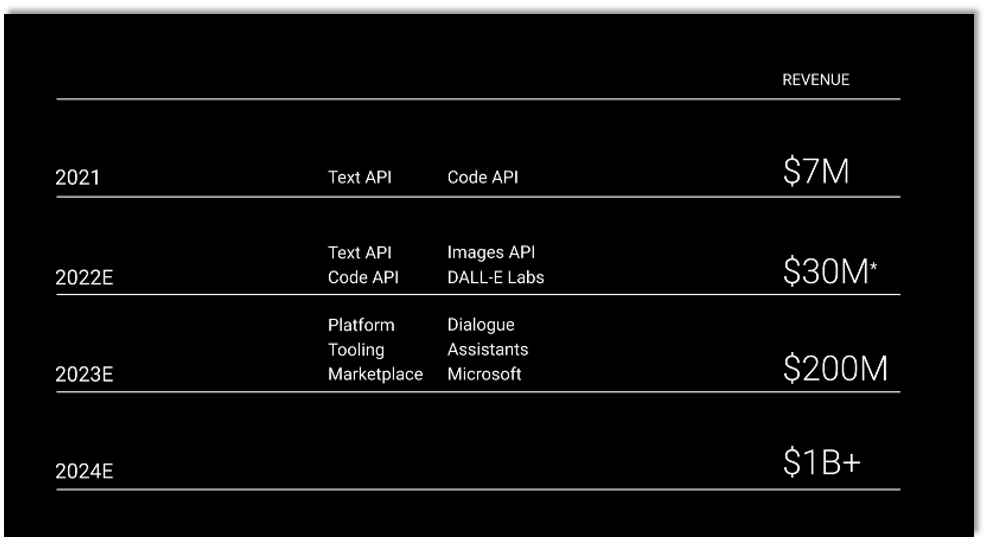
It turns out that product-driven approach was critical. The early commercialized GPT-3 API allowed OpenAI to collect massive amounts of real human inputs, and to targetedly gather human-written demonstrations as training data. User-submitted prompts reflected the distribution of demand, then high-quality human annotation continuously steered the model's generation tendencies, creating a flywheel of ecosystem and user data for OpenAI.
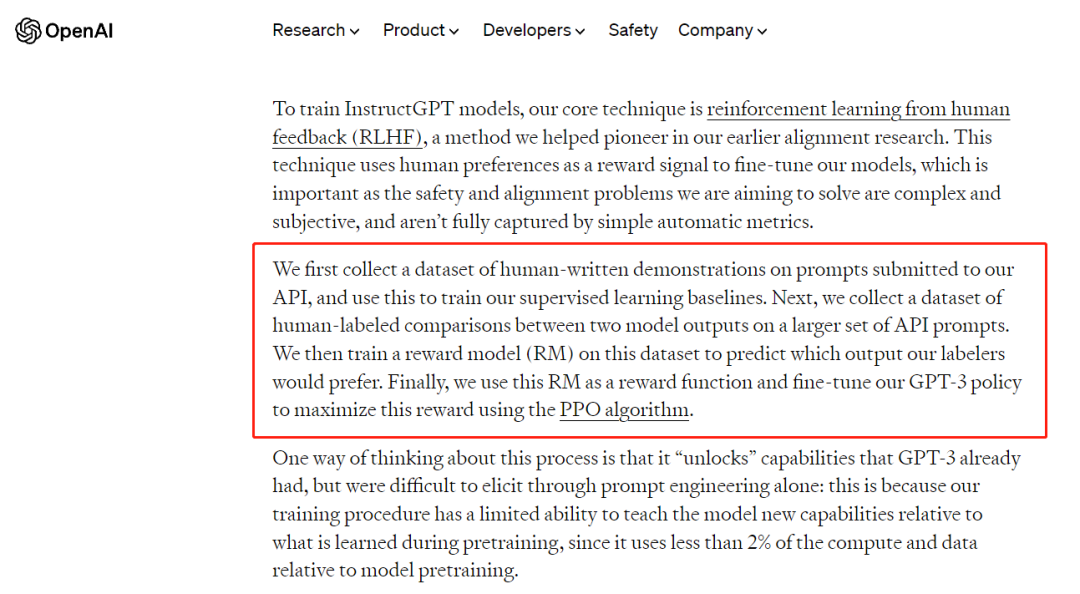
Behind this product-driven approach lies OpenAI's world-leading engineering capabilities. Computer science has a well-known concept called "human in the loop" — turning a research paper into a product prototype, then building a closed loop of user input, data feedback, annotation, and retraining requires extraordinarily sophisticated engineering. Easier said than done. Of the current engineering methods for training large models, the most important contributions in RLHF and Alignment both came from OpenAI. In its blog, OpenAI emphasized that this accumulated engineering expertise is comparable to manufacturing chips and aircraft engines.
On the engineering difficulty of training LLMs, Hugging Face founder Clem Delangue gave a brilliant interview (translating it into Chinese gets a bit convoluted):
Training large models remains a very difficult engineering challenge — a unique combination of technical, research, and project management skills. It's not just about how to correctly train the model, but about predicting how much more training is needed to reach the desired outcome. It's about judging when to ship the product versus continuing to optimize the model, whether to start a six-month or three-month large-scale training cycle, or whether to keep experimenting.
From June 2020, when the GPT-3 API opened, to the end of 2022, when ChatGPT exploded into mainstream consciousness, this product-driven data flywheel had been quietly spinning for two and a half years. Every month, a hundred million people were generating conversational data for ChatGPT to train the next generation of models — something no academic institution or internet company could match. As the title of the paper that started it all put it, "Attention Is All You Need": the performance gap between models may one day close, but for any similar chatbot product to gather such massive attention and user volume afterward? Nearly impossible.
Ironically, China's internet giants typically pride themselves on product and commercialization capabilities while being criticized in public opinion for lacking fundamental research capabilities. Yet the key to OpenAI winning this war may be precisely this: its firm commitment to a product- and commercialization-driven path for AI research.
4.2 How the Dominant Narrative "Overcorrects" in Underestimating Domestic LLMs
In recent months, we've seen the A-share market go wild — any company that could tangentially connect itself to the trend came out saying they were building large models, founders overnight becoming seasoned believers in AGI, prompting actual AI practitioners to vent: "These companies never even stockpiled GPUs. Alibaba Cloud and Tencent Cloud's A100s are already stretched thin for their own use. They take LLaMA, do some fine-tuning, and dare to call it a self-developed model?"
Media outlets have also cast skeptical eyes on China's large model battlefield. Some have taken the lead in "reflection," slapping labels like "lacks innovation" and "has no dreams" onto several domestic giants — an overwhelmingly pessimistic narrative.
But in reality, among several domestic giants and in academia, there are no shortage of people who have long been tracking frontier LLM progress and steadily tackling hard problems. Their exchanges with Silicon Valley are quite close as well. It's worth remembering: OpenAI isn't just ahead of China, it's ahead of the entire world. The consensus estimate is that GPT-4 leads Google and Anthropic by several months, and China by over a year. There is indeed a generational gap, but it essentially stems from misjudging the direction — requiring time to catch up, not some incomprehensible technological chasm at the底层. No need to overcorrect.
Looking back at history, in traditional NLP/CV fields, China's research progress was neck-and-neck with the US. In the year or two after BERT appeared, China's technical catch-up was also rapid, with many excellent BERT improvements proposed, such as Baidu's ERNIE 1.0. The real watershed where the gap widened was June 2020, when GPT-3 emerged. But this wasn't uniquely China's misjudgment — the entire world was led astray by Google's BERT, misreading the future technical trajectory. The result is that today, not just China, but Google and Meta are still in the midst of turning around to catch up.
In the early days of pre-trained model development, the technical framework converged on two distinct paradigms: the BERT (Google) model and the GPT (OpenAI) model. And the world generally favored the BERT model somewhat more — a considerable majority of subsequent technical improvements followed the BERT path.
Essentials of Large Language Model Technology, Zhang Junlin
Among domestic giants actually working on LLMs today, several are still quietly preparing major releases. From conversations, the general benchmark is approaching GPT-3.5 level. In open-source models, Tsinghua University's ChatGLM enjoys high recognition in both industry and academia — many Silicon Valley VCs, AI startup founders, and OpenAI employees frequently mention GLM as a representative of excellent open-source models in interviews and articles. GLM ranks 11th in total model likes on Hugging Face; looking only at the LLM track, it ranks second only to Hugging Face's own BLOOM.

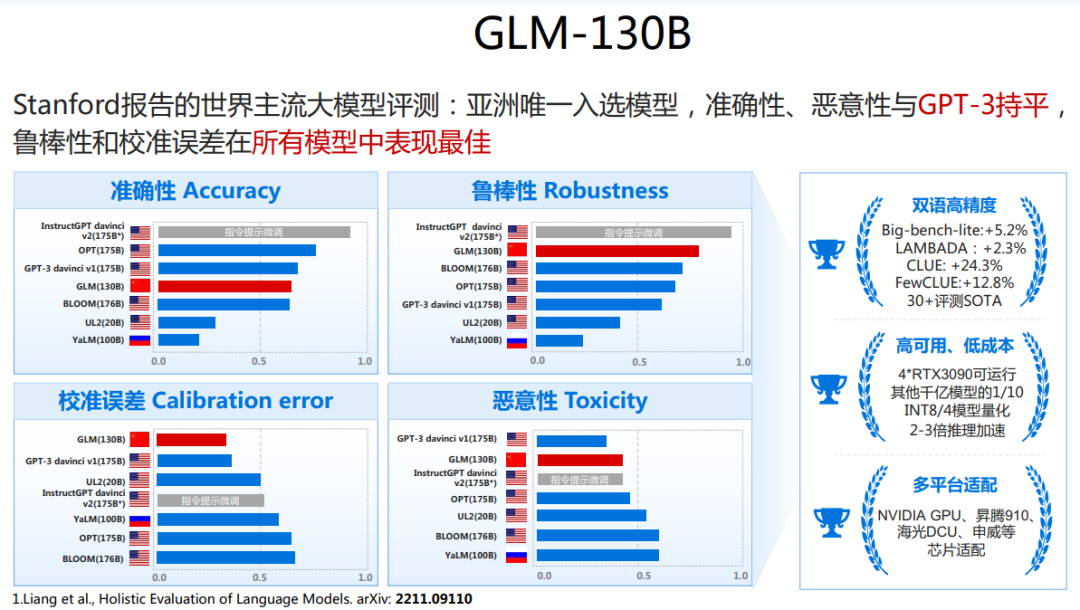
GLM performs impressively across various benchmarks
China's LLMs are indeed still catching up, with substantial engineering challenges remaining. But replication is always far easier than exploration. Inspired by Stanford's Alpaca, the prevailing catch-up technical route domestically is "using GPT-4 for instruction fine-tuning" — delegating the instruction-writing process to GPT-4, "distilling" GPT's knowledge, accumulating sufficient output data through interaction with GPT-4, then fitting and training one's own model. Thanks to GPT-4's excellent capabilities ensuring data quality, this approach significantly lowers the barrier to training LLMs.
On the other hand, in a market with free movement of talent, technology rarely remains truly secret. A Google employee publicly stated that maintaining competitive advantage through secrecy is nearly impossible ("Keeping our technology secret was always a tenuous proposition... we can assume they know everything we know"). Not to mention that hiring OpenAI employees for expert interviews is already a semi-open secret. The time China needs to catch up technologically may be shorter than expected.
More constraints and tests come from beyond technology — commercial considerations, organizational silos, and still-unclear regulation.
An NLP team lead at a major internet company lamented to me: compared to temporary technical lag, the first challenge facing both large companies and startup teams building large models domestically is actually decision-making risk.
If you understand the discussion of open-source versus closed-source in the previous chapter, this becomes clear:
-
The open-source models that ultimately emerge, boosted by community forces, will likely perform only slightly below the top closed-source models, while far surpassing mediocre closed-source ones.
-
If your self-developed closed-source model can't beat open-source, it's meaningless — where will you recoup training costs starting in the hundreds of millions? If you choose an open-source strategy, is your model confident of becoming the winner-takes-all survivor under network effects?
For resource-rich giants committed to self-developed models, the complex web of departmental interest barriers becomes the main obstacle.
For giants, how much money is there really in selling B2B APIs? Everyone is watching to see how much incremental value Microsoft Bing and Office products can generate after integrating AI capabilities. If AI conversational interfaces can truly disrupt the search scenario, what does the search boss think? Most likely: "My department makes this much money — why should I adopt the large model from the AI central R&D team instead of building my own? Otherwise my business becomes just an AI wrapper. Where's my value, won't I get eliminated?"
At the end of the day, for large companies doing LLMs, the first goal is to enhance existing business scenarios, while cash-flow businesses are more worried about being internally disrupted by AI capabilities — the conflict of interest is inherent. Business units and central teams each building their own large models is already the norm. The AI central team complains that business units aren't actively adopting their model, lacking application scenarios to collect data and iterate — how can the results be good? Business bosses counter that it's precisely because the central team's results are poor that they need to build their own. There's nothing new under the sun; the internal strife over AI that Google experienced will replay at domestic giants as well.
Technology is never the obstacle. Large models must be a "CEO-level project" — not merely because of the massive investment and difficulties. There are trade-offs, decisions, and interest allocations that only the CEO can make.
As for regulation, like gaming, film, television, publishing, and so on, a China-characteristic large model is inevitable, and a strong government relations team is mandatory. "Value alignment" is the prerequisite for this entire track to exist domestically. For this article to be publishable, there's no need to elaborate further.
II. Order Restructured: The New Monopoly King of the AI World
AI is consensus, but how to capture maximum value in the AI wave is non-consensus.
Current AI applications and early iPhone apps make for an illuminating comparison: at the dawn of the mobile app ecosystem, flashlight and weather utilities easily gained tens of millions of users; Fruit Ninja and Angry Birds basked in glory. But at mobile's endgame, the ultimate winners were WeChat and Douyin — monopolists built on network effects — and games like Genshin Impact that constructed production-capacity moats. It turned out that flashlight and weather apps in 2010 had no competitive barriers whatsoever.
Counterintuitively, technology itself rarely forms a barrier either.
The "Four Little Dragons" of the previous AI cycle that pushed CV algorithms to the extreme — today, none can turn a profit. A few years ago, a facial recognition solution sold for tens of millions; now it's worth 300,000. If only one company could deliver facial recognition algorithms at commercial grade, they'd have pricing power. But when everyone can do roughly the same, it becomes a competition on price and channel relationships. Every technology has a maturity phase. Leaders in the maturity phase may still hold algorithmic advantages, but it's merely the marginal difference between 99.9% and 99% accuracy — clients don't care. So technological competition at endgame typically devolves into cost and channel competition.
Any business that sinks into a red ocean of competition is grueling. Excess profits come from pricing power, and pricing power comes from monopoly.
The emergence of a new paradigm necessarily causes shifts in the industrial value chain. As the order of the online world is restructured by AI, where will the new monopoly emerge?
Every game company today will say they're an "AI + gaming" company, and the gaming sector in public markets has ridden the AI concept to handsome gains. But is cost reduction and efficiency gain really all AI means? When paradigms are restructured, the most common fallacy is precisely "cutting the feet to fit the shoes" — trying to graft new technology simply onto old systems. The classic example: after the mobile era, Baidu shouted "mobile first," yet merely made a mobile Baidu app, failing to deeply recognize that mobile ecosystems completely restructured information distribution.
Facing an online world that will ultimately be restructured by AI, the only effective way to judge is: first map out the图谱 of the future AI world, then see where a company sits within that图谱.
This diagram is a blunt, simplified framework for dividing up the AI world. Building on this framework, we'll briefly discuss representative companies at each layer.
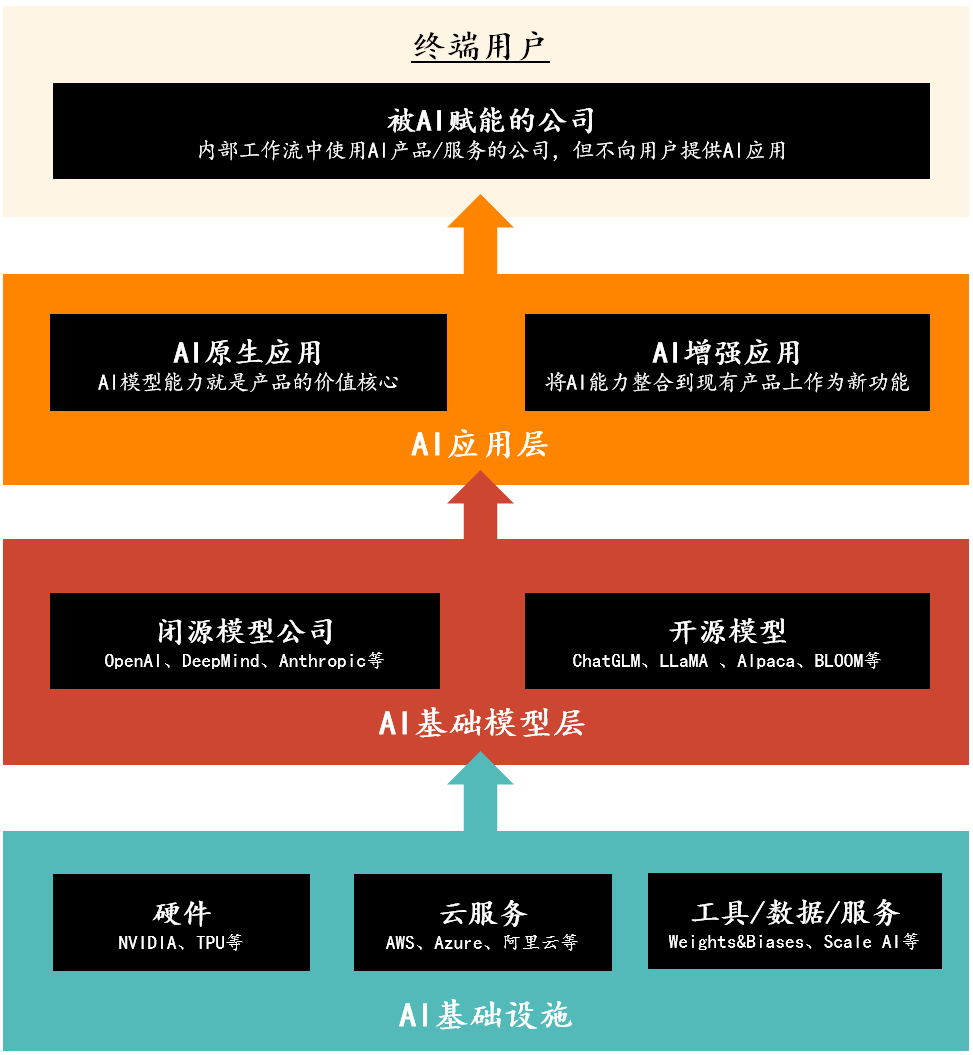
AI Infrastructure
AI infrastructure is the water, electricity, and coal of the future online world — it operates at the very bottom layer. Even today, the barrier keeping most companies from entering the AI world remains the same: insufficient infrastructure and MLOps tools to handle large-scale model training.
The infrastructure layer commands the strongest investor consensus in this AI wave. Whether cloud service providers or, further upstream, GPU and TSMC foundries, it's all an oligopoly game with extremely high barriers. A16Z already laid this out well in Who Owns the Generative AI Platform, so I won't repeat it here. NVIDIA's stellar Q1 results say it all: when the tech giants are locked in a large model arms race, you don't know who'll win the mining, but the shovel-sellers are guaranteed to make money — with strong pricing power in the near term.
Notably, cloud services are also important distribution channels for AI applications. Microsoft's unwritten rule, for instance, is that major Azure customers get easier access to GPT-4 API quotas. Anthropic has also announced an official partnership with Google Cloud. Going forward, this kind of deep integration between LLMs and cloud services — combining training, deployment, and distribution — will become the norm.
Microsoft's cloud service Azure never had much presence in China's cloud computing market, mostly serving multinational companies' China operations. Now clients are lining up to wait. As OpenAI's sole cloud agent for commercialization, it's the only channel for Chinese enterprises seeking stable, onshore access to the large models behind ChatGPT.
LatePost
Another important piece of infrastructure is the tools, data, and services oriented toward AI model training. Companies like Scale.ai, the annotation firm that partnered with OpenAI, and vector database providers Pinecone and Zilliz, are all hot commodities in Silicon Valley VC circles. The middleware ecosystem abroad is healthy, and big companies have a habit of using various third-party components. The domestic situation in China is completely different.
Under the prevailing theme of cost-cutting and efficiency gains, mid-platform teams at China's internet giants are currently in a mode of "grabbing work to prove their value." They've finally landed on LLMs as a new opportunity to justify themselves, so tools and components will definitely be built in-house. Third-party component companies will struggle to break out in China — after all, there are so many open-source solutions available. For example, rather than using external vector database products, teams prefer to layer wrapper after wrapper on Meta's open-source FAISS for their promotion defense presentations. If you're still procuring third-party components and services, what exactly is the company keeping its mid-platform team around for?
AI Foundation Model Layer
Companies at the model layer build foundation models and commercialize them as their primary product. This layer depends on the hardware and tools provided by the infrastructure layer for data processing, model training, and deployment.
OpenAI is currently the most famous model-layer company, with Google and Anthropic following close behind. As discussed above, the most important distinction at the foundation model layer is open-source versus closed-source.
"Narrowly defined" model companies commercialize by packaging model capabilities into APIs and charging per call. Jasper and Notion, for example, call GPT; Quora and RobinAI call Claude. The per-token cost of API calls varies depending on the performance the customer needs — better performance and faster speed command higher prices.
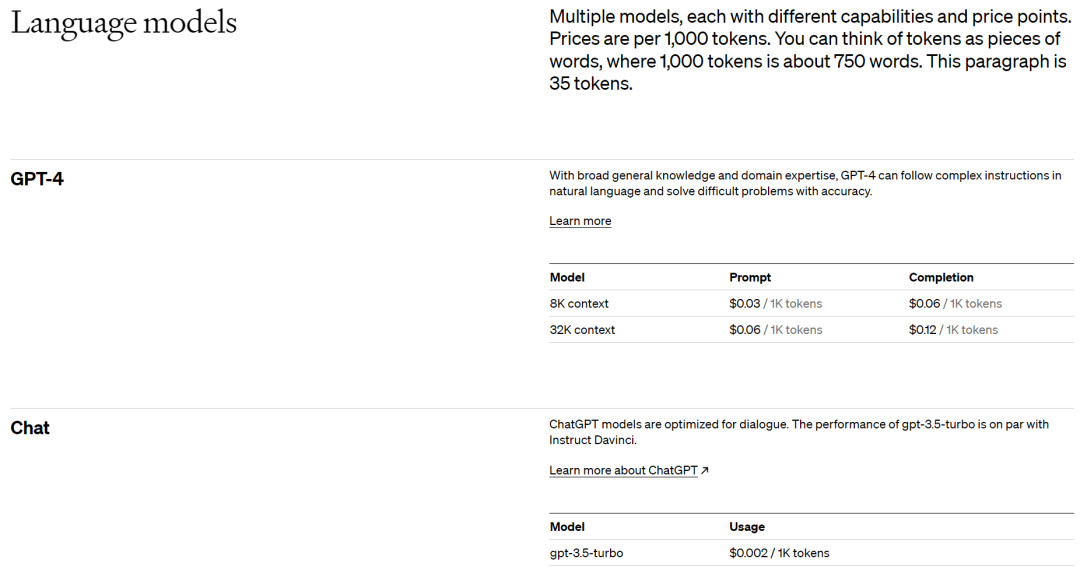
OpenAI's API pricing model
AI Application Layer
The AI application layer can be divided into two categories: AI-native applications and AI-enhanced applications.
AI-native applications derive their entire value from model capabilities. Glow and Jasper's value is entirely based on language models; Midjourney is entirely built on image generation models. The product innovation space for AI-native applications is currently enormous — "chat" as a lightweight input method doesn't fit every scenario, and more vertical, better-experienced differentiated products hold significant value.
Before ChatGPT emerged, Jasper — an AI-native application using the GPT-3 API — was the star that VCs scrambled to get a piece of. Around the same time, a company called Copy.ai was also calling GPT's API, but Jasper left its competitor far behind through excellent product experience design.
Compared to the familiar ChatGPT interface, Jasper's product form primarily addressed three questions:
-
How to reduce users' prompt input costs? The left side of the image below shows Jasper's template feature input box. You can see that its essence is breaking down prompts into structured fill-in-the-blank forms, with higher interface friendliness. Combined with fine-tuning for each template's output, this significantly reduces the number of attempts users need to generate quality content in vertical scenarios.
-
How should output results be presented? ChatGPT is one question, one answer. Jasper, by contrast, provides multiple answers each time, allowing users to upvote, edit, and favorite answers, and to rank multiple answers. This output approach gives users a sense of control through free selection, while also collecting more feedback data for optimization in subsequent generations. This is why many users evaluate Jasper as "better understanding the copywriting style I want" compared to ChatGPT.
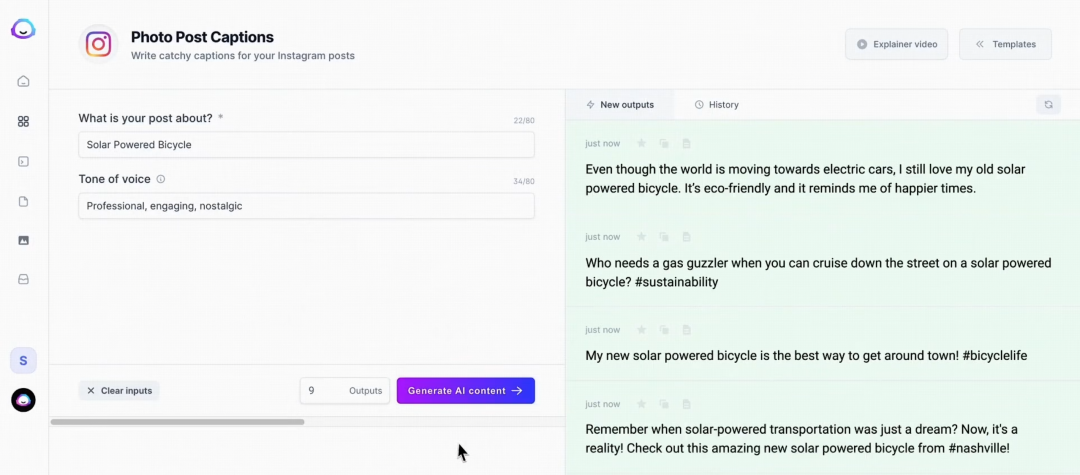
Jasper's template product interface
- How can AI tools integrate into the complete copywriting workflow? Early on, many Jasper customers feedbacked that when writing a complete article, they had to use multiple templates and constantly switch between Word and Jasper, easily interrupting their train of thought and workflow. So Jasper later launched a document feature, allowing users to directly call template capabilities within a Word-like writing interface, letting users seamlessly use AI-assisted writing in a single interface.
Even today, despite the blow from ChatGPT's free strategy, among many heavy Jasper users (primarily marketing and writing professionals), due to its unique "template" product form, model fine-tuning for vertical scenarios like marketing, and deeply integrated workflow solutions, Jasper still offers a better experience than ChatGPT for marketing copy generation.
AI-enhanced applications integrate model capabilities into existing products as new features for users. Among legacy products actively embracing AI, Notion AI is one of the most successful cases. Notion was originally a document and note-taking tool. Last September, it added a text expansion feature by calling OpenAI's API, later expanding to generating drafts, automatically summarizing meeting notes, correcting spelling and grammar, and more. Within just a few months, it acquired millions of new paying users through AI, with subscription revenue soaring.

AI document products are already showing early signs of homogenized competition and price wars
Interestingly, many applications that had nothing to do with AI at launch blew up after adding AI-related features, passively becoming "AI-native" applications. Lensa, which has taken the world by storm over the past six months, launched back in 2018 and spent its first four years as a tepid photo editing app. After adding the Magic Avatars feature, it shot straight to the top of the App Store. An entrepreneur friend I've known for years, who builds overseas utility apps, also told me: their experimental AI feature brought ultra-high microtransaction penetration rates to their apps, with users showing very strong willingness to try new things.
Several AI applications in Silicon Valley have already surpassed $100 million in annual revenue. Setting aside moats for the moment, AI applications are at least a light, quick good business right now: model-layer companies bear the vast majority of training costs upfront, and API call prices keep dropping. Pure application-layer companies have almost no R&D costs, and model call costs are only around 20%. Combine the two and you get the universally exaggerated profit margins of around 80%.
Many pioneering companies have shown us that the relationship between model performance and product experience is not entirely linear. As large model capability supply rapidly becomes oversaturated, differentiated user experience design will become increasingly important for the AI application layer.
AI-Empowered Companies
This layer consists of companies that use AI products internally but don't offer AI applications to users. In the future, all companies will become AI-empowered companies. This transformation typically happens in two steps:
In the short term, individuals within companies use AI products to improve their own productivity. Programmers increase coding efficiency through GitHub Copilot, artists improve drawing efficiency through Stable Diffusion/Midjourney, brand managers use ChatGPT to write marketing copy, and so on. Individuals who adopt AI first will gain advantages in internal competition.
In the long term, companies will leverage AI products in more systematic ways. As more workflow software integrates AI capabilities, companies will deeply embed AI into collaborative processes to enhance the entire organization's ability to conceive, discuss, and solve problems.
Enterprise IM, video conferencing, and online collaborative document tools were initially only used by internet companies, but are now standard in many traditional enterprise workflows. The proliferation of AI capabilities will follow a similar trajectory from benchmark adoption to widespread generalization.
Returning to the most critical question: "At which link will monopoly occur in the AI world?" Right now, whether in China or the US, whether in primary or secondary markets, whether among tech giants or startups, the biggest divergence over generative AI is this: where does the value center lie — the model layer or the application layer?
There are many high-quality discussions on YouTube and podcasts around this focal point. Silicon Valley VCs have shown more concern about the unclear commercial prospects of model-layer companies and caution about the ultimate degree of differentiation among large models. In the US, the companies frequently announcing large funding rounds are more often application-layer and infra companies. Domestic Chinese investors, meanwhile, remain focused on large models, hoping to tell a China-version-of-OpenAI story.
Looking at history, the ultimate winners in the software industry have been platform-type applications that directly control users and data assets. "Only mastering technology" has proven to have no value in the internet world. But in the hardware industry, looking at the model layer's analog — semiconductor design and manufacturing companies have higher concentration than downstream consumer electronics companies that face users directly. Qualcomm, TSMC, and Intel all have extremely strong bargaining power in their respective domains.
Winner takes all: five companies capture most of the semiconductor industry's profits
Will the AI world's evolution path more closely resemble the internet or the semiconductor industry? Will endgame monopoly occur at the model layer or the product layer?
Let me start with a "hot take":
The significance of large language models is significantly overestimated. Technology is merely a means to satisfy demand. End-to-end applications with full-stack capabilities and self-developed specialized models will become the new monopoly kings of the AI world.
- Moore's Law and the S-curve
The value of nearly all technology depends on the performance S-curve — large models will be no exception. This describes how performance changes over time, a pattern repeatedly validated across many technologies' development histories: initially flat, then rapidly taking off with exponential growth during the middle phase, slowing again as maturity approaches, and finally hitting a technological ceiling. Many ML algorithms' performance on specific tasks follows S-curve characteristics; those interested can look up the past decade of results from the ImageNet Large Scale Visual Recognition Challenge (ILSVRC) in computer vision.
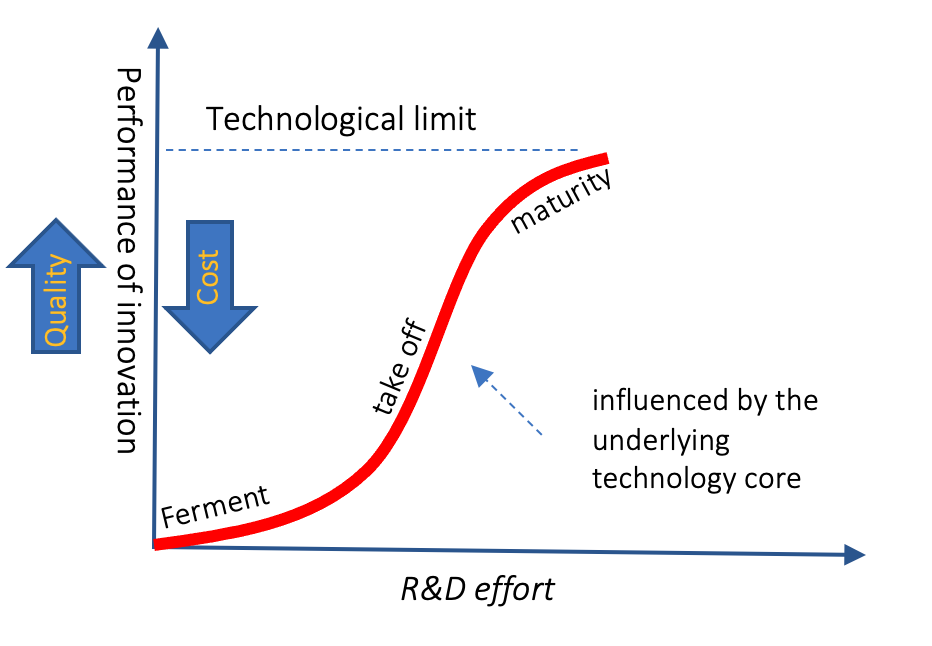
Perhaps because the first wave of half-baked products released domestically performed so poorly, the "performance gap" of large models has been excessively emphasized in Chinese-language internet discourse. There's no doubt that large models are currently in a period of performance growth, but even Turing Award winners find it difficult to judge how long this rapid growth will continue.
People are certain that most models' performance will eventually converge, but will this period of rapid growth last 5 years, 10 years, or 20 years before that happens? This will lead to fundamentally different worldlines.
When LLMs finally reach maturity and performance growth slows, what can build moats will of course still be applications. The difference between a 90-point and 95-point model is already minor; pure model-layer companies will face predicaments similar to the previous generation of CV algorithm companies. Scientific questions ultimately become product questions — after all, the deepest moats in the commercial world to date — network effects, economies of scale, brand, switching costs, and so on — all attach to specific products rather than algorithms.
However, during the phase of rapid LLM performance advancement, leading AI model-layer companies will possess undisputed话语权 (discourse power / bargaining power). Technology is hard to monopolize, but generational gaps can be maintained; 2-3 years of lead time can produce clearly perceptible differences between 60-point and 90-point performance.
Why does the semiconductor industry have such high concentration and such strong话语权 (bargaining power) in the industrial chain? The world's most famous S-curve is "Moore's Law." Our modern way of life owes itself to decades of exponential growth in transistor count. The history of predicting when Moore's Law would reach the top of its S-curve is long, as summarized in this Economist table below — the vast majority of people predicted Moore's Law's demise prematurely.

That Moore's Law persisted in the rapid-growth phase of the S-curve for so long was supported by two characteristics that distinguish the semiconductor industry from others:
- Through massive R&D investment, industry giants continuously maintained technological leadership with each product generation, preserving a performance moat from the 1980s to the present. Maintaining performance leadership requires constantly solving new problems (such as quantum effects), with increasingly staggering investment required — a 5nm-class production line fab costs approximately $5.4 billion to build, three times that of 10nm-class. Bear in mind: most technologies eventually slow not because they've hit physical limits, but because of economic constraints — after the low-hanging fruit is picked, performance gains become increasingly difficult, and the revenue growth they bring often doesn't match the massive R&D costs required.
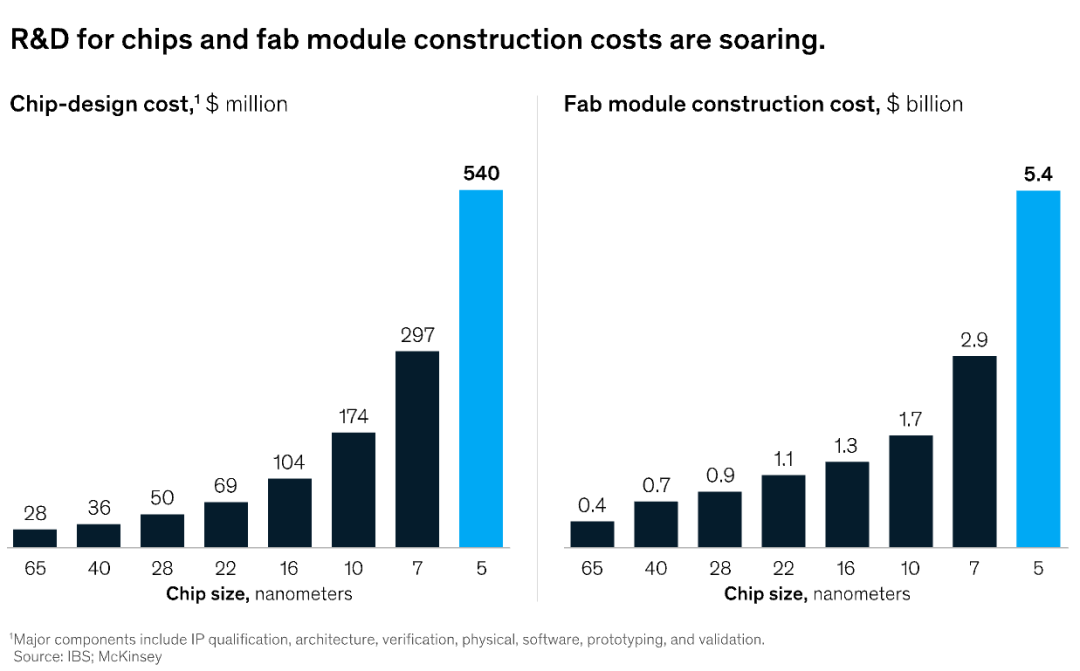
- Where does the confidence to support such massive investment come from? The answer: consumer markets' insatiable demand for performance. People always want phones and computers that are 2x faster — device performance is decisive for user experience, and over the past decade, consumer replacement cycles have almost exactly matched Moore's Law's doubling time. Applications and games that push device performance to its limit emerge endlessly; the better a game's graphics, the more transistors are needed to process them. It is the expectation of this demand that supports the semiconductor industry's steep R&D investment curve. Essentially, "infinite demand for more transistors" is the driving force behind Moore's Law's continuation.
For large model companies to become industry value centers like TSMC and Qualcomm, a necessary condition is: large model performance must demonstrate long-term sustained "Moore's Law" growth curves. However, the differences between AI and chip industries are also quite significant.
First, software is harder than hardware to maintain long-term technological leadership. In terms of barriers to entry, large model training costs are high, but pale in comparison to the billions required for chip manufacturing. In terms of catch-up speed, software can iterate and update in real-time — copying a new feature and rolling it out fully after simple gray-scale testing is straightforward — but hardware requires longer product cycles, with design, prototyping, factory production, and testing taking at least several months, giving leaders more ample time windows. Knowledge in the software industry travels with people and is highly mobile; poaching one lead designer can take away all configuration tables and documentation, but hardware is constrained by complex IP trees, manufacturing processes, and supply chains. This is why many leading AI scholars believe: even during rapid development, large model supply will be difficult for OpenAI or Google to monopolize.
Second, consumer demand for phone and PC "performance" is infinite, but many apps' actual need for "intelligence" has an upper limit — AI models one generation behind will still be very useful for the application layer. Future GPT-5, -6, -7... will improve generation by generation, but in many scenarios, there's no difference in experience once the user perception threshold is crossed. GPT-7 may be the highest-scoring model, but for simple translation tasks, GPT-4 offers better cost-performance. AAA game NPC dialogue may require GPT-7 for sufficient immersion, but e-commerce automated customer service can be fully satisfied with cheaper GPT-5.
As Fraser, former head of product at OpenAI, wrote in his blog: "Capability is only one measure of performance that matters when building a product. Latency and cost matter too and the optimal capability/latency tradeoff is specific to the product experience being delivered." Model capability is just one performance metric when building products. What needs to be specifically considered for product experience is more the tradeoff between performance, latency, and compute cost.
The economic logic underlying the semiconductor industry's "massive investment to maintain performance leadership" cannot hold in the large model赛道 (track/space).
2) Full stack is the only solution
In reality, the relationship between current model-layer and application-layer companies is quite delicate.
After being backstabbed by OpenAI, Jasper integrated APIs from multiple large model companies as an aggregator, and recently announced it would begin self-developing large models. Meanwhile, OpenAI entered the application layer by launching ChatGPT, building a plugin ecosystem, and creating native mobile applications — fully displaying its ambition to not be content as merely an API provider. The entrepreneurs running at the forefront of the AI world are essentially unified in their understanding: "full-stack" companies simultaneously occupying both the model layer and application layer are the ones with the possibility to capture maximum value.
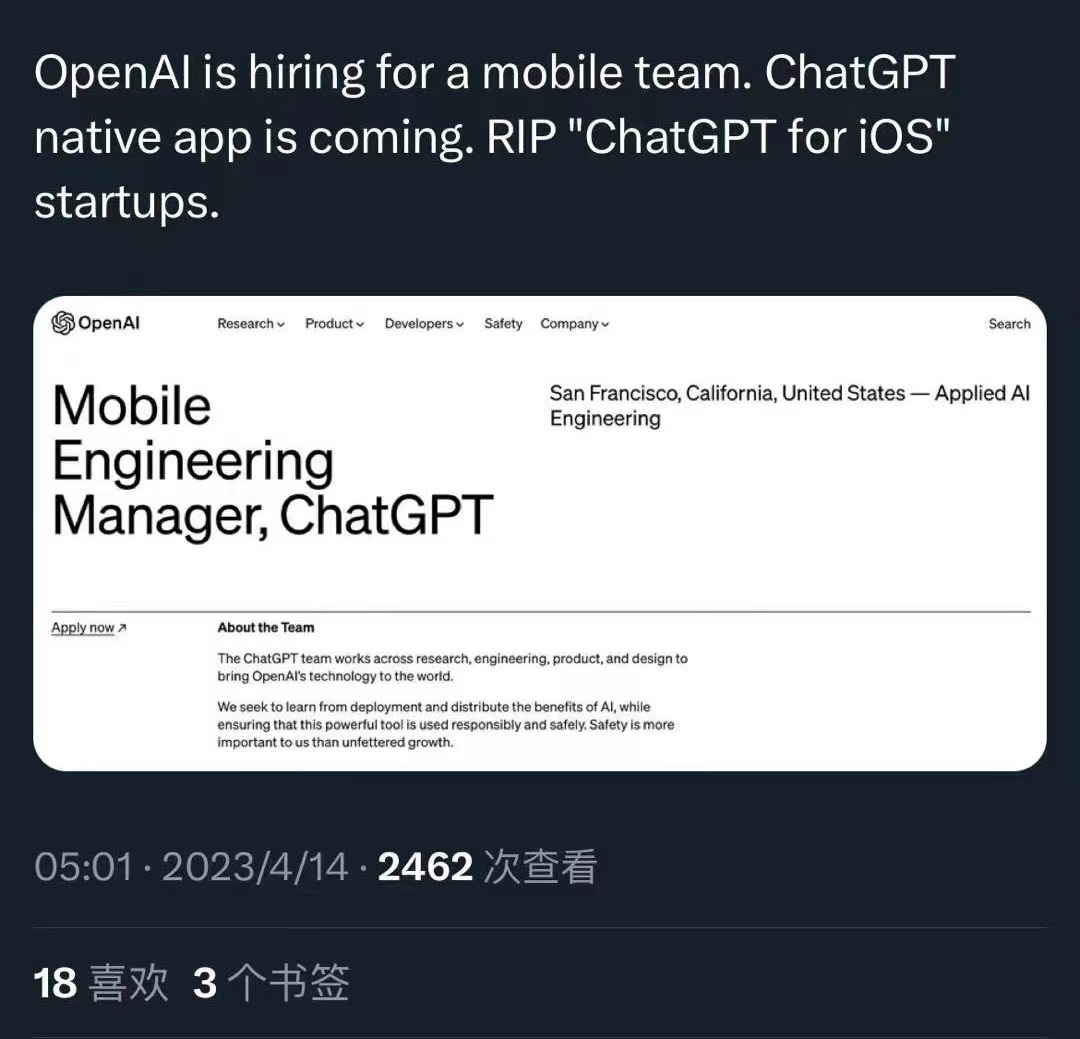
Currently, the official ChatGPT app has launched on iOS in the US App Store
The reasoning behind this is also quite simple:
-
In the AI era, controlling the model means controlling product experience
-
Data feedback is crucial for model improvement
More and more research has found that compared to parameter scale, the properties of training data (such as style and length) have greater impact on LLM generation results. Amjad, founder of Replit (the AI-assisted programming unicorn), said something in an interview that left a deep impression on me:
When we started building the Ghostwriter programming assistant, we wanted to self-host models rather than just rely on APIs. The main reason was that we really wanted to control latency, really wanted to control generation quality, hoped to improve it over time, hoped to collect data and feedback and iterate on it.
For some product use cases, like chatbots and such, using APIs is fine. But for a product like Ghostwriter that sits so close to users... we felt that end-to-end precise control of user experience was extremely important.
At first we tried all the open-source models. Then we found Codegen from Salesforce. We did some fine-tuning, figured out how to improve the model in real-time based on user feedback. After product launch, we collected more data, we knew what features were missing, so now we're training a self-developed model from scratch.
APIs are essentially a form of outsourcing. Many things can be outsourced, but outsourcing the most core elements is of course unreliable. We can hardly imagine a二次元 (ACG/anime-style) game outsourcing its world-building and character design to third-party writers succeeding; similarly, relying on APIs means outsourcing core user experience to model-layer companies, unable to control, iterate, or evolve.
Truly good product experience is the result of intentional construction in every detail. All the large platform products we find incredibly smooth today are the results of hundreds of product managers iterating over many years — but in the AI era, simply stacking PMs is insufficient; controlling experience means controlling the model itself.
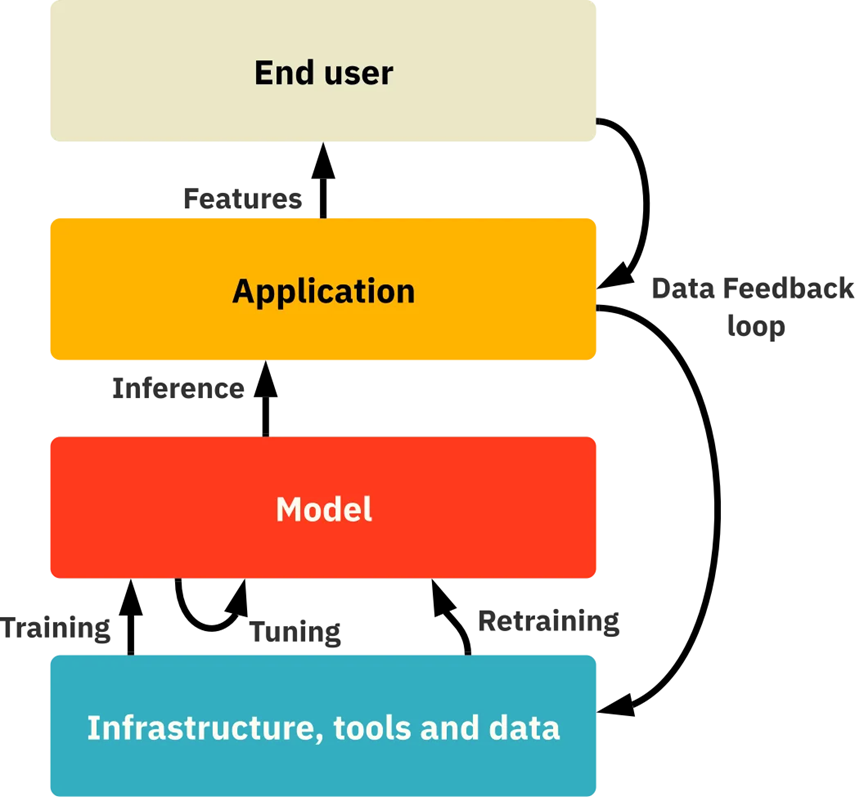
In the AI world's data feedback loop, the application layer is the largest data provider
Where does high-quality data for self-developed model training and iteration come from? Undoubtedly, building a data feedback loop within your own applications is the optimal solution. This is the most fascinating aspect of the AI world: application-layer companies are simultaneously downstream customers of the model layer and data providers.
The best specialized models and the AI applications with the most users will be one and the same in the future. Even OpenAI built its data flywheel moat through productization. Replit's success also proves that the quality of existing open-source models is already sufficient for many early-stage applications. The path of first landing a product to explore more PMF scenarios, collecting data feedback, and then returning to train your own specialized model and build moats is entirely viable.
The world rewards those who take product experience seriously and are willing to bear the costs and complexity.
3) Efficiency Is Beta, Experience Is Alpha
On the other hand, after talking with several friends in primary markets, I fully understand their anxiety about application-layer companies: after going through a complete startup cycle, today's giants are far more powerful and defensively minded than they were at the dawn of mobile internet.
Most startup success comes from non-consensus — growing quietly in corners that big companies don't care about. But generative AI reached consensus far too quickly. ChatGPT proved AI's massive commercial potential with the most astonishing user growth in history.
In an era of growth scarcity and consensus-driven fierce competition, it's extremely difficult for startups to accelerate to "escape velocity": users and time-on-platform are in the giants' hands, and product design is easily copied. Entering the model layer at this point to directly compete with giants on compute, data, and talent also seems unrealistic.
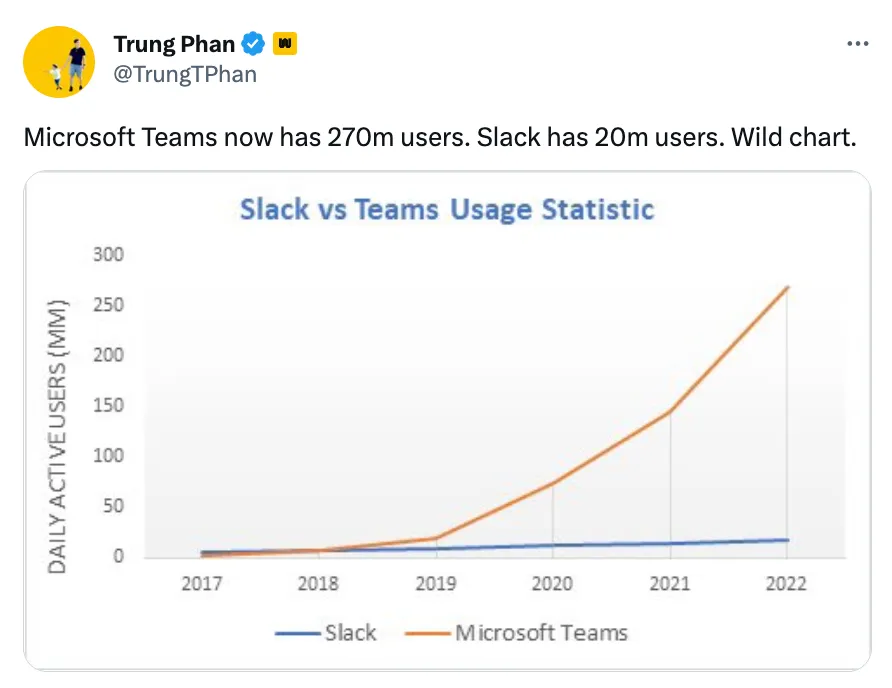
Internet competition is total war. When everyone realizes "this is a highly certain massive opportunity," the brutality of competition is unimaginable. Microsoft would rather face antitrust investigations than unbundle Teams from Office — and this indeed allowed Teams to come from behind and overtake Slack.
OpenAI already stands with Microsoft. Even if GPT has阶段性 performance leads, how likely are Google, Meta, Amazon, Oracle, and even Apple — which control massive B端 customer bases and C端 time-on-platform, and compete with Microsoft across different businesses — to call OpenAI's APIs and integrate services from a competitor into their own products?
Compared to the US, China's internet industry is even more notorious for "boundless competition." Everyone wants to play infinite games, everyone wants to own the entire industry chain; upstream-downstream cooperation is not a stable state. We saw ByteDance willingly bear higher costs to migrate from Alibaba Cloud to self-built cloud infrastructure. What's more likely in the future: large models becoming a must-have for giants, with everyone doing full vertical integration within their own ecosystems — building both foundation models and applications, plus smaller models distilled and fine-tuned for specific application scenarios.
Core capabilities cannot be outsourced. For giants, large models will be like cloud — something they must keep doing even if unprofitable, at minimum to serve their own businesses. Even if model capabilities temporarily lag, they'll keep investing long-term. For giants, what's always most scarce is "certainty."
Transformer is not the first revolution in machine learning. Over the past two decades, every wave of ML innovation (RNN, CNN, AlexNet, GAN...) saw the greatest value ultimately flow to companies with mature products and businesses. Truly large-scale AI applications emerged within Google (search/ads), ByteDance (recommendation/ads), Netflix (recommendation), and Amazon (Alexa) — algorithms providing massive value-add to what are now collectively called the "promotion, recommendation, search"三大场景. Meanwhile, "AI first" newcomers like the CV四小龙 and autonomous driving companies, who sought to win through algorithmic capability, never achieved truly remarkable commercial success.
Will this Transformer wave be the exception?
AI is not users' ultimate destination. Rather, they're waiting for AI to transform into useful products and services — preferably products and services they're already using. According to a May 10 report from The Information, in the three months after introducing ChatGPT, Bing's PC search market share grew by only 0.25% (Microsoft responded to the publication that mobile growth rates were higher). The brutal reality this reveals: generative AI alone cannot reset the competitive landscape, and the difficulty of getting users to switch platforms may exceed expectations.
Meanwhile, major companies are working overtime to introduce new AI features into their existing products with hundreds of millions of users. So compared to the wait-and-see anxiety of early-stage VCs, friends covering TMT in public markets are generally busy and energized: at least for the next few years, internet giants won't lack for new growth narratives.
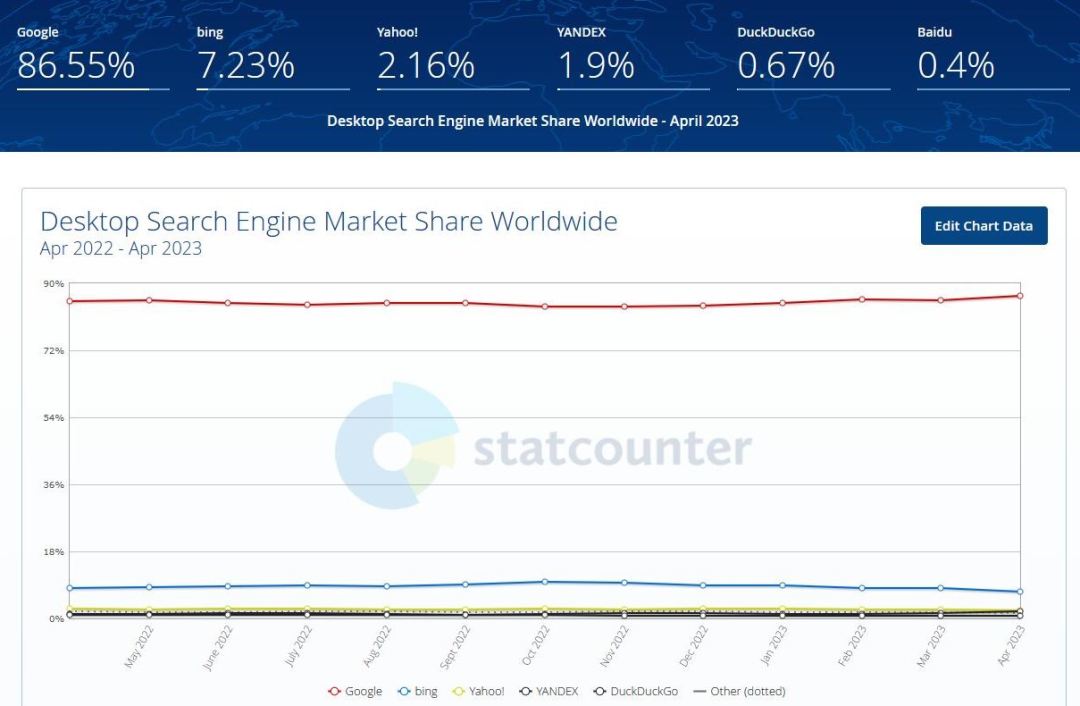
GPT's boost didn't send Bing skyrocketing
Many people have discussed with me whether to pursue efficiency (productivity) or new experiences (kill time) in this AI wave. My answer: efficiency is Beta, but experience is Alpha. Beta value will ultimately flow to giants; truly new opportunities lie in Alpha.
Efficiency gains are consensus-driven — demand is clearer, more universal, objectively measurable. Most validated AI features will eventually be integrated into existing mature products.
But experience is segmented, long-tail, and requires deep understanding of specific demographic needs. We see big-company二次元 games frequently criticized for lacking true "二次元 flavor," and even LVMH needs to acquire streetwear brands to reach young consumers. How could executives sitting in corner offices possibly know what young people on the streets are thinking?
III. Dependent Origination, Conditional Arising:
The Hard-to-Land "Cost Reduction and Efficiency Improvement"
Generative AI as an internal efficiency tool for game companies is already a tired topic. Regardless of how media hypes anxiety about game developers being replaced by AI, actual conversations reveal extremely divided assessments of AI's落地效果 within the industry:
Many game companies' marketing and operations teams are already using AI tools comprehensively, with positive evaluations. Official Weibo and WeChat account copy, daily push notifications are polished with ChatGPT. Channel campaign KV posters, tournament materials — these peripheral, assembly-line art asset needs — use SD/MJ for initial drafts before designer optimization, which does improve efficiency.
Small and medium-sized R&D teams are very excited about AI, seeing it as the best opportunity to close the art quality gap with large studios. These teams previously couldn't access top-tier artists, had limited art production capacity, and were highly cost-sensitive. AI models have learned from vast amounts of top artists' publicly available work online; even if generated images are only 50% of the quality, for small teams this represents a crucial "from nothing to something" difference.
True top-tier R&D teams, however, report AI's efficiency gains as far below expectations. With老板 personally pushing and investing over 100 million in人力成本, they still couldn't systematically integrate AIGC tools into workflows. Meanwhile, top teams aren't cost-sensitive, and their standards for art assets are extremely demanding — AI-generated content simply doesn't meet quality requirements. Often, a star artist on the team would glance at SD/MJ outputs, sigh, and say "compared to modifying this, it's faster if I just redraw it."
At the corporate level, caution is even greater to avoid regulatory and reputational risks. Both Tencent and NetEase strictly prohibit self-developed projects from directly using AI-generated content in-game; even for promotional materials, special labeling is required.
Project teams within large companies are currently generally at the stage of "individuals using AI to improve productivity," mainly in two aspects:
First, inspiration generation:
A Creative Director at a top game gave me an interesting analogy: the 0-to-1 creative design process is like "throwing paper balls." Previously, inspiration often came from aimlessly watching movies or playing games, with occasional sparks of insight — he maintained an inspiration database to capture these fleeting ideas. ChatGPT has now become a more efficient "paper ball throwing" tool; when creatively drained, chatting with ChatGPT and getting a few reference concepts always helps. Similarly, artists will casually throw paper balls into SD/MJ before formally starting on a request, seeing if new inspiration emerges.
Second, improving communication and alignment efficiency:
Game R&D has high knowledge barriers between different functions; programmers, designers, and artists lack each other's professional skills, with大量难以沟通的模糊地带 between upstream and downstream. Alignment costs in these gray areas are high — for example, a hero designer might need to find hundreds of reference images just to explain to concept artists "what I want this character to be like." If after several days of drawing it doesn't match expectations, version schedule risks emerge. AIGC's low cost significantly alleviates this problem. Quickly generated SD/MJ content, while far below final quality standards, is sufficient to anchor concepts and styles in前置沟通, enabling more efficient goal alignment between upstream and downstream.
However, beyond individual use, the落地速度 of "systematically integrating AIGC into R&D workflows" is far below expectations. There have been many归纳式 discussions about this; deducing from first principles, there are also fundamental reasons.
1) The Gulf Between "Novel and Interesting" and "Reliable Delivery" Remains
OpenAI's former product head Fraser wrote a blog post called Novelty vs Utility, and I strongly agree with his view: we are collectively experiencing survivorship bias. The generative AI boom is driven more by "novelty" than by "utility."
His argument is quite interesting: generative AI output is diverse and probabilistic. Most people talking about AI aren't heavy users of ChatGPT and Stable Diffusion — so why does AI's powerful capability still become大众共识?
— Because today's media dissemination is so developed. Most people encounter various ChatGPT conversation screenshots or AI art videos through group chats, Douyin, Xiaohongshu, and Weibo, building their understanding of AI's capabilities from there. In these widely circulated memes, AI's performance is astonishing.
The internet is a lot like a giant bubble-sort system. Whether through algorithmic recommendation or social distribution, only content that users like and forward gets propagated. What the public sees is the most interesting, most stunning material that has been selected and bubbled up from tens of thousands of AI-generated pieces every day. People's assessment of AI capabilities is shaped more by these widely circulated conversations or artworks than by their own actual hands-on experience. This is the collective survivorship bias brought about by meme propagation.
Novelty > utility — this is also the consensus among frontline practitioners on generative AI. Many planners and artists who have used SD/Midjourney long-term have told me: AI is a pretty novel and entertaining toy for them, but it's hard to use as a serious productivity tool.
The act of "gacha-style creation" itself carries a random, game-like pleasure. It is fundamentally closer to a kill-time scenario than a productivity one. So we see that Midjourney users are mostly general users who came to try something new, not professional designers. Many users in Discord channels say it's "like an addictive game."
But in actual R&D, art assets require precise, stable, controllable delivery with very clear productivity demands. As we discussed in the earlier chapter "Future Variables: When LLMs Enter the Multimodal Domain," current text-to-image applications still fall far short of stable delivery standards. Not to mention that the bulk of art costs lies in 3D assets — while startups are working on model, animation, and scene generation, these remain at a rudimentary stage where they're barely even usable as toys.
Attention is All You Need — attention quietly coalesces through one meme after another. The "Endless March 7th" event in Honkai: Star Rail is a great example. At the current stage, rather than telling capital markets stories about AIGC cost reduction and efficiency gains, game companies should think about how to leverage AI's primary attribute of "novelty" for players, combining product characteristics with AI to create memes and compete for users' scarce attention in the public domain.
2) General-purpose large models cannot meet the demands of "high-value workflows"
Some friends have discussed this with me: if we're all talking about efficiency scenarios, Jasper merely calls GPT-3's API and is praised by many marketing practitioners for genuinely improving productivity. So why is AIGC so hard to implement in the gaming industry? Is the gaming industry really that special?
Former Google Brain scientist and current AI startup CEO Maithra Raghu wrote a famous article, "Does One Large Model Rule Them All?" Her judgment on the future landscape of large models is the best answer to this question:
General-purpose AI models can satisfy relatively low-value, ambiguous-scenario, long-tail mass-market needs (such as customer service conversations, daily translation, etc.). But high-value workflows will be dominated by specialized AI systems, not general-purpose AI models.
This view seems counterintuitive at first glance — the most advanced AI capabilities all seem to come from general-purpose large models. But it is extremely consistent with the starkly polarized "fire and ice" evaluations of AI across different companies:
Among all content categories, game production has the highest complexity and cost. Compared to other industries (such as writing novels and creating music), game R&D is certainly the highest-value workflow. And within game R&D itself, the higher the value of the work, the harder it is to satisfy with general-purpose AI tools. For example, Midjourney-generated images are completely unacceptable quality for a top-tier game with 99-point quality requirements, but for reskinned mobile games and casual games, they might even represent a quality upgrade.
Gaming is the most complex content category
Maithra Raghu's argument is very clear, with three key points that we also touched on earlier:
-
High-value workflows have extremely high quality requirements for output, and model specialization is crucial for quality improvement. OpenAI's research has shown that general foundation models need more parameters and greater training investment, with higher inference costs and cloud resource consumption, just to match the performance of specialized models in their domains of expertise. General-purpose large models are more like generalists who can score 80 in every subject, but actual work more often needs specialists who score 100 in a single subject — a language model used to generate light-novel-style NPC dialogue doesn't need the ability to write research reports.
-
Highly controllable, specialized AI is needed to fully match workflows. High-value workflows have high complexity and coupling, requiring customized AI solutions. This means the entire AI system architecture must be flexible and controllable, allowing redefinition of interactions between data, models, and tools according to needs. But general-purpose large models are very inflexible. Trying to exercise fine control over externally provided large models is unrealistic from engineering (APIs alone can hardly support diverse fine-tuning), cost, and security (model companies worry about parameter leakage) perspectives. This is like how standardized SaaS, no matter how sophisticated, can't beat custom-developed OP solutions — deep modification of Unity is already standard for top-tier project teams. Low-value workflows can adapt to tools, but high-value workflows need tools to adapt to them.
-
Specialized models must be trained on proprietary data. High-value domains inevitably have large amounts of proprietary data, such as game-specific style art assets and player behavior data. Unified art style is the primary rule of game immersion — no matter how exquisite Genshin Impact's scene modeling is, it would be jarringly out of place in Escape from Tarkov's military-realistic world. The optimal AI solution for each genre/theme/worldview requires continuous training with precisely matched style data. Yet this data is precisely a company's moat and cannot be fed into external general-purpose models for training.
Most companies currently claiming to use AI for cost reduction and efficiency gains are making low-cost attempts with general-purpose models like ChatGPT/Stable Diffusion. But essentially, general-purpose models are completely mismatched with the "high-value" nature of game R&D — this is why AI shows clear efficiency gains for simple copywriting work but has been slow to land in complex R&D workflows. Even Ubisoft's internally developed Ghostwriter assistive tool currently only manages AI-generated sounds emitted by NPCs after trigger events (a relatively low-value peripheral task in R&D). Relying solely on general-purpose AI applications and APIs, without training your own specialized models, makes meaningful R&D efficiency gains virtually impossible.
In the long run, game companies training their own specialized models is an inevitable choice. We're seeing continuous emergence of lower-cost controllability enhancement work like Reference-only, and customized AIGC tools better matched to internal workflows are already a consensus direction for mid-platform teams at top game companies. However, this also means the barrier to future product competition is being raised higher: the investment required to cross the chasm from "novelty" to "stable delivery" differs enormously. As Take-Two's CEO said in an interview, AI tools will just "raise the bar" for the industry. The end of the story is beautiful, but at current AI arms race talent prices, AI tools will most likely become a new moat for top companies rather than an opportunity to narrow the gap.
Of course, as a technological optimist, I firmly believe all the difficulties above will eventually be solved. Suppose one day stable, controllable AIGC tools are as ubiquitous as Unity, and gaming industry productivity explodes. Then there remains one final ultimate question:
3) Do users really need more content?
At the 2023 juncture, fragmentation and polarization in the gaming industry is already an unstoppable trend. This polarization manifests both in demand — the vast differences in experience expectations among different player groups — and in supply — the differences in product understanding, organizational processes, and skill trees across R&D teams.
Hollywood legacy studios and Douyin MCNs both work in the "video" content form, but they probably couldn't understand each other if they tried. The same goes for gaming — while all sharing the name "game," products and companies serving different audiences already inhabit completely different worlds.
The fun of games is "one man's meat is another man's poison." SLG players don't care whether a general's card art is attractive; MOBA players don't need a freely explorable open world. The "core experiences" that different genres focus on vary tremendously. The real key question is: does AI's boost to content productivity actually make the "core experience" that players care about most any better?
For young users who favor content-heavy games (anime-style games, Eggy Party-style party games, traditional console games, etc.), productivity gains are certainly beneficial. But talent for making such products is firmly held by the "Tencent-NetEase-miHoYo" triumvirate and major Western/Japanese studios. Most domestic listed gaming companies eager to use the AIGC concept to boost their stock prices still make short, flat, fast "numerical games" targeting older paying user groups — typical genres being card games, MMOs, and SLGs.
No matter how they're packaged, the core experience of such products never strays far from "validation feedback for growth and becoming stronger." Interestingly, it was precisely the lack of content productivity in earlier years that led R&D to focus on shaping numerical experiences — pulling formulas in Excel is far cheaper than making levels in an engine. Over more than a decade of genre iteration, the granularity of goals and feedback has been broken down finer and finer, the pacing of progression has grown faster and faster, and the release of showing off has become more and more satisfying.
Supply and demand always move toward each other. China's previous generation of mainstream gamers didn't grow up playing consoles; their pleasure centers were precisely conditioned by "numerical experiences" over the long term: big spenders still care most about server wars, leaderboards, and PvP — it's victory and dominance, not quality and content. Companies that fail to deeply understand this often fall into the predicament of supply-demand mismatch with core user needs: Dragon Raja had excellent quality but performed far below expectations; SLG development costs are far lower than MMOs, yet big spenders still say "the thrill of wiping out opponents only exists in SLGs."
Right now, a lot of development thinking goes like this: once the numerical progression experience becomes formulaic, upgrade the quality and content, fantasizing that AI capabilities can close the quality gap with top-tier products. But the players still sticking with numerical games after wave after wave of filtering are battle-hardened veterans. They know exactly what they want before they even start playing: they're paying to become "above others," to dominate people, not to do charity out of love.
Users conditioned over long years of scarcity develop an inertia in their experiential demands that exceeds imagination. To put it bluntly: content is only skin-deep for numerical games, never the core. However polished the skin, it at best improves retention for the first few days. What truly determines long-term performance is core experience design: can you give paying players sufficient sense of progression achievement, venues for showing off, and the thrill of crushing opponents? And these are things AIGC tools absolutely cannot do. The most important milestone in SLG genre history was the invention of "season" design, not more refined modeling or better battle visuals.
The rise of the Caohejing faction has made "doing content" the political correctness of the gaming industry these past few years, and I personally love these companies too. But objectively, we must recognize that China has the world's most complex economic depth and demographic stratification. Players of different ages and generations have radically different core needs for products. "More content" is not a universal demand across all genre players, nor is it a panacea for product line dilemmas. For most games, "core experience shaping" matters far more than "rich content supply."
The significance of AIGC in "cost reduction and efficiency improvement" has been massively overestimated.
IV. The Holy Grail: A Miracle That Strikes at the Root
I really like what teacher Chen Yuetian said: doing content is doing feeling. Using a new feeling to attack an old feeling is the strategically correct approach for the content industry at any level.
Stretch the timeline out, and all new feelings essentially stem from "scarcity" in supply.
Over the past 30 years, film visual effects have achieved astonishing breakthroughs. From practical effects to CGI, countless visually spectacular films have been born. Yet along with this, audience thresholds for visual effects keep rising. Explosive visuals no longer feel "scarce." Well-crafted blockbusters flopping at the box office has become increasingly common. People have grown numb to Hollywood's formulaic films, finding these industrial assembly-line products mediocre, hollow, repetitive.
Visual effects spanning 30 years, same character pose, yet the emotional impact vastly different
Fast X had unbeatable visuals, yet audiences complained of aesthetic fatigue. Meanwhile, revisiting The Shawshank Redemption, Farewell My Concubine, and Toy Story from 30 years ago — with their dated visuals — we still feel that soul-stirring power. Similarly, powerful words and melodies can be remarkably simple. "Do you not see the Yellow River's waters rising from heaven, rushing to the sea never to return" employs no complex technique or structure, yet shines with peerless talent across millennia. The magicians of the Clock Tower merely use magic as a tool to reach the root. Technology and productivity in the content industry are forever only means; "scarce experience" is the pursued endpoint.
5Y Capital founding partner Qin Liu gave an interview that left a deep impression on me:
Why did we invest in Kuaishou?
In 2011, after we invested in Xiaomi, we internally asked ourselves: what exactly is a phone?
We reached this conclusion: a phone is a PC, but a PC is not a phone. What does that mean? Computers have CPUs, memory, various computing environments — phones have all of these. So phones possess PC characteristics. But phones also have three very important things that PCs don't.
-
Phones have location parameters. Because you carry your phone with you always; it follows you wherever you go.
-
Phones have address books. What's an address book? Social relationships.
-
Phones have cameras, have speakers. That is to say, a phone is also a natural multimedia generator.
Put these three points together, and we saw and proposed a non-consensus view: the next killer app will be mobile, social, and rich-media.
So the truly important question is:
What capability is unique to generative AI, that didn't exist before?
What will remain extremely scarce in a future of supply explosion?
What's the game uniquely enabled by generative AI that couldn't be done previously?
AI is magic that far exceeds the realm of magic, achieving miracles. The breakthrough in AI's underlying capabilities isn't for faster game production, but for using AI to drive experiences that "couldn't appear before." New game types will be created and defined by capabilities unique to AI.
We're still in the early days of the generative AI wave. It's difficult today to accurately predict the evolutionary path and final form of AI-native games. But some trends remain highly certain.
1) UGC: The Debate Between Rules and Social
Creating a large-DAU, long-life product is undoubtedly every game developer's dream. The biggest dark horse of the first half of this year was Eggy Party, which broke Tencent's monopoly on large-DAU genres through UGC and content distribution synergy. Meanwhile, overseas large-DAU products are more aggressively embracing AI+UGC — Roblox began internal testing of AI-assisted material textures and code generation in its editor this February. Riding the AI wind, "editor + UGC + AIGC" has become a consensus opportunity, with numerous round-based products publicly stating they will build in UGC modes.
Many believe UGC platform games will be the first to dramatically improve experience through AI's astonishing capabilities, qualifying as "AI-native." This seems intuitively right: AI assistance can further lower barriers to using built-in editors, improve creation quality, and a thriving UGC ecosystem can provide players with richer, more diverse fun.
But UGC is a big word, and using big words often drifts from real concepts and real meaning. Under the same UGC label, the content and permissions available for creation vary wildly across games:
Character customization is already standard in RPGs; creating and defining your own character is itself a light UGC experience.
Eggy Party, Super Mario Maker, and even Genshin Impact's "Divine Ingenuity" event last year go further, focusing on the level dimension, allowing players to create and share levels.
The most orthodox would be MOD UGC represented by Steam Workshop and Minecraft, where players have unlimited power to modify the game, changing code to more freely create new characters, levels, even gameplay itself.
At this moment when the AI wave arrives, will built-in editors + UGC ecosystems truly become mandatory for all round-based games? We see that the most successful large-DAU round-based games of the previous generation remain very cautious about UGC — Honor of Kings' Tiancheng editor has been online for years without officially opening. The essence behind this: within round-based games, there remain extremely clear genre and experience divisions.
The first category, which we call "strong-rules" round-based games.
Virtually all successful large-DAU games in history have been built on highly replayable "competitive rules." Whether MOBA, shooters (bomb defusal and battle royale), auto-battlers, or traditional card games — the core gameplay is human-versus-human competition within defined map/mode/rule boundaries. Mahjong and Dou Dizhu need no frequent content updates yet maintain extreme popularity and fun — as they say, fighting people is endlessly entertaining. What players pursue is the flow state of constantly honing skills within determined rules to achieve victory, not content freshness.
Do these strong-rules products really need UGC ecosystems? I'm afraid that warrants a big question mark. On one hand, strong-rules rounds have extremely high replayability; every match is a fresh experience, players rarely get bored, thus reducing dependence on content production capacity. On the other hand, even when these large-DAU teams invest heavily in new gameplay modes, players often show little interest — League of Legends' gameplay design team tried tirelessly for over a decade, yet only ARAM and URF were widely accepted by players; most new gameplay modes ended in failure and removal. And for many domestic large-DAU products, innovative gameplay modes have become operational tools for event nodes, with participation rates only barely sustained through运营 giving rewards. Remember, the designers on these large-DAU products are already the people in the world who most understand "rule design."
Under strong-rules orientation, "winning" is the sum of all meaning; experience quality is tightly bound to victory outcomes. The greatest common denominator of core player experience demands is accumulating skills, improving level, winning victories, validating growth within determined rules. Just as a Go champion would never want to switch to Chinese chess, a new set of "rules" means everyone resets to zero, starting from the same line to relearn — this is inherently missing at the user motivation level.
The second category weakens round-based rules, emphasizing social experience and level consumption.
Also round-based games, Eggy Party and Super Mario Maker-type party games have dramatically different round experiences from serious strong-rules games: weakened skill accumulation and victory results, emphasizing the fresh fun of the progression process — what we might call "messing around for laughs."
The PC-to-mobile transition has lasted a decade. In this decade, we've seen MOBA, battle royale, even Escape from Tarkov-style strong-rules gameplay become fiercely contested battlegrounds the moment validated. But before Eggy Party emerged, party games were generally considered mere小品. Fall Guys and Human Fall Flat could be viral on Steam, yet giants showed no interest in copying these prototypes.
Fall Guys' popularity came fast and left fast
The logic behind this is simple: in traditional game design theory, gameplay depth and product lifecycle are closely related. Gameplay rules must contain sufficient mastery space for players to form skill accumulation, feel capability growth, generate flow state, and thus retain long-term.
If a game can only offer momentary novelty, long-term retention becomes a massive challenge — Sheep a Sheep hit tens of millions in DAU, yet major studios didn't bat an eye. Everyone knew users drawn in by fleeting novelty and virality would scatter just as quickly. Products like Counter-Strike and League of Legends, built on time-tested rules, were the gold mines that could sustain operations for over a decade.
The consensus had always been that "continuously delivering fresh, engaging level experiences" was impossible — minigames remained minigames, and the equation of content consumption outpacing production was unsolvable. Now that consensus lies shattered. Eggy Party proved: do UGC right, and a steady stream of new content follows; memes and freshness can indeed be sustained.
Individual rounds in party games don't demand deep replayability. What players care about is the novelty and fun of first encountering a level, the experience of going through it with friends, and creating social currency and conversation topics. It's this low barrier that makes sustainable UGC ecosystems possible — the game's excellent 3C fundamentals and art quality guarantee a high floor for UGC level playability. Creators don't need to polish rules; they simply need creative freedom to drag, drop, and arrange levels. Players are just there for a good time, with socializing as the main goal and low expectations. Since it's a one-off experience anyway, they'll accept all manner of bizarre levels, which in turn motivates creators to produce more content.
Eggy Party exploded through content distribution on Douyin, and fundamentally, the two share genuinely similar underlying logic. As Andy Warhol famously put it, "In the future, everyone will be world-famous for 15 minutes." Untrained ordinary users may not produce serious films worthy of repeated viewing and analysis, but with tool assistance, they can generate ephemeral, disposable content and dopamine-triggering viral moments — enough to capture a few minutes of attention.
"Rule design" and "creating one-off experiential levels" differ fundamentally in difficulty. This means when UGC is layered onto these two game types, the resulting ecosystems diverge completely:
The strong-rules player base's extremely high demands for round quality mean even officially developed new modes by the project team frequently stumble, far exceeding ordinary players' capabilities. To support more gameplay mechanics, editors become vastly more complex than simple drag-and-drop level building. Creators typically make brief attempts, then quickly abandon ship due to steep learning curves or lack of positive feedback — unable to form a genuine ecosystem where players spontaneously create content and positive feedback loops emerge. The editors built into strong-rules games like Warcraft III custom maps and Dota 2 Arcade once nurtured gameplay innovations worthy of gaming history, but today their ecosystems show complete separation between players and creators. The vast majority of creators are no longer pure players, but small studios of full-time professional developers.
When developers begin evaluating practical returns through a pragmatic lens rather than pure fun and passion, everything changes. Players want highly playable gameplay rules, but smash hits like auto chess are rare and unpredictable — so what to do? Full-time developers eventually turned their gaze toward another proven ruleset: pay-to-win. In PvP maps, a few dozen dollars a month gets you an extra major item at spawn; many tower defense maps' monetization pressure would make browser games blush. Today, the UGC ecosystems of Warcraft III and Dota 2 — two classic titles emphasizing fair competition — are indistinguishable from browser game platforms.
Pay-to-win has become mainstream in domestic strong-rules games' UGC ecosystems
This is precisely why all leading strong-rules single-round games approach UGC with extreme caution: from the project team's perspective, UGC exists to acquire creative content cheaply to satisfy player consumption — absolutely not to open up precious user assets to external developers for harvesting and monetization. Only UGC ecosystems that genuinely motivate player participation matter, yet player capabilities fall far short of the "rule design" threshold; supply and demand simply cannot match.
Back to AI. With thorough understanding of this distinction, the picture becomes clear: in the explosion of generative AI capabilities, weak-rules, strong level-consumption, socially-driven products will undoubtedly capture more upside.
Current AI capabilities still struggle to design complete gameplay rules, but generating and optimizing one-off experiential level content is already fully sufficient. As Fall Guys' rapidly declining popularity curve revealed, insufficient gameplay depth and content volume causing low retention was originally fatal for this genre — and AI + UGC is precisely the targeted cure. Project teams using AI tools internally can scale faster; if AI assistance is further integrated into UGC editors, it greatly helps improve quality and lower barriers.
Open-source solutions for text-to-level generation powered by LLM capabilities have already appeared on GitHub. Though still rudimentary, this was science fiction just a year or two ago. I have no doubt that scaling laws will unlock more AI capabilities in coming years; in the long term, even the entire weak-rules party game genre's ecological niche may transform dramatically.
With this consensus opportunity before them, many are eager to explore the AI Roblox / Eggy Party direction. But let me end with cold water. Party game success is always social attribute success, never UGC success. UGC ecosystems are merely the medicine that alleviates retention problems and extends lifecycle in the 10-to-100 long-term operation phase — not the engine driving 0-to-1. The more pressing reality for most party games: poor 3C, unappealing art style and atmosphere, dead on arrival — what long-term operation?
AI capabilities as lubricant can substantially improve the UGC experience, but still cannot solve the "creative motivation" problem. Players' willingness and passion to create for free is anchored by the desire for social recognition. Games aren't merely entertainment for young people, but vehicles for communication within small social circles. The greatest meaning of creation lies in finding identity in an increasingly lonely society. And making a party game into social currency demands extremely high standards for underlying 3C, visual presentation, and even content distribution coordination.
Just as Douyin didn't win the short-video war by launching CapCut, AI will become mandatory for every UGC game in the future, not a winning differentiator. But before doing UGC, everyone must first understand what players actually want.
2) Gameplay Breakthrough: Emergence and Generalization
The world has suffered too long without new gameplay.
Good writing comes from nature, captured by skillful hands. Creating a deeply enjoyable, highly replayable gameplay system is beyond not just ordinary players, but top designers too. Even mighty Blizzard back in the day — Heroes of the Storm's iterative innovation in the MOBA space barely made ripples. Gaming giants worldwide (perhaps excepting Nintendo) have been killing themselves in established genres, paralyzed by gameplay innovation.
To some extent, the industry's recent emphasis on content productivity stems precisely from "gameplay breakthroughs" being beyond human will to force. As Steven (CEO) said in an interview: gameplay breakthroughs aren't common; in such circumstances, we need more content filling. In content-driven approaches, miHoYo has taught the industry an excellent lesson, and we must learn from it.
The magical capability of LLMs "emerges" only after models cross a critical scale threshold. Similarly, nearly every era-defining gameplay prototype in gaming history wasn't designed by professional designers, but naturally emerged from海量MODs created with low-barrier editors and was selected by players. The MOBA prototype emerged from the Warcraft III editor; the battle royale prototype from an Arma mod; auto chess from Dota 2 Arcade, with earlier prototypes traceable to Warcraft III Pokémon and Three Kingdoms maps — just as the geniuses who illuminated human history weren't mass-produced by methodology, only complex, chaotic, freely flourishing ecosystems can generate era-defining revolutionary innovation.
In the past, only built-in game editors could support such complex ecosystems. Everyone has wild ideas; "just one programmer away" is a joke that reflects genuine pain points. In traditional game engine development, "art asset production" and "code implementation" carry high professional barriers, requiring multi-functional collaboration to ship products. Editors come with rich, stylistically unified art assets and highly simplified, abstracted programming, erasing the two biggest barriers and letting creators truly focus on the "creativity" dimension for continuous experimentation and exploration. Before the god of creativity, all are equal.
In recent years, we've seen excellent product prototypes like Fall Guys and Vampire Survivors increasingly appear as standalone games. With the generative AI wave arriving, future "gameplay emergence" will no longer be confined to editor ecosystems — Unity and Unreal won't miss this consensus opportunity.
On May 18, Unity published an official blog post "Why we're excited about AI at Unity," taking an aggressive stance that Unity will support creators using natural language generation tools to create code, NPCs, animations, physics effects, and more. When code can be AI-assisted and art resources generated directly from natural language, the barrier to developing games with game engines may become even lower than using in-game editors for mods today — excellent gameplay prototypes, even with crude visuals, are sufficient to let players feel intense fun. AI-generated art resources may struggle to meet AAA standards, but fully suffice to support creative prototypes like Vampire Survivors.
Gaming remains a supply-driven market. Every gameplay rule breakthrough substantially expands gaming's user boundaries, creating billions in revenue. Perhaps generative AI's greatest gift to gaming is this: dramatically shortening the cycle of gameplay breakthroughs.
Yet history teaches us that the first product to stumble upon a gameplay prototype rarely captures the category's greatest rewards. The vast majority of value created by novel gameplay is captured by products that successfully achieve "generalization" — when a gameplay loop is first validated, it necessarily addresses a specific audience's needs, but many elements appealing to that niche lack universal appeal (difficulty curves, art direction, etc.). Stripping away the non-essential within that gameplay framework, distilling the core experience into a mass-market refinement, and being the first to bring it to the largest possible audience — that is the true category winner.
Emergence creates value; generalization harvests it.
Many cite the DOTA → League of Legends → Honor of Kings lineage as proof that "generalization" is the exclusive privilege of tech giants with massive user bases — this is unequivocally wrong. Attributing the most successful "gameplay generalization" in history simply to channel advantages is intellectual laziness. It ignores the staggering breakthroughs Honor of Kings achieved in single-session experience, accessibility, and metagame systems:
What is the most suitable core 3C design for mobile devices?
What single-session duration best fits modern lifestyles?
How should combat numbers be tuned so TTK aligns with session length?
Which high-frustration, negative-feedback designs should be eliminated?
Should ranked systems validate skill or engagement to best serve the broadest player base?
...
Every "generalization" solution to these questions represents massive accumulated know-how and profound user insight. Take the first question, "core 3C generalization," as an example:
MOBAs originated from RTS, so whether DOTA or LoL, the most important operational interaction in their core 3C carries RTS DNA: "target selection." On mobile, a product like Vainglory rigidly adhered to this convention, using "tap" interactions to replicate PC target-selection mechanics. Honor of Kings, even at the demo stage, abandoned the RTS lineage of "target selection" in favor of a more action-oriented "position judgment" approach — the game has virtually no target-directed abilities like those in DOTA or early LoL. Most abilities are large-hitbox AOE, and mobility is generously provided. Heroes like Guan Yu, Ma Chao, and Shangguan Wan'er, controlled via left-stick movement, were praised by players as refreshingly novel and addictively playable for hours. Fundamentally, Honor of Kings completely abandoned the vision control, information mastery, and distance-based gameplay of traditional PC MOBAs, establishing its own system of ability-direction/positioning and powerful mobility. The core combat experience is "similar in form but different in spirit" from traditional MOBAs.
Behind this billion-dollar creative genius lies years of deep reflection on "generalization": how should players interact with systems to suit the capabilities of hundreds of millions of casual users on mobile platforms? Medium determines experience — keyboard-mouse, controller, joystick, or touchscreen each demands fundamentally different 3C solutions. Touchscreens excel at swiping and dragging; precise tapping is genuinely difficult. Thus the "swipe-and-drag-dominant action approach" gave Honor of Kings a far smoother, more satisfying control feel than competitors, becoming the optimal solution for MOBA 3C generalization on mobile.
Yet even with such profound accumulated thinking on "generalization," the Honor of Kings team failed to achieve expected success overseas. Because communication infrastructure and player capabilities vary enormously across regions, requiring fundamentally different "generalization" solutions. Mobile Legends: Bang Bang explored a more locally suitable approach through further gameplay simplification, shorter TTK for heightened stimulus feedback, and reduced graphical fidelity for device compatibility. Expand the lens to global markets, and "generalization" always holds vast untapped space.
A marked trend is that future "generalization" increasingly diverges from simple "mass-market-ization," evolving toward more vertical directions. MOBA is actually a narrow exception that experienced full competition during its emergence phase. Most newly emerging gameplay prototypes possess far broader expansion potential than MOBA.
"Generalization" can emerge from differentiated experience crafting. Shooting's core is sufficiently robust and simple that layering different rule sets can generate extraordinarily diverse sub-experiences. Thus the Battle Royale war wasn't ended by PUBG — cartoony, exaggerated Fortnite, combat-reimagining Apex, low-end-rising Free Fire, even COD's Warzone mode all carved out positions through distinctive differentiated experiences, collectively expanding the gameplay paradigm's boundaries.
"Generalization" can also be IP-driven. IP maps emotion and memory — first, reducing CPA; second, pre-anchoring player cognition and creating demand. Card games and SLGs combining with IP are already mature strategies. The auto-battler prototype, when combined with LoL and Blizzard IPs, achieved greater commercial success than the original mod. One producer once joked with me: every top-tier IP deserves an auto-battler.
When generative AI democratizes game production capability, game supply will become extraordinarily abundant, and excellent gameplay rules will emerge at unprecedented speed. When prototypes are no longer scarce, "generalization" becomes the truly scarce capability.
"Generalization" is not an opportunity exclusive to giants — unprecedented supply abundance will inevitably dilute users' limited attention. Consensus-level gameplay breakthroughs reaching MOBA or Battle Royale scale will grow increasingly rare. More success will come from non-consensus paths like Fall Guys → Eggy Party. Sharply capturing smaller, earlier vertical signals becomes critical. The more vertical the category, the deeper the required understanding of its cultural and experiential core, the stronger the personal style needed, the more resolute the project control.
Future "generalization" will compete on more than channel capability: it will require failure-tolerant authorization and incentive mechanisms, understanding of users' real needs, conviction in specific experience crafting, and — the courage and determination to place bets.
3) Miracles Made Manifest: The Virtual World of One Billion People
At the level of novel experiences, AI NPCs may be the industry's most discussed topic. Autonomous agents like BabyAGI and AutoGPT — capable of orchestrating LLMs and other tools to autonomously decompose and execute tasks — represent the hottest frontier in current AI research. The Stanford AI version of The Sims that excited many game developers uses similar generative agents to simulate human behavior.
Generative Agents: Interactive Simulacra of Human Behavior
However, the path to integrating traditional-definition games with AI experiences is destined to be rocky.
Generative AI's underlying principle is statistical probability; its output inevitably carries strong randomness. Yet traditional game fun derives precisely from simplification, bounded constraints, predictability — what the book Rules of Play emphasizes as Meaningful Play. In core boss battles of games like Monster Hunter, Sekiro, and WoW, boss AI logic is carefully choreographed by designers in behavior trees. The player's journey of first encounter → death → observation, deciphering boss behavior patterns, finding designer-preset countermeasures, repeatedly attempting to build mastery, and finally succeeding to receive feedback — this entire flow of enjoyment is built upon clear, predictable boss behavior logic. Imagine if boss behavior were machine-learning-generated, with positioning and ability usage completely unpredictable, players unable to know the consequences of each choice — that would be a disaster.
Real life is not as interesting as games. Because the real world is inherently random and chaotic, causal chains excessively complex, black swans omnipresent.
Before Honkai: Star Rail's launch, producer David held a dialogue with Katsura Hashino, producer of Persona. This is exceptionally rare publicly available material of top-tier producers discussing AI.
Hashino: For Persona 5, we established the narrative's core concept from the start — "Young people delivering judgment upon society built by adults. Revenge. Making them sit up and take notice." Personally, whether creating what kind of stage or what kind of story, I ultimately hope to leave something in players' hearts.
Hashino: That is to say, no matter what content we create, first input requirements into AI tools, then manually adjust based on AI-generated content — such production methods are already practically feasible. Going forward, perhaps increasingly less manual operation will be needed, and efficiency will keep improving.
However, I feel that as creators, we must not forget certain things that will be "lost" amid this convenience. For example, to build interpersonal relationships between characters after Persona 3 — represented in-game as the "Commu" and "Coop" systems — when first developing these systems, we completely didn't anticipate they would become so beloved by players.
So I believe that while leveraging flourishing AI technology and modern society's conveniences is important, we also cannot forget what entertainment products should bring to people living in the real world.
David: Honkai: Star Rail has prepared roughly 60,000 words of dialogue for "March 7th"... Even so, the scenes we can present remain quite limited. For example, during play, players might constantly have thoughts like "I want to go to a café with March 7th and talk about her past," or "I want to go to an amusement park with her to change things up"... Yet relying solely on human resources, it's difficult to cover all these events. If we input the existing 60,000 words into AI tools... then increasing March 7th's character event count isn't impossible.
Hashino: If that really happened, every conversation with her would be quite exhausting (laughs).
Mr. Hashino's attitude toward AI-generated NPC dialogue is rather nuanced. Though expressed quite subtly in the dialogue, one can clearly sense the old-school game developer's cautious conservatism toward experience crafting. Simply summarized, Hashino's view is: games must have a unique creative core, all content should tightly revolve around this specific core, and handcrafted content best ensures this.
This philosophy is certainly admirable. But from another perspective, Hashino's thinking is largely grounded in traditional console game business models: for traditional games demanding "specific outcomes," the random, probabilistic experiences AI brings may indeed hold limited value.
— Though gradually shifting toward GaaS, copy sales remain traditional console's primary revenue source. For a copy-sales business model, what matters most is having a clear core experience to attract purchases and cultivate a stable franchise user base, not using infinite content to extend in-game retention. More radical buy-to-play producers like It Takes Two's Josef Fares have even publicly stated: does the game industry have collective anxiety? I think single-player games are already too long. What the hell is replayability? The very idea that players want to replay games is strange.
But the wheels of history keep turning. Along the console-PC-mobile arc, gaming's audience has expanded enormously, and the boundaries of what's possible in interactive entertainment keep stretching. If you traveled back twenty years and told the era's most brilliant game developers that one day over 100 million people would be competing online in a single title daily, or that a game could sustain a thriving, stable trading economy more than a decade after launch, they'd likely be dumbfounded. Competitive matches replayable tens of thousands of times, the so-called "plateau" gameplay pioneered in China, gacha-style resource monetization — none of these fit the orthodox definition of "game," yet these new elements and experiences have dramatically extended individual titles' lifespans and revenue ceilings. Traditional consoles' sluggish pivot toward GaaS is, in some ways, exactly a trap of their own experience design and business model — their revenue levels can't sustain frequent content updates (especially content with clear creative authorship), preventing them from entering a virtuous cycle of long-term operation.
History always rhymes. Every content format expands its penetration by continuously pushing the boundaries of experience.
In antiquity, books and music were among the Six Arts mastered only by the scholar-official class; in medieval Europe, literature and music were likewise controlled by church and court. After the Industrial Revolution democratized printing technology, cheap popular fiction (especially crime and adventure genres) became literature's largest category — and traditional literary writers in Europe and America fiercely denounced pulp novels as "a desecration and destruction of literature." Similarly, film industry figures have called short video vulgar, mindless cultural trash; pop music was once stigmatized as decadent and corrupting. Yet ultimately we saw that after literature, music, and video dramatically broadened their experiential boundaries, both production and consumption achieved unprecedented prosperity.
TME 2021 Digital Music White Paper
Traditionally designed games, with their carefully orchestrated creator-authored content, will of course continue to exist — and thrive. But the subtle differences in AI attitude between the producers of Honkai: Star Rail and Persona 5 in their conversation perhaps foreshadow something: a fundamentally new type of experience, radically different from traditional game design philosophy, is about to emerge — a boundless virtual world where, amid the roar of compute and the probabilistic fluctuations of AI, endless unpredictable dialogue, behavior, and stories emerge; infinite content and elements flow freely and collide within rule frameworks, whether crashing waves or trickling streams... all surging ceaselessly through an eternal paradise.
In this uncertain world freely constructed by AI, everything brims with unknowns and variables. This sensation is unprecedented in traditional gaming. Those who will savor it are unlikely to be players accustomed to the pleasures of Meaningful Play in conventional games, but rather an entirely new "AI-native" generation — just as mobile attracted masses of new players who had never touched PC games.
In our previous article, we discussed how the gaming industry has the finest talent, the magical ability to create demand, and how top game companies harbor ambitions of migrating all humanity into online worlds. Yet the larger share of online population, time spent, and profit flow remains firmly in internet platforms' grip. As dominant as Honor of Kings is, its DAU is less than one-tenth of WeChat's and one-seventh of Douyin's. Strip away form and look at essence: WeChat, integrating communication, content, commerce, work tools and more, is closer to being the de facto "virtual world where a billion people live." And game companies, at least so far, have none that have transcended gaming's boundaries.
The internet industry achieved such scale because of fundamental capabilities. People's increasingly scarce attention must be exchanged for content. All content must first be generated, then distributed to find its audience. Internet platforms redefined distribution, making information in every media format individually consumable — not just text, images, and video, but communication itself as the highest-volume content category. For gaming, no matter how strong a single-match loop or how elegant a plateau design, players will eventually tire of homogenized experiences. Even the industrial ceiling of Genshin Impact, with its 42-day version cycle, is already pushing limits. Even with hundreds of team members creating content around the clock, to compete head-on with internet platforms whose hundreds of millions of users generate infinite content for user scale and time spent — this is a mirage.
The internet restructured distribution. So if AI can restructure generation?
Current top-tier game teams of several hundred people already approach project management's scaling limits; content production is inevitably an entropic process. Even ignoring cost, collaboration complexity and management challenges prevent individual game projects from expanding teams infinitely. In other words, no matter how polished the toolchain and workflow, traditional development models have a hard ceiling on per-title content output. Linear productivity gains cannot truly promise a floating world dream for a billion people.
Now, generative AI brings a glimmer of dawn where miracles materialize — creators touch for the first time the possibility of "infinite content" — as Aoko Aozaki said, magic is a miracle that by ordinary means, no matter how much time and resources invested, could never be achieved; something no one can imitate.
Massive transformation and substitution opportunities are emerging. Internet platforms, relying on user-provided infinite content, command enormous online populations and time spent. When AI redefines content generation, will those who control this future still be internet people?
The Metaverse concept sounds somewhat mystical now, but the rise of human online immersion is an undeniable trend. Text-image-video-3D — people eternally crave more real-time, information-rich, immersive content. When AI redefines content generation and experience, in the endless war for attention, the boundary between games and the internet will blur ever further. We are destined to live in a world where reality and illusion, certainty and probability intertwine.
"In hidden dreams, the Sand King sleeps alone in silence, sketching new theorems.
In the King's dream, no one need drink a single drop of bitterness. In the new world, all is good."
| References |
|---|
| [1] aigeneration.substack.com |
| [2] blog.eladgil.com |
| [3] digitalnative.substack.com |
| [4] moreentropy.com |
| [5] nathanbenaich.substack.com |
[6] simonwillison.net
[7] gaming, social, and new media Archives | a16z.com
[8] Does One Large Model Rule Them All?, Maithra Raghu
[9] Semiconductor design and manufacturing: Achieving leading-edge capabilities, McKinsey
[10] 海外独角兽公众号
[11] ChatGPT和聪明地设计 Infra,Suits and Hoodies
[12] 万字长文,探讨关于ChatGPT的五个最核心问题,M小姐研习录
[13] RPG的未来是AI NPC吗?看《女神异闻录》与《崩坏:星穹铁道》的答案,游研社
5Y Capital seeks, supports, and inspires lonely entrepreneurs, providing everything from spiritual to operational support. We believe that if the "crazy" you in others' eyes begins to be believed in, the world will become altogether different.
BEIJING · SHANGHAI · SHENZHEN · HONG KONG