How Is AI Reshaping Games and Creation? We Talked to More Than a Dozen Industry Founders | 5Y Capital Tavern Vol. 26

How AI Is Reshaping Content, Gaming, and Entertainment
This edition comes from a closed-door 5Y Capital Tavern event in early 2025. AI is transforming the fundamental nature of content creation, gaming, and entertainment in unprecedented ways, reshaping where these industries are headed. In content creation, AI has sparked both anxiety about "whether it will replace creators" and deeper reflection on what creation actually means. In gaming and entertainment, AI is opening new possibilities for player experience, interaction models, and game development workflows.
This 5Y Capital Tavern gathering brought together entrepreneurs and industry veterans from AI-powered content creation, gaming, and entertainment. They shared their experiences, reflections, and insights on "How AI Is Reshaping Content, Games, and Entertainment." Since the full discussion is quite long, we've compiled key takeaways at the start of each topic — we hope you find them useful.
Also, a new 5Y Capital Tavern closed-door session will take place at the end of February. We'll be opening some spots to external participants — scan the QR code at the end of the article to register and explore more possibilities for AI in content, games, and entertainment :)
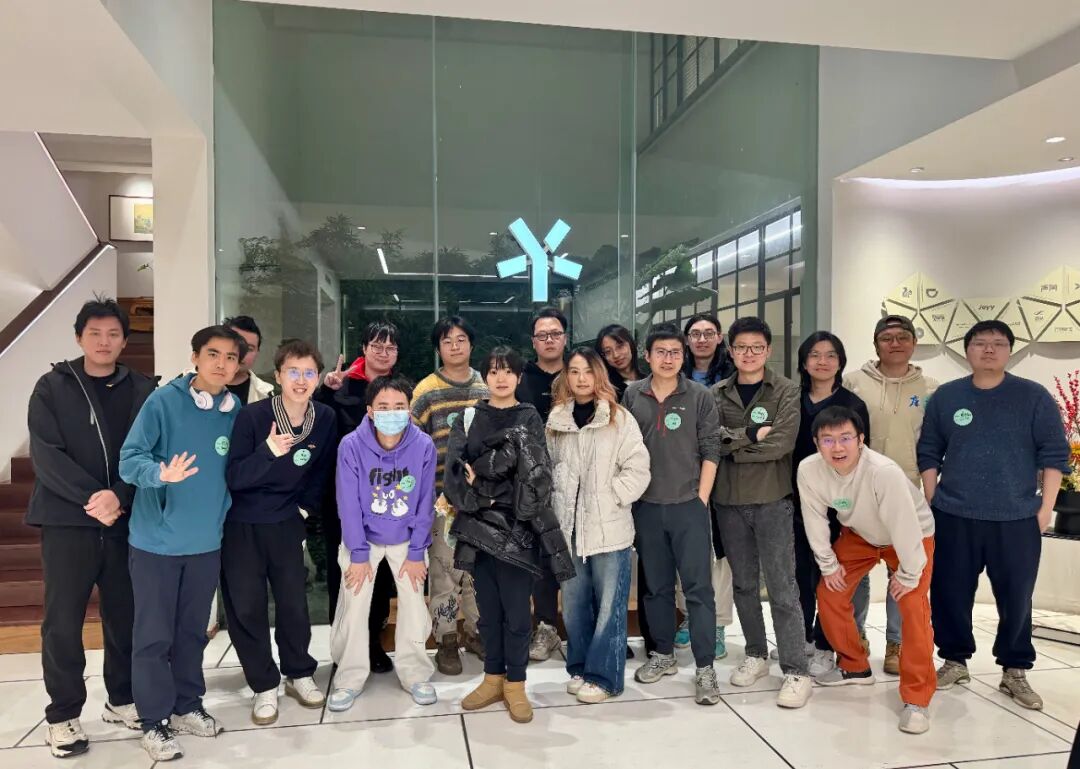
5Y Capital Tavern event
TAKEAWAYS
I. The Transformation of AI Content and Creativity
Dramatic conflict arises from contradictions within universal connections. AI can already engineer beautiful coincidences where distant pieces of information collide, then continuously intensify and visualize them. "If love between both sides can last for aye, why need they stay together night and day?"
— Xiuhan Hu, NieTa
On the triple paradox of AI coding tools: the "precise ambiguity" of generative models, the "anti-engineer-friendly" trend in coding tools, and the implicit aesthetic revolution in open-source communities.
— Haixin, Independent AI Creator
II. How AI Is Reshaping Games and Entertainment
- "The point of AI is to put my brain inside the game to play with players — to see what I can do."
- "In the era of AI games, ambition should be capped at 'bringing 10% innovation to games.'"
- "UGC ecosystems connect individual developers to massive user bases. Individual developers play to their strengths. All value lies in mutual benefit — and winning in the future."
— Ruizhao Chen, Jike Xingren
- "The users worth targeting are those who want to be heard and seen, who have their own aesthetic sensibilities, who demand more emotional value and self-expression."
- "AI games aren't just about prettier graphics wrapping around large models, or getting users to interact better with large models. It should be about large models playing a threading-the-needle role within a system, better serving the user experience."
- "In the future, we might see a Roblox Studio designed for AI Agents, where all functions, config tables, and assets are designed to help Agents learn, understand, and invoke them better."
— Haixin Qiao, Kotoko AI
- "Rather than debating open worlds versus mini-games, think about how to decouple AI innovation modules from core game systems."
- "The optimal form of AI NPCs is achieving a 'person' that meets functional needs within a product scenario."
- "UGC will restructure power dynamics: platforms provide rule engines, developers maintain core content, and players become UGC suppliers."
— Xiaowen Cao, Qingpao Games
PART 1
AI, Content, and Creative Transformation
Guests:
Xiuhan Hu, NieTa
Haixin, Independent AI Creator
How AI Is Transforming Content and Creativity
Speaker: Xiuhan Hu, NieTa
First, let me introduce our product "NieTa." In our initial product planning, we positioned it as "GitHub + Disneyland." I've rarely mentioned this concept over the past two years because I felt it was premature. Now we might define NieTa as an "open-source theme park." On this platform, users can create numerous original characters. Some top original characters have become quite popular, with roughly 13,000 people participating in creation and interaction — a bit like taking photos with LinaBell at Disneyland. Additionally, we produce MVs featuring select quality characters, and host our own Super Girl-style talent shows bringing characters together, as if you're interacting with various attractions at an amusement park.
Never Replace Creators
Sharing some learnings — I think the most important point is: never try to replace creators. From the start, I've never really believed in "replacing creators." Of course, I was tempted at times, wondering if we could skip certain steps or roles. As the saying goes, "once enough people are doing it, you get kicked out of the fan club" — if a creation method becomes widespread, creators get displaced. In reality, however, the inspiration that creators contribute is very difficult for AI to fully replace. Creators contribute the most original prototypes, or define works through conceptual tags — like "Tom and Jerry." Creators combine different elements to create unique works. This creative process is something AI struggles to directly replicate.
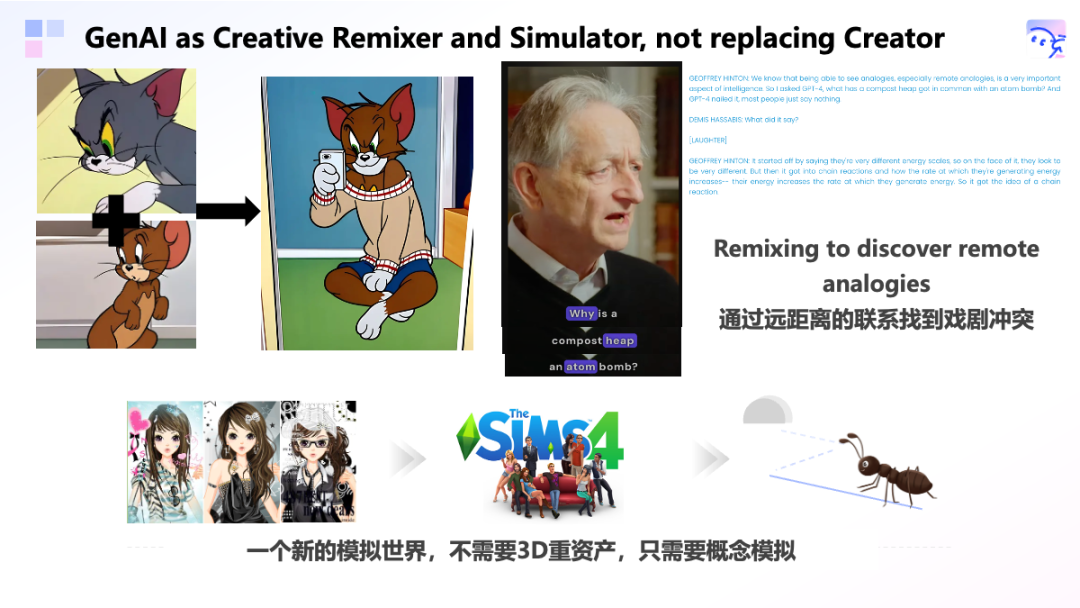
AI Excels at Finding Distant Connections and Dramatic Conflict
What AI is better at is finding dramatic conflict through distant connections. We've all learned that connections between things are universal, and contradictions drive development. AI's ability to grasp this is actually stronger than most people's — and this matters a great deal. As Geoffrey Hinton mentioned in an interview, the relationship between compost and atomic bombs — most humans definitely couldn't answer that, but AI can find the connection. Compost involves piling up fertilizer, which ferments and heats up, accelerating microbial reproduction, creating an internal chain reaction: the faster bacteria multiply, the faster fermentation proceeds, producing more bacteria. Atomic bombs work similarly, releasing neutrons through fission, which strike other atoms to trigger more fission. The analogy is distant, but it reveals the connection between two things.
A New Simulated World Doesn't Need 3D Heavy Assets, Just Conceptual Simulation
We've come to understand that building a new simulated world doesn't actually require traditional 3D heavy assets — it can be achieved through conceptual simulation. We first felt this when studying Stanford's Smallville project. Smallville is a massive simulator with a complete simulation system, but if you break down character interactions and dynamic elements into fragmented content, it becomes much more manageable and operable. From a localized state perspective, this approach is more efficient. Even in such localized environments, AI's simulation capabilities are at least 10 to 100 times stronger than traditional metaverse or 3D technology. Traditional metaverse construction requires defining all structures, element rules, and relationships and connections between objects — extremely complex. But in AI-driven simulated worlds, all of this can be accomplished through linguistic concepts.
Therefore, using AI to simulate 3D worlds and then returning to final presentation seems like taking the long way around. In many scenarios, 3D structural display expression isn't that important. In fact, AI has already demonstrated powerful capabilities in simulating social interactions and physical phenomena — for example, the Genesis engine can generate precise physics simulations from simple language descriptions. This shows that AI's application in simulated worlds is more efficient and flexible than traditional 3D technology.
Building Network Effects and Data Advantages Through Content Asset Remix
Finally, extending from the two points above: in remix or simulation, how to truly make good use of these capabilities. From the perspective of accumulating model capabilities themselves, in the current generation of products, what the application layer can do is actually relatively limited. Therefore, asset accumulation — especially content asset accumulation — becomes particularly important.
Following the logic above, you'll find that the more distant the assets, the greater the value they create. Therefore, in such a system, you should construct and accumulate as many distant inputs as possible and combine them to maximize model capabilities. This may be the truly useful part of this generation of products. If models don't achieve further breakthroughs in this generation, I believe this content asset accumulation-based effect will still be the dominant paradigm. Of course, if models achieve greater breakthroughs in the future, fully automated systems or certain Agents may become the most useful components. But at the current stage where this generation of models hasn't reached that point, the network effects and data advantages mentioned above remain the decisive factors determining a system's ceiling.
AI and Creator Ecosystem Empowerment
Speaker: Haixin, Independent AI Creator
5Y Capital Tavern: As a deep user of both generative models and coding tools, what observations do you have about these two product categories that differ from mainstream perceptions?
Haixin: The general public tends to view them in isolation, but my cross-disciplinary use has revealed a triple paradox: First, the "precise ambiguity" of generative models: the more they pursue visual realism, the more they require abstract prompts (e.g., using "faded 90s Fuji film look" instead of "brightness -10"). This shows AI is deconstructing traditional aesthetic paradigms, and creators must master "poetic parameterization."
Second, the "anti-engineer-friendly" trend in coding tools: new-generation tools like ComfyUI are replacing lines of code with nodes. This appears to lower barriers, but actually demands more systematic flowchart thinking. This foreshadows an era of "modular narrative," where storyboards equal code and storyboards equal functions. GitHub Copilot lets newcomers quickly produce "functional but clumsy" code, which in turn forces them to focus on architectural thinking rather than syntax details earlier — a path reversal akin to "practicing large characters before refining small regular script" in calligraphy.
Finally, the implicit aesthetic revolution in open-source communities: data from popular models on CivitAI shows that the most upvoted aren't high-precision models, but versions allowing 10% random noise — humans are searching for "artificial authenticity" through technical flaws, upending traditional technology evolution logic.
5Y Capital Tavern: What are you most looking forward to in 2025?
Haixin: My biggest hope: being able to use a fully-powered DeepSeek anywhere, anytime, without disconnections.
PART 2
How AI Is Reshaping Games and Entertainment
Guests:
Ruizhao Chen, Jike Xingren
Haixin Qiao, Kotoko AI
Xiaowen Cao, Qingpao Games
Yaopeng Xing, 5Y Capital Investor
Yaopeng Xing: When technology is still immature, should AI games target open worlds or mini-games as an entry point? How do you balance ambition against feasibility?
Ruizhao Chen: I believe you should choose the smallest possible gameplay loop and let AI's advantages shine within that minimal cycle. Don't make AI an accessory to heavy, complex gameplay. Game designers at GDC have repeatedly argued that hybrid gameplay creates fundamental contradictions at the底层, and I agree: our theoretical understanding of AI game design is still underdeveloped at this stage. Directly modifying and grafting onto existing heavy gameplay — the more you blend, the more contradictions you create, and the greater the risk of making a boring game.
I'd argue that in the AI game era, developers should limit their ambition to "bringing 10% innovation to a game" — with "10%" measured by in-game interaction patterns. Beyond this threshold, game design difficulty rises exponentially on one hand, and on the other, players haven't formed a consensus yet. We'd face the trap of "designing for an imagined experiential market," which is commercially unsound.
Haixin Qiao: From the perspective of rapid validation or rapid "failure," mini-games can provide teams with feedback much faster than open worlds. An open world is itself composed of many gameplay slices. Before trying to go big, you'd best figure out a small diorama first. As far as I know, there isn't yet a fully LLM-built open world. Many open worlds have experimented with lightweight LLM integration — for example, NetEase's Where Winds Meet lets players chat with AI NPCs to make friends in the martial arts world. They did quite well with dialogue pacing and staying in-character (avoiding OOC moments). But after the initial novelty, most players still prefer getting positive feedback through combat and world exploration. Visual input processes millions of times faster than reading. In RPGs, our understanding of the virtual world as characters mostly comes through vision. If a designer suddenly restricts players to a chat interaction amid the high-speed interaction of an open world, it will likely feel "boring."
Beyond applying LLMs to NPC dialogue in open worlds, we've also envisioned worlds where the entire backend runs on LLMs — an LLM-composed system as the world's infrastructure. We tried building a sandbox with narrative stories that relied entirely on a multi-agent autonomous system. The challenge here is that when the sandbox becomes too open (too many behavioral functions for agents to choose from, too many attributes/values to be affected and fed back), today's AI agents struggle to select reasonable actions to execute, and find it difficult to coordinate with other agents to advance the worldline. This reflects numerous technical problems: how large should the "decision space" we give AI be (the scope of tool use), how high should the requirement for coherence be, what to do about token costs when data volume is too large or data structures too complex, and so on. I look forward to model progress working with engineering to solve these issues.
Xiaowen Cao: First, I'd like to reframe this question as "Should we enter through large scope or small scope?" This is actually a classic risk-and-investment matching problem. Using lower-cost exploration for high-risk experimentation to find an MVP is certainly sensible. However, while small worlds are good for rapid gameplay iteration, they risk falling into the trap where the gameplay isn't substantial enough to fill the emergent possibilities of AI. The mature content ecosystem and player base of open-world games, conversely, make them better proving grounds for AI.
But the key to choosing an entry point when technology is immature isn't really about total investment size — it's about establishing risk isolation mechanisms. Rather than debating open world versus mini-game, it's better to think about how to decouple AI innovation modules from core game systems.
Making a highly playable open-world game — its business model and production risks — is actually traditional and mature. This portion of risk should be isolated from AI exploration. On the other hand, you need a highly playable, content-rich open-world game to support the growth and exploration of AI intelligence, just as a biology lab needs petri dishes before it can run virus experiments.
In summary, a balanced development strategy should be: build on a mature open-world framework, prioritize selecting specific modules for AI experimentation, and continuously optimize the technical implementation path through player feedback. This preserves commercial viability while providing real application scenarios for technological innovation. The key is using localized innovation in open worlds to validate the breakthrough potential of small technologies, rather than using immature technology to support the overall construction of an open world.
Yaopeng Xing: Should AI innovation focus on gameplay, narrative, or visuals? Which type of innovation is most likely to break through?
Ruizhao Chen: First gameplay (interaction), second narrative — these are the key domains where AI technology brings new experiences. For game designers, the meaning of AI is: "We can finally incorporate wetware intelligence into games. Now let's see — if I put my brain into the game to play with players, what can I accomplish?" We can now embed a decent game designer into a game and have it solve those fundamentally open-ended interactions — dialogue is the typical example, but there's actually much more possible.
AI technology breakthroughs have brought minimal improvement to visual presentation. Their impact doesn't even come close to UE5's implemented virtual geometry technology. In a game industry where massive funding pours into visual presentation, top-tier games compete on aesthetic cognition — AI can't yet participate in a war of aesthetic ability against top artists. However, for games that don't compete on art, AI brings overwhelming cost advantages. With art man-hours dramatically reduced, "one-person game companies" and "three-person AAA studios" have already become reality.
Haixin Qiao: Visuals are probably the most successfully deployed already. Many game companies are already using AI to assist in creating game assets and promotional art materials. But fully generative visual games — like those made with video models — probably remain somewhat distant.
Gameplay and narrative are genuinely still unclear. Today's commercial content games have massive budgets, often hundreds of millions of dollars. Players are highly sensitive to character personality and narrative quality. It's hard to imagine large models completely taking over narrative design, though assisting creative output certainly has value. For indie creators, narrative is self-expression — if you hand it all to AI, why make games at all?
Beyond gameplay/narrative/visuals, I actually think AI coding has been a huge help in game production. All our colleagues are now using AI to write code and participate in production — efficiency is vastly higher than before.
Xiaowen Cao: These three aren't actually easy to fully decouple. The integration of games and AI must still be a comprehensive solution, with the ultimate goal being whether the resulting product can deliver meaningful experiences. But if forced to separate them with certain预设, visuals and narrative would likely be realized relatively earlier.
Visuals currently connect more to changes in production paradigms — whether from lowering barriers to art creation or from cost reduction and efficiency gains in asset production. Narrative, due to the inherent nature of large language models, was the earliest direction explored — various chatbots emerged quite early. On the development side, while we haven't yet been able to completely replace human workflows with AI, both can already be deployed in ideation or copilot stages.
Gameplay innovation mostly revolves around designing around agents. Abstracting agents as individual systems that achieve a certain degree of thinking and mentality, then having players interact with agents of various positioning. This is where we're placing our bets — breakthroughs in gameplay — because we believe gameplay is the more essential core of games. Of course, changes to it require coordination with the other two and even more factors. The changes will be more difficult and complex, but also more fundamental and attention-grabbing.
Yaopeng Xing: What demographic is the best testing ground for AI games, and how do you break through to attract mainstream players?
Ruizhao Chen: AI is deeply bound to "experiential innovation." There are two types of players who are naturally suited to be AI game audiences: first, indie game players and streamers who are deeply interested in innovative gaming experiences; second, hardcore players who have invested substantial time in specific genres.
Without formed experiential consensus, the key to breaking through lies in timely community-driven development. What we're about to accomplish is a revolutionary feat of experiential innovation, not merely deconstructing and recombining traditional elements. Therefore, we need deep communication with players — let the game grow together with players, and occupy the high ground of player cognition about AI game experiences before the game even launches.
Haixin Qiao: If we view LLMs as a medium for user interaction with a game system, one value they provide is making interactive content "relevant to me" — delivering more personalized content based on more open user input/imagination, rather than strictly limited choices designed by developers. From this angle, the users worth targeting are those who want to be heard and seen, who have their own aesthetic standards for content, and who have greater demands for emotional value and self-expression. These users' more concrete in-game manifestation is being prone to forming emotional bonds with virtual characters, having better understanding and empathy for stories — for example, players of gacha games (二游) or otome games (乙游).
When developing products, we frequently communicate with these users and reference many OC (original character) circle practices. We often discuss: it's great that users can create their own virtual characters, but wouldn't it be more interesting if virtual characters could further expand their social circles, having their own friends and lives? If users are introverted, unwilling to communicate on behalf of their OCs, and lack platforms for interaction and sharing, then the significance of large models providing personalized content generation and automated social agents becomes apparent. I believe AI games aren't just about packaging large models with better graphical presentation for better user interaction, but rather having large models serve as a connective thread within a system to better serve users' experiential goals.
I think how to break through depends on whether the product's empathy needs are shared by the next generation, whether it will resonate with the times — this may be somewhat mystical. Roblox has 400 million MAU today; they couldn't have imagined this in their first ten years. But it turns out kids today simply need such a playground. Different game types have their own audiences. If it's a game+AI experiment, first serve the users your genre targets — consider whether this genre could use AI to create better experiences. If you want large DAU, then look at what collective demands young people share, how you might accompany a generation's growth. Many existing needs haven't grown and broken through not because the demographic with that need is small, but because there's too much friction in current experiences.
Xiaowen Cao: The logic for addressing these two differs. For the former, it's gamers interested in novel things and technology. These people should have relatively abundant gaming experience, able to measure works by the medium's own standards. They're also bold and willing to try new paradigms — getting a little excited when they see keywords like AI.
For breaking through to mainstream players, what's needed is more at the传播 level. How to shape a high point of meaning, making your product a form of social currency based on a widely existing need (Remini, for example). AI-assisted UGC provides game users with opportunities for expression. Combined with different games' characteristics, letting users spread content with strong emotions (funny, touching, horror, etc.) could be one angle.
Yaopeng Xing: What is the optimal form of AI NPCs, and at which环节 do they most help the gaming experience?
Ruizhao Chen: AI NPCs are best suited for games where the gameplay centers on characters. When a character serves only narrative purposes, we don't need a clever kid who can improvise on the spot. But if we can get feedback through interacting with NPCs, we gain a stronger "sense of world." A comparable case is "environmental storytelling"—using landscapes and objects scattered throughout the world to convey to players the feeling that "the world I'm in actually exists."
Haixin Qiao: Player-character relationships can be roughly divided into three types: AI as your gaming companion/teammate (e.g., AI teammates in Naraka: Bladepoint), AI as an NPC (e.g., the martial arts friends you can romance in Where Winds Meet), and AI as a piece on the chessboard (e.g., the Stanford Town experiment). None is inherently better—it depends on matching the relationship to the gameplay. The point of AI is always to give players deeper immersion. For example, in future single-player RPGs, AI companions will become very common. They could have more personalized performances (custom voices or dialogue styles), even fight alongside you, like Elizabeth in BioShock Infinite.
Xiaowen Cao: The "optimal" AI NPC, I think, is a "person" that meets the functional demands of the product scenario (never tiring, never breaking character, etc.). They would be a "chaotic entity under constraints"—a three-body system shaped by three dimensions: stable comprehension of underlying rules, flexible strategic judgment based on circumstances, and unpredictability born from "flaws."
For example: this AI NPC understands the rules embedded in the virtual world—structural mechanics, physics, basic engineering knowledge. They decide to use these rules, gather materials, and build a trap to capture and burn a wild boar. But when the boar escapes at the last second, they get so angry they fling their torch around haphazardly and accidentally burn down their own house, then burst into tears.
The goal, put simply, is to create a virtual character with intelligence, growth potential, but also flaws and a "soul." The precondition for such AI NPCs to enhance gameplay is still alignment with specific product needs, since different games demand very different things from NPCs. But broadly speaking, their greatest significance is covering a wider range of game situations. Especially in rule-driven sandbox games, there will be countless scenarios designers never anticipated. Only neural network emergence can align with the emergence produced by intersecting rules.
I think it's worth noting that controlled chaos matters more than absolute rationality. Completely rational AI NPCs lead to "superhuman opponents"—meaningful in certain contexts, but likely to undermine game fun and roleplaying pleasure. Just as Klara from Klara and the Sun is probably more likable than HAL from 2001: A Space Odyssey before the "malfunction."
Yaopeng Xing: Will UGC ecosystems disrupt traditional game development? How will power be restructured between platforms and developers?
Ruizhao Chen: The benefit of UGC ecosystems is lowering the barrier to game creation, letting creators who aren't "hexagonal warriors" enter game development and leverage their individual strengths. Traditional game development can coordinate multiple developers, combining everyone's strengths to build bigger projects. I see these as two distinct development philosophies that will profoundly reshape the game market structure.
Another advantage of UGC ecosystems is binding games tightly with communities, connecting individual developers directly with players. UGC ecosystems link individual developers to large user bases—developers play to their strengths, and all value lies in mutual benefit, with wins coming in the future.
Haixin Qiao: The maturation of AI technology is itself a democratization of content creation, and UGC ecosystems will only flourish further. Game mods will become easier to make—players can quickly create mods for games they love, even have AI teach them how to deploy them. Fan content for story-driven games will grow richer, giving players quality "surrogate meals" during content droughts. Formats like Fortnite or Eggy Party, which build UGC ecosystems inside the game itself, will also diversify. On top of these capabilities, traditional game developers will become more like creator gods—gathering users through excellent works, then letting the world branch out and develop richer ecosystems through AI-powered UGC creation.
UGC game platforms and development tools may also take new forms. Roblox Studio is a UGC game engine designed for human players; perhaps we'll soon see a Roblox Studio designed for AI agents, where all functions, configuration tables, and asset design are optimized for agents to better learn, understand, and invoke. Only by deconstructing at this layer can we achieve, at the presentation layer, ten million intelligent agents collectively building a virtual civilization.
Xiaowen Cao: If we consider user-made long and short videos as UGC in film and television relative to Netflix series and Hollywood films, then in games, UGC mainly manifests as gameplay created by players on platforms like Roblox and UEFN. Compared to text, images, and video, UGC in games is harder to achieve, primarily due to the high complexity and high barriers of game production.
AI is significant in lowering the barriers to game UGC, while UGC will also transform game production models and power structures. Games previously made by companies or professional teams will shift to PGC, and PGC will further transform into UGC.
Of course, this doesn't mean all new UGC output will find users—content ecosystems will reach a new equilibrium. Because games, compared to other media, demand greater commitments of users' time and energy, head concentration effects will be stronger. The ecosystem pattern may polarize into a small number of professional/company-level head products and a large volume of user-produced games. Head games will increasingly focus on rule/framework construction, becoming more "platform-like," enabling some users to evolve from pure content consumers to content producers.
The core of power restructuring will be the tension between control and openness—platformized products must balance "letting players freely create" with "preventing ecosystem collapse." Future power structures may have three layers: platforms provide rule engines, AI tools, and some core IP; developers maintain core gameplay and content; players become UGC content suppliers and even branch game developers. These phenomena already have some analogues in today's market—the future will see further intensification of these trends.
Yaopeng Xing: Should AI game commercialization prioritize subscriptions, ads, or content transactions? Which models have been validated?
Ruizhao Chen: Subscriptions are best, followed by content transactions. Subscription games can charge highly engaged players. With AI games, the target for experience optimization is clearer, more data accumulates, and the ability to build sustainable moats is stronger. Plus, investment in AI itself directly equals investment in game content, translating more effectively into ARPU. A relevant case: LoveyDovey, which offers female-oriented companion chat and romance gameplay through subscriptions, has achieved very strong results with experiences that far outpace competitors. No subscription-based AI game has broken into the top tier yet—that's one of our most watched directions.
Under content transactions, there have been many attempts at buy-to-play AI games. We can see many AI single-player games with excellent gameplay winning through ingenuity—the first AI indie game to sell over 10,000 copies will appear soon. There are also multiplayer AI games trying to capture share from the social gaming battlefield, but AI isn't core competitiveness in this direction, so prospects are uncertain.
Under ad-based models, many games using AIGC technology have better quality and stronger viral effects than previous mini-games; there are also small AI games with interesting gameplay monetizing through traffic. AI makes generating social viral elements very easy, so there's still considerable room to explore.
Haixin Qiao: AI game monetization still depends on gameplay and genre—the relationship to AI itself is minor. The token cost everyone was most worried about has dropped an order of magnitude every six months, and has recently been compressed to extremely low levels by DeepSeek, no longer a stumbling block to profitability. When MMOs first appeared, server costs were also very expensive, but games eventually became free-to-play. Monetization should be designed around the core experience and its satisfaction points.
5Y Capital Tavern Event Registration
The next 5Y Capital Tavern will be held in Beijing on the evening of February 28. At this event, we'll explore how recent breakthroughs at the model layer are driving transformation in gaming and entertainment, how AI can boost creative efficiency, enhance immersion, and unlock entirely new business models.
We're opening some spots for the new session. If you're an AI entrepreneur, developer, or have been closely following frontier applications and development prospects of AI in content creation, gaming, and entertainment, scan the QR code to fill out the registration form and join us in discussing how to use AI to redefine next-generation interactive experiences!

Scan QR code to fill out registration form
Comment to Win
We welcome your thoughts on the article's arguments, your experiences with AI tools, and your perspectives on AI in content creation, gaming, and entertainment. We'll select 2 featured comments to receive a gift prepared by 5Y Capital.



5Y Capital seeks out, supports, and inspires founders who are going it alone, backing them from the ground up — in spirit and in every aspect of operations. We believe that if the world starts believing in you when others think you're crazy, things will unfold in remarkable ways.
BEIJING · SHANGHAI · SHENZHEN · HONG KONG