Ketah CEO Boyan: AI Native App — Back to the Future | 5Y View

The greatest hope for AI is that it makes us better humans.

What is the core value of artificial intelligence? How will the fundamental principles of product design change in the new AI era? How will intelligent humans of the future differ from who we are today?
Today's share comes from Bai Yan, founder and CEO of Kehua, who offers his thinking on AI Native App product design and value — and his greatest hope for the AI revolution: not that people realize machines can be intelligent, but that humans realize they themselves can harness intelligence to become better humans.
We've organized his share below. We hope it inspires you :)
AUTHOR

Bai Yan, Founder & CEO of Kehua
My name is Bai Yan, founder and CEO of Kehua. Kehua is an app that uses AI to help you find people you actually click with. For the past three years, we've mainly been exploring the possibilities of AI and social connection.
The theme I want to share today is AI Native App — Back to the Future. I'll explain why "back to the future" at the end.
When people mention AI Native Apps, they usually ask me what that means. There have been a lot of buzzwords lately — AIGC, Copilot, large models, and so on. But it's actually not that complicated. Put simply, an AI Native App is "an app whose first version couldn't have been built without AI."
It sounds simple, but look at the apps on your phone and see how many meet that standard. I believe most of them would fail — which proves the point that "death means an opportunity to rebuild."
That said, this definition is pretty colloquial, so let me try a more professional framing. An AI Native App is one whose core value simply cannot be delivered without intelligence. And "intelligence, core value, and app" are exactly what I want to talk about today. What is intelligence? What is the core value of artificial intelligence? And what should the guidelines for AI Native apps look like?
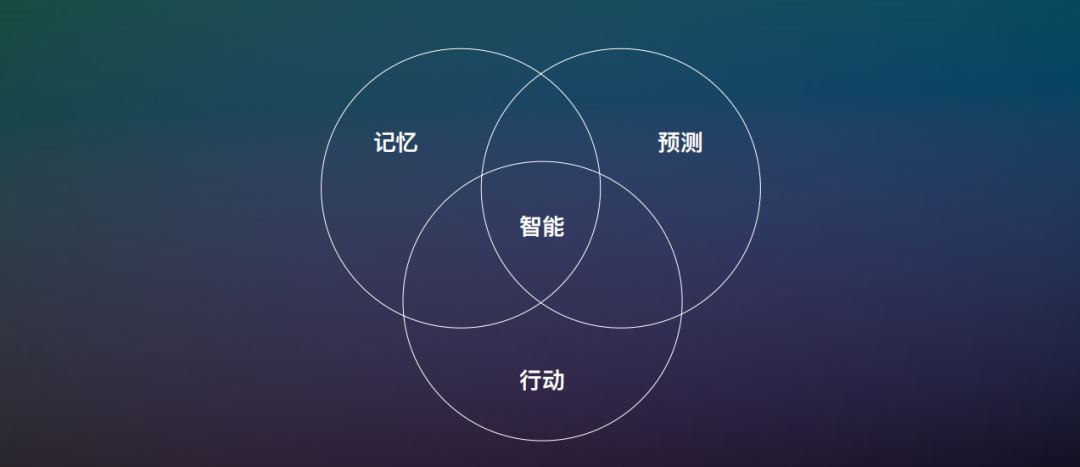
Intelligence = Memory + Prediction + Action
To me, intelligence is a system of memory, prediction, and action.
That sounds a bit abstract, so let me give a simple example. Imagine an elderly person visiting the city for the first time, taking the subway for the first time. If we were standing next to him, we might think he's slow — he doesn't know what to do. But is he actually slow? Not really. He has no memory of what's happening in front of him, so it's perfectly normal that he doesn't know how to pass through the turnstile. He can't predict what to do next, so he appears at a loss and unable to act.
This is why I say intelligence is fundamentally a memory-prediction-action system. With this foundational understanding, we can start thinking about intelligent applications.
For memory, I'll use Rewind.ai as an example. This product is fascinating. It can fully record your computer usage. If you've been using this app, three days later you can ask it: "What was Bai Yan's definition of intelligence?" And it will find the answer for you.
For prediction, there's ColorfulClouds Weather, which can forecast weather down to the minute — incredibly powerful. I want to single out prediction because right now everyone is fixated on AI generation, which is far too narrow. AI is so much more than that.
Let me give another example. Imagine a smart device that can access your physical condition and knows your daily habits, then tells you the probability of what illness you might get next. Would you want to use this app? Would it be a good intelligent application? I believe it would.
For action, my example is Tripnotes.ai, a product that helps people plan travel. It's simple — just two steps. First, you tell it where you're going, say Beijing. Second, you start asking it weird and abstract questions: "I only have three days, I'm a foodie and also a photographer, can you arrange ten places for me?" And it quickly plans it out. That's action.
This is the first part I wanted to share: "Intelligence = Memory + Prediction + Action." If you use this as a framework going forward, there are many AI Native App opportunities to imagine.
The Core Value of Artificial Intelligence
Having covered intelligence, let's talk about artificial intelligence. The core value of artificial intelligence is solving uncertainty problems with non-fixed information structures. This also sounds abstract, so I'll compare it with software. I'll be mentioning a lot of software — we do need to go back to another era.
Software solves certainty problems with fixed information structures. Take the classic food delivery app. Its information structure is simple: a store list, with category menus on the left and product lists on the right. You just choose a restaurant, confirm what you want to eat. It's solving a certainty problem.
How could we rebuild this scenario with AI? Maybe you just say "I'm hungry." It has memory of your history, knows you've been trying to lose weight, and recommends something light. But you joke with it, "It's the weekend, I want to indulge." It says, "Sure, but you'll need to exercise more next week," then recommends a burger and tells you it's the newest one, asking if you want to try it. You ask if it's getting paid for advertising, it says not this time — and maybe that's how a business model emerges. This is a typical non-fixed structure, uncertainty problem, because you don't know what you want to eat.
We can expand this scenario further. In offline life, imagine that same elderly person going to the hospital for the first time. Every hospital looks different. We can think of a hospital as software, with all its navigation, elevators, and signage. But even with all that, he still doesn't know how to register, find his department, or pick up his medicine. But if he had AR glasses with an AI sprite telling him, "I can see everything in this scene, I know what to do next, follow me" — wouldn't that be an amazing scenario? This is why AI mainly solves uncertainty problems with non-fixed information structures.

The New Guideline: Make Me Smart
For the final part, the guidelines for AI Native Apps. I'll continue comparing software and AI.
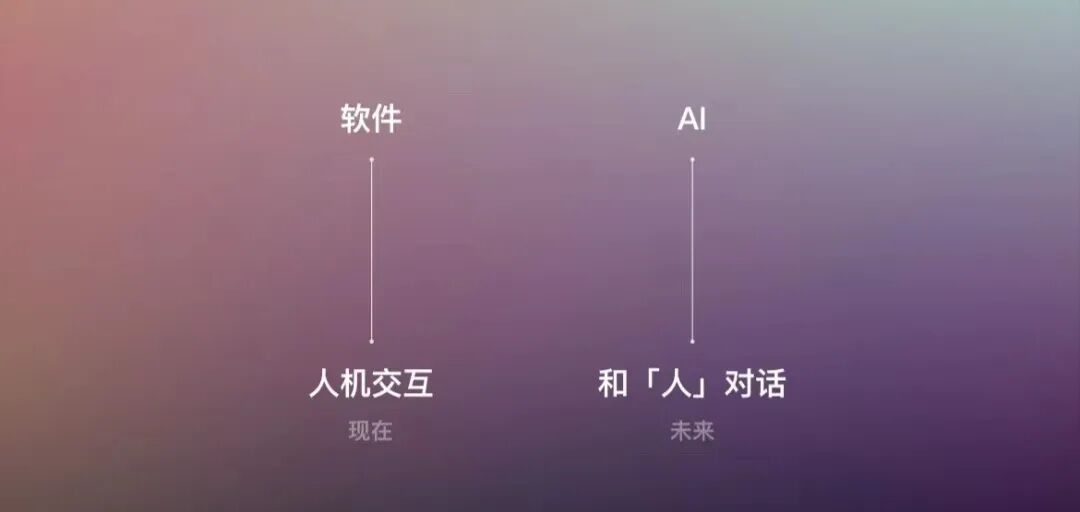
What we mainly use now is still software. Software's primary job is human-machine interaction. But in the future, we should be conversing with intelligent "people." If we think more carefully, something even more interesting emerges — it seems we used to talk to people too. In the dining scenario, I'd say "Mom, I'm hungry," and my mom would say, "Go do your homework first, I'll call you when dinner's ready."
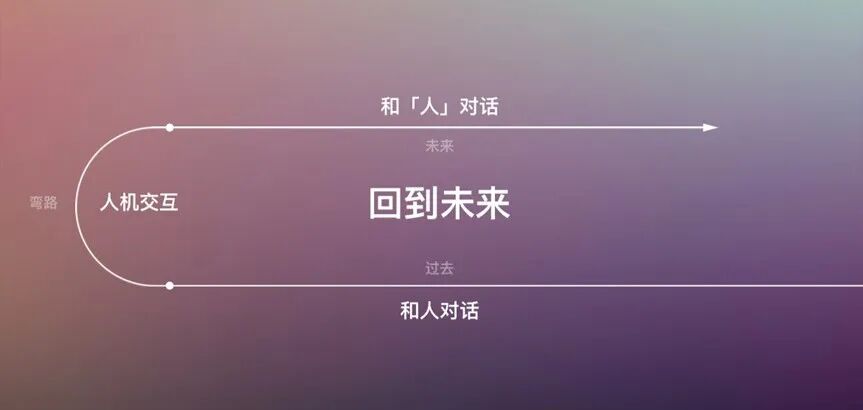
So is it possible that the path we're on now is actually the detour? For thousands of years we talked to people; now machines have learned to talk to people, and we're still going to talk to people.
These past few decades have been humans being forced to learn how to interact with machines and software. So in a sense, it's not that future intelligence makes machines more human-like — it's that we humans right now are becoming more machine-like. So conversing with intelligent "people" in the future is, in a way, going back to the future. That's why the theme of this talk is "Back to the Future." Human-machine interaction is a detour we humans had to take on our way to the future.
But there's still a question of distinction: What's the difference between future intelligent "people" and people today?
I believe the primary task of AI "people" is to solve problems humans aren't good at. I'm not good at long-term memory — let AI remember for me. I'm not good at massive computation, can't predict many things — let machines predict, I'll just follow along. I don't want to do repetitive labor — AI can do it.
These are all things AI can solve that humans aren't good at or don't want to do. Essentially, they all point to humanity's fatal pain: energy consumption.
Doing these things costs us too much energy. So AI is fundamentally about handing over carbon-based energy-consuming tasks to silicon-based systems to bear. And from this emerges the new guideline I've defined.
In the software era, because software didn't understand what people were saying, the product manager's job was to make software simple enough that humans could interact with it like machines — treating users as idiots. The guideline that emerged was Don't Make Me Think.
But in the AI era, AI has learned human language through large language models. It can think like a human, even think further than humans. Products in the AI era finally have the opportunity to treat users as humans. The core guideline is Make Me Smart.
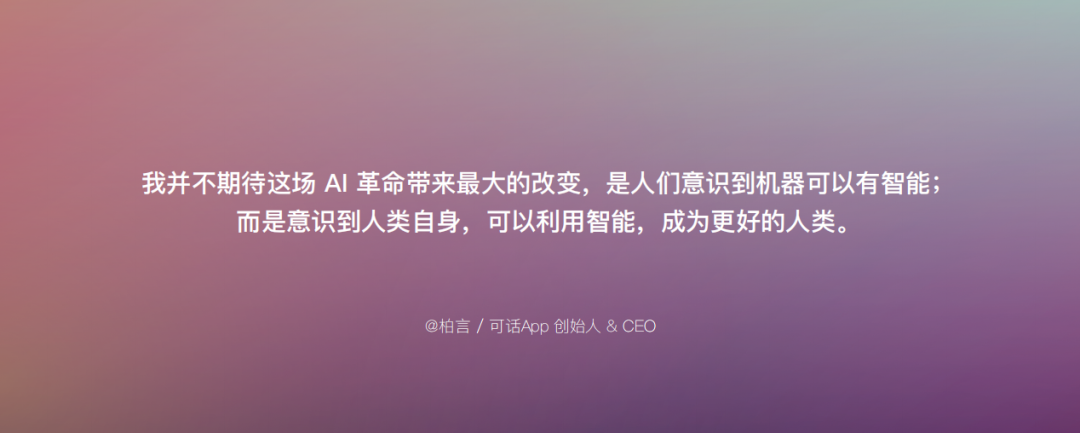
What I want to say last is: I don't expect the greatest change from this AI revolution to be people realizing that machines can be intelligent. Rather, it's humans realizing that they themselves can harness intelligence to become better humans.
Share & Win
What do you think about the transformation AI is bringing? What are your thoughts on AI Native App product design? Share your reflections and perspectives in the comments. We'll select 2 featured comments to receive a mystery gift package from 5Y Capital portfolio companies (comments accepted through June 25).




5Y Capital seeks out, supports, and inspires lonely entrepreneurs, providing support from the spiritual to all operational aspects of running a business. We believe that if the you whom others see as crazy starts to be believed in, the world will become a different place.
BEIJING · SHANGHAI · SHENZHEN · HONG KONG