Is the "ChatGPT Moment" for Bio-Manufacturing Here? | 5Y Talk

From the industry's ups and downs to the inflection point brought by AI, from a "lab crayfish" to the "ChatGPT moment" of bio-manufacturing.

Since March 2026, tensions in the Middle East have escalated sharply, sending international oil prices soaring.
In Keqiao, China's textile manufacturing hub, polyester POY jumped over 20% overnight. A 500-yuan hardshell jacket saw its raw material costs alone rise by nearly 40 yuan. Hardshell jackets, quick-dry shirts, sun-protective clothing, yoga pants — these staples of the modern urban wardrobe — derive almost all their raw materials from the petrochemical supply chain.
Every violent oil price fluctuation drives home one fact: so much of how we live, from food to clothing to shelter to transportation, rests on petrochemicals.
But what if we didn't have to rely entirely on oil? What if we could "grow" these materials using microorganisms? That's the core logic of bio-manufacturing. And AI is dramatically accelerating this process. Across the entire Biotech landscape, the intersection of AI and biological science is entering a period of密集 value realization.
At this inflection point, we invited Cheryl Cui, founder of Bota Biosciences, to join us.
Cheryl is not someone who waits for the wind to turn.
An MIT PhD, she emerged with a clear conviction: biology should not remain an experimental science dependent on luck and intuition; it has the potential to become a data-driven, scalable engineering discipline. For the past seven years, she has been exploring how to make this conviction real.
She likes to use an analogy to explain what she's doing: a cell is fundamentally a "programmable matter compiler." Its code is DNA — except instead of 0s and 1s, it's written in four letters: A, T, C, G. If we truly learn to write this biological code, we could theoretically have cells manufacture almost anything: active proteins, nutrients, bulk chemicals — no need for large-scale cultivation of cash crops, no petroleum cracking required, just microorganisms, a carbon source, and an efficient bio-manufacturing factory.
In 2019, she founded Bota in Hangzhou, building a bio-foundry from scratch, taking over a fermentation enterprise in Shandong, and establishing an industrial base in Ordos. She wasn't writing papers or doing consulting — she plunged directly into the physical world, accumulating data and capabilities through real factories, real customers, and real deliveries.
Particularly during 2022–2023, when the entire synthetic biology industry went through its "darkest hour" — with America's three star companies nearly wiped out and industry confidence hitting rock bottom — Cheryl chose to persist, committing to her conviction when she saw it.
Seven years in, Bota has cumulatively delivered 23 commercial projects, serving sectors spanning food, nutrition, and personal care, and has built a global operations network. In March 2026, Bota launched SAION AI: the world's first Physical AI platform purpose-built for bio-manufacturing. In Cheryl's words, it's not just giving scientists a smarter assistant, but creating an "AI scientist" that can self-iterate and grow smarter with every task.
From our conversations with Cheryl, we've also noticed how her way of talking about the company has changed compared to a few years ago. She used to spend a lot of time explaining what synthetic biology is; now she talks more about data loops, industrial落地, and organizational capabilities. The scientist's excitement is still there, but there's more of an engineer's conviction — she knows exactly what she's building, and exactly how far she still has to go.
Today we spoke with Cheryl about the industry's ups and downs, the inflection point AI is creating, from a "lab lobster" to bio-manufacturing's "ChatGPT moment." Joining Cheryl in conversation was Ted Jing, partner at 5Y Capital, who was the earliest investor within 5Y to open up this赛道 and has完整穿越 the entire Biotech cycle from euphoria to trough to recovery.
Here are selected excerpts from their conversation:
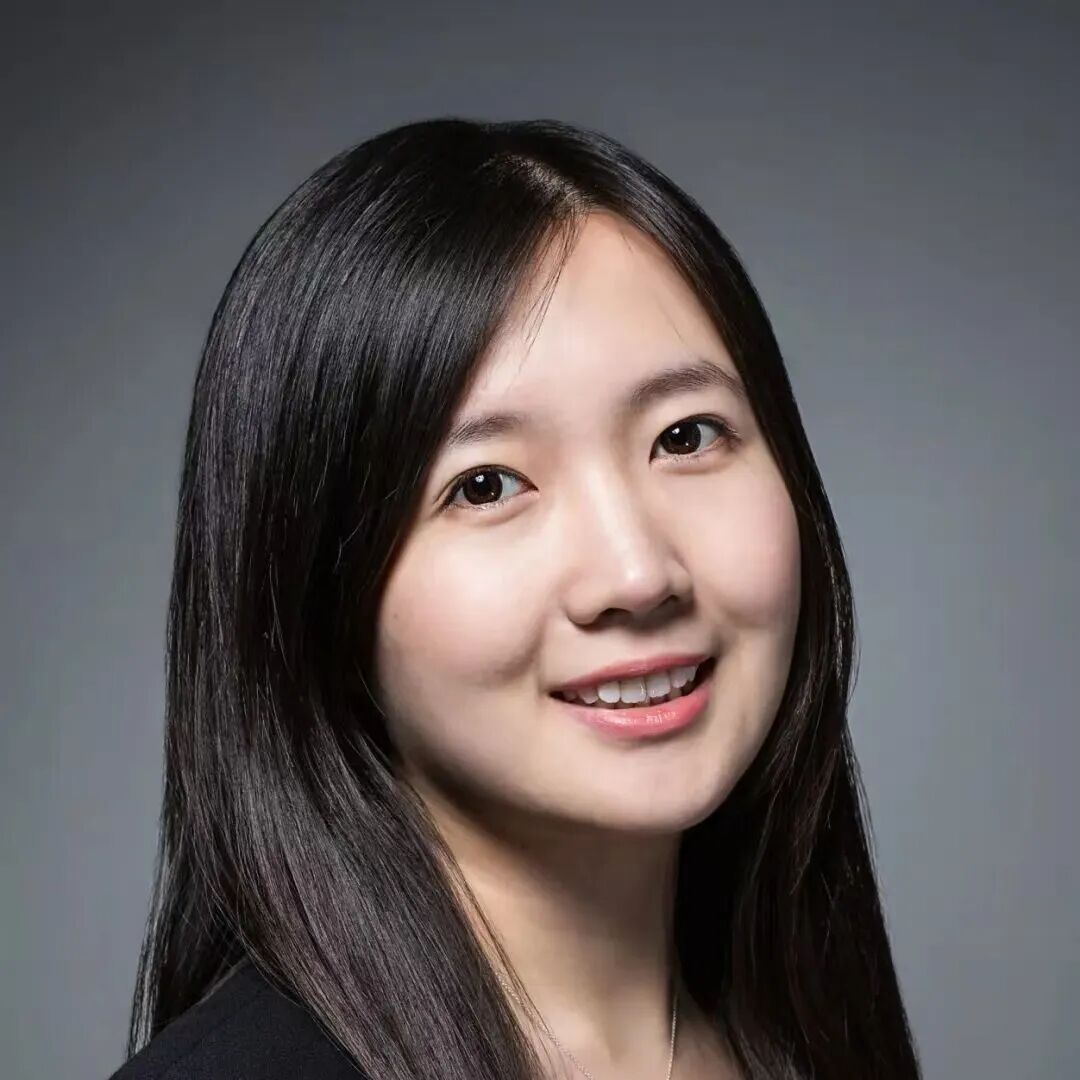
Cheryl Cui, Founder and CEO of Bota
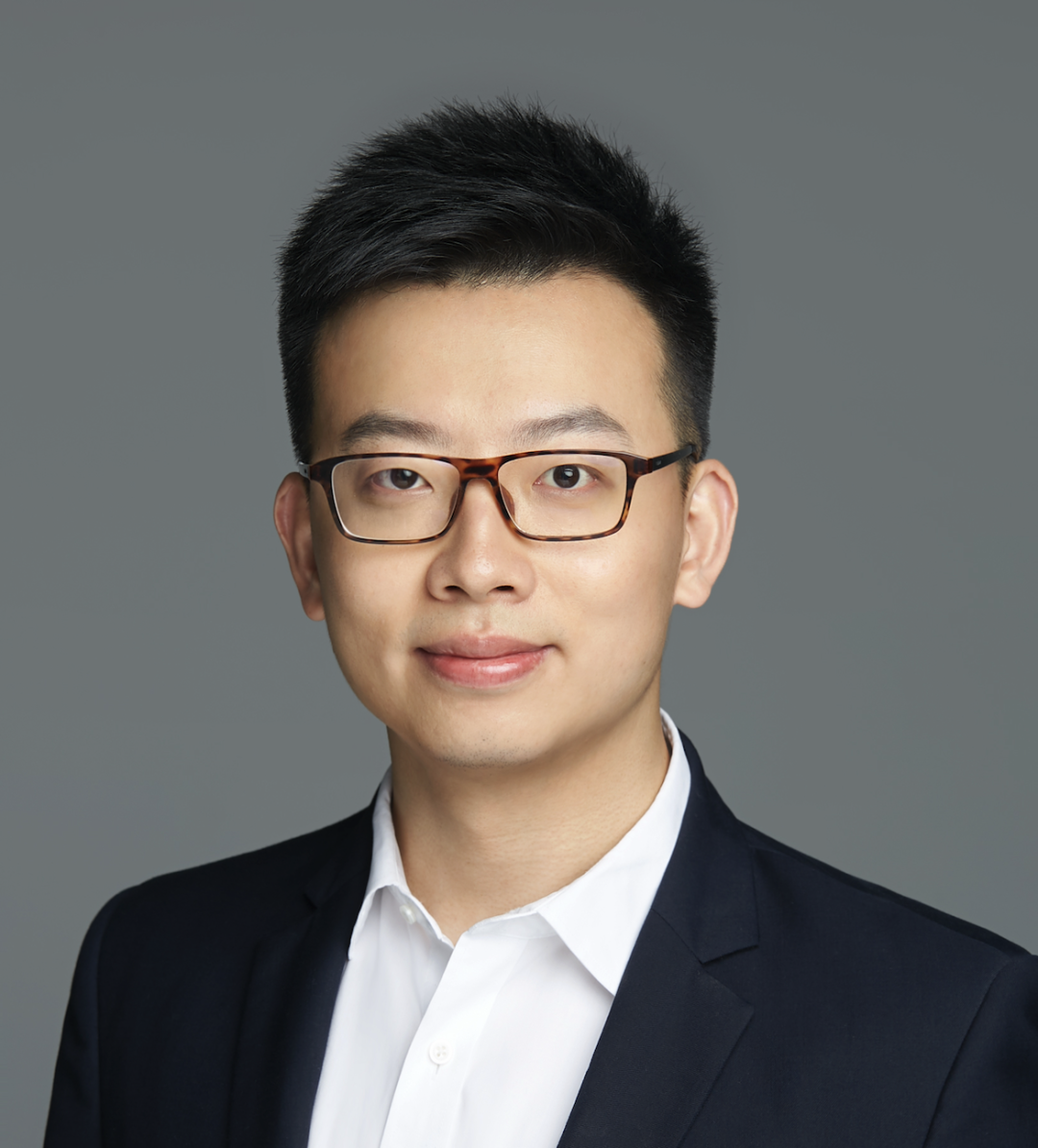
Ted Jing, Partner at 5Y Capital
I. What Is a "Lab Lobster"?
Ted: My first serious exposure to synthetic biology actually came through Cheryl's influence. During the pandemic in Shanghai, when nobody wanted to go out, we met once in Xintiandi. She told me about an industry I completely didn't understand, but she said it was the most valuable thing she'd seen during her time incubating companies in Boston. That energy made me study this industry very seriously, and later we opened up this赛道 within 5Y.
Jensen Huang says biology will be the most important discipline of the future. OpenClaw, an open-source lobster, lets AI make phone calls and send emails — but you built a "lobster" that can operate lab instruments, SAION AI. Tell us more.
Cheryl: SAION AI is a Physical AI platform we built specifically for bio-manufacturing. It's not just a lobster that helps with tasks; it gains experience through doing, continuously iterating, making the entire R&D and production process smarter and smarter.
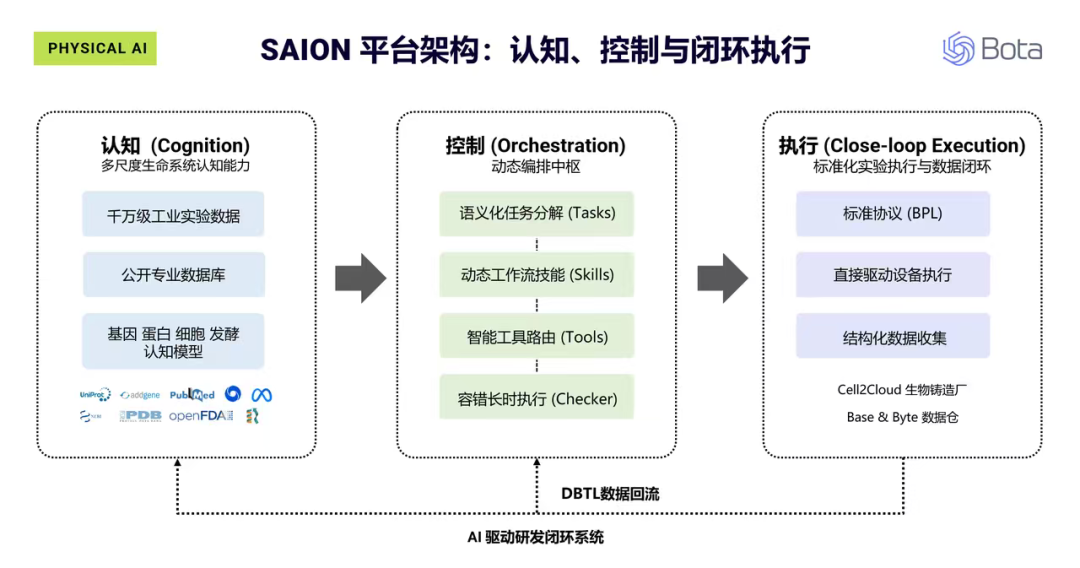
For example, when you start a new project, it begins from a good question, mapping out experimental objectives and pathways, refining them into specific protocols, then converting those protocols into standardized instructions the lab can execute. After execution, it collects results and enters the next iteration loop.
This encompasses cognitive-layer understanding, control-layer orchestration, and execution-layer experimentation. This end-to-end closed loop is SAION's core architecture.

II. Industry Landscape and Competition
Ted: AI drug discovery has been extremely hot lately, and we've invested in quite a few companies in this direction. But beyond pharmaceuticals, there's also significant room for AI combined with industrial bio-manufacturing. Compared to AI drug discovery, what do you see as the similarities and differences with AI + bio-manufacturing?
Cheryl: First, I think the similarity is that at their foundation, both are about biotech iteration + AI-driven acceleration. The difference is that drug development is a linear process: from early molecular discovery to in vitro validation, then in vivo validation and clinical trials. From initial hypothesis to ultimate validation in humans, there are many leaps of faith along the way — from in vitro cell validation to animals to humans.
But bio-manufacturing is naturally suited to AI's characteristics: it's iterative. We keep stacking new designs onto the same strain, going through DBTL cycles (Design-Build-Test-Learn), with data that can fully close the loop — and close it at high frequency. Moreover, our data isn't just from microplates in the lab; it's from two-liter bench scale, one-thousand-liter pilot scale, and dozens-of-tons production scale, accumulating day after day into a very complete dataset.
Ted: From the AI perspective, GPT, Claude, and others are evolving rapidly. If these general-purpose large models keep getting smarter, where does Bota's moat lie?
Cheryl: Even as large models become more capable, the value of vertical data and know-how actually increases, because the problems being solved are extremely vertical. For example, when SAION is given a natural language description now, the genetic sequence assembly instructions it outputs are faster and more accurate than what humans can do. Sequence design is ATCG coding where not a single letter can be wrong; one error and the protein function could change completely.
More importantly, beyond the data itself, the process of generating data is also valuable — and if commercial closure happens through that process, all the better. Every data point comes from a real project. More customers means more data, which means stronger models and higher efficiency. This is a sustainable data flywheel.
Ted: The past period has been very tough for synthetic biology. America's three former star companies were nearly wiped out: Amyris bankrupt, Zymergen acquired, Ginkgo down over 90% in market value. Ginkgo chose the pure platform model; Amyris chose the owned-brand model. Both paths failed. Where do you think the fundamental industry problem lies?
Cheryl: Many industries have gone through similar cycles. It's not that the direction was wrong. Beyond continuously advancing technical capabilities, I think we've introduced the integration of technology platforms with China's industrialization capabilities. It's somewhat similar to solar: though the direction was globally recognized, there was an unsustainable subsidy-dependent boom in the middle, but truly achieving subsidy-independent, endogenous economic viability only broke through after China's industrialization capabilities deeply介入.
Regarding the pure platform model, its logic is internally coherent, but the challenge is that when downstream markets haven't fully established their perception of bio-manufacturing's value, there's a mismatch between the platform's high investment and its payback cycle.
The efficiency-gain logic of AI in drug discovery closes more easily because drugs themselves have extremely high value density. In bio-manufacturing, we need more "billion-dollar molecules" to sustain the market, and to develop such molecules requires both R&D capability and controllable R&D investment — neither can be missing. That's why Bota integrated the full chain from lab to pilot to production, not to provide better tools to the industry, but to make biotechnology truly land in各行各业.
And frankly, globally everyone is shifting toward engineering, but in terms of automated lab construction costs, iteration speed, and supply chain support for large-scale production, China has clear advantages. We're not just doing R&D in China; we're leveraging this efficiency dividend to find a more确定性 path of cost reduction and efficiency gains for the global bio-economy.
Ted: The AI drug discovery story, even in the near term, is relatively clear to calculate — whether direct R&D savings or pipeline asset transactions, not to mention long-term asset value accumulation and profit sharing. But how do you do the math for the AI + bio-manufacturing story? A 30% yield improvement or cycle time compressed to six months — what is that actually worth?
Cheryl: Most directly, yield improvement maps to gross margin improvement. But that's only layer one. Layer two: if R&D cost drops from tens of millions of dollars to $500,000 per project, the industries we can reach expand dramatically. This order-of-magnitude reduction brings fundamental industry transformation.
Layer three is cognitive: large-scale closed-loop data will ultimately give us entirely new understanding of microbial fundamental mechanisms — this is the real leap.
If you look at how global research funding is spent, whether it's the billions NIH allocates annually in the US, or the hundreds of billions major pharma companies spend on R&D, only about 10–15% actually goes to reagents — the chemicals and consumables consumed in doing experiments themselves. The rest is mostly personnel compensation, lab rent, equipment depreciation — these fixed costs.
This cost structure is completely inverted. In an ideal state, your R&D budget should overwhelmingly go to the act of "doing experiments" itself, not to "maintaining a lab." Once new technology can flip this structure, it's equivalent to producing ten times the experimental data for the same budget. This efficiency lever is arguably even larger than simply improving AI prediction accuracy.
Ted: Right, let me add something. Many people might calculate this industry as an efficiency improvement tool. We don't see it that way. Today's AI combined with agents and automation is absolutely not just an efficiency tool — it's an entirely new productive force that can exceed traditional human intelligence and production capacity to create completely different new substances.
Many molecules inside organisms cannot be easily synthesized through chemical means, but combining AI with bio-manufacturing enables scalable mass production. Under this new productive force paradigm, a new generation of tech companies has the opportunity to create entirely new production relationships, and thereby build companies with larger market caps than traditional chemical giants in the commercial landscape. This is what attracts me most.
III. Core Technology Deep Dive
Ted: Let's walk through a concrete case. Say, zeaxanthin, an eye-protection and anti-aging ingredient you work on. Traditional methods require growing marigolds, constrained by land and climate. Can you walk us through the full process from "customer says I want this molecule" to "product leaves the factory"? What does SAION AI do at each step?
Cheryl: Zeaxanthin is a classic example of a "high-value, low-efficiency" functional ingredient.
We use SAION AI to first conduct literature research and output an R&D technical roadmap. Then we refine that roadmap into specific experimental protocols. At this step, SAION AI assesses the reusability of known chassis strains, then designs step-by-step experiments. Researchers can modify protocols during this process, creating human-AI collaboration.
After that, the genes we design are transferred into microorganisms — a step already completable at high throughput through our bio-foundry. Finally, results are collected and analyzed, entering the next round of strain construction.
On this project, we constructed over 90,000 different strains. Along the way, some key enzymes were bottlenecks in catalytic reactions. AI-driven enzyme development precisely broke through these key rate-limiting enzyme bottlenecks, improving strain production efficiency by 60%. The final product reached 80% all-trans zeaxanthin content. Meanwhile, we've completed US Self-GRAS assessment, achieving full industrial chain贯通.
Ted: SAION AI has a three-layer architecture — cognition, control, execution. Can you use autonomous driving as an analogy? Autonomous driving is "see road conditions → brain judges → steering wheel executes." SAION is similar. But what's fundamentally different between the biological world and driving conditions?
Cheryl: The difficulty of autonomous driving is making judgments in millisecond timeframes, but it has advantages: physical laws are known, and control over the vehicle is absolute — stop means stop, go means go.
Bio-manufacturing doesn't require millisecond decisions, but the challenge is that biological rules and operating logic are full of unknowns. And our control over microorganisms comes from genetic control, but genetic control doesn't directly determine final performance. It has to go through multiple layers of iteration, from gene to protein to metabolic pathway, before becoming strain performance. In other words, the control layer is indirect.
This means the core problem it must solve is causal inference: when you see an experimental result, what is the causal relationship? Why does this strain perform well under this condition, but poorly when conditions change? This rigorous logical reasoning capability is essentially how scientists think when doing research, and it's the most critical core of this Physical AI.
Additionally, biological experiments themselves have long cycles. Even two people doing the same experiment may get different results because there are too many temporal and parameter variables in the process, and they span too long. This is why we developed BPL (Bio Protocol Language), adding a standardized layer between design and execution, turning a long-cycle biological experiment into a more controllable environment, so that the data you obtain can better support causal reasoning.
But the advantage is that it allows trial and error. Unlike autonomous driving, which has extremely high safety requirements, if a biological experiment is poorly designed and yields no results, you can try again. I find this a fascinating point when drawing analogies between these two fields.
Ted: Speaking of "two people doing the same experiment getting different results," this is also where BPL's value lies. Its value is being able to translate experimental protocols written by 10 different people into the same code. Is this essentially inventing a programming language for biological experiments? Is it valid to compare it to EDA in the semiconductor industry?
Cheryl: Excellent analogy. EDA converts circuit design intent into manufacturable files. What BPL does is convert your research intent into a complete set of experimentally executable processes through machines — converting AI-generated complex protocols directly into machine instructions for our bio-foundry.
The core problem it aims to solve is the non-standardization in biological experimentation. Previous research was more experience-driven; experimental workflows were written in natural language — some wrote them繁琐, some more detailed, some more粗略. Following such "recipes" to redo experiments yielded different results. BPL lets 10 people writing different protocols code them into the same standardized instructions, essentially transforming bio-manufacturing from a luck-dependent exploration into high-precision industrial code.
Ted: The most famous synthetic biology failures almost all died at scale-up. Strains that worked fine in the lab failed in tens-of-thousands-of-liter fermenters. What does SAION solve for this环节?
Cheryl: People treat industrialization as a life-or-death dividing line, but the core issue is that many startups didn't allocate sufficient time and resources for this step, thinking lab validation means you can scale up. But scale-up itself is an independent engineering problem.
In fermentation, there are numerous controllable parameters. SAION can analyze all our historical fermentation data, identify the best-performing batches, understand why that batch's performance was better — whether temperature curves, feeding strategy, or dissolved oxygen control were the key variables — then apply this knowledge to new scale-up processes.
We've done real cases scaling from 0.5-liter fermenters to 30 tons. When you know a strain well enough, the correlation between lab and production can reach over 90%. That is, production can replicate at least 90% of lab performance. Our vision is to make bio-manufacturing a Physical AI Native industry — not just using AI in R&D, but having AI making decisions and optimizations on the production floor itself.

IV. Future and Imagination
Ted: Is bio-manufacturing having its ChatGPT moment now? If you were to define it, what should this moment look like?
Cheryl: I think its hallmark would be: when industries across the board want a new molecule, they naturally think: can I solve this problem through biological methods?
Whether searching for new product innovation points, replacing chemical raw materials, or treating industrial waste — people can naturally think of developing a biological pathway. Just as today people encountering problems first ask ChatGPT.
The market's imaginative space is far larger than people assume. A cell is fundamentally a "programmable matter compiler," but we've only developed so few application scenarios to date. It's like if after computers were invented, computing power was only sufficient to support aerospace calculations — they would never have entered ordinary people's lives. Bio-manufacturing's ChatGPT moment has not yet arrived, but AI is lowering the cost of opening this door at unprecedented speed. We expect that in the next 3 to 5 years, this确定性 will let bio-manufacturing truly cross the inflection point of industrialization.
Ted: Is SAION replacing scientists, or rewriting how scientists work? You say it could reach the level of scientists with 5 to 10 years of experience. What do human scientists do then?
Cheryl: We've internally graded AI Scientist capabilities from L1 to L5. What distinguishes a researcher from a professor isn't that they're both answering questions, but the scope of questions they answer — ultimately, it's the ability to pose good questions.
AI naturally has cross-disciplinary knowledge advantages. Humans need years of training to reach professional level in one discipline, but AI can span multiple disciplines to solve a problem. Ultimately, human scientists provide directional guidance.
Ted: Let me add an observation from a portfolio company. In certain small-sample tests, with the same amount of information, molecules designed by AI and tested through wet experiments have already outperformed those designed by traditional chemists.
And if we apply the concept of native multimodality to biology, the intelligence AI produces will certainly surpass humans in the near future. For example, proteins are encoded by a language of 20 amino acid letters, each represented by one letter; DNA and RNA are composed of four base letters, with every three bases (codon) encoding one amino acid.
And the intrinsic logic of these languages is something humans currently cannot understand — only AI can discover their secrets. Through native multimodality, AI combines its reasoning capability for natural language with its understanding of protein language. In the near future, the intelligence it produces will certainly surpass human scientists. I believe consensus on this will form quickly.
Ted: In the next two years, what will be the first product designed and executed end-to-end by SAION, from "autonomous design to autonomous execution"?
Cheryl: Actually, it won't take that long — we'll have one this year. Within the next 12 months, SAION will autonomously develop products. Of course, different projects have different difficulty levels: some are efficiency improvements on existing pathways, with less unknown territory, relatively easier; some require building entirely new metabolic pathways, such as converting non-food carbon sources into bulk chemicals with conversion rates approaching strain limits — these are like uncharted territory on the map, much harder.
Start by walking better on paths already taken, then gradually enter the unknown.
Ted: For the AI + bio-manufacturing赛道, which outcome is more likely? Platform oligopoly like semiconductors? Vertical fragmentation like SaaS? Or giants like BASF, Novozymes internalizing AI and marginalizing independent companies?
Cheryl: I think the platform model is still very promising. Looking at BASF, much of its advantage came from deep processing of petroleum, then "extracting every last drop" along the raw material chain — this is also BASF's Verbund ("integration" or "connection") concept, where every level of raw material has advantages.
From the bio-manufacturing perspective, our understanding of these molecules and chassis strains also has reusability value. Whether it forms some kind of monopoly depends partly on how strong your moat and reusability are, and partly on whether after accumulating to a certain degree, a qualitative leap occurs — not purely linear, but step-function barrier formation.
Early on it looks like single-product efficiency gains, but it gradually transforms into a systematic capability, then into core barriers across the entire industry.
It's not the internet-style network-effect monopoly, but more of an industrial type: your technology keeps iterating, always staying at the forefront. I lean toward it having certain platform attributes, but time is needed to validate this, especially the Physical AI-native closed-loop mechanism connecting experimentation to production — this is itself a new industry, using new technology concepts to connect各个环节. I think the platform attributes in this regard are very worth anticipating.
Ted: I think it probably won't concentrate like semiconductors, but certainly won't fragment like SaaS. Companies like DuPont and BASF have extremely strong scale effects in the mid-to-downstream of industry, but for new product development, they often enrich their pipelines through partnerships and M&A. Fundamentally, the entire industry has not yet established systematic capabilities for rapidly producing high-value assets at early stages.
In the future, if a batch of new companies can, through technology compounding, data compounding, and AI self-iteration, always find differentiated directions earlier than others, finding lower-cost, higher-performance bio-manufactured products, thereby establishing scale effects even at the early R&D stage, while gradually building industrial moats in mid-to-downstream through product pipeline accumulation.
Companies built this way could potentially have larger market caps than today's chemical giants. This is fundamentally "productive forces determine production relations": previous productive forces destined large companies to grow by harvesting early innovation. In the future, leading companies will possess the strongest R&D platforms and product design platforms, bringing completely different landscapes.
Ted: Last question — what's the biggest misconception in the industry today?
Cheryl: The biggest misconception is always about timing and expectations. The direction is right, but the timing of its arrival and how it manifests needs to be made to happen. After engaging with physical industries, my perception of time compounding has grown stronger.
Ted: Exactly. Most industries go through a Gartner curve — first a peak, then down to a trough, where people start actively or passively doing real work, then rise again to exceed the first peak. I've always believed this direction is right, irreversible — whether from biological replacement of chemicals, or experiments' throughput getting higher and higher, or AI getting stronger and stronger, no perspective would make this trend reverse. It's purely a timing question.
There are also cases continuously validating this judgment: Bota recently acquired a company and dramatically improved a negative-margin business's efficiency. We also have other portfolio companies whose novel molecules have gained recognition from leading customers. These are commercial progress gradually delivered under technological conviction.
And under this irreversible mega-trend, the giant companies of the future will most likely emerge in China. Because China has not only engineering efficiency on the R&D side and R&D platforms like SAION AI, but also the world's largest, lowest-cost production system. With such underlying infrastructure, even short-term fluctuations are acceptable to us.
So I believe even industry competitors, or AI bio-manufacturing companies founded later, will mutually respect each other. Finally, I also hope Bota can set an example for everyone — Bota was, after all, among the first to bring initial market momentum to this industry.
Cheryl: Ups and downs are normal; every mature industry has walked this path. We believe this path can only work in China. But once it works, it serves the global market, covering各行各业.


5Y Capital seeks, supports, and inspires lonely entrepreneurs, providing support from spirit to all operational matters. We believe that if the world begins to believe in the you whom others see as crazy, the world will become refreshingly different.
BEIJING · SHANGHAI · SHENZHEN · HONG KONG